AI, Homework & Cheating: A Parent’s Guide
Your kid is stuck on a history essay at 9pm. They open ChatGPT. Depending on what they type next, the same tool either teaches them something or hands them a finished paragraph they’ll paste in and forget by morning. That fork — help versus shortcut — is the whole thing. AI isn’t cheating and it isn’t magic tutoring. It’s a tool that can be both, and the job at home is teaching a kid which one they’re reaching for.
- The real question isn’t “should they”
- Where AI genuinely helps learning
- Where it crosses into cheating
- Tutor vs. ghostwriter, task by task
- Why leaning on it too hard backfires
- What schools and AI detectors actually do
- Teaching good use, step by step
- Family rules that let AI tutor, not write
- Talking about honesty without a fight
- FAQ
The real question isn’t “should they”
A lot of parents open this topic asking whether their kid should be allowed to use AI for schoolwork at all. That ship has mostly sailed. AI is built into search, into the keyboard, into the apps schools themselves hand out. Trying to wall it off entirely tends to produce a kid who uses it exactly as much as before, just quietly.
The more useful question is: which uses build the skill the homework was supposed to build, and which ones skip it? A maths worksheet exists to make a brain practise a method. An essay exists to make a kid organise their own thinking and put it into words. If AI does the part that was the point, the grade might look fine while the learning quietly didn’t happen. If AI does the boring scaffolding around the point — explaining a confusing step, checking spelling, suggesting a clearer structure — the learning is still the kid’s.
So this guide isn’t pro-AI or anti-AI. It’s about helping your child tell those two apart, because most of them genuinely can’t yet. To a 13-year-old, “it helped me” and “it did it for me” feel like the same sentence.
Where AI genuinely helps learning
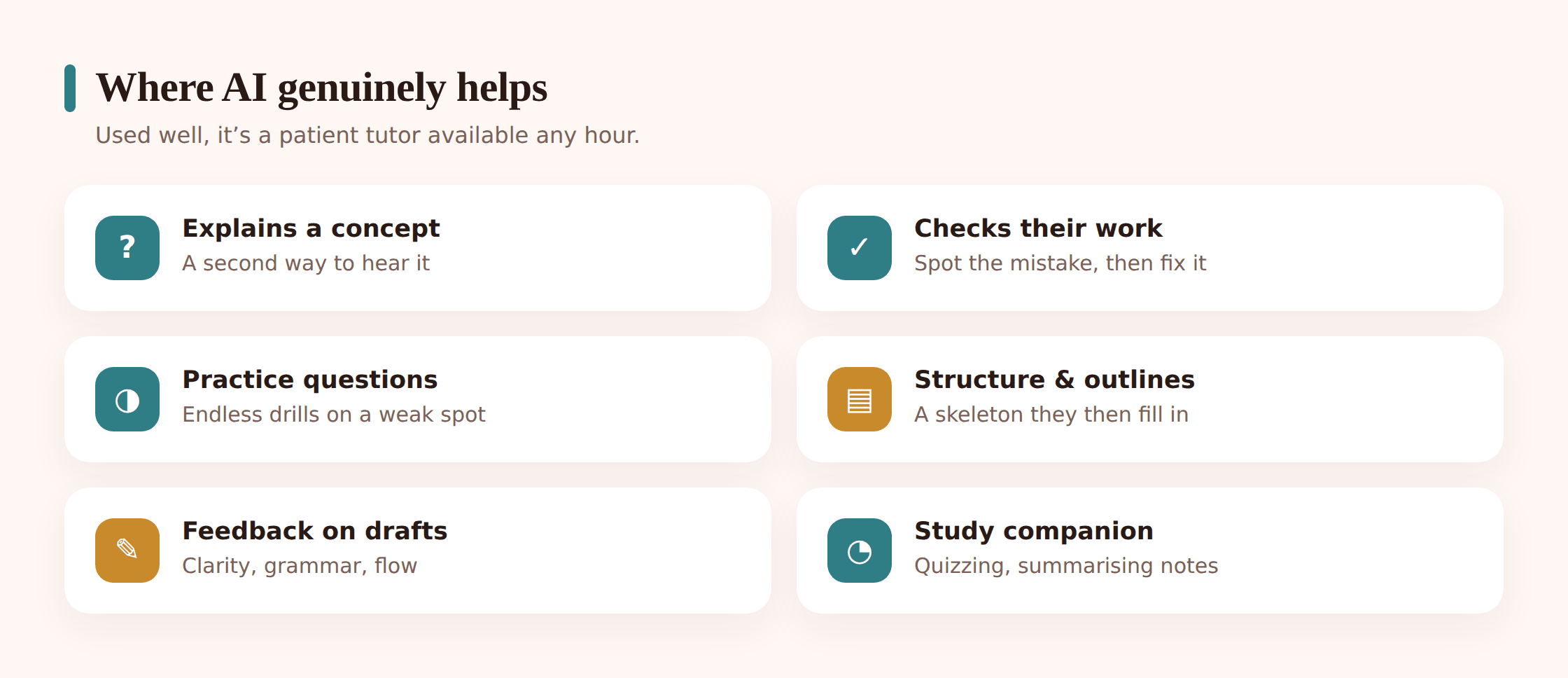
Let’s be fair, because if you pretend it’s all bad your kid will stop listening. There are real, defensible ways AI supports learning — and they mostly share one feature: the kid is still doing the thinking.
- Explaining a concept another way. A textbook explains fractions once, in one voice. A kid can ask AI to explain it with pizza, then with money, then with a number line, until one clicks. That’s genuinely good tutoring, and no human tutor is free at 9pm.
- Checking work they’ve already done. “Here’s my answer and my working — did I make a mistake, and where?” The kid did the problem. AI plays the role of the teacher circling the slip in red. They still have to understand the correction.
- Generating practice questions. “Give me five more quadratic equations like this one, without the answers.” That’s a kid choosing to drill harder. Excellent use.
- Unsticking a blank page. “I want to write about why the Roman army was effective — help me brainstorm angles.” Bouncing ideas to break the freeze is fine, as long as the kid picks the angle and writes the words.
- Structuring, not composing. “Is this essay plan logical? Should any section move?” Feedback on the skeleton, where the kid still fills every bone with their own sentences.
- Accessibility. For a child who struggles with reading or with getting thoughts onto the page, AI that reads text aloud or helps untangle a run-on sentence can be the difference between engaging and giving up. This matters a lot for some kids and deserves to be named as legitimate.
Notice the pattern. In every one of these, if you took the AI away, the kid would still have to know the material to finish. The tool sped up or softened the process; it didn’t replace the brain.
Where it crosses into cheating
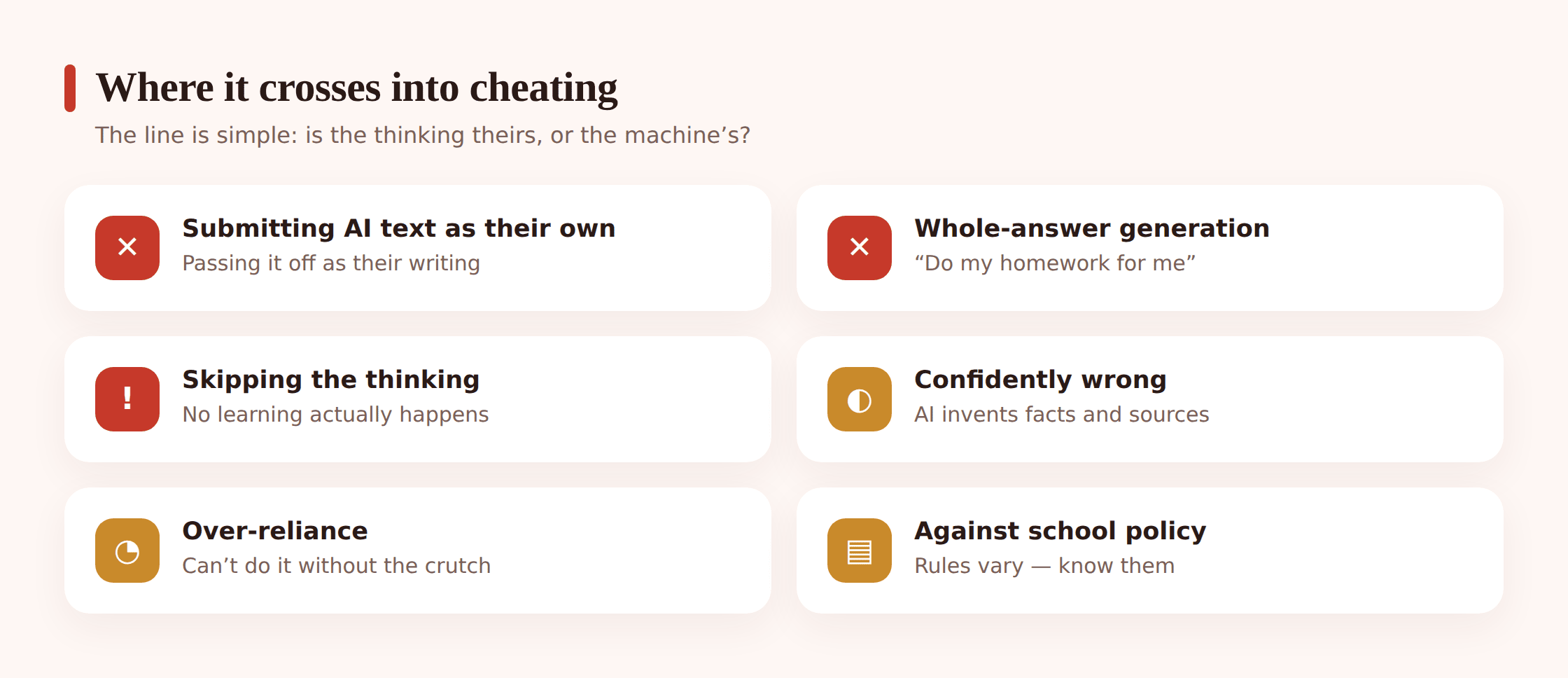
Now the honest other half. The line is crossed the moment AI does the thing the assignment was measuring, and the kid presents that output as their own work.
- Submitting AI text as your own writing. The classic. “Write me a 500-word essay on the causes of World War One,” copy, paste, hand in. The words aren’t the kid’s, the thinking isn’t the kid’s, and passing it off as theirs is dishonest — the same as copying a friend’s paper.
- Whole-answer generation on problem sets. Pasting every maths or science question in and copying the solutions. The worksheet’s entire purpose was the practice, and the practice never happened.
- Bypassing the thinking on purpose. Not “help me understand this” but “just give me the answer so I don’t have to.” Even when the answer’s right, the skill the task was training got skipped.
- Faking a source or a reading. Asking AI to summarise a book the kid was supposed to read, then writing as if they read it. AI summaries are also frequently wrong in ways only a reader would catch.
- Laundering the words. Generating an answer, then asking AI to “make it sound like a teenager wrote it” specifically to dodge detection. The intent to deceive is the giveaway.
Schools draw the exact line differently — some subjects welcome AI for brainstorming and ban it for drafting; some ban it outright for graded work; some require kids to declare what they used. Your child needs to know the actual rule for their class, not a vibe. More on that below.
Tutor vs. ghostwriter, task by task
Abstract rules slide off kids. Concrete examples stick. Here’s the same set of common assignments, split into the version that helps and the version that cheats.
| The task | Using AI as a tutor | Using AI to cheat |
|---|---|---|
| Essay | “Is my argument in paragraph two clear? Don’t rewrite it — just tell me what’s weak.” | “Write me a 600-word essay on this topic,” then hand it in. |
| Maths worksheet | “I got 14 and the book says 11 — where did my working go wrong?” | “Solve questions 1 to 20 and show the answers.” |
| Reading assignment | “I read chapter three but I’m confused about the ending — can you help me think it through?” | “Summarise this book so I don’t have to read it,” then write as if they did. |
| Science report | “Explain what a control variable is with an example I can use in my own words.” | “Write the whole method and conclusion for this experiment.” |
| Language vocab | “Quiz me on these 20 Spanish words and tell me which I keep missing.” | “Translate this whole paragraph so I can submit it as my homework.” |
| Coding project | “My loop won’t stop — explain why so I can fix it myself.” | “Write the entire program for this assignment.” |
Print that idea out if you have to. The left column is a study buddy. The right column is a stand-in. Same tool, opposite outcomes for your kid’s actual brain.
Why leaning on it too hard backfires
The cheating argument is usually framed as “it’s against the rules.” True, but the deeper problem is that over-reliance quietly robs the kid, rules or no rules.
The skill doesn’t transfer. Learning to write is learning to think — to weigh an idea, order it, and defend it in words. Outsource that enough times and the muscle never builds. The kid coasts through the homework and then meets an exam hall, or a job, where there’s no chat window and the thinking has to be theirs.
The struggle was the point. The frustrating middle bit of a hard problem — the being-stuck, the trying-again — is where learning actually lives. AI is extremely good at removing that friction, and removing all of it removes the learning with it. A little productive struggle is a feature, not a bug.
AI is confidently, fluently wrong. This is the part kids underestimate most. Large language models generate plausible-sounding text, and sometimes that text is simply false — invented dates, fake quotes, “sources” that don’t exist, maths that’s subtly off. The industry calls it hallucination. The dangerous bit is the tone: it sounds exactly as certain when it’s wrong as when it’s right. A kid who trusts it blindly hands in confident nonsense and can’t tell, because they never learned the material well enough to catch it.
That last point is the bridge to a wider skill — knowing that fluent and true aren’t the same thing. It’s the same instinct they need for dodgy news and viral posts, which we dig into in media literacy for kids. And if your child mostly uses AI to chat and ask life questions rather than for schoolwork, the companion side is its own topic — see AI chatbots & kids.
What schools and AI detectors actually do
Two things are happening in schools right now, and parents should understand both — especially the second, because it can hurt an honest kid.
Policies vary wildly, so find the real one
There’s no single national rule. One teacher encourages AI for research and forbids it for drafting. Another bans it for anything graded. A third asks students to add a note saying what they used and how. Some schools are still writing their policy as the year goes. The practical move: have your kid actually read the policy for each class, and if it’s unclear, email the teacher a plain question. “Is it okay to use AI to check my essay for mistakes?” A one-line answer beats a term of guessing and a nasty surprise.
AI detectors are unreliable — this is important
Many schools now run students’ work through “AI detector” software that claims to flag machine-written text. Here’s what parents need to know: these tools are not reliable, and they produce false positives. They regularly flag genuine, human-written work as AI-generated. Writing that’s clean, plainly structured, or a little formal — which is exactly what a diligent kid produces — tends to trip them. Students who write in English as a second language get flagged more often. There’s no way to prove you didn’t use AI, so a wrong flag is horrible to be on the receiving end of.
So detectors are worth understanding, not trusting. A few practical protections for your kid:
- Keep the working. Encourage them to write in a tool that saves version history (most do), so there’s a trail of drafts if they’re ever wrongly accused. Being able to show the essay grow over three days is the best defence there is.
- Don’t panic at an accusation. A detector flag is an allegation from an unreliable tool, not proof. If it happens, stay calm, gather the draft history, and ask the school what the flag was actually based on.
- Teach them not to weaponise the weakness. The flip side: some kids “humanise” AI text to beat detectors. That’s not clever, it’s just cheating with extra steps — and it’s the intent that makes it wrong.
The honest summary is that detectors are a blunt instrument in a fast-moving situation. The reliable signal has always been human: a teacher who knows how a kid writes, and a kid who can explain their own work. That’s worth more than any score a piece of software spits out.
Teaching good use, step by step
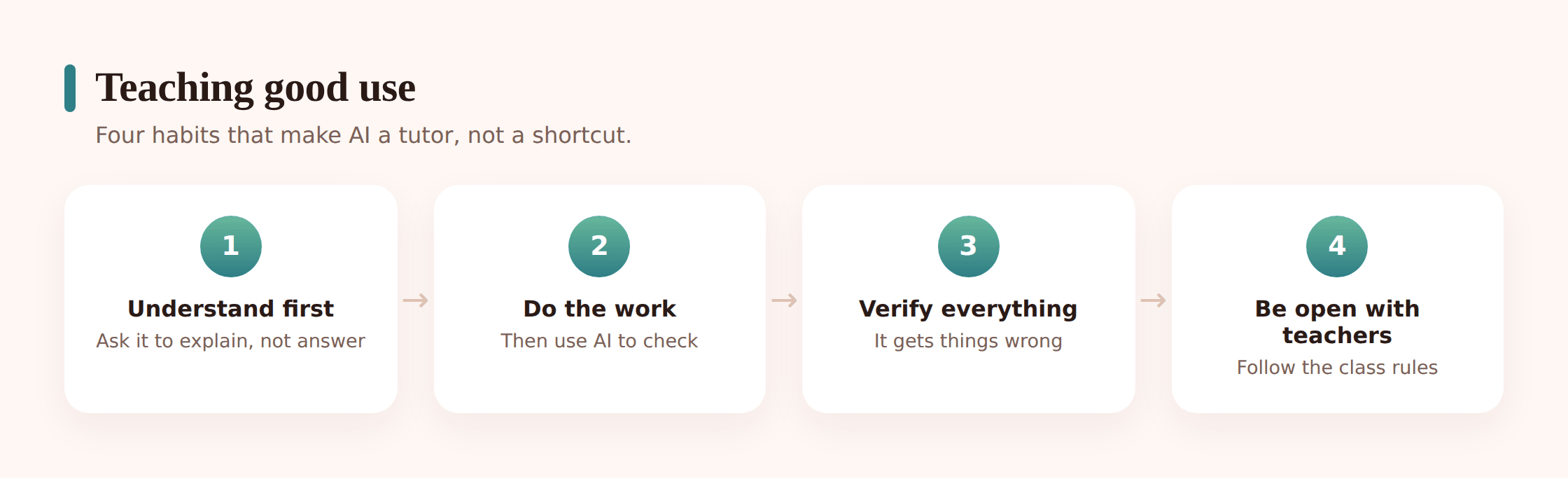
You don’t teach judgement with a lecture. You teach it by doing a round together and letting the kid see the seams.
Step 1 — Use it together and catch it being wrong
Ask AI something you both already know the answer to — a bit of family history, a local fact, a maths problem you can check. Sooner or later it’ll get something wrong while sounding totally sure. That moment teaches “don’t trust it blindly” better than anything you could say.
Step 2 — Draw the help/do line with real homework
Take an actual assignment. Show the difference between asking it to explain a step and asking it to do the step. Let your kid feel which one leaves them able to explain the work afterwards and which leaves them blank.
Step 3 — Make “verify it” a reflex
Anything that matters — a date, a definition, a fact going into an essay — gets checked against a real source. Build the habit until they do it without being told.
Step 4 — Practise the re-explain test
After they use AI on something, ask them to explain it back to you in their own words. If they can, it stuck. If they can’t, you both just learned that the tool did too much — no punishment needed, just do that bit again properly.
Family rules that let AI tutor, not write
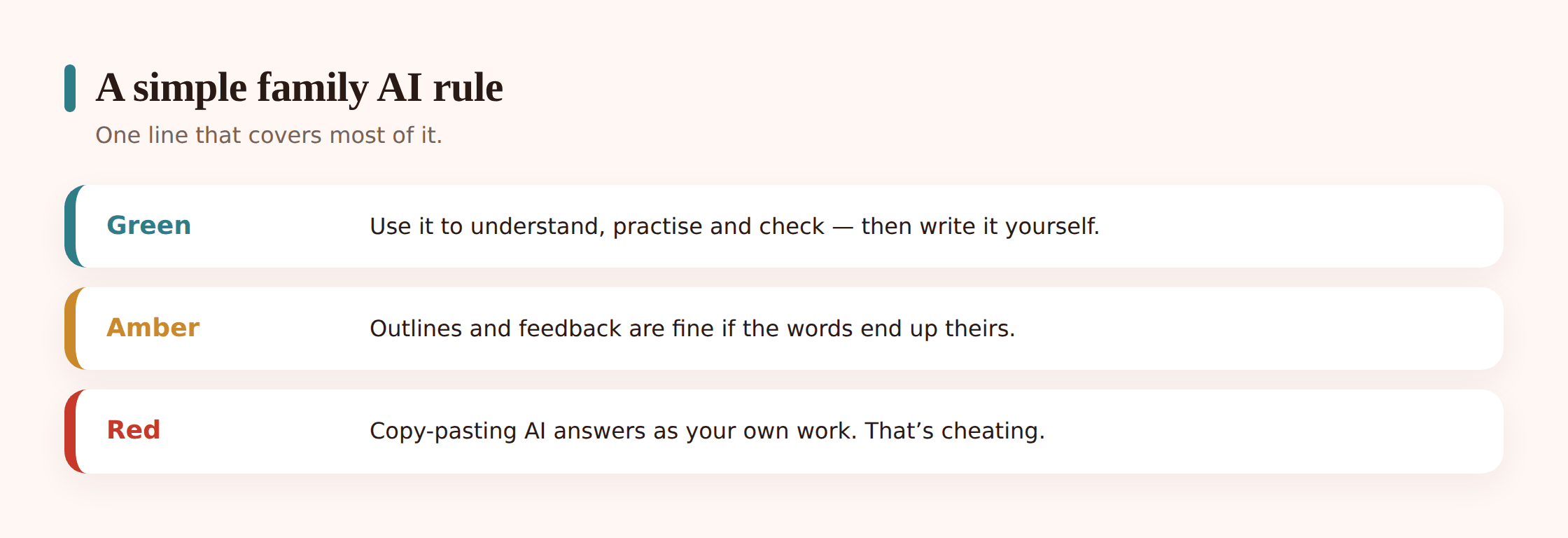
Keep it short enough to remember. Long lists die on the fridge. These are the ones that hold up:
- AI can help you understand and check — never do. If it wrote the sentence you’re handing in, that’s over the line.
- If you couldn’t explain it, you didn’t learn it. The re-explain test is the house standard.
- Confident isn’t correct. Verify anything that matters against a real source.
- Follow the class rule, not the vibe. Know your teacher’s actual policy for that subject, and when in doubt, ask them.
- Declare it if you’re unsure. “I used AI to check my spelling” is an easy sentence to say when honesty is safe at home.
- Homework time is for homework. A set, focused window beats a five-hour half-distracted crawl — for AI use and everything else.
That last one is easier to hold when the schedule supports it. A protected, low-distraction stretch — call it a homework hour — makes it far more likely the work gets real attention instead of a rushed paste-and-run at midnight. Whether you set that up with a shared calendar rule, a routine on the phone, or just a family norm, the structure does a lot of the heavy lifting.
Rules like these fit naturally inside a broader household agreement about phones and time online. If you don’t have one yet, our family phone agreement gives you a template to build on, and screen time by age helps you pitch the boundaries at the right level for how old your kid is.
Talking about honesty without a fight
Academic honesty is a values conversation, and values conversations go badly the second they feel like an accusation. A few things that keep it from becoming a standoff:
Lead with curiosity. “Show me how you’ve been using AI for school — what’s actually useful?” You’ll learn more in five minutes than in an hour of rules, and your kid feels seen rather than suspected.
Name the stakes honestly, without doom. Kids respect the real reason. “The worry isn’t the app, it’s you getting to an exam and finding the thinking muscle never got built.” That lands better than “it’s against the rules,” because it’s about them, not compliance.
Separate the mistake from the kid. If you find out they crossed the line, treat it as a wrong call about a tool, not proof they’re a cheat. A kid who’s been branded dishonest has no reason to be honest next time. A kid who’s told “that was a shortcut, let’s redo it properly” has every reason to.
Reward the honesty when it comes. The first time your child says “I basically had AI write most of this and I feel weird about it,” that’s a win, not a crime. How you react to that sentence decides whether you ever hear it again. Thank them, and fix the work together.
For the wider skill of talking to your kid about their online life without it turning into a fight, we’ve got a whole guide on helping kids think critically that pairs well with this one.
FAQ
Is using ChatGPT for homework cheating?
It depends entirely on how. Using it to explain a concept, check work you’ve already done, or generate practice questions is fine and often genuinely helpful. Having it write the answer you hand in is cheating — you’re presenting its work as your own. The quick test: could you re-explain what you submitted, out loud, without notes? If not, the tool did too much.
Can teachers actually tell if my kid used AI?
Sometimes, and imperfectly. Teachers who know a student’s usual writing can spot a jump in style or vocabulary. Schools also use “AI detector” software — but those tools are unreliable and produce false positives, wrongly flagging honest, human-written work. The most reliable check is old-fashioned: a teacher asking a student to explain their own essay. That’s why the re-explain habit protects an honest kid.
What if my kid is wrongly accused by an AI detector?
Stay calm — a detector flag is an allegation from an unreliable tool, not proof. Gather any draft history (most writing apps save versions), which shows the work developing over time. Ask the school what the flag was based on and make the case that the tool is known to misfire. Going forward, having your kid write where version history is saved is the best insurance.
What age should kids start using AI for schoolwork?
There’s no hard number, and it depends more on judgement than birthday. Younger children generally aren’t ready to tell reliable output from confident nonsense, so any use should be alongside a parent. Around the older-child and teen years, supervised use as a study aid — with clear rules and the school’s policy understood — can genuinely help. The readiness marker isn’t age so much as whether the kid can question what the tool tells them.
Should I just ban AI for homework completely?
Usually not. AI is built into the tools kids already use, and a flat ban mostly teaches them to hide it. You lose visibility and the chance to teach judgement. Supervised, rule-bound use — tutor yes, ghostwriter no — protects both their learning and their honesty far better than a wall they’ll quietly climb over.
My kid says “everyone uses it, so it’s fine.” What do I say?
Agree with the first half — lots of kids do use it, and that’s not going away. Then separate the tool from the misuse. Using AI to learn is common and fine; using it to skip the learning is common and still cheating. “Everyone doing it” changes how normal it feels, not whether it builds the skill the homework was for.