Media Literacy for Kids: Spotting Fake News & Misinformation
Your kid saw a video of a celebrity saying something outrageous. A friend swore it was real. It wasn’t — it was AI, and it fooled a lot of adults too. This is the world our kids scroll through every day, and the fix isn’t panic or a total lockdown. It’s a skill: knowing how to pause, question, and check before believing or sharing. That skill is teachable, and you’re the best person to teach it.
Why this matters now
Think about where you got the news this morning. Now think about where your kid did. For most children and teens, “news” doesn’t come from a newspaper or even a news site. It arrives sideways — a screenshot in a group chat, a clip from a creator they follow, a meme, a stranger’s post that a friend reshared. There’s no masthead, no byline, often no date. Just a claim, moving fast.
That’s not automatically bad. Kids can find brilliant explainers, primary footage, and voices that traditional media ignored. But the same pipe that delivers the good stuff delivers the junk, and the two look identical on a small screen. A careful report and a made-up rumour get the same fonts, the same share button, the same little heart.
Two things have made this harder lately. First, AI can now produce convincing fake images, voices, and video in minutes — see our parents’ guide to deepfakes. Second, the feeds themselves are tuned for engagement, and nothing engages like outrage. Accurate-but-boring loses to false-but-furious almost every time.
Here’s the balance to hold, though. The goal isn’t to raise a cynic who assumes everything is fake and everyone is lying. That’s its own kind of failure — a kid who can’t tell truth from noise just shrugs and believes whatever feels right. The goal is curious and careful. Interested in what’s true, and willing to do a little work to find out.
The problem, in plain terms
It helps kids to have names for what they’re seeing. A few worth teaching:
- Misinformation — something wrong that spreads by accident. Your aunt shares a scary health warning because she believed it. She’s not lying; she’s mistaken.
- Disinformation — something wrong on purpose. Someone made it up to make money, win an argument, or get you angry, and they know it isn’t true.
- Rage-bait and clickbait — content built to make you furious or desperate to click. If a headline seems designed to spike your blood pressure, that’s often the whole point.
- Out-of-context clips — a real video, real audio, but cut so it means the opposite of what actually happened. Ten seconds of a two-hour event can say anything.
- Fake screenshots — a “tweet” or “text message” that was never sent. Anyone can type words into a template. Screenshots feel like evidence but they’re the easiest thing to fake.
- Satire taken as real — a joke article passed around by people who missed the joke. The site was kidding. The reader wasn’t.
- AI images and video — pictures and clips of things that never happened, generated from a text prompt.
And underneath all of it: the algorithm rewards outrage over accuracy. Not because anyone’s evil, but because angry, shocked, or thrilled people watch longer and share more. So the loudest, most extreme version of any story travels furthest, whether or not it’s the true one. Kids who understand this incentive start to see the machinery instead of just the content.
How to spot a likely fake
None of these prove something is false on its own. They’re flags — reasons to slow down and check. Teach your kid to feel a little itch when they notice one:
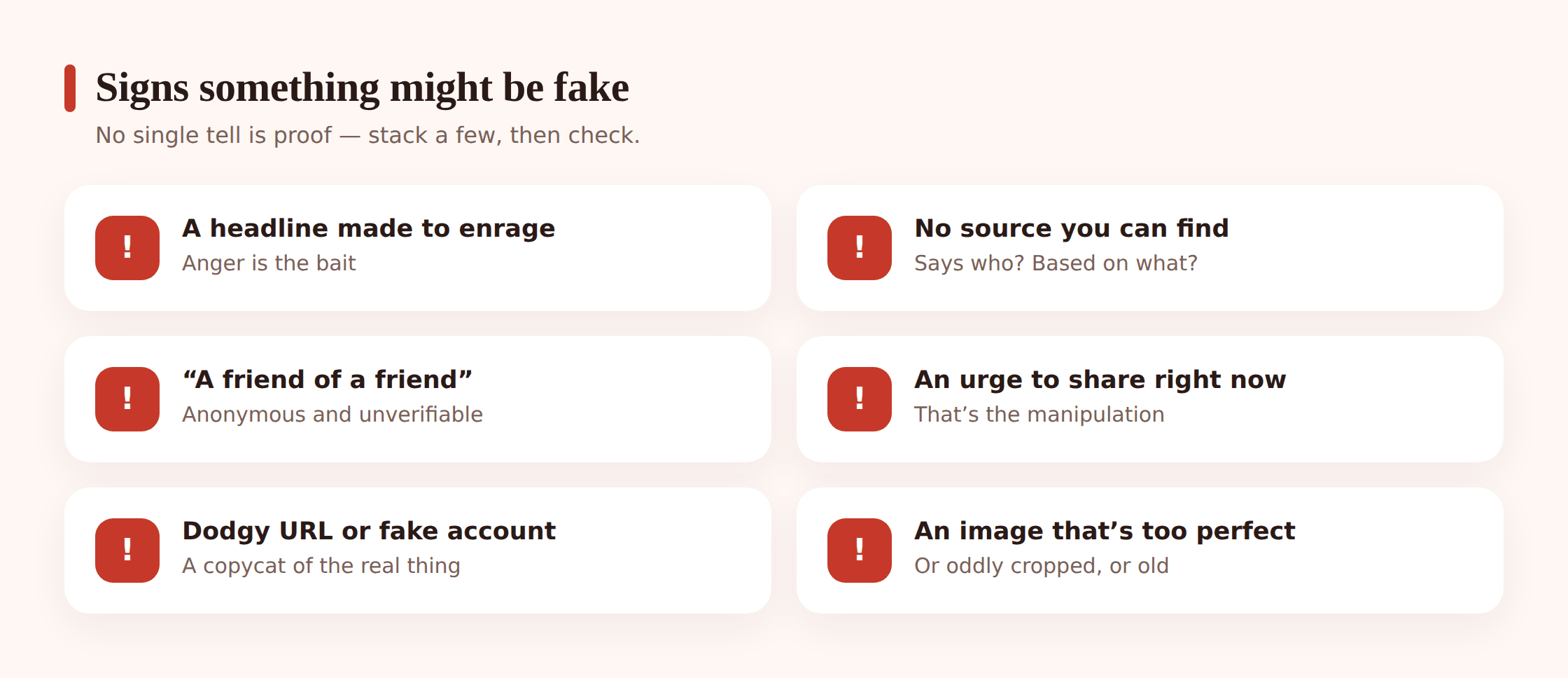
- The headline is built to make you angry. Real reporting informs. Bait provokes. If your first feeling is fury, that’s a reason to pause, not to share.
- There’s no source, or a source you can’t find. “Scientists say,” “sources confirm,” “everyone knows.” Which scientists? Confirmed where? If you can’t trace it back to anyone, be suspicious.
- It’s a friend of a friend. “My cousin’s coworker heard that…” Anonymous chains are how rumours travel. Nobody’s name is ever attached because nobody can back it up.
- You feel an urgent pull to share it right now. “Send this to everyone before they delete it!” Urgency is a manipulation tactic. Truth can wait five minutes for you to check.
- The URL or account looks off. A news site at a weird address, a “verified” account that’s actually spelled slightly wrong, a page with three followers and one viral post.
- The image is too perfect or oddly cropped. Strange hands, melty backgrounds, text that isn’t quite letters — or a photo cropped so tight you can’t see the context around it.
- The date is old. A real photo from years ago, reshared today as if it just happened. Old news recycled as breaking news is one of the most common tricks.
- Only one place is reporting it. If something huge really happened, more than one outlet would have it. A single dramatic source and silence everywhere else is a red flag.
The feeling is the tell. The single most useful thing you can teach: the stuff most likely to be fake is the stuff engineered to make you feel something big and act fast. Anger, fear, “I can’t believe this.” When your kid notices that jolt, that’s the exact moment to stop and check — not after they’ve already hit share.
The fact-check routine kids can actually use
Adults do this in their heads in seconds once it’s a habit. For kids, make it explicit — a short routine they can run on anything that gives them that jolt.
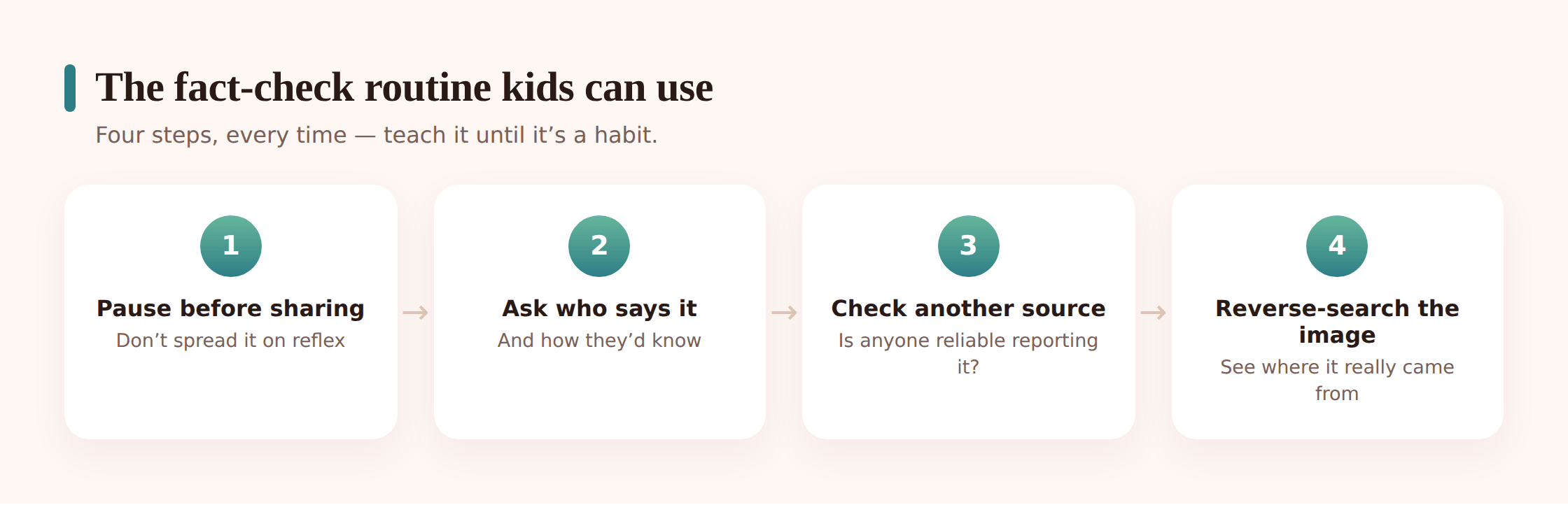
- Pause before you share. That’s the whole battle, honestly. Sharing feels good and takes half a second. Just not doing it immediately buys time to think.
- Ask: who says this, and how would they know? Trace the claim to a person or organisation. Are they in a position to actually know? A random account posting about a plane crash isn’t the same as the airline or a news crew there.
- Check another trusted source. Does anyone else report it? Open a new tab, search the claim, see who’s covering it and whether they agree.
- Look up the exact claim. Type the surprising bit into a search engine, maybe with the word “fact check.” Established fact-checkers have often already looked into the viral ones.
- Reverse-search the image. Right-click or long-press and search the picture. You’ll often find it’s years old, from a different country, or already flagged as fake. This one trick catches a huge share of image hoaxes.
- Check the date and the full context. When was this actually posted? For a clip, is there a longer version that changes the meaning? Ten more seconds of video often tells a completely different story.
- Be willing to say “I don’t know yet.” This is the grown-up move. You don’t have to have an instant opinion. “I’m not sure, I need to look into it” is a perfectly good place to land.
You won’t run all seven steps on every post — nobody does. But when something feels big, surprising, or perfectly designed to enrage, that’s when the routine earns its keep.
Teaching it by age
Media literacy grows with the kid. Aim the lesson at where they are.
Young kids (roughly 5–8). Keep it simple and concrete. The big idea: not everything online is true, and some things are just adverts. Help them spot when a video is trying to sell them a toy versus just being a story. “Is this person telling us something, or trying to get us to buy something?” That single distinction — content versus ad — is the foundation everything else sits on.
Tweens (roughly 9–12). Introduce sources and fakery. They can grasp that anyone can post anything, that a screenshot can be typed up by anybody, and that a real photo can be used to tell a lie. Play with it: show them how easily a fake text message or headline can be made, and the point lands fast. This is also the age to start talking about scams aimed at kids and fake giveaways — “Claim your free console, just enter your details!” — which run on the same too-good-to-be-true machinery.
Teens (13+). Go deeper — bias, algorithms, deepfakes, and the responsibility that comes with a share button. Teens can handle the idea that even honest sources have a slant, that their feed is shaped to keep them scrolling, and that a convincing video can be entirely fabricated. Connect it to their own reach: when they reshare something false to a few hundred followers, they’ve become part of the spread. This ties naturally into social media safety and how viral trends and challenges take off whether or not they’re true or safe.
The AI angle
AI raises the stakes because the old shortcut — “it’s a photo, so it’s real” — no longer holds. AI can generate images of events that never happened, write fake quotes in a convincing tone, and clone a voice from a few seconds of audio. Some fakes still have tells (strange hands, warped text, audio that’s slightly too smooth), but the tells are fading fast, and chasing them isn’t a reliable long-term strategy.
So the durable lesson isn’t “here’s how to spot AI.” It’s verify before you trust. Where did this come from? Is a real, accountable source standing behind it? For anything shocking, that reverse-search and second-source check matters more than ever. If a video shows a public figure saying something wild, the question is simple: are reputable outlets reporting it, or is it only bouncing around anonymous accounts? Our deepfakes guide goes deeper on this, including the family “safe word” trick for the AI-voice scam where someone calls sounding exactly like a relative in trouble.
Building the habits at home
Skills stick when they’re lived, not lectured. A few things that actually work:
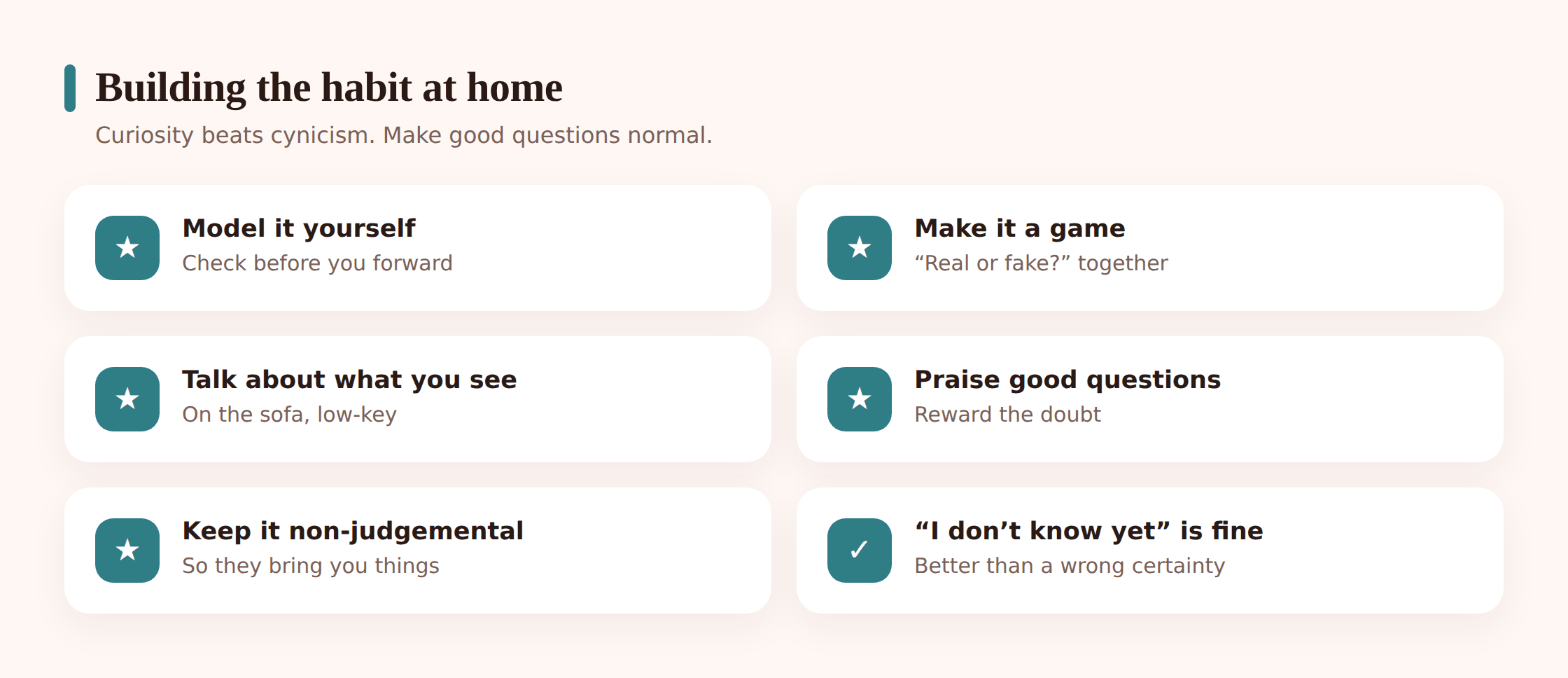
- Model it yourself. This is the big one. Don’t forward the scary warning to the family chat without checking it first. If your kid sees you pause, search, and say “actually, this one’s fake,” that teaches more than any talk.
- Make it a game. “Spot the fake.” Show a couple of posts and guess which is real, then check together. Kids love catching the trick, and the skill sneaks in through the fun.
- Talk about stuff you see together. When something comes across your own feed, mention it out loud. “Huh, I’m not sure this is real — let’s see who’s saying it.” Ordinary, casual, constant.
- Praise the good questions. When your kid says “wait, is that actually true?” — celebrate it. You’re rewarding the instinct you most want to grow.
- Keep it non-judgemental. If they believed or shared something fake, don’t make them feel stupid — plenty of adults fell for the same thing. A kid who’s afraid of being mocked stops bringing you things. A kid who knows you’ll help them figure it out keeps the door open.
That last point is the whole game. The aim isn’t a child who never gets fooled — impossible, and it happens to all of us. It’s a child who, when something feels off, comes to you before they act on it. That habit starts and ends with how you react. For more on keeping that channel open, see talking to your kids about online safety.
Where tools help (and where they don’t)
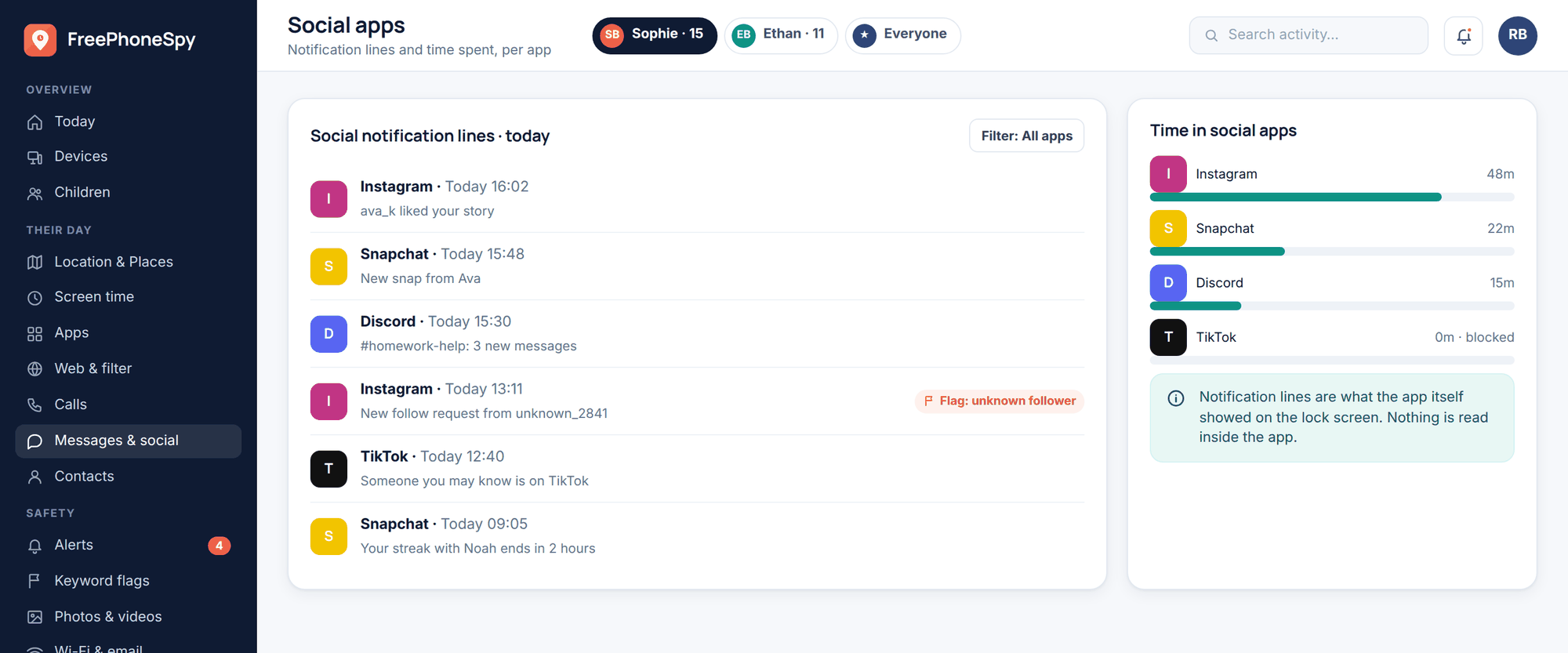
Let’s be honest about what technology can and can’t do here. A content or web filter can block a chunk of obvious scam and junk sites, which reduces how much garbage reaches a younger child in the first place. Keyword alerts can flag when a worrying topic shows up in their world so you know to have a conversation. That’s genuinely useful — it buys you time and awareness.
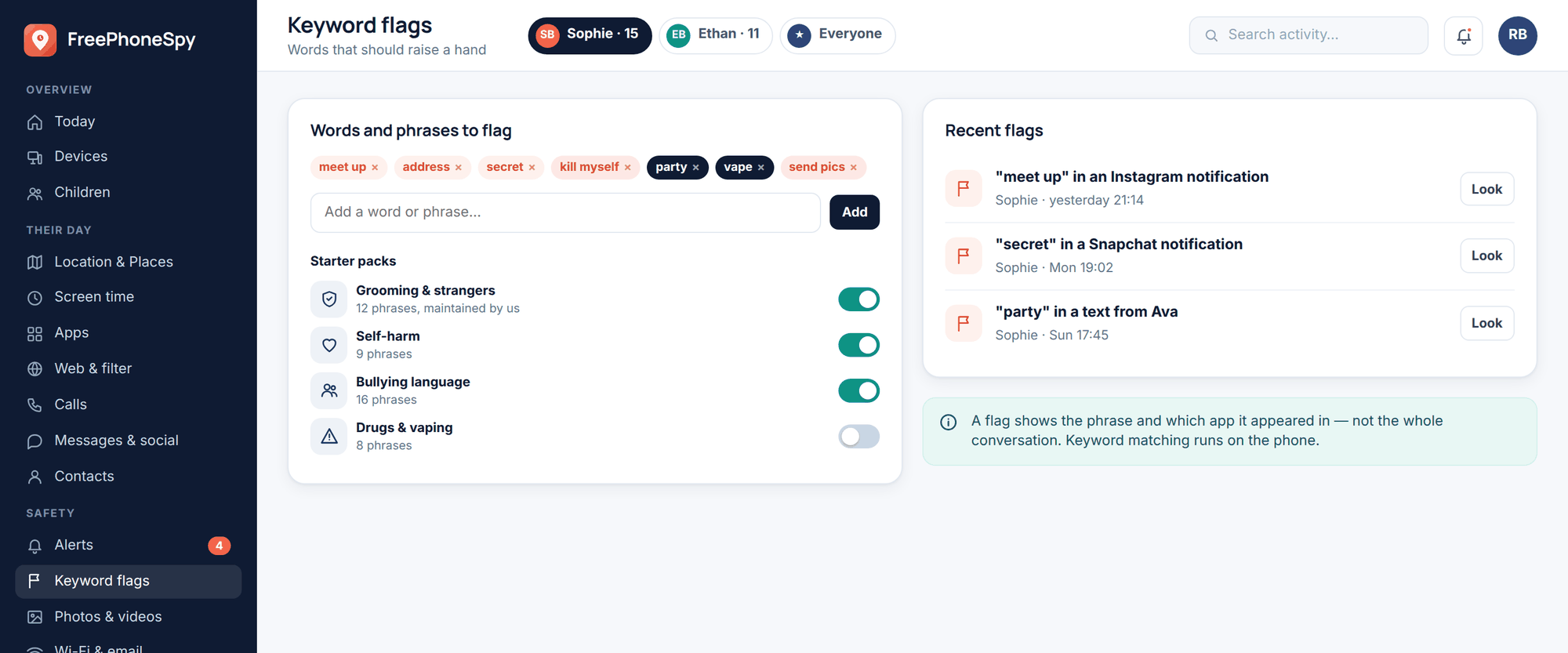
But here’s the honest limit: no app teaches critical thinking. A filter can’t tell a clever hoax from real reporting, and it can’t reason about context or bias. It won’t be there when your kid is on a friend’s phone, or when they’re twenty and scrolling on their own. The real, portable defence is the skill in their head. Tools are a helpful backstop for the youngest kids; they are not a substitute for the thinking.
If you do use monitoring while your kids are young, treat what it surfaces as conversation starters, not verdicts. A flagged keyword or a filtered site is a reason to talk, not a reason to interrogate.

The family “before you share” checklist
Print this, or just talk through it until it’s second nature. Before anyone in the house reshares something that feels big:
- Did it make me angry, scared, or thrilled? (If yes — slow down.)
- Who’s actually saying this, and how would they know?
- Is anywhere else reporting it, or is it just this one post?
- When is this from? Is it old news dressed up as new?
- If there’s an image or clip — have I reverse-searched it or looked for the longer version?
- Could this be a joke, an ad, or AI-generated?
- Am I sure enough to put my name on it? If not — don’t share it yet.
Frequently asked questions
Isn’t teaching kids to doubt everything going to make them cynical?
It can, if you frame it as “everything’s a lie.” So don’t. Frame it as curiosity: not “trust nothing” but “check the surprising stuff.” The aim is a kid who’s interested in what’s true and knows how to find out — not one who’s given up on truth altogether. Balance is the point.
My kid is convinced something fake is real. How do I handle it without a fight?
Don’t lead with “you’re wrong.” Get curious together: “Interesting — where’d you see that? Let’s find out who’s saying it.” Walk through the check side by side. If it turns out to be fake, they’ll see it themselves, which sticks far better than being told. And if you’re the one who’s wrong sometimes, say so — that models the whole thing.
What’s the single most useful skill to teach first?
The pause. Just not sharing something the instant it triggers a big feeling. Everything else — sources, reverse-search, second opinions — only happens if they slow down first. Teach the pause and you’ve done most of the work.
How do I keep politics out of it?
Teach the how, not the what. Focus on process — checking sources, spotting bait, questioning context — and apply it evenly to claims from every direction. A good media-literacy habit makes a kid harder to fool by anyone, whatever the topic. You’re building a method, not handing them your conclusions.
Are fact-checking sites reliable?
Established ones are a useful tool, but teach kids to use them as a starting point, not gospel. The stronger habit is checking whether multiple independent, reputable sources agree — and reading how they reached the conclusion, not just the verdict. Cross-checking beats trusting any single authority.
At what age should I start?
Earlier and simpler than you’d think. Even five-year-olds can learn “some of this is an advert” and “not everything online is true.” You’re not delivering a lecture on disinformation — you’re planting a first instinct to question, and you build on it every year.