Teens & Healthy Relationships Online
A lot of your teen’s love life now happens on a screen. The good parts and the worrying parts. Most of it is ordinary and sweet, but the same phone that keeps two people close can also become a leash. Helping a teen tell the difference — respect from control — is one of the quieter, more useful things a parent can do.
How relationships play out on phones now
When two teenagers start seeing each other, the phone comes along for the ride from day one. There’s the steady stream of messages that runs from morning to lights-out. There’s the follow on every app, the tagging, the reacting to each other’s stories within seconds. A relationship that a generation ago lived at school and on a landline now lives in a pocket, all day, in writing.
Most of that is lovely. Being able to say goodnight, share a song, send a photo of the dog — it’s how closeness feels for them, and it isn’t a problem. But the always-on nature of it creates an expectation that’s new and heavy: that you’ll always be reachable, and that a reply is owed quickly. A message left on “seen” for an hour can spark a whole spiral that a slow text reply never would have.
Layer social media on top and you get a second stage. Who liked whose photo. Who’s in the background of that group shot. Whether a partner follows an ex, or comments on someone else’s post. None of this is inherently trouble, but it’s a lot of visible information about another person’s social life, delivered constantly, at an age when feelings run hot. The raw material for jealousy is just… always there. This connects to the wider push and pull of growing up online, which we cover in teens, privacy & independence.
The pressure points
Certain moments come up again and again in young relationships, and they’re worth naming so your teen recognises them when they arrive. On their own, none of these makes a relationship unhealthy. It’s the pattern, and the pressure behind them, that matters.
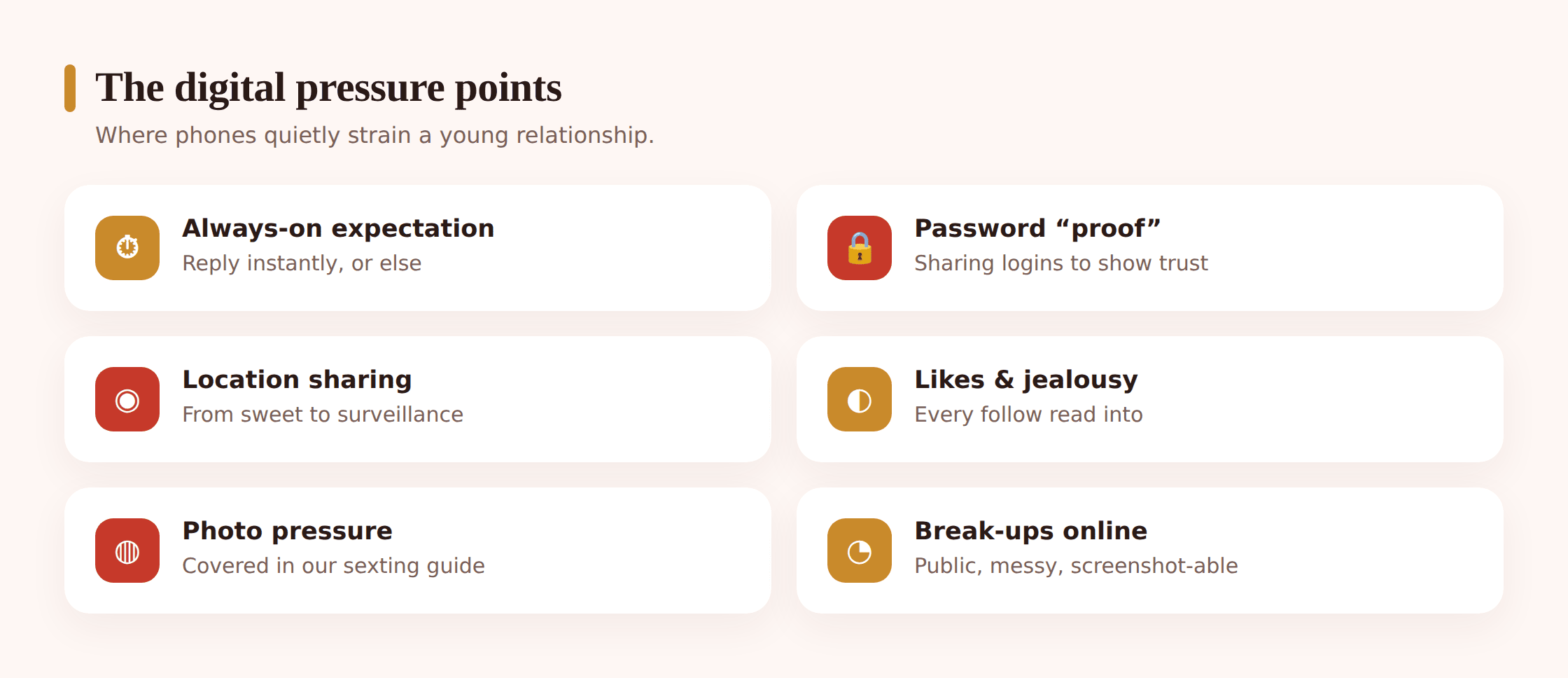
- Sharing passwords to “prove trust.” A partner asks for the login to a phone or an account, framed as proof there’s nothing to hide. It sounds romantic and lands as control.
- Sharing locations, always on. Live location sharing between partners can be practical, but “always on, always checked” is a different thing — especially when one person asks and the other doesn’t feel able to say no.
- Demanding to see the phone. Scrolling through a partner’s messages, checking who they’ve been talking to, going through their photos.
- Jealousy over likes and follows. Being told off for liking a friend’s post, or pressured to unfollow certain people.
- Monitoring each other’s activity. Watching when someone was last online, timing how long a reply took, keeping score.
- Pressure to send photos. Being worn down into sending intimate images. This one has its own risks and its own conversation — we cover it fully in talking about sexting, so it isn’t repeated here.
Here’s the quiet thread running through most of these: they get dressed up as love. “I just want to know you’re safe.” “If you trusted me you’d show me.” “I only get jealous because I care so much.” A teen who’s flattered by the intensity can miss that the underlying message is control. Part of your job is to help them hear it.
Healthy respect vs controlling behaviour
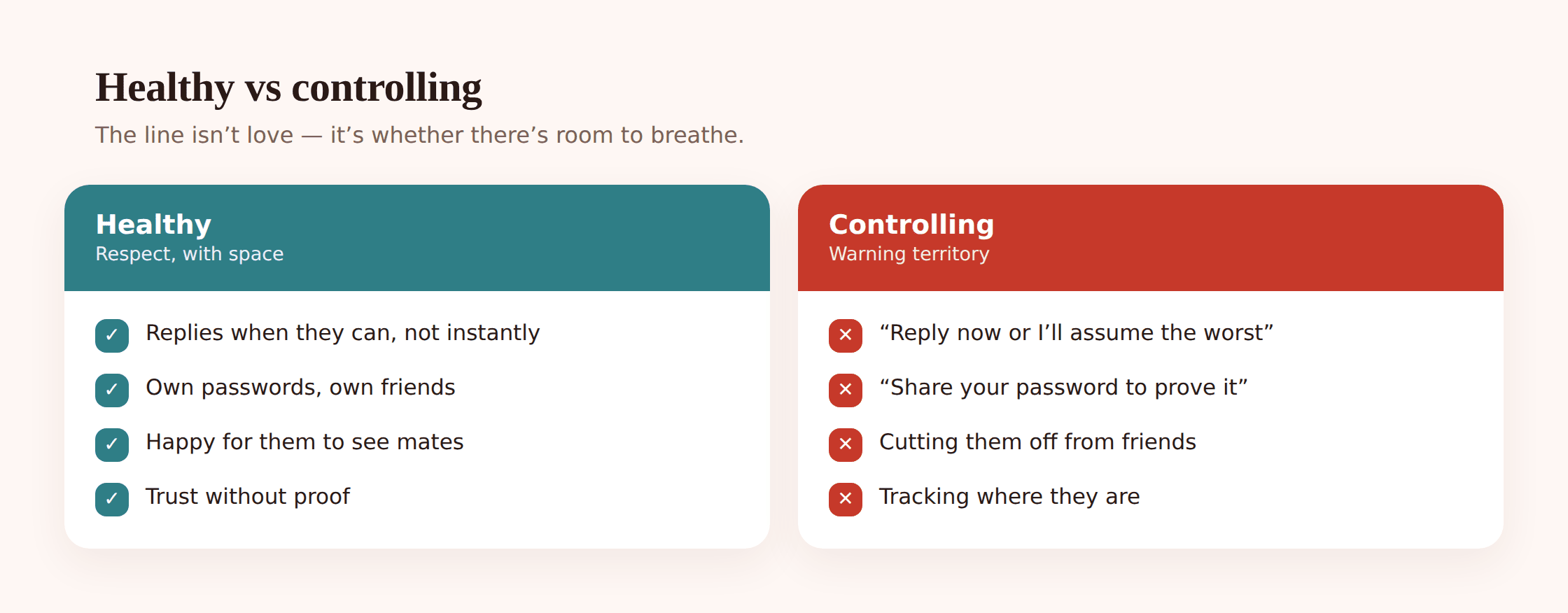
The clearest way to teach this is side by side. Healthy and controlling can look surprisingly similar from the outside — both involve wanting to be close — but they feel completely different to be on the receiving end of. The test is usually about freedom: does this person’s behaviour expand your teen’s world, or shrink it?
What digital respect looks like
- You can take hours to reply and it’s fine. Nobody’s owed an instant answer.
- Your accounts and your phone are yours. A partner who trusts you doesn’t need your password.
- You still have your own friends, your own group chats, your own life online.
- Location sharing, if it happens at all, is mutual, agreed, and easy to switch off.
- Disagreements happen over text without threats, sulking that lasts for days, or punishment.
- “No” is respected the first time — about photos, about plans, about anything.
What digital control looks like
- Isolation. Being nudged, then pushed, away from friends — “your mates don’t like me,” “why do you even talk to them.”
- Tracking. Wanting constant access to a partner’s location and getting agitated when they can’t see it.
- Constant checking. A barrage of messages demanding to know where someone is, who they’re with, why they didn’t reply.
- Threats. “If you break up with me I’ll…” — to share a photo, to hurt themselves, to tell people something.
- Guilt-tripping. Turning every boundary into evidence that your teen doesn’t care enough.
- Monitoring accounts. Demanding passwords, reading messages, deciding who a partner is allowed to follow.
The simplest line to give a teen. Someone who loves you wants you to have your own friends, your own phone, and your own space. Someone who wants to control you slowly takes those away and calls it love. If a relationship makes your world smaller, that’s the signal.
It’s worth being honest with your teen that controlling behaviour rarely announces itself. It usually starts small and sweet, and each step feels reasonable on its own. That’s exactly why it’s hard to spot from the inside, and why having named it in advance helps so much.
Red flags to teach your teen
Give your teen a short mental list they can carry into any relationship. Not a set of rules to police a partner with — just a few things that, if they keep happening, mean it’s time to talk to someone they trust.
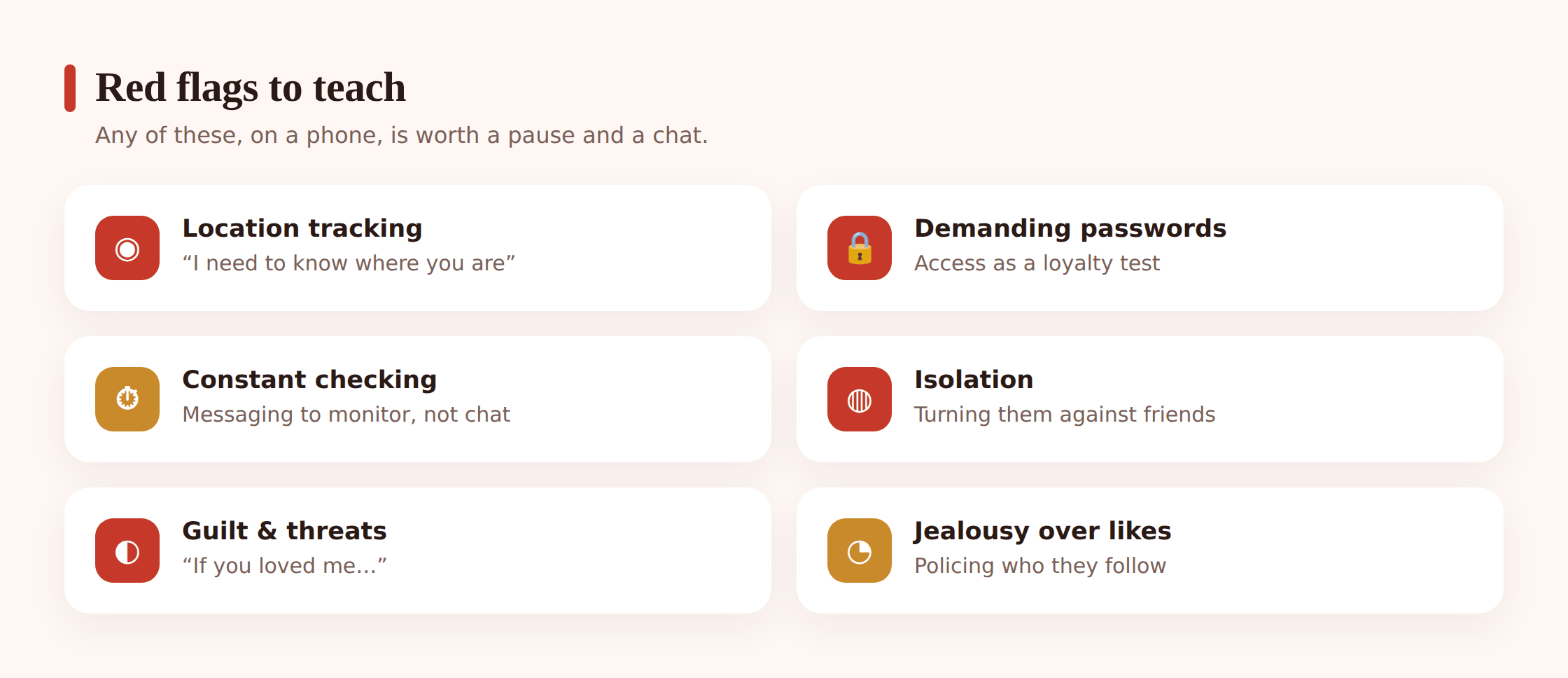
- They get angry or cold when you don’t reply fast enough.
- They want your passwords, or to go through your phone, and treat “no” as suspicious.
- They check your location constantly, or want it on all the time.
- They try to keep you away from friends or family, or make you feel guilty for seeing them.
- They’re jealous of ordinary things — a like, a comment, a friend of a different gender.
- They use threats, ultimatums, or “if you loved me you would” to get what they want.
- They put you down, then say they were joking, so you feel silly for minding.
- You find yourself editing what you do to avoid setting them off.
That last one matters most. When someone starts walking on eggshells — choosing photos carefully so a partner won’t react, not mentioning who they saw, feeling relief when the other person is in a good mood — the relationship has already tipped. Teach your teen to notice that feeling in themselves, because it’s often the earliest and truest sign.
Notice that several of these red flags — tracking a partner, going through their phone, checking who they talk to — are surveillance behaviours. That’s the point. If controlling a partner’s phone is a warning sign in a relationship, it’s worth remembering the same logic applies to how we treat our own teens. The goal here is an open conversation, not a way to monitor a teen’s private relationship from the outside.
How to talk about it without prying
The instinct, when you’re worried, is to ask direct questions or to look at their phone. Both tend to close the door. Teens guard their romantic lives closely, and a parent who interrogates or snoops quickly becomes someone to hide things from. The better approach is slower and sideways, and it keeps you as the person they’ll actually come to.
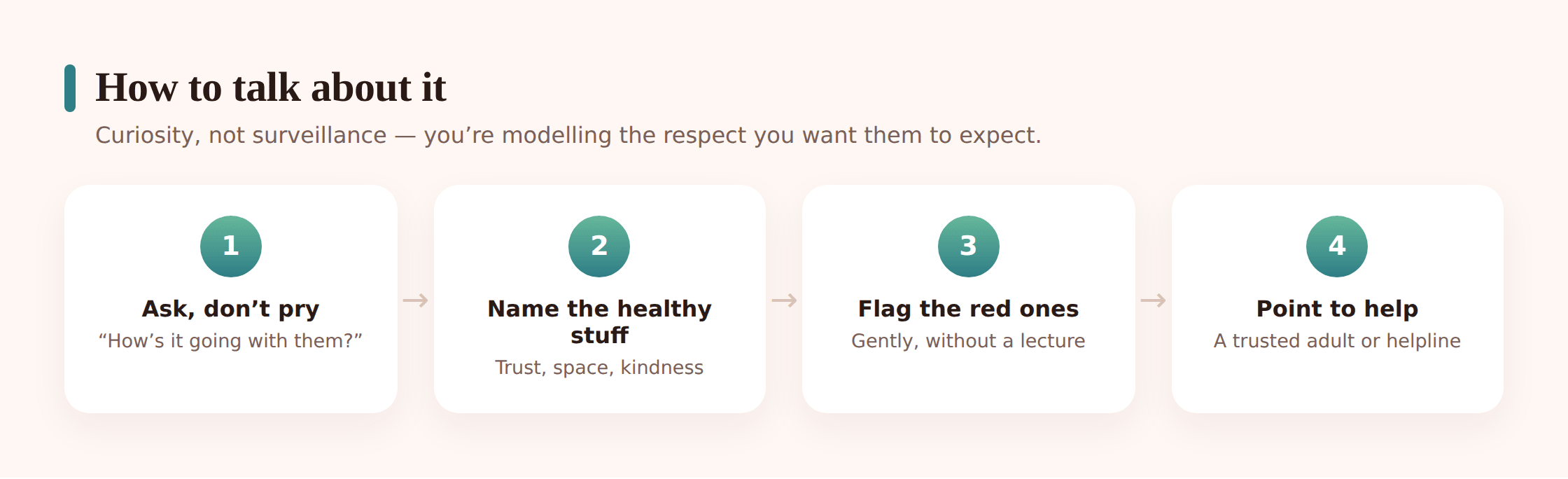
Talk about ideas, not their specific relationship
It’s far easier for a teen to discuss “what makes a relationship healthy” than “what’s going on with you and your partner.” Use a storyline, a friend’s situation, a news item as the way in. You’re handing them a framework without putting them on the spot.
Ask questions you don’t already have an answer to
“What do you think it means when someone asks for their partner’s password?” invites a real conversation. “Has your partner asked for your password?” invites a wall. Curiosity works where cross-examination doesn’t.
Name the behaviours, not the person
If you have a concern, talk about the behaviour rather than attacking their partner. “Constantly checking where someone is isn’t a sign of love, it’s a sign of control” lands better than “your partner is controlling.” Criticise the person and a teen will defend them, and defend the relationship, harder.
Say the thing you most want them to know, plainly
“You can always come to me, and I will never make it worse” is worth saying out loud, more than once. Teens in difficult relationships often stay quiet because they fear a parent will overreact, forbid the relationship, or take the phone. Remove that fear on purpose.
Keep the door open even when you disagree
Forbidding a relationship almost never ends it — it just moves it out of your sight and makes your teen feel they have to choose. Staying connected, even to a relationship you don’t love, keeps you close enough to help if things go wrong.
The parallels with other tough subjects are strong here. The same calm, non-shaming approach that works for cyberbullying works for this: you’re building a relationship where hard news can reach you, rather than a set of rules that push it underground.
Consent and respect online
Underneath all of this sits one idea worth making explicit with your teen: consent isn’t only about photos or physical closeness. It runs through the whole digital side of a relationship, and it goes both ways.
Sharing a location is a choice, not a default a partner is owed. Posting a photo of someone, tagging them, or sharing a screenshot of a private chat needs their say-so. Reading a partner’s messages “just to check” isn’t devotion, it’s a boundary crossed. A teen who understands that respect means asking, and accepting no, is better protected — and less likely to become the controlling one themselves. That second half matters. Any teen can drift into checking-up behaviour when they’re anxious, and it helps to name it as something to notice in yourself, not just to watch for in a partner.
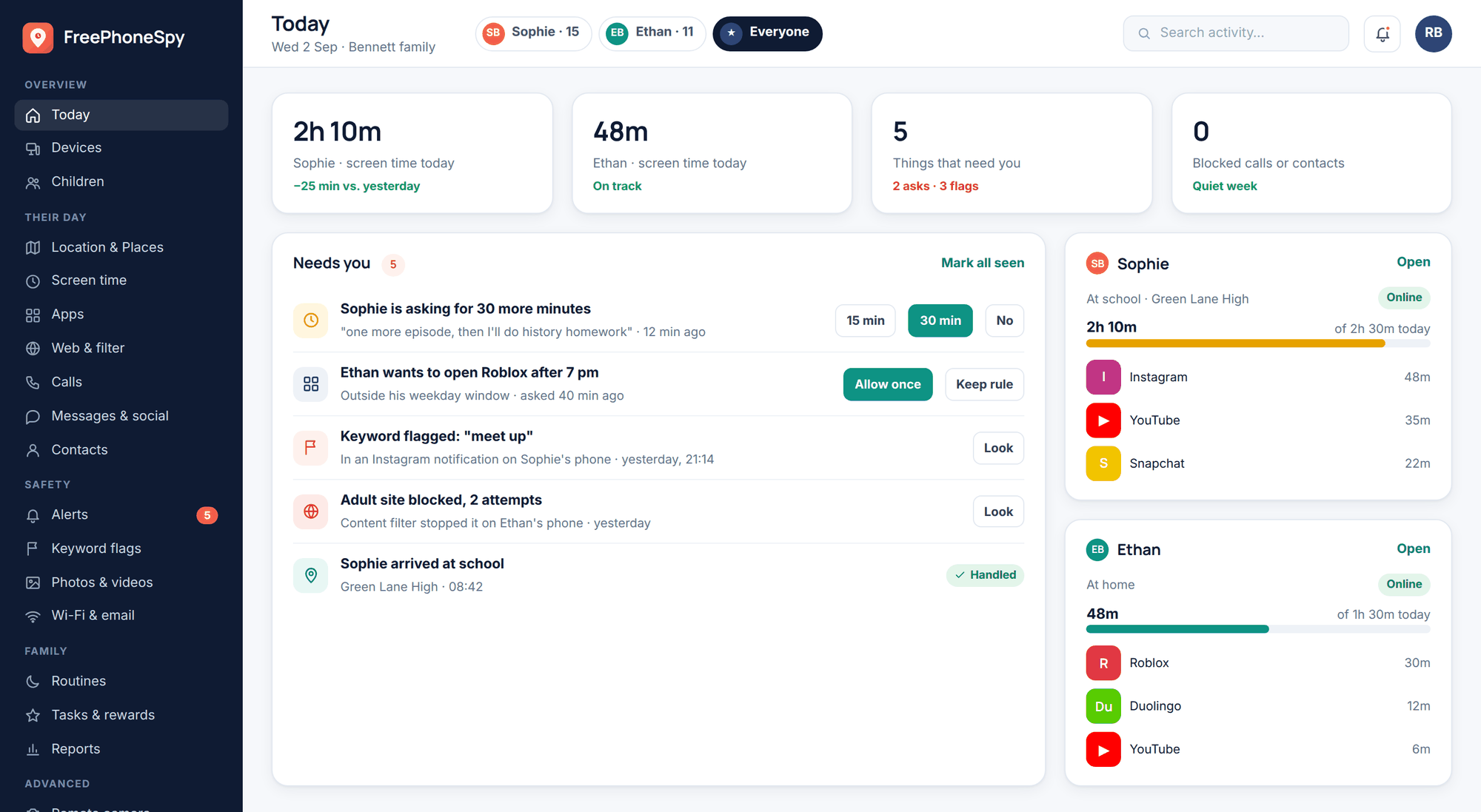
FreePhoneSpy is transparent, consent-based monitoring for a family’s Android phones, set up openly and known to everyone on the device. It’s for the ordinary business of keeping younger children safe together — never a tool for reading a teen’s private relationship or checking up on who they’re dating. A teen’s romantic life is exactly the kind of thing that stays healthy through conversation and trust, not surveillance. If tracking a partner is a red flag, quietly tracking a teen is the same move wearing a parent’s face.
If your teen is in a controlling relationship
Sometimes you’ll realise it’s gone past worrying and into genuinely unhealthy. Maybe your teen tells you. Maybe you see the shrinking world — the friends dropping away, the anxiety around the phone, the walking on eggshells. Whatever tips you off, how you respond in the first few moments shapes whether they let you help.
Stay calm and stay on their side
Anger at the partner, however justified, often reads to a teen as anger at their choices. Lead with “I’m glad you told me” and “none of this is your fault.” Your steadiness is what keeps them talking.
Don’t demand they break up on the spot
Leaving an unhealthy relationship is often the hardest and, for a short while, the least safe moment, and a teen who feels pushed may dig in. Support them toward the decision rather than issuing it. Ask what they want and what would help.
Help them reconnect with their world
Controlling relationships work by isolation. Gently rebuilding the friendships and interests that fell away is both a comfort and a form of protection. Make room for the people who were pushed out.
Bring in the right help
You don’t have to be the only support. A trusted adult, a school counsellor, or a specialist helpline can offer things a parent can’t — and a teen sometimes finds it easier to open up to someone outside the family.
Take threats and images seriously
If a partner is threatening your teen, or using intimate images as leverage, keep any evidence and get help — a helpline, and the police if there’s a threat to safety. The sexting guide covers the image side and how to get content removed.
Where to get help
Start with a trusted adult and your teen’s school counsellor — both can support and, where needed, involve the right services. For specialist help with unhealthy or abusive relationships, national youth and relationship-abuse helplines exist in most countries (in the US, for example, Love Is Respect supports young people around dating; the National Domestic Violence Hotline covers wider abuse). Search for the equivalent service where you live, and contact local police or emergency services if anyone is in immediate danger.
Hold onto the long view. Most teens will have a rocky relationship or two, learn from it, and come out fine — especially the ones with a calm adult nearby who never made them feel they had to hide. Your steadiness now is what they’ll draw on later, in relationships you’ll never see.
Common questions
Is sharing passwords a red flag?
Being pressured to share them is, yes. A partner who trusts you doesn’t need your login, and “prove you’ve got nothing to hide” is a control move dressed as romance. Teach your teen that their accounts are theirs, full stop, and that saying no to a password request is completely reasonable — not a sign they’re hiding something.
My teen’s partner tracks their location — is that normal?
Mutual, agreed location sharing between two people who both find it useful can be fine. The warning signs are one-sidedness and pressure: it’s always on, one person checks it constantly, and switching it off causes trouble. If your teen feels they can’t turn it off without a fight, that’s the part to focus on — not the feature itself.
How do I bring it up without seeming like I’m prying?
Talk about the ideas rather than their specific relationship. Use a show, a friend’s situation, or a general “what do you think makes a relationship healthy?” to open the door. Ask questions you’re genuinely curious about instead of ones that feel like a check-up, and do it sideways — in the car, cooking — not as a sit-down.
Should I read their messages to check on the relationship?
It usually backfires. Reading a teen’s private messages tends to break the trust that makes them tell you things, and it models the exact surveillance that’s a red flag in a relationship. Keep any family safety tools open and agreed, and reserve them for younger children’s general safety — a teen’s love life stays healthy through conversation, not covert checking.
My teen’s partner gets jealous over social media. Is that a problem?
A flicker of jealousy is human. A pattern is the concern: being told who they can follow, getting grief over ordinary likes, being made to unfollow friends. Watch whether the jealousy is shrinking your teen’s world or just passing through. The first is controlling; the second is usually just a feeling being felt.
What if I don’t like their partner but nothing’s actually wrong?
Tread lightly. Forbidding or badmouthing a partner tends to push a teen closer to them and further from you. Unless you’re seeing real red flags, stay connected, stay curious, and keep the relationship where you can see it. You’ll have far more influence as the parent they still talk to than as the one who laid down the law.