Teens, Privacy & Independence: Loosening the Reins Safely
The hardest part of monitoring a child’s phone isn’t setting it up. It’s knowing when to take it off. A nine-year-old and a seventeen-year-old need completely different things from you, and the settings that kept the younger one safe will quietly corrode your relationship with the older one if they never change. Good parenting online has a trajectory built in: you start close, and you step back on purpose, handing over privacy and control as your child shows they can carry it. This is about doing that well — loosening the reins without dropping them.
Why privacy actually matters for teenagers
It’s tempting to treat a teenager’s demand for privacy as a nuisance to be managed — a phase, a bit of attitude, something you concede to keep the peace. That framing misses what’s really going on. The pull toward privacy in adolescence isn’t rebellion. It’s development doing exactly what it’s supposed to.
Somewhere around twelve or thirteen, a child’s main job quietly changes. For years it was learning to trust you and rely on you. Now it’s learning to become a separate person — someone with their own opinions, their own friendships, their own inner life that doesn’t route through a parent. That work needs room. A teenager tries on identities, says things to friends they’d never say at the dinner table, works out who they are by testing it somewhere you’re not watching. A private space to do that in isn’t a luxury. It’s the workshop where an adult gets built.
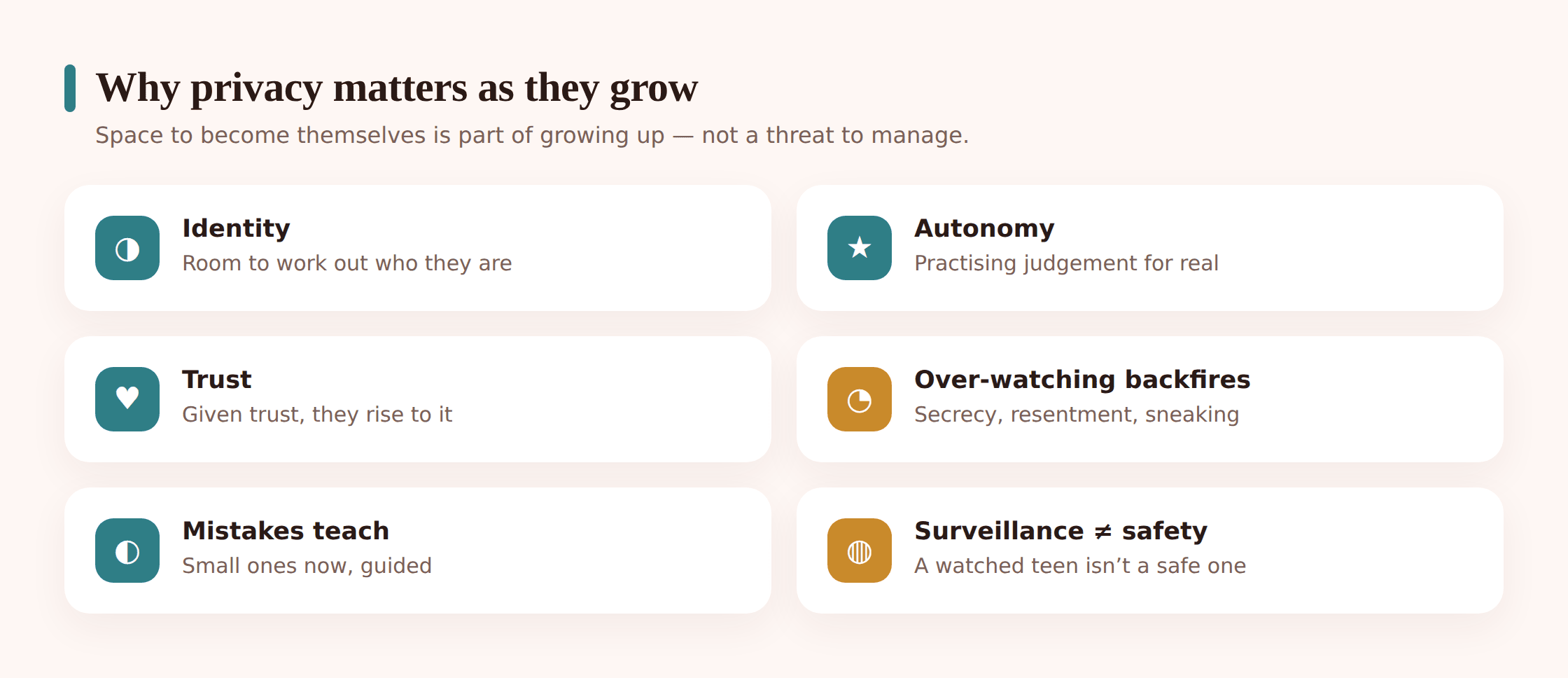
There’s a second thing at stake, and it’s about you as much as them. Trust runs both directions. A teenager who’s told, in effect, “we’ll keep watching everything because we can’t be sure of you” hears a verdict about their character. Do that for long enough and they start to believe it, or they resent it, or both. Whereas the teenager handed a piece of trust — and then another — learns that trustworthiness is a thing that pays off. You can’t lecture someone into being responsible. You grow it by giving small amounts of freedom and letting them feel what it’s like to hold it well.
None of this means privacy is absolute or that a fourteen-year-old should vanish into an unmonitored phone overnight. It means privacy is a real developmental need with a cost attached to ignoring it, and that cost climbs steeply the older your child gets. The instinct that made close monitoring right at nine is the same instinct that makes it wrong at seventeen. The circumstances changed; keeping the settings the same is the mistake.
The trust ladder: phasing oversight down
The cleanest way to think about all this is a ladder. At the bottom rung is a young child with a first phone, who needs close oversight because they genuinely can’t yet judge online risk. At the top rung is a near-adult who runs their own digital life with you as a consultant, not a supervisor. The whole point of the years in between is to climb — moving up a rung as your child shows they’re ready, taking controls off at each step rather than adding them.
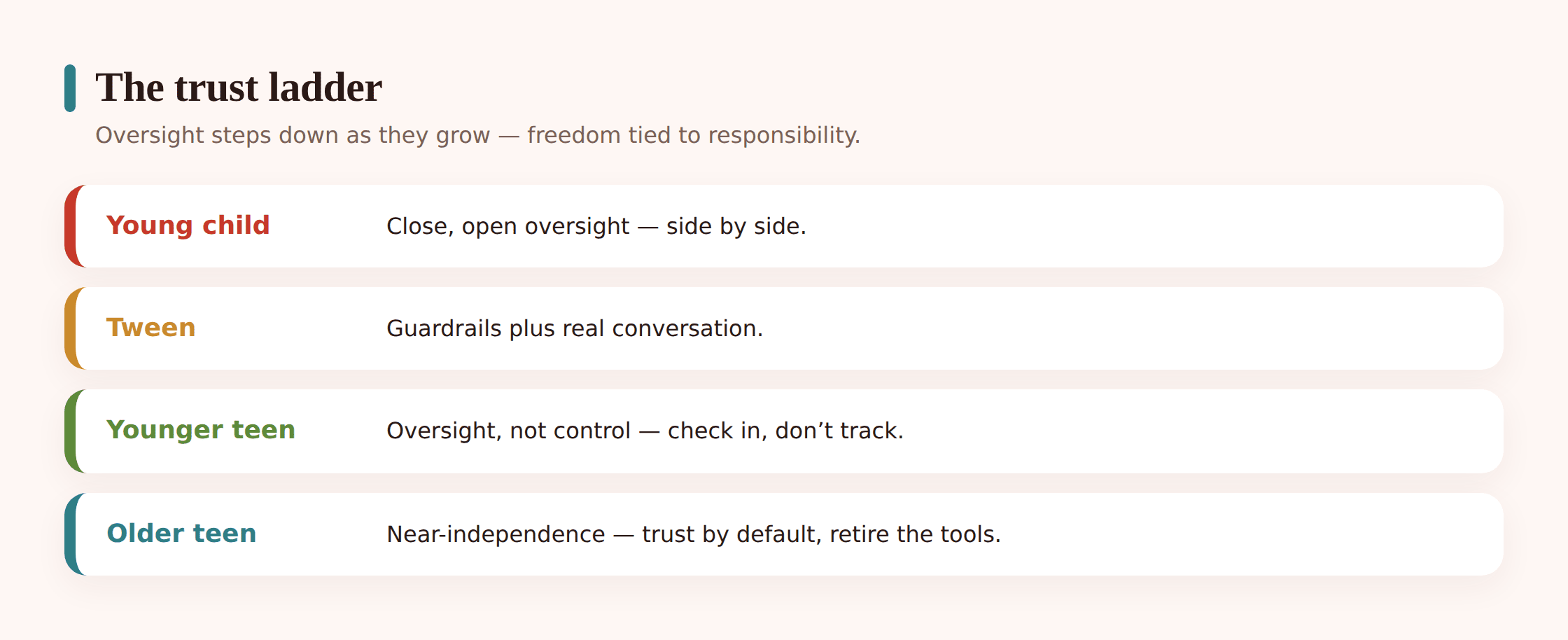
Roughly, the rungs look like this. Treat the ages as loose markers, not rules — readiness varies enormously between two kids of the same age, and you know yours.
The younger child (first phone, roughly 10–12)
Close but open oversight. Location so you know they got where they were going, screen-time and bedtime limits, and a safety net that flags genuinely alarming contact. The child can see all of it — nothing hidden. At this rung the balance leans toward protection because a child this age hasn’t built the judgment yet. There’s more on where to start in our piece on at what age to monitor.
The early teen (roughly 13–15)
Oversight lightens and gets more targeted. Message bodies come off if they were ever on; you keep a light safety flag and location, and you drop the granular stuff. You start narrating the shift out loud: “You’ve shown me you handle this, so I’m taking X off.” The teen begins to have real say in the setup. This is the rung where the relationship starts doing more of the safety work than the software does.
The older teen (roughly 16–17)
Near-independence. Most active monitoring is gone. You might keep location sharing — often mutual by now, the kind of thing families do for each other rather than something imposed — and an agreement that they’ll come to you if something goes wrong. The distinction between the two of you as watcher and watched has mostly dissolved. What’s left is a relationship and a couple of practical arrangements. For the fuller picture on where covert oversight was never appropriate, see monitoring vs spying.
Tying freedom to demonstrated responsibility
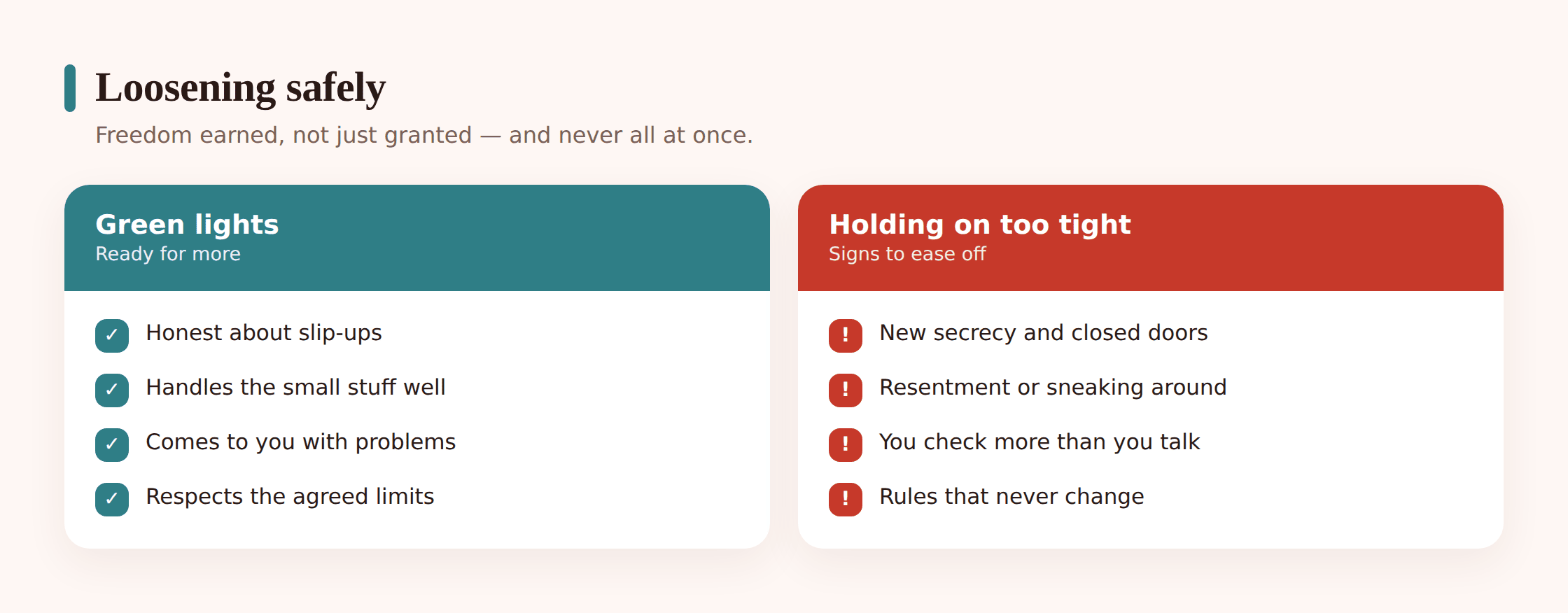
Climbing the ladder shouldn’t happen automatically on a birthday, and it shouldn’t be a fight either. The healthiest version ties each step to something the teenager actually did. Freedom gets earned, and just as importantly, the terms are known in advance so it never feels arbitrary.
This works best when you name the deal out loud. Something like: “When you’ve kept to the agreement we made for a couple of months — home when you said, honest about where you are, coming to me when something’s weird — I’ll take the location check off during the day.” Now the teenager has a reason to be reliable that isn’t just avoiding trouble. Reliability buys something they want. That’s a far stronger engine than surveillance, because it recruits them into the project instead of making them the subject of it.
A written family phone agreement is the natural home for this. It’s where you write down not just the current rules but the path — what comes off, and what earns it. Revisiting that document every few months, and actually loosening something each time there’s cause, turns an abstract promise into a felt reality. The teenager watches the reins loosen in response to their own behaviour, which is exactly the lesson you want them to internalise before they leave home and nobody’s watching at all.
- Make the criteria concrete. “Be responsible” is unmeasurable. “Answer texts when I check in, be where you said you’d be” is something a teen can actually deliver on and you can actually observe.
- Loosen in visible steps. Take one specific thing off and say so. A silent relaxation teaches nothing; a named one teaches that trustworthiness pays.
- Let a slip cost a rung, not the ladder. If trust gets dented, step back one notch and explain why — then leave a clear route back up. Collapsing everything over one mistake tells them the whole system was never really about them.
- Give them a voice in the terms. A teenager who helped write the deal keeps it. One who had it dictated looks for the loopholes.
The baseline that still matters
Stepping back isn’t the same as walking away, and it would be dishonest to pretend the risks vanish the day your child turns fifteen. Some things are worth keeping regardless of age, and there’s no shame in holding a thin baseline even with an older teen — as long as it’s open and proportionate.
The distinction that keeps this healthy is between safety-checking and surveillance. Safety-checking is narrow, known, and about specific dangers: knowing an older teen’s location on a night out, an agreement that certain extreme risks would be flagged, a shared understanding that you’ll notice if something goes badly wrong. Surveillance is broad, continuous, and about the person rather than the danger: reading their chats, tracking their movements minute to minute, monitoring for the sake of knowing. The first is compatible with a good relationship at any age. The second isn’t, past a certain point.
What does a defensible baseline look like for an older teen? Usually something like mutual location sharing the whole family uses, off during ordinary daily life; no reading of message content; and a standing agreement — not a technical control — that they’ll tell you if they’re in trouble and you won’t overreact when they do. The tools recede into the background. FreePhoneSpy fits this stage as something you’ve been steadily dialling down for years and are close to retiring — a light, visible layer, never a hidden one, and something you switch off entirely when the trust it was scaffolding can stand on its own.
Signs you’re holding on too tight
The trouble with over-monitoring an older teen is that it rarely announces itself. You don’t get an alert. Instead the costs show up sideways, in the relationship, and they’re easy to misread as ordinary teenage moodiness. Here’s what to watch for — signals that the setup that once fit has become a straitjacket.
- Secrecy has gone up, not down. The more you watch, the more they hide. Second accounts, a friend’s phone for the real conversations, a locked expression when you walk in. Heavy monitoring doesn’t reduce hidden behaviour; it drives it underground where you genuinely can’t see it.
- Resentment has settled in. Not a flash of annoyance — a steady, cold sense that you don’t trust them. When a teenager stops arguing about the monitoring and just goes quiet about it, that’s often worse than the fights.
- They’ve stopped coming to you. This is the big one. The whole point of staying close was so they’d tell you when something went wrong. If they’ve stopped bringing you problems, the oversight has cost you the exact thing it was meant to protect.
- You’re checking out of habit, not concern. If you’re looking at the panel with no specific worry — just to know — the monitoring has stopped being about their safety and started being about your anxiety. That’s a signal to step back, not lean in.
- The controls haven’t changed in a year or more. Standing still is itself a sign. A setup that hasn’t loosened as your child matured is one you’ve stopped thinking about, and it’s almost certainly too tight for who they are now.
If several of these ring true, the fix isn’t a better app or tighter rules. It’s a conversation and a genuine loosening. Sneaking, secrecy and resentment are what a teenager does when the legitimate need for private space has nowhere to go. Give it somewhere to go and the pressure drops.
How to step back and keep the lines open
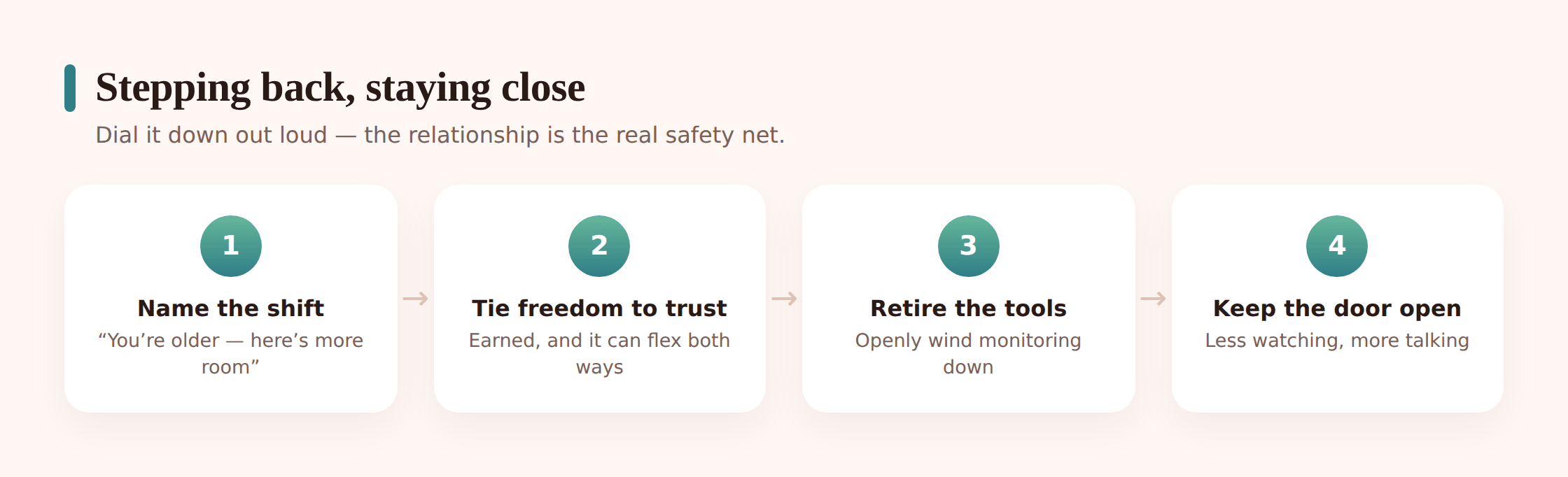
Loosening controls well is a skill, and doing it clumsily — going silent, or making it feel like a test — can leave a teenager more unsettled than reassured. The move is to be explicit: name what you’re doing, name why, and make clear the relationship is the thing that stays.
Say what you’re taking off, and why
Don’t loosen in silence. “You’ve shown me over the last few months that you’ve got this, so I’m taking the location check off during the day — I trust you.” Naming it turns a settings change into a message about trust, which is the part that actually lands.
Replace the oversight with a standing agreement
As a control comes off, put an understanding in its place. “I’m not going to be checking, so here’s the deal instead: if something goes wrong, you come to me, and I promise not to lose it.” The agreement is what does the safety work now, so make it explicit and hold up your end of it.
Keep the door genuinely open
The single most protective thing for an older teen is knowing they can bring you a bad situation without the roof falling in. Say it, and then prove it the first time they test it. One calm response to a real problem buys more safety than a year of monitoring.
Let them keep some things private, on purpose
Deliberately not knowing things is part of respecting an older teen. You don’t need to read the group chat. Signalling that some of their life is simply theirs is how you show the trust is real rather than performative.
Stepping back doesn’t mean disengaging. If anything it asks more of you as a parent, because you’re trading the easy certainty of a dashboard for the harder work of a relationship. But that’s the trade that grows an adult. The teenager who learns to manage their own digital life, with you available but not watching, walks into independence already practised at it. That was always the assignment. There’s more on protecting the trail they leave behind in privacy & digital footprint, and the ground rules worth agreeing early in a family phone agreement.
At what age should I stop monitoring my teenager entirely?
There’s no universal number, but by the mid-to-late teens most active monitoring should be gone, with maybe a light, mutual safety arrangement left. Base it on demonstrated responsibility rather than a birthday. A steady, honest sixteen-year-old is ready for near-independence sooner than a fifteen-year-old who’s still working things out — and readiness, not age, is what should move the dial.
Isn’t loosening controls just giving up on keeping them safe?
No — it’s changing what keeps them safe. For a young child, settings do a lot of the protecting. For an older teen, the protection lives almost entirely in the relationship: whether they’ll come to you when something goes wrong. Heavy monitoring at that age tends to weaken that relationship, so it can actually make a teenager less safe, not more.
My teen wants total privacy right now. Do I just hand it over?
Not all at once, and not as a surrender. Frame it as a ladder they climb by showing they can handle each step. It’s reasonable to keep a thin baseline — location on a night out, a standing agreement to talk if there’s trouble — while dropping the intrusive stuff. Give ground steadily and in response to their behaviour, so the freedom feels earned and the terms stay clear.
What if I loosen up and then something goes wrong?
Step back one rung, calmly, and say why — then leave a clear route back up. A single slip should cost a specific piece of trust, not collapse the whole system. Overreacting teaches a teenager that honesty is dangerous, which trains them to hide the next problem instead of bringing it to you. A measured response keeps the door open.
How do I know if I’m monitoring out of anxiety rather than need?
Ask what specific worry you’re checking for. If there’s a concrete reason, that’s safety-checking. If you’re looking just to know — with no particular concern — that’s your own anxiety talking, and it’s a sign to step back. The panel isn’t there to soothe a parent; it’s there for genuine safety signals, and an older teen has earned the benefit of the doubt.
Should location sharing be the last thing to go?
Often, yes — and it doesn’t have to feel like monitoring at all. Many families keep location sharing going both ways into adulthood, not as oversight but as something they do for each other. The difference is mutuality and consent: shared willingly, off during ordinary life, and never used to interrogate. In that form it can stay long after everything else has been retired.