Cyberbullying: A Parent’s Guide to Spotting and Stopping It
Cyberbullying doesn’t look like the old kind. There’s no black eye, no note passed in class. It’s a group chat that goes quiet when your child joins, a screenshot passed around 30 phones, a name that keeps trending in the year-group DMs. It follows a child home and into their bed. And most kids won’t tell you — not because they don’t trust you, but because they’re scared telling will make it worse, or get their phone taken away. This guide is about seeing it early, saying the right thing, and acting calmly when it matters.
What cyberbullying actually looks like now
Ask most adults to picture bullying and they think of nasty comments. That still happens, but it’s a small slice. The stuff that really wounds kids today is quieter and cleverer.
There’s the group-chat pile-on: one kid says something, and 12 others jump in with laughing emojis. Nobody threw a punch, but your child is sitting there watching everyone agree they’re a loser, in real time, at 11pm. There’s exclusion — a second chat gets made without them, and they only find out because someone mentions “the other group”. There are fake accounts set up to mock a specific child, sometimes using their real photos. There are screenshots: a private message, a bad photo, an awkward voice note, ripped out of context and forwarded until it’s everywhere.
It moves fast across apps. Snapchat, because messages vanish and feel consequence-free. Instagram, for the public comments and the story replies. TikTok, where a stitch or a duet can turn one kid into the joke of the week. And gaming — voice chat on Discord, Fortnite, Roblox — where a lot of the cruelty is spoken, so it leaves no text trail at all. A child can be having an ordinary evening on the sofa and be getting hammered the whole time, and you’d never know from the outside.
That’s the part parents underestimate. It doesn’t stop at the school gate any more. It’s in their pocket, and it’s on at midnight.
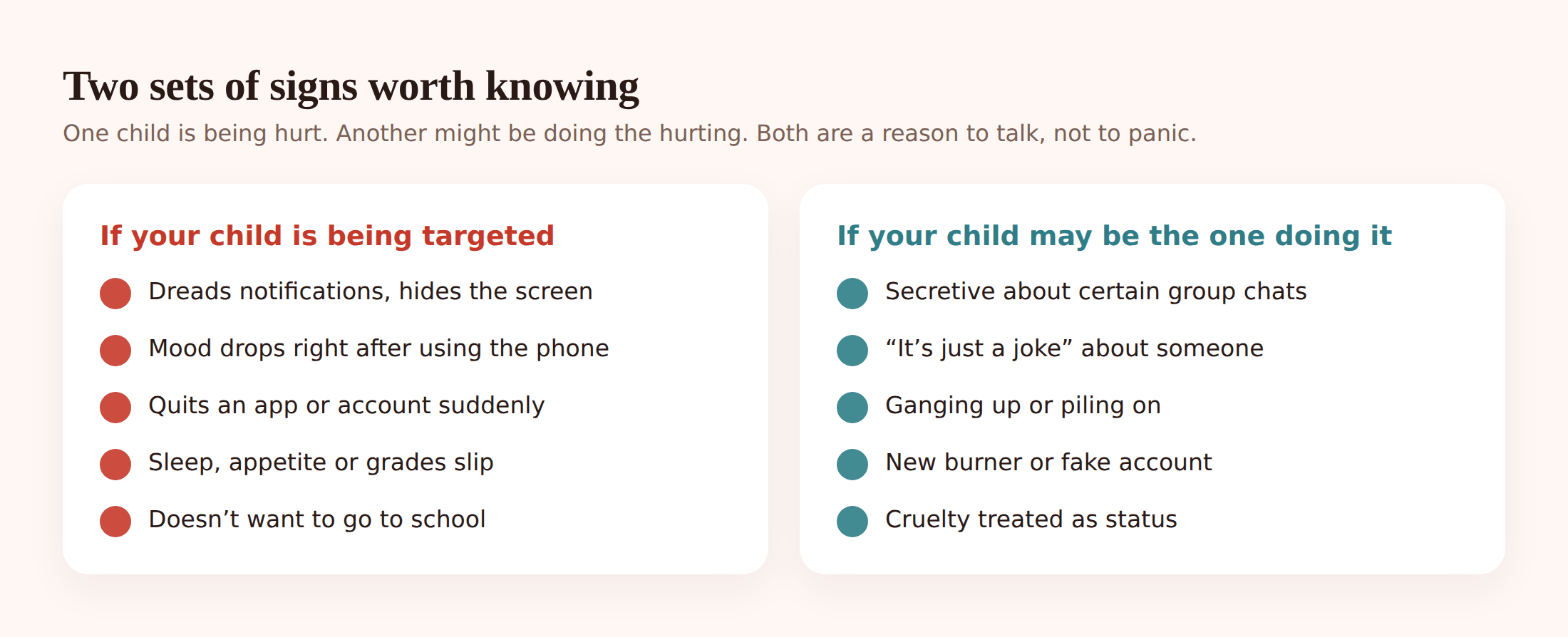
Signs your child is being targeted
Kids who are being bullied online rarely announce it. They go inward. What you’re looking for is a change from their normal — not one bad evening, but a pattern that sticks around.
- They dread notifications. The phone buzzes and they flinch, or go pale, instead of reaching for it.
- They hide the screen. Tilting it away, locking it fast when you walk past, going quiet mid-scroll.
- An app disappears. They loved Snapchat last month and now they’ve deleted it with no explanation. Quitting a platform suddenly is often a retreat, not a phase.
- Mood drops after phone use. They go up to their room fine and come down flat, teary, or snappy. Watch the “after”, not just the “during”.
- Sleep and appetite shift. Up at odd hours, exhausted, off their food, or eating for comfort. The body keeps score of stress.
- They pull back from friends. Suddenly doesn’t want to go to the party, the club, the group thing they used to love.
None of these on their own proves anything — teenagers are moody and private, and that’s normal. It’s the cluster, and the change, that matters. If two or three of these landed in the same few weeks, pay attention.
Signs your child might be doing it
This is the harder conversation, and the one most of us don’t want to have. But bullies are somebody’s kids too, and it’s usually not because they’re cruel to the core. Kids pile on for status, to stay in with a group, or because it genuinely feels like a joke to them until someone points out it isn’t.
Signs to watch for:
- Secrecy about specific chats. Not general privacy — a particular group they close instantly, laugh at, and won’t talk about.
- Ganging-up language. “Everyone thinks she’s…”, “we all agreed…”. A pack forming around one target.
- “It’s just a joke.” Said defensively, before you’ve even accused them of anything. Often the tell that they know it landed badly.
- Cruelty treated as currency. A screenshot of someone else’s embarrassment shared like a trophy. Laughing about a kid who “deserved it”.
- A sudden new social status. More popular, more confident, at the same time another child in their circle has gone quiet.
If you see this, try not to react in horror. A child who feels branded a monster will hide harder. The goal is to catch it while it’s still fixable — which, at this age, it almost always is.
How open monitoring helps — early and gently
Let’s be honest about what a monitoring app is for here, because it’s easy to get this wrong. It is not for reading every word your child types. It’s not a lie detector, and it won’t show you a voice chat on Discord or a Snap that vanished in three seconds. What it does well is give you an early nudge — a reason to open a conversation before things have spiralled.
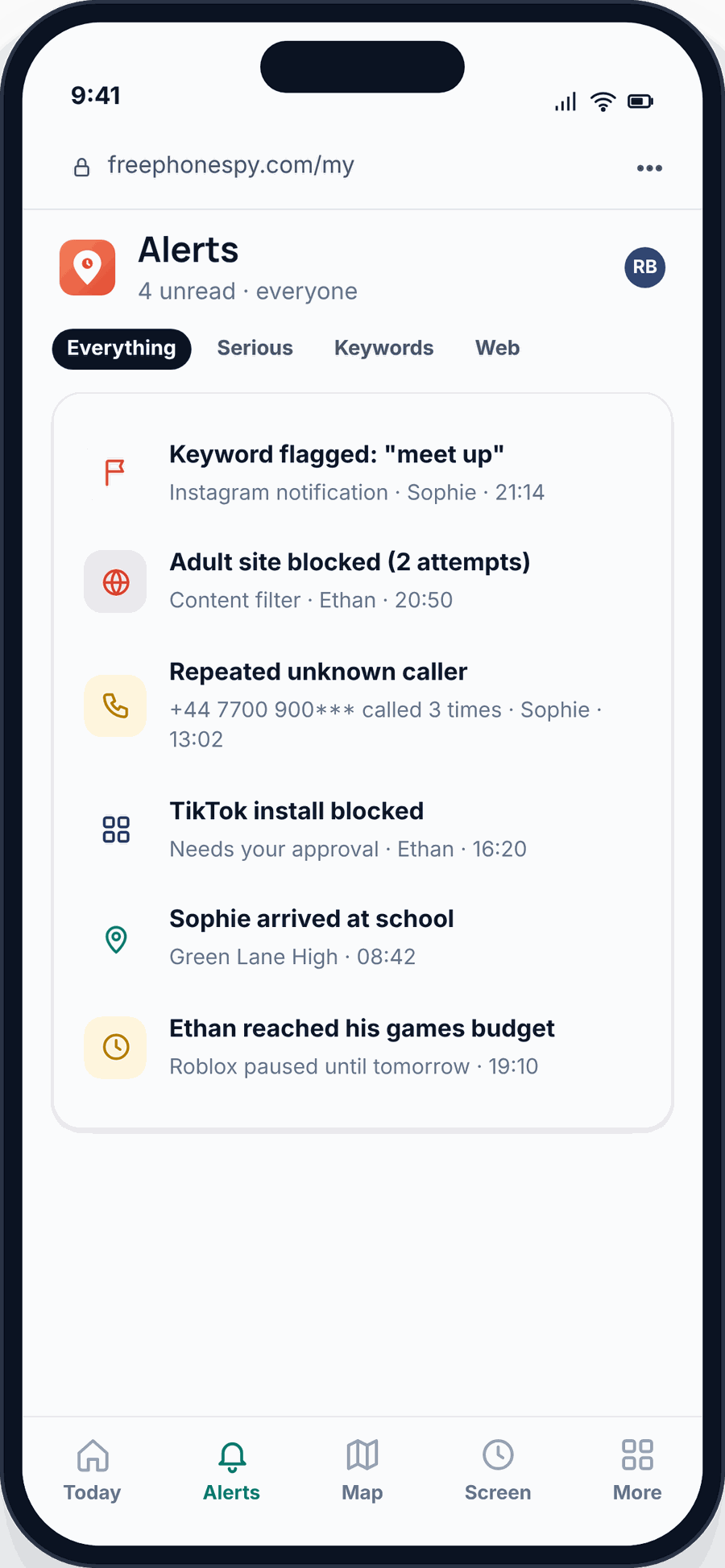
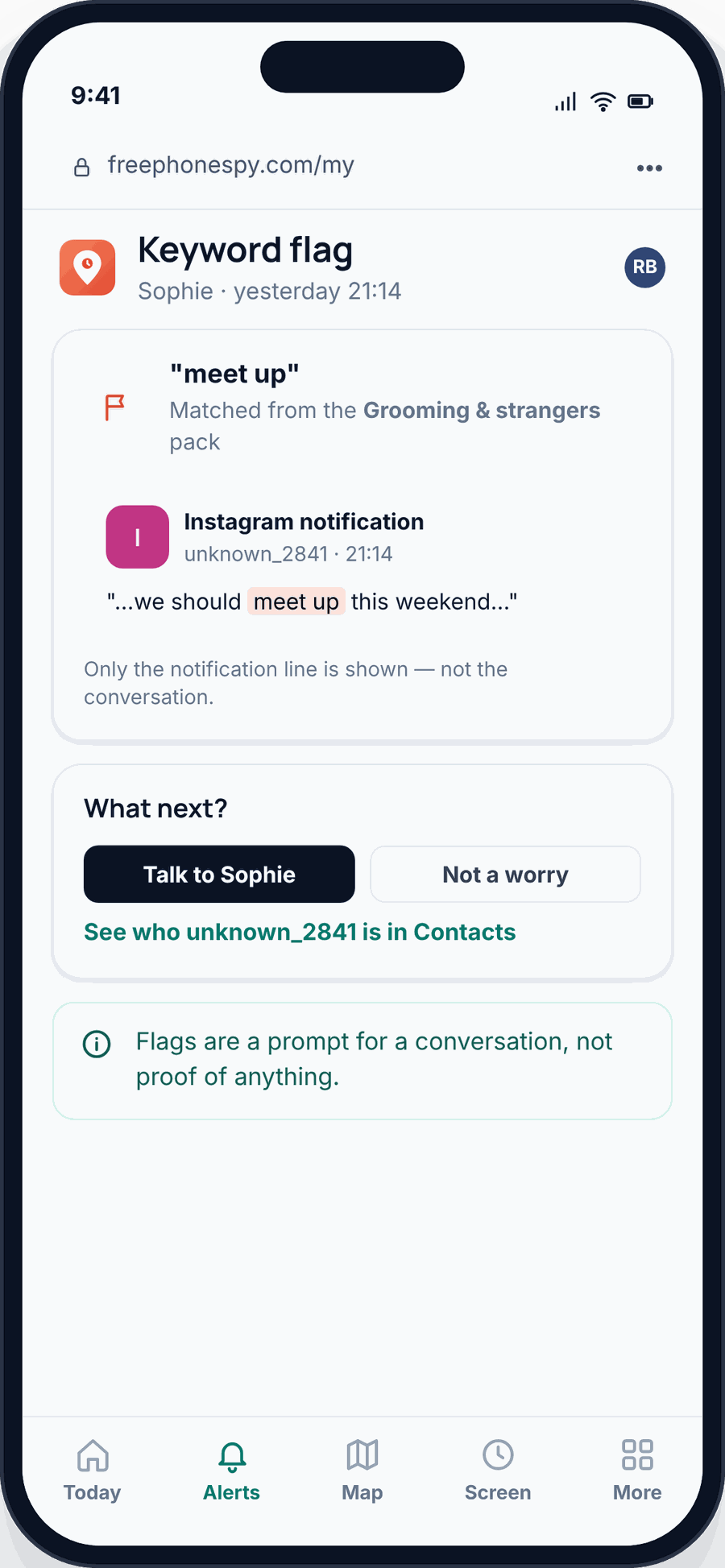
Here’s how the pieces actually help. Keyword alerts let you flag words that matter — a specific slur, a mean phrase that’s been going round, or the name of a child who’s been a problem. When one shows up in a notification, you get a quiet heads-up. You’re not reading the whole chat; you’re being told “this might be worth a gentle check-in tonight.”
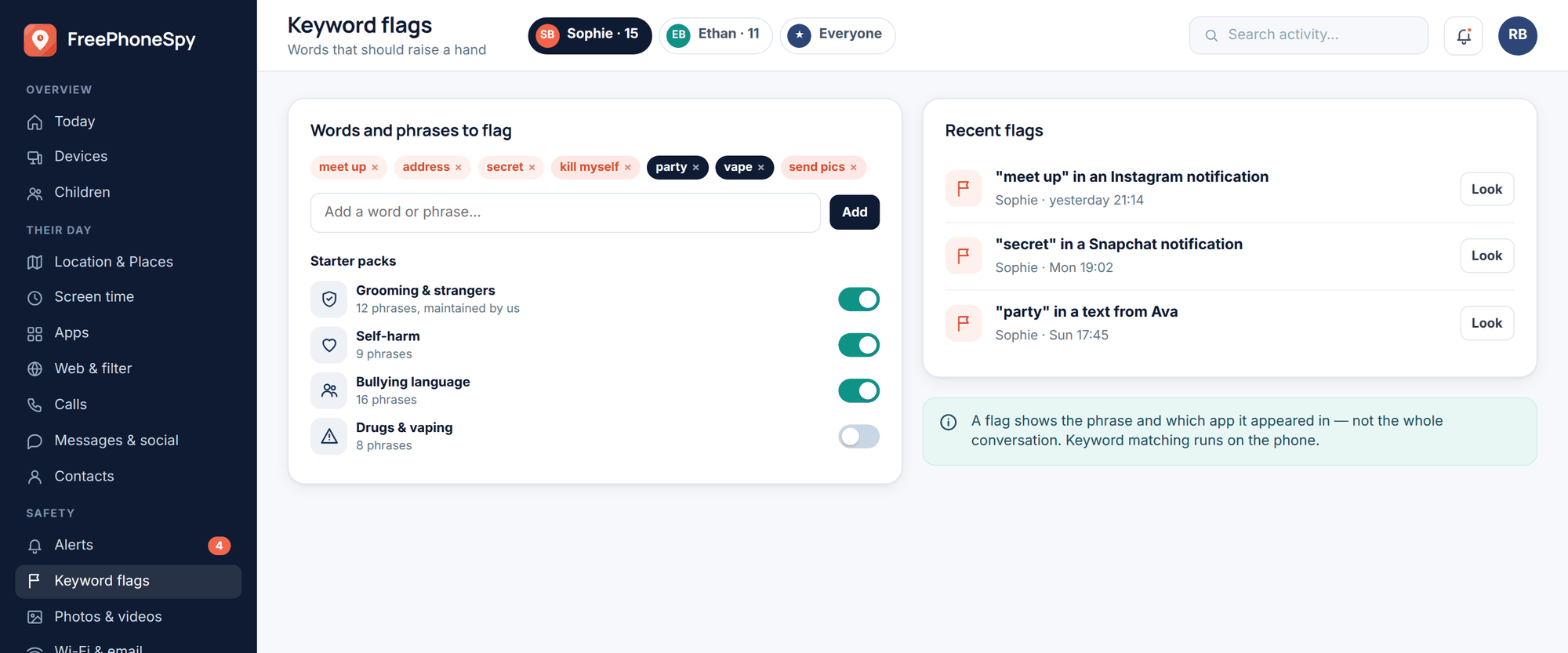
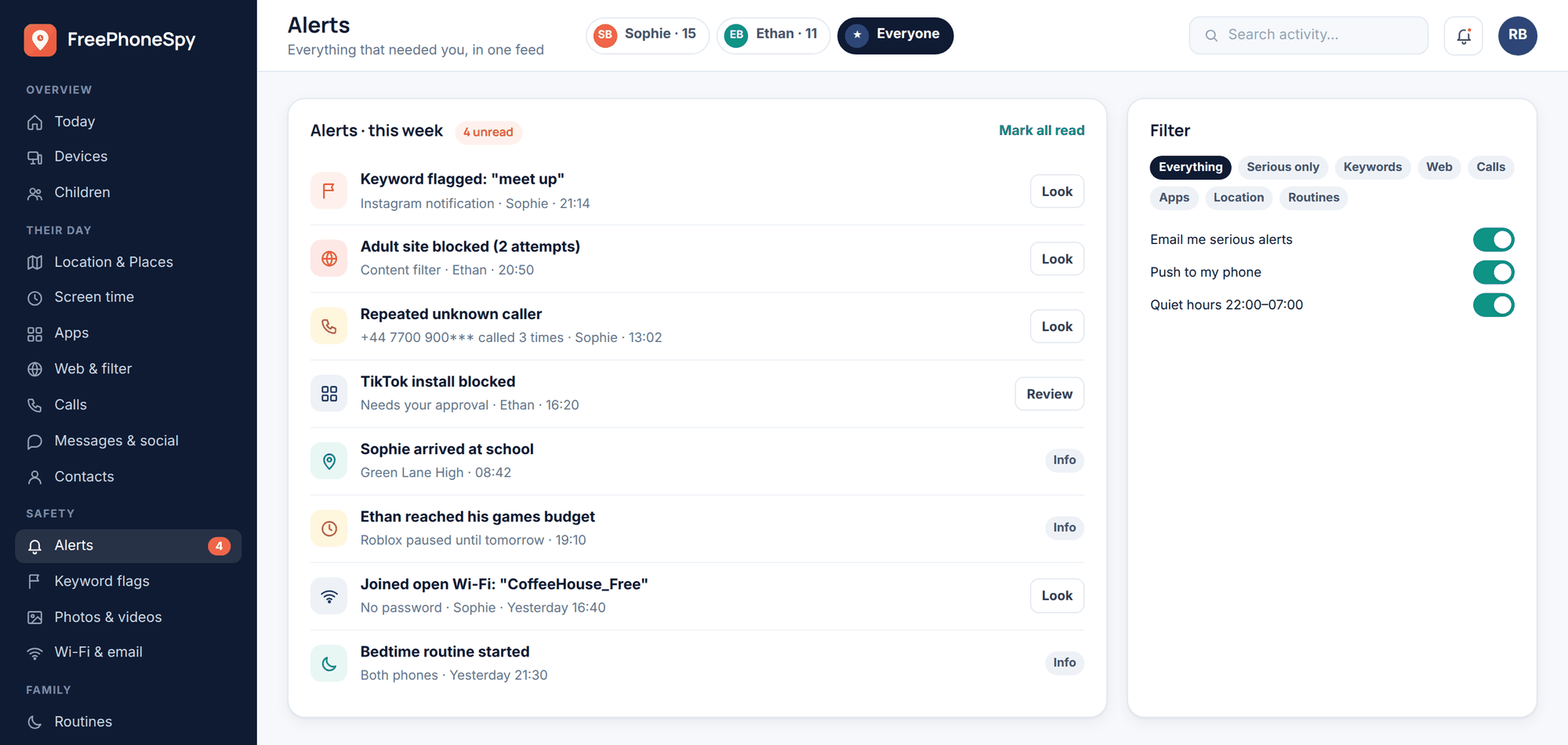
The alerts feed is where patterns show up. One flagged word is nothing. The same name flaring up every evening for a fortnight tells a story. Being able to see it laid out over time is what turns a vague worry into “okay, something’s actually going on here.”
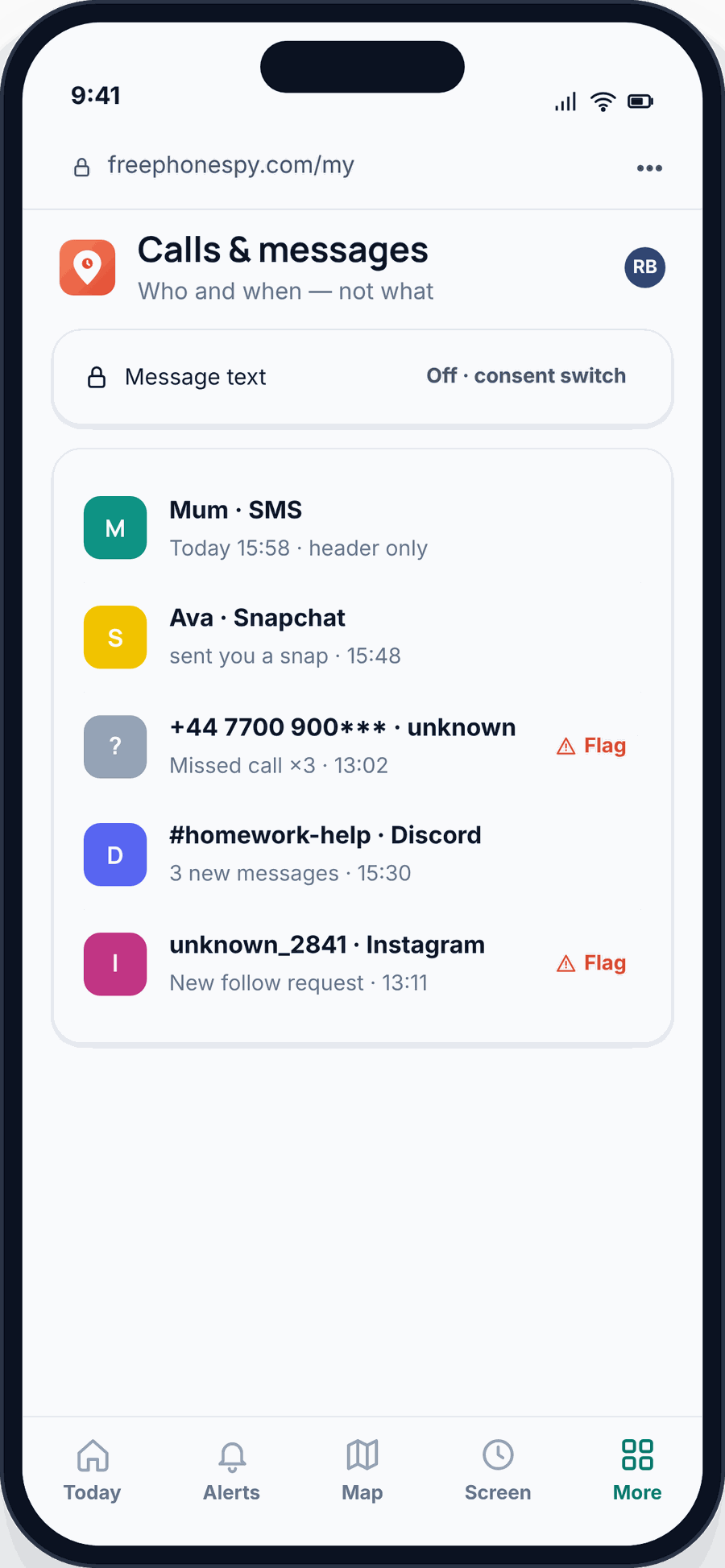
Messages and social shows you headers — who messaged, and when — always. The actual message bodies stay private unless you turn on an explicit consent switch, ideally with your child’s knowledge. For most families that’s the right balance: you can see that Sophie’s been getting messages from someone at 1am for a week without reading a word of them, and that alone is enough to ask, “Hey — everything okay with that group?”
You manage all of this from any web browser — the web panel — with nothing to install on your side. And the honest limit bears repeating: you will not see everything. Vanishing messages, voice chat, and a friend’s phone are all out of reach. Treat the app as a smoke alarm, not a camera. It tells you when to go and look, in person, with your kid.
What to say: real scripts
When you do sit down, what comes out of your mouth in the first ten seconds decides whether they open up or shut the door. The single most important message is: you are not in trouble for telling me. Say it out loud. Kids stay silent because they’re afraid of losing their phone or making it worse. Take that fear off the table first.
For a child you think is being targeted, try opening light and sideways rather than head-on:
“I noticed you’ve been a bit flat after you’re on your phone in the evenings. You don’t have to tell me everything — but if something’s going on, I’m on your side, and we’ll sort it together. You won’t lose your phone over this.”
“Is someone being horrible to you online? You can just tell me who. I promise I won’t go charging in and embarrass you — we’ll decide what to do together.”
If they do tell you something, your first job is to not overreact. Believe them, thank them for telling you, and resist the urge to grab the phone and start firing off messages. That’s the thing they were most afraid of.
For a child who’s been unkind, the tone is different — firm, but not shaming:
“I saw some messages about [name] that weren’t kind. I’m not going to shout. But I need you to help me understand what happened, because that kind of thing really hurts someone — and I know you’re better than that.”
Notice what that last one does. It names the behaviour clearly, refuses to pretend it didn’t happen, but leaves the child their dignity and a way back. “I know you’re better than that” is a door, not a wall.
Calm action steps that work
Once you know something’s happening, there’s a sensible order to things. Panic and retaliation make it worse; calm and methodical fixes it.
- Don’t retaliate. No angry messages to the other kid or their parents in the heat of the moment. It escalates, and it can put your child in a worse spot socially. Everyone cools down first.
- Preserve the evidence. Screenshot the messages, posts, and profiles before anything gets deleted. Note dates and times. If it ever goes to the school or further, this is what makes your case.
- Block and report on the platform. Every app — Instagram, Snapchat, TikTok, Discord — has block and report tools built in. Use them. Reporting a fake account or a harassing profile can get it taken down.
- Involve the school. If the kids involved go to the same school, the school can act, even for things that happen online out of hours. Go in calm, with your screenshots, and ask what their process is.
- Know when it crosses a line. Threats of violence, sexual content involving a minor, sustained harassment, or blackmail are not “kids being kids” — they can be criminal. At that point you preserve everything and contact the police or the relevant reporting service. Trust your gut: if it feels like more than bullying, it probably is.
Through all of this, keep your child in the loop on what you’re doing. Nothing corrodes trust faster than a kid confiding in you and then watching you go nuclear behind their back.
If your child is the one bullying
This one stings, but handled well it can be one of the more important things you ever teach them. The aim is accountability without shame. Shame makes kids defensive and sneaky; accountability helps them grow.
Start by getting the facts calmly and hearing their side — kids often minimise (“it was a joke”, “she started it”), and you’ll need patience to get past that. Then be clear that whatever the reason, the impact on the other person was real and it has to stop. Focus on repair: what does putting this right look like? Sometimes that’s a genuine apology, sometimes it’s deleting a post, sometimes it’s leaving a chat that’s turned toxic.
And practically — remove the audience. A lot of online cruelty runs on spectators. Getting your child out of the group that’s egging it on, or off the app where it’s happening for a while, cuts off the oxygen. It’s not a punishment so much as changing the conditions that made it easy.
Keep the long view. A child who’s confronted with the harm they caused, and helped to make it right, usually comes out kinder. A child who’s just branded a bully and punished often learns only to hide it better.
Where to get support
You don’t have to carry this alone, and neither does your child. Bullying — on either side — can knock a kid’s mental health hard, and it’s completely reasonable to bring in help.
Your child’s school will usually have a counsellor or pastoral lead who deals with this often and knows the local picture. Your GP is a good first port of call if you’re seeing real signs of anxiety, low mood, or changes in eating and sleep that aren’t lifting. And sometimes the most useful thing is simply a trusted adult who isn’t you — an aunt, a coach, an older cousin — someone your child will talk to when they’ve gone quiet at home.
This is a sensitive area, and there’s no shame in getting professional support early rather than waiting for a crisis. If your child seems genuinely unsafe or is talking about hurting themselves, treat it as urgent and seek help straight away.
A monitoring app is a tool for noticing and starting conversations. It is not a substitute for a counsellor, a GP, or your own steady presence. Use it as the first nudge — then lead with the human stuff.
If you’re weighing up whether monitoring is even right for your family, it’s worth reading the honest difference between monitoring and spying, and the signs a child’s phone might need a closer eye. Bullying often travels alongside other online risks, so keeping kids safe from online predators is worth a look too.
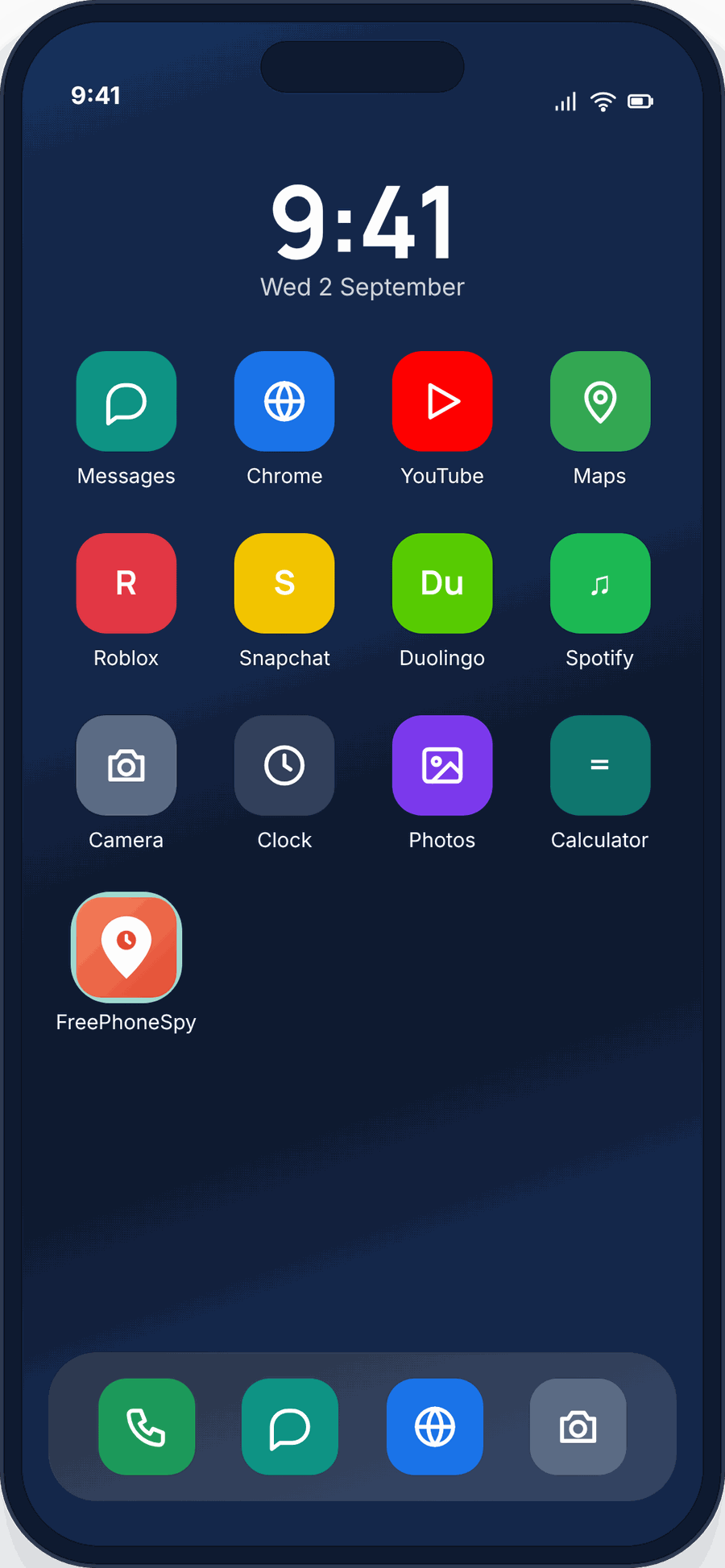
One practical note: FreePhoneSpy’s child app runs on Android. If your child has an iPhone, you can get a lot of the same early-warning value from Apple’s built-in Screen Time and Family Sharing — worth setting up either way.
Common questions
Won’t my child just get sneakier if they know the app is there?
Some worry about this, but hidden monitoring tends to backfire harder — when a kid finds out (and they usually do), the betrayal wrecks trust for years. Open monitoring, agreed together, sends the message “I’m here to help”, which is exactly the message a bullied child needs. It works precisely because it’s not a trap.
Can I read all my child’s messages to see if they’re being bullied?
You can turn on message bodies behind an explicit consent switch, but for most families that’s more than you need and more than is healthy. Headers — who and when — plus keyword alerts usually give you enough to know when to ask. Reading everything erodes the trust you’re trying to build, and it teaches kids to move to apps you can’t see.
What if the bullying happens on Snapchat or voice chat, where nothing’s saved?
Then the app won’t catch it, and it’s important to be honest about that. Vanishing messages and voice chat are out of reach. This is why the app is a starting point, not the whole answer — the mood changes, the sleep, the dropped app all still tell you something’s wrong, and that’s your cue to talk.
My child says everyone will laugh if I get involved with the school. Should I stay out of it?
Hear the fear — it’s real — but don’t let it stop you acting on serious harm. You can involve the school discreetly and ask them to keep your child’s name out of it where possible. Preserving evidence and reporting quietly is usually better than doing nothing and hoping it blows over.
Is it really free?
You can start free for 10 days with no card. After that it’s kept free by a few simple tasks, and the core stays free. Your family’s data is never sold. You can get started free whenever you’re ready.
What if I discover my own child is the bully?
Stay calm and go for accountability without shame — get the facts, make clear it has to stop, focus on repair, and take away the audience that’s fuelling it. Kids confronted honestly and helped to make amends usually come out kinder. It’s a hard moment, but it’s a teachable one.