Teens & Dating Apps: What Parents Need to Know
Most dating apps say 18 and over, right there in the app store. Your teen knows that. They also know it takes about four taps and a made-up birthday to get past it. The apps aren’t designed with a fourteen-year-old in mind, which is exactly why a fourteen-year-old on one is in a room full of adults. This is a guide to what’s actually going on — why teens are drawn to these apps, what genuinely puts them at risk, and how to talk about it in a way that keeps your teen talking back.
The apps, and who they’re for
It helps to know the names before you can talk about them. The big mainstream apps — Tinder, Bumble, Hinge — are dating platforms built for adults looking to meet other adults. Tinder is the one most people picture: swipe right if you like a photo, swipe left if you don’t, message when two people match. Bumble works similarly but has women send the first message. Hinge markets itself as the app “designed to be deleted,” aimed at people wanting relationships rather than casual matches. Grindr is a dating and hookup app used primarily by gay and bisexual men, and it’s very adult in tone.
Then there’s a second group that muddies the water: apps marketed at teenagers that aren’t strictly dating apps but function socially in similar ways. Yubo is the clearest example — often called “Tinder for teens” in the press, though it presents itself as a friend-making and live-streaming app. It allows younger teens on with age bands, but the swipe-to-connect and live-video format means kids meet strangers there constantly. Snapchat, Instagram, and Discord aren’t dating apps either, yet plenty of teen “dating” actually happens through them. The line between a dating app and a social app your teen dates on is blurrier than the app store categories suggest.
The age rules — and how teens get around them
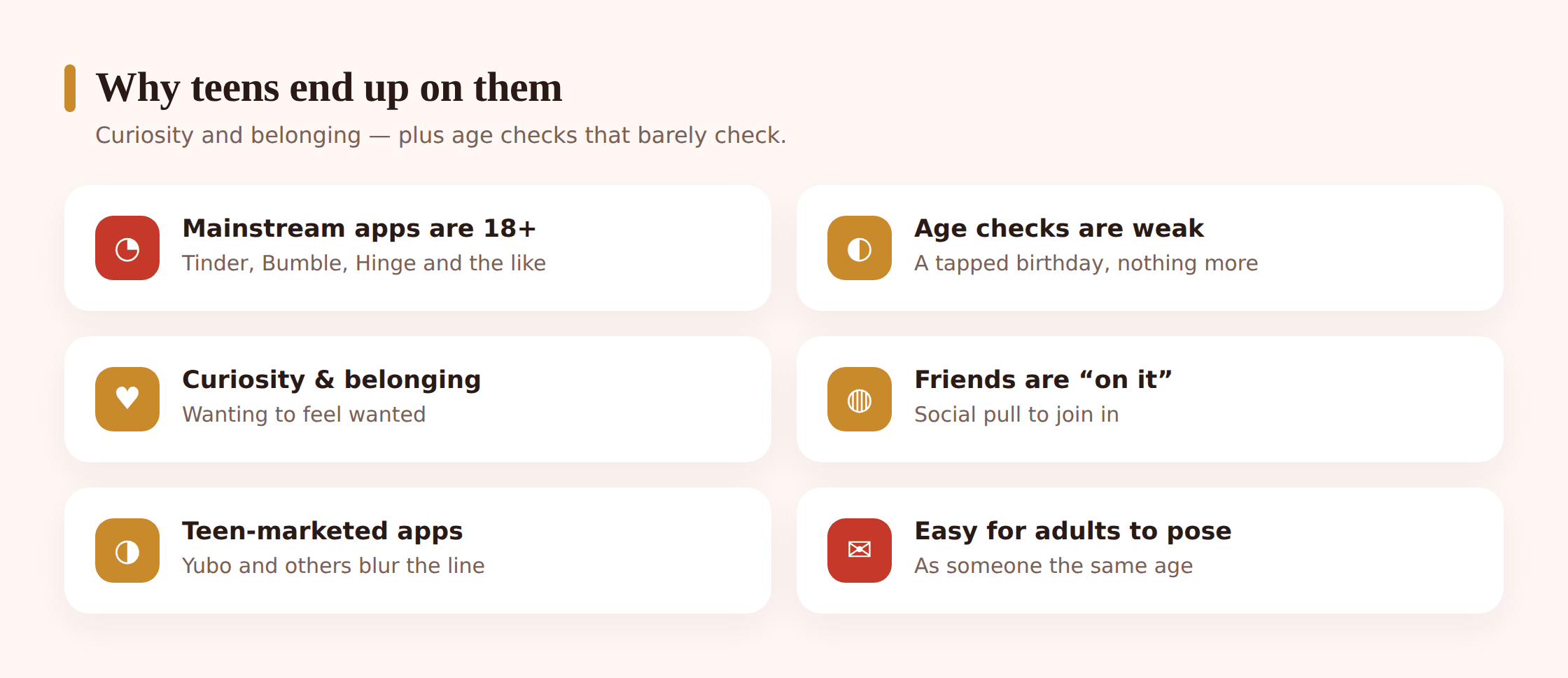
Here’s the uncomfortable truth every parent should sit with: the age checks on most dating apps are weak. Tinder, Bumble, and Hinge all require users to be 18. To enforce it, they mostly ask you to type a birthday. That’s it. A thirteen-year-old who enters a birth year that makes them nineteen is now, as far as the app is concerned, an adult. Some apps have started adding photo-based age estimation or ID checks, but coverage is patchy and easy to sidestep. Grindr and the rest sit in the same boat.
Teens get past these gates in a handful of predictable ways. They lie about their birthday on signup. They borrow an older friend’s or sibling’s account. They download the app, use it, and delete it before you’d ever spot the icon — or hide it inside a folder, or use a version with a disguised name. None of this requires technical skill. It requires a spare five minutes and a reason to want on.
The reason age rules exist isn’t bureaucratic. An 18-plus rule is there because these apps put strangers who want romantic or sexual contact in direct, private conversation with each other. That’s fine between consenting adults. It’s a serious problem the moment a minor is on the other end of it — and the app has no reliable way of knowing they are.
Why teens are drawn to them
Before the risks, it’s worth understanding the pull, because “just don’t” lands better when it comes from someone who gets why the temptation is real. Teenagers aren’t downloading dating apps to be reckless. They’re doing it for reasons that make sense from the inside.
- Curiosity about dating. Romance and attraction are a huge part of adolescence. An app promises a low-stakes way to explore it without the terror of asking someone out at school.
- Validation. A match is a tiny hit of “someone likes me.” For a teen who feels invisible or unsure of themselves, that can be powerful — and habit-forming.
- Everyone’s talking about it. If older kids at school mention Tinder or Yubo, a younger teen wants in on the reference. Being left out feels worse than the risk feels real.
- Finding their people. This matters especially for LGBTQ+ teens, who may not know anyone like them locally and go looking online for a community that doesn’t exist in their town. The need is genuine even when the platform is wrong for their age.
- Boredom and privacy. A phone in a bedroom, a dull evening, and an app that promises something happening elsewhere. Curiosity plus opportunity does a lot of the work.
None of these make it safe. But all of them make it human. A teen who feels judged for the impulse will hide the behaviour, not drop it. A teen who feels understood is far more likely to actually hear the “and here’s why it’s not okay yet” that follows.
The risks that actually matter
Let’s be clear and calm about this. The point isn’t to frighten you; it’s to be accurate, so you can talk to your teen from a place of knowing rather than panic. Here’s what genuinely raises concern when a minor is on a dating app.
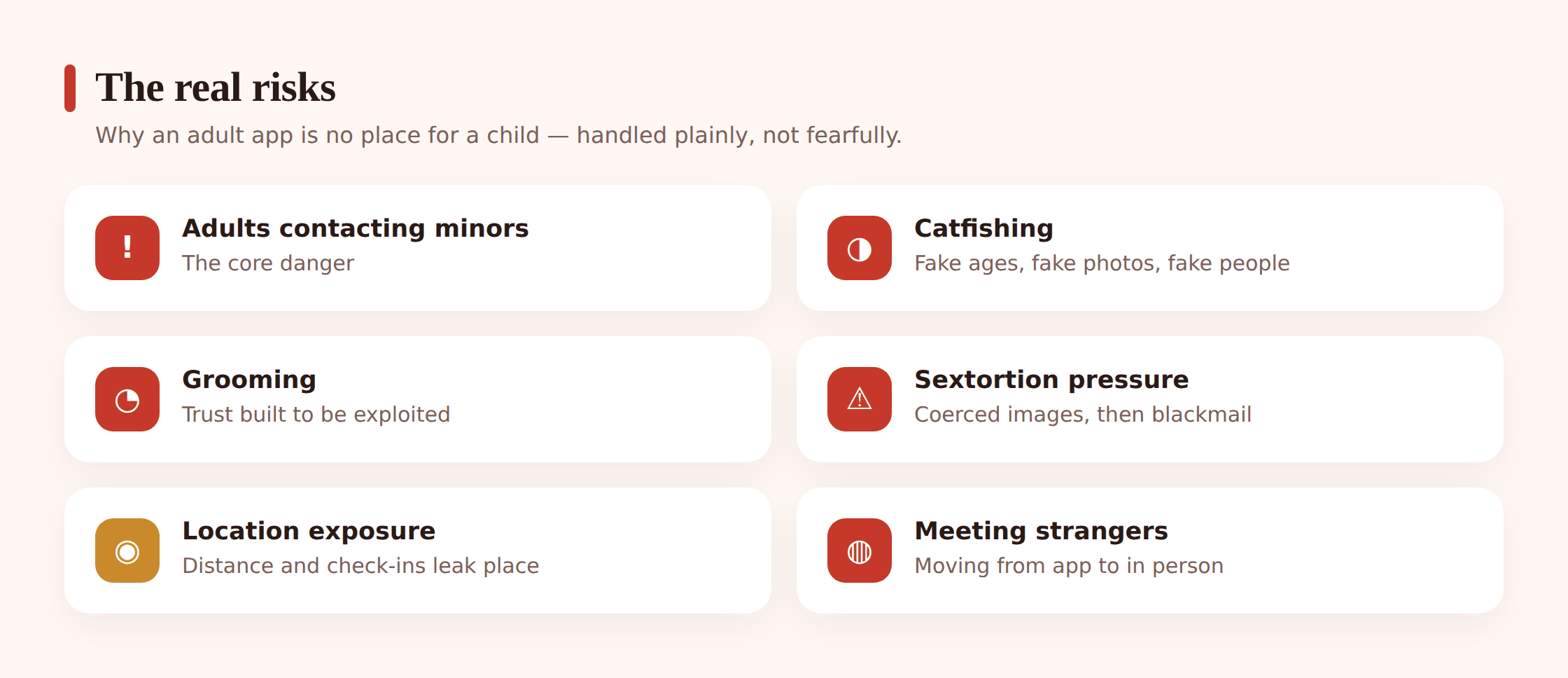
Adults contacting minors
This is the core issue. Because age gates are weak, a dating app can and does put adults in private conversation with kids. Most adults, told they’re talking to a minor, would end the conversation. The danger comes from the minority who wouldn’t — and who may have sought out a younger person on purpose. A teen posing as older has no way to filter for that.
Catfishing and fake profiles
Not everyone is who their photos say. Fake profiles are common on dating apps, used for scams, for stealing images, and by adults pretending to be closer to a teen’s age to seem safe. If you want the full picture on spotting a fake, we cover it in catfishing and fake profiles.
Grooming
Dating apps hand a predator the two things grooming needs: a private channel and a reason to build a one-on-one bond. The pattern is a slow one — attention, flattery, a sense of being understood, then a gradual push toward secrecy and boundary-crossing. It’s covered in depth, protectively, in our guide to protecting kids from online predators.
Sextortion pressure
One of the fastest-growing threats to teens online involves someone using a private image — real or faked — to demand money or more images. It can escalate frighteningly quickly and it targets boys as heavily as girls. We handle it carefully, with the exact steps to take, in sextortion: what every parent needs to know. The related conversation about images is in talking to your teen about sexting.
Location exposure
Dating apps are built around distance — “2 miles away” is a core feature. That means the app is broadcasting roughly where your teen is to strangers by design. Some apps have leaked more precise location than users realised. For a minor, letting a stranger narrow down where they live or go to school is a real physical-safety concern, not a theoretical one.
Meeting up in person
The whole point of a dating app is to move from screen to meeting. A teen who arranges to meet someone they’ve only talked to on an app is taking the biggest risk of all — and often keeping it secret. Before any teen meets anyone from online, they and you should read meeting online friends safely.
How to talk about it without shame
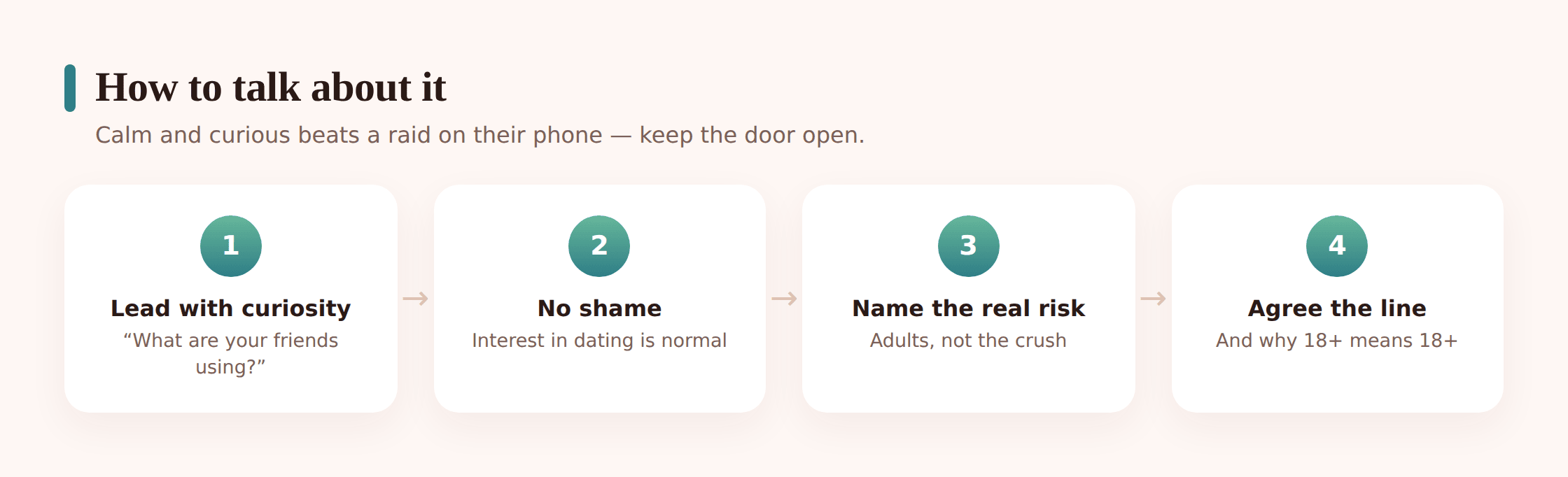
Shame is the thing that shuts the door. A teen who gets shouted at, mocked, or told they’re stupid for being curious about dating learns one lesson: don’t tell Mum or Dad. That’s the worst outcome, because the whole safety net depends on them coming to you when something goes wrong. So the goal of the conversation isn’t to win it. It’s to keep the line open.
A few things that help:
- Start with curiosity, not accusation. “I’ve been reading about apps like Tinder and Yubo — have you or your friends come across them?” invites a real answer. “Are you on Tinder?” invites a defensive one.
- Separate the impulse from the app. Say out loud that wanting to date, wanting to be liked, wanting to explore who they’re attracted to — all of that is normal and fine. It’s this particular tool, built for adults, that’s the wrong fit for now.
- Be honest about the real reason. Not “because I said so,” but “because these apps can’t tell you’re not an adult, so they’ll put adults in front of you, and I can’t be sure who those adults are.” Teens respect a reason they can actually check.
- Ask what they’d do. “If someone on there asked to meet, or started asking for photos, what would you do?” This teaches without lecturing, and it tells you how much they already understand.
- Make the promise explicit. Tell them plainly: if anything on any app ever feels wrong, scary, or embarrassing, they can come to you and you will not lose it. Then, crucially, keep that promise when they test it.
If you find out your teen is on one
Maybe you saw a notification, a friend’s parent mentioned it, or your teen told you outright. However it surfaced, the first few minutes shape everything that follows. Here’s a calm way through it.
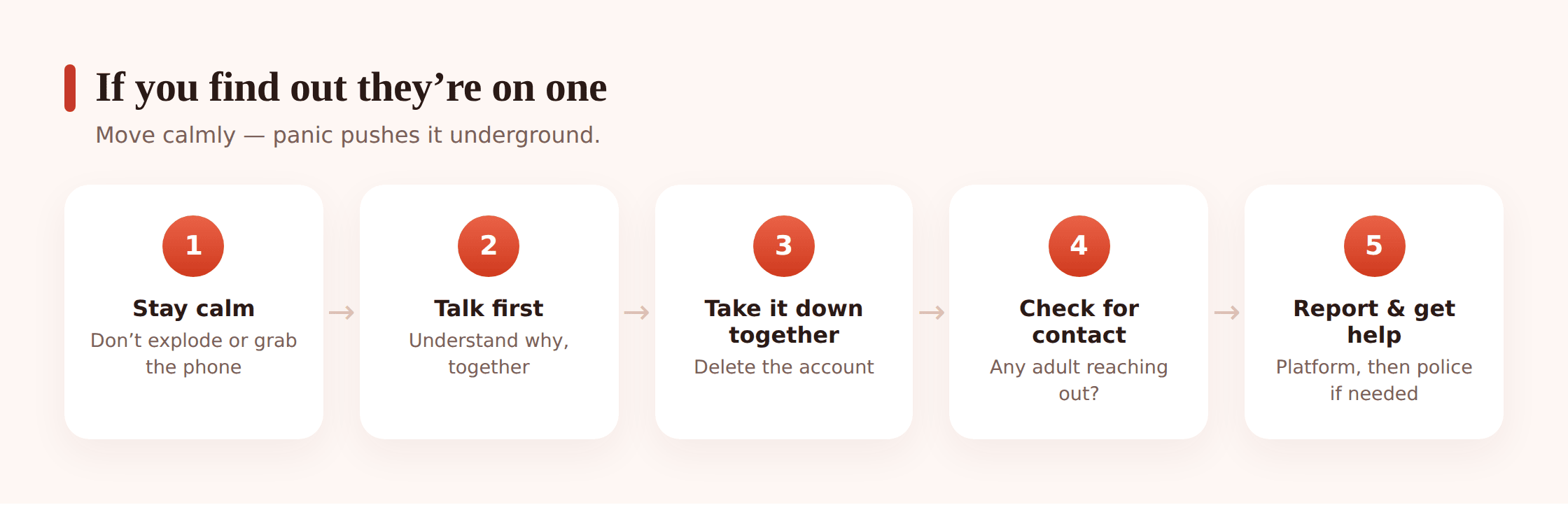
Step 1 — Steady yourself first
Take a breath before you say anything. Your teen is watching to see whether it’s safe to be honest with you. A furious opening confirms their fear that it isn’t, and the truth goes underground. Aim for concerned, not explosive.
Step 2 — Lead with them, not the app
Open with “I’m not angry, I want to understand” rather than “How could you.” Ask how they got on it, how long they’ve been using it, and whether anything on there has felt uncomfortable. You’re gathering facts and lowering the temperature at the same time.
Step 3 — Check for immediate risk
Gently find out the important things: has anyone asked to meet, asked for images, sent anything explicit, or been pushy or threatening? If yes, that changes the response from a family conversation to a safeguarding one — see the next step.
Step 4 — Act on anything serious
If an adult has been grooming your teen, pressuring them for images, or making threats, don’t handle it alone. Keep the evidence — screenshots of the profile and messages — then block and report the account to the app, and contact the police. In the US you can report to the NCMEC CyberTipline, and Take It Down can help remove images of a minor. In the UK, report to CEOP and talk to Childline. These services exist precisely for this and treat it seriously.
Step 5 — Take the app down together
Delete the account and the app with your teen, not behind their back. Doing it together makes the point that this is a shared decision for their safety, not a punishment being handed down. Deleting the account matters as much as the app, since the profile lingers otherwise.
Step 6 — Agree what happens next
Close with the forward-looking part. What are the rules now, what apps are okay, and how will you both handle the next time curiosity strikes? End it as a plan you built together, not a sentence you passed.
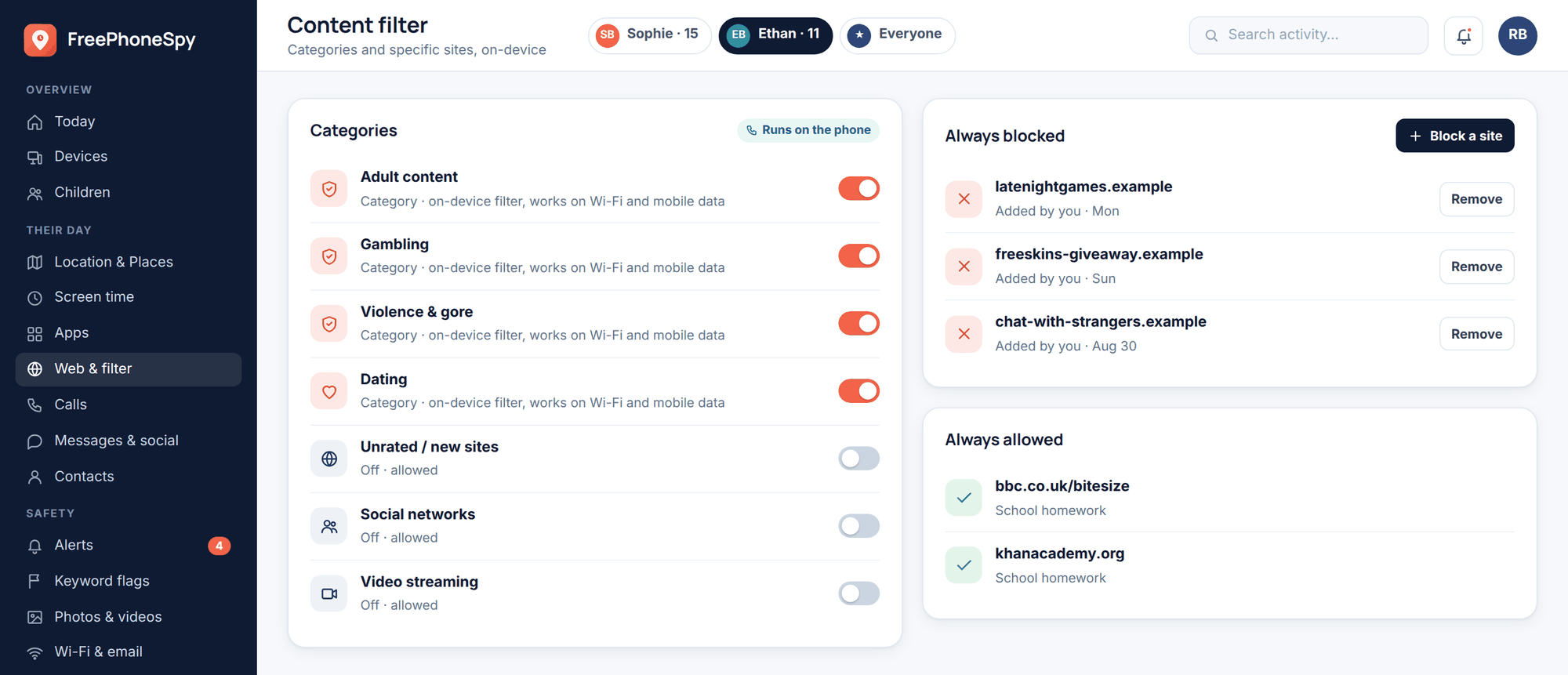
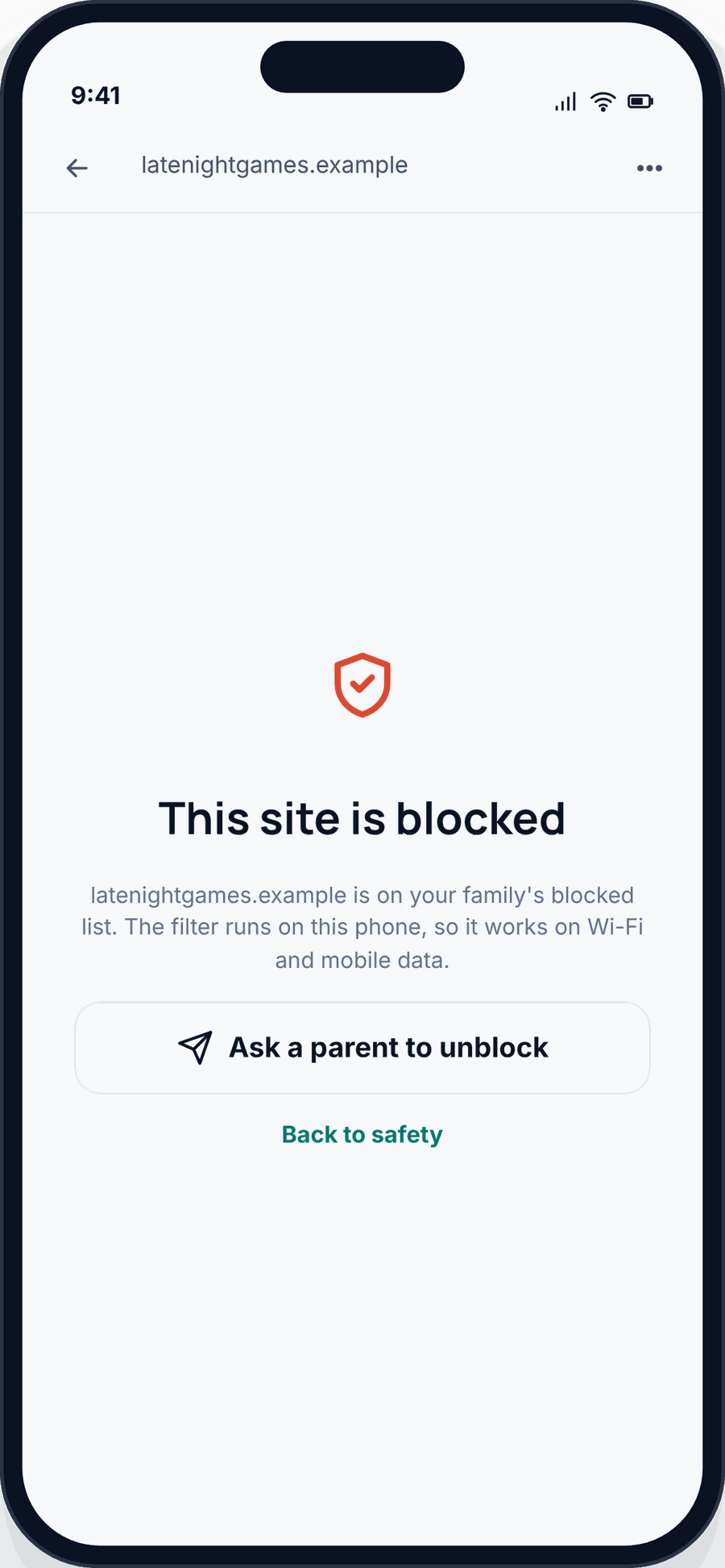
Tools can support this, honestly, but only as a backstop to the talking — never a replacement for it. FreePhoneSpy is a transparent, consent-based parental monitor for an Android phone you own, run from a web panel, and one thing it’s genuinely useful for here is awareness of which apps are installed on a younger child’s device. Your teen knows it’s there; that’s the entire design.
Rules and safer ground for older teens
A sixteen- or seventeen-year-old is a different conversation from a thirteen-year-old, and it’s worth being honest that outright bans get harder as kids get older and more independent. The mainstream apps are still 18-plus, and that rule is worth holding. But you can meet an older teen’s genuine interest in dating with better ground than a covert app.
- Real-world dating first. Meeting people through school, clubs, sports, and friends-of-friends is safer precisely because there’s a shared context and other people who know them both.
- Age-appropriate community, not adult dating. An LGBTQ+ teen looking for others like them is better served by moderated, teen-focused support spaces and local youth groups than by an adult hookup app.
- The non-negotiable meeting rules. If an older teen ever does meet someone from online, the rules are firm: a public place, in daylight, someone knows where they are and who they’re meeting, and you can reach them. Our meeting online friends guide has the full checklist.
- Location off, always. Whatever app they use, precise location sharing with strangers stays off. Distance features on dating apps are a reason to be cautious, not a convenience.
Warning signs worth noticing
None of these prove anything on their own, and a teen wanting more privacy is often just being a teen. But when several cluster together, it’s worth a gentle conversation.
- Sudden secrecy about the phone — turning it face-down, quick app-switching, or new locks when you come near.
- A new app you don’t recognise, or an app icon that seems disguised or tucked deep in a folder.
- Talking about a new friend, boyfriend, or girlfriend they can’t quite explain how they met.
- Mentioning someone older, or being vague about a person’s age.
- Gifts, gift cards, or money you can’t account for — a possible sign of contact turning exploitative.
- Big mood swings tied to the phone, or anxiety and secrecy after messages arrive.
- Wanting to go and meet someone, especially far away or without you knowing who.
The response to any of these is the same: not a raid on the phone, but a calm, curious conversation. The warning signs are a reason to ask, not a verdict to deliver.
FAQ
What age can you use dating apps?
The mainstream apps — Tinder, Bumble, Hinge, Grindr — all require users to be 18 or over. They’re built for adults meeting adults, and they aren’t appropriate for children. Some apps marketed at teens, like Yubo, allow younger users in age bands, but they still connect kids with strangers and carry their own risks.
My 14-year-old is on Tinder — what do I do?
Stay calm and lead with understanding, not anger. Talk to them first — how they got on it, whether anything has felt wrong. Then delete the account and app together rather than behind their back. If an adult has been pressuring them, asking for images, or making threats, keep the evidence, block and report the account, and contact the police or a child-protection service like the NCMEC CyberTipline (US) or CEOP (UK). The step-by-step is in the section above.
How do teens get past the age checks?
Usually by simply entering a fake birthday at signup, since most apps only ask rather than verify. Some borrow an older friend’s or sibling’s account, and some download, use, and delete the app quickly to avoid being spotted. It doesn’t take any technical skill, which is exactly why the age rule can’t be relied on to protect them.
Is Yubo safe for teens?
Yubo markets itself to teens and has added age and safety features, but its swipe-to-connect and live-video format means your teen meets strangers there constantly, and adults have been found using it. Treat it as a stranger-meeting app rather than a safe walled garden. If your teen uses it, the same conversations about location, meeting up, and coming to you when something feels wrong all apply.
Should I just secretly check my teen’s phone?
Secret searches tend to backfire — a teen who feels spied on hides more and tells you less, which leaves them less safe, not more. Openness works better: clear expectations, apps set up together, and a relationship where they’ll actually come to you. If you use a monitoring tool, use it transparently and with your teen’s knowledge, as a prompt for conversation rather than a substitute for one.
My teen is LGBTQ+ and says the apps are how they find community. What now?
Take the need seriously — it’s real, especially where there’s no local community. But an adult dating app is still the wrong place for a minor. Help them find moderated, teen-focused support spaces and local youth groups instead, and keep talking. Meeting the need with something safer works far better than a flat “no” that leaves them looking on their own.