Should You Delay Giving Your Child a Smartphone?
Somewhere around the end of primary school, most parents hit the same fork in the road. The asking has started. Half the class already has a phone, or says they do. And you’re stuck between two fears at once — that you’ll hand over too much, too soon, and that you’ll leave your child stranded on the outside of everything their friends are doing. There’s no single right answer here, which is exactly why the decision feels so heavy. This is a piece about the timing itself, and about the quieter options in between “no phone” and “here’s a full smartphone”.
The case for waiting
A growing number of parents are choosing to hold off, and they’re not doing it out of nostalgia. In the last few years, informal pacts like “wait until 8th grade” have spread through school communities — groups of families agreeing together to delay smartphones until roughly age fourteen. The appeal is obvious once you’ve felt the pressure yourself. If a dozen families in a year group all say “not yet”, no single child is the odd one out, and the whole “everyone has one” argument loses its edge.
The developmental reasoning behind waiting is worth taking seriously. A smartphone isn’t really a phone. It’s a doorway to social media, group chats that never sleep, an infinite feed built to hold attention, and a camera that can turn a bad afternoon into something permanent. A ten-year-old’s ability to step back, judge risk and resist a designed-to-be-irresistible app is still very much under construction. Handing that device over doesn’t just give a child new powers — it asks them to police their own use of something adults struggle to put down.
Sleep is one of the clearest reasons to delay. A phone in the bedroom is a phone under the pillow, and a younger child rarely has the self-control to leave a buzzing screen alone at eleven at night. Attention is another. When a device offers a hit of novelty every time boredom appears, the muscle for tolerating boredom — the one that fuels reading, daydreaming and getting properly stuck into things — gets less of a workout.
Then there’s the social layer, which is where the real risk sits for this age group. Group chats can turn cruel fast. A photo shared without thinking follows a child around. Strangers slide into games and apps you didn’t know had a chat function. None of this is a reason to panic, but all of it is easier to handle when a child is a bit older, a bit steadier, and a bit more willing to come to you when something goes sideways.
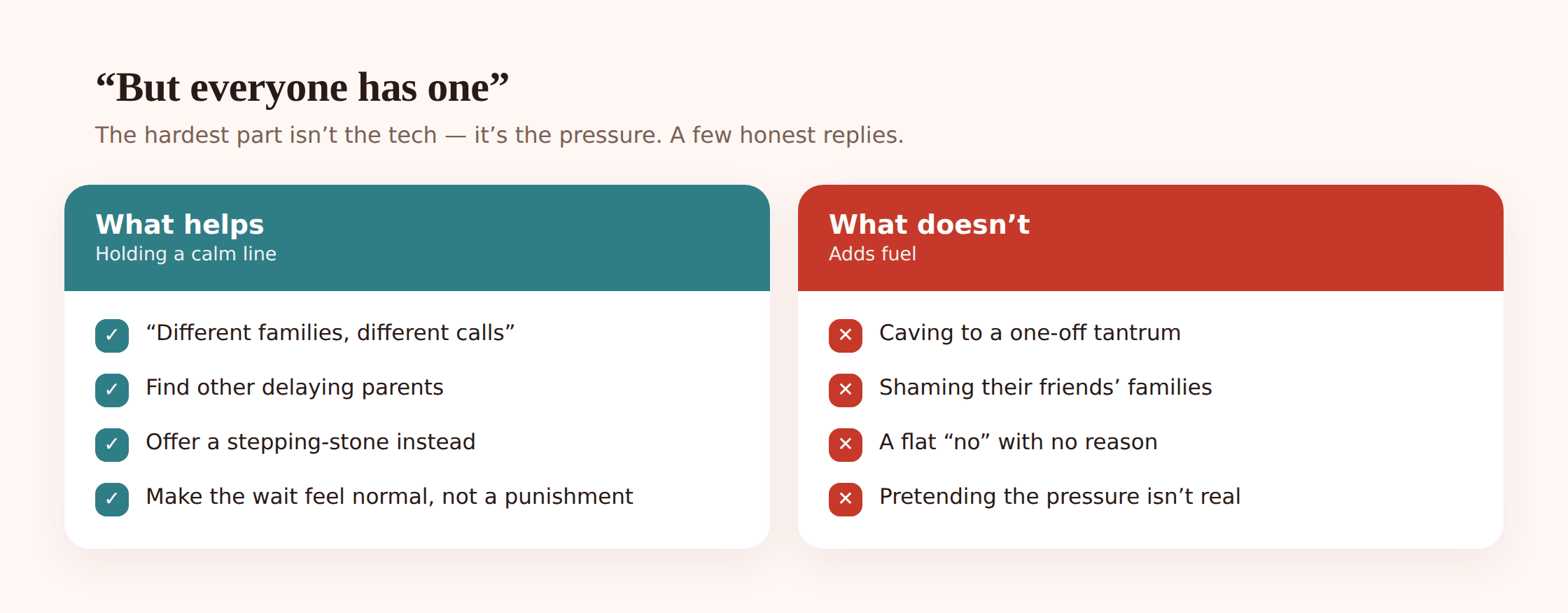
And the “but everyone has one” problem deserves an honest look, because it cuts both ways. Sometimes it’s genuinely true, and sometimes it’s a child repeating a line that works. Either way, it’s a real feeling and it’s worth sitting with rather than swatting away. You can take the social sting seriously and still conclude that the timing isn’t right — those two things aren’t in conflict.
The case against waiting too long
Here’s the part the delay movement sometimes skips. Waiting has costs too, and pretending it doesn’t isn’t fair to your child.
Social exclusion is the big one, and it’s not imaginary. A huge amount of a teenager’s social life now happens in the phone — the after-school banter, the plans that form in a group chat and then just happen, the in-jokes, the memes, the sense of being on the inside. A child who’s the only one without a way in can end up genuinely left out, not because their friends are unkind but because the meeting point moved and they weren’t there. That’s a real loss, and for some kids it lands hard.
There’s a practical safety and logistics case as well. Once a child is walking home alone, taking the bus, going to clubs or moving between two homes, being reachable stops being a luxury. Knowing they arrived, being able to say “practice is cancelled, come get me”, being findable if a plan falls apart — these are the everyday reasons phones earn their keep. A basic phone or a watch can cover a lot of this, but at some point a smartphone’s maps, transit apps and messaging genuinely make life easier and safer.
And then there’s the skill argument. Living well online is a learned thing, not something that switches on at a certain birthday. Judging whether a message is a scam, handling a falling-out in a group chat, deciding what’s fine to post and what isn’t, knowing when to close the app — these are skills, and skills need practice with someone nearby to help. A child who gets their first smartphone at sixteen with no guardrails and no experience isn’t automatically safer than one who started at twelve with support. Sometimes they’re less prepared, because they’ve had no low-stakes runway to make small mistakes and learn from them.
The honest summary: waiting protects a younger child from things they’re not ready for, and waiting too long can leave an older one socially stranded and unpracticed. The sweet spot is different for every family, and it moves depending on the child in front of you.
Is your child actually ready?
Age is the number everyone reaches for, and it’s the least useful part of the decision. A cautious, organised eleven-year-old who walks the dog and tells you when something’s wrong may be readier than a scattered fourteen-year-old who loses a jumper a week. Readiness is about behaviour, not birthdays.
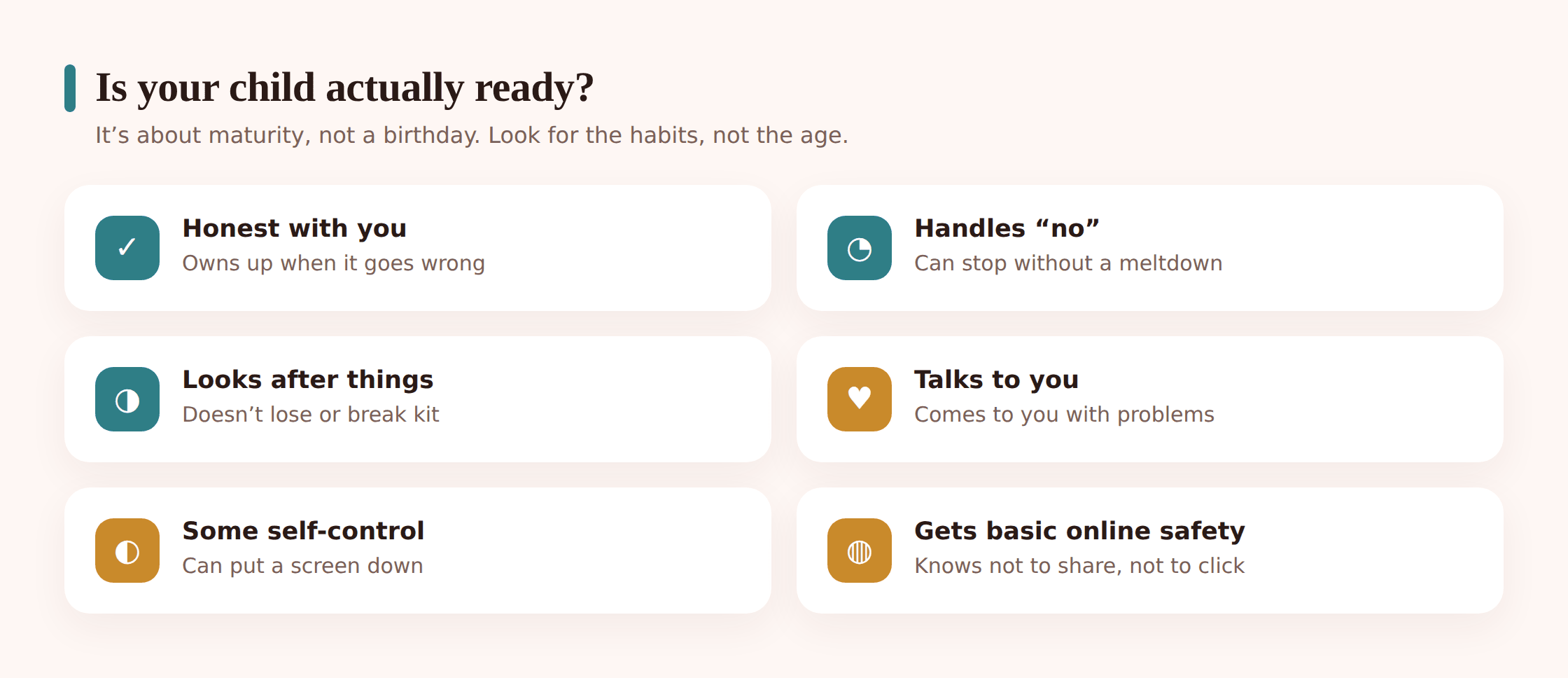
A few honest signs a child is closer to ready:
- Responsibility with things. They look after belongings, remember their stuff, and a device wouldn’t spend its life face-down on a damp floor.
- Honesty when it’s inconvenient. They tell you the truth even when it costs them something. This is the single most important one, because the phone will eventually take them somewhere awkward, and you need them to come and tell you.
- Some self-regulation. They can stop a game when asked, put a screen down without a meltdown, and don’t fall apart at the word “no”.
- A real reason, not just the crowd. They can say why they want it beyond “everyone else has one” — a walk home, a club, staying in touch with a parent across two houses.
- They already talk to you. Not about everything, but enough that you trust a hard conversation could happen when it needed to.
Notice what’s not on that list: how much they want it, how much they beg, or how old their friends were when they got theirs. Wanting isn’t readiness. If you’re weighing the age angle in more depth, our companion piece on at what age to monitor a child’s phone digs into how supervision should shift as they grow, and our guide to screen time by age gives a sense of what’s developmentally reasonable at each stage.
One more thing readiness isn’t: permanent. A child who isn’t ready this spring may well be by the autumn. “Not yet” leaves the door open in a way “no” doesn’t, and it turns the phone into something earned rather than something extracted through persistence.
Alternatives and stepping stones
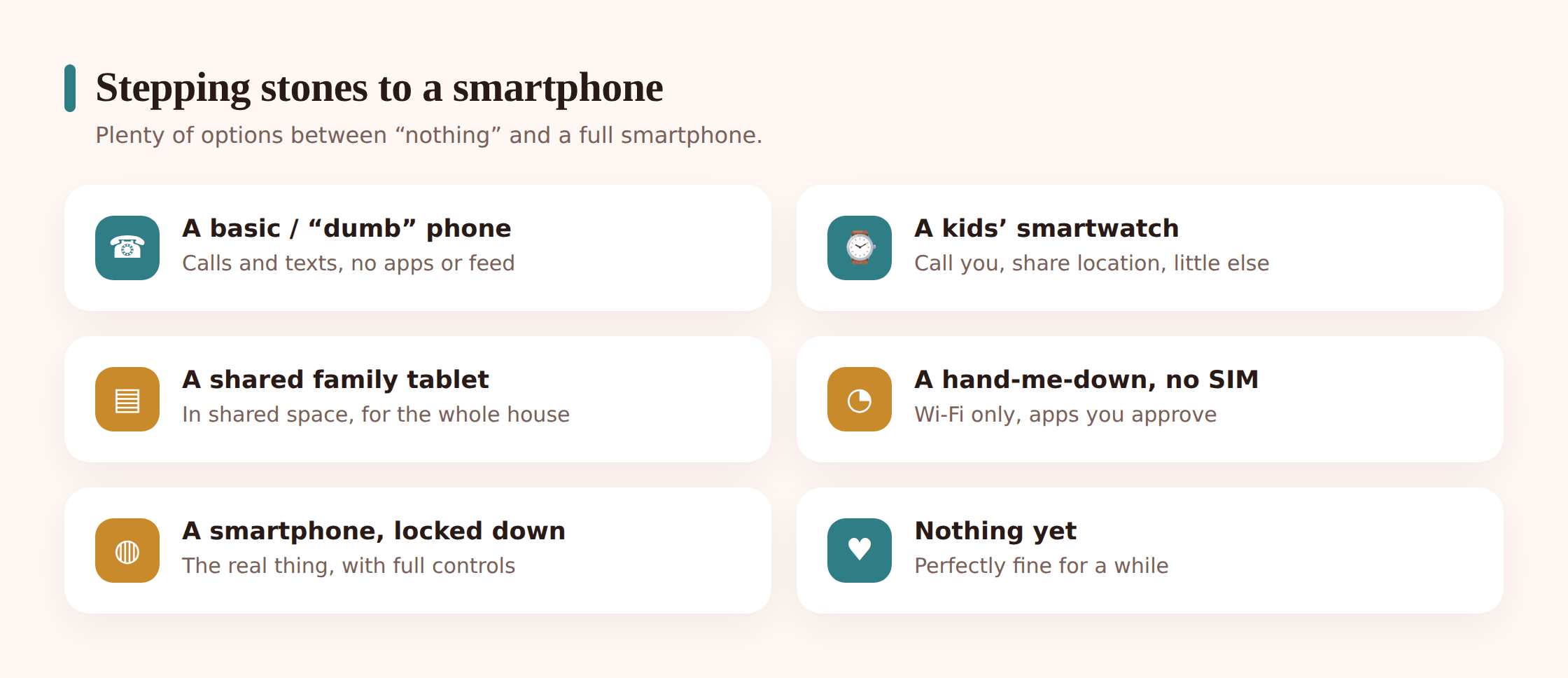
The most useful reframe in this whole debate is that “phone or no phone” is a false choice. There’s a whole staircase between them, and each step solves a specific problem without dropping the entire internet into a young pocket. Pick the step that matches the actual need.
The basic phone or “dumbphone”
A simple handset that calls and texts and does almost nothing else. If the real need is “I want to reach them and they want to reach me”, this nails it with no feed, no app store and no camera drama. It’s also a soft way to teach the basics — answering, not losing it, keeping it charged — before anything more powerful arrives.
A kids’ smartwatch
For a younger child, a watch that calls a short list of approved contacts and shows you their location can be the perfect first step. It stays on their wrist, so it doesn’t get left on a bus, and there’s no screen to disappear into. It answers the “did they get there?” question cleanly. We’ve written a full guide to kids’ GPS watches if that’s the direction you’re leaning.
A family-shared tablet
A tablet that lives in the living room, not in a bedroom, lets a child video-call grandparents, play the games their friends talk about and get comfortable with apps — all in a shared space where use is naturally visible and naturally limited. It scratches a lot of the “I want to do what my friends do” itch without the always-on, always-with-you dynamic of a personal phone.
A hand-me-down with no SIM
Your old phone, wiped and set up fresh, works fine on home Wi-Fi with no SIM in it. It can message over Wi-Fi, run a few apps and act as a training phone — powerful at home, inert the moment they walk out the door. Just be sure you actually wipe it and sign it out of your own accounts first; a hand-me-down is a smartphone with your fingerprints still on it if you skip that step.
| Option | Good for | Watch out for | Rough stage |
|---|---|---|---|
| Basic / dumbphone | Calls and texts, staying reachable | No maps or apps friends use; can feel “babyish” to some kids | Younger, first taste of independence |
| Kids’ smartwatch | Location plus approved calls, hard to lose | Limited messaging; battery and fit | Primary-age, walking to school |
| Family-shared tablet | Apps and video calls in a shared space | Squabbles over turns; stays home | Any age, before a personal device |
| Hand-me-down, no SIM | App practice on home Wi-Fi | Must be wiped and signed out properly | Bridge before a real smartphone |
| Full smartphone | The whole toolkit, out and about | Everything at once; needs the most support | When readiness and need line up |
None of these is a permanent home. They’re rungs. A child might spend a year on a watch, a year on a basic phone, get comfortable, and step up to a smartphone having already learned to keep a device charged, answer their parents and not lose the thing. That’s a much gentler on-ramp than going from nothing to everything on a single birthday.
Deciding as a family
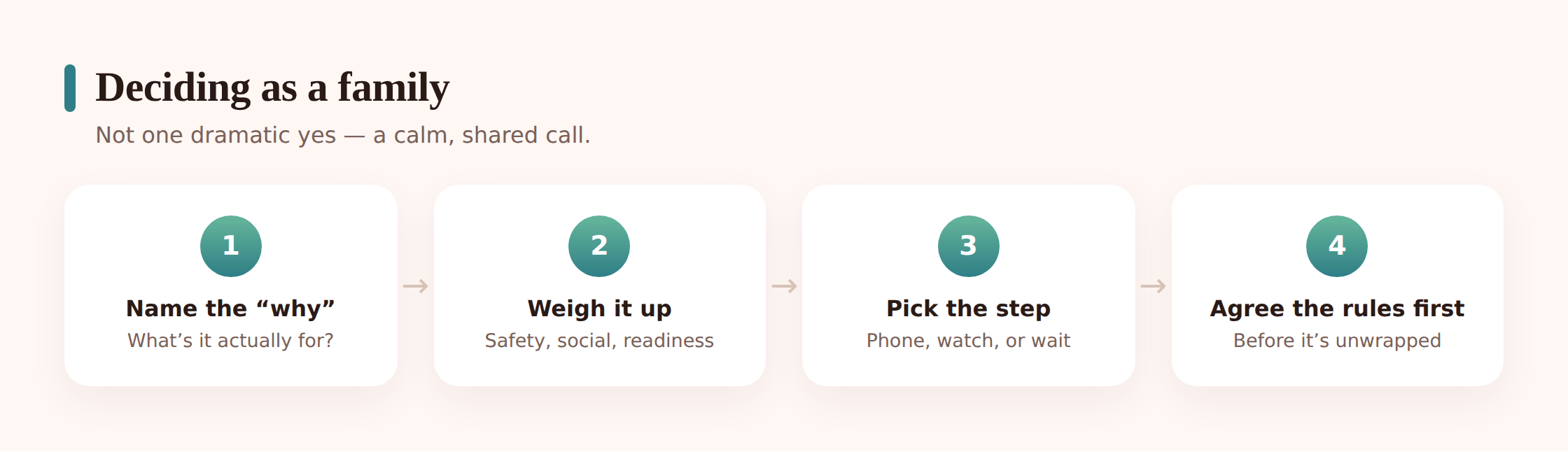
The best version of this decision is made together, out loud, rather than delivered as a verdict. That doesn’t mean a child gets a veto — you’re still the parent — but a decision they’ve been part of is one they’re far more likely to respect.
1. Name the real need
Start with the problem, not the product. Is it safety on the walk home? Feeling left out of the group chat? Wanting to game with friends? Different needs point to different answers, and some don’t need a smartphone at all.
2. Separate wanting from being ready
Both are real, but they’re not the same. Look honestly at the readiness signs together — responsibility, honesty, self-control — and be willing to say “the want is real, the readiness isn’t there yet”.
3. Talk to other parents
Find out what the class is actually doing, not what your child claims. If a few families are willing to hold off together, the social cost of waiting drops sharply for everyone.
4. Pick a step, not a leap
Choose the smallest option that meets the real need. You can always move up a rung in six months. It’s much harder to walk a full smartphone back once it’s been handed over.
5. Agree the terms before, not after
If the answer is a smartphone, settle the deal first — where it charges overnight, what’s on it, what the limits are. A phone that arrives with an agreement starts on much better footing than one you try to add rules to later.
It also helps to say the timeline out loud. “We’re thinking a smartphone around the start of secondary school, and here’s what would need to be true first” gives a child something concrete to work toward, and it turns the whole thing from a battle into a plan.
Introducing the first smartphone well
When you do decide yes, how you introduce it matters as much as the timing. A smartphone handed over cold, with rules bolted on afterward, tends to go worse than one that arrives as part of an agreed-upon deal. The first few weeks set the pattern.
Keep the first version small. It doesn’t need every app on day one. Start with the essentials — calls, messages, maps, a camera — and let the rest be earned and added over time. A quieter phone is an easier phone to learn on, and it leaves room to grow into.
Set it up side by side, so the settings and limits are something you did together rather than something you imposed. Agree a charging spot outside the bedroom, a wind-down time, and a shared understanding that you can talk about anything that comes up on it without the phone being snatched away as punishment. That last point is what keeps a teenager coming to you when something goes wrong.
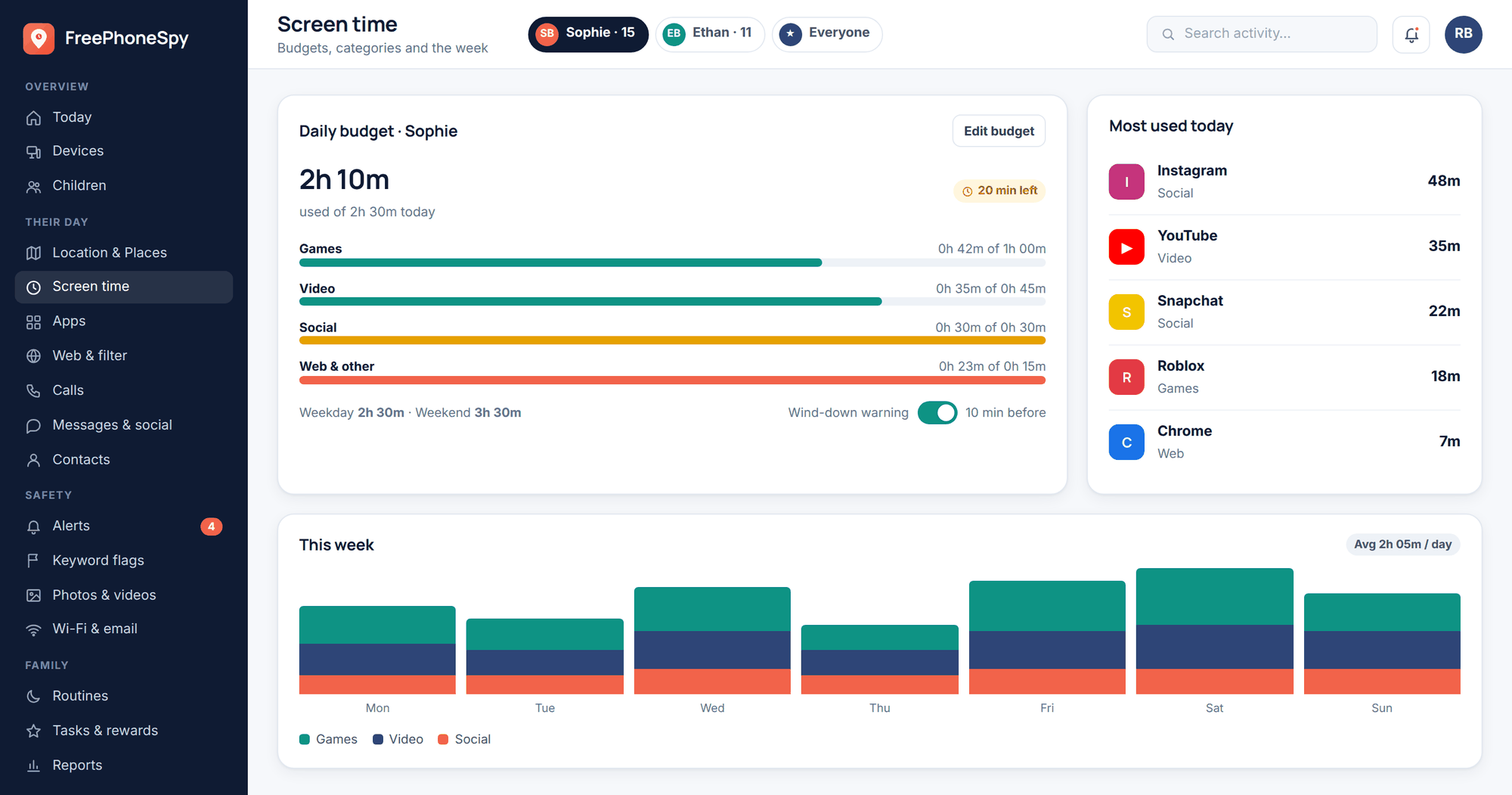
This is also where a tool like FreePhoneSpy fits — lightly, and out in the open. Once the smartphone is in play, an agreed screen-time budget, a sensible content filter and a shared location aren’t about spying; they’re the training wheels you both know are on. The child can see the limits, understands why they’re there, and the whole thing eases off as they show they can handle more. That’s the difference between monitoring and surveillance, and it’s the whole point.
For the full walk-through of settings, accounts and the deal itself once you’ve decided to go ahead, our first phone setup guide covers the how-to step by step. This piece is about the decision that comes before it — and there’s no shame in taking your time getting there.
Is there a “right” age to give a child a smartphone?
No, and anyone who gives you a hard number is oversimplifying. Common pacts aim for around fourteen, but readiness varies enormously from child to child. A steady, honest twelve-year-old with a real need may be readier than an older sibling was. Focus on behaviour and circumstances, not the birthday.
My child says everyone in their class has a phone. Is that a good enough reason?
It’s a real feeling and worth taking seriously, but it isn’t the same as readiness. It’s often partly true and partly a line that works. You can acknowledge the social sting, check what’s actually happening with other parents, and still decide the timing isn’t right yet — or meet it halfway with a basic phone or a watch.
Will delaying leave my child behind socially?
It can, and that’s a genuine cost worth weighing rather than dismissing. The way most families soften it is with a stepping-stone device — a basic phone or a shared tablet keeps a child connected enough without handing over a full smartphone before they’re ready.
What’s the best first step if I’m not ready for a smartphone?
Match the step to the need. If it’s safety on the walk home, a kids’ GPS watch or a basic phone covers it. If it’s wanting to do what friends do, a family-shared tablet in a common room scratches that itch. If it’s app practice, a wiped hand-me-down on home Wi-Fi with no SIM works well.
Is a hand-me-down phone a good idea?
It can be, as long as you wipe it fully and sign out of all your own accounts first. A leftover login turns your old handset into a route back into your email and photos. Cleaned up properly, and left without a SIM at first, it makes a solid low-stakes training phone.
Once we do get a smartphone, how much should I monitor?
Start closer, with open and agreed limits, and ease off as your child shows they can handle more. Younger children need more guardrails; a maturing teenager needs progressively fewer. The point is to work yourself out of a job, not to watch forever. Our guide on at what age to monitor goes into how that dial should move over time.