Job & Money-Making Scams Targeting Teens
A 16-year-old wants their own money. Not a fortune — enough for trainers, a concert, a bit of independence from the bank of mum and dad. So they search “part-time jobs” or scroll past an ad on Instagram: “Students wanted, £25 an hour, work from your phone, no experience.” They apply. Within a day someone’s messaging them on WhatsApp, friendly and quick, talking about “getting started today.” No interview, no address, no boss you could point at — just a warm voice and a promise. That gap, between wanting a first job and knowing what a real one looks like, is exactly where employment scams live. They aren’t a watered-down version of adult fraud. Teens are hunted specifically, with pitches built for someone who’s never had a payslip and doesn’t yet know that legitimate work never asks you to pay to start.
Why job scams aim at teens
You might think a teenager is a poor mark for a job scam — no salary to steal, no career to threaten. Fraudsters see it differently, and their reasons each point straight at a defence you can teach.
Teens have never had a real job, so they’ve no template for a normal one. An adult knows an employer doesn’t text you at 11pm, doesn’t pay before you’ve done a thing, and doesn’t ask for your sort code in the first message. A 16-year-old has nothing to compare against. When the “recruiter” skips the interview and jumps to “let’s get you set up,” it doesn’t feel wrong — it feels efficient.
They want money and they want it soon. A teenager saving up feels the gap between what they’ve got and what they want more sharply than most adults do. “Get paid today, work from your phone” is aimed straight at that impatience. The urgency the scam manufactures meets an urgency the teen already brought with them.
They’re flattered by being chosen. “We’re recruiting brand ambassadors, and your profile stood out.” To an adult that’s a form letter. To a teen it can feel like recognition — someone noticed them, thinks they’re the right sort, wants them specifically. That warm feeling is the point; it lowers the guard before any ask arrives.
And the real prize often isn’t the teen’s money at all. Sometimes the scammer wants a small “training fee.” Sometimes they want the teen’s bank details. And sometimes — the most serious version — they want the teen’s bank account itself, to push stolen money through it. A clean account belonging to someone with no fraud history is worth more to a criminal than anything in a teenager’s savings. That’s the money-mule problem, and it gets its own section below.
The scams, named and explained
They come in a lot of costumes, but underneath there’s a short list of tricks. Once a teen can name the pattern, the costume stops working.
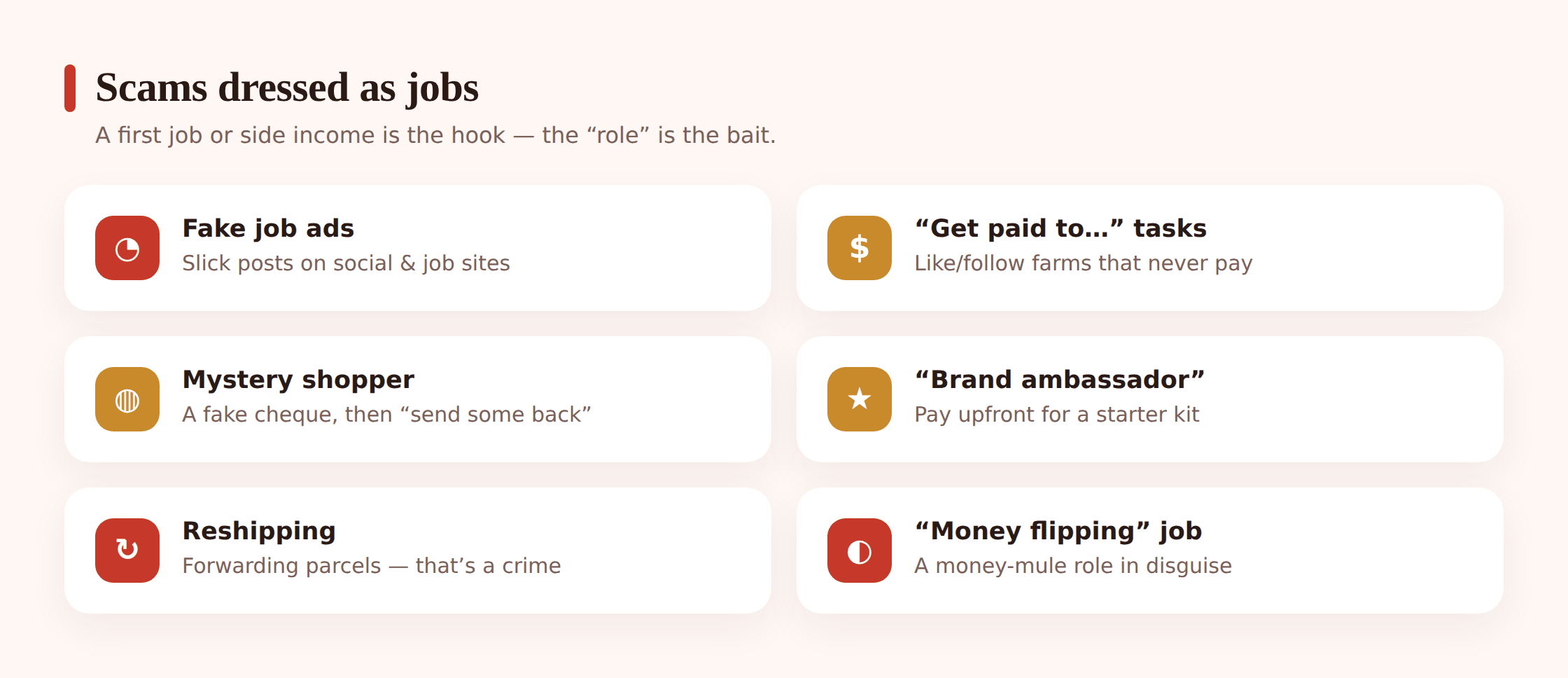
Fake job ads on social media and job sites
An ad appears — on Instagram, TikTok, a job board, or in a DM — for a role that’s vague but well paid: “Data entry, £20/hr, remote, flexible, no experience.” You apply and get a fast, keen reply that moves the chat off the platform almost immediately, usually to WhatsApp or Telegram. Real jobs exist on job sites too, so the scam hides in the crowd. The tells: no named company you can look up, no real interview, and a rush to get you “onboarded” before you’ve asked a single normal question.
“Work from home / get paid to…” task scams
The teen is offered small money for tiny online tasks — “like these videos,” “leave app reviews,” “complete these clicks, £3 each.” The first day or two might even pay out a few pounds to prove it’s real. Then the tasks require a “deposit to unlock higher-paying batches,” or a fee to withdraw the earnings that are showing in a dashboard. The dashboard balance is just numbers painted on a screen. The moment real money has to flow toward the teen, it never does — it only flows the other way.
Mystery-shopper scams
“Get paid to shop and rate the service.” Sounds plausible — mystery shopping is a real thing. The scam version sends the teen a cheque to deposit, tells them to spend part of it on a “test purchase” or gift cards and keep a fee, then wire the rest back or report their findings. The cheque is fake. It bounces days after it first appears to clear, and by then the teen has sent real money out against money that was never there. They’re left owing their own bank.
“Brand ambassador” and influencer-manager scams
Tailored for teens who post. “We love your content — become a paid brand ambassador.” The catch varies: they must buy a “starter kit” or sample products upfront to be reimbursed later (they won’t be), or pay a “manager” who’ll grow their following and land deals, or hand over their login so the “agency” can “optimise” the account — which is how accounts get stolen. A real brand deal never starts with you paying them.
Upfront-fee and “pay for training or equipment” scams
The job’s real-sounding, the pay’s good, there’s just one step first: pay for a background check, a training course, a starter kit, a laptop they’ll ship you, or software you “need.” Sometimes they’ll “kindly” send you the money for the equipment (fake cheque again) and ask you to forward it to their “supplier.” The rule underneath every version is the cleanest one to teach: a legitimate employer pays you. You never pay them to be hired.
Fake cheque and overpayment scams
This trick powers several of the others, so it’s worth naming on its own. The “employer” sends a cheque or bank transfer for more than expected, then apologises for the “mistake” and asks the teen to send the extra back, or buy gift cards with it. Because the teen’s bank shows the money as available at first, it feels safe. It isn’t. The original payment gets reversed once it’s found to be fake, the teen’s own money is what got sent back, and the bank comes after them for the shortfall.
Reshipping scams
Advertised as “package handling,” “shipping coordinator,” or “quality control from home.” The teen receives parcels at their address and reships them abroad using labels the “employer” provides. The goods are almost always bought with stolen card details. The teen is laundering stolen property, their address is now attached to fraud, and the promised wages usually never arrive at all. It’s a crime dressed as an entry-level job.
Money-mule recruitment
The most serious of all, disguised as a “payment processor,” “finance agent,” or “money transfer” role. It deserves its own section, next, because it can turn a teen from a victim into — in the eyes of the law — an offender, without them ever understanding what they agreed to.
These sit close to the cons in our guide to online scams targeting kids and teens, and the payment side overlaps with money and shopping safety for teens. When the “job” is really a get-rich-quick investment pitch, it shades into crypto and investment scams targeting teens.
Money-mule recruitment disguised as a job
This one gets its own section because it’s the gravest and the least understood. It’s also where a teen who thinks they’ve landed a lucky first job can end up committing a serious crime.
Here’s the shape of it. A “job” offers good money for barely any work: receive some money into your own bank account, keep a cut — £50, £100 — and forward the rest on, or withdraw it as cash and hand it over. It might be sold as a “payment processing agent,” “financial administrator,” or “local transfer coordinator.” The money passing through is stolen — from fraud, scam victims, sometimes worse. The teen’s clean account is being used to launder it and break the trail. That teen is a money mule.
Frame this protectively, not as a threat, because a teen recruited as a mule almost always believes they’ve found a legitimate side income — not that they’re breaking the law. They’re being used. Recruiters target young people precisely because teens have clean accounts and don’t understand the risk. So the goal at home isn’t to frighten them into silence. It’s to make sure they recognise the offer for what it is before they say yes, and know they can come straight to you the second something about a “job” and their bank account feels off.
Red flags that hold across all of them
The costumes change; the tells barely do. Teach these once and they cover a job scam your teen has never seen before.
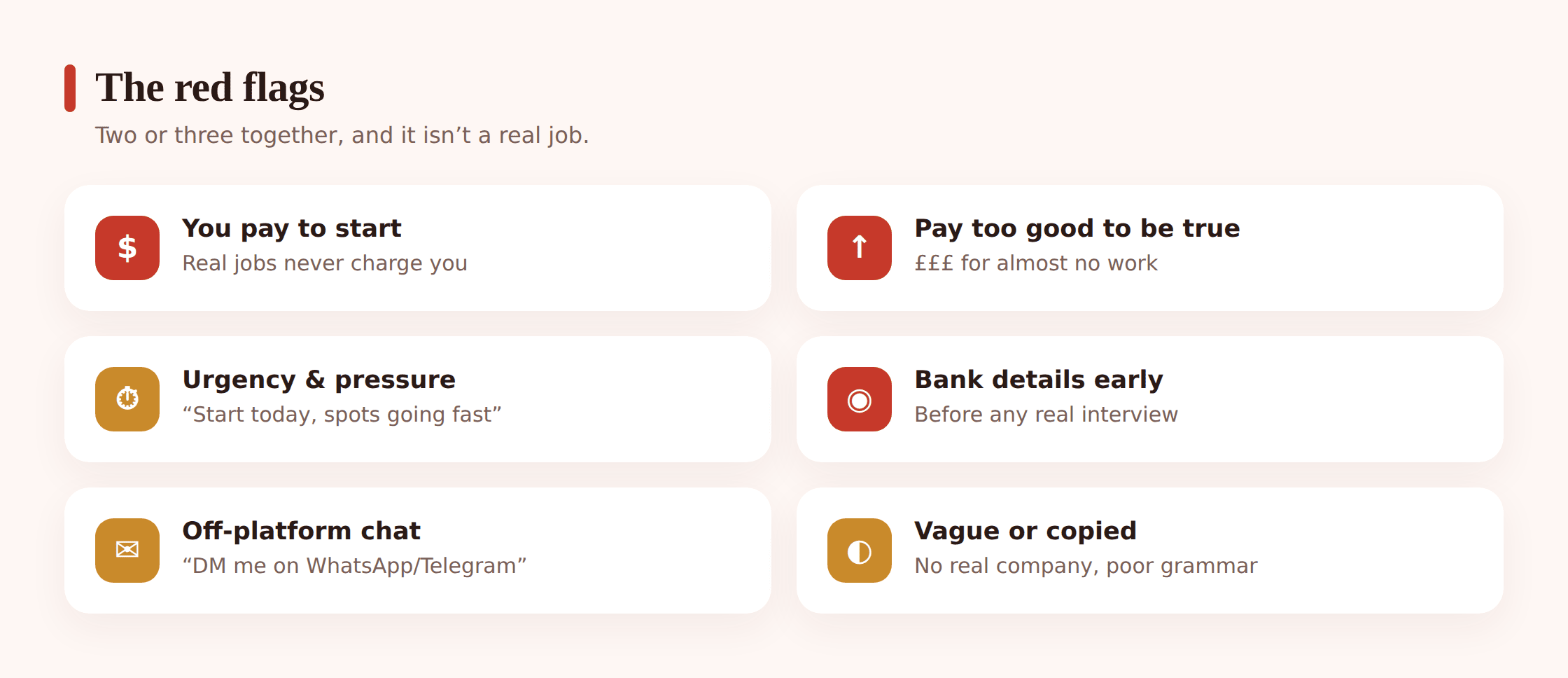
- You have to pay to start. Training fees, starter kits, equipment deposits, “background check” charges — a real employer never makes you pay to be hired. This one flag alone is usually enough.
- The pay is too good for the work. “£25 an hour to like videos from your phone, no experience.” Nobody pays a beginner premium rates for nothing. If the money doesn’t match the task, the task isn’t the real deal.
- They want your bank details, ID or passwords early. A genuine employer asks for bank details to pay you — after you’re hired, through proper paperwork, not in the first chat and never a password or PIN.
- There’s pressure and urgency. “Start today, spots are going, reply now or you miss out.” Real hiring is slow and boring. Manufactured rush exists to stop you thinking.
- The chat moves off-platform fast. Straight from an ad to WhatsApp or Telegram, away from anywhere with reporting and a record. Legitimate recruiters are happy to stay on email and the company’s own channels.
- No real company you can find. No named business, no website that predates the ad, no address, no interview, no one whose name you can look up. A ghost employer is a scam.
- Poor grammar and odd wording. Not always present, but clumsy English, random capital letters, and copy-pasted messages are common in these ads and messages.
- Money comes in and has to go back out. Any “job” that puts money into your account for you to forward, withdraw, or buy gift cards with is either an overpayment scam or a money-mule setup. Both are traps.
How to check a job is real
Scepticism is easier when you’ve got a routine to run. Walk your teen through these before they reply to anything, and turn it into a habit rather than a one-off warning.
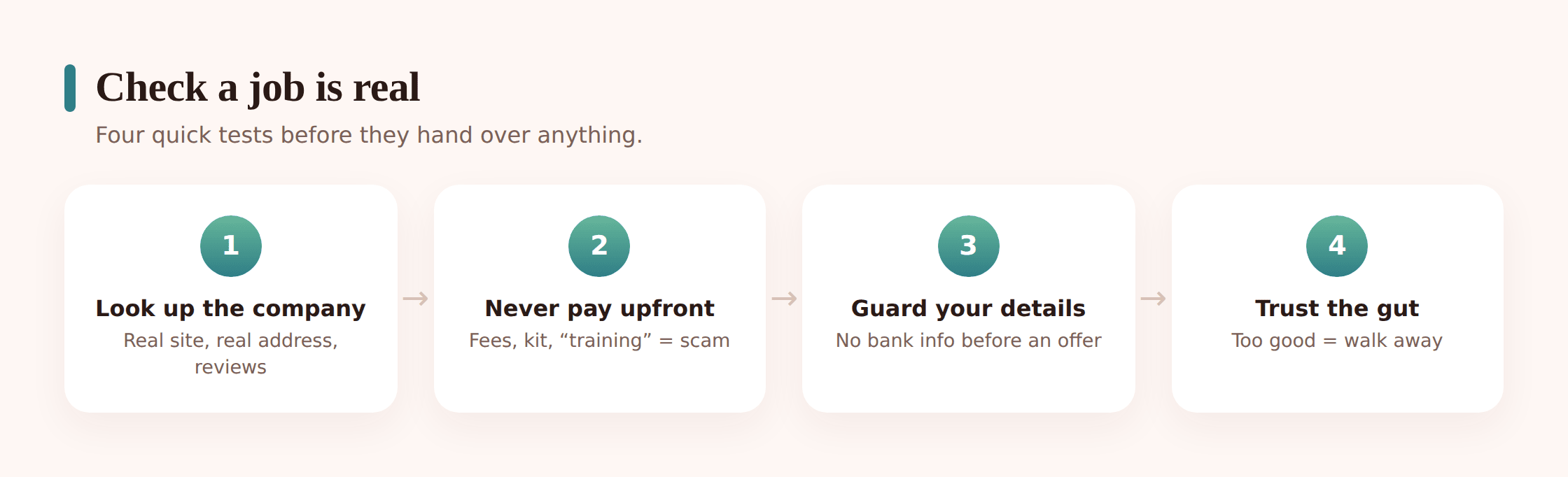
Look the company up independently. Search the business name plus the word “scam” and “reviews.” Find their real website by searching, not by clicking the ad’s link. If the “company” has no footprint older than a few weeks, or the only mention is the ad itself, walk away.
Check the contact details match. A real recruiter emails from the company’s own domain, not a free Gmail or Hotmail address, and definitely not only through WhatsApp. If the “HR manager” for a known brand is messaging from a personal account, it isn’t them.
Expect a normal process. Genuine jobs involve an application, an interview of some kind, and clear information about hours, pay, and who you’d report to — before any money or bank details are involved. If all of that is skipped in favour of “let’s get you started,” that’s the answer.
Never pay, and never move money. Full stop. No legitimate first job requires you to buy a kit, pay for training, or receive and forward funds. The moment money is asked to flow toward the employer or through the teen, the conversation is over.
Slow it down and ask an adult. The single most useful habit: before saying yes to anything money-related, run it past a parent. Not for permission — for a second pair of eyes that has the scar tissue a teen hasn’t grown yet. Make that a standing, no-judgement offer.
If your teen is caught up in one
Maybe they paid a “training fee.” Maybe they deposited a cheque that’s now bounced. Maybe money landed in their account and they forwarded it before anything felt wrong. Speed and calm matter more than anything here — and blame, if it comes at all, comes much later.
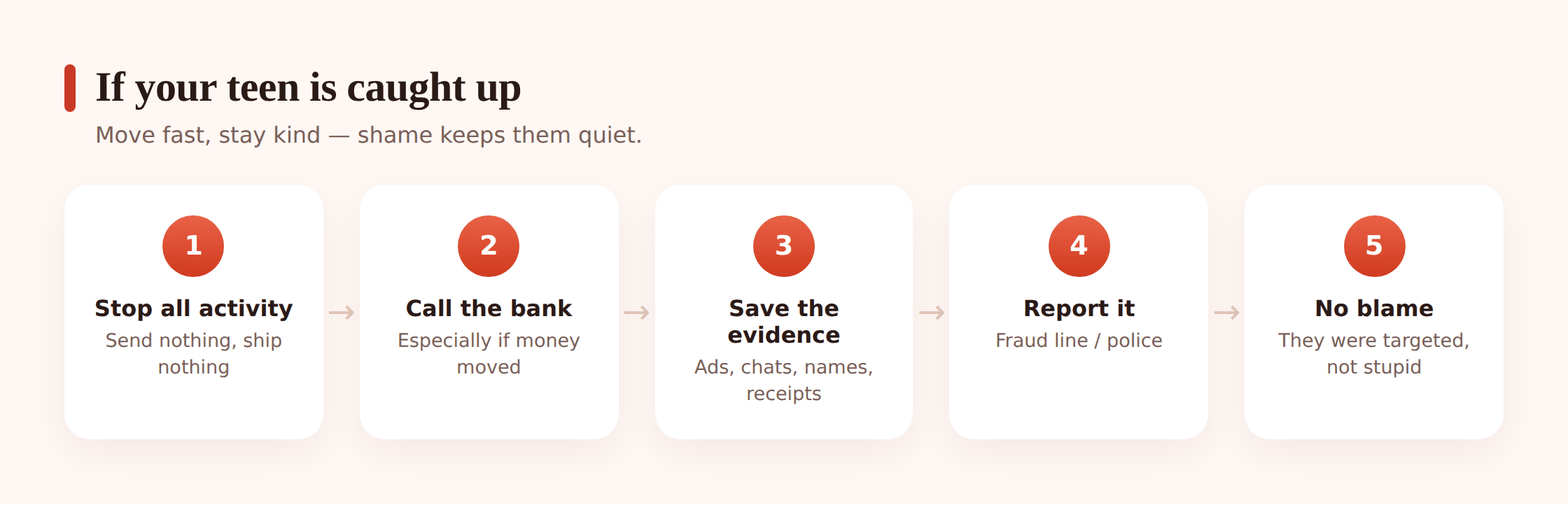
1. Stay calm — no shame, get the facts
A teen who’s been scammed already feels stupid and scared; a telling-off just teaches them to hide the next one. Lead with “you’re not in trouble with me, let’s sort it.” Then get the details fast: what “job,” what they paid or received, how much, what bank details or ID they shared, and — crucially — whether any money was put into their account and passed on.
2. Stop the bleeding
Cut off anything still live. Don’t send another penny — no “final fee,” no “return the overpayment,” no gift cards. Freeze or lock the bank card in the app. Stop replying to the “employer,” but don’t delete the conversation yet.
3. Call the bank straight away
Phone the number on the card or use the app’s fraud line and say it’s a scam. If money was sent, ask what can be recovered — some transfers can be recalled if you’re quick. If a cheque was deposited and spent against, tell them now. And if money came in and was forwarded, say so plainly — hiding it makes the mule situation worse, not better. Banks handle a young person who comes clean early very differently from one who conceals it.
4. Secure the accounts
Change passwords on anything exposed — banking, email, the job platform, any account sharing a password with them — and turn on two-factor authentication. If bank login details or ID were handed over, treat the whole account as compromised and let the bank reissue.
5. Save the evidence
Screenshot the ad, the messages, the profile or account that made contact, any “contract” or job wording, cheque images, and transaction confirmations — before the account vanishes or messages are deleted. You’ll need it for the bank and any report.
6. Report it
Report to your country’s fraud authority and to the platform where the ad or contact appeared. If your teen was recruited as a money mule, being upfront early is genuinely protective. Our guide on how and where to report a scam walks through exactly where to go.
Awareness on the device, in the open
Conversations do most of the work here. But a lot of these approaches arrive quietly — a new messaging app appears so the chat can move “off-platform,” a payment app gets installed overnight, a flurry of DMs lands from an unknown “recruiter.” On an Android phone you own and manage, an app like FreePhoneSpy can give you awareness of what’s newly installed and unusual contact patterns, so an approach doesn’t stay invisible until money’s already gone. Used openly, it’s a prompt for a conversation, not a replacement for one.
The quick checklist
The whole article, boiled down to what to actually do and say.
- A real job pays you and never asks you to pay to start — no exceptions.
- Never pay for training, a starter kit, equipment, or a “background check” to get hired.
- Treat “£25/hr from your phone, no experience” as a scam, not a lucky break.
- Never let money land in your account to forward on — that can be a crime.
- Never buy gift cards with, or send back, an “overpayment” — the cheque is fake.
- Never hand over your bank login, PIN, or account for anyone to “use.”
- Be wary when a job jumps straight to WhatsApp or Telegram off the ad.
- Look the company up independently before replying — no footprint, no job.
- Expect a normal application and interview; a rush to “onboard” is a red flag.
- Run any money-related offer past a parent first — no shame, speed beats silence.
FAQ
How do I know if a job offer is real?
Run three checks. First, look the company up independently — search the name with “scam” and “reviews,” and find their real website yourself rather than clicking the ad. Second, expect a normal process: an application, an interview, and clear details about hours and pay before any money or bank details come up. Third, apply the one rule that never fails — a real job pays you and never asks you to pay to start, buy a kit, or move money on its behalf. If an offer skips the process or breaks that rule, it’s a scam, however professional it looks.
What exactly is a money mule?
A money mule is someone who lets their bank account be used to receive and pass on money that isn’t theirs — usually stolen or scam money. It’s often disguised as a “job”: money lands in the teen’s account, they keep a cut and forward the rest, and the point is to launder it and hide the trail. Teens get targeted because they have clean accounts and often don’t realise it’s illegal. The rule to teach is simple: never let anyone move money through your account, ever, no matter what the “job” is called.
They asked my teen to pay upfront for training or equipment — is that a scam?
Almost certainly, yes. Legitimate employers pay for their own training and equipment; you never pay them to be hired. The version where they “kindly” send money to cover the equipment and ask your teen to forward it to a “supplier” is worse — that’s usually a fake cheque, and forwarding the money makes your teen part of the fraud. Any job that requires payment to start is a scam. Stop, don’t pay, and don’t send anything on.
Can my teen actually get in trouble if they were tricked into being a mule?
Unfortunately, yes — acting as a money mule is a crime even when the person didn’t know where the money came from, and consequences can include frozen and closed accounts, being blocked from banking or credit for years, and in serious cases prosecution. But how it’s handled matters enormously. A teen who was clearly deceived, comes forward early, stops immediately, and cooperates is treated very differently from one who conceals it. That’s exactly why coming to you fast, without shame, is the protective move.
My teen deposited a cheque from an “employer” and now it’s bounced. What happened?
That’s a fake cheque scam. The cheque looks like it clears for a few days, which is long enough for the teen to spend part of it or send some back as instructed. Then the bank discovers it’s fake, reverses it, and the teen is left owing their own money for whatever they spent or sent. Contact the bank immediately, explain it was a scam, stop sending anything else, and keep all the messages. No genuine job pays you by cheque and then asks for part of it back.
How do I talk about this without scaring my teen off telling me things?
Lead with “you won’t be in trouble with me” and mean it. These scams are professionally built and catch smart, sensible people constantly, so framing it as “only an idiot falls for this” guarantees your teen hides it when it happens. Talk about the tricks openly, share your own near-misses, and make the deal explicit: run any job or money offer past me first, and my job is to help, not to lecture. That single dynamic protects them more than any control setting.