Helping Kids Build Healthy Digital Habits & Focus
Most advice about kids and phones sounds like a battle plan. Lock this, block that, confiscate at nine. It can work for a night, but the moment your back is turned the old pattern floods back in, because a rule someone else made isn’t a habit — it’s a wall to climb. What you actually want is a kid who reaches for the phone on purpose, notices when a feed has swallowed an hour, and can sit with a hard maths problem without checking a screen every ninety seconds. That’s a skill. And skills are built, slowly and with a fair bit of company, not installed overnight.
Why habits beat rules
A rule lives outside your child. It’s a fence you built, and their job — as far as they’re concerned — is to find the gate. Every parent who has watched a screen-time limit get dodged with a second device or a cousin’s login knows this feeling. The rule wasn’t wrong. It just never became theirs.
A habit lives inside them. It’s the thing they do without being told because it fits how they see themselves. “I don’t take my phone to bed” is a sentence a fourteen-year-old can own. “My mum won’t let me take my phone to bed” is a sentence they resent. Same bedroom, same phone, completely different result — because one of them survives the day you’re not there to enforce it, and the other doesn’t.
There’s a reason this matters more the older kids get. Young children accept rules because you said so. Teenagers are wired, correctly, to test authority and build independence — that’s their developmental job, not a personality flaw. If your whole strategy is external control, you’re setting up a fight you’re guaranteed to lose eventually, usually right when the stakes get higher. Habits sidestep the fight. You’re not the warden; you’re the coach helping them get good at something.
Autonomy is the engine here. People stick with things they chose. When a child has a hand in shaping the plan — picked which room the charger lives in, decided that homework happens before games — they defend that plan instead of dodging it. It’s theirs to protect. Your job shifts from enforcing to noticing, encouraging, and occasionally reminding. That’s a far nicer job, and a far more effective one.
Aim for the internal, not the external. A limit you enforce buys you tonight. A habit they own buys you the next ten years. When you can, trade a little control now for a skill that lasts.
How apps grab attention
Here’s the thing kids find genuinely interesting, and it changes how they see their own phone: the apps aren’t neutral. They’re built, deliberately and cleverly, to hold attention for as long as possible, because attention is what the companies sell. This isn’t a conspiracy and it isn’t evil — it’s just the business. But once a kid can see the game being played on them, they stop feeling like the app is winning by magic. They start spotting the moves.
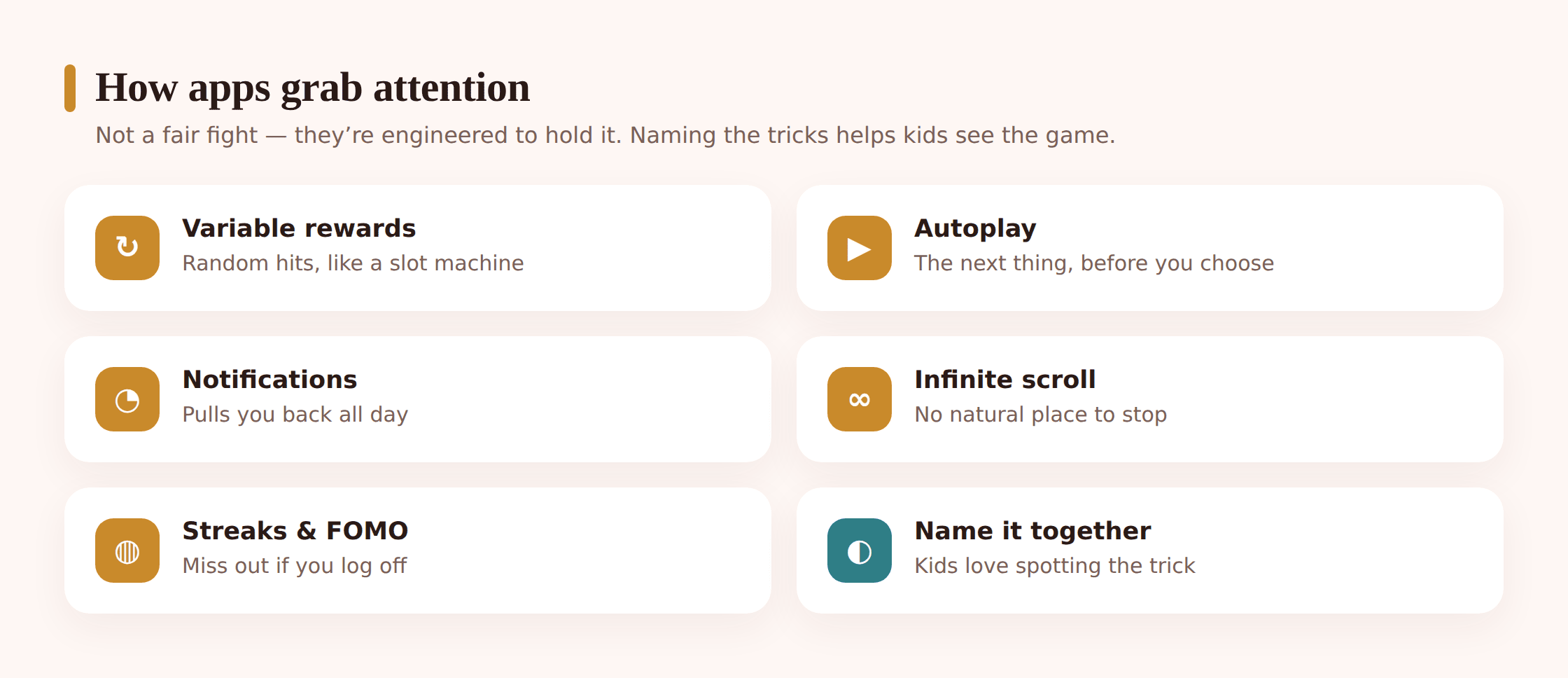
Explain it simply, the way you’d explain how a claw machine is rigged. A few of the main tricks:
The slot-machine pull
When you refresh a feed, you never know what you’ll get — a brilliant video, a boring one, a message from a friend, nothing. That unpredictability is the exact mechanism that makes slot machines hard to walk away from. Psychologists call it a variable reward. Your brain keeps pulling because maybe this time. Point it out to a kid mid-scroll and they’ll recognise it instantly: “I keep swiping and I don’t even know why.” That’s the trick working, and now they can see it.
Autoplay and the bottomless feed
The next video starts before you’ve decided to watch it. The feed never ends — there’s no last page, no natural stopping point where you’d think “right, done.” Older media had edges. A show finished. A magazine ran out of pages. These are designed with the edges sanded off precisely so you never hit the moment where you’d naturally stop. Naming this helps kids create their own edges: closing the app at the end of one video, watching a playlist instead of the endless feed.
Notifications as bait
That little red badge is engineered to feel urgent. Most notifications aren’t news you needed — they’re a hook to pull you back in, often dressed up to seem social (“someone’s waiting for you!”). Every buzz is an interruption someone else scheduled for you. When kids realise the phone is tapping them on the shoulder, not the other way round, turning most of it off stops feeling like a loss and starts feeling like taking back the wheel. Our guide to managing notifications goes deeper on the how.
You don’t need to frighten anyone. Frame it as getting smart, not getting scared: the designers are very good at their job, and the fun part is learning to enjoy the good bits without getting played. Kids who understand the machinery use their phones more deliberately, not less happily. If your child is curious about the deeper mechanics, our piece on how social media algorithms work unpacks the recommendation side.
Building focus and attention
Focus is a muscle, and like any muscle it grows with use and wastes with neglect. The worry with constant phones isn’t only what kids see — it’s that a brain trained to switch every few seconds gets bad at staying anywhere for long. Deep focus is where the good stuff happens: understanding a chapter, finishing a drawing, getting properly lost in a book or a build. It’s worth protecting, and it’s very trainable.
One thing at a time
Multitasking is mostly a myth. What actually happens is fast switching, and every switch has a cost — the brain has to reload where it was. Homework with a phone buzzing beside it isn’t homework plus texting; it’s worse homework and worse texting, taking longer than either would alone. The single most useful focus habit you can teach is single-tasking: one task, phone in another room, until it’s done. It feels harder for the first few minutes and much easier after that, because the brain settles once it stops bracing for the next interruption.
Phone-free study, by default
Make “phone somewhere else while studying” the normal setting, not a punishment rolled out on bad days. In another room is better than face-down on the desk, because a phone you can see still quietly taxes your attention even when it’s silent — part of your mind stays on guard for it. This one swap does more for grades and for the sheer relief of finishing faster than almost anything else on this page.
Boredom is allowed
This one’s counterintuitive, so it’s worth saying plainly: boredom isn’t a problem to be solved with a screen. It’s the doorway to imagination. A kid staring at the ceiling on a dull afternoon is a kid whose mind is about to wander somewhere interesting — a made-up game, a question, a plan. Fill every empty moment with a feed and that doorway never opens. Let kids be bored sometimes. Resist the urge to hand them a device the second they complain. What grows in that space is worth the ten minutes of grumbling.
Protect one deep block a day. Even twenty minutes of single-tasking — reading, building, drawing, practising — with no screen in reach builds the focus muscle. Consistency beats duration. A short block most days does more than a long one once a week.
Building the habits, step by step
You don’t roll all of this out at once. A habit lands when it’s small, specific, and attached to something that already happens. Here’s a way through that doesn’t overwhelm anyone.
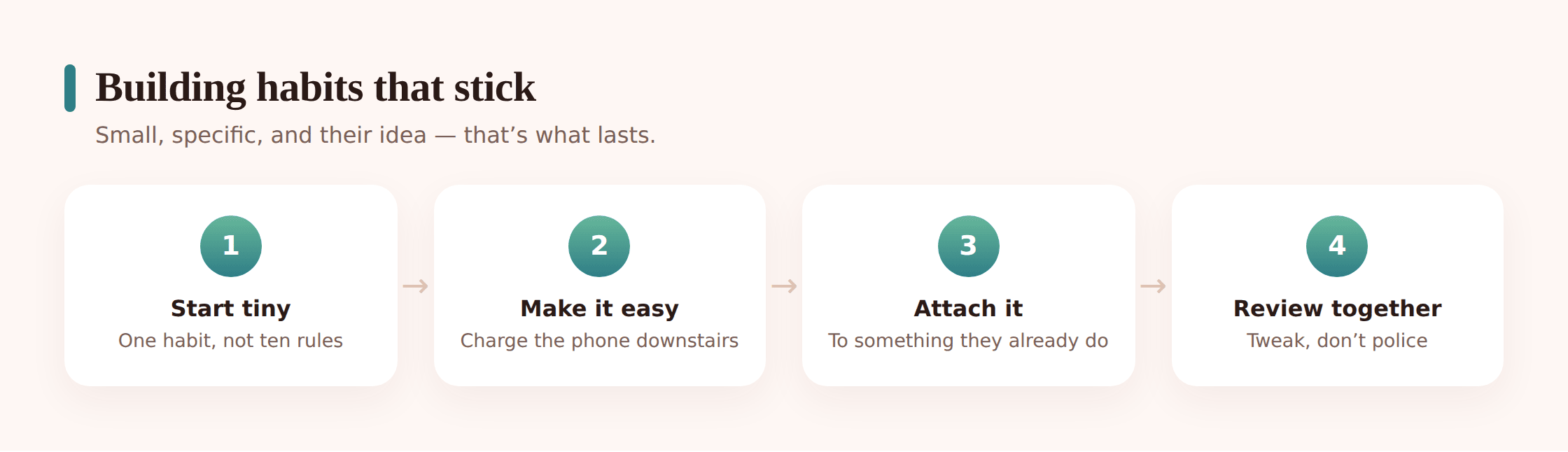
1. Pick one habit to start
Not ten. One. The charger leaving the bedroom is a great first pick because it’s concrete and it pays off in better sleep almost immediately. Choose the single change that would help most and start only with that. A stack of new rules collapses; one small habit holds.
2. Attach it to something that already happens
Habits stick when they’re glued to an existing routine. “Phone goes on the hall shelf when we sit down for dinner.” “Homework happens before screens, right after the snack.” You’re not adding a floating rule to remember — you’re bolting a new behaviour onto a moment that already exists, so the moment becomes the reminder.
3. Make the good choice the easy one
Design the environment so the habit needs no willpower. Charger in the kitchen, not the bedroom. Notifications off, so there’s nothing pulling. A book or something to do left out where the phone used to sit. Don’t rely on your kid resisting temptation all evening — remove the temptation from arm’s reach and the habit runs itself.
4. Name what you notice, warmly
When it goes well, say so, lightly and specifically. “You finished that whole chapter without checking your phone — how’d it feel?” You’re helping them notice the payoff themselves: the calm of finishing, the better sleep, the free evening. When a child connects the habit to a good feeling they had, it becomes theirs. Praise the effort and the noticing, not just the outcome.
5. Add the next one when the first is boring
A habit is ready to be joined by another once it’s stopped feeling like a change and started feeling like just how things are. That might be two weeks, might be two months. There’s no rush. A slow build that sticks beats a fast one that snaps back.
Practical habit swaps
Habits change most easily when you swap one behaviour for a better one rather than just banning the old thing. A ban leaves a hole; a swap fills it. Here are the ones families come back to.
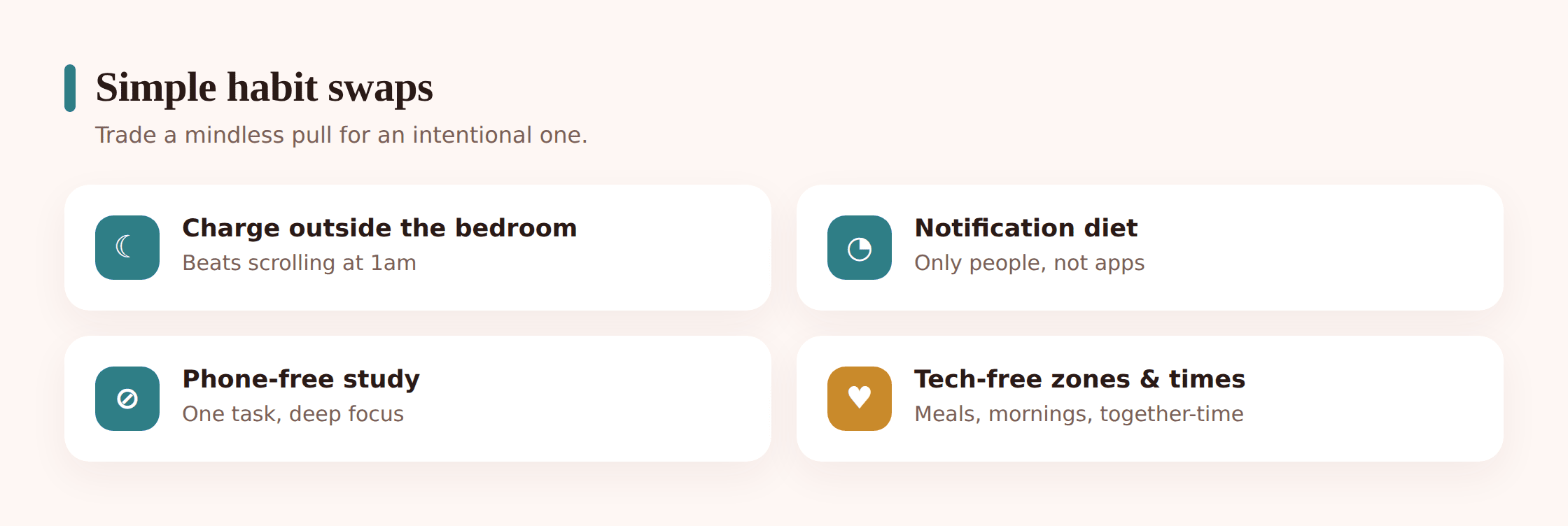
Charge the phone outside the bedroom
If you do one thing on this whole page, do this. A phone on the nightstand means the last thing before sleep and the first thing on waking is a screen — and it means the midnight scroll is always one arm’s reach away. A charging spot in the kitchen or hallway, for the whole family, fixes more sleep problems than any app. Buy a cheap alarm clock so “but I need it for the alarm” stops being the reason.
Put the phone on a notification diet
Go through the apps together and turn off notifications for everything that isn’t a real person messaging directly. Games, shopping apps, most social feeds — silence them. What’s left is signal instead of noise, and the phone stops interrupting a hundred times a day. It’s a fifteen-minute job that changes how the whole device feels.
Set tech-free times and zones
Pick moments and places where screens simply don’t come. The dinner table is the classic — phones off the table, everyone’s, including the grown-ups. The first hour after school, maybe. The car. Bedrooms at night. You’re not banning phones from life; you’re carving out a few protected spaces where being present is the default. Keep the list short so it’s easy to honour.
Trade mindless scroll for intentional use
Teach the difference between using a phone and being used by one. Going in to message a friend, look something up, or watch a specific thing — that’s intentional, and it has a natural end. Opening an app because your hand was bored and surfacing forty minutes later — that’s the machine driving. A simple habit helps: before opening something, a quick “what am I actually here for?” And when the thing is done, close it, rather than drifting into the feed. This is a lifelong skill, and it’s the whole ballgame.
Swap, don’t just subtract. “No phone at dinner” works far better as “phones on the shelf, and we actually talk.” Give the freed-up time somewhere to go and the habit sticks. Leave a vacuum and the phone rushes back to fill it.
Modelling it yourself
Kids learn what they watch you do, not what you tell them to do, and no part of this is louder than that. A parent who lectures about screen time from behind their own scrolling has already lost the argument, and the kid knows it. This isn’t a comfortable thing to sit with, but it’s the most powerful lever you have — and it’s free.
So do the habits yourself, visibly. Put your phone on the shelf at dinner. Charge it out of your own bedroom. Say out loud when you catch yourself: “I’ve been scrolling for ages, I’m putting this down.” That last one is gold — it teaches your child that noticing and course-correcting is normal and grown-up, not a failure. You’re not modelling a person who never gets pulled in. You’re modelling a person who notices and climbs back out. If your own habits could use a look, our guide to digital wellbeing for parents is a good, non-judgy place to start.
You don’t have to be perfect. You have to be honest and trying, out loud, where they can see it. That’s a far more useful thing for a kid to watch than a parent who pretends the pull doesn’t exist.
What to expect by age
The habits are the same; the grip changes with age. Match the approach to where your child actually is.
Little ones (roughly 3–7)
This is the easy window, and the one to plant seeds in. Young kids would mostly rather have you than a tablet. Keep screens a small, defined part of the day, always with an obvious end (“two episodes, then we cook”). The real work here is your own modelling — they’re studying what you do with your phone long before they own one. Our page on screen time for toddlers covers this age in depth.
Middle years (roughly 8–12)
Now habits can be taught directly and kids can grasp the “how apps grab attention” conversation — they find it genuinely interesting. This is the golden age for building routines before the social pressure fully lands: phone-free homework, charger out of the room, notification diet. Set these as the normal way things are done and they carry into the teen years as habits rather than battles.
Teens (13+)
Lead with autonomy or lose the room. Teens need real say and real reasons; “because I said so” backfires now. Shift from rules toward shared standards you both signed up to, and be willing to explain your thinking. The social stakes are real — being off a group chat genuinely costs them — so take that seriously rather than waving it away. For the bigger picture on this age, see our guide to phones and teen mental health.
Making it collaborative
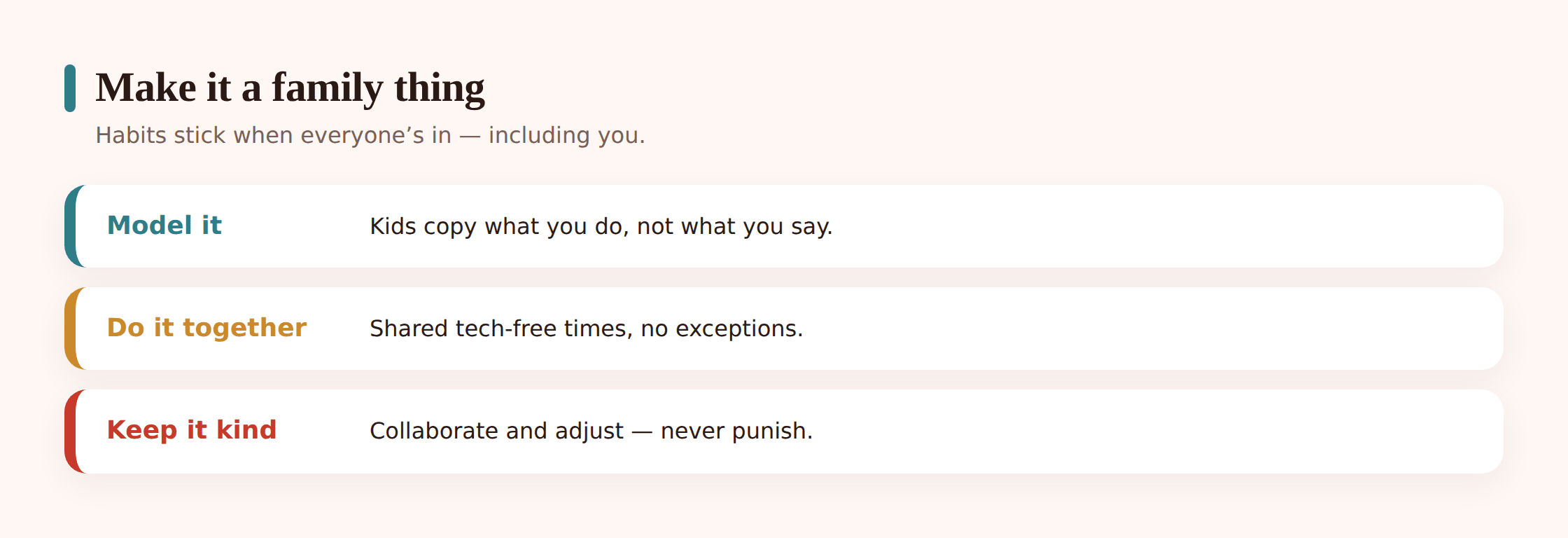
The difference between a habit that lasts and a rule that gets dodged usually comes down to one thing: was the child part of building it? Punitive doesn’t work here, not because it’s mean but because it’s ineffective. A limit imposed from above is a challenge to beat. A plan made together is something to keep.
So sit down as a family and build it out loud. Ask what they think a fair setup looks like. Let them own parts of it — which room the charger goes in, whether homework comes before or after a snack, what the tech-free zones are. When kids help write the plan, they enforce it on themselves, which is the only enforcement that ever really works. Writing it down together, as a simple agreement everyone signs, makes it concrete; our family phone agreement gives you a template to start from.
Keep it warm and keep revisiting it. Habits drift, ages change, an agreement that fit at ten needs a rewrite at thirteen. Treat it as a living thing you tune together, not a verdict handed down once. And if the whole household’s habits have crept and you want a clean restart before building the new ones, a short family digital detox can clear the ground first.
- Start with one habit. Charger out of the bedroom is the highest-payoff first move.
- Show kids the game. Variable rewards, autoplay, notifications — name the tricks so they can spot them.
- Guard one focus block a day. Single-tasking, phone in another room, even twenty minutes.
- Let boredom happen. Don’t fill every empty moment with a screen.
- Swap, don’t just ban. Give the freed time somewhere to go.
- Model it visibly. Do the habits yourself, and say when you slip.
- Build it together. A plan they helped shape is a plan they defend.
My kid says everyone else has unlimited screen time. How do I answer that?
Usually it isn’t quite true, but arguing the facts misses the point. Try agreeing that your family does things its own way and that the goal isn’t fewer screens for the sake of it — it’s being in charge of the phone instead of hooked by it. Frame the habits as a skill their future self will thank them for, not a punishment. And check your own habits are in the plan too; fairness dissolves most of the complaint.
Isn’t teaching them how apps are designed a bit much for a child?
Kids handle it better than adults expect, and they find it genuinely interesting — it’s a bit like learning how a magic trick works. You don’t need scary statistics or dark framing. Keep it simple and even a little funny: “See how it always plays the next one before you decide? That’s on purpose, so you never stop. Sneaky, right?” Understanding the trick makes them feel clever and in control, not frightened.
How do I build focus habits without it becoming another fight?
Make the environment do the work instead of relying on willpower or nagging. Phone charges in another room during homework — that’s the setup, not a battle repeated nightly. Then notice the payoff out loud when it lands (“you finished way faster tonight”). You’re helping them feel the benefit themselves, which is what turns a rule you enforce into a habit they keep.
What if my teenager just refuses to go along with any of it?
Step back from control and lead with a real conversation. Ask what they think is reasonable and actually listen. Teens push hardest against rules that feel imposed, so hand them genuine say in the plan — even if the result is looser than you’d pick, a looser plan they own beats a strict one they sabotage. Pick the one or two things that matter most (sleep is usually top) and let the smaller stuff go.
Do these habits still work if we’ve already got into bad patterns?
Yes, though it takes a little longer to reset an established groove than to lay down a fresh one. Start with a single change rather than a dramatic overhaul, expect a few days of friction as the old reflex protests, and keep it collaborative rather than cracking down. If things feel really stuck, a short reset can help — see our family digital detox guide — and then rebuild with the small habits here.
How long before a new habit actually sticks?
It varies more than the neat “21 days” you’ll hear — some habits settle in a week, others take a couple of months, depending on the child and how deep the old pattern ran. The sign it’s stuck isn’t a date on the calendar; it’s when the behaviour stops feeling like a change and starts feeling like just how things are. That’s your cue it’s safe to add the next one.