Digital Wellbeing for Parents: Your Own Phone Habits
We ask kids to put their phones down, then check ours at the dinner table. It’s easy to do. Nobody hands you a rulebook when you become a parent, and the phone is right there in your pocket, buzzing. This isn’t a lecture about screen time. It’s a friendly look at your own habits, and a few small changes that help you feel more present — and quietly teach your kids more than any rule ever could.
- Let’s start honest
- Why your habits matter more than your rules
- Notice your own patterns first
- Healthier habits that actually stick
- Being present with your kids
- Work and the always-on trap
- Model it out loud
- Tools that help a little
- Be kind to yourself
- Reset your habits this week
- Questions parents ask
Let’s start honest
Picture the scene. You’ve told the kids no phones at dinner. Ten minutes in, yours lights up. You glance. You mean to glance for a second, but it’s a message from work, so you tap it, and now you’re typing a reply while your six-year-old is halfway through a story about a snail.
You’re not a bad parent. You’re a normal one. The phone is designed to pull exactly that reflex out of you, and it’s very good at its job. So let’s put guilt aside right now. It doesn’t help, and you don’t need it. What helps is noticing the pattern and nudging it, gently, in a better direction.
Here’s the thing that makes this worth doing: kids copy what they see, not what they’re told. You can set every rule in the house, but the loudest lesson is the one you’re living. If you want them to have a calm relationship with a screen one day, the most useful place to start is your own hand.
Why your habits matter more than your rules
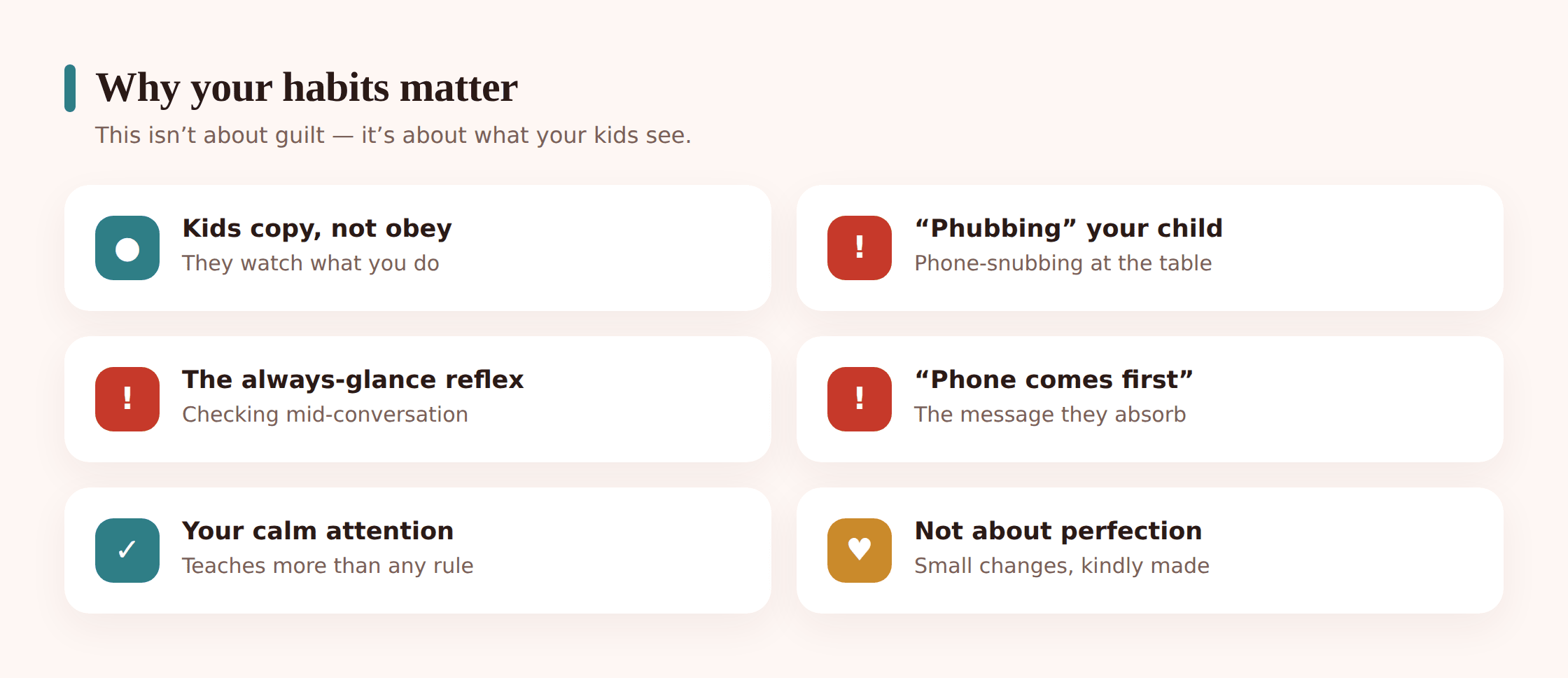
Researchers have a word for it: phubbing. Phone-snubbing. It’s when someone’s talking to you and you’re half-looking at a screen. Do it to another adult and they feel brushed off. Do it to a child and the message lands even harder, because they’re still working out how much they matter to you.
It’s rarely one big moment. It’s the always-glancing reflex. The phone comes out at the park, at the school gate, on the sofa. Each glance is tiny. But a kid who grows up watching a parent’s eyes flick down mid-sentence, again and again, slowly learns something: the phone comes first, and I come after the phone.
Flip it around and the good news is just as real. When you look up, put the phone down, and give your calm, full attention — even for a couple of minutes — your child feels it. That kind of attention teaches more about focus, patience, and being wanted than any screen-time chart on the fridge. Your presence is the lesson. If you’re worried about the bigger picture here, our piece on phones and teen mental health goes deeper, but the foundation is simple and it’s you.
Notice your own patterns first
Before you change anything, just look. No judgement, no resolutions. Curiosity is enough.
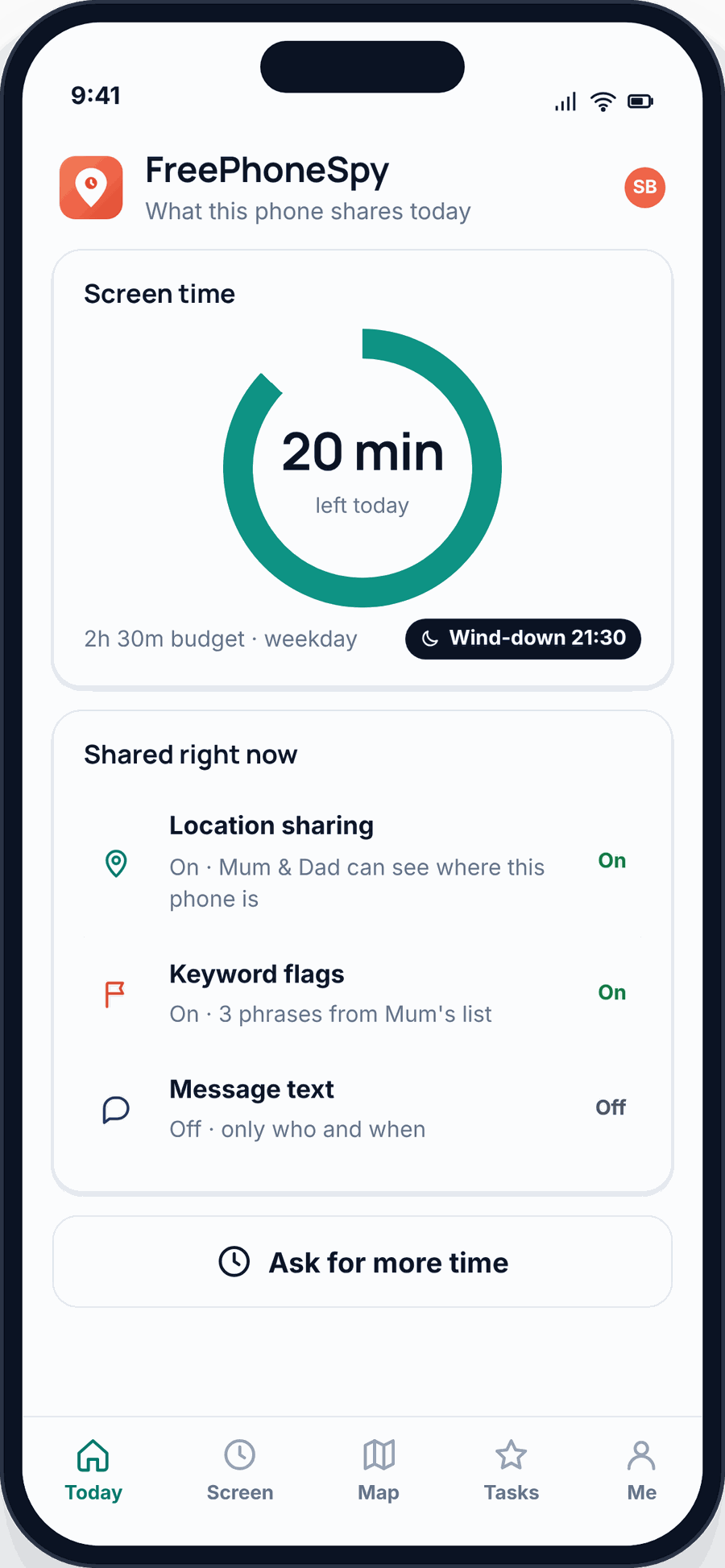
Your phone tracks your usage whether you look or not. On Android it’s under Digital Wellbeing; on an iPhone it’s Screen Time. Open it. The number might surprise you. Try not to react to it — a big number isn’t a character flaw, it’s just data. You’re a detective here, not a judge.
As you look, watch for the loops:
- The reflex unlock — you pick the phone up with no reason at all, look at the home screen, and put it down again.
- The doom-scroll — you meant to check one thing and twenty minutes vanished.
- The work-creep — messages that used to stop at 6pm now trickle into the evening.
Then notice the triggers. Most reaching-for-the-phone isn’t about the phone. It’s about a feeling. Boredom, standing in a queue. Stress, when a conversation gets hard. The little gap while the kettle boils or the kids brush their teeth. Once you can name the trigger, you get a choice you didn’t have before.
Healthier habits that actually stick
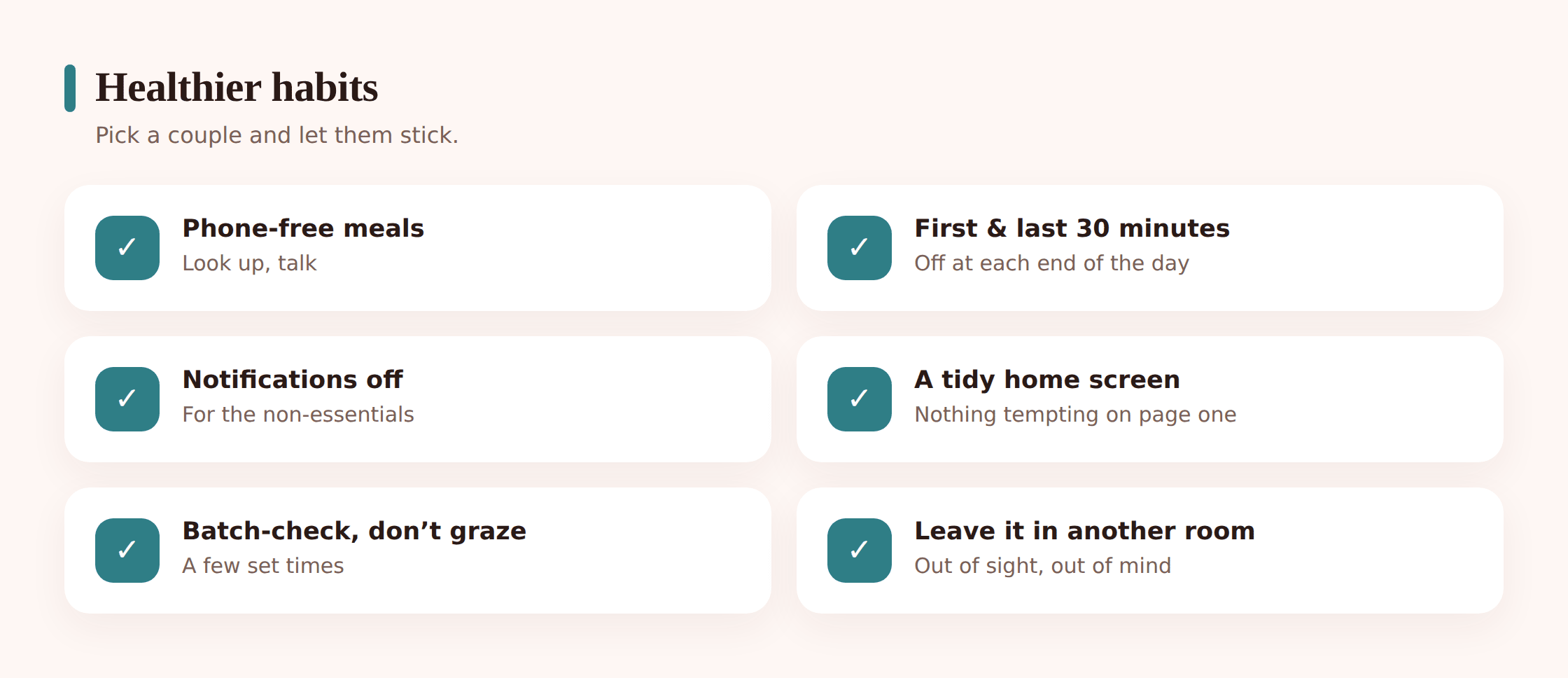
You don’t need a digital cleanse or a flip phone. You need a few habits that make the mindless stuff harder and the good stuff easier. Start with one. Let it settle for a week before you add another.
Set phone-free zones and times. Meals are the obvious one. So is the bedroom at night — charge the phone in the kitchen and buy a cheap alarm clock. And try protecting the first and last 30 minutes of your day. If the first thing you touch each morning is a screen, your attention is spoken for before your feet hit the floor.
Turn off notifications for anything that isn’t a person. Games, news apps, shopping, social feeds — none of it needs to interrupt you. Keep alerts for calls, messages, and calendar. Silence the rest. Our guide to managing notifications and focus walks through the settings if you want a hand.
Tidy the home screen, or go greyscale. Move the sticky apps off the first page so opening them takes intent, not muscle memory. Some people switch the whole screen to greyscale — a grey feed is a lot less tempting than a bright one.
Batch-check instead of grazing. Pick two or three times a day to deal with email and social, and let it wait between. Grazing all day keeps you half-in, half-out of everything.
Leave it in another room, sometimes. The single most effective trick, and the simplest. You can’t reflex-check a phone that’s on the hall table. Do this during dinner, bath time, or an hour on the weekend.
Single-task. When you’re on the phone, be on the phone. When you’re with your kid, be with your kid. Trying to do both means doing neither well, and they can tell.
Try just one this week. Habit changes fail when we try to fix everything at once. Choose the one that would make the biggest difference and ignore the rest for now. You can always add another next week.
Being present with your kids
Here’s a freeing idea: you don’t have to be attentive every waking hour. Nobody can, and pretending otherwise just makes you feel like you’re failing. What kids remember is the quality of the attention, not the quantity.
Short bursts of full attention beat long stretches of distracted hovering. Ten real minutes on the floor, phone in another room, building the tower and knocking it down — that lands. Two hours on the sofa while you scroll and murmur “mm-hmm” does not.
- Look up when they talk. Not always, not perfectly, but make it the default. Eye contact tells a child they’re worth stopping for.
- Guard the transition moments. Pickup from school, bath time, the bedtime routine. These are the small windows kids often use to tell you the real stuff. Keep the phone away for them.
- Narrate it out loud. “I’m putting my phone away so we can play.” It sounds small. It teaches your child that phones get put down on purpose — and that they’re worth putting it down for.
Work and the always-on trap
A lot of parent phone use isn’t scrolling — it’s work bleeding into home. That one deserves its own honest look, because it’s the hardest to defend against. Work feels important and urgent, so we let it in.
But every after-hours reply teaches two audiences. It tells your workplace you’re always reachable, so they’ll reach you more. And it tells your kids that a buzzing phone outranks whatever’s happening in the room. Neither is what you actually want.
Set a boundary and let the phone help you hold it. Turn on Do Not Disturb for evenings and weekends. Mute the work chat after hours. If your job genuinely needs you on call sometimes, fine — but make it a real exception, not the quiet default. You’re not modelling laziness by logging off. You’re modelling a life with edges.
Model it out loud
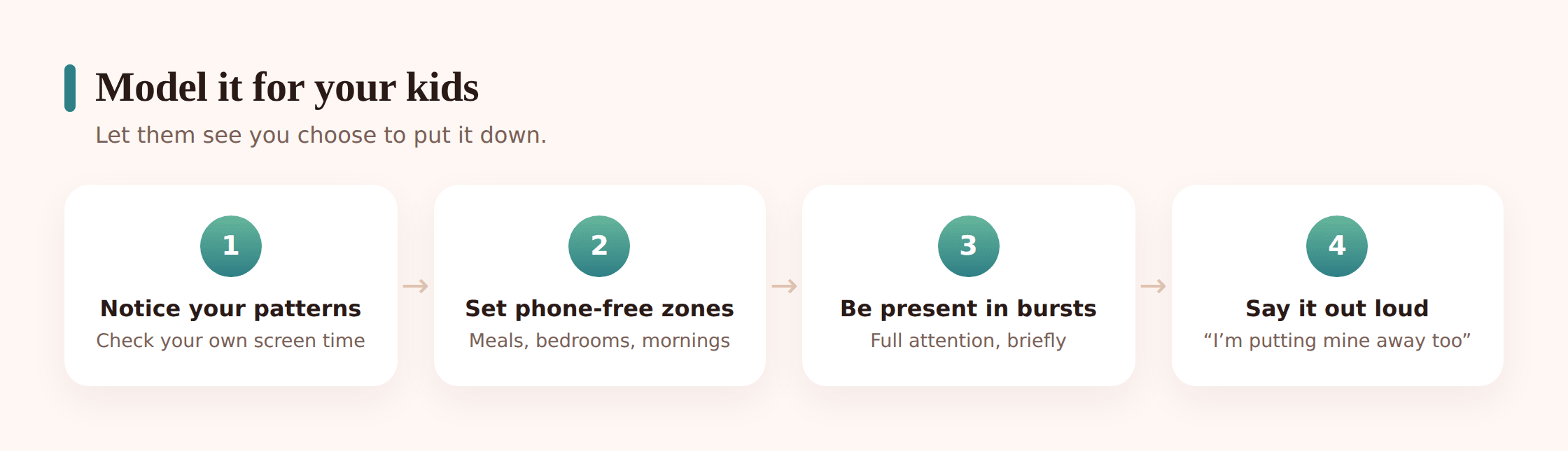
Kids learn most from what they see you choose. So make the good choices visible.
Let them see you put it down. Don’t hide the effort. “I really want to check this, but I’d rather hang out with you.” Now they’ve watched you weigh it and pick them.
Admit when you overdo it. “I’ve been on my phone too much today. Let’s do something.” Owning it teaches honesty, and it takes the shame out of screen use for the whole family.
Apologise for phubbing. If you brushed them off mid-sentence, say so. “Sorry, I was looking at my phone. Tell me again.” It costs nothing and it repairs a lot.
Do screen-free things together. Cook, walk, play a board game, kick a ball. Not as a punishment for screens — just as good things you both like. A family digital detox can be a fun reset rather than a grim one.
Make the rules apply to you too. A family phone rule that only covers the kids is a rule they’ll resent and ignore. If phones are away at dinner, yours is away too. Write it down together — a simple family phone agreement that everyone signs, grown-ups included, carries far more weight than a rule handed down from on high.
Tools that help a little
Habits do the heavy lifting. But a couple of settings can hold the door open while your habits find their feet.
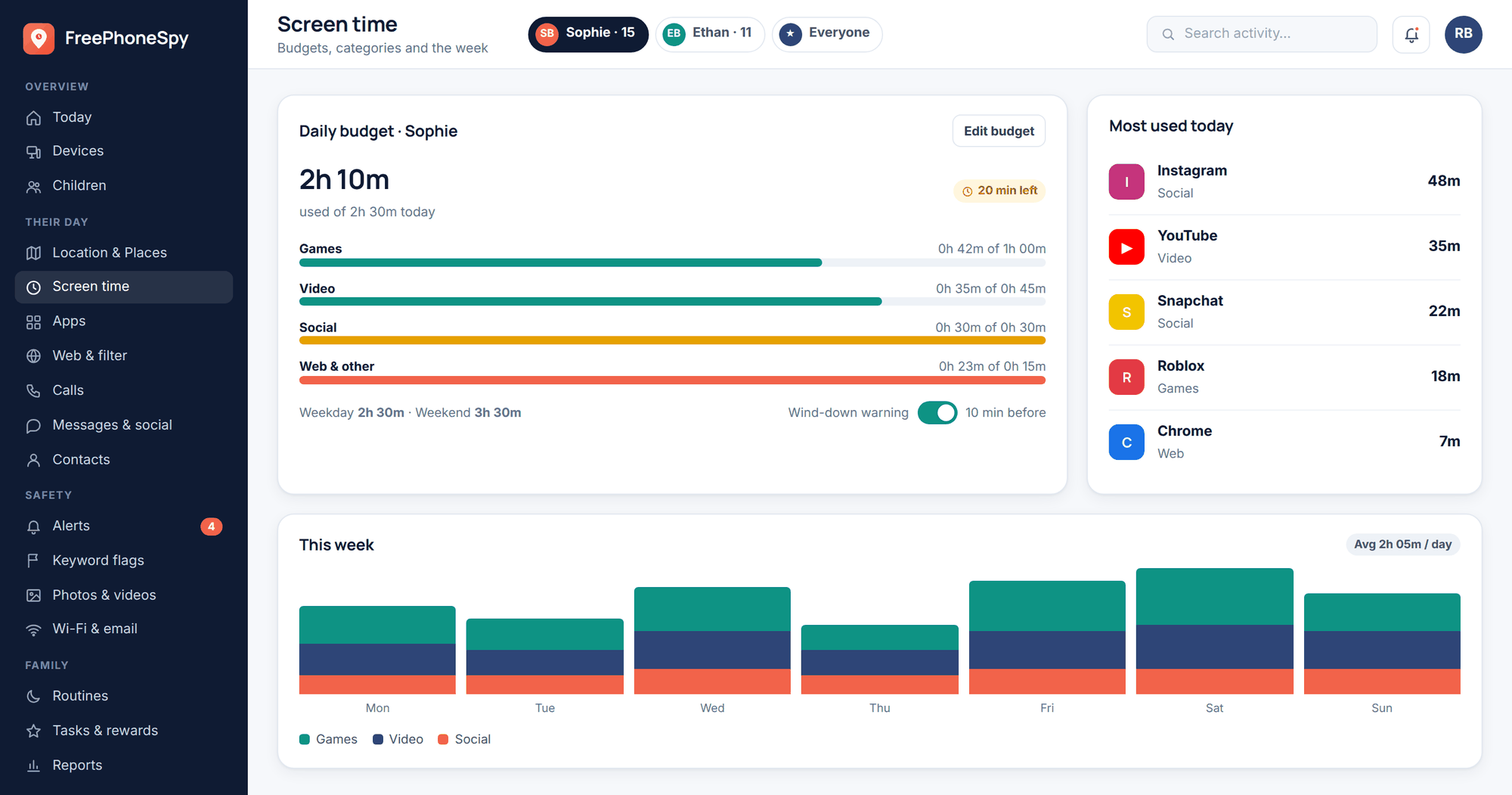
On your own phone, the built-in tools are genuinely good and free. Android’s Digital Wellbeing and Apple’s Screen Time both let you set app timers, schedule a Focus mode, and turn on a bedtime wind-down that dims the screen and quiets notifications at night. Set a timer on your stickiest app and you’ll be surprised how often you just… stop when it nudges you.
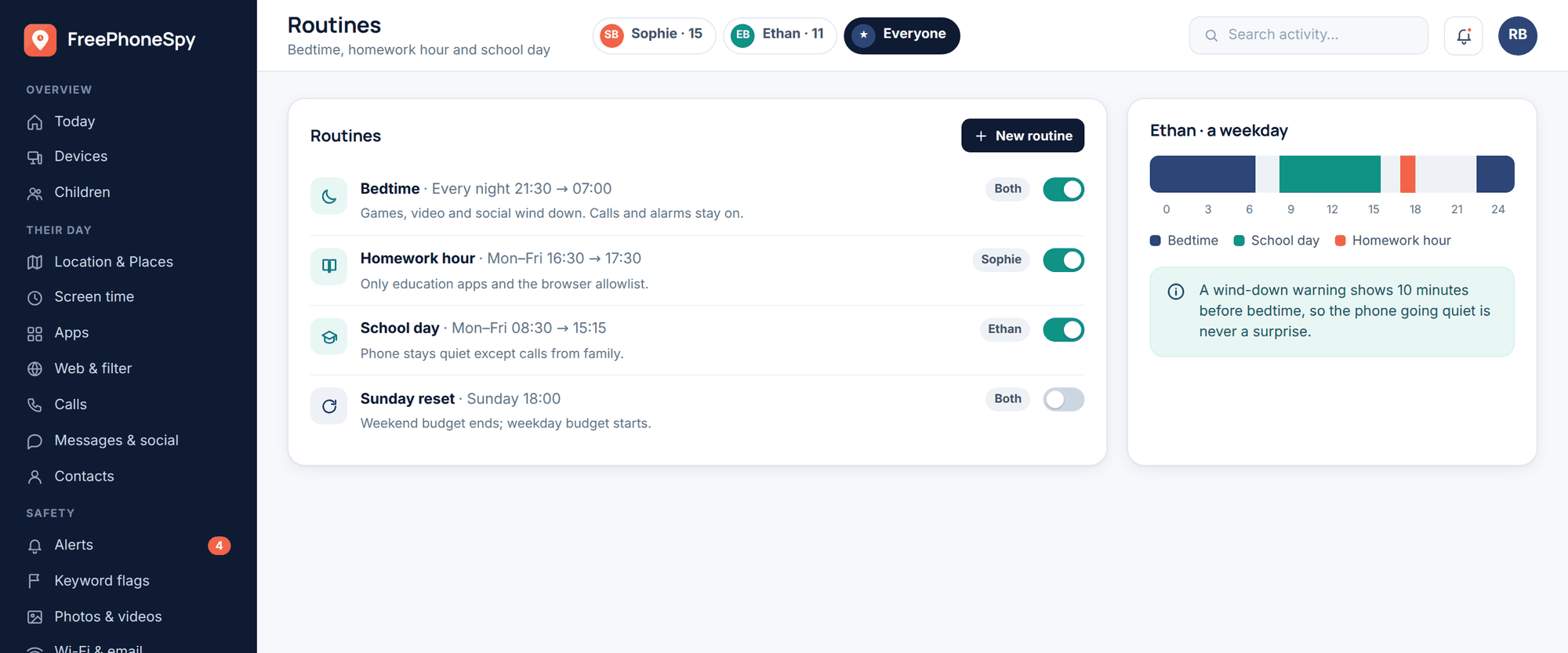
If yours is a family Android setup and you all agree to it, FreePhoneSpy can add shared routines and budgets on top — dinner and bedtime windows that apply to everyone’s devices at once, set from a web panel. It’s transparent by design and only worth using when the whole family’s in on it. Handy for keeping a rule consistent, but it’s the agreement behind the rule that matters, not the toggle. (On iPhone, Apple’s own Screen Time covers the same ground.)
Be kind to yourself
You will slip. You’ll have a day where you’re stressed and you scroll for an hour and phub your kid three times before lunch. That’s not failure. That’s Tuesday.
Aim for better, not perfect. Perfect isn’t available to any parent, and chasing it just adds a layer of guilt you don’t need. The point is the direction you’re heading, not whether you nail it every day. A phone habit that’s a bit calmer this month than last month is a real win, and your kids will feel the difference long before the numbers are tidy.
Give yourself the same grace you’d give your kid learning something hard. You’re learning too.
Reset your habits this week
If you want somewhere to start, here’s a gentle week. Pick what fits. Skip what doesn’t.
- Open your screen-time report once, and just read it. No reaction.
- Pick one phone-free zone — dinner table or bedroom — and hold it for the week.
- Turn off notifications for one app that keeps pulling you in.
- Move your two stickiest apps off the first home screen page.
- Charge your phone outside the bedroom for at least three nights.
- Narrate putting the phone away to your kid once a day: “Phone’s away, let’s play.”
- Turn on Do Not Disturb for the evening one weeknight and see how it feels.
- Notice one trigger — boredom, stress, waiting — and let the reach pass without acting on it.
That’s plenty. If you do half of it, you’re ahead of where you were, and your kids are watching a parent who’s trying. That’s the whole game.
Questions parents ask
Isn’t some of my phone use just… normal life? Work, maps, photos of the kids?
Absolutely, and this isn’t about cutting that out. The target is the mindless stuff — the reflex unlocks and doom-scrolls — not the useful tools. If your phone is helping you live your life, great. The problem is only the bits that pull you away from it.
My teen says I’m a hypocrite about screen time. Are they right?
Probably a little, and that’s worth taking on the chin. The strongest move is to agree, out loud: “You’re right, I’m working on it too.” Then make the family rules apply to you as well. A shared agreement that binds the grown-ups earns far more respect than a one-sided rule.
I feel anxious when I don’t check my phone. Is that a problem?
It’s common, and it usually eases with a bit of distance. Start small — leave the phone in another room for twenty minutes, not the whole day. The jittery feeling fades faster than you’d expect. If it’s persistent and heavy, that’s worth a gentle chat with your GP, no shame in it.
Will limiting my own phone actually change my kid’s habits?
More than a rule will. Kids calibrate their sense of “normal” from home. A parent who models calm phone use is quietly setting the baseline their child grows up copying. It’s slow, but it’s the most durable thing you can do.
Do I need an app to fix my habits?
No. Your phone’s built-in Digital Wellbeing or Screen Time is enough for one person, and it’s free. Apps and family tools help when a whole household wants to coordinate, but they’re a support, not the fix. The fix is attention and intention, and those don’t install.
Where do I even start if this all feels like a lot?
One thing. Phone out of the bedroom tonight, or phone-free dinner tomorrow. Just one. Let it become normal before you add anything. Small and boring beats big and dramatic every time.