Teaching Kids Digital Consent & Respecting Others’ Privacy
Most online-safety talks with kids point inward. Protect your passwords, guard your location, don’t overshare about yourself. All good. But there’s a whole other half we tend to skip, and it’s the half that shapes what kind of person a child becomes online: how they treat everyone else. Every group photo, every screenshot, every forwarded chat involves someone who isn’t in the room to say yes or no. Raising a kid who asks first, and who deletes when asked, is quieter work than teaching them to dodge a scammer. It also matters more than we give it credit for.
What digital consent actually means
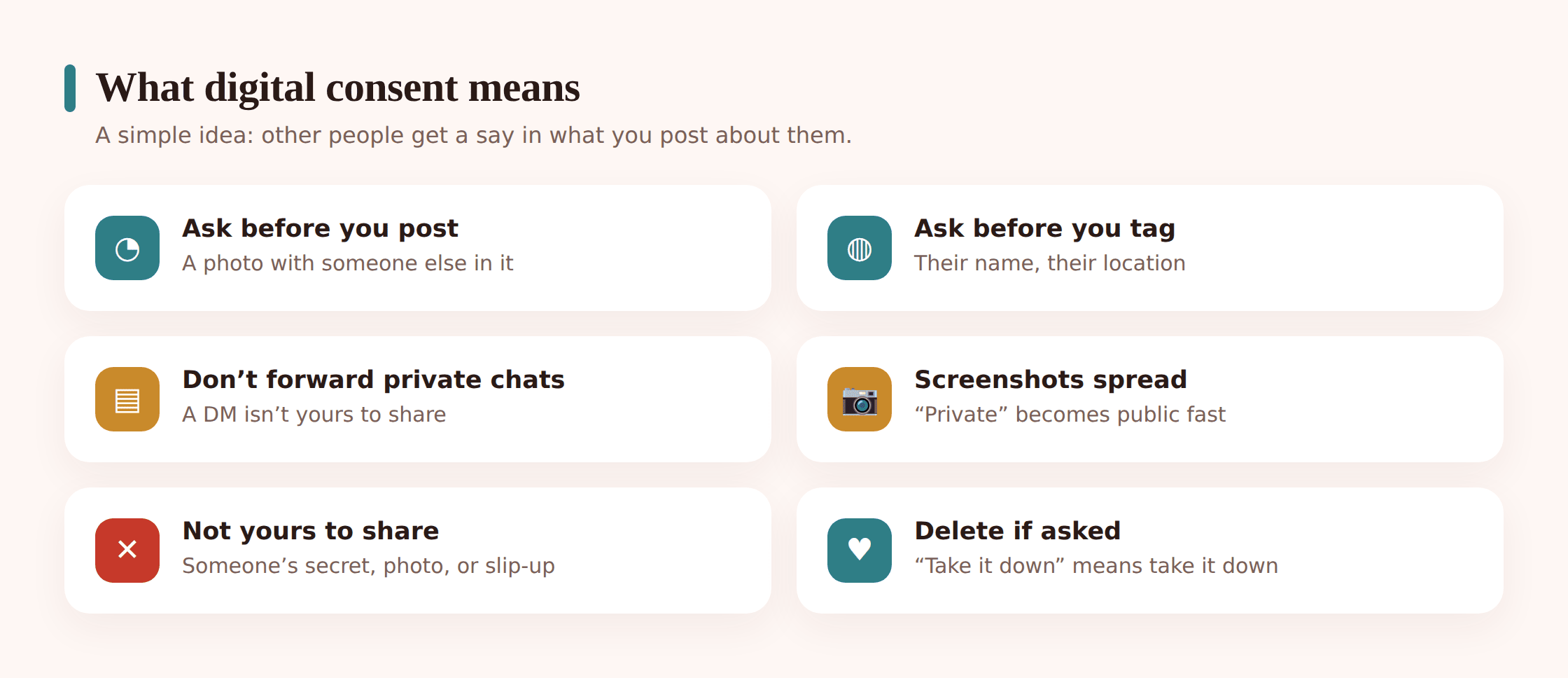
Digital consent is a simple idea wrapped in an unfamiliar name. It means asking someone before you do something online that involves them. Before you post the photo they’re in. Before you tag them. Before you screenshot the chat and send it on. Before you reshare their story, mark where they are, or repeat the thing they told you in confidence. The other person gets a say in how they show up online, because it’s their face, their words, their moment too.
Kids grasp the offline version of this early. You don’t read someone’s diary. You don’t repeat a secret. You don’t take someone’s stuff without asking. The online version follows the exact same logic, but it moves faster and reaches further, so the same instinct needs a nudge to catch up. A screenshot takes half a second. A repost reaches a hundred people before lunch. The speed is what makes the “ask first” habit worth building deliberately, because the technology won’t slow anyone down on its own.
It helps to name the flip side too. Consent runs both ways. Your child is the subject of other people’s posts just as often as they’re the one posting. When they understand how it feels to be tagged in a photo they hate, or to find a private message screenshotted and passed around, the reason to ask first stops being an abstract rule and starts being something they actually feel.
Why it matters more than it looks
It’s tempting to file this under manners, something nice but optional. It’s more than that, for a few concrete reasons.
Everyone is the subject of someone else’s post. Your child doesn’t control most of the images of themselves that end up online. Their friends do. Which means the culture your child helps build, ask-first or post-anything, is the culture they’ll live inside too. Teaching them to respect others is, in a very direct way, teaching the whole friendship group to protect each other.
Screenshots make “private” public. Kids often believe a message sent to one person, or a story that disappears in a day, is somehow safe. It isn’t. Anything on a screen can be captured, and once it’s captured it can travel anywhere. A private moment can go public in the time it takes to tap a button. Understanding this changes how a child treats other people’s private things, because they realise a friend trusted them with something fragile.
A shared photo can embarrass or endanger. Most of the harm here isn’t dramatic. It’s a friend mortified by an unflattering photo, a classmate teased over a moment they’d rather forget, someone’s location shared so the wrong person now knows where they are. Sometimes it’s heavier: a photo that gets a kid in real trouble, or a shared secret that isolates them. Kids rarely mean to cause any of this. They just don’t pause to picture the person on the other end.
This article is about that outward-facing skill specifically. If you want the inward-facing side, protecting your own child’s information and reputation, we cover that in your child’s digital footprint, and the broader ground rules live in social media safety.
The everyday situations kids face
Rules stay abstract until you attach them to real moments. These are the ones that come up again and again. Talk them through with your child before they happen, and the pause becomes a reflex instead of an afterthought.
Posting a group photo
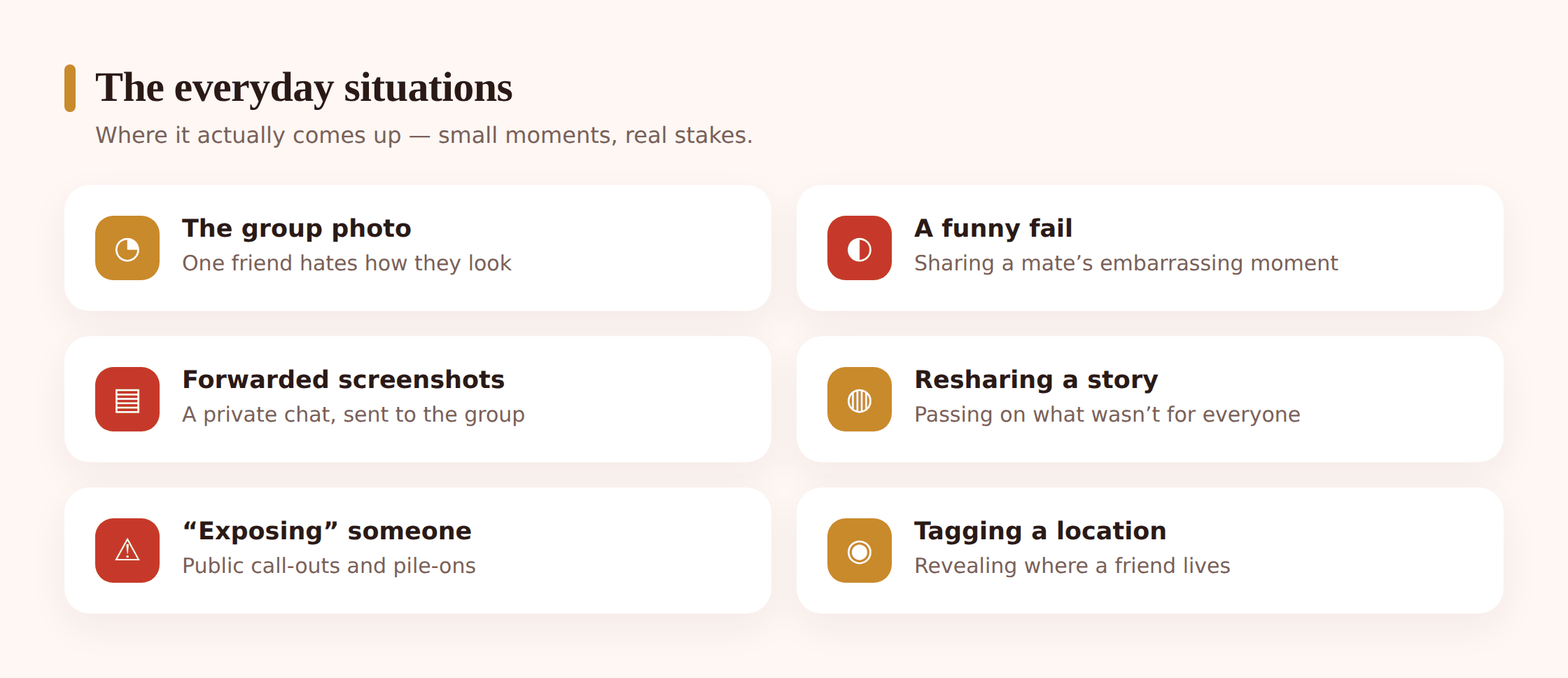
The classic one. Your child takes a great photo at a party, they look brilliant, and so does everyone except one friend caught mid-blink or mid-sentence. Posting it is easy. Checking first, “is everyone happy with this one?”, takes ten seconds and saves a friendship. The rule that helps: you can love a photo of yourself and still owe the other people in it a quick ask.
Sharing a friend’s embarrassing moment
Someone trips, says something silly, has a wardrobe mishap. It’s funny. The pull to share is strong, because a good laugh gets a reaction. But the person laughing hardest is rarely the one in the photo. Kids need to hear, plainly, that a moment being funny to you doesn’t make it yours to broadcast.
Screenshotting private chats and forwarding them
This is where a lot of real hurt happens. A friend vents, confides, or says something in the heat of an argument. Someone screenshots it and it starts travelling. The friend feels betrayed, sometimes publicly. The habit to build here is the strongest one in the whole list: a private message is borrowed, not owned. It stays where it was sent unless the person who wrote it says otherwise.
Tagging location
Adding a place to a post feels harmless. It tells everyone exactly where a group of kids are, right now. That’s a privacy call that belongs to each person there, not to whoever happened to post. Teach your child to leave friends’ locations off unless they’ve checked, and to think twice about tagging their own.
Resharing someone’s story
A friend posts a story meant for their own circle. Your child screenshots it and reposts it to a different, wider audience. The friend chose who saw it the first time; the repost quietly takes that choice away. “They posted it, so it’s fair game” is the reasoning to gently dismantle. Posting to some people is not the same as posting to everyone.
“Exposing” people and sharing secrets
There’s a whole genre of online behaviour built around revealing things about others, the callout, the exposé, the group chat where someone’s secret becomes content. Some of it wears the costume of justice. Most of it is just cruelty with a caption. And the plainest one of all: a classmate tells your child something private, and it ends up shared. Kids need to know that being trusted with a secret is a small responsibility, and that spending it for a moment of attention costs more than it looks.
Simple rules worth teaching
Kids don’t carry policies around in their heads. They carry short, sticky phrases. These four do most of the work, and they’re easy to repeat until they become second nature.
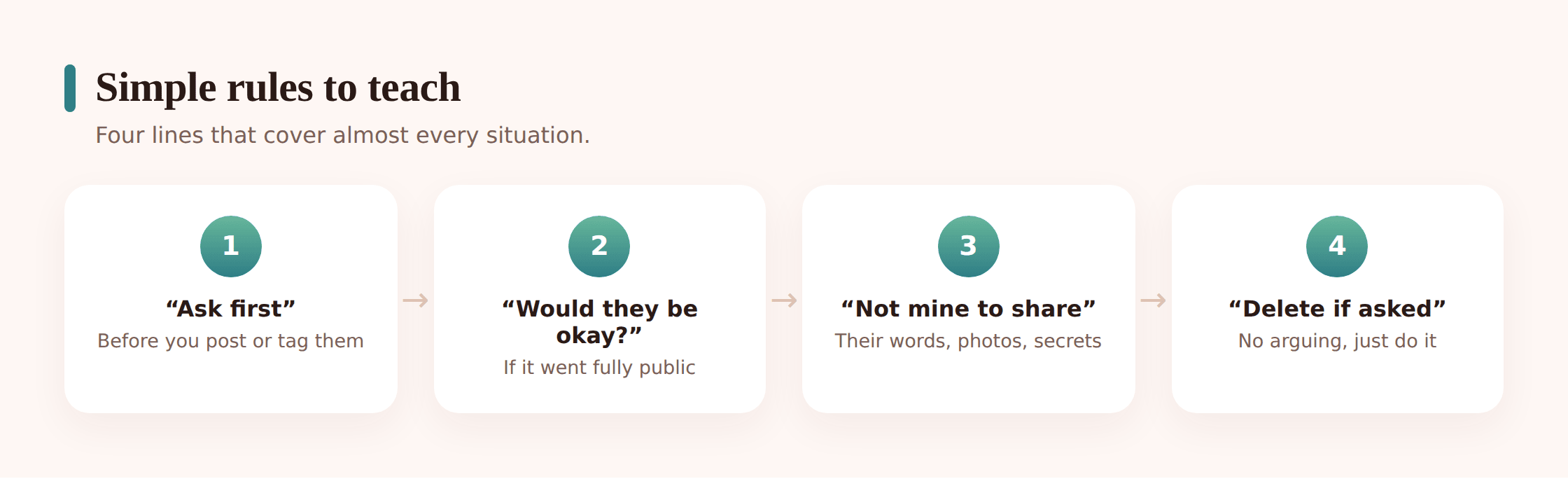
- Ask first. Before you post, tag or share anything with someone else in it, ask them. A quick “okay if I post this?” covers most of life. If you can’t ask, don’t post.
- Would they be okay if it went public? Not just okay with you seeing it, okay with anyone seeing it, because anything shared can end up there. If the honest answer is no, or you’re not sure, leave it.
- Not yours to share. Someone else’s message, photo, secret or location isn’t yours to pass on, even if you have it on your phone. Having something and being allowed to share it are two different things.
- Delete if asked. If someone asks you to take down a post or untag them, do it, straight away, without arguing. No “but it’s a good photo.” Their comfort outranks your post.
Where we stand. FreePhoneSpy is built around open, consent-based family safety, the idea that the people involved know what’s happening and agree to it. The same principle a family uses at home, no surprises, everyone has a say, is exactly what your child is learning to extend to their friends. Respecting other people’s privacy isn’t a separate lesson from how a healthy family already works. It’s the same value pointed outward.
Modelling it as a parent
Here’s the uncomfortable, useful truth: kids learn consent less from what we say and more from what we do to them. If a child grows up watching their own moments posted without a word to them, the lesson lands whether we mean it to or not, that sharing people is normal and asking is optional.
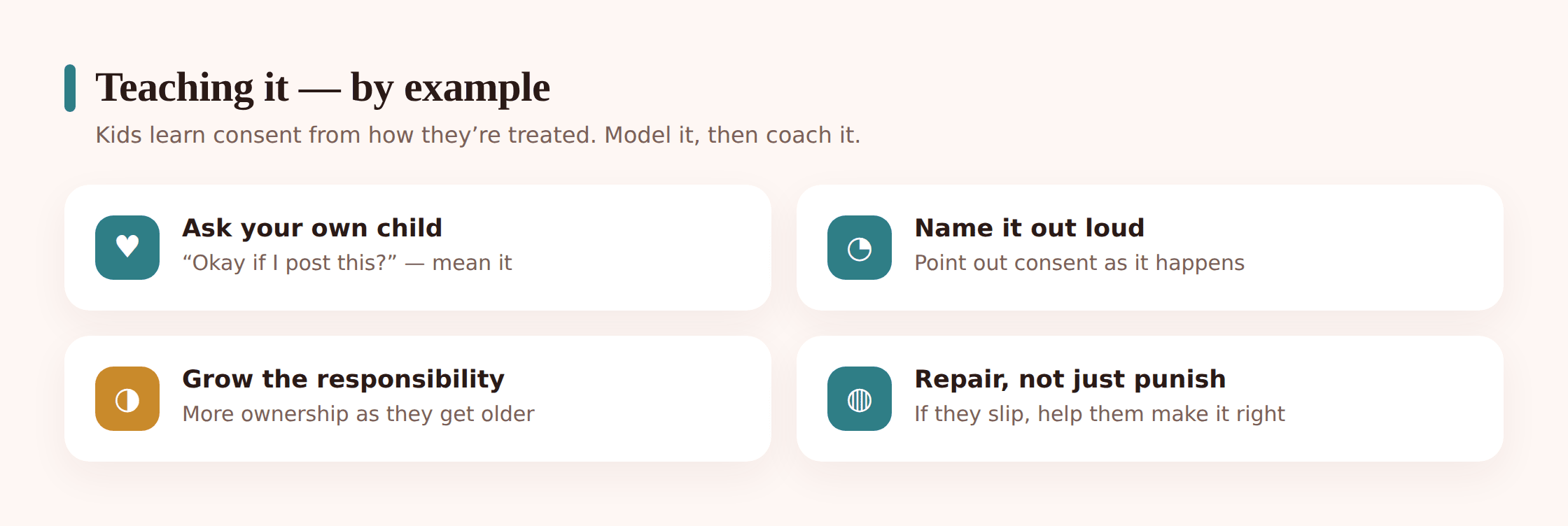
So the strongest thing you can do is ask your own child before you post them. “I got a lovely photo of you today, mind if I put it up?” It feels almost too small to matter. It’s the whole lesson in one sentence. When they say no, and you respect it, you’ve shown them that consent is real, that it’s honoured even when it’s inconvenient, and that they’re allowed to say no to sharing too. This ties directly to sharenting, where we go deeper on posting about your own kids well.
A few more ways to model it, all quiet:
Ask out loud
Make the asking visible. “Let me check with Grandma before I share this photo of her.” Kids absorb the habit by watching it happen in ordinary moments, not by being told about it.
Take it down when asked
If your child, or anyone, asks you to remove something, do it without a fuss and let them see you do it. That single act teaches “delete if asked” better than any rule you could recite.
Talk through your own choices
“I’m not going to post that one, it’s a bit embarrassing for your friend.” Narrating the decision shows the reasoning, and the reasoning is what transfers to situations you’ll never be there for.
Own it when you slip
If you posted something you shouldn’t have, say so and fix it. “You’re right, I should’ve asked first. I’ve taken it down.” Repair models better than perfection ever could.
What to expect at each age
Consent grows in layers. A five-year-old and a fifteen-year-old need very different conversations. Match the lesson to where they are.
Ages 4 to 7
Long before screens dominate, you’re planting roots. This is the age of “ask before you take,” “we don’t share secrets,” and “how would you feel if?” Keep it about people and feelings, not devices. When you do photograph them, ask, so the pattern is set early. They won’t understand privacy in the abstract, but they understand fairness and feelings completely.
Ages 8 to 11
Now screens are in the mix, and the concrete rules land. Ask before you post. Screenshots can spread. A private message stays private. Use real examples from their world, group chats, shared photos, a friend’s secret, because they’re starting to hit these moments themselves. This is also a good window to introduce the bigger picture through talking about online safety, so consent sits inside a wider conversation they already trust.
Ages 12 to 14
The social stakes rise and so does the complexity. Now you’re talking about resharing stories, “exposing” people, screenshots as social currency, the pressure to pass things on. They can handle nuance here: the difference between telling a trusted adult about something worrying and spreading a rumour for fun. Lean into their strong sense of fairness, which is usually sharp at this age, and connect it to how they’d want to be treated.
Ages 15 and up
Older teens can hold the full picture, including the parts that follow them into adult life. Reputations, screenshots that resurface years later, the ethics of “cancelling” someone, consent around images in relationships. Treat them as the near-adults they are. The conversation shifts from rules you set to values you share, and from you deciding to them owning it.
When your child shares something they shouldn’t have
It will happen. A screenshot gets forwarded, a photo goes up without asking, a secret slips out. When it does, the instinct is to come down hard. Try to resist leading with punishment, because the goal isn’t just to stop the behaviour, it’s to build the person who wouldn’t do it again. That comes from understanding and repair, not fear.
Stay calm and find out what happened
Get the story before the verdict. Kids often share without grasping the harm, or under pressure from a group. Understanding why doesn’t excuse it, but it tells you which lesson is actually needed.
Name the harm through the other person’s eyes
Shift the focus to the person affected. “How do you think your friend felt seeing that go around?” Empathy does the teaching here. You want them to feel it from the other side, which is where the real understanding lives.
Make it right
Repair is the heart of it. Take the post down. Untag. Apologise to the person, genuinely. If it spread, do what can be done to stop it going further. Involving your child in fixing it is more powerful than any consequence you could hand them.
Talk about next time
Once it’s mended, look forward. “What could you do differently if this comes up again?” Turn the mistake into a rehearsal for the next decision, so the whole thing becomes something they learned from rather than just got caught for.
There’s room for consequences, of course, especially if the harm was real or deliberate. But let them sit alongside repair, not replace it. A child who fixes their mistake and understands why it hurt someone has learned far more than one who was simply grounded and told never again.
None of this is a single sit-down lecture. It’s a running thread through ordinary life, a question asked before a photo goes up, a moment of “how would you feel?”, a decision talked through out loud. Kids who grow up inside that thread tend to carry it without thinking. They become the friend who asks first, the one whose group chats feel safe, the person others trust with a photo or a secret. That’s a good thing to raise, and it starts with the smallest habit there is: the pause before you post.
My child shared a friend’s private message, what now?
Start by understanding what happened and why, then turn to the friend. Help your child take the screenshot down where they can, stop it spreading any further, and offer a real apology. Talk it through from the friend’s side, how it feels to have a private message passed around, so the lesson sticks. Keep the emphasis on repairing the trust rather than just on the fact they got caught. That’s what makes it less likely to happen again.
Is a screenshot really a big deal?
It can be. A screenshot takes something meant for one moment or one person and makes it permanent and shareable. A disappearing story, a private chat, a message sent in confidence, all of it can be captured and sent anywhere, forever. That’s exactly why it matters. Kids often assume “temporary” means safe. Helping them see that anything on a screen can be saved is one of the most useful things you can teach.
How is this different from teaching my child to protect their own privacy?
Protecting their own privacy is about guarding their information and their reputation, which we cover in your child’s digital footprint. This is the outward-facing version: respecting everyone else’s. The two work together. A child who understands why they want their own moments protected is far better placed to protect other people’s, because they know exactly how it feels from the inside.
What if my child says “everyone shares stuff, why can’t I?”
It’s a fair thing for them to feel. The honest answer is that common doesn’t mean harmless, and that being the person who asks first is something to be proud of, not embarrassed by. You can also flip it: ask how they’d feel if their private messages or unflattering photos were shared around because “everyone does it.” Most kids arrive at the answer themselves once it’s their moment on the line.
My child is upset that a friend shared something about them. How do I help?
Take it seriously, because being on the receiving end genuinely hurts. Help them ask the friend to take it down, and support them in that if the friend resists. Use the moment gently, when the sting fades, to connect it back to their own choices: this is exactly why we ask first. Being the subject of it is often the most powerful lesson a child ever gets about respecting others.
At what age should I start this conversation?
Earlier than you’d think, in a form that fits. With little ones it’s “ask before you take” and “we don’t share secrets,” no screens required. As they get older it grows into posting, tagging, and screenshots. The values, fairness, empathy, asking first, are teachable from about four. The technology-specific parts layer on as they start using the tools. You’re never too early to plant the roots.