When Your Child Is the One Bullying: A Parent’s Guide
Nobody wants this phone call. A teacher, another parent, a message you weren’t meant to see — and the floor drops out. Your child, the one you tucked in and taught to say sorry, has been cruel to someone. Maybe for weeks. The first thing most of us feel isn’t anger at our kid. It’s a hot rush of “no, not mine, there’s been a mistake.” That instinct is human, and it’s also the first thing you’ll need to set aside. Because how you handle the next few days matters more than almost anything — for the child who got hurt, and for your own.
How parents find out — and the urge to deny it
It usually arrives sideways. The school rings and asks you to come in. Another parent sends a stiff, careful message. You catch the tail end of a group chat over your child’s shoulder and the tone of it stops you cold. Sometimes it’s a screenshot forwarded by a friend’s mum, already three steps removed from where it started, and you’re piecing together what actually happened from fragments.
Whatever the route, the reaction is often the same, and it comes in a predictable order. First, denial — my kid wouldn’t. Then, minimising — it was probably just banter, kids fall out. Then, blame that points anywhere but home — the other child provoked it, the teacher’s exaggerating, it’s all being taken out of context. None of that makes you a bad parent. It makes you a parent whose whole nervous system just got told that the person you love most has hurt someone, and your brain is scrambling to protect the image you hold of them.
Here’s the trap, though. Every minute you spend defending your child against the accusation is a minute you’re not spending helping them face it. Kids read this fast. If they see you close ranks and argue their innocence to the school, they learn that mum or dad will always get them off the hook, and the behaviour has no reason to stop. The most useful thing you can do in that first wave of disbelief is buy yourself a beat: “Thank you for telling me. I need to look into this properly and talk to my child before I say anything else.” That’s not agreeing they’re guilty. It’s refusing to decide they’re innocent before you know.
Why kids bully (it’s rarely what you think)
The cartoon version of a bully — a sneering kid who’s just mean to the bone — barely exists. Real children who bully are complicated, and the reasons usually make an uncomfortable kind of sense once you look.
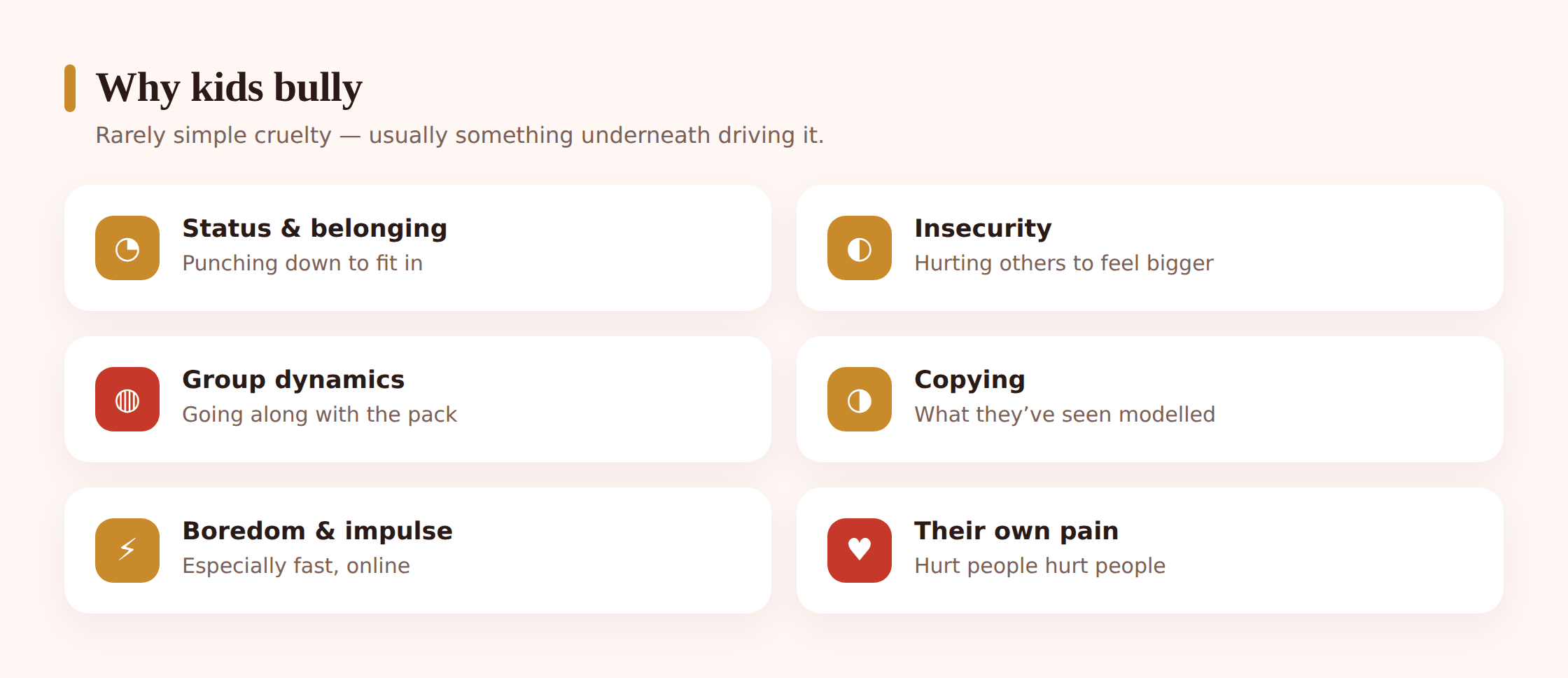
Status and belonging. A huge amount of it is social climbing. Putting someone else down is a fast, ugly way to look bigger, funnier, or more in with the popular crowd. If a joke at another kid’s expense gets fifteen laughing emojis, that’s a hit of belonging, and belonging is oxygen to a teenager.
Group dynamics. Plenty of kids who’d never start it will happily pile on. The chat’s already going, everyone’s agreeing, and your child adds their bit because stepping out feels riskier than joining in. They’re not the ringleader — they’re the crowd. That doesn’t make them innocent, but it changes what you’re dealing with.
Insecurity and their own pain. This is the big, quiet one. Kids who feel small, anxious, or out of control at home or in themselves sometimes reach for the one lever that makes them feel powerful — making someone else feel worse. A child being bullied elsewhere, struggling with a change at home, or just wretched about themselves can turn that outward. The cruelty is a symptom of hurt as often as it’s a cause of it.
Copying what they’ve seen. Kids absorb the temperature around them. If contempt is normal in the house, if an older sibling rules by mockery, if the influencers they watch build their whole brand on tearing people down, some of that leaks into how they treat their peers. They’re rehearsing what they’ve been shown.
Boredom and the thrill of it. Some bullying is just entertainment gone sour — a dull evening, a group chat, and someone becomes the sport. There’s a genuine buzz to the reaction, the drama, the sense of being at the centre of something.
Not grasping the harm — especially online. This one is specific to the screen, and it’s real. When you can’t see a face crumple, when the message vanishes, when there are twenty other people typing, the harm doesn’t land as harm. A kid who’d never say something to another child’s face will type it without a flinch, because online it doesn’t feel like it’s happening to a person. That distance is doing a lot of the damage, and it’s also something you can actually teach your way through.
None of these are excuses. They’re handholds. You can’t change a behaviour whose cause you refuse to look at, and “my child is just bad” isn’t a cause — it’s a dead end. If the reason is status, you work on where else they can get it. If it’s their own pain, you tend to the pain. Naming the why is the first move toward the how.
Signs your child might be involved
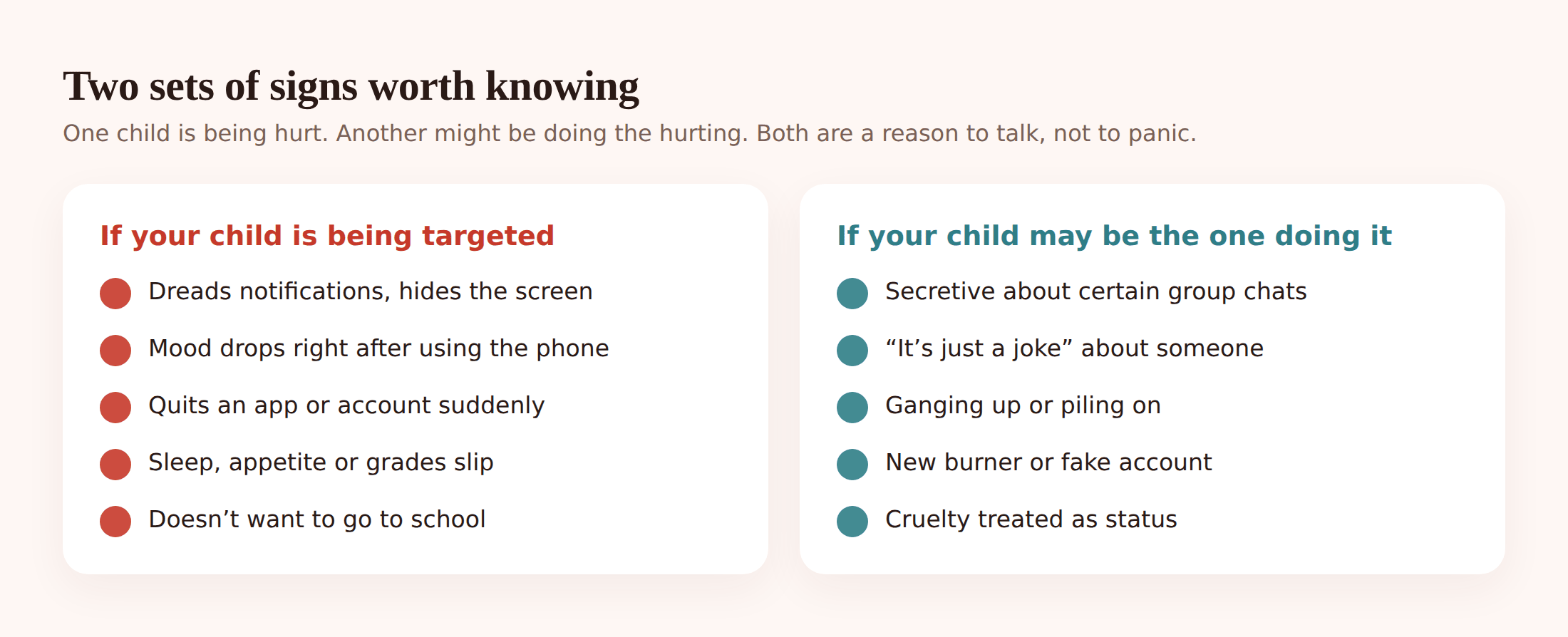
Kids who bully rarely advertise it, and the signs look nothing like the withdrawal you’d see in a child who’s being targeted. If anything, a child doing the bullying can seem to be doing well — riding high, socially confident, part of the in-group. That’s what makes it easy to miss.
- Secrecy around specific chats. Not general teenage privacy — a particular group they snap shut when you come near, laugh at, and won’t explain.
- Cruelty as currency. Screenshots of someone’s embarrassment shared like trophies. A running joke about a kid who “deserves it.” Contempt that’s become a bonding language with their friends.
- “It’s just a joke,” said too fast. Defensive before you’ve even accused them of anything — often a sign they already know it landed badly.
- A sudden rise in status. More popular, more sure of themselves, right as another child in their orbit has gone quiet or dropped out of the group.
- Ganging-up language. “Everyone thinks she’s…”, “we all agreed…”. The vocabulary of a pack forming around a single target.
- Unexplained new stuff, or aggression that spills at home. Sometimes bullying comes with taking things from other kids. Sometimes the same contempt shows up in how they talk to a younger sibling or to you.
- Zero empathy when other kids’ troubles come up. A hardness, a “who cares,” when a story about someone being hurt would once have got a reaction.
One or two of these on their own prove nothing — teenagers are private and moody and that’s the job. It’s the cluster, and the change, that should make you look closer. And “looking closer” doesn’t mean going through their phone in secret. It means paying attention, staying in the conversation, and being honest with your child about what you’re noticing and why.
How to respond well
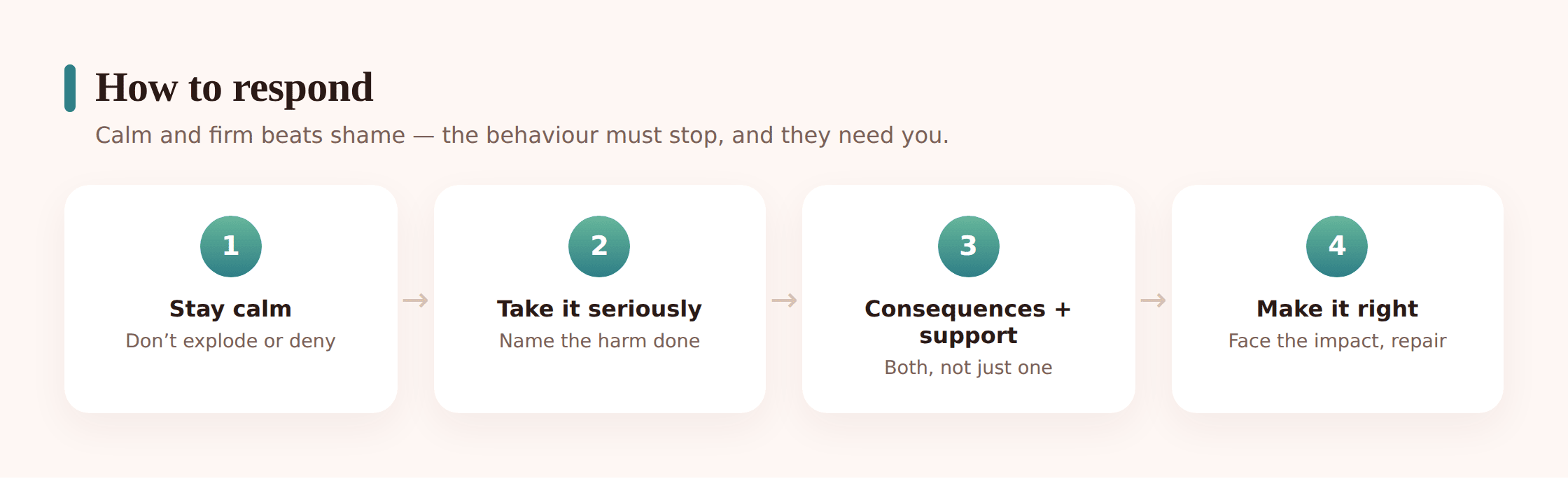
The instinct is to explode, ground them for a month, and confiscate the phone on the spot. Understandable, and mostly counterproductive. A child who’s just been hit with a wall of shame and punishment goes into self-defence, stops listening, and learns to be more careful next time — not kinder. What you’re aiming for is accountability without humiliation. Those aren’t opposites; the trick is holding both.
Get calm before you get into it
If you’re shaking with anger, that’s not the moment. Take the evening if you need it. “We’re going to talk about this properly tomorrow” is a fine thing to say. A conversation you have while flooded will be one you both regret. You want to walk in steady, not to detonate.
Get the facts, not a confession
Come to it curious rather than at full prosecution pace. “The school told me something happened with Jamie. I want to hear your side of it.” Let them talk. Kids will often minimise — “it was just a joke,” “everyone was doing it” — and that’s information, not the end of the conversation. You’re mapping what actually happened, including your child’s part in it, before you decide anything.
Take it seriously — out loud
Once the picture’s clear, don’t soften it into nothing. “This wasn’t a joke. What you did hurt someone, and it has to stop.” Say the actual thing. Kids need to hear that the adult in the room isn’t going to wave it away, because a lot of them are half-hoping you will.
Make them face the impact
This is the heart of it. Not “you’re a bully” — that’s a label they’ll either fight or wear. Instead, turn them toward the other child. “Picture it was you. You open your phone and twenty people are laughing at you. You can’t get away from it, it’s in your bed, it’s the first thing every morning. That’s what Jamie’s been living with.” You’re not trying to crush them. You’re trying to switch the empathy back on — the thing the screen switched off.
Set real consequences — with support alongside
There should be a cost, and it should connect to what happened. Time off the app or platform where it went on. A proper apology, done right (more on that below). But pair every consequence with support, because a child who only gets punishment learns to hide, while a child who gets accountability plus a hand to change actually changes. “There are consequences, and I’m also going to help you fix this” is the sentence that does the work.
A note on the phone specifically: taking it away entirely, forever, is tempting and usually blunt. Removing them from the particular group or platform where the bullying lives is sharper and fairer — it cuts off the audience and the tool without cutting them off from every friend they have. A lot of online cruelty runs on spectators, and quietly removing the stage often does more than a blanket ban.
Helping them repair and change
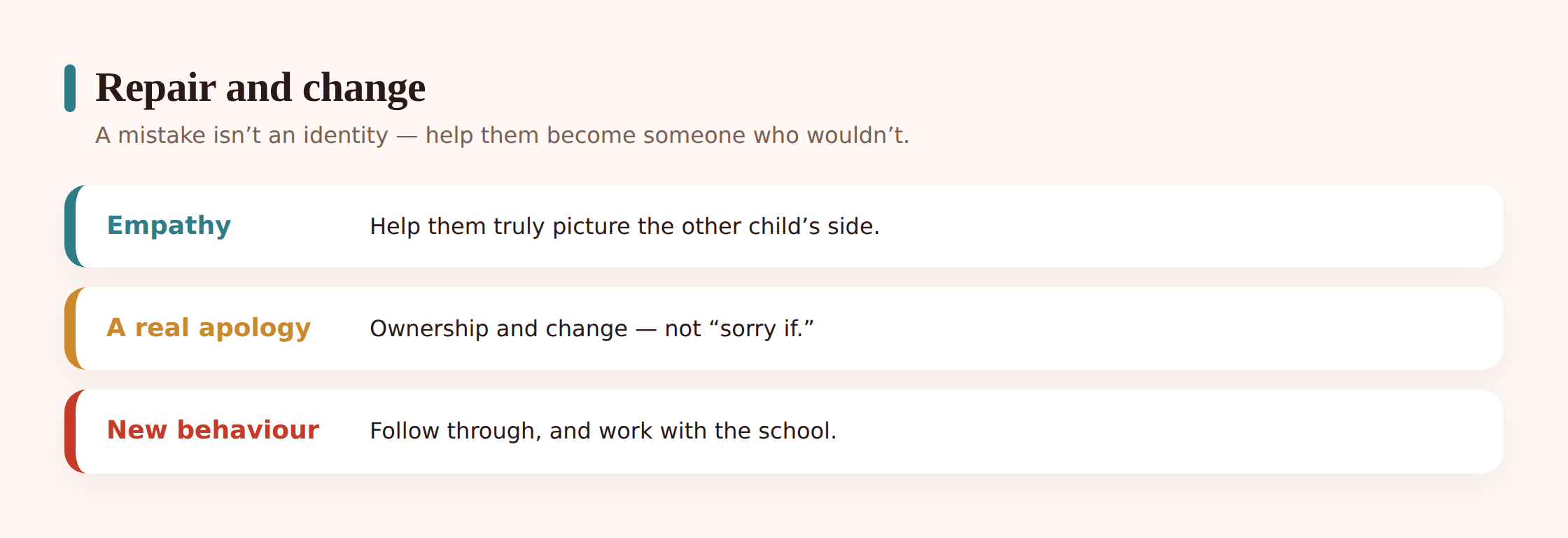
Stopping is necessary but it isn’t the whole thing. A child who simply stops because they got caught hasn’t grown; they’ve just gone quiet. What you’re after is a kid who understands what they did, makes it right where they can, and becomes someone who wouldn’t do it again. That takes a few pieces working together.
Build the empathy back
Keep coming back, gently, to the person on the other end. Not as a lecture on repeat, but woven in. Ask questions that make them do the imagining — “What do you think that felt like?” “What would have made it stop, if you’d been Jamie?” Empathy isn’t a switch you flip once; it’s a muscle you help them use until it works on its own again.
An apology done properly
A muttered “sorry” to make the adults go away is worse than nothing. A real apology names the specific thing (“I shared that photo and got people to laugh at you”), owns it without excuses (“that was cruel, and there’s no reason that makes it okay”), and doesn’t demand forgiveness back. It might be face to face, it might be a message, it might go through the school if direct contact isn’t wise — the form matters less than the honesty. And your child needs to accept that the other kid doesn’t owe them a warm response. Making amends isn’t a transaction where you say sorry and get absolved.
Change the actual behaviour
Repair is backward-looking; this is forward. If the pull was status, help them find it somewhere that isn’t cruelty — a sport, a skill, a place they can be good at something. If it was the group, talk honestly about who they’re spending time with and whether that pack brings out the worst in them. If it was their own pain, that’s what you tend to next. The behaviour was doing a job for them; you’re helping them get that need met a better way.
Keep the relationship intact through it
Through all of this, your child needs to know the ground hasn’t disappeared under them. “I’m furious about what you did, and I’m not going anywhere” is a thing they need to feel. Shame that convinces a kid they’re irredeemable doesn’t produce good behaviour — it produces hiding, and sometimes worse. The kids who come out of this genuinely changed are almost always the ones whose parents stayed firmly on their side while being crystal clear the behaviour had to end.
This is also a moment to widen the conversation about how they treat people online generally. A lot of the harm came from the screen making other kids feel unreal, and that’s worth naming directly — it connects to everything from group chats to comments to what they laugh along with. If you want the flip side too, so your child knows what it looks like from the receiving end and how you’d want them to handle being targeted, cyberbullying (when your child is targeted) is worth reading together. The way platforms reward pile-ons and outrage is its own factor, and social media safety covers the ground where a lot of this plays out.
Working with the school
Your first pull might be to fight the school — to defend your child, dispute the account, get the punishment reduced. Resist it. The school is not your enemy here, and treating them as one teaches your child that consequences are something to lawyer their way out of. Go in as a partner: “I take this seriously, I want to understand what happened, and I want to help fix it.” That single stance changes everything about how the school works with you.
Practically, that looks like a few things. Ask for the specifics calmly rather than arguing them. Find out what the school’s process is and cooperate with it rather than trying to route around it. Ask what they’ve seen — schools often have a wider view of the social dynamics than you do, including whether your child is the driver or one of a crowd. And ask about support, not just sanctions: many schools have a counsellor or pastoral lead who deals with exactly this and can work with your child, not only discipline them.
If your child is being bullied elsewhere themselves — which is more common than parents expect in kids who bully — the school needs to know that too, because it changes the whole picture. Hurt kids hurt kids. A child who’s a target in one setting and an aggressor in another isn’t a contradiction; they’re a child in trouble who needs help on both fronts.
When it signals a need for more help
Most bullying, caught and handled well, doesn’t need a professional. But sometimes the behaviour is a flare telling you something bigger is going on, and it’s worth knowing what those signals look like.
Pay attention if the cruelty is persistent and genuinely doesn’t shift no matter what you do; if it comes with a real absence of empathy or remorse that unsettles you; if it sits alongside other worrying things — hurting animals, fire-setting, a pattern of aggression that’s escalating; if your child seems deeply unhappy, anxious, or angry underneath it; or if you suspect they’re being bullied, hurt, or exposed to something harmful themselves. Any of these is a reason to bring in help, not a verdict on your parenting.
Where to turn is fairly straightforward. The school counsellor or pastoral lead is often the easiest first door and knows the local landscape. Your GP is a sensible first port of call if you’re seeing real distress, low mood, or changes in your child that aren’t lifting, and they can point you toward more specialist support if it’s needed. And a psychologist or family therapist can help unpick what’s driving the behaviour when it’s clearly coming from somewhere deeper. This is a sensitive area and there’s no shame in reaching out early rather than waiting for a crisis — for either of your children, the one who acted and any who were hurt.
It’s worth remembering, too, that the pressures underneath a lot of this are real and heavy. The link between phones, social media, and how kids feel about themselves is well worth understanding as part of the wider picture — teen mental health covers where a lot of the strain comes from, and some of it may be feeding what you’re seeing.
A short checklist for the hard week
- Pause before you react. Steady beats fast. The first conversation sets the tone for all of them.
- Skip the denial. “Not my kid” costs you the time your kid needs you to spend helping them.
- Name the harm plainly. No softening it into “banter.” It hurt someone, and it stops now.
- Turn them toward the victim. Empathy is the thing that broke; rebuilding it is the point.
- Consequences plus support, always paired. Punishment alone teaches hiding. Support alone teaches nothing changed.
- Get the apology right. Specific, owned, no strings, no demand for forgiveness.
- Work with the school, not against it. Partner, don’t defend.
- Look underneath. Status, group, pain, boredom, distance — find the why, address the why.
- Keep the relationship whole. Furious about the behaviour, unshakeably on their side.
- Get help if it doesn’t shift. A counsellor, your GP, a psychologist — early, not at crisis point.
Common questions
I found out my child is bullying someone — what now?
Don’t act while you’re flooded. Give yourself the evening if you need it, then have a calm conversation to understand what actually happened. Take it seriously out loud, turn your child toward the harm they caused, set consequences that connect to what they did, and pair those with support and a clear path to make it right. Then follow through on the repair. The first conversation matters more than the punishment.
Should I punish them?
There should be a consequence, and it should link to what happened — time off the platform where it occurred, a proper apology, that kind of thing. But punishment on its own tends to teach a child to hide the behaviour rather than change it. The version that actually works is accountability plus support: a real cost, alongside a genuine hand to understand what they did and become someone who wouldn’t do it again. “There are consequences, and I’m going to help you fix this” beats a month’s grounding and nothing else.
Why is my kind kid being cruel online?
Because the screen strips out the thing that usually stops them — the other person’s face. A child who’d never say something cruel out loud will type it, because online it doesn’t feel like it’s happening to a real person. Add a group chat where everyone’s piling on, a hit of status for the funniest jab, and it’s easy for a genuinely kind kid to get swept into something they’d be ashamed of in the room. It’s not that your kind child is secretly cruel. It’s that the setting made cruelty feel weightless. That’s teachable.
What if my child says it was just a joke, or that everyone was doing it?
Treat both as information rather than a case closed. “Everyone was doing it” often means your child was part of a crowd rather than the ringleader, which changes your approach but not the fact that it has to stop. “It was just a joke” is usually a sign they know it landed badly. Acknowledge what they’re saying, then bring it back to the person on the other end: it doesn’t matter that it felt like a joke to you — here’s what it felt like to them.
Will monitoring my child’s phone fix this?
No — and it’s the wrong frame. A monitoring app, used openly and agreed together, can help you stay in the conversation and notice patterns, but it doesn’t build empathy or repair a relationship. It’s a prompt to talk, not a solution. The real work is the conversations, the accountability, the apology done right, and addressing whatever was driving the behaviour. Used as a hidden trap, monitoring makes things worse — it teaches your child to be sneakier and to trust you less. Used in the open, it’s just one small support among the human ones that matter more.
How do I handle my own guilt about this?
Gently, and without letting it run the show. Almost every parent in this situation cycles through “where did I go wrong,” and some honest reflection is healthy — but spiralling into shame helps nobody, least of all the child who needs you steady right now. Kids bully for all sorts of reasons, plenty of which aren’t about your parenting at all. The most useful thing you can do with the guilt is channel it into showing up well: handle this with calm and integrity, and you’re teaching your child exactly how a good person faces having done wrong.
This is one of the harder things you’ll do as a parent, and the fact that it’s landed on you doesn’t mean you’ve failed. What your child does next depends a lot on what you do now — and handled with steadiness and honesty, a child who’s been made to face the harm they caused, and helped to put it right, usually comes out of it kinder than before. That’s the whole aim: not a child who’s been branded, but one who’s genuinely changed.