Kids & Influencers: Parasocial Relationships & ‘Finfluencers’
Ask a nine-year-old about their favourite creator and you’ll hear the tone people usually save for a close friend. They know the pet’s name, the running jokes, the daily routine. It feels like a real relationship, even though the creator has no idea your child exists. That one-way bond shapes what kids buy, believe, and want to be. It brings genuine good and some real traps, and the most useful thing a parent can do is understand how it works rather than wave it away.
What “parasocial” actually means
A parasocial relationship is the sense that you personally know someone you’ve never met and who has never met you. It’s a one-sided bond that feels two-sided. The term is decades old — it was first used to describe how people felt about radio hosts and TV presenters — but nothing has ever fed it like a phone.
Watch how a creator talks to camera. They look straight down the lens. They say “you” and “we.” They share the small stuff — what they had for breakfast, a bad day, a silly opinion about a sandwich. That’s the texture of real friendship, and your child’s brain files it accordingly. The difference is that a friend knows your name back. A creator is performing intimacy for millions at once, and your child is one of them.
This isn’t a flaw in your kid. Adults form these bonds too; plenty of grown-ups feel a jolt of grief when a favourite podcaster quits. The feeling is normal. What matters is that a child hasn’t yet built the mental sorting system that says: this person is warm to me and also selling me things and also doesn’t know I’m alive. All three can be true at once, and holding them together is a skill you can teach.
Why the pull is so strong for kids
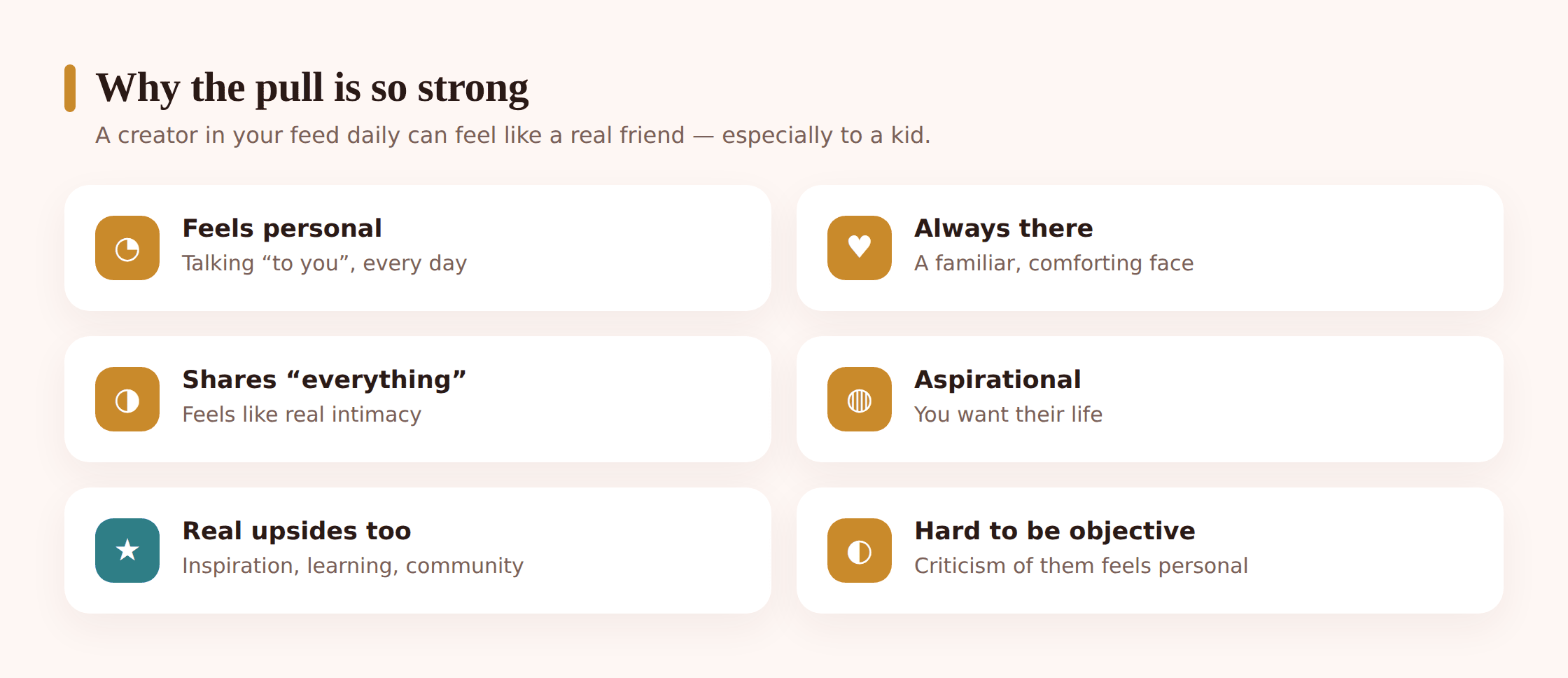
A few things stack up to make the bond unusually powerful in childhood.
- Repetition. A creator who posts daily shows up in your child’s life more often than most relatives do. Familiarity breeds attachment, and the sheer volume is new — no TV star of the past was in a kid’s pocket every single day.
- Directness. Talking to camera, using the viewer’s language, replying to comments now and then — it all reads as personal contact, even when it’s broadcast to a stadium’s worth of strangers.
- Age and identity. Kids and teens are working out who they are, and they do it partly by trying on other people. A creator becomes a template: this is how to dress, joke, react, exist.
- The algorithm. Feeds notice attachment and feed it. Linger on one creator and you’ll be handed more of them, plus others just like them. If you want the mechanics, we cover them in how algorithms work — the short version is that the app is engineered to deepen exactly this kind of loyalty.
- Belonging. Fandoms come with a whole community — in-jokes, a shared vocabulary, other kids who care about the same person. Leaving the creator can feel like leaving the friends too.
Put those together and you get a bond that can feel more reliable than the messy, up-and-down friendships of an actual playground. The creator never falls out with your child, never leaves them out, never has a bad day at them. That steadiness is part of the appeal, and part of what makes it worth understanding.
The genuine upsides
It would be easy — and wrong — to treat all of this as a problem to be managed. Plenty of what kids get from creators is good, and pretending otherwise just tells your child you don’t get it.
- Inspiration and skills. Kids learn to draw, code, cook, skateboard, speak languages and fix bikes from people who make it look reachable. A good creator can switch on an interest that lasts years.
- Role models they’d never meet otherwise. A child can find someone who shares their background, disability, faith, or niche obsession, and see a version of their future they didn’t know existed.
- Community and belonging. For a kid who feels out of step at school, an online fandom can be where they finally fit. That’s not a consolation prize; it’s real connection.
- Comfort and routine. A familiar voice at the end of a hard day is soothing. Lots of adults use creators the same way.
- A window on the world. Done well, creators expose kids to lives, jobs, and places far outside their own street.
Hold onto this list. When you eventually raise the harder stuff, starting from “I know why you love them” earns you a hearing that “influencers are bad” never will.
Where it goes wrong
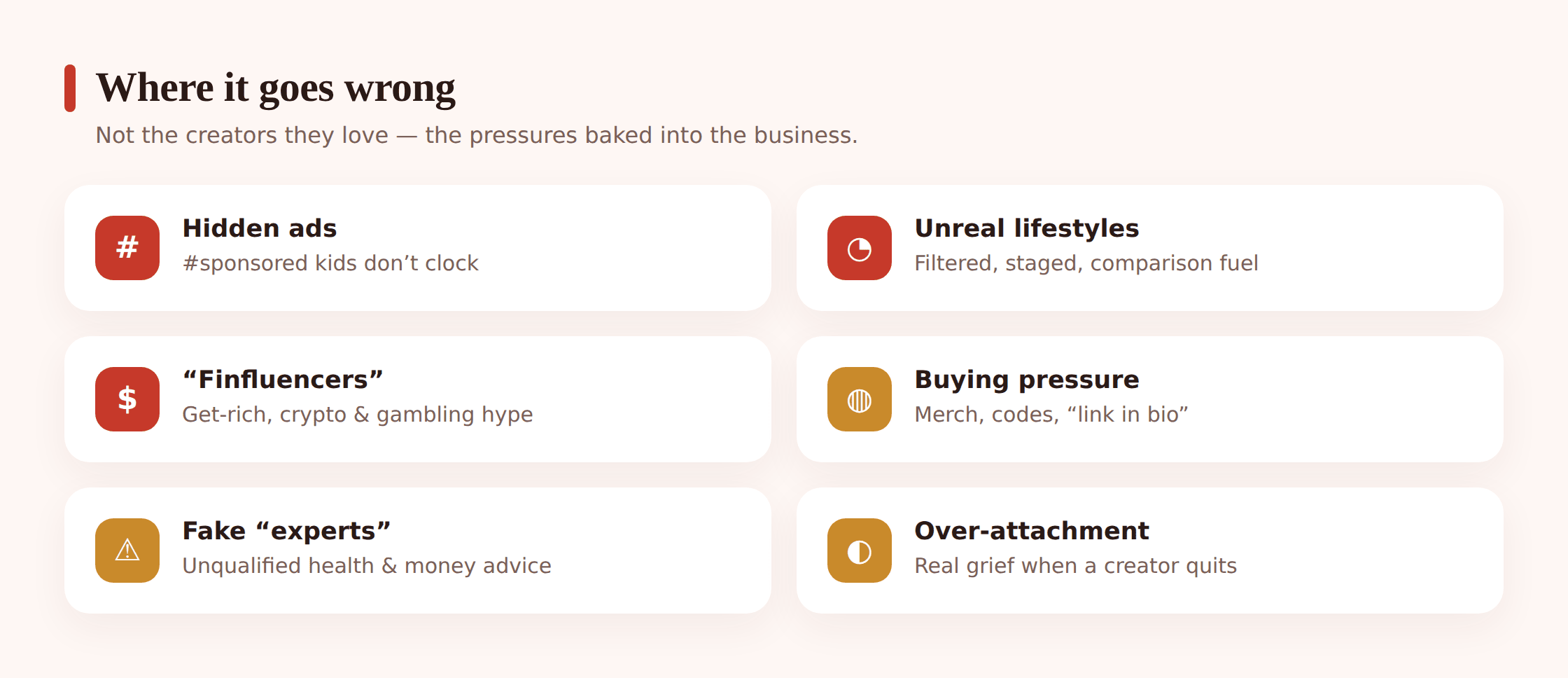
The trouble isn’t the affection. It’s what the affection can be pointed at. A few patterns come up again and again.
- Ads kids don’t spot. A #sponsored tag buried under three other hashtags, or a quick “thanks to today’s partner” at the top, is legally a disclosure and practically invisible to a child. To your kid it’s just their trusted friend loving a product. They don’t register that money changed hands. This is the single most useful thing to teach, and we come back to it below.
- Unrealistic lifestyles. The perfect room, the constant holidays, the endless new stuff — it’s curated, often staged, sometimes rented for the shoot. A child measuring their ordinary life against a full-time performer’s highlight reel comes off worse every time. We go deeper on that ache in social media & self-esteem.
- Buying pressure and merch. Hauls, “must-have” drops, limited-edition merch timed to sell out — a lot of content exists to move product. Loyalty to the creator gets converted into spending, and kids feel it as supporting a friend rather than being marketed to. This ties into in-app purchases when the buying happens inside a game or app.
- Unqualified “experts.” A creator with a big following and no training will confidently hand out advice on nutrition, mental health, supplements, workouts, or medicine. Charisma reads as authority to a child, and “my favourite person said so” can outweigh a doctor or a parent.
- Extreme and stunt content. Mukbang binges, dangerous “challenges,” shock content, and escalating stunts get rewarded with views, so they escalate. Kids can absorb a warped sense of what’s normal, or feel pushed to copy something risky.
- Parasocial grief and over-attachment. When a creator quits, gets cancelled, changes, or turns out to be someone unpleasant, the loss can hit a child genuinely hard. It’s real grief over a relationship that was, from the other side, never a relationship at all.
Finfluencers and money advice
“Finfluencers” — financial influencers — deserve their own paragraph because the stakes are money, and the pitch is tuned to teenagers who feel broke and ambitious at the same time. Some are genuinely trying to teach the basics of saving and budgeting, and that’s fine. The dangerous ones sell shortcuts: crypto tokens that will “definitely” moon, trading “systems,” dropshipping courses, and increasingly gambling and betting dressed up as smart investing.
The tells are consistent. Guaranteed returns. Urgency and countdowns. Screenshots of profits that can’t be checked. A “secret” the mainstream doesn’t want you to know. A referral link or a paid course at the end. And crucially, warmth — the same parasocial bond that makes a kid trust a gaming creator makes them trust a money one, except now the trust is being converted into deposits.
Two things make teens especially exposed. First, they often don’t yet grasp that promoting a token can move its price, so an influencer can hype something they already hold and sell into the excitement they created. Second, gambling and trading apps now share the same slick, gamified feel as everything else on the phone, so the line between “investing” and “betting” is deliberately blurred. If your teen is being pulled toward any of this, our guide to crypto & investment scams targeting teens goes through the specific schemes and how to respond.
Teaching kids to spot the sell
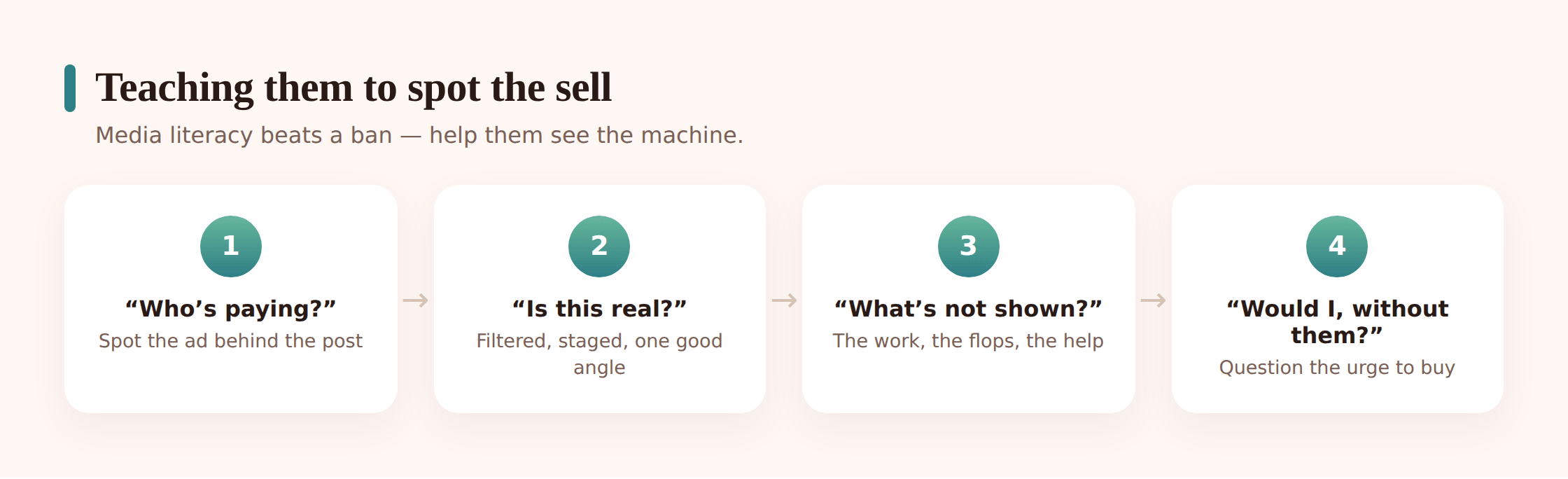
The goal isn’t to make your child cynical about everyone they follow. It’s to give them a few questions they can run in the background, so they stay a fan without becoming a mark. These land far better as shared curiosity than as a lecture.
Spot the money
Watch a video together and play “find the ad.” Look for #sponsored, #ad, “paid partnership,” gifted items, discount codes, and affiliate links. Once a kid has spotted a few, the buried ones stop being invisible. Make it a game, not a test.
Ask who gains
Teach the one question that does most of the work: who makes money if I believe this? If the answer is the person telling you, the advice isn’t neutral. This works for products, for money schemes, and for “experts” alike.
Check the qualifications
For anything about health, food, bodies, or money, ask what actually qualifies this person. Being popular isn’t training. A doctor, a coach, and a random confident creator are not the same source, however warm the second one feels.
Separate the person from the pitch
Help your child hold two ideas at once: you can genuinely like a creator and still not buy what they’re selling. Liking them doesn’t oblige you to trust their every recommendation or spend a penny.
Notice the edit
Point out that what they see is chosen and shaped — the good takes kept, the boring bits cut, the room tidied for the shot. It’s a highlight reel, not a life. Naming that quietly drains a lot of the comparison out of it.
You don’t have to deliver all of this in one sitting. A stray comment while you’re both watching — “oh, that’s an ad, see the little tag?” — teaches more than any sit-down ever will, because it’s real and it’s low-pressure.
How to talk about it without dismissing it
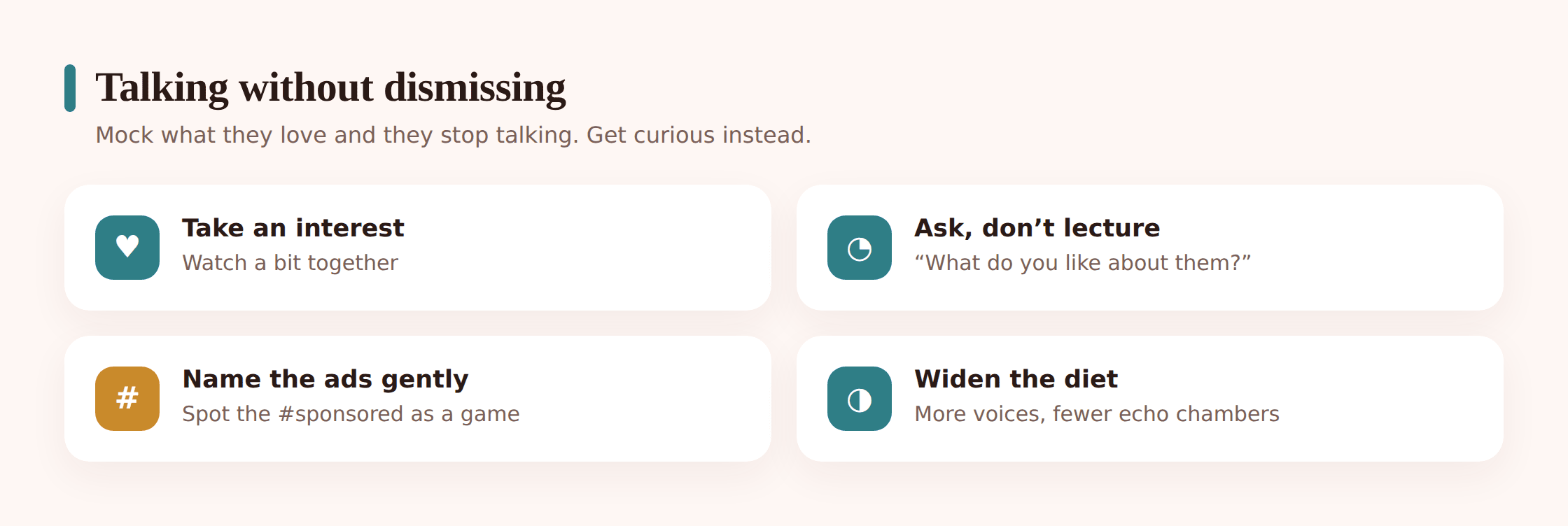
Here’s the trap most parents fall into: the creator your child loves looks, to you, like noise. So you say something dismissive, and instantly you’ve made yourself someone your kid can’t talk to about the very thing that fills their day. The bond with the creator is real to them. Mock it and you don’t weaken it — you just lose your seat at the table.
Try the opposite. Get curious. Ask them to show you why this person is so funny or so good at the game. Watch a couple of videos. Laugh at the bits that are actually funny. Once your child believes you’re genuinely interested rather than gathering evidence, the harder conversations — about ads, about money, about that stunt everyone’s copying — become things you can raise without a door slamming.
Keep it specific and light. “Do you reckon they actually paid for that, or were they given it?” invites a real answer. “You know it’s all fake, right?” invites an eye-roll. And stay honest about the good side; if you only ever bring up creators to criticise them, your kid learns to route around you.
For the wider picture — settings, boundaries, and the platforms themselves — our guide to social media safety for kids sits alongside this one. This piece is about the relationship; that one is about the environment it lives in.
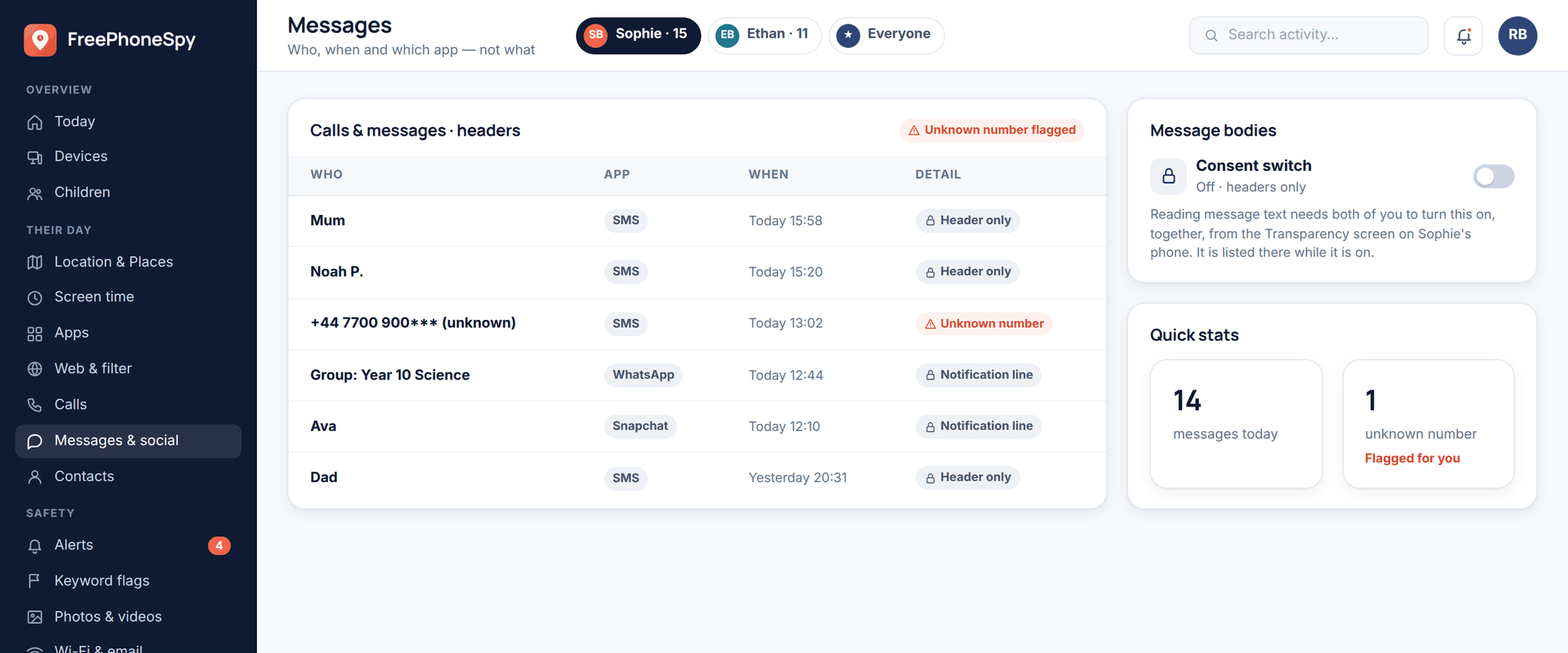
If you do use tools to keep an eye on younger children’s screen time or the apps they’re spending hours in, keep them out in the open. Something like FreePhoneSpy is meant to be set up with your child’s knowledge — a shared view of how the day is going, not a secret watch. For influencer culture specifically, the honest conversation does the heavy lifting anyway; no dashboard teaches a kid to spot a #sponsored tag. That part is you.
FAQ
Is it unhealthy for my child to be this attached to a creator?
Usually no. A strong parasocial bond is normal and mostly harmless — adults have them too. It’s worth a gentle look only if it’s crowding out real friendships, driving a lot of spending, or feeding serious comparison. Attachment itself isn’t the problem; what it’s pointed at is.
My kid says the creator “would never lie to them.” How do I respond?
Don’t attack the creator. Agree that they might genuinely like the product — and add that they’re also being paid, and both can be true at once. The idea you’re planting isn’t “your friend is a liar,” it’s “even people we like have reasons to sell us things.” That’s easier to hear.
How young is too young to be following influencers?
There’s no clean age line, and lots of content aimed at young kids is influencer-shaped. The younger the child, the more you’re the filter — watching alongside them, choosing channels together, and narrating the ads out loud — rather than expecting them to spot the sell on their own.
What do I do about finfluencers pushing crypto or trading at my teen?
Take it seriously without panicking. Teach the “who profits if I believe this?” question, treat guaranteed returns and countdowns as red flags, and make it safe for your teen to tell you when they’re tempted. Our crypto & investment scams guide has the specifics.
A creator my child loved just quit and they’re genuinely upset. Is that odd?
Not at all. It’s real grief over a real feeling, even though the relationship was one-sided. Don’t minimise it with “but you never even met them.” Acknowledge the loss, let them be sad, and it’ll pass like any other.
Should I ban the influencers I don’t like?
Banning specific creators tends to backfire and drive it underground, and it teaches nothing durable. You’ll get further teaching your child to think critically about whoever they watch, and stepping in with real limits only for genuinely harmful content rather than stuff that’s merely annoying to you.