Crypto, Trading & Investment Scams Targeting Teens
A 15-year-old gets a DM from an account that looks like a mate from school: “Bro I turned £50 into £600 in a week, want me to plug you in?” There’s a screenshot of a trading app showing green numbers, a friendly voice, and a link. No mugging, no threat — just a door held open to easy money at exactly the age when easy money sounds like the answer to everything. Crypto and investment scams aren’t a grown-up problem that teenagers happen to overhear. Teens are a target in their own right, chased with pitches built for how they think, what they want, and what they don’t yet know. This is about that specific corner of the internet: the money-flipping DMs, the fake coins, the “signals” groups, and the quietly dangerous trap where a teen ends up moving someone else’s stolen money without understanding what they’ve agreed to.
Why scammers aim at teens specifically
You might assume a 14-year-old with no savings is a poor target. Scammers don’t think so, and their reasons are worth understanding, because each one points at a defence.
Teens live where the pitches live. Money-flipping and crypto hype spread on exactly the platforms teenagers spend hours on — short-video feeds, group chats, gaming voice channels, DMs. A stranger with a “plug” doesn’t have to find your teen. The algorithm hands them a “day-in-the-life of a 17-year-old trader” video, they watch, and the next one is a bit more explicit about how to start.
The FOMO is real and it’s sharpened by “flex” culture. A teenage feed is a highlight reel of things other people apparently have — cash fanned out, a new phone, designer stuff, captions like “money doesn’t sleep.” Almost all of it is staged, rented, or lifted from someone else’s post. But to a teenager comparing their allowance against a wall of apparent wealth, “everyone my age is making money except me” feels true. Scammers sell the shortcut to closing that gap.
They don’t have the scar tissue yet. Most adults have been burned once — a dodgy deal, a friend who never paid them back — and it left a “this feels off” instinct. A 13-year-old hasn’t earned that instinct. A confident stranger showing screenshots is genuinely persuasive when you’ve no experience of how easily screenshots are faked.
And a small amount is enough. Scammers aren’t always after a teen’s non-existent savings. Sometimes they want £20 to “activate” an account. Sometimes they want the teen’s bank account itself, to move other people’s money through — which is the mule problem we’ll come to, and the one with the heaviest consequences.
The scams, named and explained
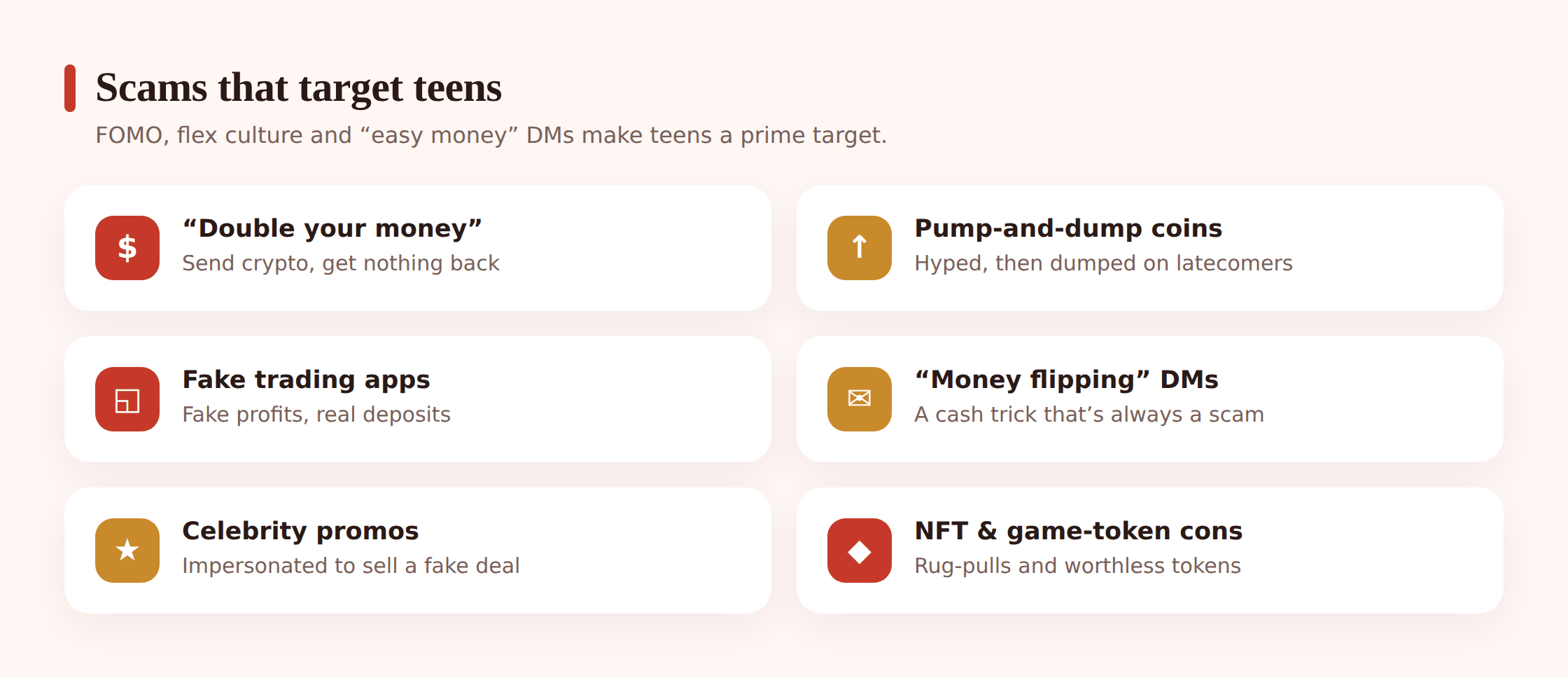
They wear different costumes, but there’s a fairly short list of underlying tricks. Once a teen can name the pattern, the costume stops fooling them.
“Money flipping” and cash-flipping DMs
The classic teen version. A message — often from a hacked or fake account posing as a friend — says “send me £30 and I’ll flip it to £300, I know a method.” The “method” doesn’t exist. Either the money’s just gone, or the teen is asked to send more to “unlock” the bigger payout. Every so often an early, tiny “profit” gets paid out to build trust before the real ask lands. There is no legitimate service anywhere that turns your £30 into £300 by you handing it to a stranger online. None. It’s the oldest con there is with a new coat of paint.
Fake crypto giveaways and “double your money”
“Send 0.1 of any coin to this wallet and we’ll send back double — celebrating 1 million followers!” These ride on the branding of real exchanges or famous names. The moment crypto leaves a wallet it’s effectively irreversible, so once the teen sends, it’s gone with no chargeback and no bank to call. No real company doubles money you send it. The whole thing runs on the idea that if the offer sounds mad enough and looks official enough, someone will try “just a little” to see.
Pump-and-dump coins and meme tokens
A group chat or influencer whips up hype around a brand-new coin or meme token: “we’re all buying at 9pm, this is going to 100x, don’t miss it.” Teens pile in. The people running it — who bought in early and cheap — sell into that wave of buying, the price collapses, and the latecomers are left holding something worth almost nothing. The teen wasn’t investing; they were the exit liquidity for someone else’s plan. The tell is any coordinated “everyone buy now” push, especially with a countdown.
Fake trading apps and “signals” groups
A slick app or website shows the teen’s balance climbing beautifully after they deposit. It’s a screen, not a market — the numbers are painted on. Everything looks great until they try to withdraw, and suddenly there’s a “tax,” a “fee,” or a “verification deposit” needed before they can take money out. Pay it and there’s another. The money was never really there. “Signals” groups are the sibling: pay a subscription for “expert” buy/sell tips that are worthless, and often steer you into whatever the organiser is dumping.
Celebrity and influencer impersonation
A video of a famous person “endorsing” a trading platform — increasingly a deepfake with a cloned voice — or an account impersonating a creator the teen follows, promoting a “guaranteed” opportunity. Real endorsement or not, “a rich famous person wants to make you rich too” is a sales script, never a fact. Our guide on deepfakes and what parents need to know covers how convincing these fakes have become.
NFT and game-token scams
This one lands right in gaming territory, where teens already trade. A “rare” NFT or in-game token that’s “about to moon,” a site that mints free NFTs if you connect your wallet, a Discord drop that’s actually a wallet-drainer. Connecting a wallet or signing the wrong prompt can empty it. It overlaps with the item scams in our online gaming safety guide — same instincts, dressed as crypto.
Romance and friendship that turns into “investment”
Someone builds a relationship first — a new online “girlfriend,” a friendly older “mentor” in a gaming community — over days or weeks. Then, casually, they mention how well they’re doing with a crypto platform and offer to show the teen how. This is the long-game version, and it’s effective precisely because the teen trusts the person before money’s ever mentioned. It shares DNA with the tactics in our piece on protecting kids from online predators: earn trust, isolate, then exploit.
For the broader family of cons beyond the money-making ones, our guide to online scams targeting kids and teens covers the psychology, and how to spot a phishing or scam text handles the message-based versions.
The money-mule trap — the one that ruins lives
This deserves its own section because it’s the most serious and the least understood. It’s also the one where a teen can go from victim to, in the eyes of the law, an offender — without ever grasping what they signed up for.
Here’s the shape of it. Someone offers a teen “easy money for doing nothing.” All they have to do is receive some money into their own bank account, keep a cut — £50, £100 — and forward the rest to another account, or take it out as cash and hand it over. It might be dressed as a “job” (“payment processing agent”), a favour for a new online friend, or part of a flipping scheme. The money passing through is stolen — from scam victims, fraud, sometimes worse. The teen’s account is being used to launder it and break the trail. That teen is a money mule.
The reason to frame this protectively rather than as a threat: a teen recruited as a mule almost always thinks they’ve found a lucky little side hustle, not that they’re committing a crime. They’re being used. The recruiters deliberately target young people precisely because teens have clean accounts and don’t understand the risk. So the goal at home isn’t to frighten your teen into silence — it’s to make sure they recognise the offer for what it is before they say yes, and know they can come to you the instant something feels wrong.
Teach the flat rule: never let anyone put money into your account to pass on, and never give anyone your bank login, card, or details to “use.” There is no legitimate job or friendship that needs this. A real employer pays you; they don’t route money through you. If an “opportunity” involves money landing in your account that you then move on, it’s mule recruitment, full stop.
Red flags that hold for every version
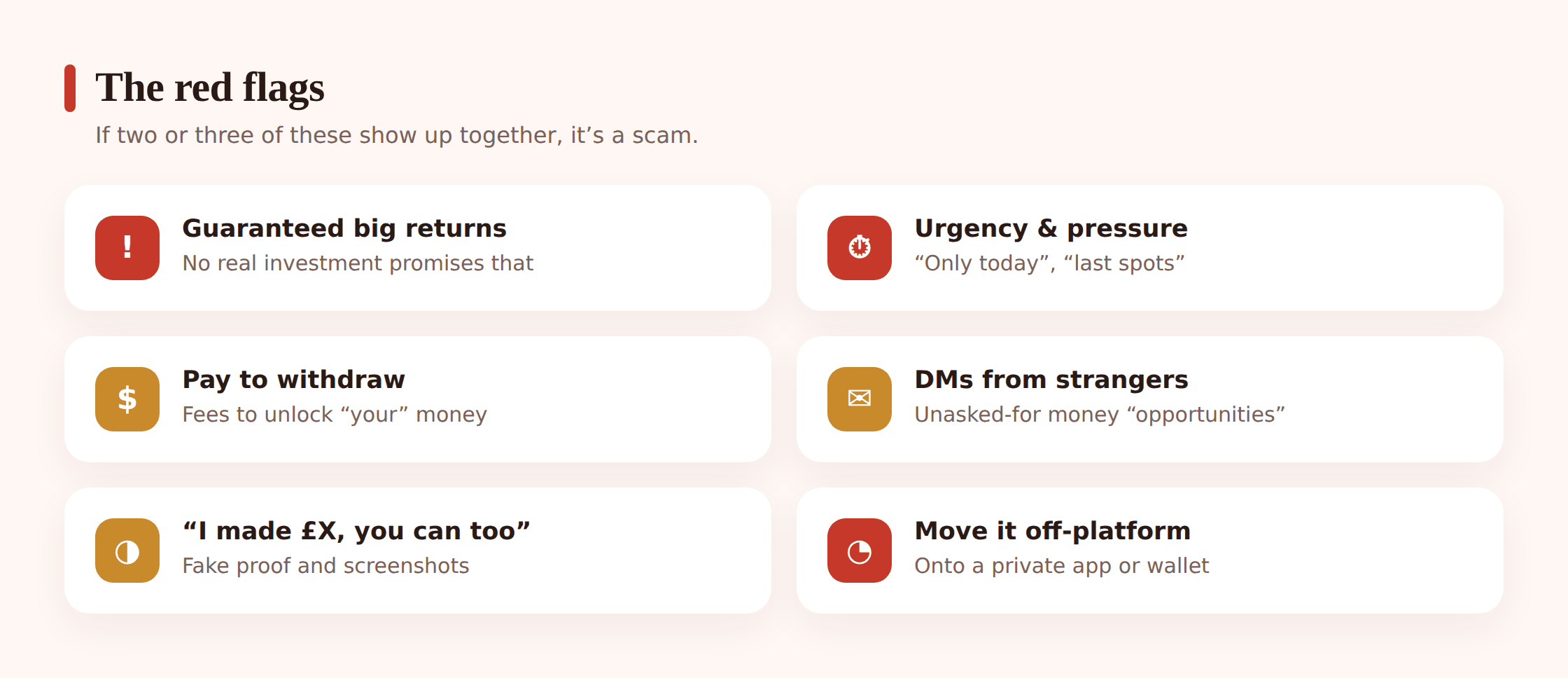
The disguises change; the tells barely do. Drill this handful and your teen can spot almost any version without having to recognise the specific scam.
Guaranteed or huge returns
“Guaranteed profit.” “Risk-free.” “100x.” “Double your money.” Real investing never guarantees returns, and the higher the promised reward, the higher the real risk — that’s the one iron law of it. A guarantee of big, fast, certain money is the single most reliable sign of a scam. Nobody gives that away to strangers.
Urgency and countdowns
“Spots are running out.” “Price goes up at midnight.” “Only for the next 10 people.” Urgency exists to stop the teen thinking or asking anyone else. A genuine opportunity is still there tomorrow. Pressure to act right now is a pressure to switch off judgement.
You have to pay to get your money out
This is the tell that unmasks fake platforms. If withdrawing “your” profits requires paying a fee, a tax, or a “verification deposit” first, the money isn’t real and you’re being milked. No legitimate platform makes you pay to withdraw your own funds.
The pitch comes from a DM, a stranger, or a “friend” acting oddly
Unsolicited money offers slide into DMs. If a friend’s account suddenly starts pushing a flipping scheme, assume the account’s been hacked and message them another way to check. Real financial opportunities don’t arrive as a surprise message from someone you barely know.
“I made £X, you can too” — with screenshots
Screenshots of huge profits, cash, and lifestyle are the core sales tool and the easiest thing in the world to fake or borrow. Proof of someone else’s supposed success is not proof you’ll succeed, and it’s usually not even proof they did. Treat every flex screenshot as a prop, because that’s what it is.
Secrecy and “don’t tell anyone”
“Keep this between us.” “Don’t tell your parents, they won’t get it.” Any money situation that comes with a request to hide it from you is, by that fact alone, a warning. Legitimate things survive being talked about out loud.
Teaching healthy money scepticism
You can’t pre-warn a teen about every scam — new ones launch weekly. What you can build is the underlying judgement, so an unfamiliar pitch still trips their radar.
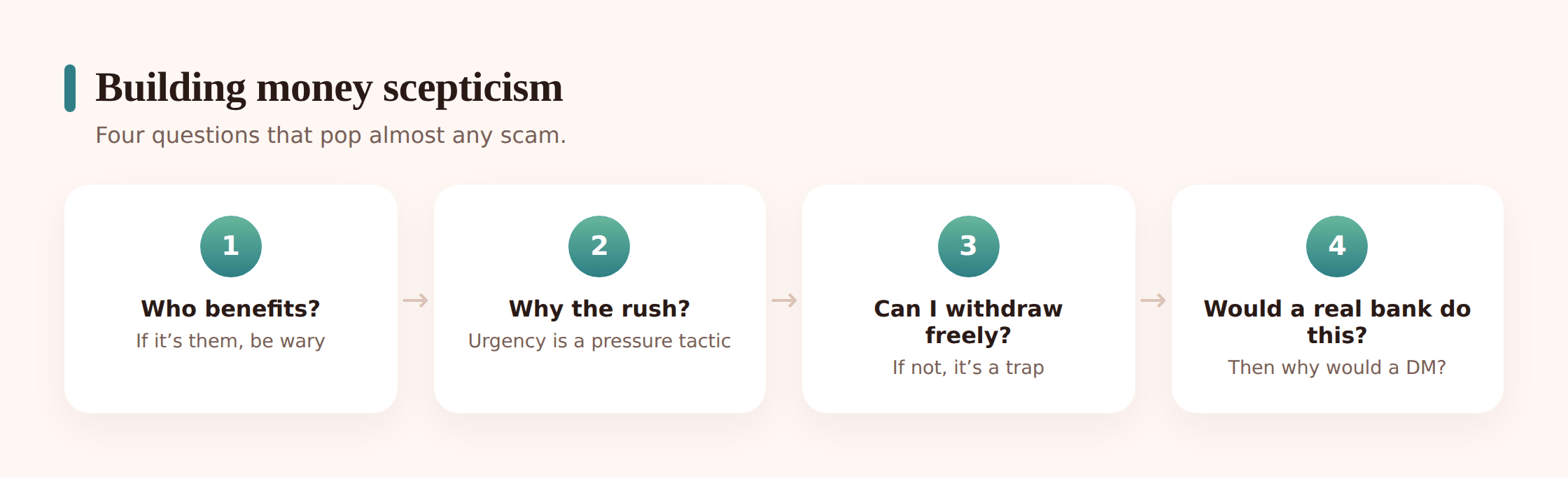
Teach where money actually comes from. The best inoculation is understanding that real wealth is slow, boring, and comes from work, saving, and time. Get-rich-quick isn’t a faster version of investing — it’s a different thing wearing investing’s clothes, and the fast money in it flows to the person running the scheme, not the teen. If a teen genuinely understands “if it were this easy, everyone would be rich,” half the pitches lose their grip.
Ask “who profits from me doing this?” Turn it into a reflex question. The stranger urging them to buy a coin makes money when they buy. The “signals” group makes money from the subscription. The mentor gets a recruitment cut. Following the money usually reveals the teen isn’t the customer — they’re the product, or the mark.
Normalise slowing down. Every one of these scams needs a fast, un-consulted decision. The counter-habit is a pause and a second opinion: “I never put money into anything the same day I hear about it, and I ask someone first.” Boring, and it defeats nearly all of them.
Talk about your own money thinking out loud. “I saw an ad promising 20% returns — that’s way too high to be real, so I ignored it.” Reasoning aloud about your own choices teaches judgement far better than a list of banned things. And it signals that money talk in your house is normal, not shameful.
Separate crypto-the-technology from crypto-scams. Some teens are genuinely curious about crypto, and that’s fine — you don’t have to trash the whole subject. The point isn’t “crypto is a scam”; it’s that scammers use crypto’s hype and irreversibility as a weapon. A teen can find the tech interesting and still never send coins to a stranger.
If your teen is caught up in one
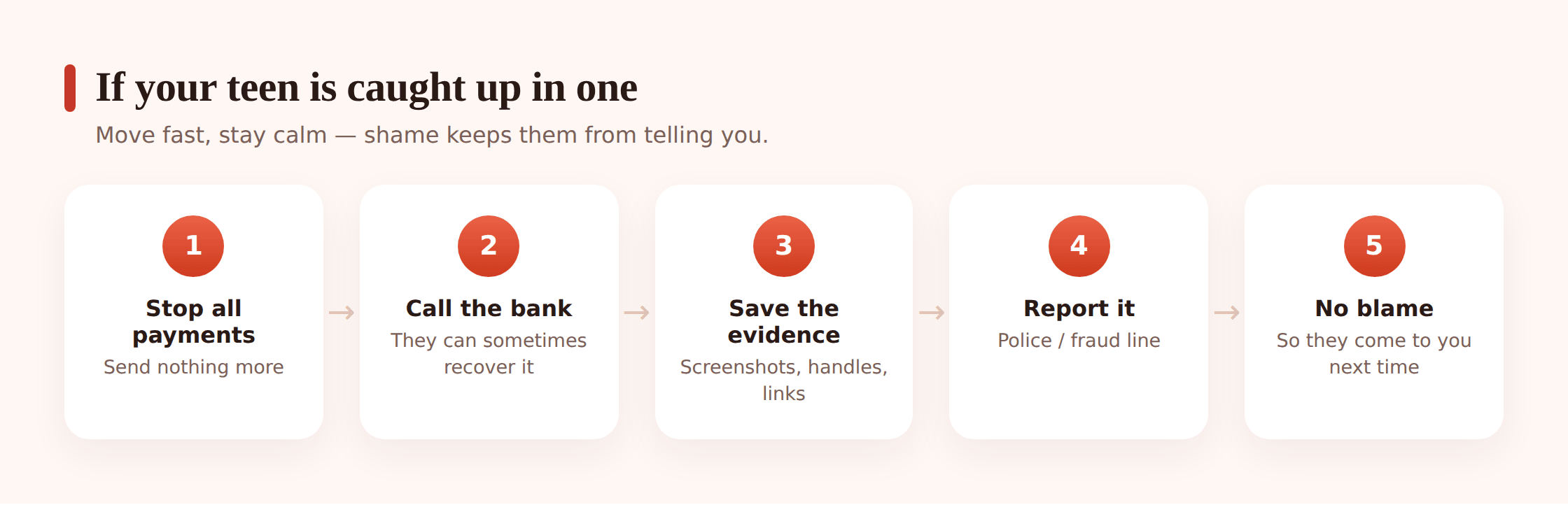
Maybe they’ve lost money, been recruited to move it, or just realised mid-scheme that something’s wrong. Either way the first hours matter, and your reaction sets whether they’ll ever tell you anything again. Speed and calm, not blame.
1. Stay calm — no shame, get the facts
A teen who’s been scammed feels stupid and terrified already; a telling-off just teaches them to hide the next one. Lead with “you’re not in trouble with me, let’s sort it.” Then get the details fast: what platform, what did they send or receive, how much, what accounts and details were shared, and — crucially — did anyone put money into their account.
2. Stop the bleeding
Cut off whatever’s still live. Freeze or lock the bank card in the app. Don’t send another penny — especially not a “fee to withdraw,” which only feeds the scam. If a crypto wallet was connected to a dodgy site, move any remaining funds to a safe wallet and revoke the site’s access. Stop replying to the scammer, but don’t delete anything yet.
3. Call the bank straight away
Phone the number on the card or use the app’s fraud line and tell them it’s a scam. If money was sent, ask what can be recovered — some transfers can be recalled if you’re quick, and there are schemes for certain scam cases. If money came in and was passed on, tell the bank that too; hiding it makes the mule situation worse, not better. Note that crypto sent to a scammer is almost always unrecoverable — manage that expectation gently.
4. Secure the accounts
Change passwords on anything exposed — banking, email, the platform, any account that shared a password with it — and turn on two-factor authentication. If a bank login or card details were handed over, treat the whole account as compromised and let the bank reissue.
5. Save the evidence
Screenshot the messages, the profile or account that made contact, the platform, wallet addresses, transaction confirmations, and any “job offer” wording — before it’s deleted or the account vanishes. You’ll need it for the bank and any report.
6. Report it
Report to your country’s fraud authority and to the platform where it happened. If your teen was used as a money mule, being upfront with the bank early is genuinely protective — cooperation and youth are treated very differently from concealment. Our guide on how and where to report a scam walks through exactly where to go.
Awareness on the device, in the open
Conversations do most of the work here. But a lot of these approaches arrive quietly — a new “trading” app appears on the phone, a flurry of DMs from an unknown account, a payment app installed overnight. On an Android phone you own and manage, an app like FreePhoneSpy can give you awareness of what’s installed and new contact patterns, so an approach doesn’t stay invisible until money’s already gone. Used openly, it’s a prompt for a conversation, not a substitute for one.
The quick checklist
The whole article, boiled down to what to actually do and say.
- Treat every “flip your money” or “double your crypto” offer as a scam — no exceptions.
- Never send money or crypto to a stranger, however friendly or convincing.
- Never pay a fee, tax, or “deposit” to withdraw your own money — that’s the trap.
- Ignore guaranteed returns, countdowns, and “spots running out.”
- Never let anyone put money into your bank account to pass on — that’s a crime.
- Never share your bank login, card, or details for anyone to “use.”
- Assume a friend pushing a money scheme has been hacked; check another way.
- Treat profit screenshots as props, not proof.
- Ask “who actually profits if I do this?” before acting.
- If something feels off, tell a parent fast — no shame, speed beats silence.
FAQ
My teen was offered “money flipping” — is it always a scam?
Yes. There is no legitimate service anywhere that turns a small amount you send a stranger into a much larger amount handed back. Every version — send £30, get £300, “I know a method” — is a con. Sometimes a tiny early “profit” gets paid to build trust before the real ask, which fools people into thinking it’s genuine. Treat any flipping offer, even from a friend’s account, as a scam and a sign that account may be hacked.
What exactly is a money mule?
A money mule is someone who lets their bank account be used to receive and pass on money that isn’t theirs — usually stolen or scam money. The recruiter offers “easy cash for doing nothing”: money lands in the teen’s account, they keep a cut and forward the rest. The point is to launder the money and hide its trail. Teens are targeted because they have clean accounts and often don’t realise it’s illegal. The rule to teach: never let anyone move money through your account, ever.
Can my teen actually get in trouble if they were tricked?
Unfortunately, yes — acting as a money mule is a crime even when the person didn’t know where the money came from, and consequences can include frozen and closed accounts, being blocked from banking or credit for years, and in serious cases prosecution. But how it’s handled matters enormously. A teen who was clearly deceived, comes forward early, stops immediately, and cooperates is treated very differently from one who conceals it. That’s exactly why coming to you fast, without shame, is the protective move.
Is crypto itself a scam I should ban?
No. Crypto is a technology; the scams are people using its hype and irreversibility as a weapon. Banning the whole topic tends to push a curious teen toward learning about it from the exact strangers you’d least want teaching them. A better line is: crypto can be interesting, but you never send it to strangers, never chase guaranteed returns, and never trust an app just because the balance goes up. Curiosity is fine; the specific behaviours are the danger.
My teen’s “investment app” won’t let them withdraw without paying a fee. What’s happening?
That’s a fake trading platform, and the withdrawal fee is the scam. The balance you can see is just numbers on a screen — the money was never really invested. Paying the “fee,” “tax,” or “verification deposit” only leads to another demand. Stop paying immediately, don’t send another penny, screenshot everything, and report it to your bank and fraud authority. No legitimate platform ever charges you to take out your own money.
How do I talk about this without scaring my teen off telling me things?
Lead with “you won’t be in trouble with me” and mean it. These scams are professionally engineered and catch smart people constantly, so framing it as “only an idiot falls for this” guarantees your teen will hide it when it happens. Talk about the tricks openly, share your own near-misses, and make the deal explicit: come to me the moment something feels off about money, and my job is to help, not to lecture. That single dynamic protects them more than any control setting.