Doomscrolling & News Anxiety: Helping Kids Cope With the News
A child can now carry every crisis on the planet in their pocket, updating in real time, all day. That’s a lot for a young mind to hold. If your kid has been jumpy after seeing something in the news, or you’ve caught yourself thumbing through grim headlines at midnight, this is for both of you. The habit has a name, and there are gentle, workable ways out of it.
Staying informed is a good thing. Caring about the world is a good thing. But there’s a point where following the news stops being informative and starts being corrosive, where a young person isn’t learning anything new, just absorbing wave after wave of worry. This article is about that line, how kids end up on the wrong side of it, and how to help them back.
What doomscrolling actually is
Doomscrolling is the habit of scrolling on and on through bad news, unable to stop, even though every new item leaves you feeling worse. The word pairs “doom” with “scroll” for a reason. It isn’t ordinary reading. Ordinary reading has a natural end. You finish the article, you close the tab. Doomscrolling has no end, because the feed has no bottom and the world always supplies more.
It usually starts small and reasonable. A kid wants to know what happened after a big event they heard about at school. So they check. Then they check again. Then the feed offers something adjacent and equally alarming, and another thing after that, and forty minutes later they’re somewhere dark and far from where they began, feeling worse and not really sure why they’re still looking.
Grown-ups do exactly the same thing, which is worth remembering before we frame this as a “kids these days” problem. The pull is human. The difference is that a developing brain has fewer tools to climb back out, and a child’s sense of how the world works is still being built. What they scroll past becomes part of that picture.
Why it’s so easy to fall into
Nobody sits down intending to spend an hour feeling frightened. Kids fall into doomscrolling because several forces line up and push in the same direction. Understanding them helps, partly because it takes the blame off your child. This isn’t weak willpower. It’s a well-designed trap.
Alarming content travels furthest
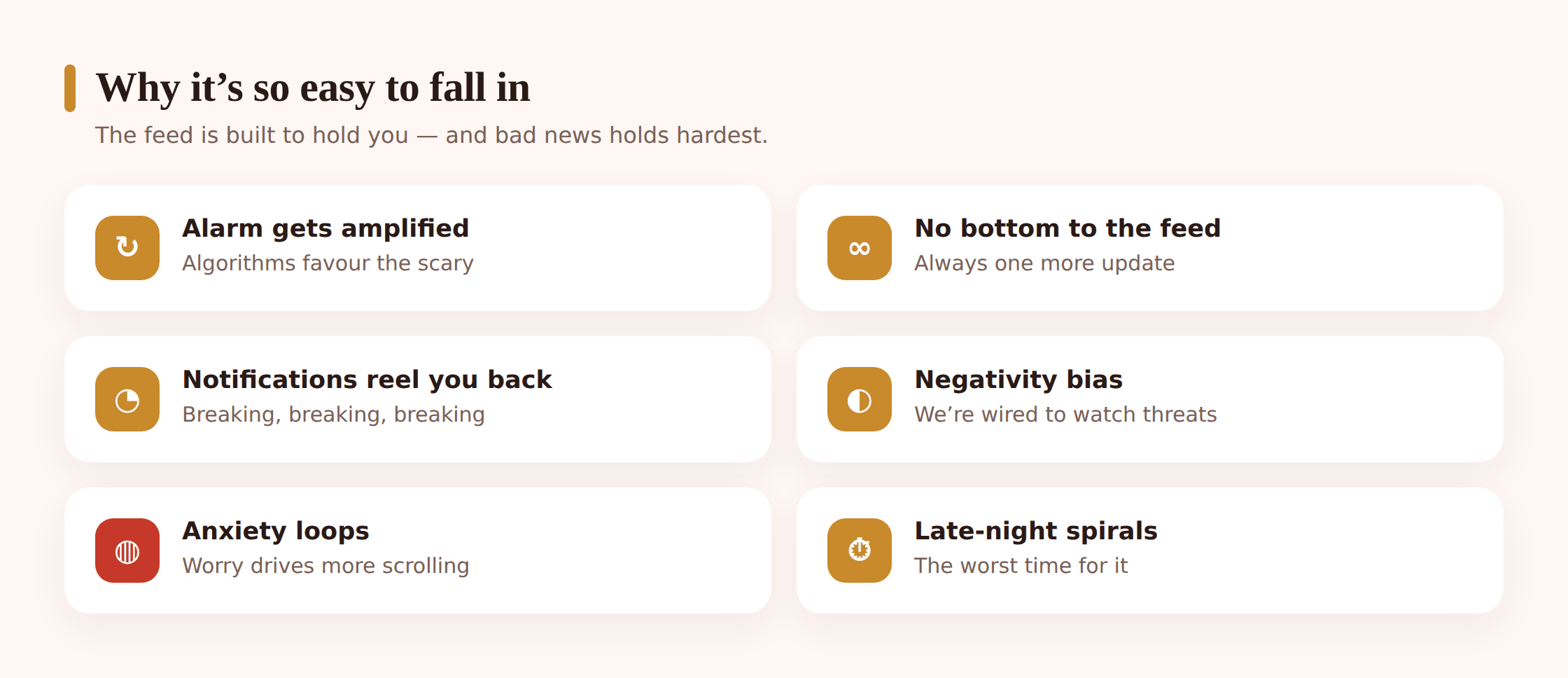
Feeds are ranked by what keeps people engaged, and few things hold attention like alarm. Content that shocks, frightens, or outrages gets more clicks, more shares, and more time, so the systems that sort our feeds quietly learn to serve more of it. This isn’t a conspiracy against your child. It’s just what happens when a machine optimises for engagement and fear happens to be engaging. If you want the mechanics, we cover them in how algorithms work.
Our brains are wired for bad news
Humans have a negativity bias. A threat mattered more to our ancestors’ survival than good news did, so we’re built to notice danger and dwell on it. That instinct served us on the savannah. It serves us poorly when a phone can deliver a thousand distant dangers a day, none of which we can act on. A child’s brain has this same bias, still forming, with the volume turned up.
Notifications keep pulling them back
Breaking-news alerts are designed to interrupt. Each buzz is a small tug that says something urgent is happening, come and look. For a kid who’s already anxious, those pings act like taps on the shoulder from an anxious friend who only ever brings worrying updates.
The feed never ends
Infinite scroll removes every natural stopping point. There’s no last page, no “you’re all caught up.” Without a built-in finish line, kids keep going until something external stops them, and often nothing does until a parent walks in or the battery dies.
How heavy news exposure affects kids
Some awareness of the world is healthy and age-appropriate. The problem is dose, not information. When the dose gets too high, it shows up in a handful of recognisable ways.
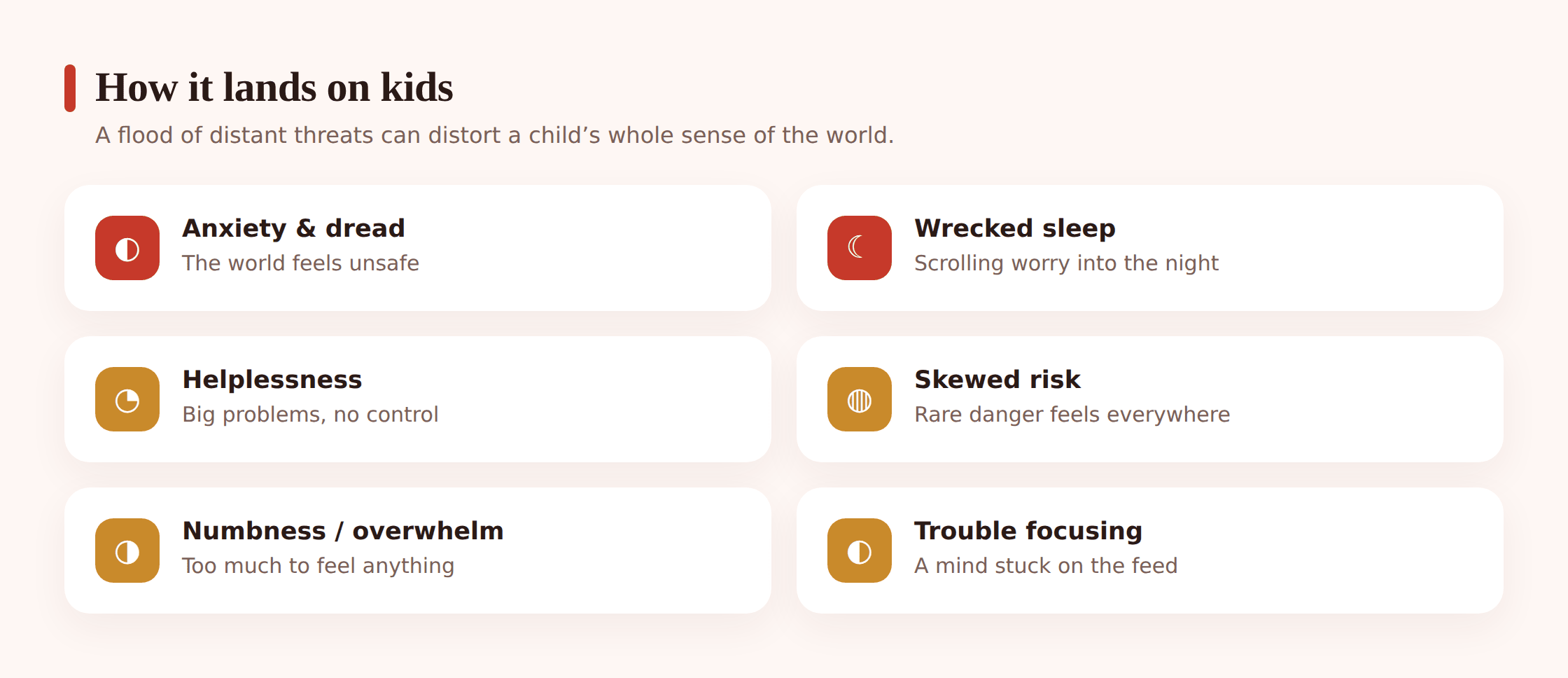
Anxiety that lingers. A steady drip of frightening headlines can leave a child in a low hum of unease they can’t quite name. They may not link it to the news at all. It just feels like the world has become a scarier place.
Broken sleep. News read close to bedtime is a poor lullaby. The content is stirring, the screen light delays sleep, and a mind full of worst-case scenarios doesn’t settle easily. Lost sleep then makes everything else harder to cope with the next day, which is its own quiet spiral. Sleep comes up again in our piece on teen mental health, because it’s so often the thread that unravels first.
A feeling of helplessness. This one is particular to news. Kids read about huge problems far away and can do nothing about any of them. Adults feel this too, but we’ve had years to build a tolerance for holding worry we can’t fix. A child hasn’t. The gap between caring deeply and being able to help nothing can settle into a heavy sense of powerlessness.
A distorted sense of danger. If you only ever see the worst thing that happened anywhere on earth today, the world starts to feel far more dangerous than it is. Rare, dramatic events get replayed until they feel common and close. A child may become frightened of things that are, statistically, very unlikely to touch their life, simply because those things fill the feed.
Trouble concentrating. A mind that keeps drifting back to something alarming has less room for homework, hobbies, or being present with friends. We look at the focus side of this more fully in healthy digital habits.
None of this means your child is fragile or that something is wrong with them. These are ordinary reactions to an extraordinary volume of distress, most of it about things happening far outside their own life.
Informed versus drowning in it
It’s worth being clear that the goal is not to raise a kid who knows nothing about the world. Curiosity about events, empathy for people far away, a wish to understand, these are things to nurture, not shut down. Sealing a child off from all news isn’t healthy either, and it isn’t really possible once they have friends and a phone.
The line is roughly this. Being informed means understanding what’s happening, in enough depth to make sense of it, and then getting on with your day. Drowning means going back again and again for updates that add nothing, refreshing the same story, absorbing the emotional charge over and over without gaining any new understanding. Informed has a shape and an ending. Drowning is a loop.
A useful question to help a child ask themselves is simple: “Did that tell me something new, or did it just make me feel worse?” Learning something new is being informed. Only feeling worse is the signal to stop. Most kids can grasp that distinction once you name it, and it gives them a tool they can use on their own.
How to help, step by step
The good news is that this is one of the more fixable digital-wellbeing problems. Small changes to sources, timing, and settings make a real difference, and none of them require confiscating a phone. Here’s a calm order to work through.
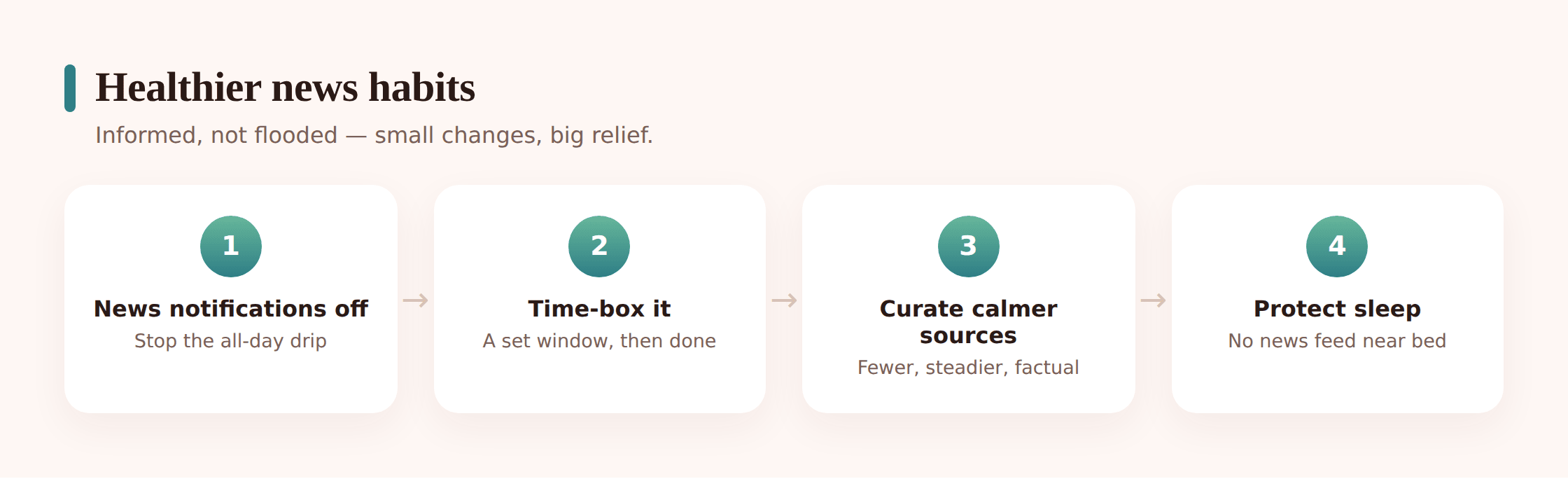
Step 1: Turn off news notifications
This is the single highest-value change, and it takes two minutes. Go into the settings for news apps and any social apps, and switch off breaking-news alerts. Your child can still check the news when they choose to. They just won’t be tapped on the shoulder by it all day. Removing the interruptions removes most of the compulsive pull on its own.
Step 2: Curate calmer sources together
Not all news is delivered the same way. Some outlets are built for calm, factual explanation, others for constant alarm. Sit down together and pick a couple of steadier sources your child can go to when they want to understand something, ideally ones that explain rather than sensationalise. Steering them toward better sources also builds the skill of judging quality, which we go deeper on in media literacy.
Step 3: Time-box the news
Suggest a set time and a set limit. Maybe they catch up once a day, for ten or fifteen minutes, rather than grazing continuously. A defined window gives the news a beginning and an end, which is exactly what an infinite feed strips away. Some families find a specific time works, like after dinner, so it never bleeds into bedtime.
Step 4: Protect sleep
Keep news, and ideally the phone itself, out of the bedroom at night. Nothing good comes from reading about disasters in the dark at eleven pm. A charging spot outside the bedroom and a firm “no news after this hour” protects both the sleep and the mood that depends on it.
Step 5: Model it yourself
Kids read our habits far more than our lectures. If you’re doomscrolling at the dinner table, no amount of advice will land. Letting your child see you put the phone down, say “I’ve had enough news for today,” and mean it, teaches more than any rule. This is the hardest step and the most powerful.
Step 6: Replace, don’t just remove
An hour of scrolling leaves an hour to fill. Have something ready to move toward, a walk, a game, a book, time with the family, so stepping away from the feed feels like a gain rather than a loss. Boredom is often what sends a kid back to the feed, so a good alternative does a lot of quiet work.
- News notifications switched off on phone and social apps
- One or two calmer, explain-it-well sources agreed on
- A daily time window for catching up, not all-day grazing
- Phone charging outside the bedroom overnight
- A go-to activity ready for when they step away
- You modelling the same habits, visibly
Talking about scary events
Sometimes the problem isn’t the habit but a specific frightening event your child has already seen. When that happens, how you talk about it matters more than any setting. A few principles help.
Ask before you explain. Start by finding out what they’ve heard and how they understood it. Kids often fill gaps with something scarier than the truth, and you can’t correct a fear you haven’t found yet. A simple “what did you hear about that?” opens the door.
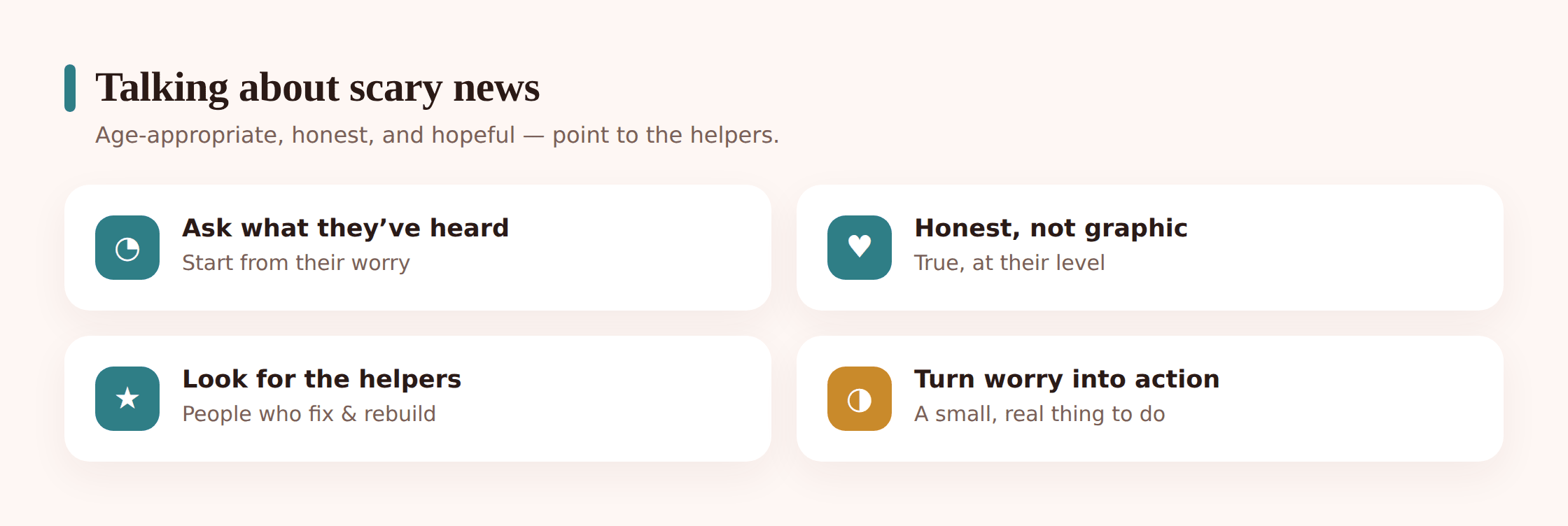
Be honest, and match the age. You don’t need to hide that difficult things happen, but a younger child needs a smaller, gentler version than a teenager does. Answer the question they actually asked, without piling on detail they didn’t ask for. Honesty and age-appropriateness aren’t in conflict. You can be truthful and still be careful about how much.
Point to the helpers. When something frightening happens, there are always people rushing toward it to help, the rescuers, the doctors, the volunteers, the neighbours. Directing a child’s attention to them is honest, and it reframes a scary event as something people respond to rather than something that just happens to us. It’s one of the most reliable ways to steady a worried kid.
Turn worry into an action. Helplessness eases when there’s something small to do. Writing a card, donating a little pocket money, or simply doing a kind thing nearby gives a child a way to answer the feeling of “but what can I do?” The action doesn’t have to be big. It just has to be real.
Stay non-partisan. Keep the conversation about your child’s feelings and wellbeing, not about who’s right or wrong in a particular dispute. Kids don’t need to be recruited to a side to be reassured. Focus on the human bit, the fear, the kindness, the fact that they’re safe right now.
When anxiety needs more support
Most news-related worry eases with the steps above, some conversation, and a bit of time. But sometimes anxiety runs deeper than the habit, and it’s worth knowing when to reach for more help.
Consider talking to a professional if the worry is persistent and doesn’t lift after you’ve changed the habits, if it’s spilling into sleep, appetite, school, or friendships, if your child is avoiding normal activities because the world feels too dangerous, or if the fear seems out of proportion and keeps returning no matter how much reassurance you give. Physical complaints with no clear cause, like frequent stomach aches or headaches, can sometimes be anxiety wearing a disguise.
A good first step is your family doctor or GP, who can listen, rule things out, and point you toward child-focused mental-health support if it’s needed. Reaching out isn’t an overreaction and it isn’t a sign you’ve done something wrong. It’s just getting the right kind of help for a child who’s struggling, the same as you would for anything else. Trained people are good at this, and children usually respond well.
My child follows the news closely and gets upset. Should I just block it all?
Blocking everything tends to backfire, and it teaches a child that the world is too frightening to look at. A better path is to shape the habit, calmer sources, no notifications, a set time to catch up, rather than to seal it off. You want a kid who can handle knowing things, in measured amounts, not one who’s simply kept in the dark.
How much news is too much for a child?
There’s no single number, and it varies with age and temperament. A more useful test than counting minutes is watching the effect. If checking the news reliably leaves your child more anxious, sleeping worse, or dwelling on distant dangers, that’s too much for them, whatever the clock says. Dial it back and see if things settle.
My teen says following every crisis is being a responsible citizen. How do I argue with that?
Don’t argue, agree, then refine. Caring about the world is admirable. Point out that constantly refreshing a feed doesn’t actually help anyone, and that burning out on worry leaves less energy for the things that do help, like understanding an issue properly or taking a small action. Being informed and being flooded are different, and the flooded version isn’t the more responsible one.
Should I hide upsetting news from a younger child completely?
For very young children, shielding them from graphic or frightening coverage is reasonable and kind. But if they’ve already heard something, don’t pretend it isn’t happening. Give them a small, honest, gentle version, focus on safety and on the people helping, and let them ask what they need to ask.
I doomscroll too. Do I have to fix my own habit first?
You don’t have to be perfect, but working on it alongside your child helps both of you, and it makes you a lot more convincing. Trying to change together, and being open when you slip, models something more useful than pretending you’ve got it sorted. Kids respect the honest effort more than the flawless example.
The news seems to have made my child anxious about a specific, unlikely danger. What now?
Gently put it in proportion without dismissing the feeling. Acknowledge that the thing is scary and rare, explain simply why it’s unlikely to affect them, and point to who keeps them safe. If the fear sticks around despite reassurance and keeps interfering with normal life, that’s a good moment to check in with your GP.
The world will keep producing hard news, and our kids will keep having phones. We can’t change either. What we can do is help a child hold the news at a healthy distance, informed but not flooded, caring but not crushed. Turn off the alerts, choose calmer sources, protect the sleep, keep talking, and stay close. That’s most of the work, and it’s well within reach.