How to Talk to Your Kids About Online Pornography
Almost every parent hopes their child will somehow miss this part of the internet. Most won’t. The good news is that the thing that protects kids best isn’t a perfect filter or a lucky escape — it’s a parent who can talk about it plainly, without panic, before it becomes a big secret. That’s a skill you can learn, and this guide walks you through it.
Why kids run into adult content
It usually isn’t a child going looking. A pop-up ad on a free game. A word typed slightly wrong into a search bar. A link a friend sends in a group chat with a laughing emoji, no warning attached. A recommended video that autoplays after the one they meant to watch. The internet doesn’t wait for a child to be ready, and it doesn’t check their age at the door.
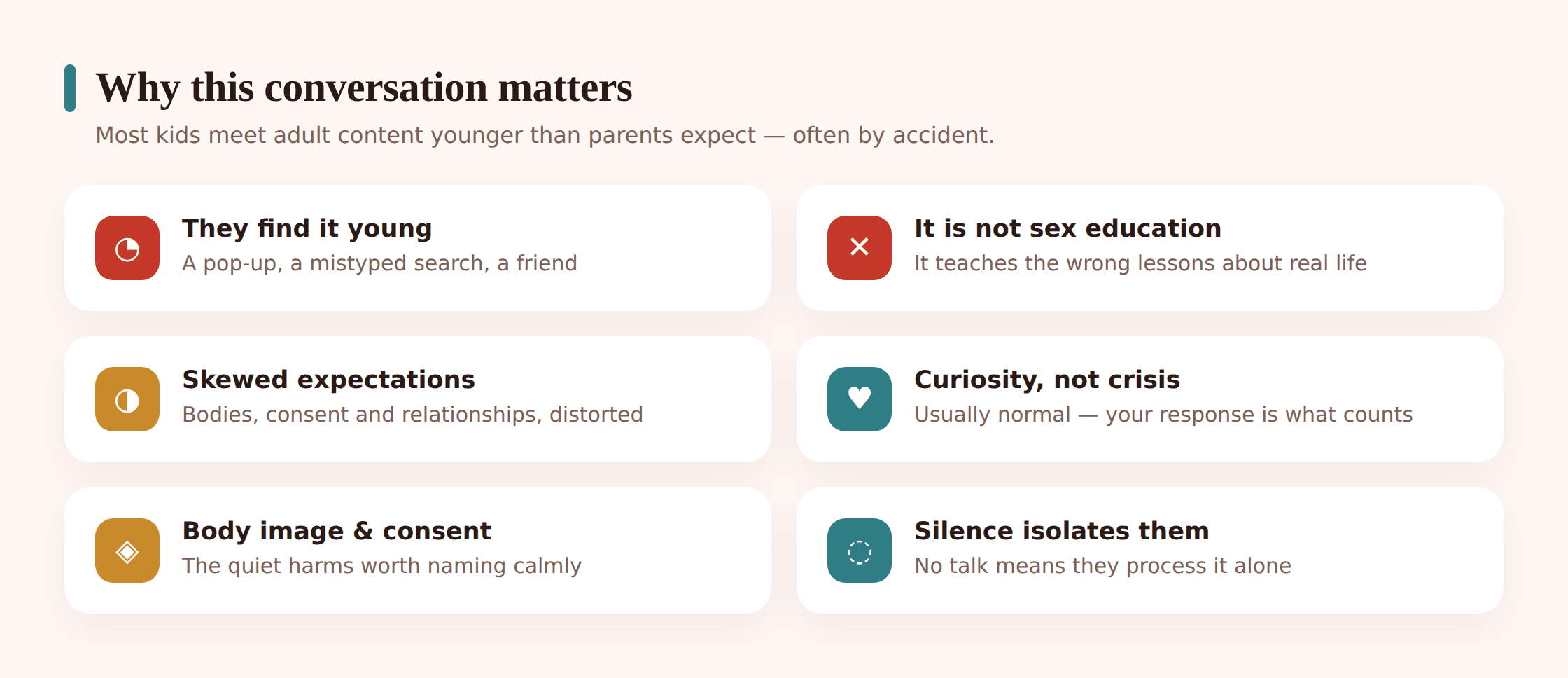
Research consistently finds that most children encounter this kind of material younger than their parents expect — often at an age when they don’t even have the words for what they’re looking at. That’s worth sitting with for a second, because it changes the plan. If you assume it happens at fifteen, you’ll start the conversation years too late. Curiosity is normal, too. A ten-year-old who hears a word at school and searches it isn’t broken or precocious. They’re doing exactly what curious children have always done, except now the search bar answers instantly and without judgement.
None of this means your child is at fault, and none of it means you’ve failed as a parent. It’s the environment. Your job isn’t to build a wall high enough that nothing ever gets over it. It’s to make sure that when something does, your child comes to you instead of carrying it alone.
Why it matters — and what it isn’t
Let’s be clear about the concern, because “it’s inappropriate” isn’t really an argument a curious child will accept. The problem with adult content as a teacher is that it teaches badly.
It presents a performance as if it were ordinary life. Bodies look one narrow way. Everyone appears endlessly willing. Nobody talks about feelings, consent, awkwardness, protection, or the fact that real intimacy involves two people who actually care what the other one wants. A child who absorbs those images without a counterweight can quietly form a set of expectations — about what bodies should look like, about what people are supposed to want, about how consent works — that are simply false. For younger children the worry is more basic: they can be frightened or confused by images they don’t understand and can’t unsee.
Here’s the framing that helps most: this material is not sex education. It’s closer to a stunt film than a driving lesson. You wouldn’t want your teenager learning to drive by watching car chases, and the same logic applies here. That comparison lands with kids, and it opens the door to the real point — that you’d rather they learned about relationships and bodies from honest sources, including you, than from something built to sell attention.
What filters do, and where they stop
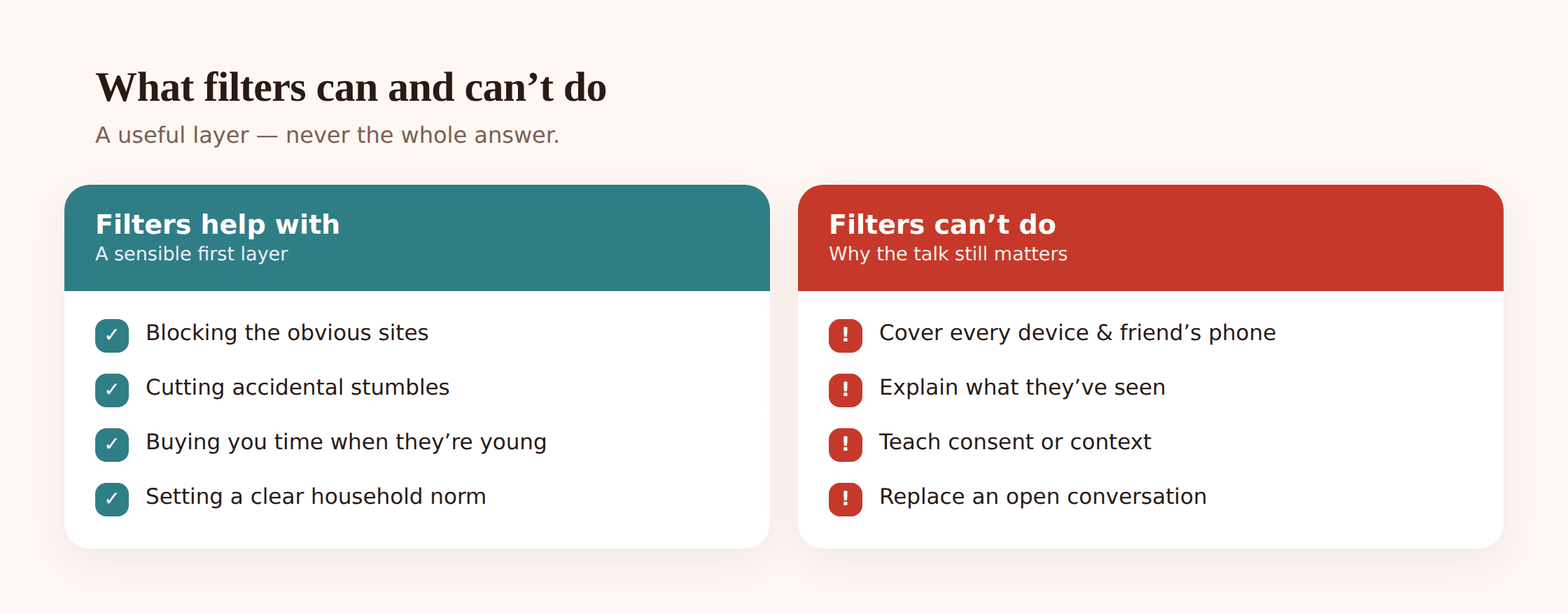
Technical tools genuinely help, and you should use them. Router-level filtering, safe-search settings, age controls on app stores and streaming apps, and content filtering on the devices your child uses will all block a large amount of material before it ever reaches a screen. If you want the practical setup, our guide to blocking websites and apps covers it step by step, and a tool like FreePhoneSpy can be one layer here — keeping age-appropriate limits on what a younger child’s device can reach, set up openly and with their knowledge.
But a filter is a fence, not a chaperone. Kids move between your home network and a friend’s, between a filtered tablet and an unfiltered phone someone hands them at school. Content slips through recommendation feeds and private messages that no filter inspects. And a filter has never once explained to a child why the thing it blocked was worth blocking. It just says no, silently, which teaches nothing and sometimes sparks more curiosity than it settles.
So treat filters as one layer among several. They buy you time — especially with younger children — and they cut down the accidental exposures. The conversation is what does the lasting work. This is the same principle behind broader online safety conversations: the tools handle the easy cases, and you handle the ones that matter.
Whatever monitoring or filtering you use, keep it open and age-appropriate. Tell your child the filter exists and why — “this is here to keep the really grown-up stuff off your tablet for now” is honest and easy to say. Covert surveillance of your child tends to backfire: when they find it, and they usually do, the lesson they learn is that you can’t be trusted with the truth. That’s the opposite of what you want here.
How to have the conversation
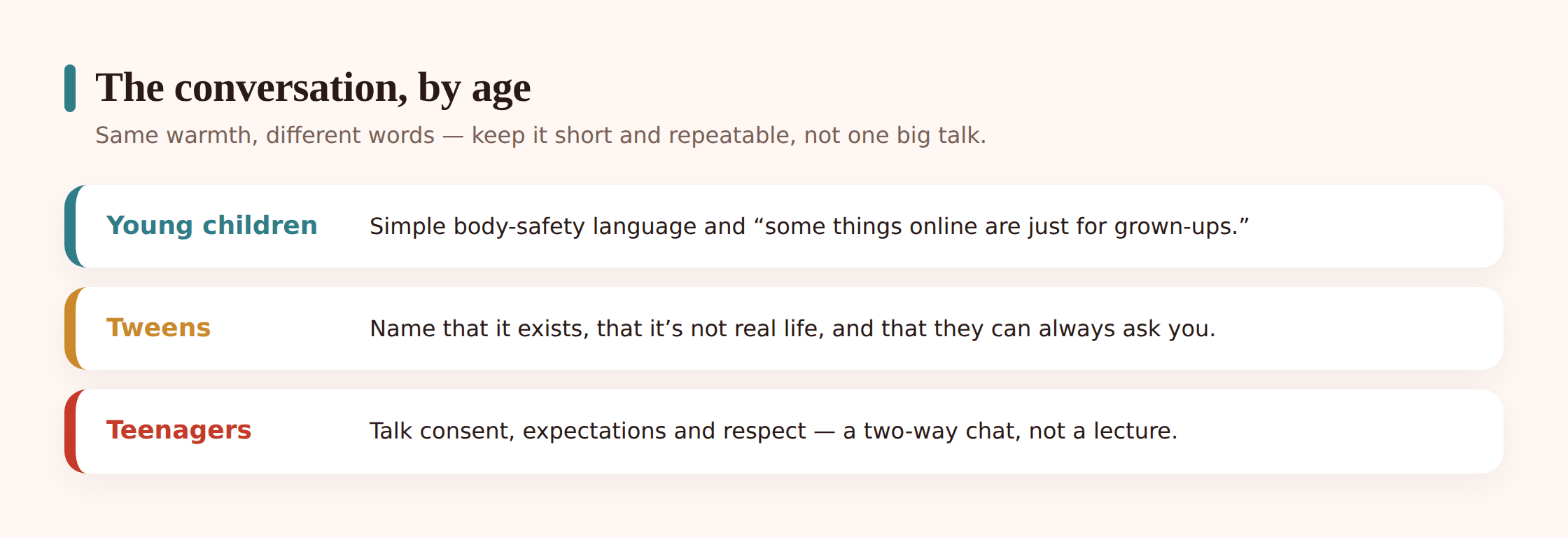
Forget the idea of a single, dreaded “big talk.” It doesn’t work, and it puts enormous pressure on one conversation to carry everything. What actually works is a running series of small, low-key moments, matched to your child’s age, that make the subject ordinary rather than forbidden.
A few principles hold at every age. Stay calm — your face is the message, and if you look horrified your child will stop talking. Use plain, correct words rather than nervous euphemisms. Listen more than you lecture; a question answered honestly is worth ten warnings. And keep the door open: end more or less every version of this with some form of “if you ever see something that confuses or upsets you, you can always tell me, and you won’t be in trouble for it.” Then, crucially, honour that promise when the moment comes.
Younger children (roughly under 9)
At this age you’re not explaining pornography. You’re planting two simple ideas. First, some things online are made for grown-ups and aren’t meant for kids — the same way some films are. Second, if something they see makes them feel yucky, weird, or scared, they should come and tell you, and that’s always the right thing to do.
Keep it concrete and short. “Sometimes the internet shows pictures that are only for adults. If that ever happens, it’s not your fault, and I want you to tell me so I can help.” You’re not describing anything. You’re giving them a script for a moment that might otherwise leave them frightened and silent. Pair it with the body-safety language you may already use — that their body is theirs, that grown-ups shouldn’t ask them to keep secrets — and you’ve built a solid foundation without ever showing them a thing.
Tweens (roughly 9 to 12)
This is the age where honesty matters most and where a lot of parents freeze. Tweens are curious, they hear things at school, and they very often have their first accidental encounter somewhere in this window. If they can’t ask you, they’ll ask a search bar or a slightly older kid, and neither of those has their best interests at heart.
Now you can name it. You can say the word “pornography” and explain, simply, that it’s pictures or videos of adults doing sexual things, made to be watched, and that it’s not real life — it’s acted, like a film, and it gives a false picture of bodies and relationships. That single idea, “it’s not real and it’s not how people actually are,” is the most protective thing you can hand a tween. You don’t need any detail beyond that. If they’ve already seen something, this is also the age to gently ask and to reassure them they’re not in trouble.
Teenagers
By the teenage years you can assume exposure has happened, whether or not you know about it. So the conversation shifts from “you might see this” to “let’s talk honestly about what this stuff actually gets wrong.” Teens respond far better to being treated as thoughtful people than to being warned like children.
This is where you can talk about the real substance: that porn presents an unrealistic and often disrespectful picture of sex, that it usually erases consent and communication entirely, that it can warp expectations about bodies and about what partners should want, and that comparing yourself or a future partner to it is a recipe for feeling bad. You can acknowledge, without endorsing, that curiosity is normal and that most people encounter this material — you’re not pretending they live in a bubble. What you’re offering is a critical lens: the ability to look at it and think, that’s a performance, not a instruction manual.
Consent is the thread worth pulling hardest with teens, because it’s the thing the content most reliably leaves out. Real intimacy runs on two people paying attention to what the other one actually wants. If your teen takes one idea from you, let it be that. This also sits naturally alongside conversations about sexting and about how people misrepresent themselves online, including the adults who target young people — related risks, but distinct ones worth their own discussions.
If you find out they’ve seen it
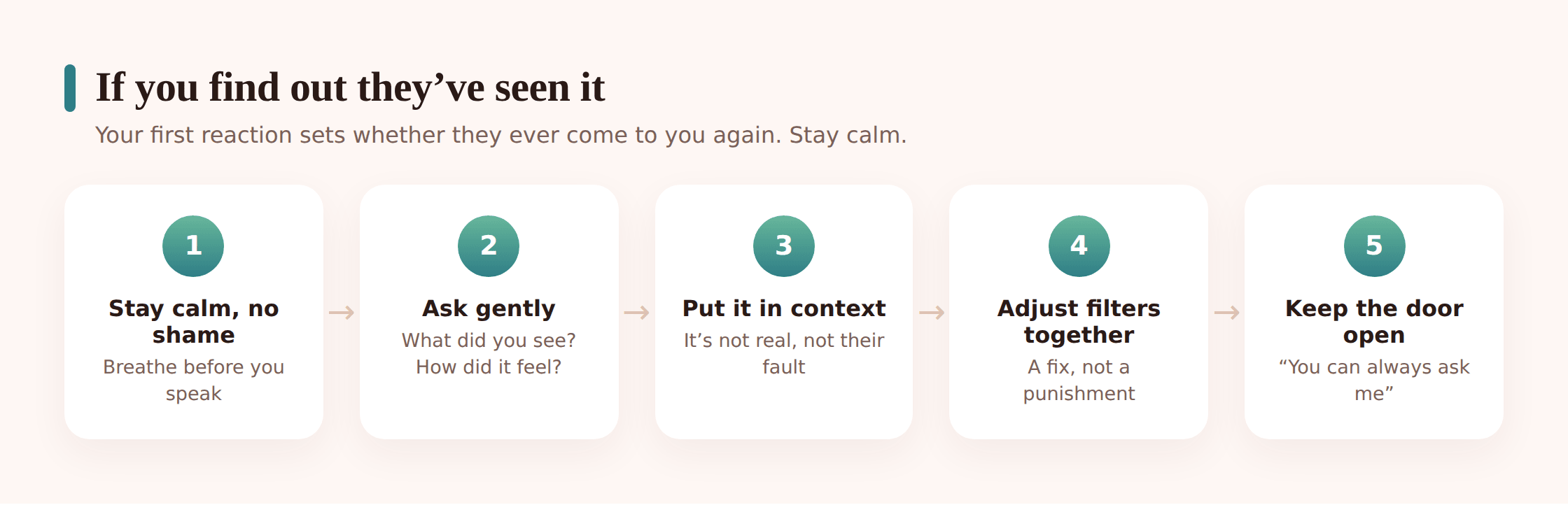
Maybe you saw it in a browser history. Maybe a younger child told you, upset. Maybe an older one admitted it. However it surfaces, the next sixty seconds matter more than anything else, because your reaction teaches your child whether honesty about hard things is safe with you. Lead with calm, not consequences.
Step 1 — Steady yourself first
Take a breath before you say anything. This is normal and common, your child is not damaged, and you have not failed. If you’re too rattled to be calm, it’s completely fine to say “I want to talk about this properly, let’s sit down after dinner” and come back when you’ve settled. A measured conversation later beats a panicked one now.
Step 2 — Lead with reassurance, not interrogation
Open with warmth: “Thanks for being honest,” or “You’re not in trouble — I just want to make sure you’re okay.” For a younger child who’s frightened, comfort comes first, questions later. You’re trying to keep them talking, and shame slams that door instantly.
Step 3 — Find out gently what happened, without detail
You don’t need a description of what they saw, and you shouldn’t ask for one. What helps is the shape of it: did they come across it by accident or go looking, how did it make them feel, is anyone else involved. Ask kindly, accept short answers, and don’t push for more than they offer.
Step 4 — Skip the punishment-first reaction
Punishing a child for seeing, or even for seeking out, adult content mostly teaches them to hide better next time. Curiosity isn’t a crime. If a rule was genuinely broken — a device used somewhere it shouldn’t be, say — you can address that calmly and separately, but don’t let it swallow the actual conversation. The goal is understanding, not a verdict.
Step 5 — Put it in context and reset gently
Use it as the opening for an age-appropriate version of the talk above. Reassure them it’s not real life, answer what they ask, and, if needed, quietly adjust the practical layers — settings, where the device lives at night, filter levels — while explaining why. Then genuinely let it go. A child who’s forgiven and understood is far safer than one who’s been made to feel dirty.
When to get extra support
Most of the time, this is a home conversation and nothing more. But some situations do warrant a steadier hand than a parent alone, and there’s no shame in reaching for one. Consider talking to a professional if you notice patterns like these:
- Use that looks compulsive — your child seems unable to stop despite clearly wanting to, and it’s crowding out sleep, school, or friendships.
- A much younger child showing sexual knowledge or behaviour well beyond their years, which can occasionally signal exposure to something harmful and is worth a careful professional look.
- Signs that content is genuinely distressing them — anxiety, withdrawal, nightmares, or shame they can’t shake.
- Any hint that another person, especially an adult, is involved in showing or sending material to your child.
- Your own sense, as the person who knows them best, that something is off and you’d like guidance.
Good places to start are your family doctor or GP, your child’s pediatrician, or a school counsellor — all of whom can talk with you confidentially and point you further if needed. Reputable organisations offer solid, parent-friendly guidance too: Internet Matters and Common Sense Media both publish age-based advice, and in the UK the NSPCC runs a helpline for exactly these worries. If another person may be involved with your child inappropriately, treat that as a child-protection matter and contact the relevant authorities or helpline in your country rather than handling it alone.
Reaching for help isn’t an admission that you’ve done something wrong. It’s what thoughtful parents do when a topic is bigger than an evening chat. A counsellor or doctor has had this conversation many times and can take a lot of the weight off you.
The short version
- Assume your child will encounter this younger than you’d like — usually by accident. Start early, in small doses.
- Use filters and open, age-appropriate device settings, but treat them as one layer, not the answer.
- Scale the message to their age: “for grown-ups, tell me if you see it” for the youngest, “it’s not real life” for tweens, an honest talk about consent and expectations for teens.
- If you find out, lead with calm and reassurance. Skip the punishment-first reaction.
- Make the standing promise real: they can always tell you, and they won’t be in trouble for being honest.
- Get professional support when use looks compulsive, distress runs deep, or another person is involved.
My 8-year-old saw something by accident. Is that normal?
Yes, sadly it’s common at that age, and it doesn’t mean anything is wrong with your child or your parenting. Comfort them first, reassure them they did the right thing by not hiding it, and keep your explanation simple — some things online are only for grown-ups, and it wasn’t their fault. Then quietly check your filters and safe-search settings. One accidental exposure, handled warmly, does no lasting harm.
Should I punish my child for looking at porn?
Punishment-first is usually the wrong move. It mostly teaches kids to hide better and to stop coming to you, which is the opposite of what keeps them safe. Curiosity, especially in tweens and teens, is normal. Respond with a calm conversation instead. If an actual rule was broken — a device used somewhere off-limits — you can address that part evenly and separately, but don’t let it turn the whole thing into a court case.
What age should I start talking about this?
Earlier and gentler than you’d think. For young children it’s not about porn at all — it’s “some things are for grown-ups, and tell me if you see something that upsets you,” which you can say to a five- or six-year-old. The more direct version fits the tween years, around nine to twelve, when curiosity and accidental exposure both climb. There’s no single right day; it’s a series of small talks that grow up alongside your child.
Isn’t it better to just block everything and not mention it?
Blocking helps, but on its own it leaves your child unprepared for the moment something gets through — and something eventually does, at a friend’s house, on an unfiltered phone, in a message. A child who’s only ever met a silent “no” has no way to make sense of what they see and no reason to tell you about it. Filters plus conversation is far stronger than either alone.
My teen admitted they watch it regularly. How worried should I be?
For most teens, some curiosity here is developmentally ordinary rather than alarming. The productive response isn’t panic or a ban — it’s an honest conversation about what the material gets wrong, especially around consent, real bodies, and how actual relationships work. Worry becomes warranted if it looks compulsive, is displacing sleep or friendships, or is clearly distressing them; that’s the point to bring in a doctor or counsellor.
I feel too embarrassed to have this conversation. Any advice?
You’re in good company — most parents dread it. Two things help. First, you don’t need to be smooth; saying “this is a bit awkward for me, but it’s important” is completely fine and even models honesty. Second, you don’t need all the answers in one go. A short, calm, imperfect conversation you actually have beats a perfect one you keep avoiding. If you’d rather not go it alone, a GP or school counsellor can help you find the words.