“Everyone Else Has It”: When Your Child Wants Social Media Before the Age Limit
It usually arrives at the dinner table, or in the car, delivered with a specific weariness: “Everyone else has it. I’m literally the only one.” The it is Snapchat, or TikTok, or Instagram — and your child is ten, or eleven, or twelve. You know the apps say 13. You also know that “everyone” is doing a lot of work in that sentence. This is one of the hardest small decisions of modern parenting, partly because there’s no clean answer and partly because saying no can feel like grounding your kid socially. Here’s how to think it through without losing the plot or the relationship.
- Why the age limits exist (and what 13 actually means)
- Why kids want it — and how real “everyone” is
- The honest case for waiting
- What actually goes wrong with an underage account
- How to decide as a family: readiness over birthday
- Saying “not yet” without making them an outcast
- If you do say yes: doing it as safely as possible
- FAQ
Why the age limits exist (and what 13 actually means)
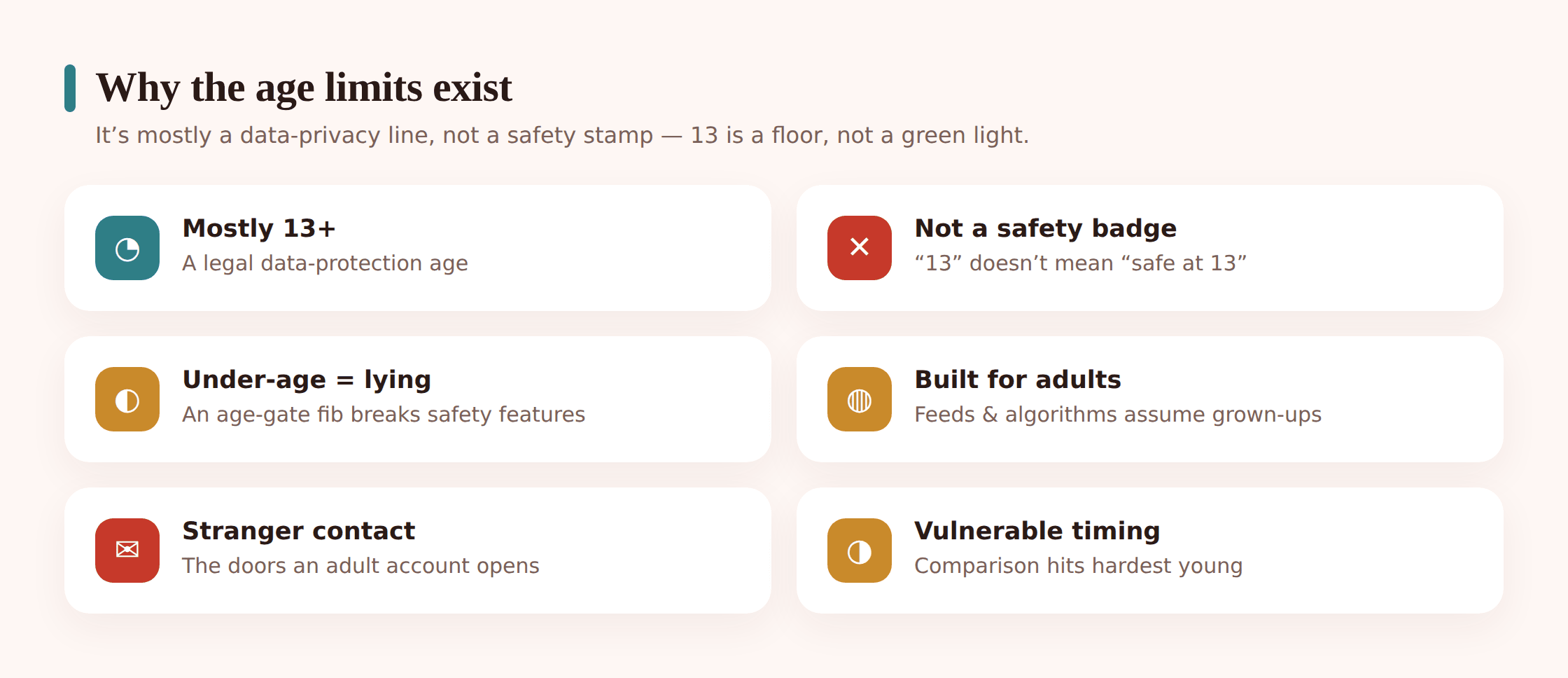
Start with the thing most parents half-know but rarely get told straight: the reason nearly every big platform sets its minimum at 13 has very little to do with a panel of child psychologists deciding thirteen-year-olds are ready. It’s mostly about data-protection law.
In the United States there’s a rule called COPPA — the Children’s Online Privacy Protection Act — which puts strict requirements on collecting personal data from children under 13. Verifiable parental consent, limits on what can be gathered and how it’s used, real penalties for getting it wrong. Most companies looked at that and decided the cleanest option was simply not to serve under-13s at all. So they set the door at 13, ask for a birth year at sign-up, and call it done. Other countries have their own versions with their own age thresholds, but the 13 you see on the app store is largely a legal line, not a developmental one.
That matters for how you read it. Thirteen isn’t the platform certifying “this is now safe and healthy for your child.” It’s the age at which the company stops being legally on the hook for handling a minor’s data with extra care. As one useful way to put it: 13 is a floor, not a green light. Plenty of fifteen-year-olds aren’t ready for the messier corners of these apps, and the platforms themselves have quietly admitted as much — hence the recent push toward teen accounts, default privacy for under-16s, and stricter defaults. If the apps thought 13 was a clean bill of health, they wouldn’t be bolting on all those extra protections for teenagers.
Why kids want it — and how real “everyone” is
Before you can answer well, it helps to actually hear what your child is asking for. “I want TikTok” is rarely about TikTok. Underneath it is something more like: I want to be in the loop. I want to see the joke everyone’s quoting. I want the group chat to include me. I don’t want to be the one who didn’t know.
That’s a real and reasonable need. Belonging is close to the whole job of being a kid at that age, and a lot of belonging now happens through a screen. The group chat is where the sleepover gets planned and where the running joke lives. Being outside it isn’t nothing — it can genuinely mean missing things, and a child who feels left out isn’t making it up.
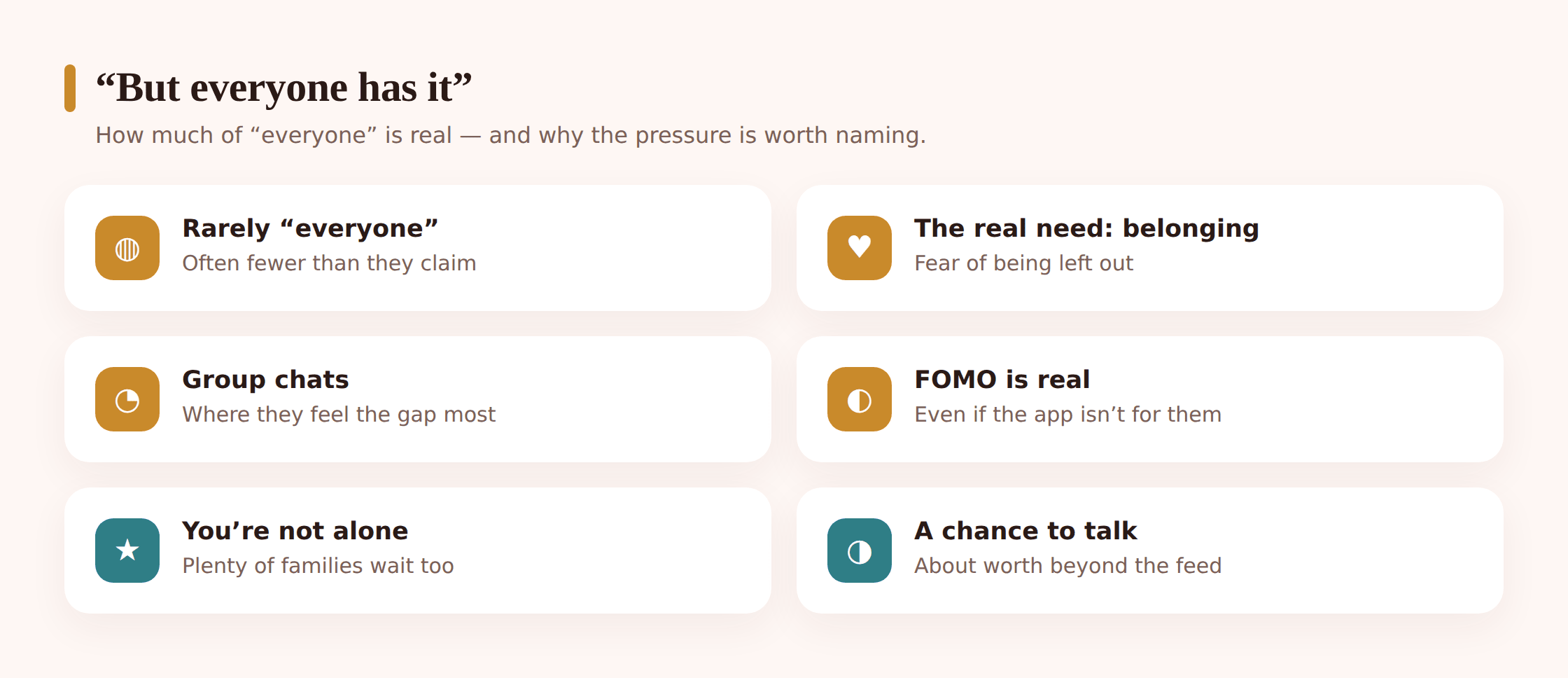
Now the other half. When your child says “everyone has it,” it’s worth gently testing the word. “Everyone” is how it feels, and feelings are real, but the number is almost always smaller than the claim. In a lot of classes the truth is more like: a handful of kids have accounts, some have them but rarely use them, several have parents who said no, and the “everyone” is really three or four loud voices. Ask, kindly and specifically — who exactly, on which app, do their parents know — and the picture usually softens. You’re not trying to catch them in a lie. You’re helping both of you see the actual landscape instead of the panicked version.
It’s also fair to notice the pull isn’t only social. These apps are built to be wanted. The endless scroll, the notifications, the little hit of a new like — that’s engineering, not accident, and it works on adults too. So your child wanting it badly isn’t evidence they’re ready. It’s partly evidence the product is good at its job.
The honest case for waiting
You’ll hear the case for saying yes loudly — usually from your child, sometimes from other parents. The case for waiting deserves an honest hearing too, because it’s stronger than “because I said so.”
The strongest argument is simple: a bit more time helps. A twelve-year-old and a fourteen-year-old are different creatures. The extra two years buy impulse control, a thicker skin for social knocks, a better nose for when something’s off, and enough life to put a mean comment in proportion. None of that is guaranteed by a birthday, but the odds move in your favour with age, and there’s no rush that can’t wait.
Waiting also keeps your child out of an environment currently tuned for adults during the exact years they’re most porous to comparison. And it’s far easier to say yes later than to claw an app back once it’s part of their day. “Not yet” leaves the door open. “Yes then no” starts a fight.
What waiting is not: a moral verdict on parents who said yes. Loads of thoughtful, loving families let a twelve-year-old on Snapchat with the settings locked down and a real conversation running alongside it, and their kids are fine. This isn’t a purity test. It’s a judgement call, and reasonable parents land in different places with the same information.
What actually goes wrong with an underage account
Vague worry doesn’t help anyone. Here’s the specific stuff, because the specifics are what make waiting a real argument rather than a nervous one.
The age-gate lie breaks the safety features. This is the big one and the one parents miss. When a child signs up with a fake birth year that makes them 16 or 20, the app believes them. Every protection built for young teens — private-by-default, restricted messaging, limits on who can find them, softer algorithms — is switched off, because as far as the platform knows it’s dealing with an adult. So the underage account isn’t just “the same app a bit early.” It’s the app in its least protected mode, aimed at the youngest, least ready user. The lie that gets them in is the thing that strips the guardrails.
Contact from strangers. An open account can be messaged and followed by anyone. Adults do use these apps to reach children — often by posing as a peer, warming things up slowly, then moving the chat to somewhere more private. A locked-down teen account shuts a lot of that down. An account pretending to be an adult doesn’t get those locks.
The algorithm doesn’t know it’s a child. Recommendation feeds are built to hold attention, and they learn fast. Watch a few clips on one anxious theme and you’ll get a pile more. For a young child that pull is strong and the exit is genuinely hard to find — and because the app thinks they’re older, the content filters that might have helped aren’t on.
Comparison at a vulnerable age. These feeds are highlight reels sold as everyday life — filtered faces, edited bodies, the best two seconds of everyone’s week. Older teens struggle with this; a ten- or eleven-year-old, right in the middle of working out who they are, has even fewer defences. This is a real theme across our writing on social media safety for kids, and it hits hardest before the self is settled.
If Instagram specifically is the app on the table, it’s worth reading is Instagram safe for kids alongside this — the risks and the settings there apply directly.
How to decide as a family: readiness over birthday
Here’s the reframe that makes this manageable: stop treating it as a date on the calendar and start treating it as a readiness check. The birthday is one input, not the answer. Two kids the same age can be worlds apart on whether they’re ready for a public app.
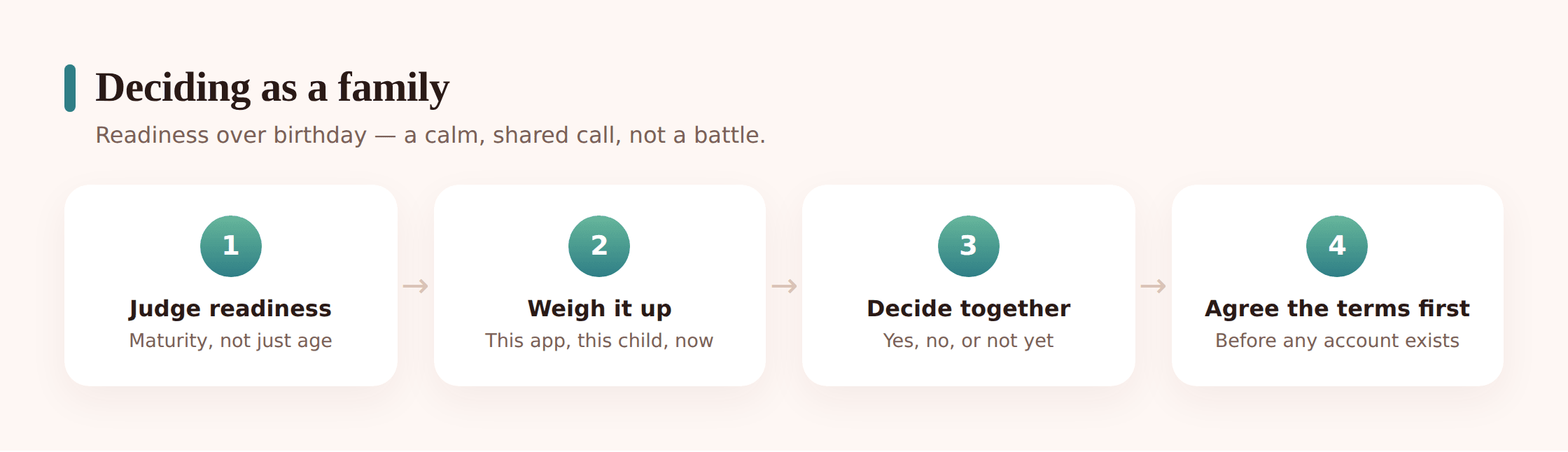
Some honest questions to sit with, ideally out loud with your child rather than about them:
- When something upsets them online or on a game, do they come and tell you — or does it go underground?
- Can they walk away from a screen when time’s up without it becoming a war every single time?
- Do they understand that a private message can be screenshotted, and that “delete” doesn’t really mean gone?
- Have they shown they can be kind in a group chat, and not pile on when others do?
- Would they recognise a stranger being too friendly, or an adult fishing for personal details, and back away?
- Can they cope with being left out of one thing without it flattening the whole week?
None of these needs a perfect score. They’re a temperature check, not a driving test. If most of them are shaky, that’s useful information — not a verdict on your child, but a sign the ground isn’t quite firm yet. If most are solid, a supervised yes might be reasonable even a little before the birthday the app claims to want. You know your kid better than a sign-up form does.
It also helps to decide with the other adult in your child’s life, if there is one, so the answer is the family’s and not one parent’s to be argued around. And it helps to name what “ready” would look like out loud, so your child hears that this is a door that opens, not a wall — which leads straight into how you actually say the word.
Saying “not yet” without making them an outcast
The word matters. “No” sounds like a wall and a full stop. “Not yet” sounds like a door with a timer on it — and it’s usually the truer thing anyway. You’re not banning social media for life; you’re saying this app, at this age, isn’t the moment. Say that plainly, and mean it, and then do the harder part: make the “not yet” livable.
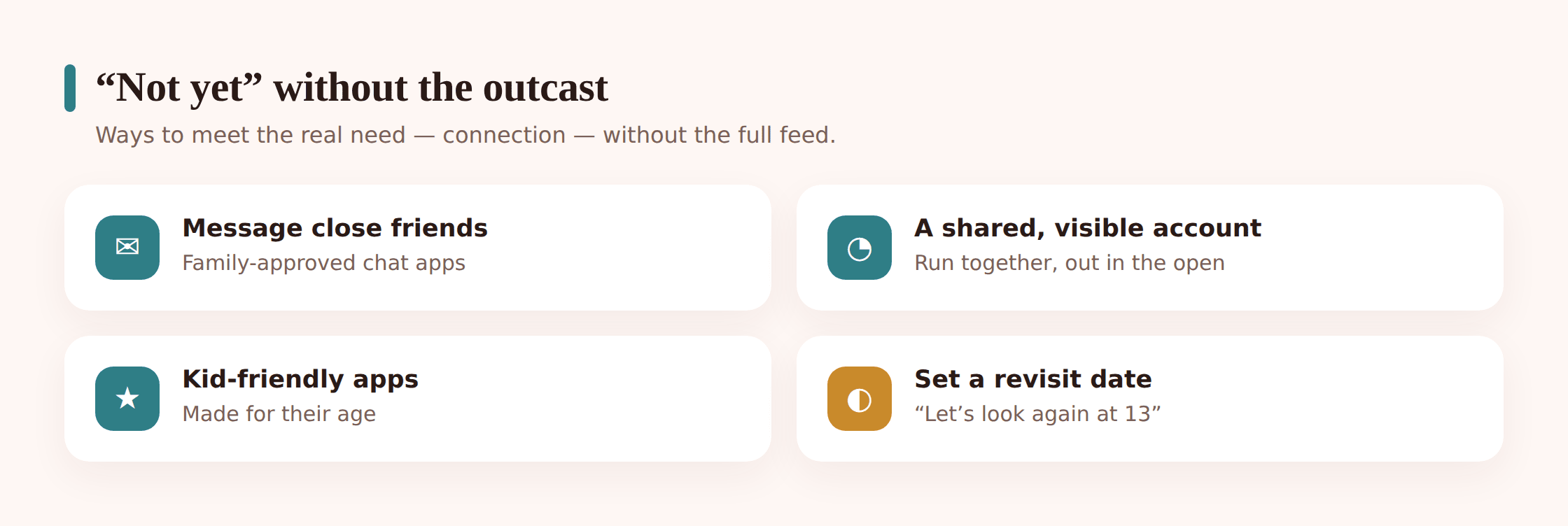
Because here’s the thing: the social need underneath the request is real, and if you just block the app and offer nothing, your child genuinely does miss out, and they’ll resent it. Fill the gap instead.
- Let them message their actual friends. A lot of what a kid wants from Snapchat is just talking to their two or three close mates. A basic messaging app, or a family-approved group chat with kids you and their parents know, covers most of that without the open feed.
- Try a shared or family-visible account. For something like a video app, an account you set up together, that lives on the family device and that you both can see, scratches the itch while keeping training wheels on. It’s a bridge, not a compromise of principle.
- Point them at genuinely kid-built apps. There are messaging and video apps designed for under-13s with proper protections baked in rather than bolted on. They’re less cool, and that’s the trade — but they’re a real answer to “I want to send my friends stuff.”
- Set a revisit date, and honour it. “We’ll look at this again on your twelfth birthday” is powerful precisely because it’s a promise, not a brush-off. Put it in the calendar. When the date comes, actually have the conversation — even a yes-with-conditions builds more trust than a moved goalpost destroys.
And say the quiet part to them: being the last one on isn’t the social death it feels like at eleven, and being a bit behind on an app is not the same as being left out of a friendship. Plenty of the closest kids in any class are the ones who mostly hang out in person. That’s not a lecture to deliver once and forget — it’s a thing to keep gently true in how your family spends time.
If you do say yes: doing it as safely as possible
Maybe you’ve weighed it and the answer is yes — a supervised, locked-down, eyes-open yes. That’s a legitimate place to land, and the goal now is to do it well rather than half-heartedly. The difference between a good early account and a bad one is almost entirely in the setup and the conversation.
Set it up together, in the same room
Sit down and make the account with them, on the same sofa. You choosing the settings alongside them — not doing it for them, not leaving them to it — is the single most protective move there is. It also signals this is a shared thing, not a private one.
Use a real birthday
Boring, and it matters more than anything else on this list. A truthful birth year is what lets the app apply its teen protections. Enter a fake age to make them older and you’ve switched off the exact guardrails you’re trying to rely on.
Lock it down to private
Private account. Followers approved by request only. Messaging restricted so only accepted contacts can reach them. Turn off “suggest my account to others” and anything that lets strangers find them by phone number or contacts. Comb through the privacy menu together — it’s tedious and it’s the whole point.
Agree the rules out loud, before the first post
Not a lecture — a short, mutual agreement. Who they’re allowed to accept. What’s fine to post and what isn’t. That you’ll be able to see the account. What happens if something goes wrong — the deal being they can always come to you, and coming to you doesn’t get the app taken away as a punishment. A written family phone agreement is a good home for all of this.
Keep it visible, not secret
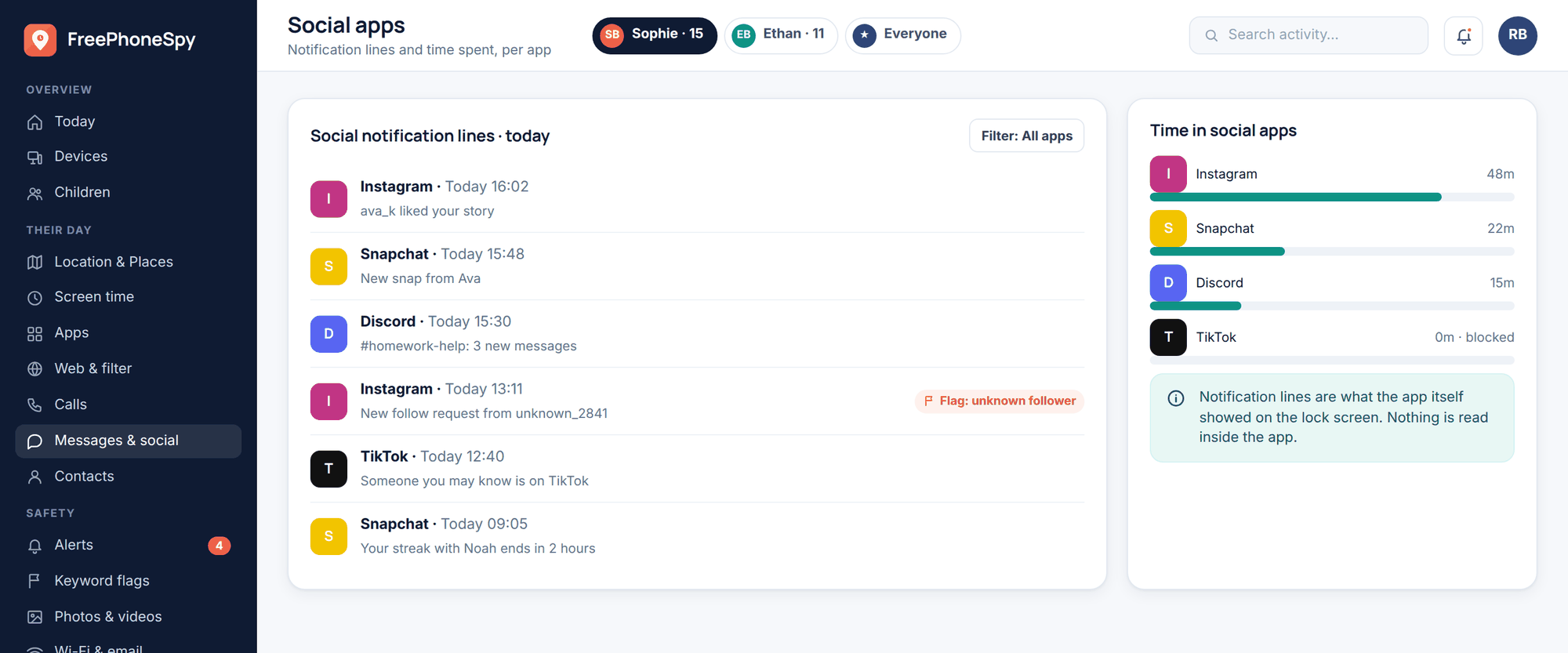
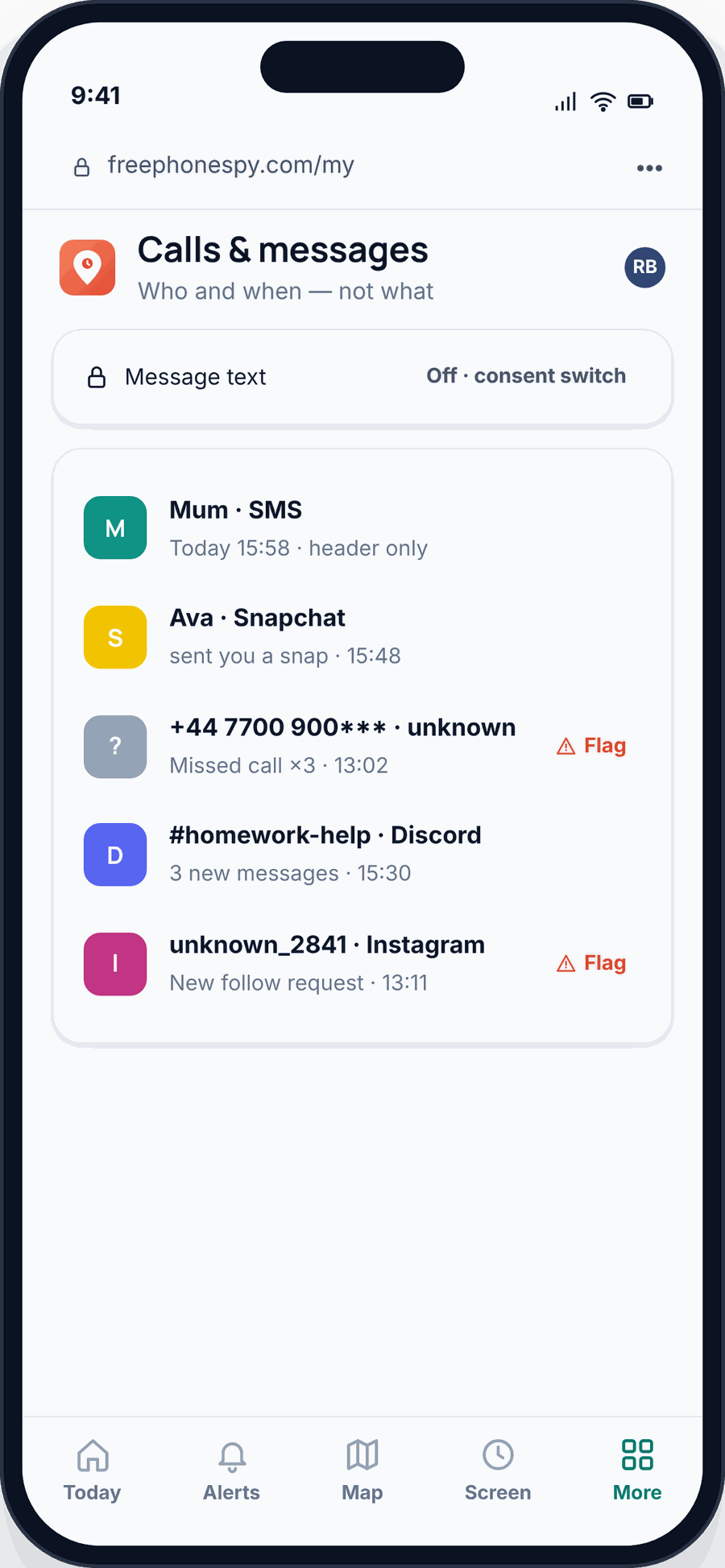
Follow each other, or keep the account something you can both see. If you use device-level tools to keep an eye on things, the child knowing about them is the whole ethic — visibility you’ve agreed on, not surveillance you’re hiding.
Then keep the conversation going. The setup isn’t a one-off; it’s the start. Ask what they’re seeing, laugh at the good stuff with them, be the unshocked adult they can bring the weird stuff to. An early account with a parent who’s genuinely interested and not just policing is a far safer thing than a later account handed over cold.
One last thing, and it applies to the whole decision. This is bound up with the bigger question of when the phone itself arrives — worth reading alongside our piece on delaying a first smartphone, since the device and the apps on it are really one conversation. Whatever you decide, you haven’t got it wrong by being careful, and you haven’t got it wrong by trusting your kid. You know them. Use that.
FAQ
Is it illegal for my under-13 to have Instagram?
No — your child isn’t breaking a law by having an account. The age limit is the platform’s own rule, set mainly to stay on the right side of data-protection laws like COPPA that govern collecting data from under-13s. Signing up under-age breaks the app’s terms of service, which means they can lose the account, and — more importantly — the account won’t have the protections meant for young teens. So it’s not a crime, but it’s not a good idea either.
Everyone in their class really does seem to have it — am I being unfair?
You’re not being unfair by pausing. “Everyone” almost always shrinks when you look closely — a few active kids, a few who barely use it, and several whose parents also said no but quietly. Even where it’s genuinely common, common doesn’t mean ready or safe. Plenty of parents you’ll never hear from made the same call you’re making. Test the word gently with your child, and decide on your kid, not the loudest three in the class.
What’s the harm in just lying about their age to get the protections later?
The lie is the harm. When the app thinks your child is an adult, it treats them like one — public reach, open messaging, unfiltered feeds, none of the teen safeguards. Those safeguards only switch on for an account that admits it belongs to a young teen. Adding a fake older birthday doesn’t unlock adult freedom safely; it strips away the exact protections a real age would have given.
Are there any good alternatives that actually keep them in the loop?
Yes. Most of what a young child wants is to message their close friends, and a basic messaging app or a parent-approved group chat covers that. For video-style fun, a shared family-visible account or a genuinely kid-built app designed for under-13s does a lot of the job with real protections. None are as cool as the grown-up app — but they answer the actual need, which is staying connected to their friends.
If I say yes, what’s the single most important thing to get right?
Use a real birthday and set it up together, private, in the same room. Those two things do most of the protective work: the true age lets the app apply its teen safeguards, and doing it side by side makes the account a shared, visible thing rather than a private world you’re locked out of. Everything else — agreed rules, keeping it visible, staying curious — builds on that base.
My child says I’m ruining their life by saying not yet. Am I damaging our relationship?
Almost certainly not — though it can feel that way in the moment. Kids protest boundaries hard and then live inside them fine. What protects the relationship is how you say it: “not yet” rather than a flat wall, a real revisit date you honour, and alternatives so they’re not left with nothing. A child who feels heard and knows the door will open can be furious today and completely okay next month. The resentment usually comes from feeling dismissed, not from the answer itself.