Sharenting: Sharing Photos of Your Kids Online (Safely)
You snap a photo of your toddler covered head to toe in birthday cake, and before the plates are cleared it’s already on the family group chat. This is one of the most ordinary, loving things a parent does. It even has a name now: sharenting, the sharing of your children’s photos and stories online. Nobody does it to cause harm. But the online world has a long memory, and a photo posted with pure affection at three can look very different to a child at thirteen. This is a gentle look at how to keep the joy and lose the risk.
What sharenting is, and why we do it
Sharenting is a blend of “sharing” and “parenting”, and it covers everything from a single first-day-of-school photo to a running account of a child’s whole life. The first ultrasound. The messy weaning face. The tantrum turned into a funny caption. The proud school report. Most of us have done some version of it, and there are good reasons why.
For one, it keeps distant family close. A grandparent three time zones away gets to watch a grandchild grow up, week by week, in a way that letters and phone calls never allowed. For another, parenting can be isolating, and posting a photo is a small hand reaching out: look, I made this person, and today they did something wonderful. The likes and comments that come back are a bit of warmth on a long day. There’s community in it too. Ask any parent of a child with a rare condition, or a new baby who won’t sleep, and they’ll tell you the online groups they found got them through.
None of that is a problem. The point of this article isn’t to make you feel watched or guilty. It’s to notice that the tools we use to share, social platforms, cloud photo albums, group chats, were mostly built to spread things widely and keep them forever, which sits a little awkwardly with the private life of a child who can’t yet weigh in.
The risks of oversharing
Let’s be clear-eyed without being alarmist. The vast majority of photos parents post are seen by people who wish the child nothing but well, and nothing bad ever comes of them. The risks below aren’t likely to strike any one family. They’re just worth understanding, because a few of them compound quietly over years, and the small habits that guard against them cost you almost nothing.
A digital footprint your child never chose
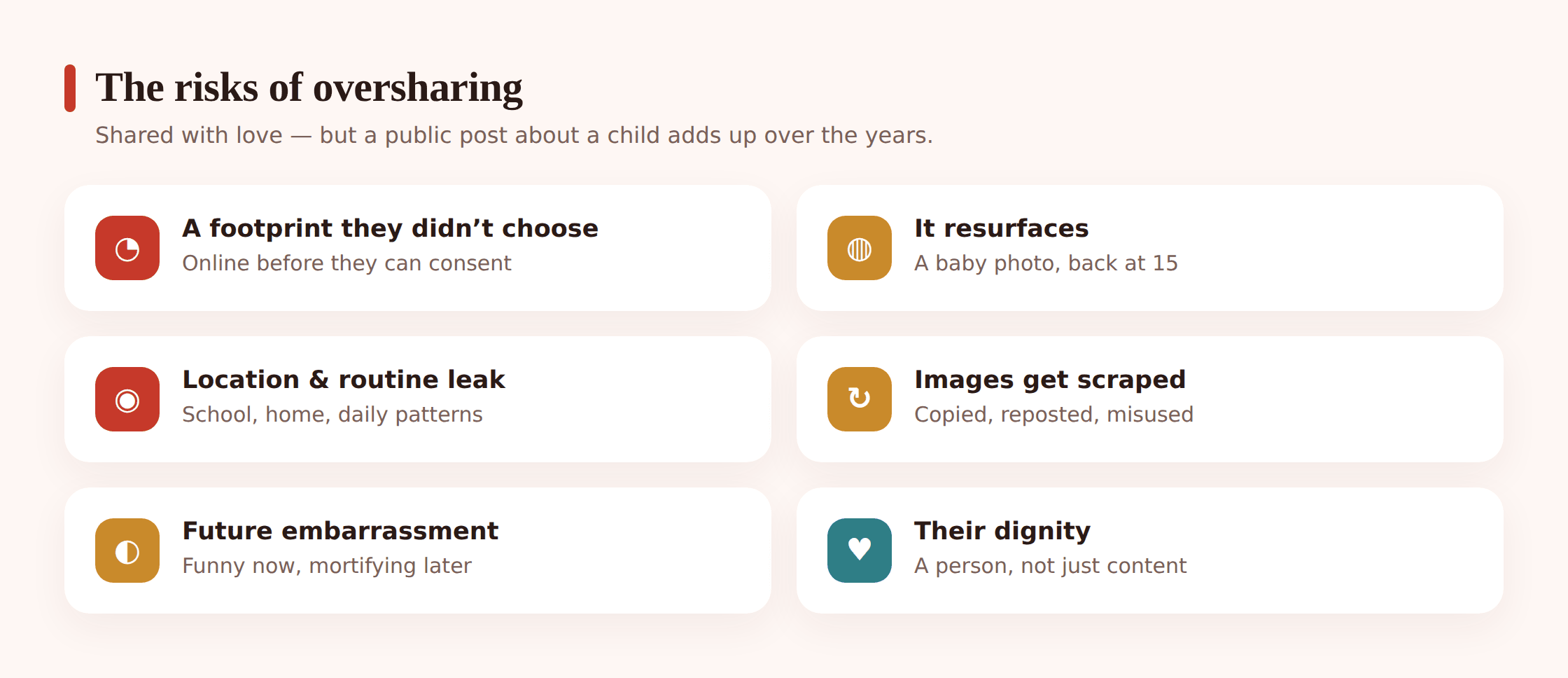
By the time many children are old enough to open their own account, there’s already a substantial record of them online, none of which they agreed to. Their name, face, birthday, milestones, moods, and struggles may all be searchable, tagged, and archived. This is separate from the footprint they’ll build themselves; if you want to think about that side, we cover it in your child’s digital footprint. The sharenting version is different, because it’s a footprint made for them, by you, before they had any say.
Images that resurface later
The bath-time photo that’s adorable now can become the thing a fourteen-year-old is mortified to discover a classmate found. Screenshots outlive deletions. A picture you take down still exists on the phones and in the archives of everyone who saw it. Kids are increasingly sensitive to this, and “but you were so cute” rarely lands well with a teenager who feels their privacy was spent without permission.
Privacy and safety leaks
Photos carry more information than the image itself. A school logo on a jumper, the name of a street sign, a house number, the regular Tuesday-swimming caption, a geotag quietly attached by your phone, each is a small clue. On their own, harmless. Stitched together across dozens of posts, they can sketch a surprisingly complete picture of where a child is and when. In the rare cases where that matters, it matters a lot; our guide to doxxing and personal info explains how scattered details get assembled by someone with bad intent.
Images being scraped or misused
Public photos can be copied by anyone, and not always by a human. Automated tools harvest images at scale to train systems, populate fake profiles, or worse. A completely innocent photo of a child in a swimsuit at the beach is innocent in your hands; it isn’t necessarily innocent once it’s floating on the open web where you no longer control who saves it. This is the single strongest argument for keeping certain photos out of public reach entirely.
Embarrassment as they grow
Not every risk is a stranger or a scraper. Sometimes it’s just your own child, at twelve, wishing to whatever powers exist that the potty-training saga wasn’t the top result when someone searches their name. Dignity is a real thing to a growing person, and it shows up earlier than we expect. What reads as a sweet family memory to you can read as a betrayal to them.
Where we stand. FreePhoneSpy is built around open, consent-based family safety, the kind of parenting where kids know what’s shared and why. That same spirit applies to your own posting. The healthiest approach to sharenting isn’t secrecy in either direction; it’s honesty with your child about what goes online and a genuine willingness to let their wishes shape it as they grow.
Consent, dignity, and your growing child
Here’s the idea at the centre of all this, and it’s a slightly uncomfortable one: your child is a person with their own right to privacy, even when they’re too small to claim it. A baby can’t consent to anything, which places the whole burden of judgment on you. That’s not a reason to freeze, it’s a reason to imagine forward. A useful test before posting is simply, would my child, at sixteen, be glad this is out there? If you’re not sure, that hesitation is information.
Consent isn’t a single yes-or-no moment either. It grows with the child. A four-year-old can’t reason about digital footprints, but they can absolutely tell you they don’t want their friends to see a photo, and honouring that small no teaches them something huge: that their feelings about their own image count. By seven or eight, plenty of children can be asked directly, “Is it okay if I put this on the family page so Grandma sees it?” The answer might surprise you, and either way you’ve handed them a bit of ownership over their own story.
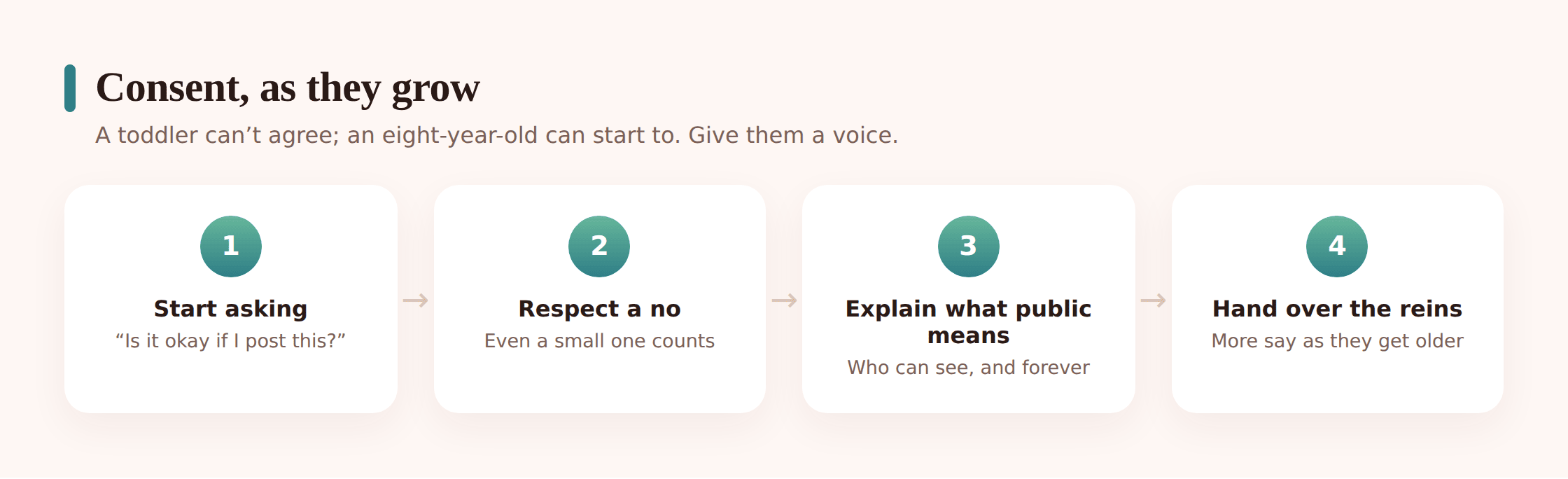
As children move toward the teen years, this becomes non-negotiable if you want to keep their trust. Teenagers are building an identity in public and in private, and a parent posting about them without asking can feel like a real breach. The same principles that guide their own growing independence apply to how you talk about them; our piece on teens, privacy and independence goes further into that shift. A simple standing rule, “I won’t post anything about you without checking first,” costs you a little spontaneity and buys you a lot of goodwill.
Safe-sharing rules that actually stick
You don’t need to become a hermit about it. Most of the risk drops away with a handful of habits that become second nature after a week or two. Here’s a practical set.
Lock down your audience
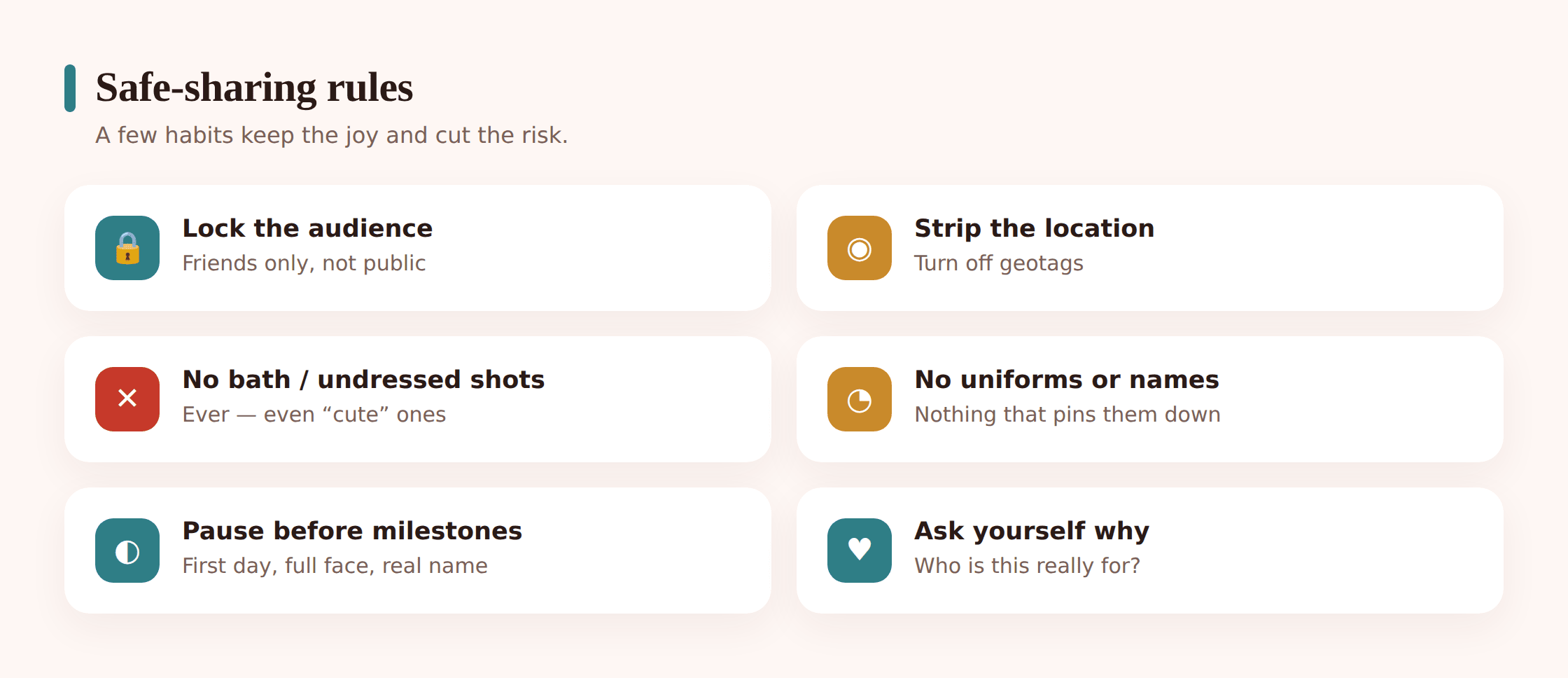
The single biggest lever. Switch accounts to private, and actually look at who’s on your friends or follower list, because most of us have collected people over the years we couldn’t name. On platforms that allow it, use a close-friends or family-only list for anything showing your kids, and post there rather than to the whole world. A photo seen by thirty people who love your child is a completely different thing from one seen by an open public feed.
Strip the location
Turn off geotagging in your camera and social apps so your phone stops quietly attaching coordinates to photos. Don’t tag your exact location, and be wary of posting from a place while you’re still there, especially anywhere your child goes regularly. If you want the memory, post it a day or two later from home.
Skip the bath, toilet, and undressed shots
They’re cute to you and completely misusable to the wrong stranger. Nappy changes, potty triumphs, bath-time bubbles, anything without clothes, keep these entirely offline. There’s no privacy setting careful enough to make a public version of these safe, so the rule is simply: not online, not even to friends.
Hide the identifying details
Watch for school uniforms and logos, the front of the house with a number, street names, sports club kit with a location on it, and full names paired with a birthday. You don’t have to crop your life into abstraction; just glance at the background before you post and ask what a stranger could learn.
Think twice before the big milestones
The classic first-day-of-school chalkboard, “Ava, age 5, Year 1, Oakfield Primary”, is adorable and hands over a child’s full name, age, year group, and school in one image. Enjoy the tradition, just leave the specifics off, or share the detailed version only in a private family space.
Pause on the hard stuff
Meltdowns, medical struggles, behaviour you’re worried about, embarrassing moments. Venting is human and support is real, but ask whether this is your story to tell publicly or your child’s. A trusted friend or a private group is usually the better place than an open post.
- Accounts set to private, follower list actually reviewed
- Location and geotagging switched off in camera and social apps
- No bath, nappy, toilet, or undressed photos anywhere online
- No school uniforms, house numbers, or full-name-plus-birthday combos
- Milestone posts kept vague in public, detailed only in private spaces
- A habit of asking your child, once they’re old enough, before you post
If you’d like to fold these into a broader once-a-year sweep of your household’s settings and accounts, our family digital safety check-up walks through the whole thing in one sitting.
Talking to grandparents and relatives
Here’s the twist a lot of careful parents don’t see coming: you can lock down every one of your own accounts and still have your child’s photos flowing freely, because a proud grandparent or an aunt with a very public profile is posting them. This is one of the trickier conversations in modern family life, partly because it’s so well-meant. Nobody’s grandmother is trying to endanger anyone. She just loves the child and wants to show them off.
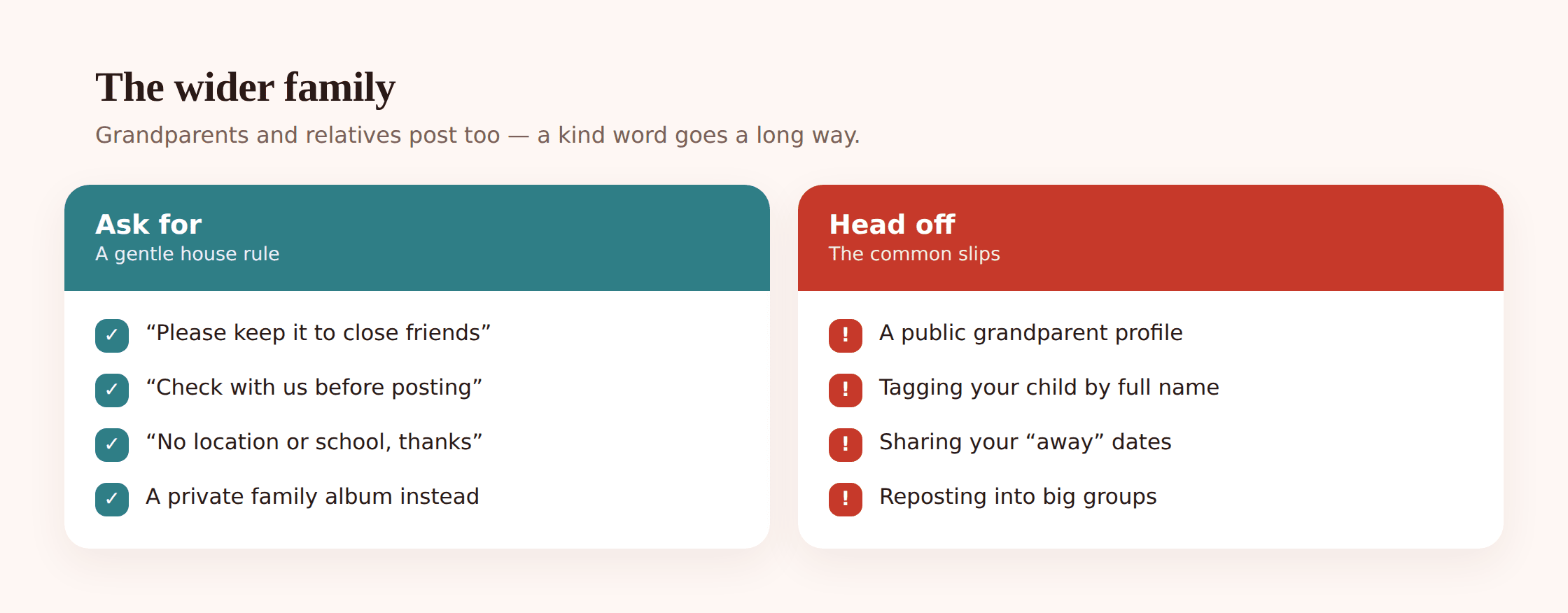
The tone that works is warm and specific, not a lecture about the perils of the internet. Lead with the reason, which is the child, not the technology. Something like: “We’re trying to keep photos of the kids to just family, so could you send them to me directly instead of posting them, or add me before you share?” Most relatives respond well when it’s framed as a family choice rather than a criticism of them. It also helps to make the easy path easy, set up a private shared album they can post into freely, so they still get to share and you keep the perimeter.
A few practical asks that tend to go down gently:
- “Please check with me before posting the grandkids, we’re keeping them off public feeds.”
- “Send photos to our family group instead, that way everyone sees them and they stay with us.”
- “If you do post, could you keep it to friends-only and leave out their school and full name?”
- “No bath or swimsuit shots online, please, we’ve got a rule about that one.”
If a relative keeps posting after you’ve asked, it’s fine to be a little firmer, and fine to say it comes from the child’s own wishes as they get older. That framing, “she’s asked us not to share her photos now,” is hard to argue with and models exactly the respect you’re trying to teach.
Giving kids a say as they grow
The nicest thing about handling this well is that it doesn’t stay your job forever. The aim is to gradually pass the wheel. Start young by simply asking and honouring the answer, even when it’s inconvenient. As they get older, show them what you’re about to post and let them veto it, no reasons required. By the teenage years, the default flips: nothing about them goes up without a yes, and old posts they’re unhappy about come down when they ask.
Some families make a little agreement of it, the way you might for phone use, and it can sit comfortably alongside a wider household understanding about devices and online life. What you’re really teaching, underneath the settings and the rules, is that a person gets to have a say over their own image and story. A child who grows up knowing their “no” was respected is far better placed to expect that respect from friends, partners, and the wider internet, and to offer it to others. That lesson outlasts any photo.
Common questions
Is it really so bad to post photos of my kids?
No, and please don’t read this as a verdict that you’ve done harm. Sharing your children’s lives is one of the great ordinary pleasures of being a parent, and for most families nothing about it goes wrong. The point is only that a few small habits, private audiences, no location, no undressed shots, asking as they grow, remove almost all of the downside while keeping all of the joy.
My child is a baby and can’t consent. What am I supposed to do?
You become the stand-in for their future self. Before you post, picture them at sixteen and ask whether they’d be glad it’s out there. When you’re unsure, keep it in the private family album rather than the public feed. You’re not aiming for perfection, just for choices your grown child would understand.
What should never go online, even to friends?
Anything showing a child undressed, including bath, nappy, potty, and swimwear-in-context shots. No privacy setting makes a public version of these safe, and even friends-only carries risk if an account is ever compromised. Keep them entirely offline, on your own device or in an end-to-end private album.
Can I take down photos I posted years ago?
Yes, and it’s a good habit to revisit old posts occasionally. Deleting from the original platform removes it from public view going forward, though it won’t reach copies others already saved. Don’t let the imperfect reach stop you, taking down what you can is still worth doing, especially anything with a location, a school, or a photo your child now dislikes.
How do I ask relatives to stop posting without causing a rift?
Lead with the child and the reason, keep it warm, and offer an easy alternative. “We’re keeping the kids off public feeds, so could you pop photos in our family album instead?” lands far better than a warning about internet dangers. Most relatives are posting out of love and will happily switch once they understand it’s a family choice.
My teenager is upset about old photos I shared. How do I handle it?
Take it seriously and act on it. Apologise plainly, ask which posts bother them, and take those down. Then set a going-forward rule that you’ll check with them before posting anything. It’s a small loss of spontaneity for you and a big gain in trust, and it models exactly the respect for personal privacy you want them to carry into the rest of their lives.
Sharenting isn’t a problem to be solved so much as a habit to be tended. Keep the audience small, keep the location and the identifying details out, skip the shots that could be misused, and let your child’s own voice grow louder in the decision every year. Do that, and you keep the best part, the delight of sharing a life you’re proud of, while quietly handing your child a privacy they’ll one day be grateful you protected.