Kids, Gambling & Loot Boxes: A Parent’s Guide
Your kid isn’t sitting at a poker table. They’re on the sofa opening a card pack in a football game, and the animation slows down right before it reveals whether they got the rare player. That pause — the flicker of “it might be this time” — is the exact hook a slot machine uses. Loot boxes, gacha pulls, skin bets and free-to-play casino apps have quietly put gambling mechanics in front of millions of children, mostly without the word “gambling” appearing anywhere. This isn’t a rant against gaming. It’s about one specific thing games borrowed from the casino, why it lands so hard on a developing brain, and what you can do about it.
The gambling mechanics hiding in kids’ games
Strip away the graphics and a loot box is a simple bet. You hand over money — or a currency you bought with money — and a random process decides what you get. Usually it’s junk. Occasionally it’s the thing you wanted. That structure has a name in psychology: a variable ratio reward schedule. Rewards arrive on an unpredictable pattern, and it turns out that’s the single most powerful way to keep a brain repeating a behaviour. It’s why people pull slot levers for hours. It’s also why your child will open “just one more” pack.
Three ingredients do the heavy lifting, and they’re worth naming out loud so you can point them out to your kid.
Random rewards. You never know what’s inside, so every open carries a little jolt of hope. Predictable rewards get boring fast. Unpredictable ones don’t.
Near-misses. Watch a pack-opening animation closely. It often shows you the rare items spinning past, landing just one slot away from the jackpot, before settling on the common one. That “so close” feeling isn’t a coincidence — near-misses fire almost the same reward signal as an actual win, and they push people to try again. Slot machines were engineered around this decades ago. Games copied it.
Variable reinforcement plus a countdown. Layer a clock on top — a limited-time banner, a battle pass that expires, a “special offer ends in 2 hours” — and stopping starts to feel like losing something. The urgency is manufactured.
Types: loot boxes, gacha, skins and casino apps
These mechanics show up in several forms. Your child may be exposed to more than one, and they don’t all feel like gambling from the outside.
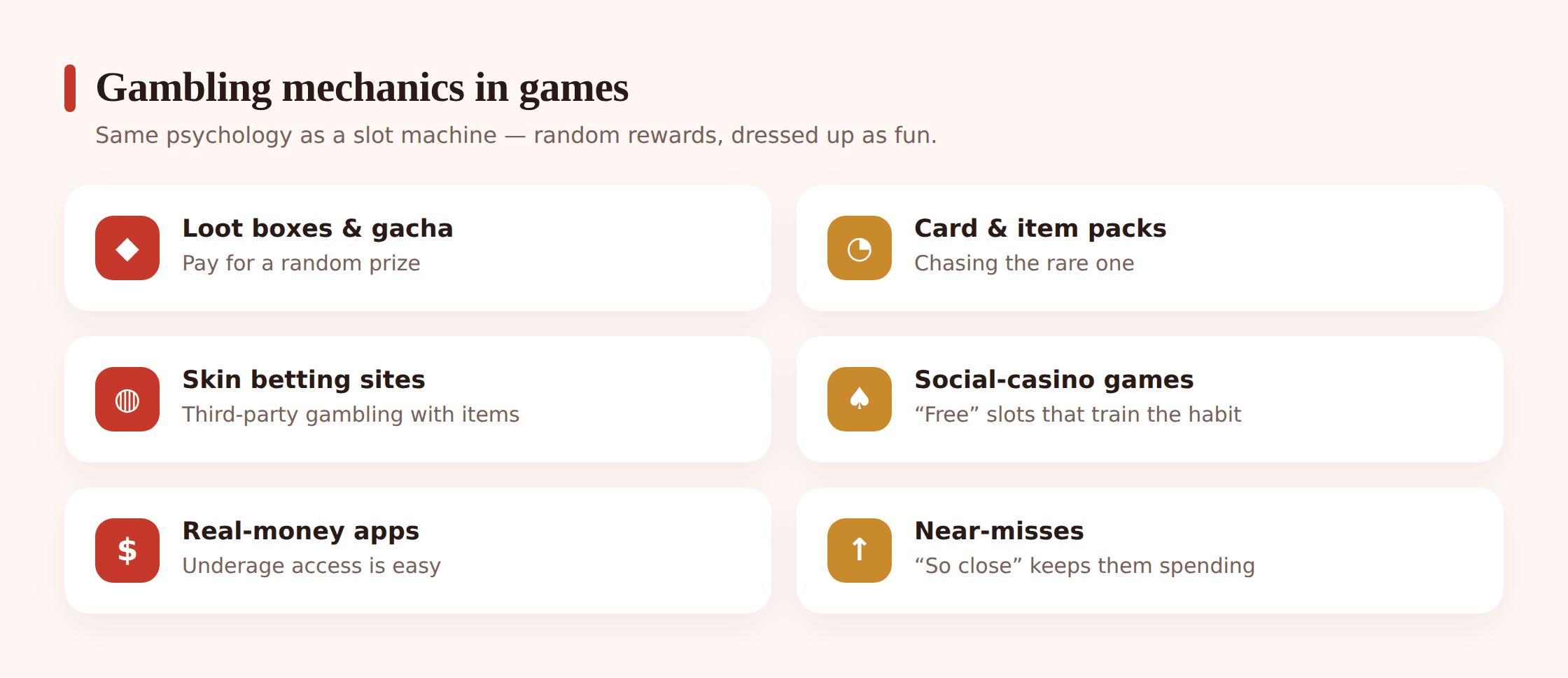
Loot boxes and card packs
The classic. A sealed crate, chest or pack that you open for a random selection of items. Shooter games sell weapon skins this way; football and basketball games sell player cards; countless mobile games sell gear. Some show published odds now (regulators pushed for this), but a nine-year-old reading “0.8% legendary drop rate” doesn’t translate that into “I’ll spend a fortune and mostly get nothing.”
Gacha
Named after Japanese capsule-toy machines, gacha games are built almost entirely around the pull. You spend premium currency to “roll” for characters, and the best characters sit behind brutal odds. Many use a “pity” system — guaranteed reward after, say, ninety failed pulls — which sounds generous but actually sets a spending target and makes the grind feel rational. Gacha games are enormously popular with teens and have some of the most refined monetisation on the planet.
Skins and third-party “skin betting”
Here’s where it gets darker. In some games, cosmetic items (“skins”) can be traded or sold, which means they have real cash value. That’s created an ecosystem of third-party websites — outside the game, unregulated, with no meaningful age checks — where people wager skins on coin-flips, roulette wheels or the outcome of esports matches. To a child it can look like a game feature. It is, functionally, an unlicensed casino that happens to take digital knives and hats as chips, and those can be cashed out for money. This is one of the clearest bridges from “game” to genuine gambling, and it’s the one most parents have never heard of.
Social casino and “free” casino-style games
Search any app store for “slots” or “casino” and you’ll find hundreds of free games with cherries, jackpots and spinning reels. They don’t pay out cash, so they usually sidestep gambling law and carry mild age ratings. But they teach the exact rhythm of gambling — the reels, the near-misses, the “buy more coins to keep playing” — and they normalise it as harmless fun. Research consistently links playing these social-casino games in youth with a greater likelihood of gambling for real money later. They’re the on-ramp, not the destination.
When it crosses into real-money gambling
Everything above is the training ground. The cliff edge is a licensed betting or casino app taking real money — and yes, underage kids do reach them.
Not usually by hacking anything. Real gambling apps require you to be of legal age and to verify identity, but the weak points are human. A child might use a parent’s account that’s already logged in and verified. They might enter a birth year that makes them an adult on a site with lazy checks. They might be handed a link by an older friend, or drawn in by a flashy advert during a football stream or a YouTube video, or by a “free bet” promo. Skin-betting and crypto-based gambling sites are especially loose, because they operate in the gaps between jurisdictions.
You don’t need to know the mechanics of how to place a bet to protect against this — and this article won’t walk through any of that. What matters is the principle: an adult’s verified, logged-in account on a shared device is the most common door in. Close that door and most of the risk goes with it. This overlaps with the money side of things covered in in-app purchases, and with the get-rich-quick pull of crypto and investment scams aimed at teens, which lean on the same “one big win” fantasy.
Why it’s riskier for young brains
Adults fall for these mechanics too — that’s the point of them. But children and teenagers are, genuinely, worse-equipped, and it’s not about intelligence.
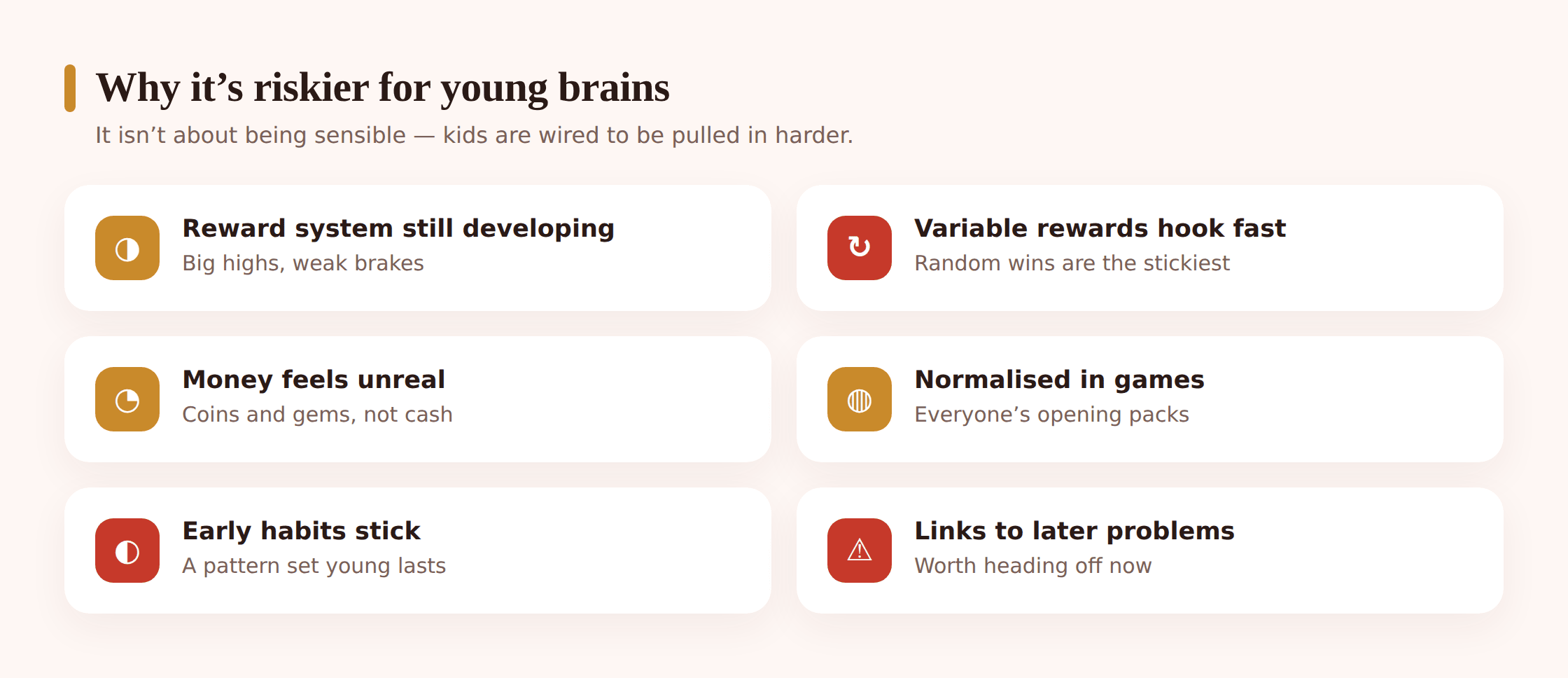
The brakes aren’t fully built. The part of the brain that handles impulse control, weighing consequences and resisting a tempting short-term reward — the prefrontal cortex — keeps developing into the mid-twenties. Meanwhile the reward system is running at full tilt through the teens. So you’ve got a powerful “want” engine paired with weak braking. Variable rewards hit that combination like a key in a lock.
Fake money hides the cost. Kids don’t spend pounds. They spend gems, V-Bucks, coins, primogems. Two conversions away from real cash, the sting of spending disappears. A child who’d never hand over a £20 note will happily blow the equivalent in a currency that doesn’t feel like money.
They can’t judge the odds. Understanding that a 1% drop rate means you’ll usually lose, that past pulls don’t change future ones, that the “house” always keeps an edge — that’s abstract probability, and it’s genuinely hard. Many adults get it wrong. Children get it wrong more, and the games are designed to keep them from thinking about it.
An early “win” leaves a mark. A big early payout — pulling the legendary character on your third try, winning a skin bet — can set a hook that lasts for years. The brain files “this pays off” and chases that feeling long after the losses pile up.
Warning signs to watch for
Most kids who open loot boxes never develop a problem, the same way most people who buy a lottery ticket don’t. But some do, and the signs look a lot like adult gambling harm scaled down. Any one of these on its own may be nothing. A cluster is worth a proper conversation.
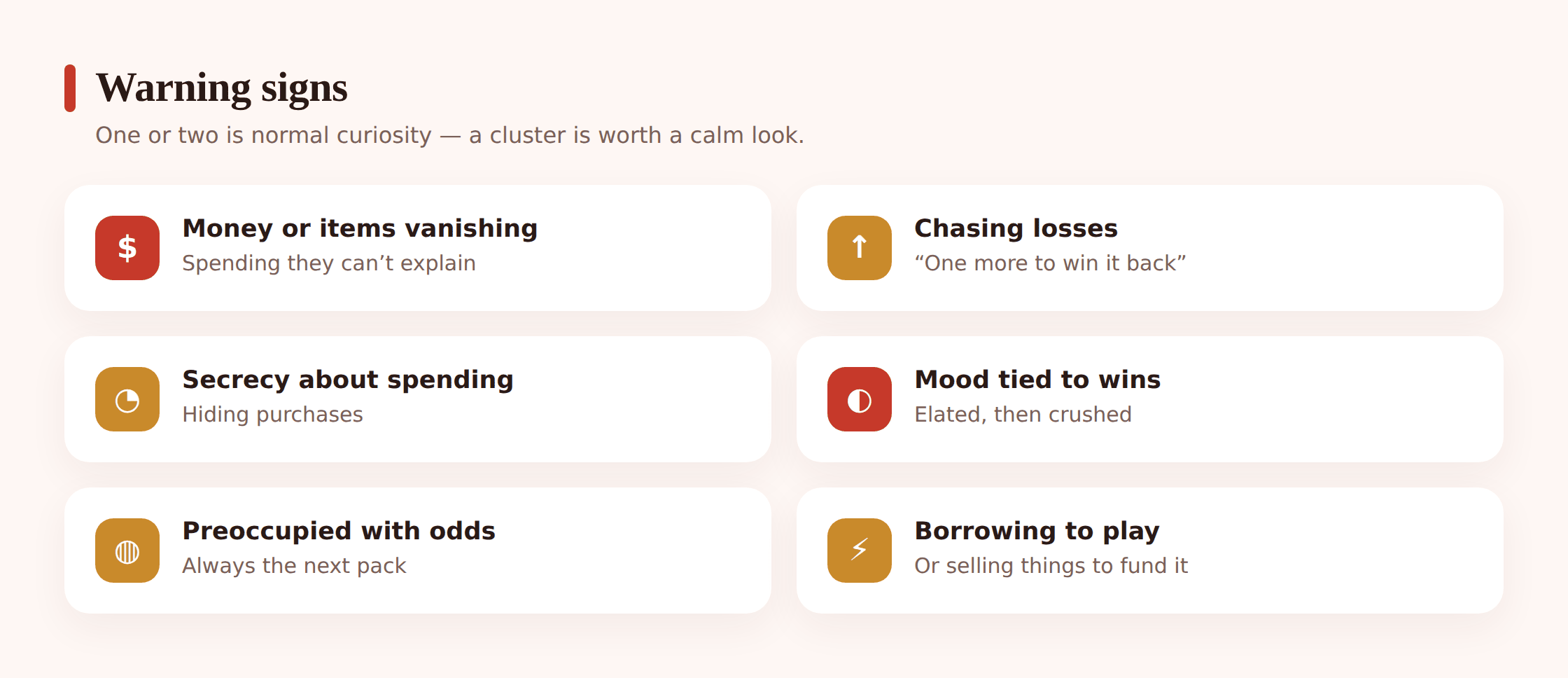
- Chasing losses. “I have to keep going to win back what I spent.” This is the single most telling sign — it’s the core engine of every gambling problem.
- Money and items disappearing. Gift-card balances that evaporate, pocket money gone with nothing to show, and — a specific one — game items or skins vanishing, which can mean they’ve been sold or wagered on a third-party site.
- Secrecy and defensiveness. Hiding the screen, getting sharply angry when you ask about spending, deleting purchase confirmation emails, vague answers about where money went.
- Mood tied to wins and losses. Elation after a good pull, a slump or real distress after a bad run. When a child’s emotional weather is being set by random game outcomes, that’s a flag.
- Preoccupation. Talking constantly about the next pack, the next drop, the next bet; planning around it; restless or irritable when they can’t play.
- Borrowing or worse. Asking to borrow money, “owing” friends, or in older teens, taking money that isn’t theirs to cover spending.
- Escalation. Needing to spend more to get the same buzz — the amounts creep up over time.
How to protect them
You don’t have to ban games, and trying to usually backfires. The goal is to remove the easy money, cap the exposure, and — the part that actually sticks — make sure your child understands the trick being played on them.
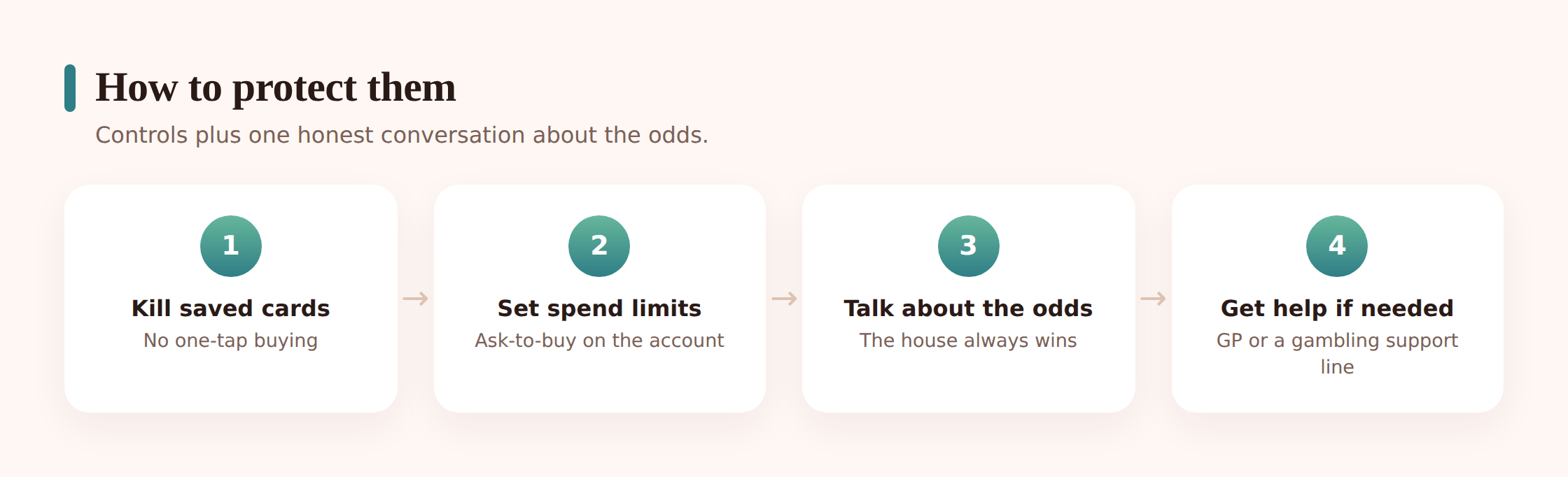
1. No saved cards on the kid’s account
This is the big one. A stored card plus one-tap buying is what turns a child’s curiosity into a charge. Remove the card, and use gift-card balances or an allowance instead — when it’s gone, it’s gone, with nothing behind it to overspend. The full walkthrough for every platform is in our guide to in-app purchases and kids.
2. Turn on spending controls and purchase approval
Apple’s Ask to Buy and Google Family Link both let every purchase — free or paid — wait for your approval on your phone. Set store purchases to require a password every time, not after a grace window. Roblox, Xbox, PlayStation and Steam each have their own spend limits and parental PINs; set them low or to zero.
3. Use age ratings as a filter, not a guarantee
Check PEGI or ESRB ratings, and note that many now carry an explicit “in-game purchases (includes random items)” label — that phrase is the loot-box warning. Ratings are a starting point, though, not the whole story: plenty of mild-rated games still sell packs, and skin-betting sites carry no rating at all.
4. Block the third-party gambling and “free currency” sites
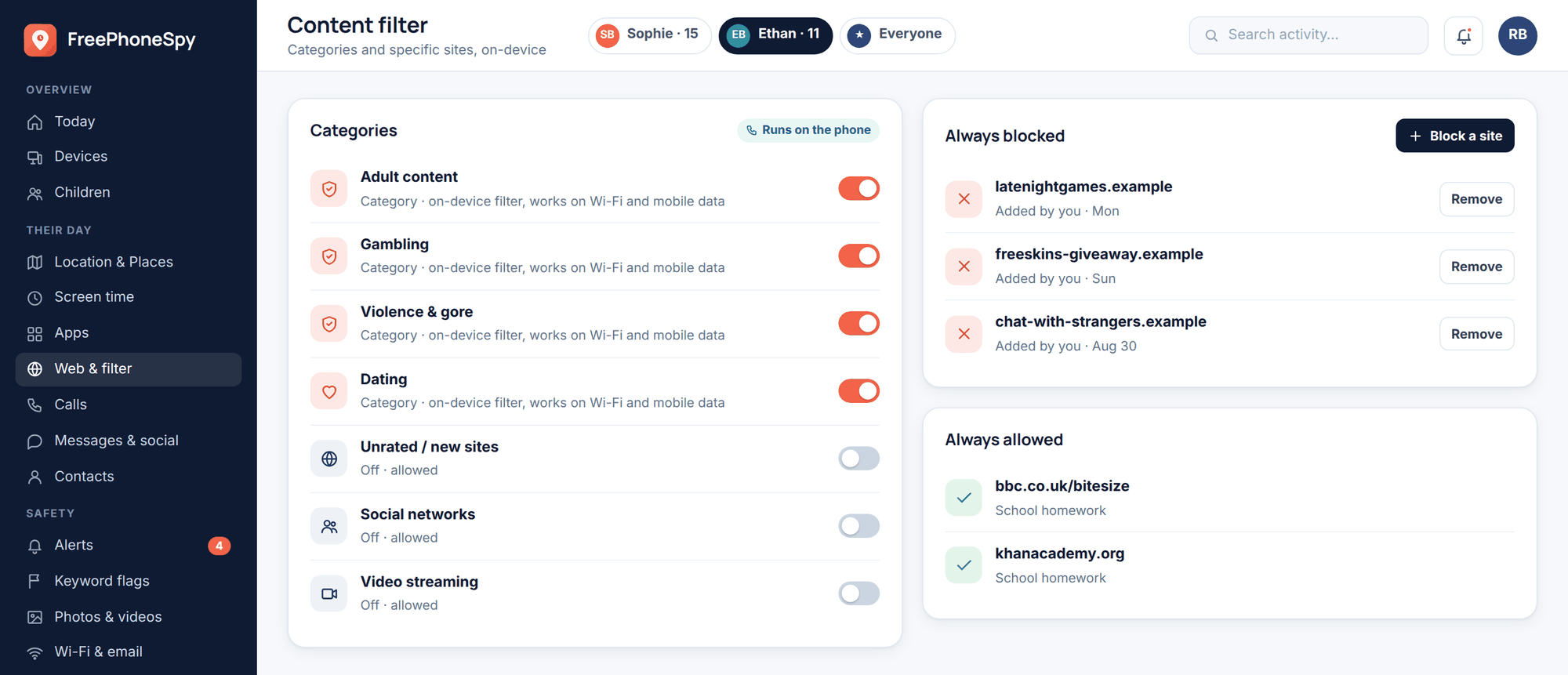
Skin-betting sites, unlicensed casinos and “free Robux/V-Bucks” scam pages all live on the open web, outside the games themselves. A content filter that blocks those pages before your child lands on them closes the most dangerous door — the one that leads off-platform to real wagering. This is the same web-filtering approach covered in online gaming safety.
5. Have the odds-and-house-edge talk
This is what actually protects them long term, because they’ll eventually be somewhere your controls aren’t. Sit down and open a pack together. Point out the near-miss animation. Explain that the pack costs 800 coins but the item costs 500 so you’re nudged to overbuy. Say the quiet part: “The company makes money because most people spend more than they get back. That’s the whole business. Even adults fall for it.” Teach that random rewards mean the house always wins over time — that’s not bad luck, it’s the design.
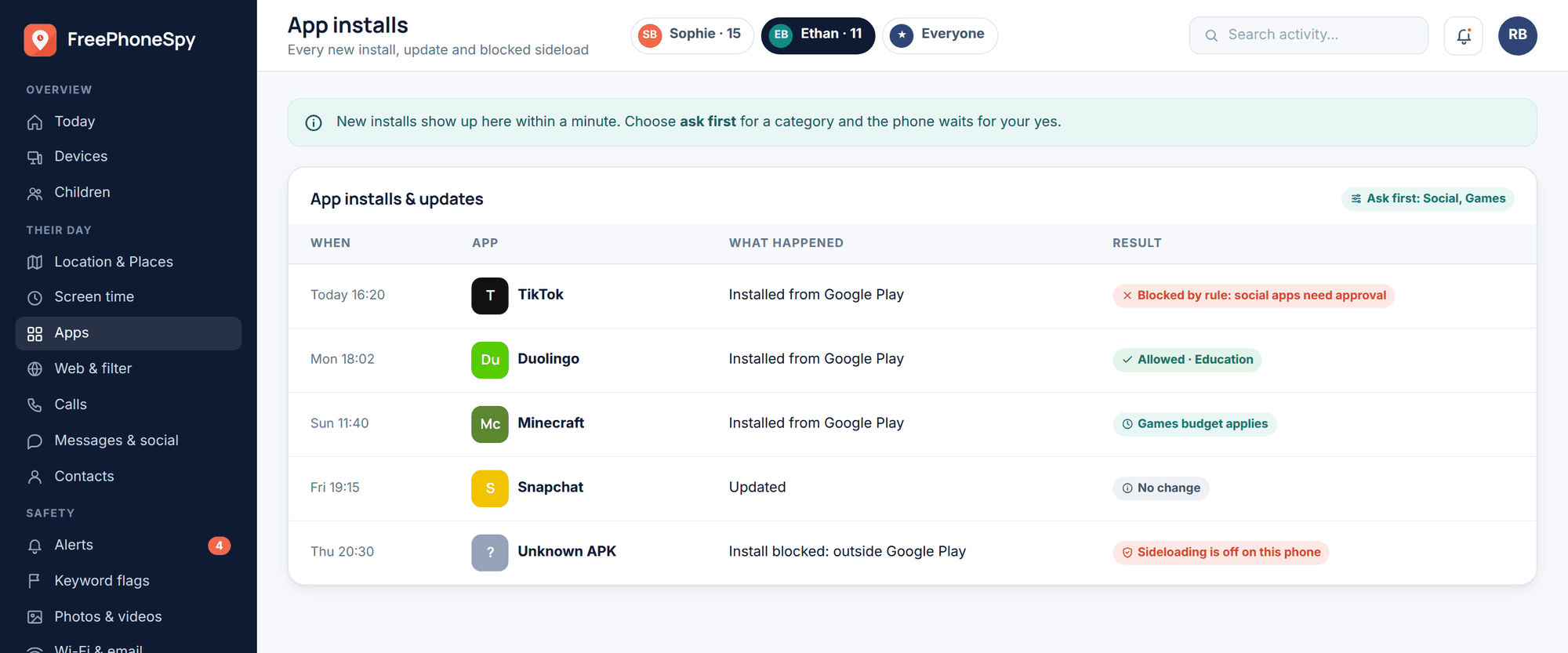
On the awareness side, a tool like FreePhoneSpy on your child’s Android — set up openly, with agreed limits — can cap time in the one game where the spending happens, block the off-platform gambling and scam-currency sites in its content filter, and flag when new spending-heavy apps appear, so the topic comes up early rather than after a charge lands. It’s a way to keep the conversation informed, not a substitute for having it.
If your child already has a problem
If the warning signs are stacking up, don’t panic and don’t lead with punishment — shame drives the behaviour underground, and secrecy is the thing you most want to avoid. Work through it calmly.
Talk first, and listen
Open without accusation. “I’ve noticed the coins keep running out and it seems to really get to you — can we talk about it?” Let them explain. Kids caught in a chasing loop often feel trapped and relieved to be asked. Make it clear the money matters less to you than they do.
Remove access to the money and the mechanic
Take the card off every account, switch to a fixed allowance, and pause or uninstall the specific games or sites driving it — especially any third-party betting site. This isn’t forever; it’s a circuit-breaker so the loop can’t keep running while you sort things out. Block the gambling sites at the filter level so a re-download doesn’t reopen the door.
Rebuild without the buzz
A random-reward loop leaves a gap. Help fill it — other games without gambling mechanics, sport, time with friends, anything that delivers reward through effort rather than chance. The aim isn’t to strip out fun, it’s to replace the specific hook.
Get help if it’s beyond a family fix
If the behaviour is entrenched, causing real distress, or involves significant money, bring in support. Start with your GP, who can refer on. A school counsellor can help too. National gambling-support services (of the GambleAware type) offer free, confidential advice and have resources aimed specifically at young people and their families. You don’t have to work it out alone, and asking for help early makes a real difference.
The quick checklist
- Remove saved cards from the child’s accounts — use gift cards or an allowance.
- Turn on Ask to Buy (Apple) or Family Link approval (Android); require a password every time.
- Set spend limits and parental PINs on Roblox, Xbox, PlayStation, Steam.
- Check age ratings for the “random items / in-game purchases” label.
- Block skin-betting, casino and “free currency” sites in a content filter.
- Open a pack together and explain near-misses, overbuying and the house edge.
- Say it plainly: these are designed to take money, and adults fall for them too.
- Watch for the cluster — chasing losses, secrecy, disappearing money, mood tied to wins.
- If there’s a problem: talk, remove access, rebuild, and get help early.
FAQ
Are loot boxes really gambling?
They run on the same core mechanic — paying for a random chance at a reward — and use the same psychological hooks, including near-misses and variable rewards. Several countries have moved to regulate them as gambling, and others require published odds. Whatever the legal line where you live, it’s safest to treat them as gambling in effect and talk to your child that way.
Is my kid too young to worry about this?
Probably not, if they’re gaming at all. Pack-opening and gacha mechanics appear in games rated for young children, and the “fake money hides the cost” problem hits youngest kids hardest because they understand real money least. You don’t need to frighten a seven-year-old, but a simple “those mystery boxes are designed to make you keep buying” plants the right idea early.
My child only plays free games — is there really a risk?
“Free” is where a lot of this lives. Free-to-download games make their money from in-game purchases, including loot boxes, and free social-casino apps teach the rhythm of gambling without paying out cash. Free doesn’t mean no spending and it doesn’t mean no gambling mechanics — often the opposite.
What’s skin betting, and should I worry about it?
It’s wagering game items that have real cash value on third-party websites — outside the game, unregulated, with weak or no age checks. It’s one of the clearest bridges from gaming to real gambling, and most parents have never heard of it. If your child plays games with tradeable items, it’s worth blocking those sites and asking about it directly.
How do I talk about odds without a maths lecture?
Keep it concrete. Open a pack together and count: how many opens to get something good, how much that cost. Point at the near-miss animation and name it. Land on one plain sentence — “over time the company always ends up ahead, that’s how they make money” — rather than explaining probability. The goal is a healthy suspicion, not a statistics grade.
Isn’t blocking games just going to make them sneaky?
That’s exactly why the recommendation isn’t a blanket ban. Do it in the open, target the gambling mechanic specifically rather than gaming in general, and pair every control with the reason behind it. A child who understands why skin-betting sites are blocked is far less likely to go looking for a way around them than one who just hit a locked door with no explanation.