Money & Online Shopping Safety for Teens
Your teen wants a pair of trainers that retail for £120. They find them for £45 on a site they’ve never heard of, with a countdown timer and “only 2 left.” That’s the moment their money sense gets tested — not in a lecture, but at a checkout screen at 11pm. Teenagers are shopping, subscribing, and sending money online years before most of them have a proper handle on how any of it works. The good news is you can teach the skills that actually matter without reading their messages or hovering over every purchase. This is about the money side of the phone: first cards, real scams, sneaky subscriptions, and the habits that keep a small mistake from becoming an expensive one.
- First cards: debit, prepaid, and teen accounts
- Which payment method limits the damage
- How shopping scams target teens
- Subscription traps and free-trial auto-renewals
- Secure payment habits worth drilling
- If they get scammed: act fast
- Keeping an eye on app spending, openly
- Teaching money sense without hovering
- The safe-shopping checklist
- FAQ
First cards: debit, prepaid, and teen accounts
Cash used to be the training wheels for money. You gave a kid a tenner, they spent it, and when it was gone it was gone. Online, that natural limit disappears. So the first real decision most parents face is what kind of card a teen carries, because the card decides how much can go wrong.
There are a few broad categories, and it’s worth knowing them by type rather than brand. Several teen banking cards exist now, and new ones launch every year, so pick on features, not adverts.
Teen debit cards linked to a parent app
These are the GoHenry-style products — a card in the teen’s name, controlled through an app on your phone. You can usually set a spending limit, block certain kinds of merchant, get a notification every time the card is used, and top it up when you choose. Some let teens set savings goals or earn small amounts for chores. The appeal is visibility with independence: the teen spends on their own, and you see the receipts without asking. Many charge a small monthly fee.
Prepaid cards
A prepaid card holds only the money you load onto it. There’s no overdraft and no link to your main account, so the worst-case loss is whatever’s on the card. That hard ceiling is genuinely useful for online shopping, where a scam can only take what’s there. The trade-off is fewer features and sometimes top-up fees.
Youth accounts from high-street banks
Most banks offer a current account for 11-to-18s with a debit card and their own app. These tend to have no monthly fee and give the teen a more “grown-up” banking experience, which matters more to a 16-year-old than you’d think. Parental controls vary a lot, so check what you can actually see and limit before you commit.
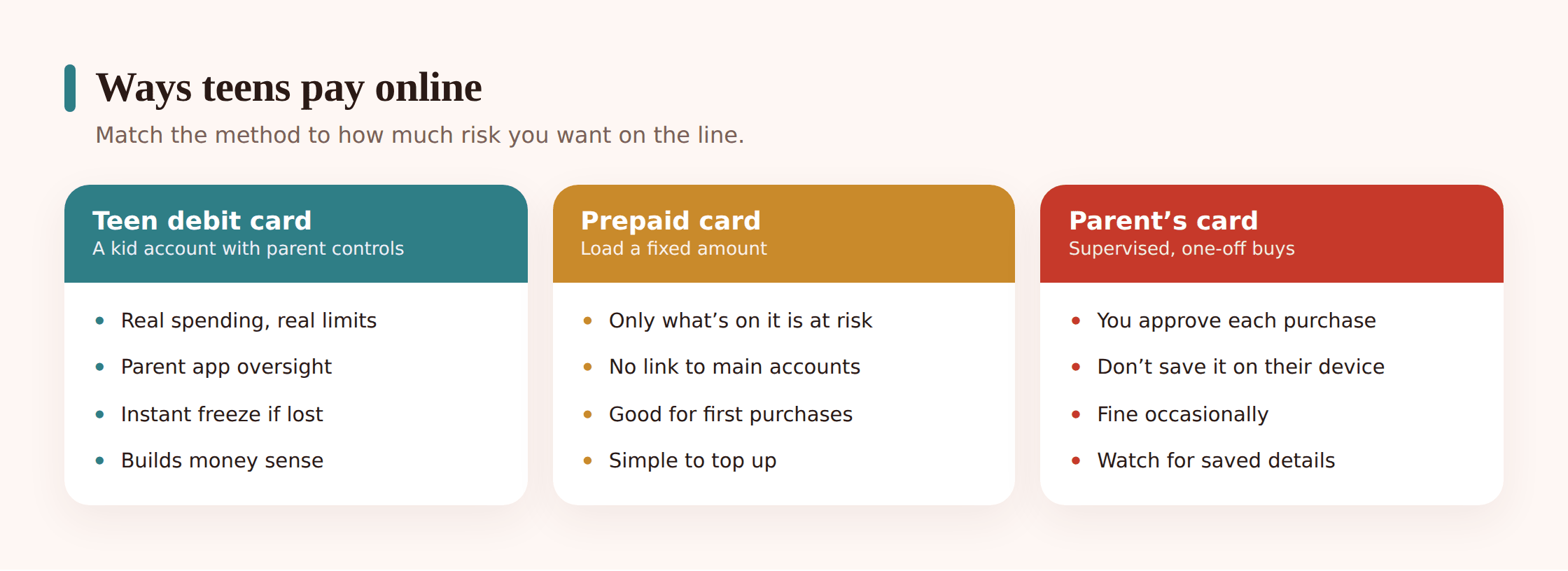
Which payment method limits the damage
Every payment method carries a different amount of risk if it ends up in the wrong hands or on a dodgy site. Here’s how the common ones stack up for a teen shopping online.
| Payment method | How it limits risk | Good for |
|---|---|---|
| Prepaid card | Only holds loaded funds; a scam can’t drain more than the balance. No link to family savings. | First online purchases, unfamiliar sites, gaming top-ups |
| Teen debit card (parent-managed) | Spend limits and merchant blocks; you get a real-time alert on every transaction. | Everyday spending with built-in visibility |
| Youth bank debit card | Bank fraud protection applies; chargeback possible on card payments. | Older teens ready for more independence |
| Credit card (borrowed from parent) | Strong fraud and purchase protection, but exposes your full credit line. | Rare, supervised big purchases only |
| Bank transfer / “friends and family” payment | Almost no protection. Once it’s sent, it’s usually gone. | Never for buying goods from strangers |
| Gift cards / vouchers as payment | Untraceable and unrecoverable — a classic scam demand. | Never for paying a “seller” or “prize fee” |
The single most useful line in that table is the last two. If anyone — a seller, a “prize” contact, a person renting out concert tickets — asks a teen to pay by bank transfer or gift card instead of a normal card, that’s the scam signal. Card payments can often be reversed. Transfers and gift cards almost never can.
How shopping scams target teens
Scammers know teenagers are impulsive, brand-driven, and short on the “this feels off” instinct that comes from being burned a few times. The pitches are tuned for that. Here are the ones that actually catch teens, with the tells that give each away.
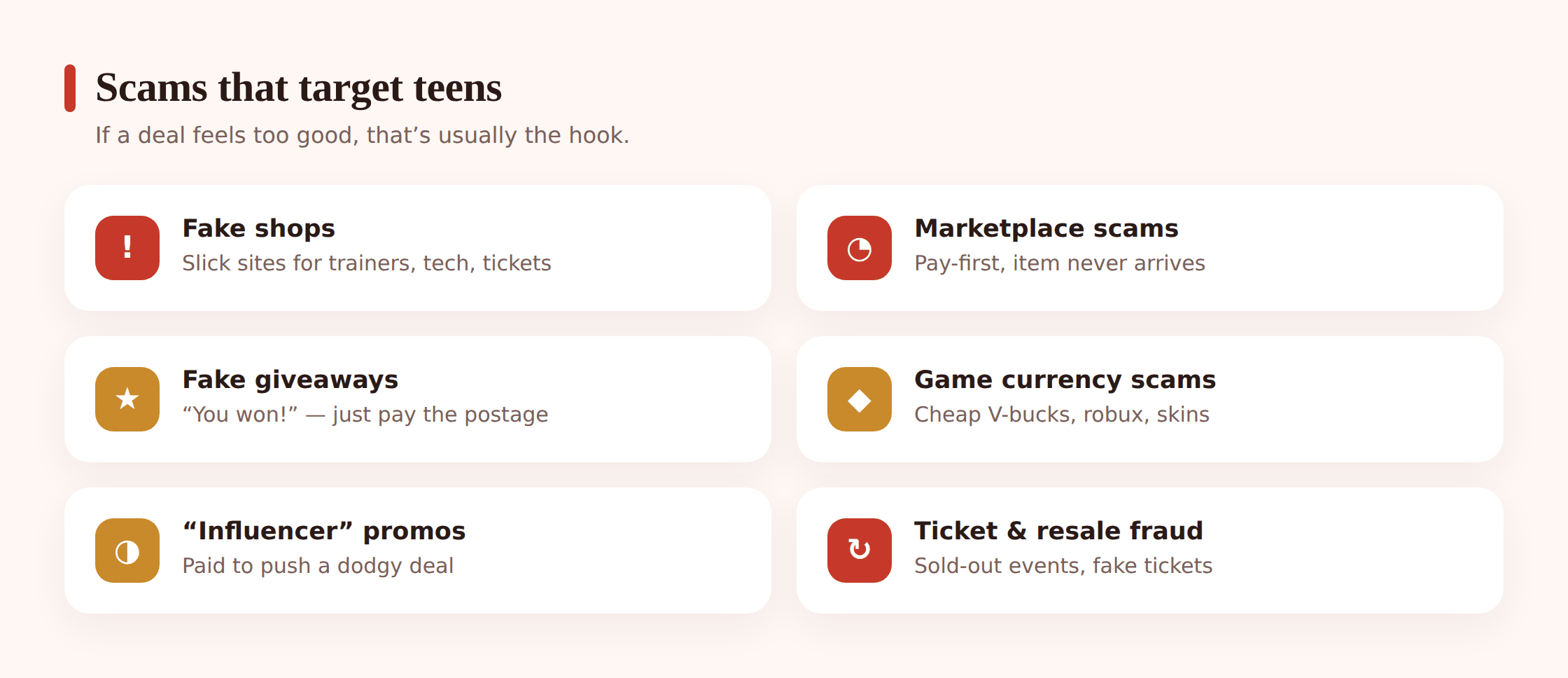
Fake shops and too-good-to-be-true deals
A slick-looking site sells trainers, a games console, or a phone at a price no real shop matches. There’s a countdown, a “flash sale,” a wall of glowing reviews. The teen pays and either gets nothing, gets a cheap knock-off, or gets a “tracking number” that never moves. Tells: a brand-new site with no real trading history, prices far below everywhere else, no proper company address or contact, and pressure to buy right now.
Social-media marketplace scams
A lot of teen buying and selling happens on marketplace and buy-and-sell groups. The scam version: a “seller” with a too-cheap item insists on payment by bank transfer before you can see it, or a “buyer” overpays and asks for the difference back. Meet-in-person deals get switched to “I’ll post it if you pay now.” The tell is almost always a push away from safe payment and toward a transfer.
Fake giveaways and “you’ve won” messages
“We’re giving away a PS5 — just pay £4.99 postage.” “You’ve won a gift card, click here.” The prize is the bait; the goal is either card details or a small “fee” that unlocks nothing. Real giveaways don’t ask you to pay to receive a prize, and they don’t need your card number to post you something.
Gaming-item and in-game currency scams
Cheap V-Bucks, discounted skins, a “trusted trader” selling a rare account, a site promising free currency if you log in with your game credentials. Some steal the login, some take the payment and vanish, some drain a linked card. Teens trade these constantly, often with strangers. The rule is simple: currency and items only ever come from the official store, and nobody legitimate needs your password to give you a skin. This overlaps with in-app purchases and surprise charges, which is worth reading alongside this.
Ticket scams
Sold-out gig, big match, festival. A stranger online has spare tickets and needs payment by transfer, fast, “because other people are asking.” The tickets don’t exist, or the same PDF gets sold to five people. Teens desperate not to miss an event are perfect targets. Only buy from official sellers or the venue’s own resale, and never by transfer.
“Influencer” and promo-code scams
A creator a teen follows — or an account impersonating one — promotes a discount code, a crypto “opportunity,” a giveaway, or a mystery box. Sometimes the influencer is real and just careless about who sponsors them; sometimes the whole account is fake. Either way, “use my code, it’s basically free money” is a pitch, not a fact. If it involves paying to make money, it’s a scam.
For the wider picture beyond shopping, our guide on online scams targeting kids and teens covers the psychology, and how to spot a phishing text handles the message-based version of all this.
Subscription traps and free-trial auto-renewals
Not every money leak is a scam. Some are perfectly legal and still catch teens out completely. Subscriptions are the quiet one — money that leaves every month for something nobody’s using.
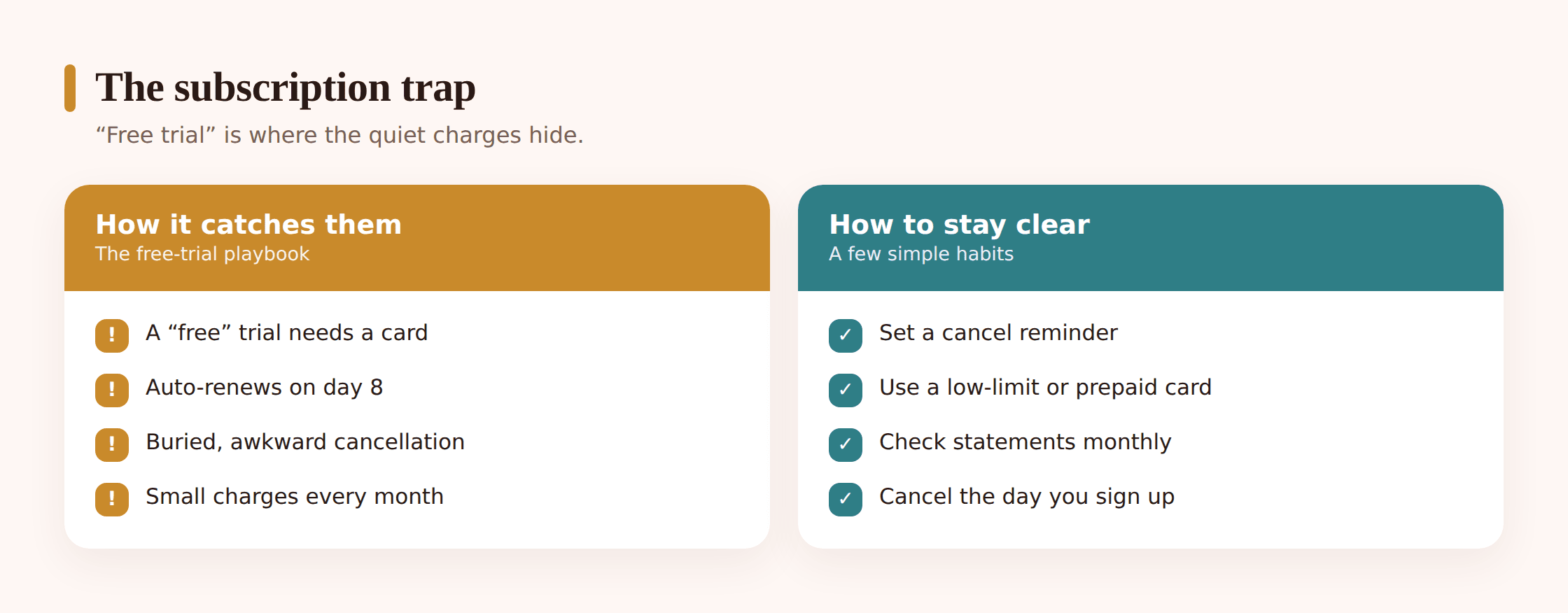
Free trials that auto-renew. A teen signs up for a week of a streaming service, a game pass, an editing app, or a fitness thing. It asks for card details “just to verify.” On day eight it charges, and unless someone cancels, it charges every month after that. The trial was never really free — it was a subscription with a delayed first payment.
Stacked small subscriptions. £2.99 here, £4.99 there, a couple of game passes, a music app, an “upgrade” inside an app they barely open. Individually invisible. Together they can quietly eat £30 a month. Teens rarely add them up.
Hard-to-cancel signups. Some services make cancelling deliberately awkward — buried buttons, “are you sure” loops, offers to stay. A teen who can’t find the cancel button just gives up and keeps paying.
The best defence against auto-renewals is the calendar. When a teen starts any free trial, they set a reminder for two days before it ends. That one habit turns “oops, I’ve been charged for four months” into “cancelled it in time.”
Secure payment habits worth drilling
Most online-money safety comes down to a handful of habits. Drill these until they’re automatic and your teen is protected against the large majority of what’s out there.
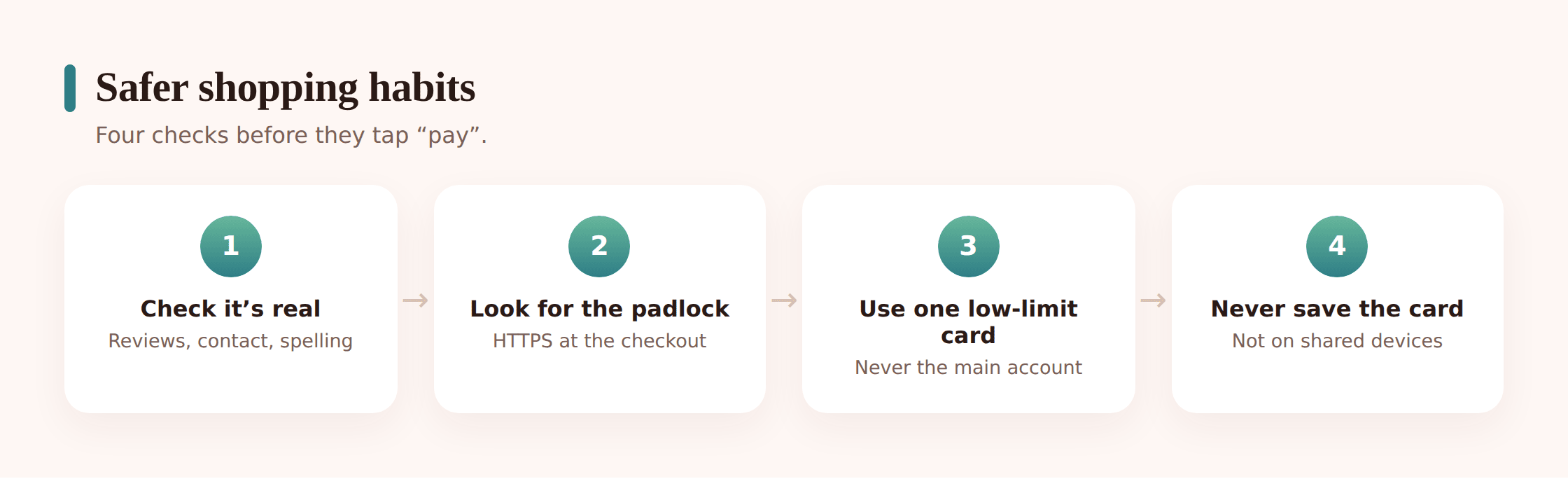
Never save card details on a shared or borrowed device
School computers, a mate’s laptop, a shared family tablet, a games console everyone uses. “Save my card for next time” on any of those means the next person can spend your money. Type it in each time, or don’t buy on that device.
Check it’s a real, secure checkout
Before entering card details, the address should start with https and show a padlock. That padlock means the connection is encrypted — it does not mean the shop is honest, so it’s necessary but not sufficient. Teens should also glance at the actual web address: scam sites use lookalike names like “niike-deals.shop” hoping you won’t read closely.
Use one card for online shopping
Keeping a single card — ideally a prepaid or low-limit one — for all online purchases contains the damage if the details leak. If that card gets compromised, you cancel one card, not your main account. It also makes it far easier to spot a rogue charge, because everything online runs through one statement.
Slow down at the checkout
Countdown timers, “3 people are viewing this,” “only 1 left” — these exist to switch off the part of the brain that asks questions. The habit to build is a deliberate pause before paying: is this seller real, is the price plausible, is the payment method normal? Ten seconds of doubt stops most scams.
If they get scammed: act fast
It will probably happen at least once. When it does, speed matters more than blame — the first hour or two often decides whether the money comes back. Here’s the response, in order.
1. Stay calm and get the facts
A panicking teen hides things; a supported one tells you everything. Get the story fast and without a lecture: what site, what payment method, how much, when. You can talk about lessons later. Right now you need details to act on.
2. Contact the bank or card provider immediately
Call the number on the back of the card or use the app’s fraud/report function. Tell them it’s fraud or a scam purchase. If it was a card payment, ask specifically about a chargeback — banks can often reverse card transactions to fraudulent merchants. The sooner you call, the better the odds.
3. Freeze or cancel the card
If card details were entered on a fake site, assume they’re compromised. Freeze the card in the app right away and get a replacement. On a parent-managed teen card this is usually one tap.
4. Change any exposed passwords
If the scam involved logging in — a fake gaming site, a cloned shop, a phishing page — change that password everywhere it was used, and turn on two-factor authentication. Scammers reuse stolen logins fast.
5. Gather the evidence
Screenshot the listing, the messages, the payment confirmation, the site address, and any receipts before they vanish. You’ll need these for the bank and any report.
6. Report it
Report the scam to the relevant fraud authority in your country, and report the seller or account to the platform where it happened. Reporting rarely gets money back on its own, but it helps get the scammer shut down before they hit someone else. Our guide on how and where to report a scam walks through exactly where to go.
Keeping an eye on app spending, openly
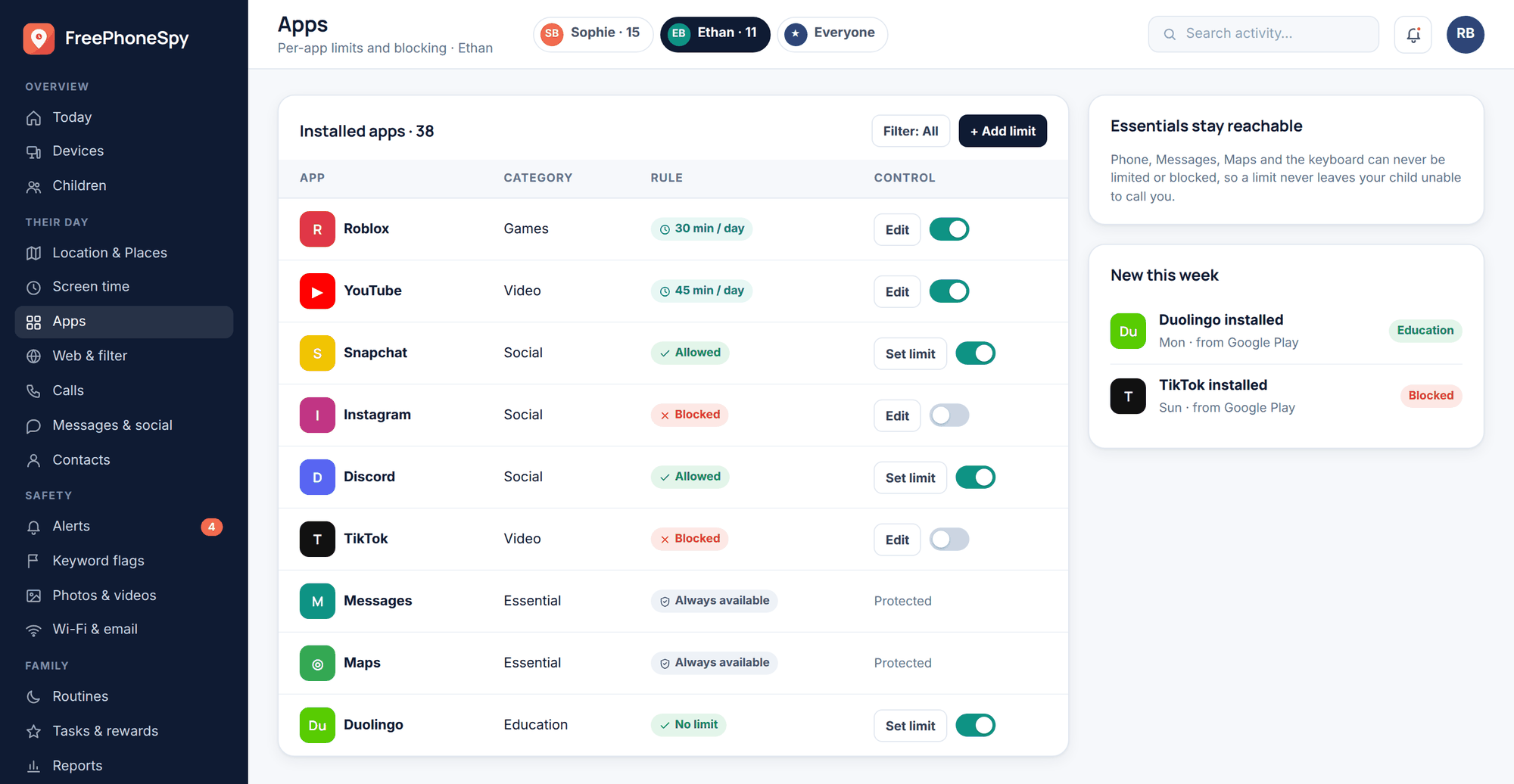
Cards and habits handle the shopping side. The spending that hides best is inside apps — a game quietly billing, a subscription buried in an app the teen forgot about, a new payment app appearing on the phone. On an Android device you own and manage, an app like FreePhoneSpy can give you awareness of what’s installed and how the phone’s being used, so a spending problem doesn’t stay invisible until the statement arrives.
Teaching money sense without hovering
The end goal isn’t a teen who can’t spend without permission. It’s one who doesn’t need you watching. That means letting them make small, survivable mistakes now, while a bad call costs pocket money instead of a paycheque.
Let them lose a fiver. If a teen buys something dodgy for a small amount and it goes wrong, resist the urge to swoop in and refund it. A cheap lesson that stings a bit is one of the best money teachers there is. Save the rescue for the genuinely big stuff.
Talk about your own purchases. “I nearly bought this, then I checked reviews and it was fake.” Thinking out loud about your own decisions teaches the reasoning far better than a list of rules. Money sense is caught more than taught.
Give real control on the safe stuff. A monthly allowance on their own card, with no line-by-line questions about how they spend it, builds judgement. Budgeting only becomes real when there’s something actual to budget and real consequences for blowing it.
Make it easy to come to you. The most dangerous scam is the one a teen hides out of embarrassment. If they know the response to “I think I got scammed” is help rather than a telling-off, they’ll come to you early — while the money can still be recovered. That single dynamic protects them more than any control setting.
The safe-shopping checklist
Print this, or run through it with your teen once. It’s the whole article boiled down to what to actually do.
- Use one low-limit or prepaid card for all online shopping.
- Never save card details on a shared, school, or borrowed device.
- Check for https and a padlock, and read the web address for lookalike spelling.
- Treat “buy now, pay by transfer or gift card” as a scam signal — stop.
- Buy tickets and gaming currency only from official sellers, never strangers.
- Never pay a fee to receive a “prize,” and never share a bank one-time code.
- Set a reminder two days before any free trial ends.
- Audit subscriptions together every couple of months and cancel the dead ones.
- If something goes wrong, tell a parent fast — speed beats blame.
- If scammed: call the bank, freeze the card, change passwords, report it.
FAQ
What age should my teen get their first card?
There’s no single right answer, but many families start with a tightly controlled prepaid or parent-managed teen card around 11 or 12, then move to a proper youth bank account as the teen shows they can handle it. Match the card’s limits to how much responsibility they’ve earned, and loosen the controls over time rather than keeping a young child’s leash on a 16-year-old.
Is a prepaid card safer than a debit card for online shopping?
For containing scam damage, yes — a prepaid card only holds what you’ve loaded, so the worst case is losing that balance, with no link to your main account. The trade-off is fewer protections like chargeback on some cards and sometimes top-up fees. A good middle path is a low-limit teen debit card that still gives fraud protection but caps how much can go missing.
How can I tell if an online shop is fake?
Look for prices far below everywhere else, a brand-new site with no trading history, no real company address or contact details, pressure to buy immediately, and payment pushed toward bank transfer. Search the shop’s name plus the word “scam” or “reviews” before buying. A padlock in the address bar means the connection is encrypted, not that the shop is honest — so it’s reassuring but not proof.
My teen paid by bank transfer for something that never arrived. Can I get the money back?
It’s much harder than with a card, but act immediately anyway. Call the bank the moment you realise — some transfers can be recalled if you’re quick, and banks have schemes for certain scam cases. Gather all the evidence and report it. This is exactly why teaching teens to avoid transfers for buying goods matters so much: card payments can often be reversed, transfers usually can’t.
How do I stop free trials turning into charges I didn’t want?
Two habits. First, whenever a trial starts, set a phone reminder for two days before it ends so there’s time to cancel. Second, audit the subscriptions list in the app store settings and on the card statement every couple of months and cancel anything nobody’s using. If you want extra visibility on app spending on a device you own, an openly-installed monitoring app can flag new apps and activity early.
Should I just watch every purchase my teen makes?
No — that teaches dependence, not judgement, and it usually backfires by pushing spending underground. Set sensible limits, keep visibility on the big risks, and let them make small, survivable mistakes with their own money. The aim is a teen who makes good calls when you’re not looking, and that only develops with real practice and real (small) consequences.