AI Voice Cloning & Impersonation Scams: Protecting Your Family
The phone rings and it’s your daughter, sobbing, saying she’s been in an accident and needs money right now. The voice is hers — the catch in her breath, the way she says “Mom.” Except it isn’t her. A stranger recorded a few seconds of her talking online, fed it to a piece of software, and now they’re using her cloned voice to frighten you into wiring cash. This is one of the fastest-growing scams around, and the defence is calmer and simpler than you’d think.
What voice cloning actually is
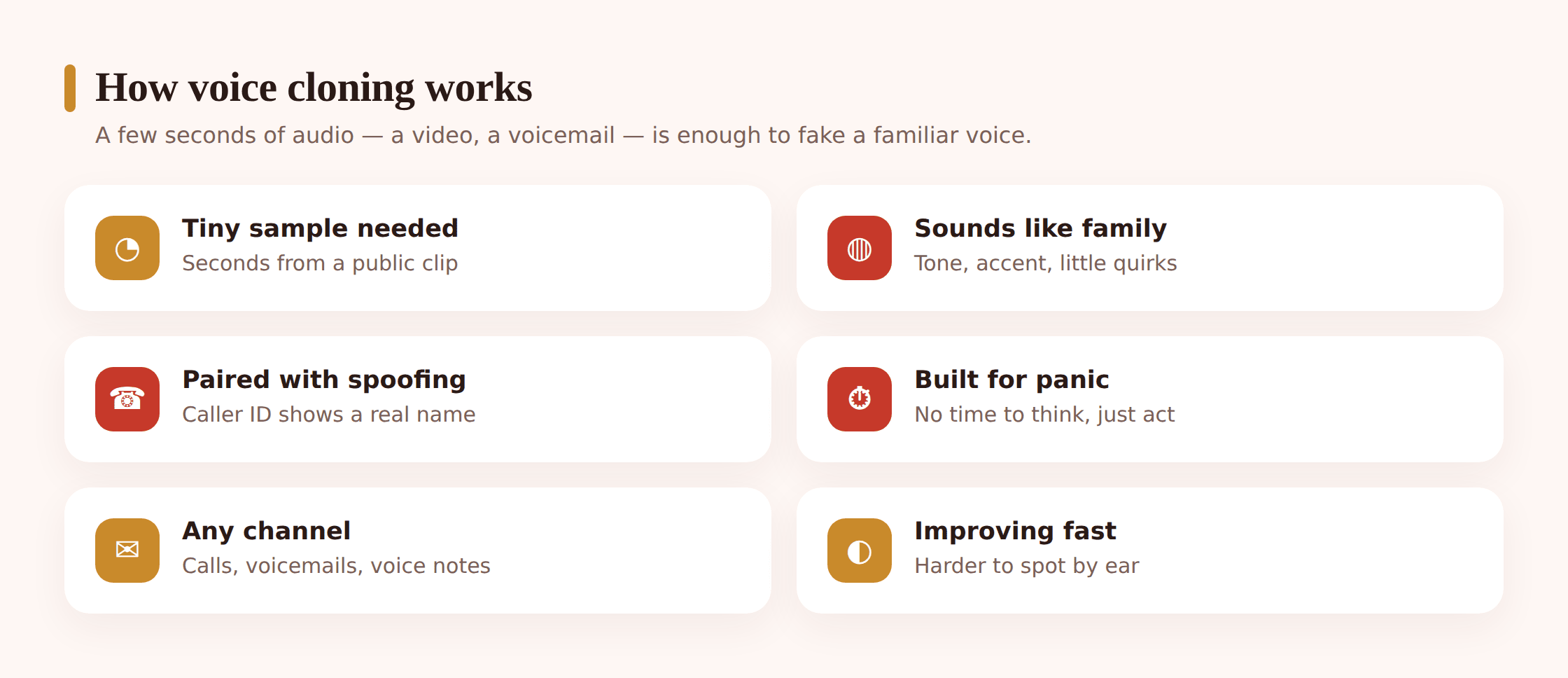
Voice cloning is software that studies a recording of someone talking and then generates new speech in that same voice, saying whatever the operator types. The result carries the person’s tone, accent, pacing, even little verbal habits. Play it down a phone line, where audio is already a bit compressed and muffled, and it can be indistinguishable from the real person to an ear that isn’t braced for a trick.
The part that unsettles most parents is how little raw material it takes. It’s no longer minutes of clean studio audio. A short clip is often enough — the kind of clip that lives on a public social account, a voicemail greeting, a video from a school play, a livestream, a podcast a teenager did for fun. Your family’s voices are more available than you might realise, and none of it had to be handed over deliberately.
Here’s the reassuring flip side, and it’s the whole point of this article. Cloning a voice does not give a scammer your memories, your inside jokes, your plans, or the answer to a question only the real person could answer. The technology fakes the sound. It can’t fake the relationship. Every defence below leans on that gap.
The scams, one by one
People lump these together as “AI scam calls,” but they come in a few distinct shapes. Knowing the shape makes it far easier to catch one mid-call, when your heart is pounding and you’re not thinking clearly. That racing-heart moment is exactly what the scammer is counting on.
The family emergency call
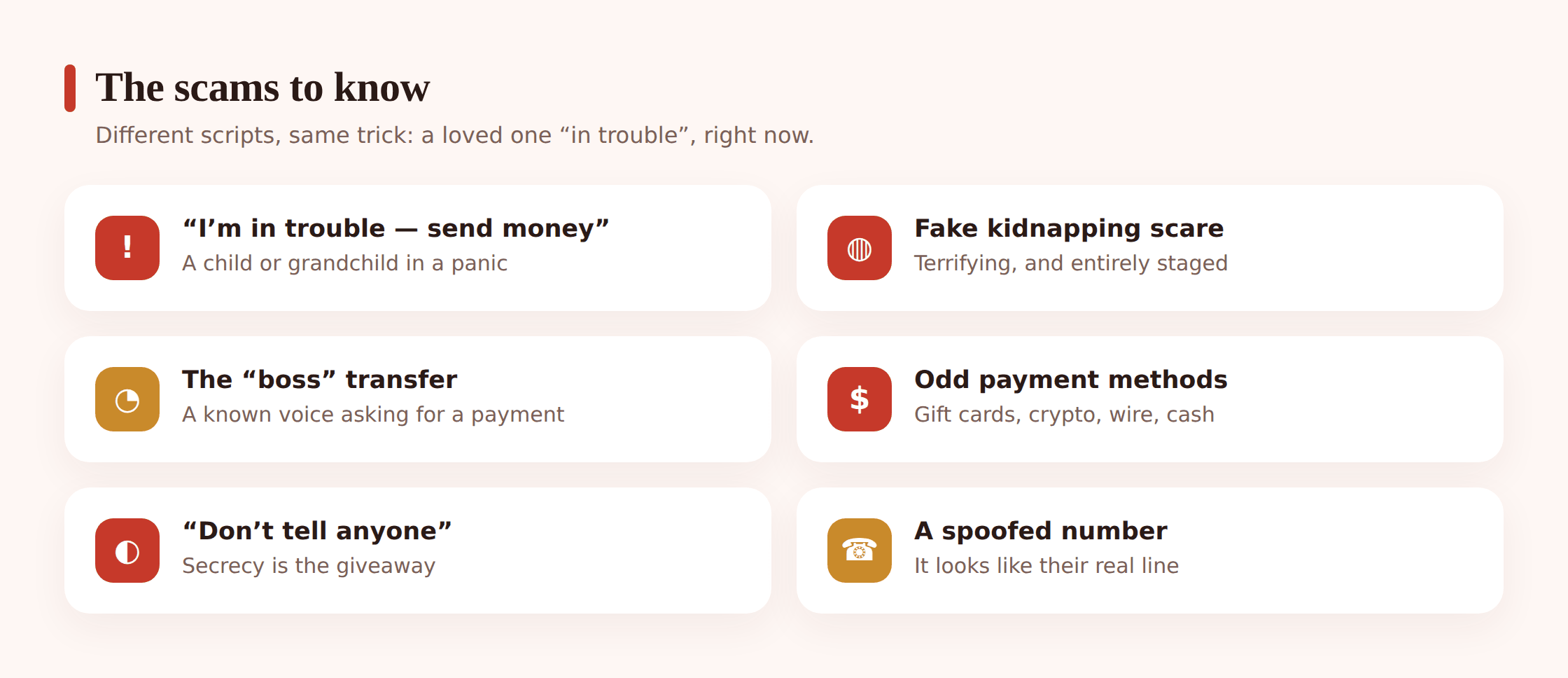
This is the big one. A voice you love calls in distress — an accident, an arrest, a hospital, a lawyer’s fee, bail money. They need cash immediately and they’re too upset or too ashamed to explain much. Sometimes a second “person” takes over the call: a fake police officer, a fake doctor, a fake lawyer who keeps the pressure on and tells you where to send money. The emotional gut-punch of hearing your own child or grandchild in trouble is the entire mechanism. Panic is doing the work the scammer can’t.
The cloned child or grandchild
Older relatives are targeted heavily with this one, because a grandparent will move mountains — and money — for a grandchild, and may be less likely to pause and verify. The cloned voice says “Grandma, it’s me, please don’t tell Mom and Dad, I messed up.” The plea for secrecy isn’t incidental. It’s there to keep you from making the one phone call that would end the scam.
The fake kidnapping
The cruellest version. A caller claims to have taken your child and plays what sounds like your child crying or screaming in the background. They demand money now and warn you not to hang up or contact anyone. It is terrifying by design, and it is very often a bluff built on a cloned voice and a stranger’s guess about your family. The child is usually safe at school, at practice, or asleep down the hall.
The “boss” or known contact asking for a transfer
Not every version targets parents about kids. A cloned voice of a manager, a colleague, or a company executive calls an employee and asks them to move money, buy gift cards, or approve a payment “quietly, before end of day.” This hits teenagers with first jobs and adults alike. The authority of a familiar voice plus a plausible-sounding urgent task is enough to skip the checks people would normally run.
Caller ID that backs up the lie
To make any of the above stickier, scammers often spoof the number so your phone shows a name or number you trust — your daughter’s, your bank’s, a local police line. Seeing the “right” name on the screen while hearing the “right” voice in your ear feels like two independent confirmations. It’s neither. Both can be faked, and faking both is the standard playbook now. What shows on the screen is never proof of who’s actually speaking.
Why it’s so convincing — and so frightening
It helps to understand why these calls land so hard, because the fear itself is a tool being used against you. When you hear a loved one in genuine-sounding distress, your body reacts before your mind catches up. Adrenaline floods in. Your focus narrows to the emergency. The rational, sceptical part of your brain — the part that would normally ask “wait, does this add up?” — goes quiet exactly when you need it most.
Scammers know this. That’s why the scripts are built around panic and speed. They don’t want you calm, and they don’t want you to have a spare minute, because a calm minute is fatal to the whole scheme. The voice gets you to lower your guard; the urgency keeps it down. Feeling frightened by one of these calls doesn’t mean you’re gullible. It means you love someone. The goal isn’t to stop feeling the fear — it’s to have one habit strong enough to run even while you’re afraid.
The red flags
These signs rarely show up alone. When two or three stack up in a single call, treat it as a scam until you’ve proven otherwise — not the other way around.
- Manufactured urgency. It has to happen now, this minute, or something terrible follows. Real emergencies usually survive a five-minute verification. Scams don’t.
- A demand for secrecy. “Don’t tell your mother.” “Don’t call anyone.” “Keep this between us.” Secrecy exists purely to stop you checking. It’s one of the loudest warning signs there is.
- An unusual way to pay. Gift cards, cryptocurrency, wire transfers, payment apps to a stranger. No genuine hospital, police force, or lawyer collects money this way. Gift cards especially are a screaming red flag — they’re untraceable and irreversible, which is exactly why scammers love them.
- Pressure not to hang up. A caller who insists you stay on the line is stopping you from doing the one thing that breaks the scam: calling the real person back.
- A story that keeps you off balance. Vagueness about details, a shaky voice that conveniently explains why they “don’t sound quite right,” a hand-off to an “official” who takes over.
- It arrives out of nowhere. An unexpected crisis from someone you weren’t expecting to hear from, at an odd hour, is worth extra suspicion, not less.
This shares a lot of DNA with text-based scams, which run on the same urgency-and-secrecy engine. If you want the messaging version, our guide on how to spot a phishing text maps neatly onto what you’ll hear on these calls.
How to verify a call is real
This is the heart of it. You don’t need to become a voice-analysis expert or catch some tiny digital glitch — cloned audio can be clean enough that there’s nothing to catch. You just need a habit that works no matter how real the voice sounds. The habit is to stop trusting the channel the call came in on and confirm through a separate one.
Step 1 — Hang up
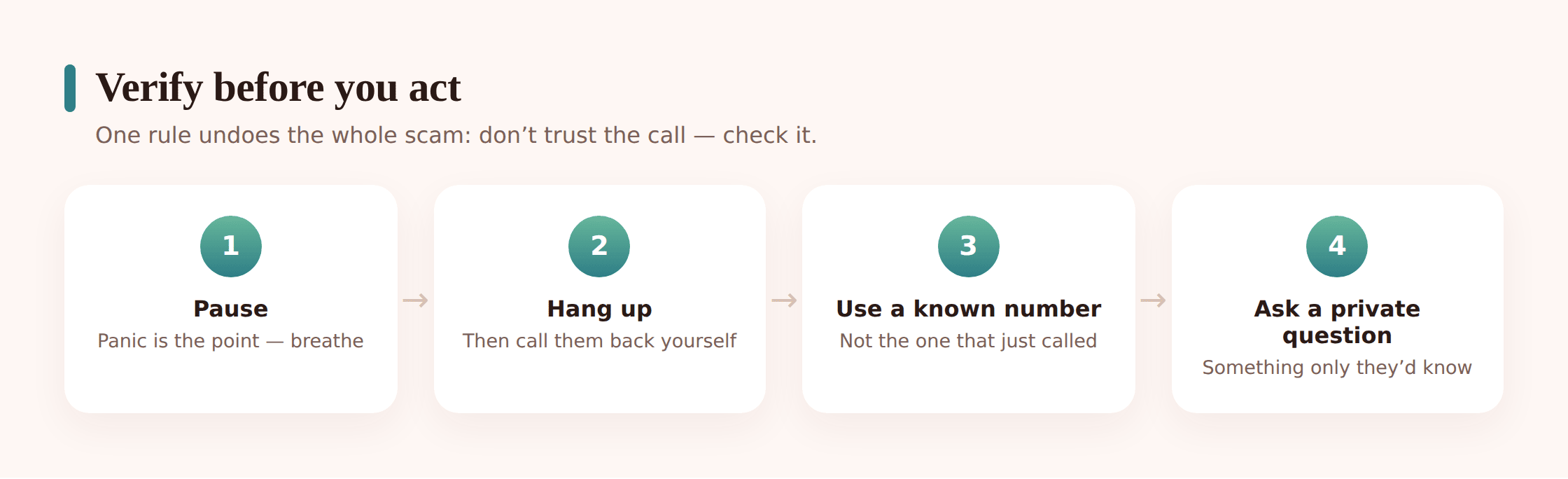
Politely or not, end the call. This feels rude when you think a loved one is in danger, and that instinct is precisely what scammers exploit. Hanging up costs you nothing if it’s real and saves you everything if it’s not. A genuine relative will completely understand once it’s sorted out.
Step 2 — Call back on a number you already have
Dial the person on the number you know — from your own contacts, not any number the caller gives you and not by hitting “call back” on the incoming call, since that may just reconnect you to the scammer. If you reach your daughter and she’s fine, you have your answer. If you can’t reach her, call someone who’d know where she is.
Step 3 — Ask something only the real person could answer
If you can’t hang up, or want to test in the moment, ask a question a stranger couldn’t possibly answer and a script can’t cover. The name of a pet you had years ago. What you cooked together last weekend. Where you sat at a family event. A cloned voice can sound perfect and still have no idea. Don’t ask yes/no questions or feed them the answer (“Is this about the car?”) — make them produce a specific detail.
Step 4 — Refuse the payment method
If a call is steering you to gift cards, crypto, or a wire to an unfamiliar account, that alone is your cue to stop and verify no matter how convincing everything else is. Don’t buy, don’t read out any codes, don’t transfer. Verify first, every time.
Set up a family safe word
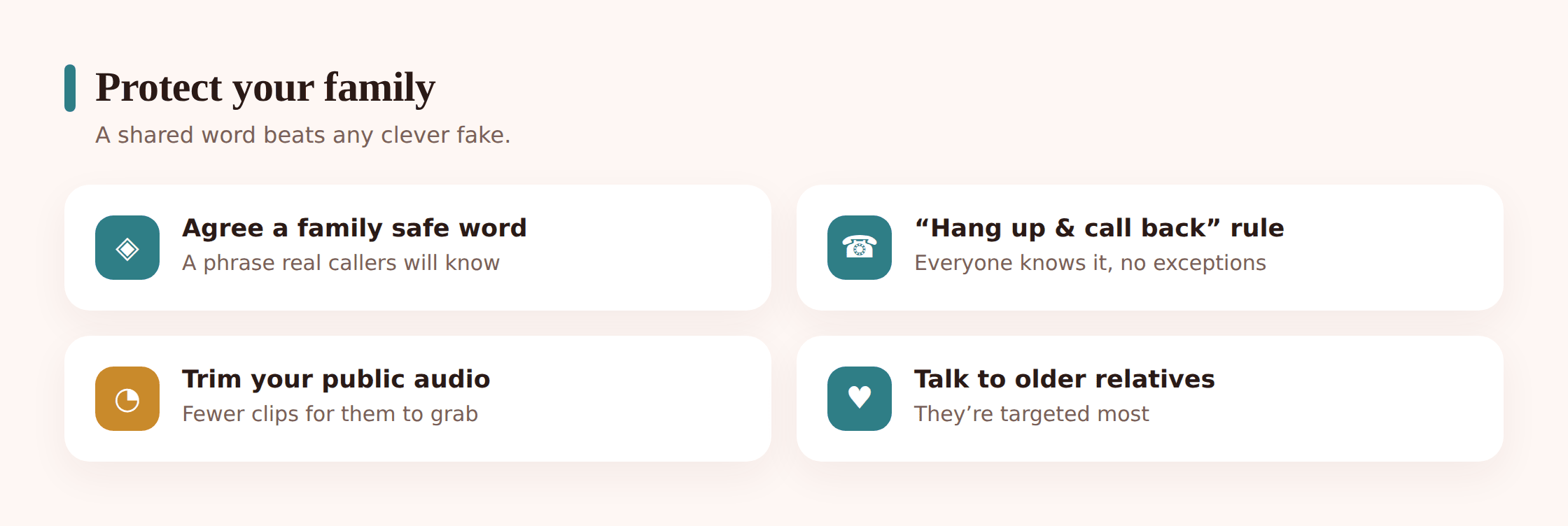
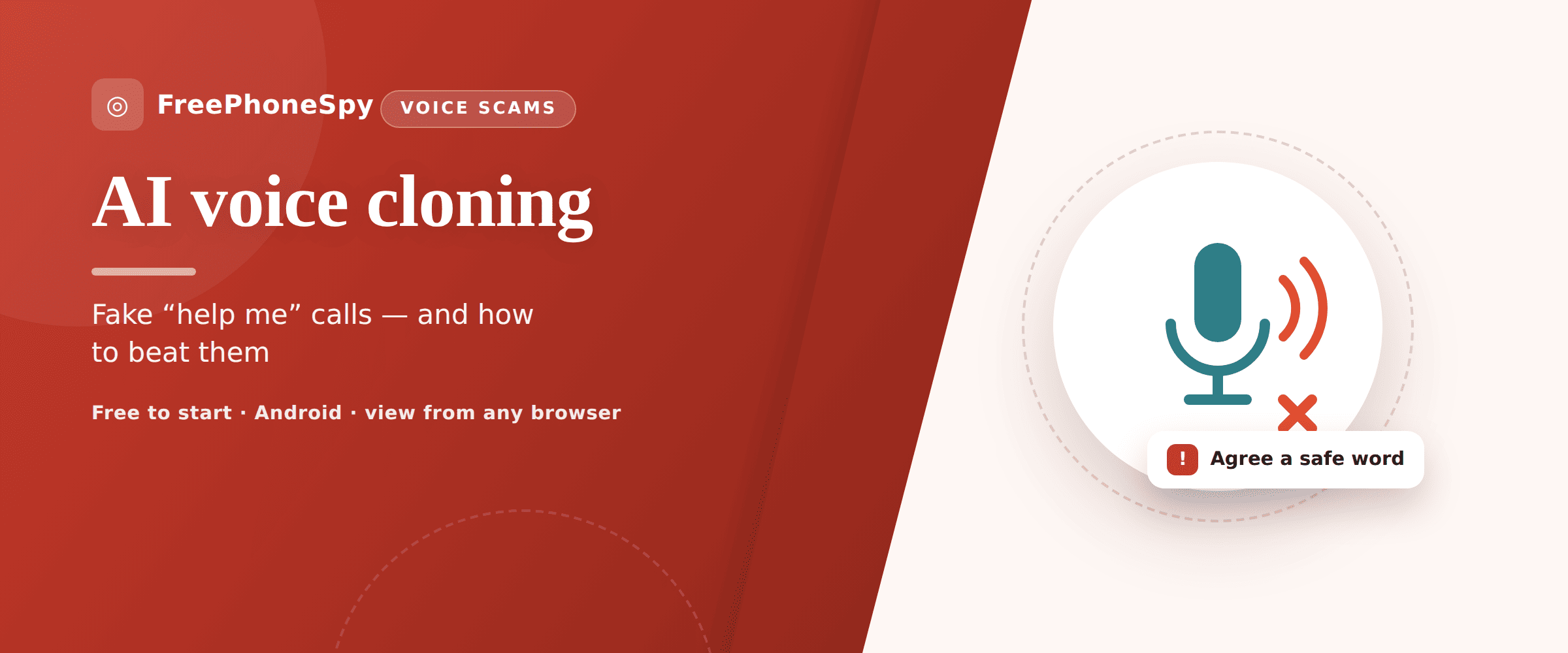
A family safe word is the single most effective, lowest-effort defence against voice cloning, and it takes one short conversation to set up. It’s a pre-agreed word, phrase, or question that your family uses to confirm identity in an emergency. If someone calls in a panic asking for money or help, you ask for the safe word. The real person knows it. A cloned voice doesn’t. The scam collapses on the spot.
Step 1 — Pick something memorable but not guessable
Choose a word or short phrase that isn’t tied to anything public. Skip pet names, street names, birthdays, or anything you’ve posted online. A random, slightly silly pairing works well — the odder it is, the easier to remember and the harder to guess.
Step 2 — Share it only in person, only with the family
Tell everyone who needs it — kids, partner, parents, grandparents — face to face. Don’t text it, don’t email it, don’t put it in a family group chat. The safe word only works while it stays inside the family.
Step 3 — Agree the rule that goes with it
The word is only half of it. The rule is: no money moves and no urgent action is taken on any distress call until the safe word is given, or the person is reached on a known number. Make it a firm household policy, not a maybe. That way nobody has to make a judgment call in the middle of a panic.
Step 4 — Refresh it now and then
If you ever say it out loud somewhere it could be overheard, or you’re just not sure, change it. It’s a two-minute conversation. Do it whenever you like.
Teach the youngest and oldest members of your family especially, since they’re targeted most. And frame it as a family thing you all do together, not a scary lecture — a small shared secret that keeps everyone safe.
Shrink your family’s voice footprint
You can’t erase every recording of your family, and you don’t need to. But you can reduce how much of your voices sits out in the open, which lowers the odds of being an easy target. This is about sensible trimming, not going off the grid.
- Set social accounts to private. Public videos and stories with clear audio are the easiest source material. Locking accounts down means only people you approve can pull from them.
- Be choosier about voice and video posts. That livestream, that long talking-to-camera video, that podcast clip — none of it is dangerous by itself, but each one adds to what’s available. A quick pause before posting audio of your kids is a fair habit.
- Mind voicemail greetings. A long personalised voicemail message is a clean, easy sample of your voice. A short, generic greeting gives less away.
- Screen unknown callers. Don’t feel obliged to have a long chat with an unknown number, and be wary of “can you hear me?” style calls that just try to get you talking. Let unknown callers go to voicemail and call back if it’s legitimate.
- Talk to older relatives about their footprint too. This protects the whole family, and grandparents may not realise how much of their voice is public or how these scams work.
Trimming your voice footprint sits alongside the wider habit of managing what your family shares online generally. If you want the broader version of this, our overview of online scams targeting kids covers the fuller picture of how oversharing feeds different scams.
If you’re targeted or scammed
Maybe you catch one of these calls and hang up clean. Maybe you don’t realise until afterward. Either way, here’s the calm sequence.
If you’re on the call right now
- Don’t pay anything. No transfers, no gift cards, no crypto, no codes read aloud. Money sent this way is almost always gone for good.
- Hang up and verify. Reach the real person on a number you already have, or someone who can confirm they’re safe. This resolves the vast majority of these calls in under a minute.
- Don’t let pressure override the rule. The more someone insists you can’t hang up or must act instantly, the more certain you can be that hanging up is the right move.
If you already paid or shared details
- Contact your bank or the payment provider immediately. Speed matters. Some transfers can be stopped or reversed if you move fast. If you bought gift cards, contact the card issuer right away and keep the cards and receipts.
- Change any passwords or details you gave out. If you shared account information during the call, secure those accounts. Our guide to family passwords and 2FA covers locking things down.
- Report it. Report the scam to your local authorities and to the relevant fraud-reporting service in your country. Reporting helps others and can occasionally help recover funds. Our guide on how and where to report points you to the right places.
- Tell your family. There’s no shame in being targeted by a convincing scam — these are engineered to fool sharp, caring people. Telling relatives means they’ll recognise it if the scammer tries again with someone else in the family.
Where a tool fits — honestly
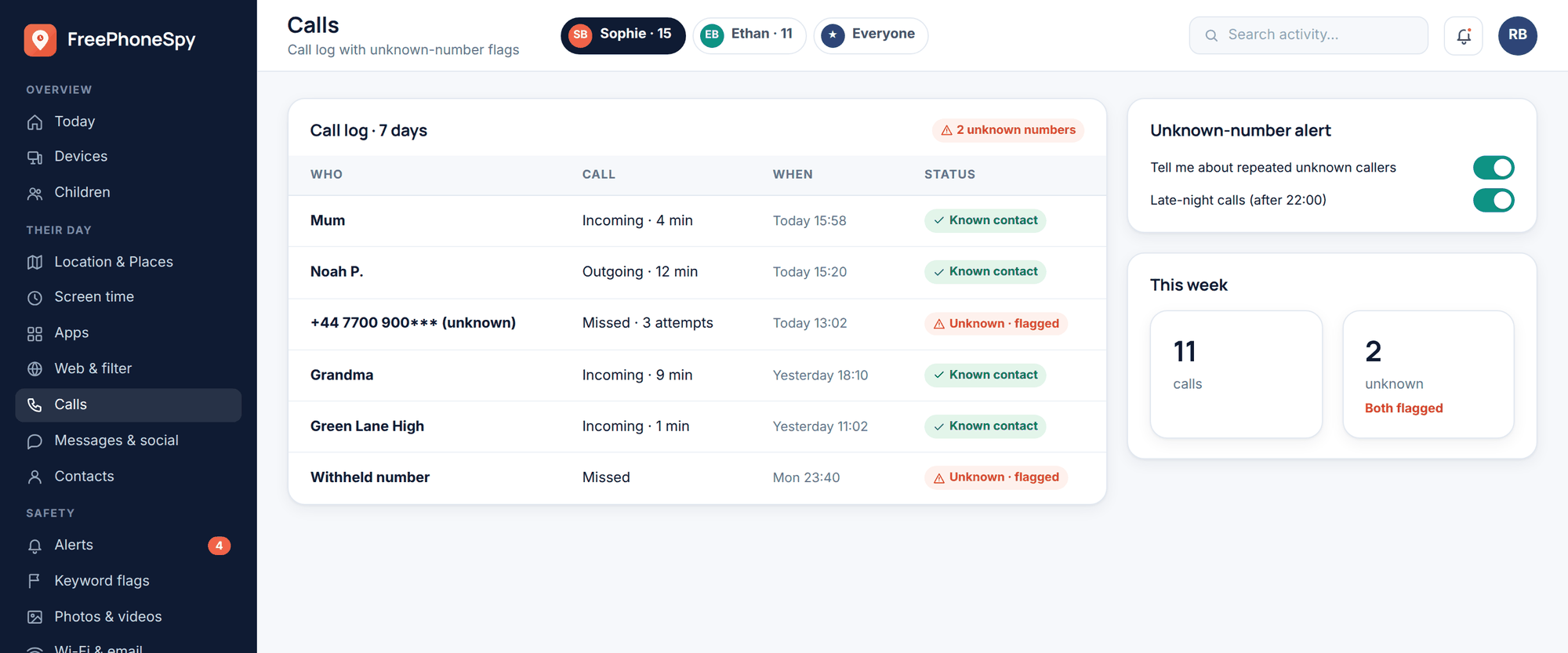
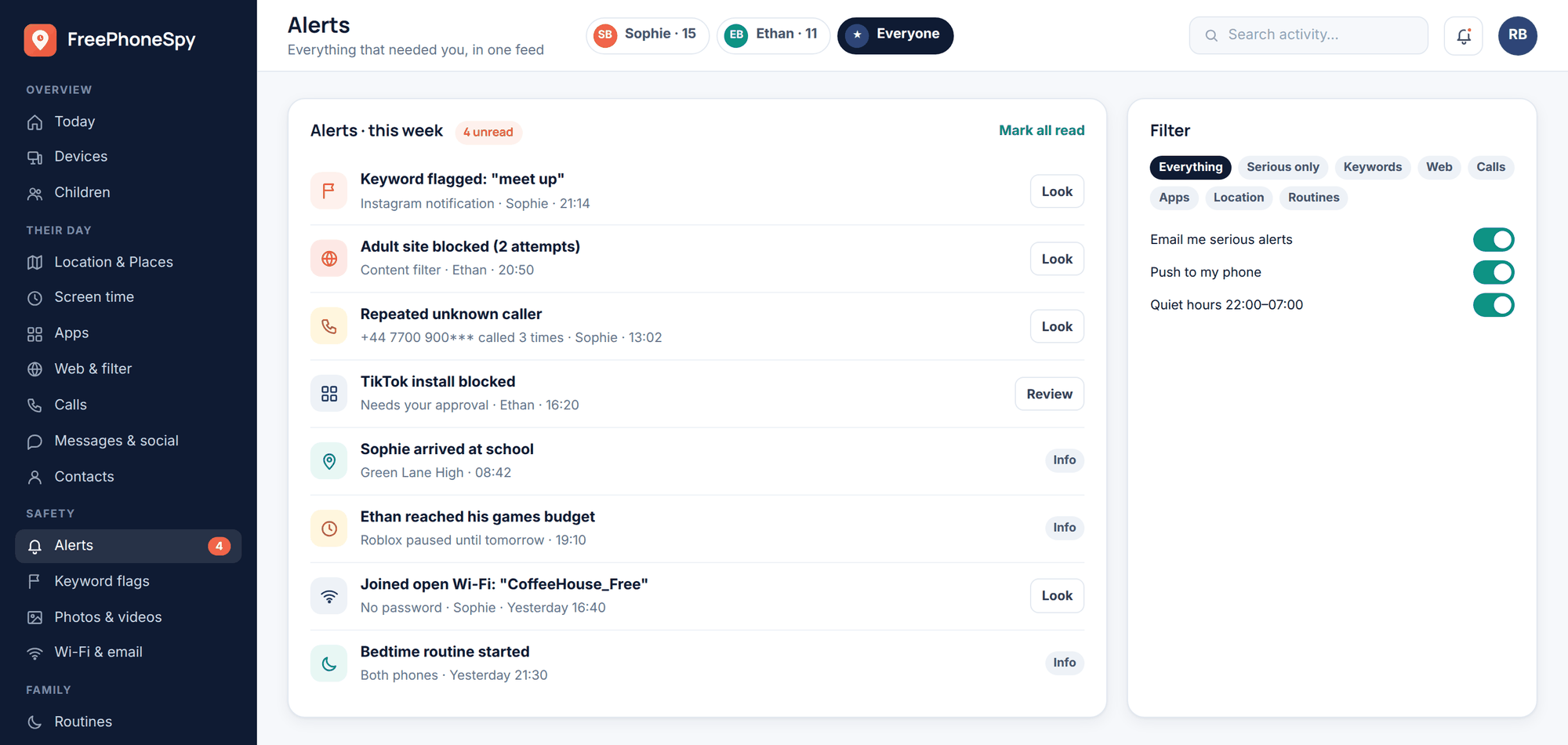
Be clear-eyed about what any app can and can’t do here. No consumer tool reliably detects a cloned voice on a live call. What monitoring can do is help you stay in the loop on a younger child’s phone — a call log you can look over together, an alert on a worrying keyword — so odd contact patterns surface sooner and you’re having the conversation earlier.
FreePhoneSpy is transparent, consent-based monitoring for a child’s Android phone, run from a web panel your child knows about. It’s a way for families to keep an eye on things openly, together — not a scam-detector and never a substitute for the safe word and the second-channel habit. Those two human habits are the real defence, and they cost nothing.
If you want the visual side of AI fakery — cloned faces, fake images and video rather than voices — our companion guide on deepfakes and AI covers that ground, and the mindset is the same: seeing or hearing something is no longer proof it’s real.
FAQ
It really sounded exactly like my son. How is that possible?
Voice cloning software can recreate a person’s tone, accent and speech habits from a short recording — the kind that’s easy to find on public social accounts, voicemails or videos. Over a phone line, where audio is already a little muffled, a clone can be genuinely hard to tell from the real voice. The sound is copied; the person behind it isn’t. That’s why you verify through a second channel instead of trusting your ears.
What’s a family safe word and how do we choose one?
It’s a pre-agreed word, phrase or question that only your family knows, used to confirm identity in an emergency. If a distressed “relative” calls asking for money, you ask for the safe word — a clone can’t answer. Pick something memorable but not guessable (nothing you’ve posted online), share it only in person, and pair it with a rule that no money or urgent action happens until it’s given.
They’re demanding gift cards. Is it a scam?
Almost certainly, yes. No legitimate hospital, police force, lawyer, or family member resolves a real emergency with gift cards, cryptocurrency, or a wire to an unfamiliar account. Those payment methods are untraceable and irreversible, which is exactly why scammers insist on them. A gift-card request during an “emergency” is one of the clearest scam signals there is. Don’t buy anything, and verify the story independently.
The caller ID showed my daughter’s name. Doesn’t that prove it’s her?
No. Scammers can spoof caller ID so your phone displays a name or number you trust, even your own family member’s. Seeing the right name while hearing the right voice feels like double confirmation, but both can be faked and faking both is standard now. Treat what’s on the screen as unproven. Hang up and call back on a number you already have.
Isn’t it rude to hang up on family in an emergency?
It isn’t, and reframing this helps. Hanging up to verify is what a careful, loving person does — it costs nothing if the call is real and protects you completely if it’s not. A genuine relative will understand entirely. Talk about this rule with your family in advance so that when someone hangs up and calls back, everyone already knows it’s the smart move.
What should I do the moment I suspect a cloned-voice call?
Don’t pay or share anything. Hang up and reach the real person on a number you already have, or ask a question only they could answer. If you’ve already sent money, contact your bank or payment provider immediately, secure any accounts you exposed, and report the scam to your local authorities and fraud service. Then tell your family so they’ll recognise it too.