Beauty Filters, Photo Editing & Kids’ Self-Image
Your child taps a screen and, in an instant, their nose is a little smaller, their skin is smooth, their eyes are wider and brighter, their jaw is a touch sharper. It happens so fast and looks so ordinary that it barely registers as editing at all. That’s the heart of the issue. A whole generation is growing up seeing a subtly improved version of their own face as the normal one — and the real face in the mirror as the thing that needs fixing. This is a guide to what those filters and editing apps are doing to how kids see themselves, and how to help without making them feel watched or judged.
How filters work, and how normal they’ve become
An augmented-reality beauty filter maps the geometry of a face in real time — the camera finds the eyes, the nose, the jawline, the lips — and then nudges all of it toward a single, remarkably consistent template. Skin gets smoothed and evened out. Eyes get bigger. The nose narrows. The chin sharpens or shrinks. Cheekbones lift. Sometimes lips plump and skin tone shifts. It all happens live, at video speed, and it moves with your child’s face so seamlessly that the edit is nearly invisible even to the person wearing it.
Photo-editing apps take the same idea a step further. After a photo is taken, a young person can smooth away a blemish, whiten teeth, slim a waist, lengthen legs, erase a spot, reshape a jaw — with sliders that make the whole thing feel like tidying up rather than transforming. Some apps do this automatically the moment a selfie is captured, so a child may be looking at an edited version of themselves without having chosen a single setting.
Here’s the part that matters most: none of this is fringe behaviour any more. Filters are baked into the cameras of the apps kids use every day. Reaching for one isn’t a special occasion; it’s the default way a lot of young people photograph themselves, the way you might once have picked a flattering angle. When something is that ordinary, it stops feeling like editing at all — and that’s exactly what makes it worth talking about.
Why filters are a problem
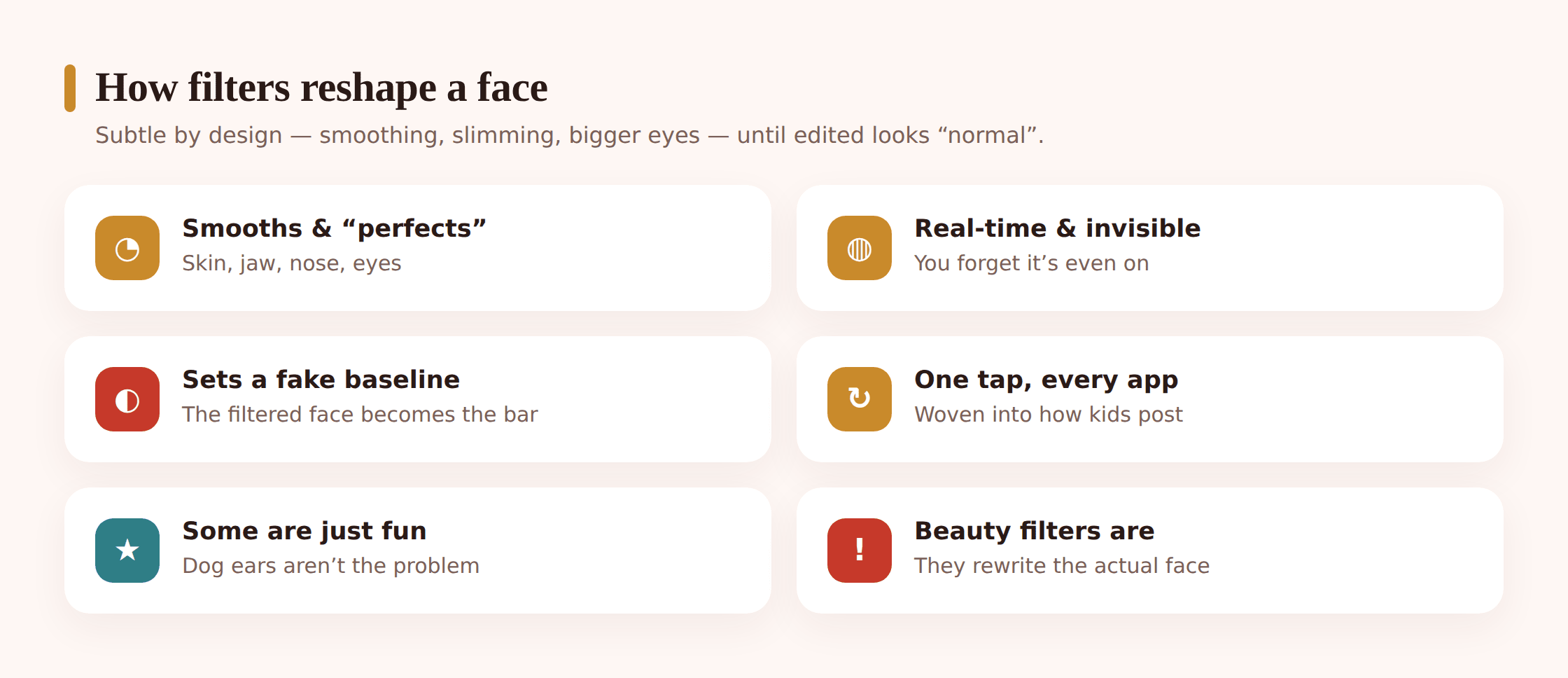
A filter now and then, for a laugh, harms nobody. The trouble starts somewhere subtler, and it builds up slowly rather than arriving all at once.
The filtered face becomes the expected face
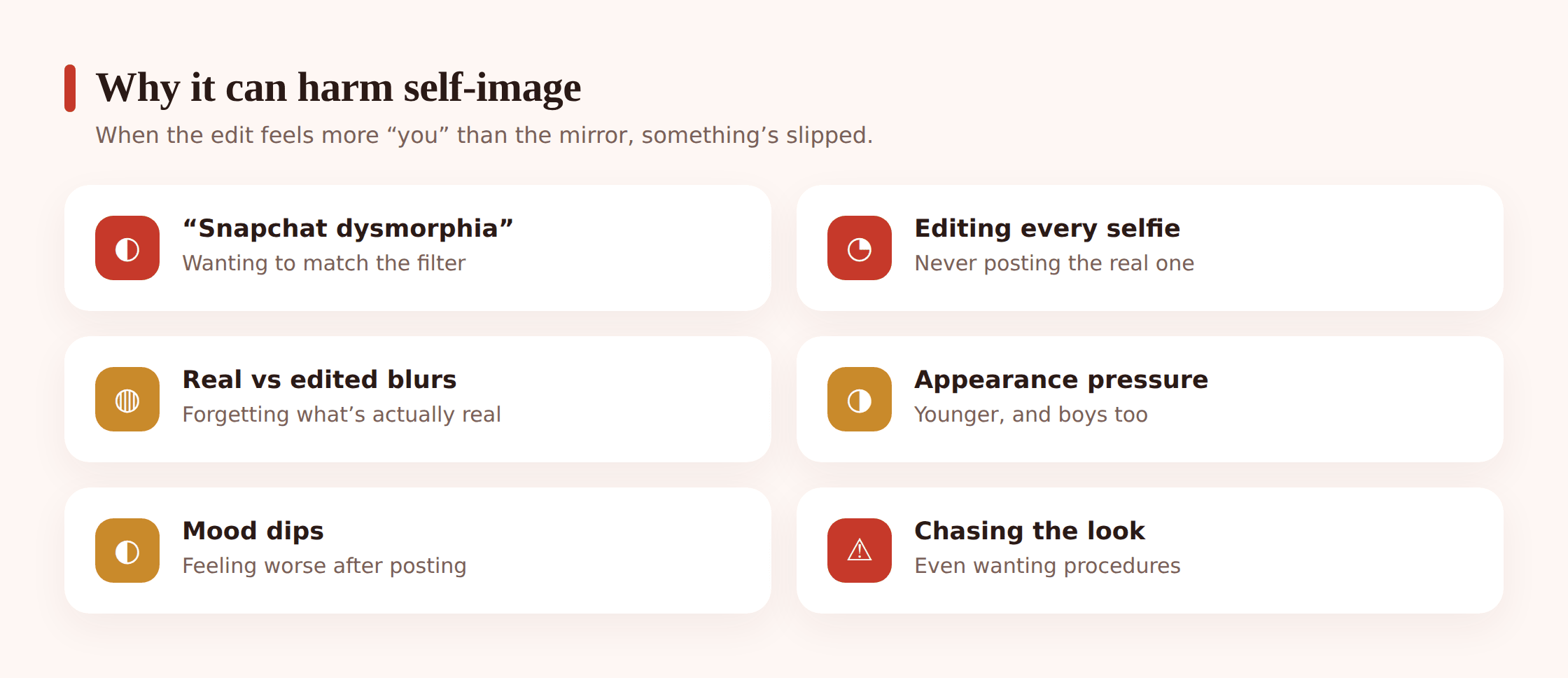
When a child sees a smoothed, sharpened version of themselves dozens of times a day, that version stops looking edited and starts looking correct. The brain adjusts to what it sees most. So the real face — the one in the bathroom mirror, with its pores and its actual nose and its ordinary asymmetry — starts to look wrong by comparison. Not different. Wrong. The child hasn’t changed how they look. They’ve changed what they expect to see, and reality can’t keep up.
Wanting to look like the filter
Doctors have started using an informal phrase for something they’re seeing more of: “Snapchat dysmorphia” — young people bringing filtered selfies to appointments and asking to be made to look like the edited image, rather than like a celebrity or a photo of themselves. It’s a striking shift. The reference point isn’t a real person any more; it’s a computer-generated version of the child’s own face that doesn’t, and can’t, exist. When the goal is to match something impossible, no amount of change ever feels like enough.
Editing every selfie, and blurring what’s real
Once editing becomes routine, a strange thing happens: the line between a real photo and an edited one gets hard to find. A young person scrolls a feed where nearly every face has been smoothed, slimmed, and sharpened, and reads all of it as simply what people look like. They compare their unedited body to everyone else’s edited one, never realising the contest is rigged. And they start editing their own photos before anyone sees them, because posting the raw version now feels almost like being caught undressed. The edited self becomes the public self, and the real one becomes a secret.
The pressure is hitting younger, and it isn’t only girls
Two things have shifted. First, appearance pressure is reaching children earlier — kids who are still in primary school are already absorbing the idea that a photo of them should be adjusted before it’s shared. Second, it’s no longer something only girls carry. Boys feel it too, often around jawlines, skin, muscle, and height, and often with less permission to say so out loud. Because we tend to expect this stuff in girls, a boy quietly editing his photos or fixating on his appearance can go unnoticed for far longer. Both deserve the same gentle attention.
This sits close to the wider issue of comparison, covered in social media & self-esteem, and it overlaps with body image around movement and food in fitness apps & body image. Filters are the appearance-specific corner of that bigger picture: it’s the face and the selfie, the editing itself, that we’re focused on here.
Playful filters vs appearance-altering ones
Not all filters do the same job, and the difference is worth naming clearly — for yourself and for your child. Lumping them all together as “bad” misses the point and makes you easy to dismiss.
Playful filters add something obviously unreal: dog ears, a rainbow tongue, a cartoon crown, googly eyes, a face-swap that turns everyone into a potato. Nobody looks at a dog-ears selfie and thinks that’s what the person really looks like. These are costumes. They’re fun, they’re social, and they don’t quietly rewrite anyone’s idea of their own face.
Appearance-altering filters do the opposite. They keep the face believable while changing it — smoother skin, a smaller nose, bigger eyes, a sharper jaw. Because the result still looks like a real photo of a real person, it slips past the brain’s “that’s fake” alarm. That’s the category that does the slow damage, precisely because it doesn’t announce itself.
- Playful: obviously unreal, worn like a costume. Altering: believable, so it’s mistaken for reality.
- Playful: everyone knows it’s a joke. Altering: often posted with no hint it was edited at all.
- Playful: the child still recognises their real self underneath. Altering: the edited self gradually becomes the preferred self.
- Playful: comes off and is forgotten. Altering: becomes a standard the real face is measured against.
Helping your child see this distinction is one of the most useful things you can do. It’s a lot easier for a young person to hear “the puppy filter is fine, it’s the ones that quietly reshape your actual face I want us to think about” than a blanket “filters are bad.” The first respects their world. The second gets tuned out.
Warning signs a child’s self-image is affected
Most kids use filters without any lasting harm. But some patterns are worth taking seriously, especially a few of them together, or a clear change from how your child used to be. None of these is a diagnosis. They’re reasons to pay closer attention and, if they persist, to get some support.
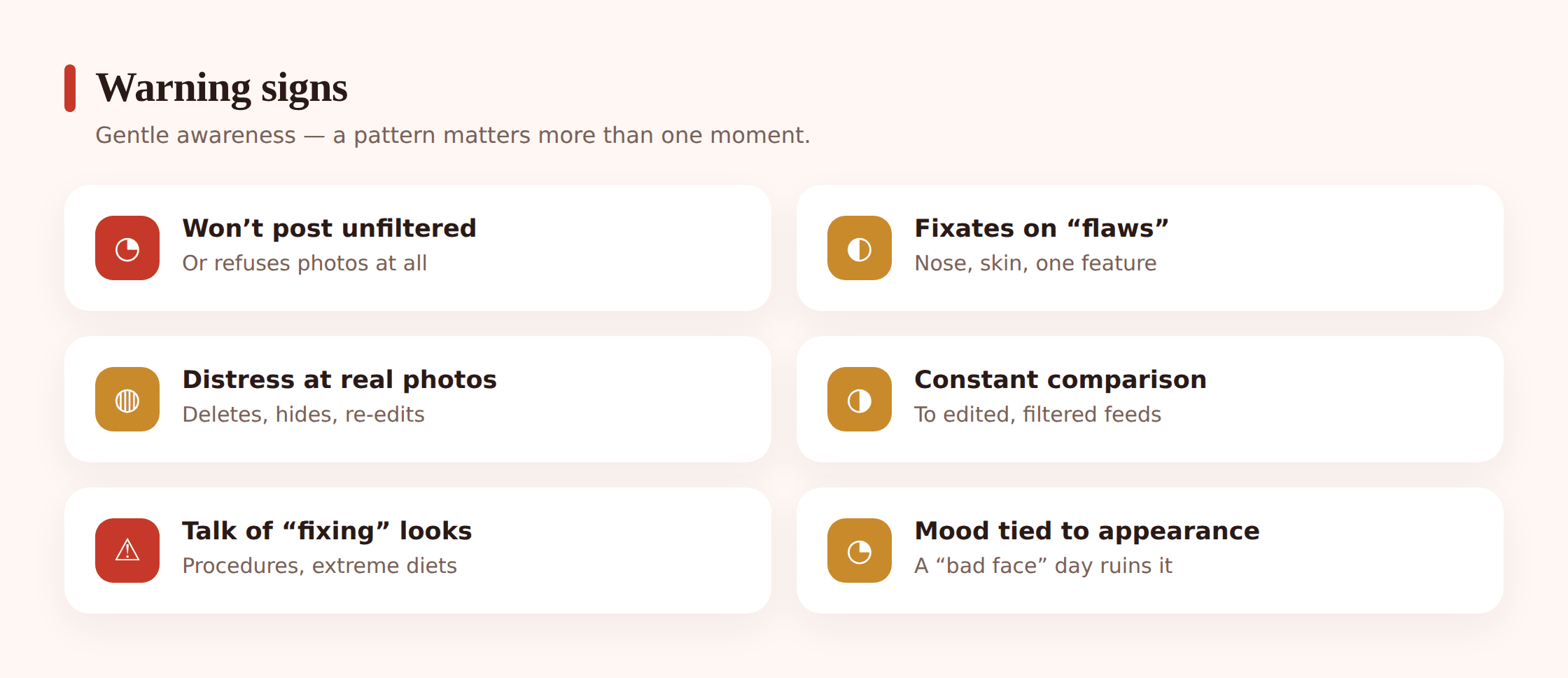
- Won’t post or share unedited photos. A real reluctance to be seen without a filter, or distress when an unedited photo of them exists.
- Endless retakes. Taking the same selfie dozens of times, deleting most, never satisfied with any version.
- Fixating on specific features. Repeated, worried talk about a nose, skin, jaw, eyes — often the exact features filters “fix.”
- Wanting to look like the filtered version. Talk of wanting surgery, procedures, or drastic change to match an edited image, especially at a young age.
- Distress at their own reflection. Real unhappiness looking in the mirror or seeing candid, unfiltered photos taken by others.
- Avoiding the camera entirely. Ducking out of family photos, refusing to be filmed, hiding from any un-edited capture.
- Mood tied to appearance feedback. Likes, comments, and how a photo “performs” clearly driving how they feel about themselves that day.
- Comparing constantly. Measuring their looks against edited images in their feed as though those images were real and reachable.
- Withdrawing. Pulling back from friends, activities, or being seen, in a way that seems tied to how they feel about their appearance.
One thing worth saying plainly: if worries about appearance start tipping into changes around eating — restricting food, secrecy or fear around meals, a fixation on weight or shape — please treat that as something to act on rather than watch. There’s guidance on where to turn near the end of this article.
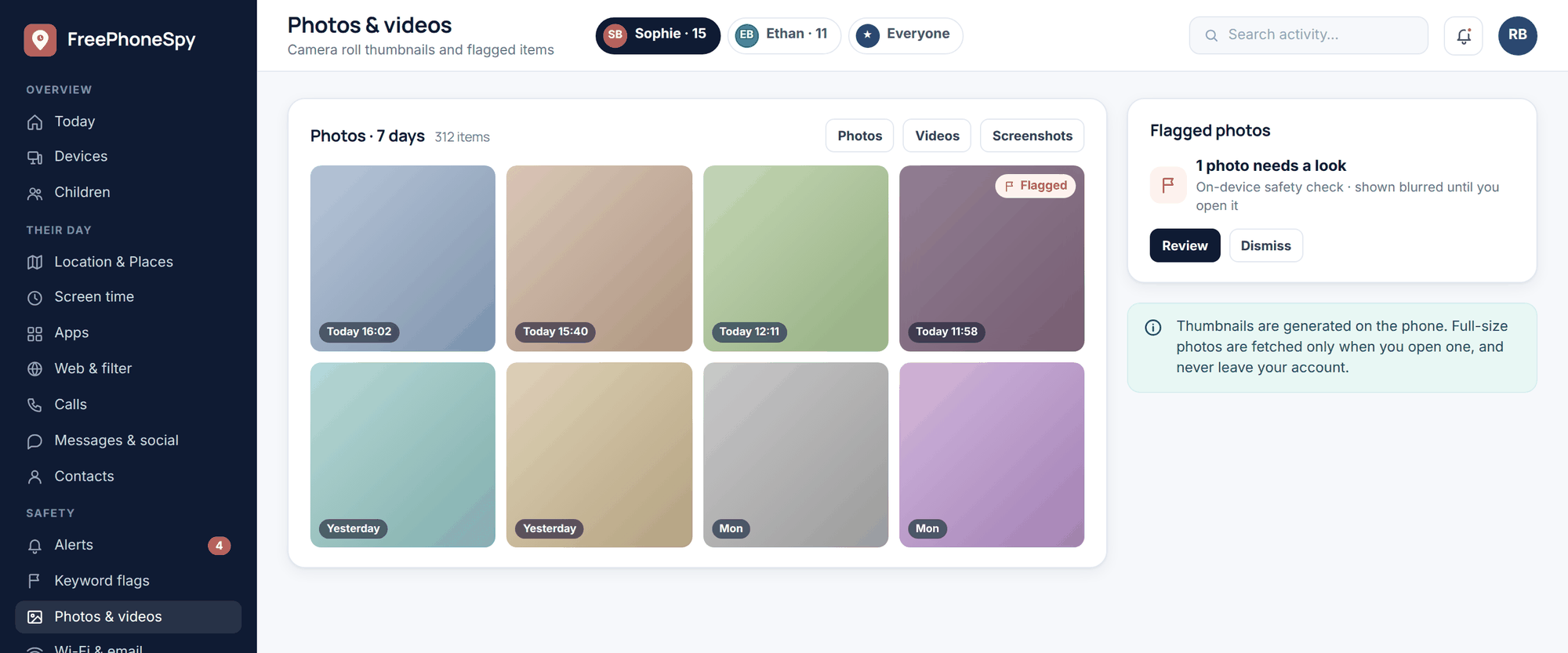
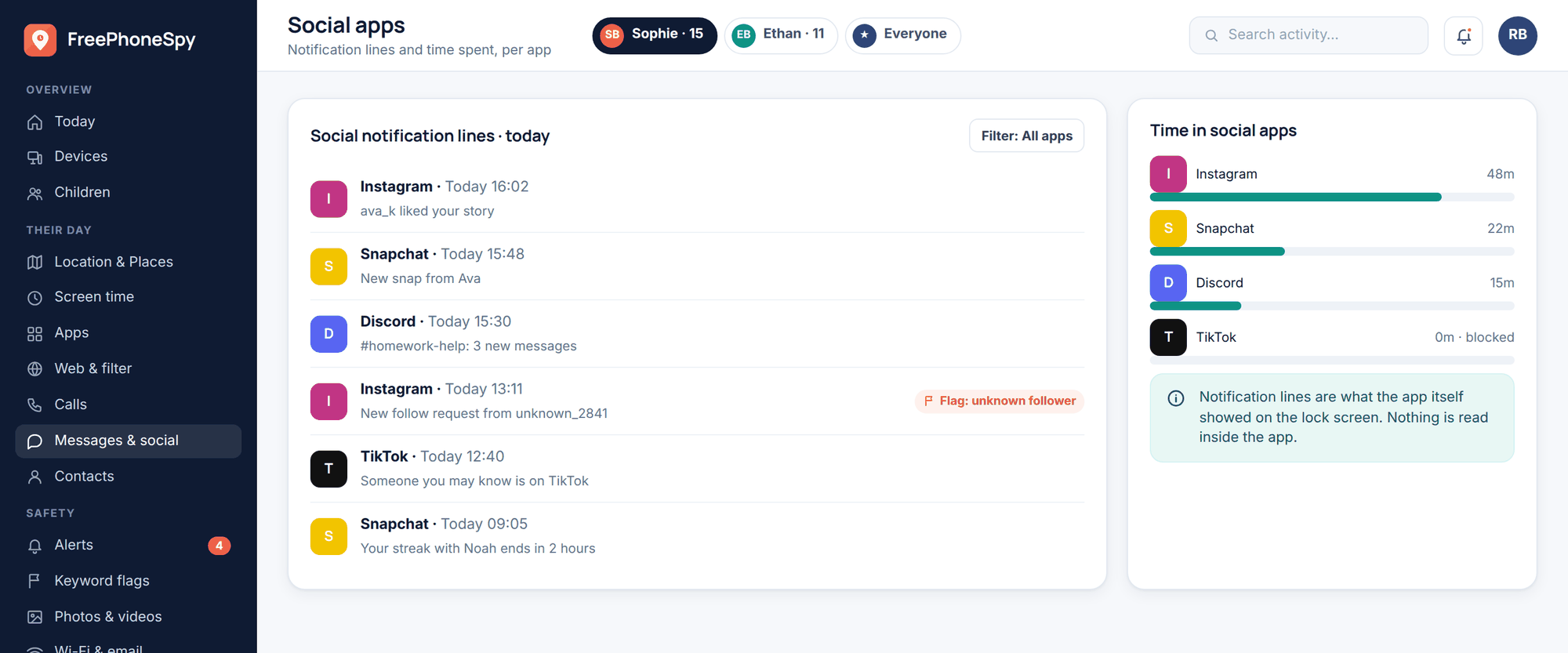
Set up together and out in the open, a tool like FreePhoneSpy can help you notice when photo and camera apps have quietly become a much bigger part of your child’s day. That’s a conversation starter, not proof of a problem. The talking that follows is what actually helps.
Building media literacy and resilience
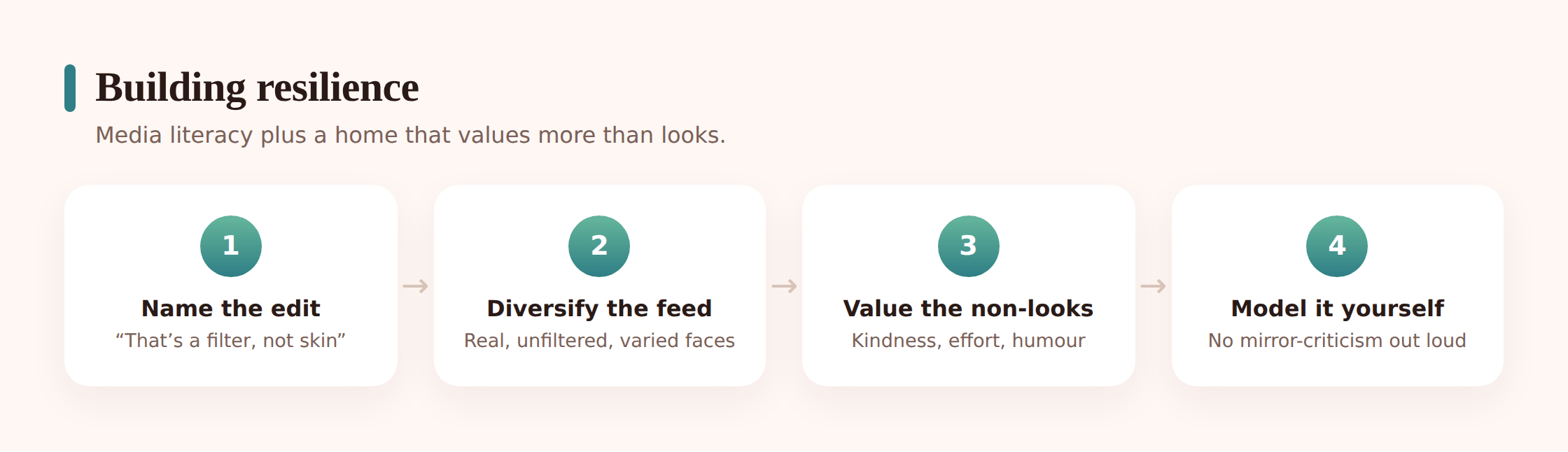
You can’t filter-proof a childhood, and trying to ban filters outright tends to backfire — it makes them forbidden and interesting, and it teaches kids to hide. The stronger play is to build the mental muscles that let a young person see the edit for what it is and shrug it off. That’s media literacy, and it’s learnable.
Teach them to spot the edit
Make it a shared game rather than a lecture. Look at images together and notice the tells: skin with no texture at all, a background that warps or bends near a slimmed waist, teeth that are impossibly white, a jawline sharper than any real jaw. Once a child learns to see the seams, the magic breaks a little — and a photo they can see through has far less power to make them feel small.
Say the quiet part out loud
Name the mechanics plainly. Almost everyone in that feed has smoothed and reshaped their photo before posting. The comparison your child is making — their real face against everyone else’s edited one — is a contest that was rigged before they entered it. Kids are relieved to hear this. It reframes their “everyone looks better than me” into “everyone’s using the same tricks I am.”
Fill the feed with real faces
Whatever a young person follows shapes what feels normal to them. Help them seek out accounts that show unfiltered skin, a range of bodies, ages, and looks — creators who post the messy, ordinary, un-retouched version on purpose. A feed with diverse, real faces in it does quiet, constant work to reset a child’s sense of what a normal face actually is.
Value more than looks, out loud and often
Notice and name the things about your child that have nothing to do with appearance — their kindness, their humour, how they stuck with something hard, the way they treat a friend. When a young person’s sense of worth rests on many pillars, a photo that “underperforms” or a bad day with the mirror has far less power to knock the whole structure down.
Model it yourself
Kids absorb more from what you do than what you say. If you pick apart your own face in photos, edit every picture of yourself, or comment on other people’s looks, they clock it. You don’t have to love every photo of yourself — nobody does — but a parent who can post an ordinary, unedited photo and not agonise over it teaches something no talk can.
All of this ties into the bigger picture of teen mental health and sits alongside the practical side of social media safety. The through-line is the same everywhere: a full, warm, offline life — where a child is known and valued for far more than a photo — is the best protection against anything a screen can throw at them.
How to talk about it supportively
This is delicate, because the wrong comment — even a well-meant one — can land hard on a young person who’s already sensitive about how they look. A few principles keep the conversation safe.
- Lead with curiosity, not alarm. “That filter’s clever — what does it change?” opens a door. “You’re obsessed with your looks” slams it. Calm interest keeps a child talking; panic makes them defensive.
- Don’t over-praise appearance either. Piling on compliments about how pretty or handsome they are keeps the spotlight on looks, just from the other side. Aim to make appearance simply less central, not more.
- Criticise the tech, not the child. The problem is a filter designed to make everyone feel their real face falls short — never anything about your child’s actual appearance. Point your frustration at the app, and keep them out of the line of fire.
- Watch your own body talk. Cut the running commentary on your own face and weight, and on other people’s. A child listening learns that appearance is something adults police in themselves constantly — and turns that lens on their own face.
- Ask, then genuinely listen. You don’t need answers ready. Often the most useful thing you can be is a steady, non-judging person your child can think out loud with.
- Keep the door open. One chat rarely settles anything. What matters is that your child knows they can come back to you, again and again, without being lectured or panicked at.
If a conversation goes badly, that’s normal — leave it, and try again another day, softer. The relationship is what does the healing, and relationships are built in many small, ordinary moments rather than one big talk.
When to reach for more help
Some of this is beyond what a parent should carry alone, and reaching out early genuinely changes how things go. Please talk to your GP, your child’s doctor, or a qualified professional if you notice intense, persistent distress about appearance that dominates your child’s thinking, a strong desire to drastically alter their face or body to match an edited image, withdrawal from friends and life tied to how they feel about their looks, or any sense that these worries are taking over.
And if appearance worry starts showing up as changes around eating — restricting food, skipping meals, fear or secrecy at mealtimes, a fixation on weight or shape — treat that as a reason to act rather than wait. Disordered eating is serious, it can escalate quietly, and it responds far better to early, professional help.
FAQ
Are beauty filters actually harmful, or am I overreacting?
An occasional filter for fun harms nobody. The concern is the slow, cumulative effect of appearance-altering filters used constantly: they quietly reset what a child believes a normal face looks like, so their real face starts to feel like it falls short. You’re not overreacting to pay attention to that. You would be overreacting to panic or ban everything — a calmer, curious approach works far better.
What’s “Snapchat dysmorphia”?
It’s an informal term some doctors use for young people wanting to look like their own filtered selfies — bringing edited images to appointments and asking to be changed to match, rather than to look like a celebrity or a real photo. The worrying part is that the goal is an image that can’t exist, so no change ever feels like enough. It’s a reason to keep filters in perspective and, if a child is fixated on drastic change, to seek professional support.
Should I just ban filters and editing apps?
Outright bans tend to backfire — they make filters forbidden and interesting, and they push the behaviour underground where you can’t see or discuss it. It’s usually more effective to draw the line between harmless playful filters and appearance-altering ones, teach your child to spot edits, and build resilience through what they follow and how they’re valued at home. Aim to raise a child who can see through a filter, not one who’s forbidden from touching one.
My son seems affected too. Isn’t this mostly a girls’ issue?
No. Boys feel appearance pressure as well — often around jawlines, skin, muscle, and height — and frequently with less social permission to talk about it, which means it can go unnoticed for longer. Because we tend to expect this in girls, a boy quietly editing his photos or fixating on his looks is easy to miss. The same warm attention and the same conversations apply to any child.
How do I bring it up without making my child self-conscious?
Lead with curiosity about the technology rather than concern about their looks — “what does that filter actually change?” is safer than any comment on their face. Point your frustration at the apps, not the child, and avoid piling on appearance praise, which just keeps the focus on looks. Keep it light, keep it ongoing, and make clear you’re on their side. Expect several small chats rather than one big one.
When should I get professional help?
If distress about appearance is intense and persistent, if your child wants to drastically alter their face or body to match an edited image, if they’re withdrawing from life over how they feel about their looks, or if any of this is spilling into changes around eating — those are reasons to talk to your GP or your child’s doctor rather than manage it alone. You don’t need certainty, and earlier is always better. For worries about disordered eating specifically, the National Alliance for Eating Disorders helpline can guide you.
If you’ve read this far because you’re worried about your own child, that worry is a measure of how much you care. You don’t need the perfect words, and you don’t have to fix it alone. Keep filters in perspective, help your child see through the edits, make sure they know they’re valued for far more than a photo, and lean on people who do this for a living when you need to. If body-image distress ever tips toward disordered eating, the National Alliance for Eating Disorders helpline — 1-866-662-1235 — is a warm, expert place to start, with your GP or your child’s doctor right beside you. Staying close and reaching out early are two of the strongest things a parent can do.