Fitness Apps, Calorie Counting & Body Image
A step counter, a running app, a smartwatch that buzzes when your teenager has been sitting too long — none of it is a bad thing. For a lot of young people these tools are genuinely motivating, and moving your body is good for both mood and health. But the same apps that nudge one kid to go for a walk can pull another into rigid rules, anxious tracking, and treating a number as a verdict on their worth. This is a guide to spotting the difference, gently, and staying close while you do.
The honest picture
Fitness apps and wearables sit in an awkward spot. Everything about them is designed to feel healthy — the green rings, the streaks, the little celebrations when you hit a target. And for many teenagers, that’s exactly what happens. A running app gives a shy kid a reason to get outside. A step goal turns a boring afternoon into a walk with a friend. A smartwatch makes a young person who felt clumsy in PE realise they can actually do this, and enjoy it.
Here’s the part the shiny marketing skips. The very features that motivate — targets, streaks, numbers going up, numbers going down — are the same features that can hook a vulnerable young person into something that stops being about health at all. When a teenager starts to feel that they’ve failed as a person because they didn’t close a ring, or can’t relax until a number is logged, the tool has quietly turned into a source of anxiety.
Neither outcome is guaranteed. It depends on the child, what else is going on in their life, and how much of their sense of self they’ve started to hang on those figures. Your job isn’t to declare these apps good or evil. It’s to notice how they’re landing for your child, and to stay close enough to tell.
Body image runs underneath all of it, and it’s worth saying plainly: adolescence is a time when many young people feel uneasy in a changing body. That unease is normal. It becomes a concern when it starts driving behaviour — what they eat, how much they move, how they feel about themselves day to day. Fitness apps don’t cause that on their own, but they can give it a set of tools and a scoreboard.
Helpful vs harmful
The same app can be either, so it helps to look at the relationship rather than the app. Here’s roughly what the good version and the worrying version look like side by side.
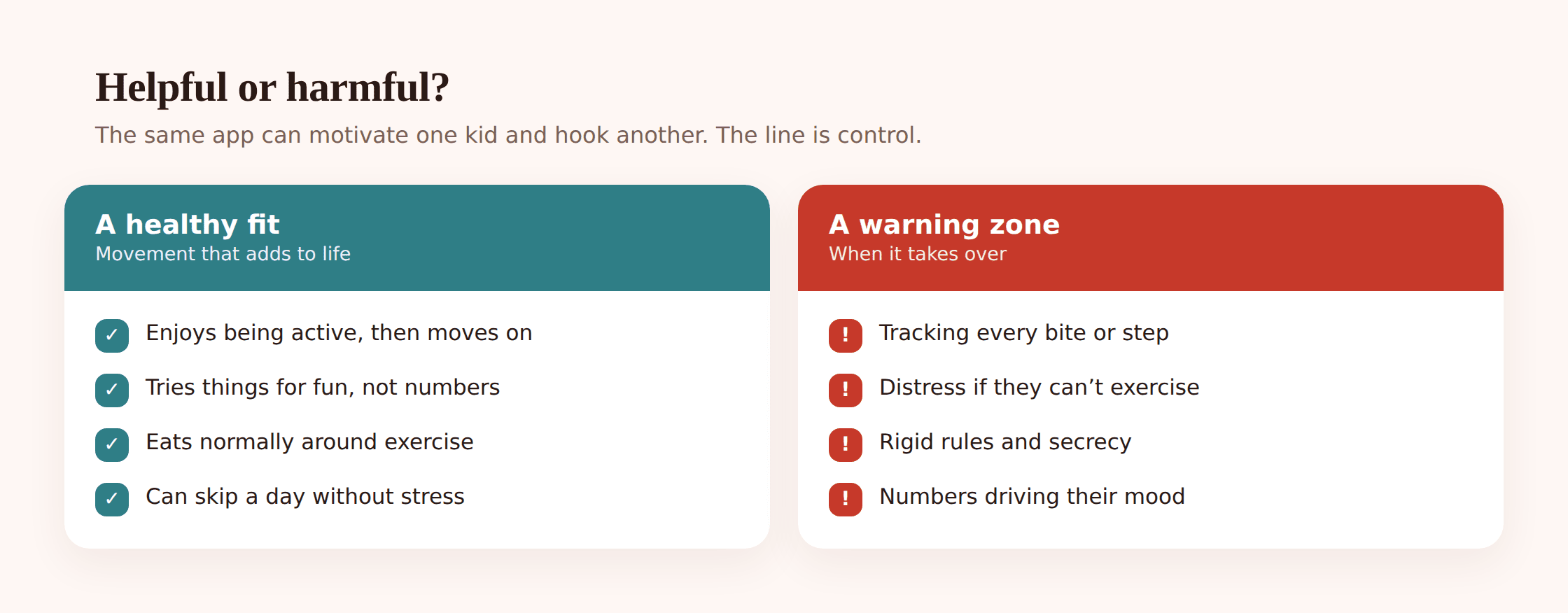
- Helpful: movement they enjoy and would do anyway. Harmful: movement they feel they have to do, even sick, injured, or exhausted.
- Helpful: the app is one input among many. Harmful: the number decides whether it was a good day or a bad one.
- Helpful: missing a target is a shrug. Harmful: missing a target brings real distress, guilt, or a need to “make up for it.”
- Helpful: food is fuel and pleasure and something shared. Harmful: food becomes a running total to be earned, offset, or feared.
- Helpful: they talk about it openly. Harmful: it goes quiet and secretive — hidden logging, defensiveness when you ask.
- Helpful: the app flexes around life. Harmful: life bends around the app — plans skipped, sleep cut, meals rearranged to protect the routine.
A calorie-counting app deserves its own line here. For an adult with a specific, supported goal it might be a neutral tool. For a growing teenager it is far more often a fast track to seeing food as numbers to be minimised — and that framing is exactly the one that disordered eating feeds on. If your child has downloaded one, that’s not a crisis by itself, but it’s worth a gentle, curious conversation about why, and worth paying attention to what it does to their mood around meals.
The content problem: comparison and “what I eat in a day”
The apps are only half of it. The other half is the endless river of fitness and food content your teenager scrolls through, most of which arrives dressed up as inspiration and wellness. A lot of it isn’t.
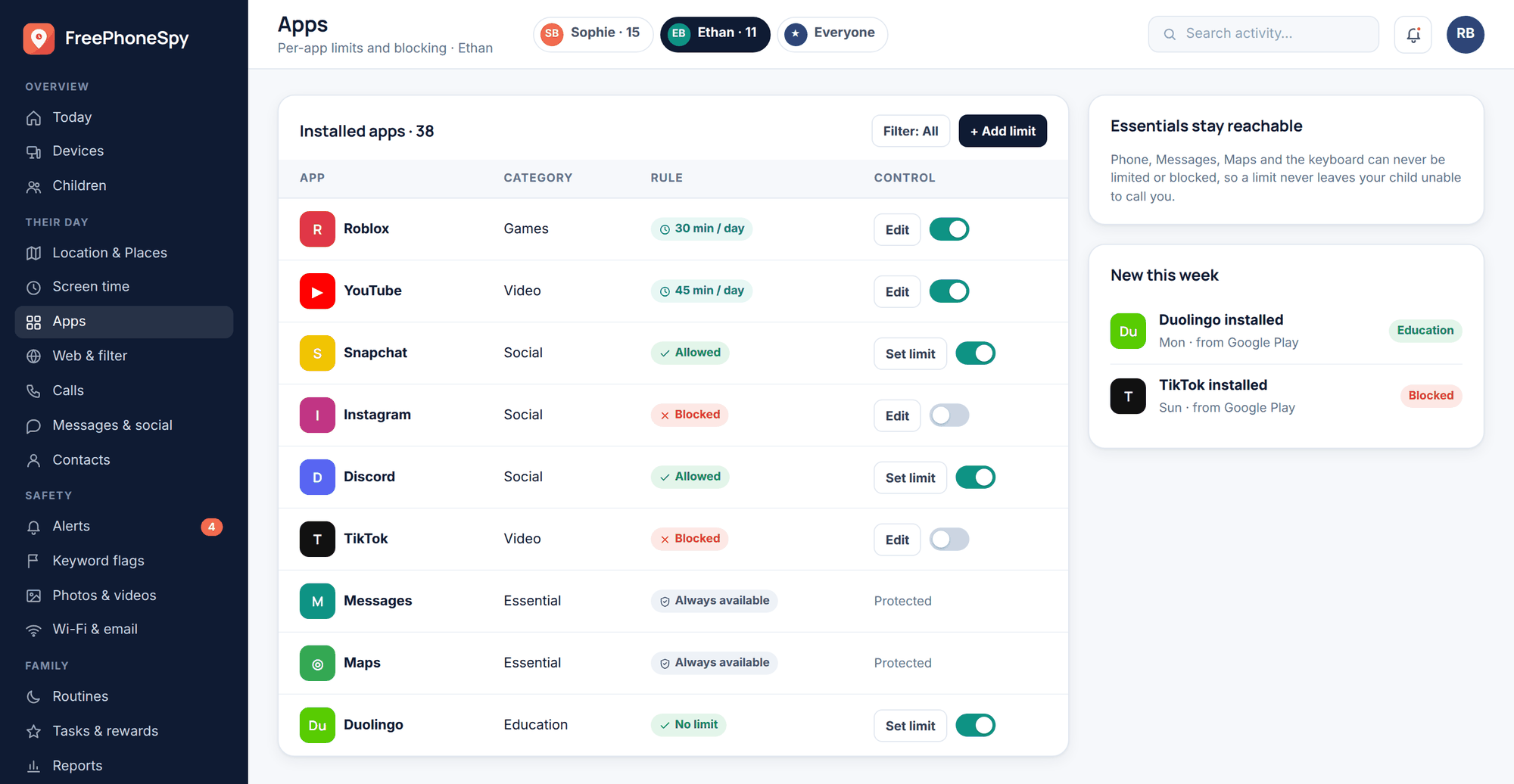
“What I eat in a day” videos are a good example. On the surface they’re harmless — someone showing their meals. Underneath, they hand a young person a stranger’s eating as a yardstick to measure their own against, usually a stranger who is filming a curated, incomplete, sometimes sponsored version of a single day. Bodies get compared. Portions get compared. And the algorithm, noticing that a worried teenager lingers on this stuff, quietly serves up more of it. The feed isn’t trying to make your child feel good. It’s trying to keep them watching.
The comparison here is rigged in the same way it is with any polished feed. Your child measures their ordinary, three-dimensional, real body and real appetite against a flat, filtered, best-angle version of someone else. It’s an unfair contest they never agreed to enter. This is close cousin territory to social media & self-esteem, and the same instinct helps: naming the mechanics out loud so your child is a little less at the mercy of them.
You don’t need to ban the content, which rarely works and often backfires. What helps more is teaching your child to notice what it’s doing to them — to clock the moment they close the app feeling smaller than when they opened it, and to treat that feeling as information. A feed that consistently leaves them anxious about their body is one worth pruning, muting, or stepping away from, and they’re far more likely to do that if it’s their own realisation than your rule.
Warning signs the tracking has turned unhealthy
Most kids use these apps without any trouble. But some patterns are worth taking seriously, especially two or three together, or a clear change from how your child used to be. None of these is a diagnosis. They’re reasons to lean in, pay closer attention, and — if they persist — talk to a professional.
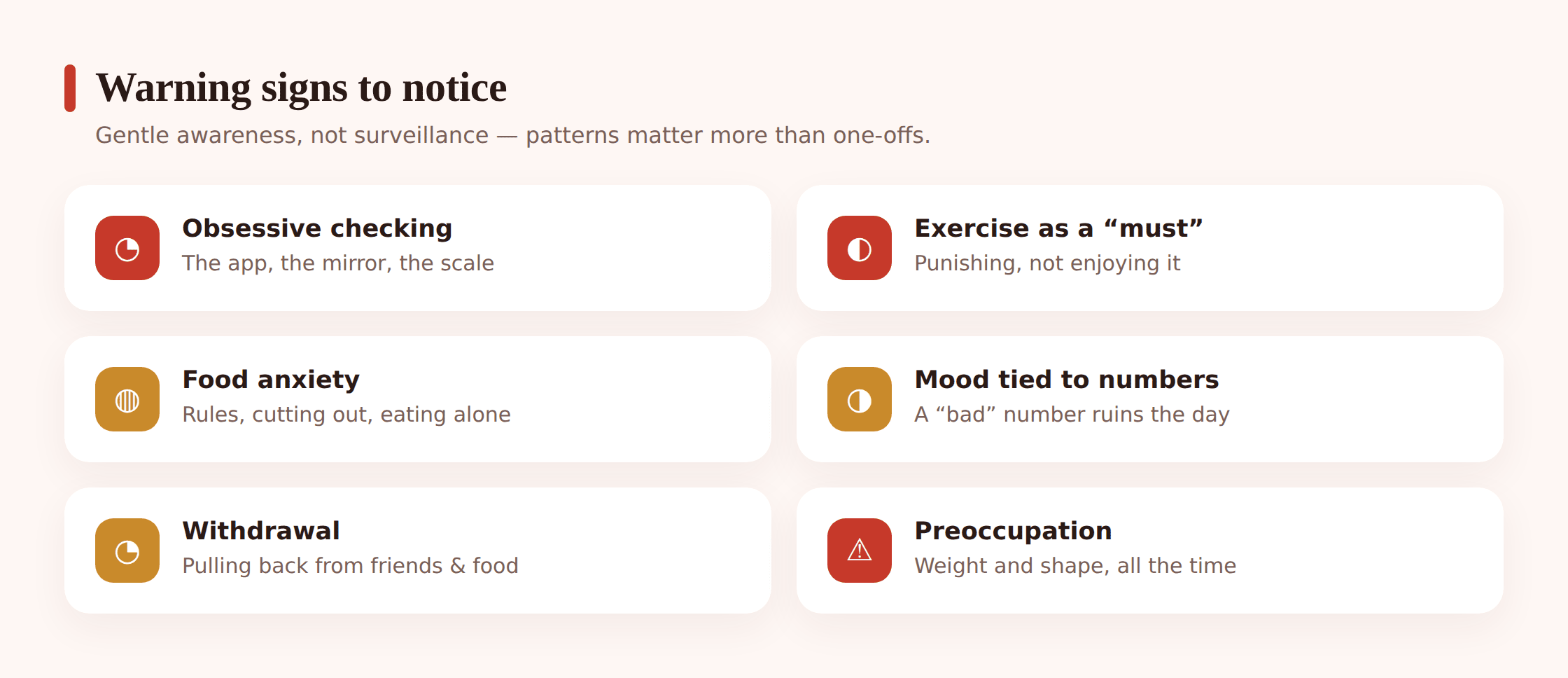
- Rigid rules. Exercise or logging that must happen, at a set amount, no matter what — and rules that only ever get stricter, never looser.
- Distress when they can’t. Real anxiety, irritability, or low mood when they miss a workout, can’t track, or the watch runs flat. A missed target feeling like a moral failure.
- Exercising when they shouldn’t. Working out while ill, injured, or plainly exhausted, because stopping feels unbearable.
- Compensating. A sense that food has to be “earned” through exercise, or “made up for” afterwards.
- Food and exercise anxiety. Tension around mealtimes, avoiding eating with the family, growing lists of foods that are suddenly off-limits, or unease at any meal they didn’t plan.
- Weight and body preoccupation. Frequent checking, frequent comparing, talk that keeps circling back to shape or size, distress at ordinary changes in a growing body.
- Secrecy. Hidden tracking, closing apps quickly, defensiveness or evasiveness when the subject comes up.
- Life shrinking around it. Social plans, sleep, and enjoyment being sacrificed to protect the routine.
- The numbers becoming the point. Mood clearly rising and falling with the figures on the screen, as though they measure the child’s worth.
One important note on food specifically: if you’re noticing signs that eating itself has become restricted, frightening, or secretive, please treat that as something to act on rather than watch. Disordered eating is serious, it can escalate quietly, and it responds far better to early, professional help than to waiting. There’s more on that below.
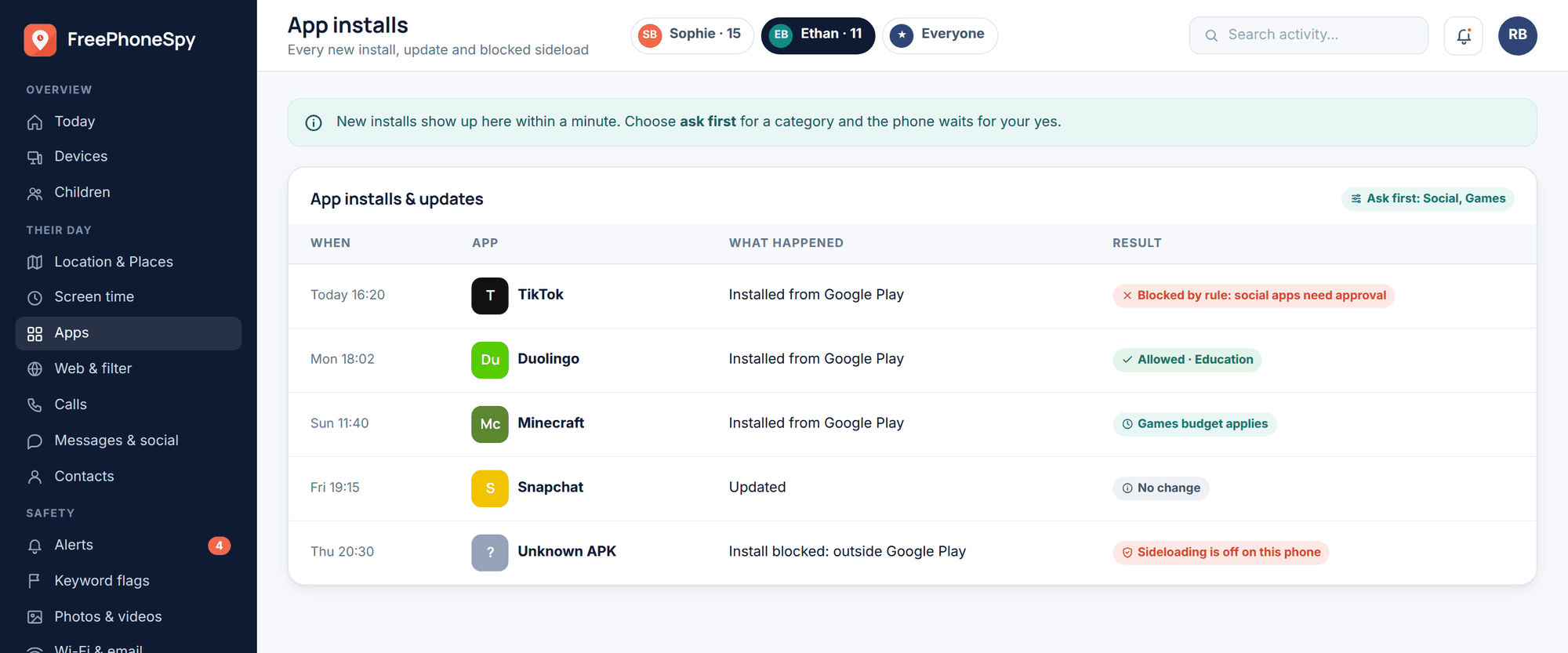
Tools like FreePhoneSpy, set up together and out in the open, can help you see when a fitness or food app has quietly become a much bigger part of your child’s day than it used to be. That’s a conversation starter, not proof of anything. What actually helps is the talking that follows.
Encouraging a healthy relationship with movement and food
The counterweight to all of this is a home where movement is joyful and food is easy. You have more influence than any app, mostly through the ordinary things you model and make room for.
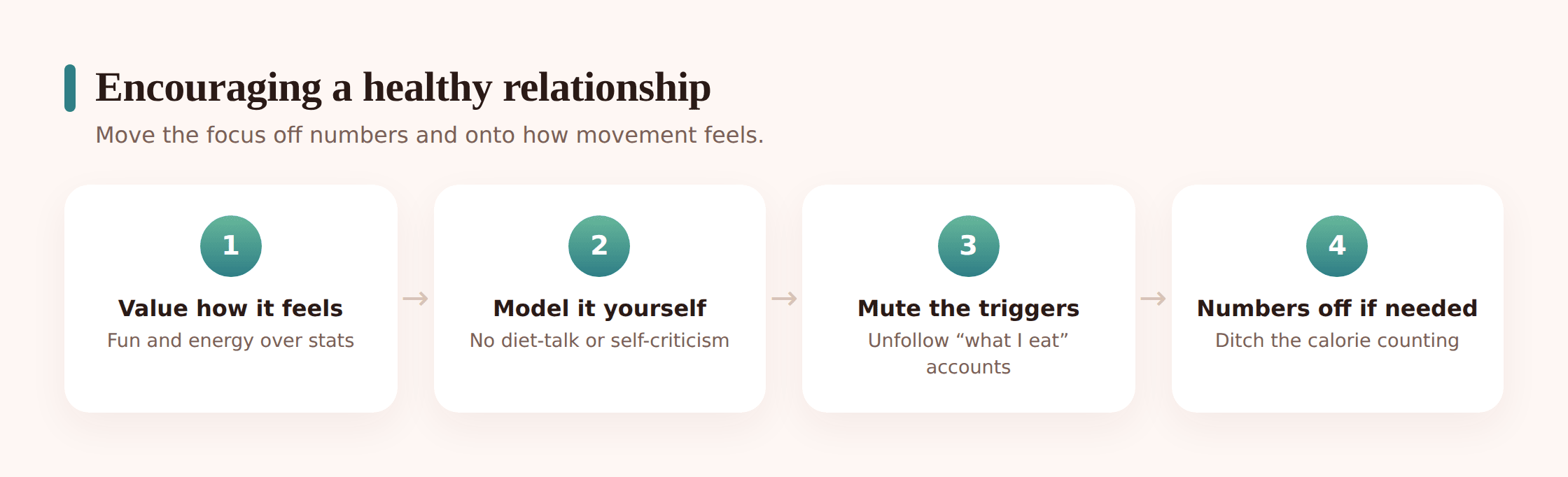
Make movement about fun, not numbers
Frame exercise as play, connection, and feeling good — a bike ride, a kickabout, a dance, a walk with the dog — rather than as calories burned or targets hit. The kind of movement that sticks for life is the kind a person actually enjoys, and enjoyment doesn’t need a scoreboard. If the watch comes off sometimes and nobody minds, that’s a win.
Keep food neutral and shared
Try to talk about food as fuel, pleasure, and something the family does together, rather than as “good” and “bad,” “earned” and “sinful.” Loaded language around food — even when it’s aimed at yourself — teaches a listening teenager to see eating as a test they can pass or fail. Regular, relaxed family meals, with a range of foods and no drama, do a quiet amount of protective work.
Watch your own tracking and talk
Kids absorb far more from what you do than what you say. If your own relationship with a scale, a step count, or your own body is fraught, they notice. You don’t have to be perfect — nobody is — but modelling a calm, unbothered relationship with movement and food is one of the most powerful things you can offer.
Uncouple bodies from worth
Notice and praise your child for things that have nothing to do with how they look or how much they move — kindness, effort, humour, curiosity, the way they treat a friend. When a young person’s sense of value rests on many things, a bad number on a screen has far less power to knock them down.
Let the app be optional
Help the tracking stay a tool, not a boss. Encourage days off. Turn off streaks and aggressive notifications together if they’re causing stress. Make it completely normal to leave the watch in a drawer for a weekend. The message underneath is the important one: you are in charge of the app, not the other way round.
This connects to the wider picture of teen mental health and to keeping bodies moving in a happy, unpressured way — there’s more on the physical side in screens & physical health. The through-line is the same: a full, warm offline life is the best counterweight to anything a screen can throw at a young person.
Talking about bodies without making it worse
This is delicate, because the wrong comment — even a kind one — can land hard on a young person who’s already sensitive about their body. A few principles help.
- Comment on bodies less, not more. That includes praise about weight or shape, and it includes your own body. “You look like you’ve lost weight” teaches that weight is being watched and judged. Aim to make bodies simply not the topic.
- Lead with curiosity, not alarm. “I’ve noticed you seem stressed if you miss your run — what’s that like?” opens a door. “You’re obsessed with that app” slams it. Panic makes kids defensive; calm interest keeps them talking.
- Ask, then listen. You don’t need answers ready. Often the most useful thing you can do is be a steady, non-judging person your child can think out loud with.
- Avoid diet talk entirely. Don’t offer eating rules, food restrictions, or “just eat a bit less / move a bit more” advice. For a young person heading somewhere unhealthy, that kind of talk pours fuel on it. Keep food neutral and leave any actual guidance to a professional.
- Separate the behaviour from the child. The worry is the pattern, never the person. Your child needs to feel that you’re worried with them and firmly on their side, not disappointed in them.
- Keep the door open. One conversation rarely fixes anything. What matters is that your child knows they can come back to you, again and again, without being lectured or panicked at.
If a conversation goes badly, that’s normal — try again another day, softer. The relationship is the thing that helps, and relationships are built over many small moments, not one big talk.
When to get professional help
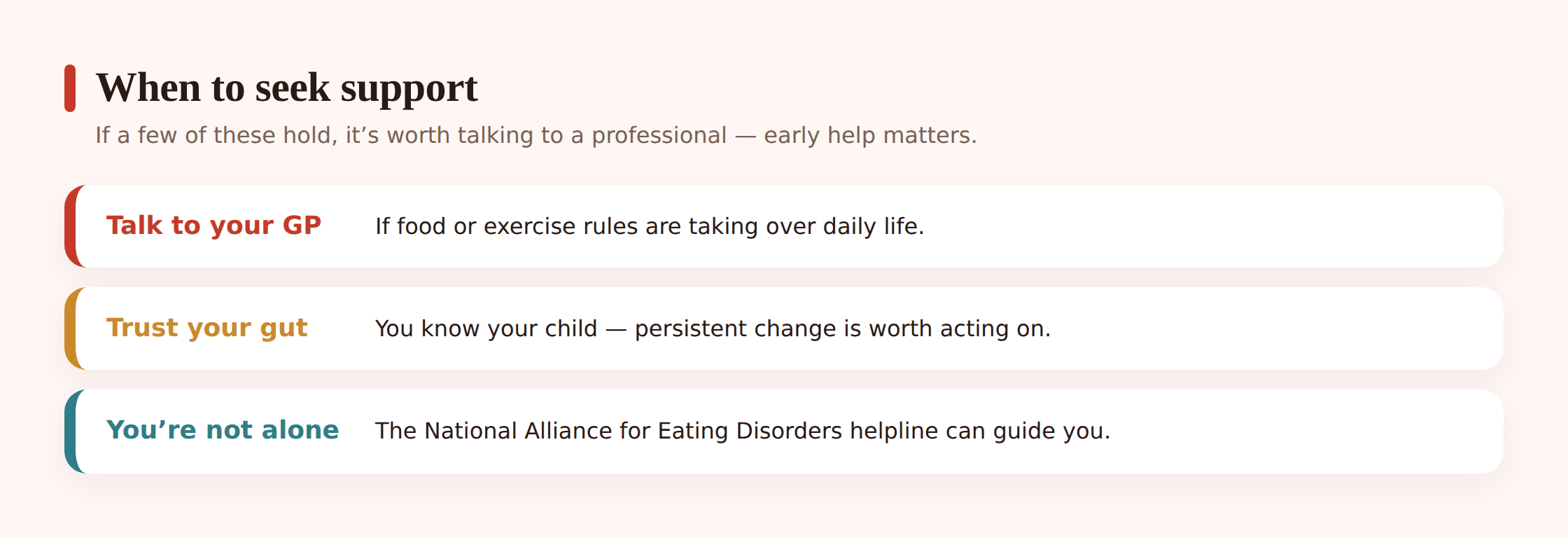
Some things are beyond what a parent should try to handle alone, and reaching out early genuinely changes outcomes. Please talk to your GP, your child’s doctor, or a qualified professional if you notice any of these:
- Restricting food, skipping meals, or growing fear or secrecy around eating.
- Exercise that feels compulsive — driven, distressing to stop, continued through illness or injury.
- Noticeable changes in weight, energy, mood, or physical health.
- Intense, persistent distress about body shape or size that dominates their thinking.
- Withdrawal from friends, food, or activities they used to enjoy.
- Any sense that these worries are taking over your child’s life.
You do not need to be certain, and you do not need to wait until things are severe. A doctor would far rather see a young person early than late. Trust your instinct — a parent who feels something is off is usually onto something real, and getting it checked costs nothing but a conversation.
FAQ
Are fitness apps and smartwatches bad for teenagers?
Not inherently — for plenty of young people they’re motivating and fun, and moving your body is good for mood and health. The risk isn’t the app itself but the relationship with it. Watch for the tipping point where a tool that encourages movement becomes a set of rules that causes anxiety, guilt, or compensating. A relaxed relationship is healthy; a distressed, rule-bound one is the signal to step in.
Should I let my teen use a calorie-counting app?
For a growing teenager, calorie-counting apps carry real risk, because they push food into being numbers to be minimised — the exact framing disordered eating feeds on. It’s not automatically a crisis if they’ve tried one, but it’s worth a gentle, curious conversation about why, and worth watching what it does to their mood around meals. Many families choose to steer away from them altogether for this age group.
My child gets upset when they miss an exercise target. Is that a red flag?
A one-off grumble, no. But genuine distress, guilt, or a need to “make up for” a missed workout — especially if it’s a pattern, or the rules keep getting stricter — is worth paying attention to. It suggests the number has taken on more emotional weight than it should. Stay curious, keep the conversation open, and if it persists or comes with changes around food, talk to a professional.
How do I bring it up without pushing them away?
Lead with curiosity rather than alarm, and comment on the pattern, not their body. Something like “I’ve noticed you seem really stressed if you can’t track — what’s that like for you?” opens a door. Avoid diet talk, avoid weight comments, and make clear you’re worried with them and on their side. Expect it to take more than one conversation; keeping the door open matters more than getting it perfect.
What about “what I eat in a day” and fitness content?
Most of it is a curated, incomplete, sometimes sponsored slice of someone’s life, handed to your child as a yardstick for their own body and appetite. Banning it rarely works. What helps more is teaching your child to notice how it makes them feel — and to treat consistently feeling worse after scrolling it as a reason to mute, unfollow, or step away. Their own realisation sticks better than your rule.
When should I get professional help rather than handle it myself?
Any restricting of food, compulsive exercise, secrecy or fear around eating, notable changes in weight or energy, or intense ongoing distress about body shape — those are beyond what a parent should manage alone. You don’t need certainty and you shouldn’t wait for things to get severe. Contact your GP or your child’s doctor, and use the National Alliance for Eating Disorders helpline for guidance.
This is a sensitive subject, and if you’ve read this far because you’re worried about your own child, that worry is a sign of how much you care. You don’t have to have the perfect words, and you don’t have to sort it out on your own. Stay close, keep food and movement as neutral and joyful as you can, and lean on people who do this for a living when you need to. If disordered eating is a concern, the National Alliance for Eating Disorders helpline — 1-866-662-1235 — is a warm, expert place to start, and your GP or your child’s doctor is right there beside you. Reaching out early is one of the kindest, strongest things a parent can do.