Group Chats: Helping Kids Handle Drama & Pressure
A one-to-one message is a conversation. A group chat is a room — and rooms have an audience, a mood, and a pecking order. Your child might handle a friend perfectly well one-to-one and still come apart in a chat of 40 people, because the rules are different in a crowd. The pressure to reply the second it buzzes, the pile-on that snowballs in ten seconds, the sick feeling of watching a plan form that you weren’t invited to. This is about that specific world, and how to help your kid stand steady in it without pulling the plug on their whole social life.
Why group chats hit differently
Most parents worry about the stranger in the DMs. Fair enough. But a lot of the day-to-day stress in a kid’s phone doesn’t come from strangers at all — it comes from their actual friends, in a chat everyone’s in. This is a different problem from cyberbullying, where there’s usually a target and someone doing the targeting. Group chats can be perfectly friendly and still be exhausting. The trouble is structural. It’s baked into the shape of the thing.
Think about what a group actually is. On WhatsApp, Snapchat, Discord, or an iMessage thread, dozens of people are talking at once, and every one of them can see everything. There’s no private aside. Say something clumsy and 30 people read it before you can take it back. Add to that the fact that these chats never close — there’s no end to the school day, no “see you tomorrow”. The room stays open at midnight, at 6am, on holiday, during dinner. Your child is a permanent resident of a crowded space they can’t ever fully leave.
That’s the bit adults miss. We picture messaging as something you pick up and put down. For a lot of kids it’s more like a party they’re stuck at, where leaving early looks rude and everyone will talk about it once you’re gone.
The specific pressures kids feel
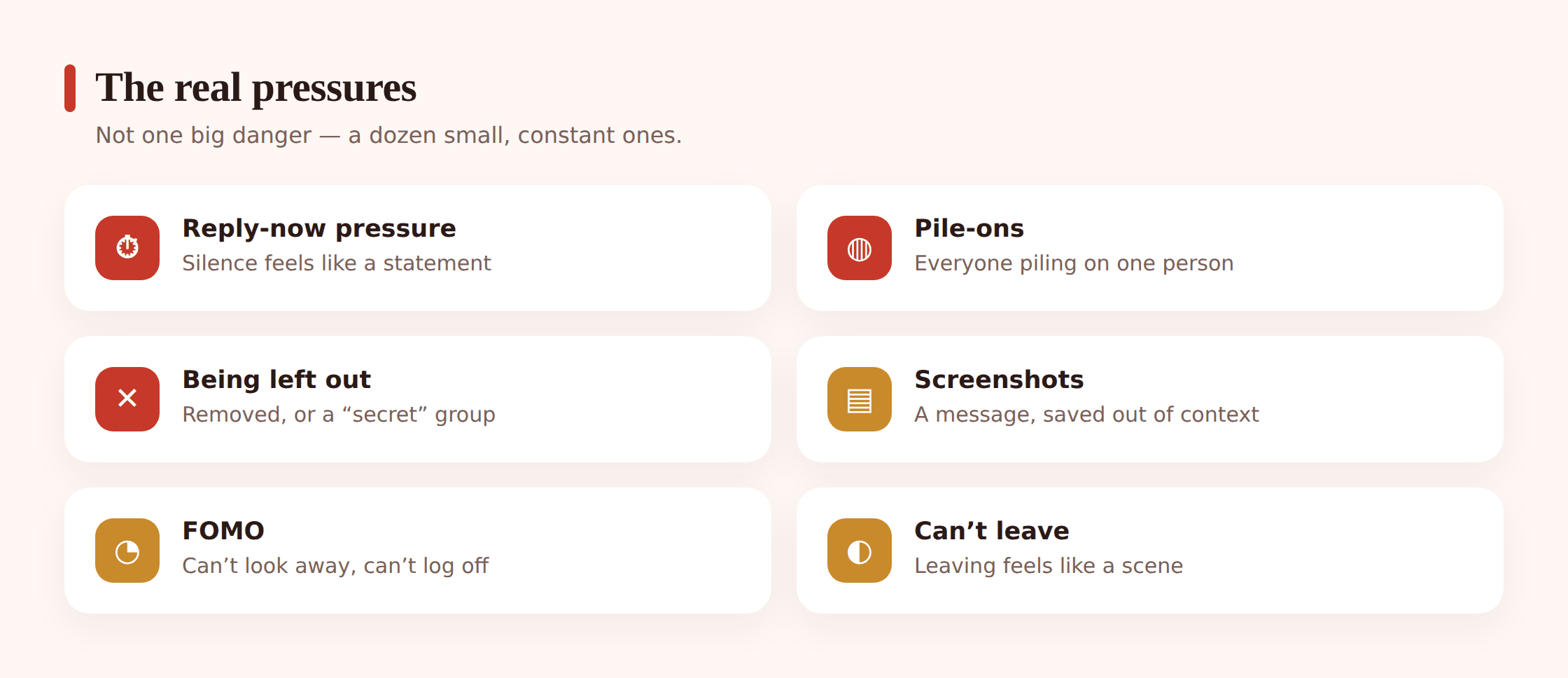
When kids describe why a chat stresses them out, the same handful of things come up again and again. None of them is dramatic on its own. Stacked together, they wear a child down.
The always-on pressure to respond
Read receipts and “typing…” turned messaging into a performance. If your child sees a message and doesn’t reply, the other person often knows. In a group, a slow reply can read as ignoring someone, or being stuck-up, or not caring. So kids stay glued, not because they love it, but because going quiet has a social cost. Ever watched your teenager reply to a buzz at the dinner table with a flicker of panic? That’s the “if I don’t answer now, it’ll be weird” reflex.
Pile-ons and ganging up
A group has momentum. One person makes a dig, another adds a laughing emoji, a third piles on, and within a minute there’s a wave rolling downhill at one kid. Nobody planned it. Each person added one small thing. But if your child is on the receiving end, it feels like the entire room turned on them at once. And here’s the sting — a friend who’d never be cruel one-to-one will happily throw in a laughing face when the group’s already laughing. The crowd gives cover.
Being left out — or removed
Exclusion in a group is loud precisely because it’s visible. A second chat gets made without your child, and they find out when someone mentions “the other group”. Or worse, they get removed from a chat and watch their name vanish from the member list in front of everyone. There’s no soft way to be dropped from a group. It’s public, and it’s instant.
Screenshots taken out of context
Everything in a chat is one screenshot away from a different chat. A joke that made sense in the moment, a half-formed opinion, a photo shared in confidence — captured and forwarded, stripped of everything around it. Kids know this on some level, which adds a background hum of caution to everything they type. The clever ones learn to self-edit. The rest learn the hard way.
Saying things you’d never say one-to-one
People are braver, and worse, in a crowd. A kid who’d never insult a classmate to their face will join in when the group’s already going. It’s the same instinct that makes a quiet person shout at a football match. The group dilutes the sense of personal responsibility — “I only said one thing” — even as the pile it’s part of does real damage. This is often how an ordinary kid ends up on the wrong side of a situation. Worth reading alongside when your child is the bully, because group chats are where a lot of that starts.
The huge, chaotic chat — and not being able to leave
Some chats are just too big. A hundred people, hundreds of messages a day, notifications firing constantly. It’s noise, and it’s stressful, but leaving feels impossible. If your child clicks “exit group”, everyone sees the message: “so-and-so left.” That single line can trigger a round of “why did they leave?”, so most kids stay in chats they’d love to escape, just to avoid the drama of going.
The fear of missing out
Underneath all of it is FOMO. If I mute this, I’ll miss the plan. If I don’t check, I won’t get the joke everyone’s quoting tomorrow. The chat is where friendships are maintained now, so switching off feels like switching off from your friends. That fear is what keeps a tired, stressed kid checking a chat that’s making them miserable.
How group dynamics change behaviour
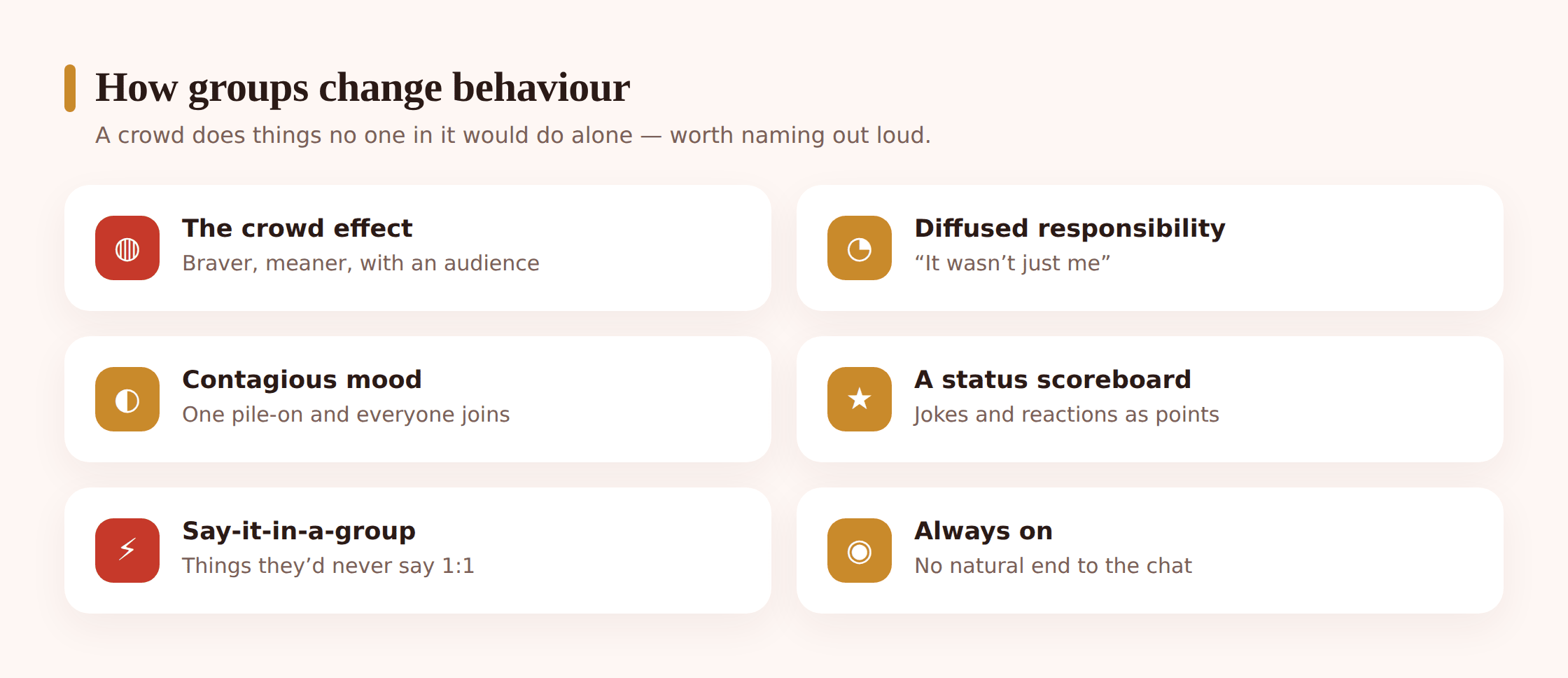
Here’s the part that helps a child most once they understand it: people don’t behave the same in a group as they do alone. It’s not a character flaw. It’s how humans work in crowds, and it’s been true since long before phones. Naming it out loud takes a lot of the shame out of it.
Three things happen in a group that don’t happen one-to-one.
Responsibility spreads out. When 20 people watch someone get picked on and nobody steps in, it’s not that 20 people are heartless. It’s that each one assumes someone else will say something, and the more people there are, the easier it is to stay quiet. Your child needs to know this so they recognise it in themselves — that silent shrug of “not my job” is the group doing its thing, not a true reading of what’s right.
The mood becomes contagious. Groups pick up a tone and run with it. If the chat’s gone snarky, snark feels normal, and a kind message suddenly feels out of place. Kids match the room without deciding to. That’s why a chat can turn nasty so fast — nobody chose it, everyone caught it.
Status is always in play. A group is a live scoreboard. Who got the laugh, who got ignored, who’s in the new smaller chat. Kids read that scoreboard constantly, even when they’d swear they don’t care. A message that gets no replies can feel like a public snub. Understanding that the “scoreboard” is mostly noise — that a message getting missed usually means people were busy, not that they hate you — is a genuinely calming thing for a teenager to hold onto.
Warning signs your child is struggling in a chat
Kids rarely walk in and announce that a group chat is stressing them out. It leaks out sideways. What you’re watching for is a shift from their normal — not one grumpy evening, but a pattern that lingers.
- They flinch at the buzz. The phone goes off and they tense up or check it with dread rather than interest. A chat that brings only anxiety is doing damage.
- Relief when it’s quiet. They visibly relax when the phone’s in another room, then get twitchy when they’re “allowed” back on it.
- Muttering about “the group”. Offhand comments — “the chat’s so annoying”, “I don’t even know why I’m in it” — that they wave off if you ask. The wave-off is the tell.
- Checking obsessively but not enjoying it. Scrolling the same chat over and over with a flat or worried face, not laughing, not replying.
- Mood drops after a session. They go up cheerful and come down flat, teary, or snappy. Watch the after, not just the during.
- A sudden app deletion. They loved Snapchat last week and now it’s gone with no reason given. Quitting a platform overnight is usually a retreat.
- Talk of being left out. Mentions of a party, a plan, a smaller chat they weren’t part of — floated lightly, but landing heavily.
One of these is just a Tuesday. Two or three of them clustering in the same few weeks is worth a gentle conversation. You’re looking for the change and the cluster, not any single moment.
Skills to teach — the ones that actually help
You can’t stand in the chat for your child. What you can do is hand them a few concrete moves so they’re not defenceless when the room turns. These are small, learnable, and they stick.
Don’t react in the first ten seconds
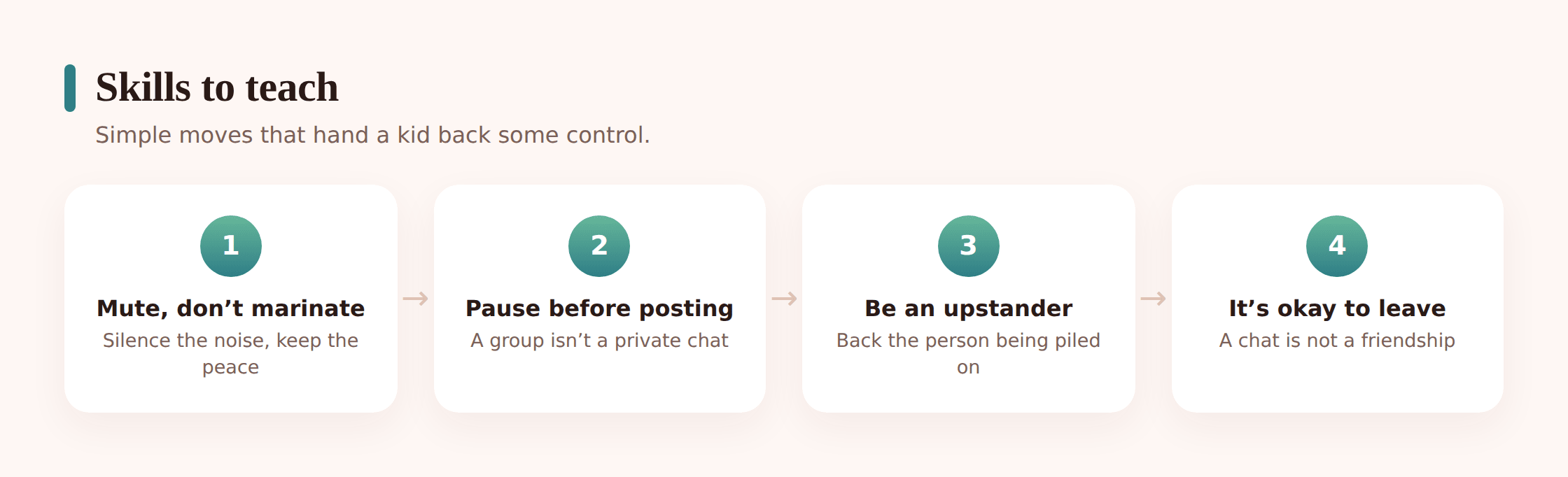
The worst replies are the instant ones. Teach your child that when a message stings, the move is to put the phone down, not to fire back. Nothing in a group chat has to be answered that second, even though it feels like it does. Ten minutes later, the reply they’d have sent in anger looks like a bad idea, and the reply they send calm actually helps. “You never have to win the chat in the first ten seconds” is a good line to give them.
Mute freely — it’s not a statement
Kids treat muting like a betrayal, as if silencing a chat means silencing their friends. It doesn’t. Muting turns off the notifications; the chat’s still there when they choose to look. Show them where the mute button is on WhatsApp, Snapchat, and Discord. A muted chat they check twice a day is a hundred times healthier than a live one buzzing every ninety seconds. Nobody can even tell you’ve muted them.
Know when to leave — and that leaving is allowed
Some chats have run their course, or turned toxic, and the right move is out. Yes, “so-and-so left” shows up. That’s survivable. Help your child think it through: is this a chat I need for a real reason, or one I’m staying in out of fear? If it’s the second, leaving is fine, and the momentary awkwardness passes by lunchtime. For a big chaotic chat, muting is often enough. For a nasty one, leaving is a strength, not a sulk.
Assume every message could be screenshotted
Not to make them paranoid — to make them deliberate. A simple rule: if you wouldn’t want it on the school noticeboard with your name on it, don’t put it in the chat. That covers mean comments, secrets that aren’t theirs to share, and photos of other people. It also protects them, because the kid who never types anything screenshot-worthy is a lot harder to embarrass later.
Be an upstander, not a bystander
This is the big one. When the group’s piling on someone, the crowd effect makes staying silent feel normal. Teach your child that they don’t have to make a speech — a single “ok that’s a bit much” or “leave them alone” changes the whole temperature of a chat, because it breaks the spell that says everyone agrees. Even better, a private message to the kid getting hammered: “that was out of order, you good?” They don’t have to fight the whole group. They just have to refuse to be part of the pile. One voice is often all it takes for others to find theirs.
How parents help without confiscating everything
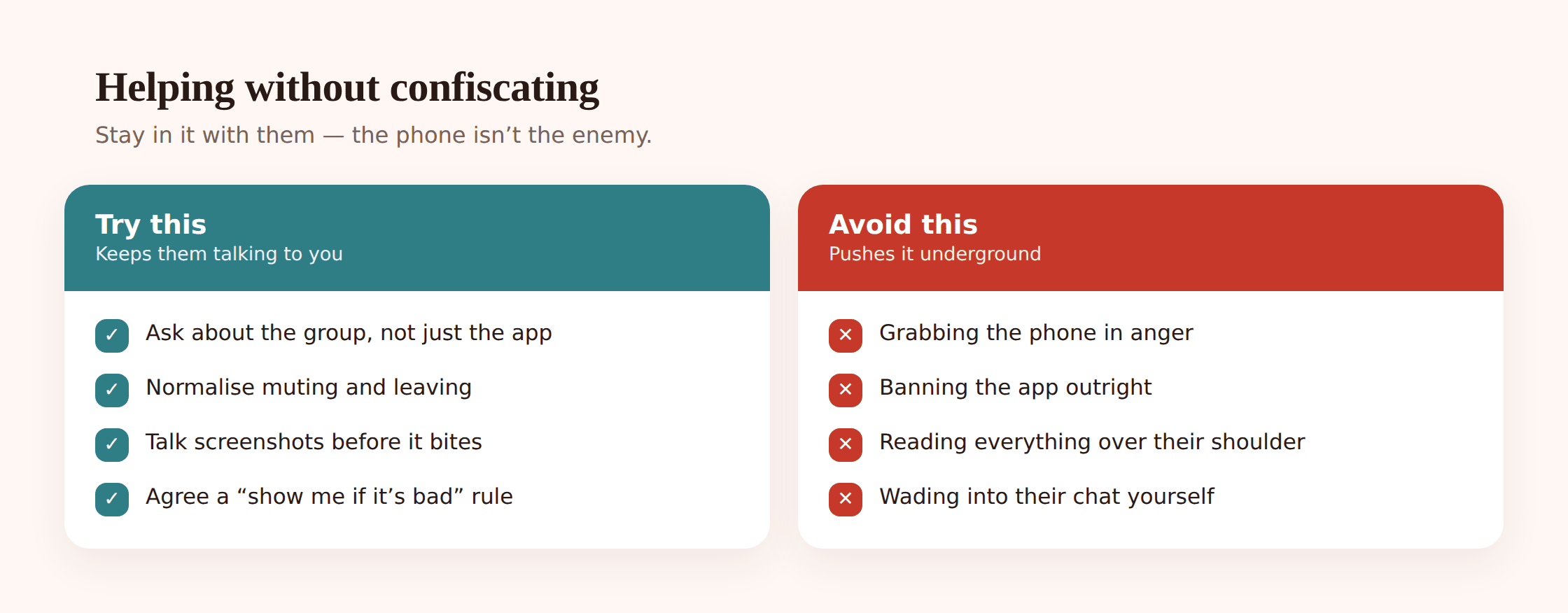
The instinct, when a chat is hurting your kid, is to take the phone. Sometimes for a night that’s the right call. As a first move it usually backfires — because to your child, you didn’t remove the problem, you removed their entire social world and blamed them for it. Next time something goes wrong, they’ll hide it, because telling you means losing the phone. That’s the exact opposite of what you want.
A better set of moves:
- Get curious before you get cross. “What’s the group like at the moment?” beats “who’s upsetting you?” Let them describe the dynamic. You’ll learn more, and they’ll feel like you’re on their side.
- Normalise the crowd effect. Tell them people are worse in groups, that it’s not just their friends being awful, and that even adults do it. Taking away the “why are my friends like this?” confusion helps a lot.
- Coach the skill, don’t seize the phone. “Have you tried muting it for tonight?” teaches something. Confiscation teaches nothing except to hide the next problem.
- Protect the sleep, not the whole day. A blanket ban breeds resentment. Phones charging outside the bedroom overnight is a limit most kids can live with, and it stops the 1am chat from wrecking their sleep. Our social media safety guide has more on setting limits that hold.
- Be the safe place to bring the mess. The kid who knows you’ll help rather than punish is the kid who tells you when a screenshot’s going round or a chat’s turned nasty. That trust is worth more than any control setting.
If a specific chat has crossed into genuine bullying — a target, a pattern, real cruelty — that’s a different response, and it may mean talking to the school or the other parents. Our cyberbullying guide covers the calm action steps. WhatsApp in particular comes up a lot with younger kids; if that’s your situation, is WhatsApp safe for kids goes into the app’s specifics.
Open awareness, agreed limits
You don’t need to read your child’s every message to help them through group-chat drama. Honestly, reading everything usually makes things worse — it turns you into a surveillance problem on top of their social one. What helps is a general sense of the shape of things: which chats are busy, when the phone lights up, whether a quiet kid has gone suddenly quieter. Patterns, not transcripts.
Pair that with a simple family agreement about phones and chats — when they charge overnight, what’s fair to expect around the dinner table, and the standing promise that bringing you a problem never costs them their phone. Awareness plus agreed limits plus an open door beats confiscation every time. The aim isn’t a monitored child. It’s one who can handle a room full of noise, knows when to step out of it, and tells you when it gets too loud.
Common questions
My child is in a group chat that clearly stresses them out. Should I make them leave it?
Talk it through rather than ordering it. Some chats are worth muting instead of leaving — a big class group they need for real information, say. Others have genuinely turned toxic and leaving is the healthy move. Help your child weigh whether they’re staying for a real reason or out of fear of the “so-and-so left” message. If it’s fear, reassure them the awkwardness passes fast. Let it be their decision where you can; they’ll own it better.
How is a group chat different from cyberbullying?
Overlapping but not the same. Cyberbullying has a target and someone doing the targeting, usually repeated and deliberate. Group-chat stress often comes from ordinary friends in a normal chat — the pressure to respond, the crowd turning snarky, the fear of missing out. A group chat can be perfectly friendly and still be draining. When a chat crosses into a sustained pile-on aimed at one kid, it has become bullying, and our cyberbullying guide covers what to do next.
My kid never replies to us but is glued to the group chat. Why?
Because the group has a social cost for going quiet that home doesn’t. In a chat with read receipts, not replying can read as a snub, and kids feel that pressure keenly. It’s not that they value the chat over you — it’s that the chat feels like it’ll punish silence and you won’t. Naming that out loud (“I get that going quiet in the group feels risky”) often lands better than “why can’t you put it down?”
Is it normal to say things in a group you’d never say one-to-one?
Normal, yes — good, no. People are bolder and less careful in a crowd; responsibility feels spread out, so individuals do things they’d never do alone. That’s exactly why the “would I say this to their face?” test is worth teaching. It pulls your child back to being one person making one choice, instead of a voice in a pile.
What’s an upstander, and how do I teach my child to be one?
An upstander is the person who breaks a pile-on instead of joining or ignoring it. It doesn’t take courage-of-a-hero — a single “ok that’s enough” in the chat, or a quiet private “you alright?” to the kid getting hammered, is often all it takes to change the mood. Teach it as a small, specific move, not a lecture. Kids are far more likely to step in when they know exactly what stepping in looks like.
Should I read my child’s group chats to keep them safe?
You rarely need to, and reading everything usually backfires — it makes you a surveillance problem on top of their social one, and it teaches them to hide things. Broad, open awareness works better: which chats are busy, when the phone’s active, whether a normally chatty kid has gone quiet. Set it up in the open, keep the door open for them to bring you problems, and you’ll hear about the real trouble because they told you, not because you caught it.