Sleep & Screens: Helping Your Child Sleep Better
Of all the ways phones tangle up family life, sleep is the one you can actually fix. It’s concrete. You can see it working within a week. And better sleep quietly improves almost everything else — mood, patience, focus at school, the way a tired kid handles a hard day. So if you only change one thing about phones this month, change what happens at night.
Why sleep is the fixable one
Big questions about phones and childhood are genuinely hard. How much is too much? What does it do to attention over years? Nobody has clean answers, and honest people disagree. Sleep is different. The mechanism is well understood, the fix is practical, and you get feedback fast.
You don’t have to win a philosophical argument to get your kid to bed. You just have to change a few things about the evening. A phone out of the bedroom, a set screens-off time, a consistent wake-up — those are small, boring, doable moves. And when a child sleeps better, you notice. They’re less snappy. School mornings get less awful. The whole house softens a little.
If you’re after the wider picture — mood, self-esteem, the slow drip of comparison — that’s a different conversation, and we’ve written it up in Phones and Teen Mental Health. This piece stays narrow on purpose. It’s about sleep.
What actually happens: light plus engagement
Two things go wrong when a phone comes to bed, and they stack.
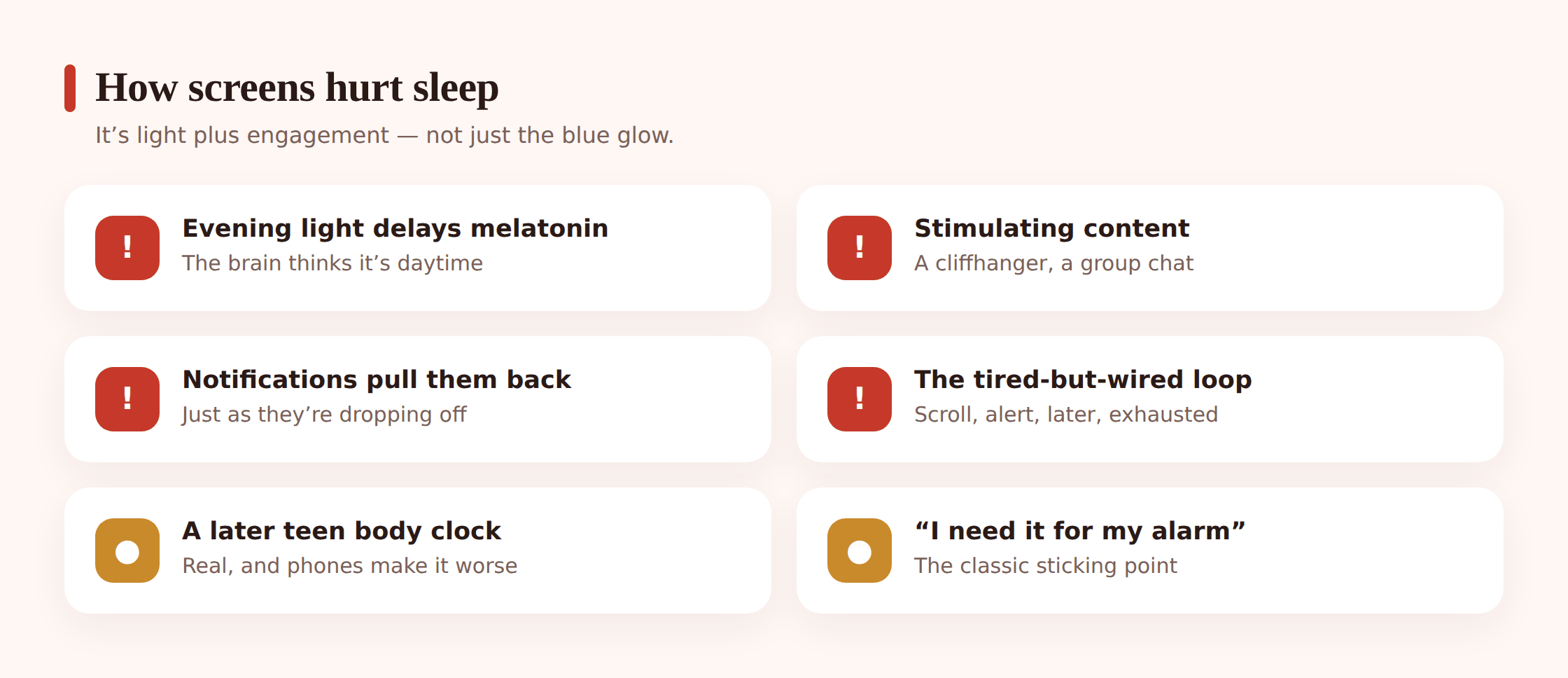
The first is light. Your brain reads bright light in the evening as a signal that it’s still daytime. That delays melatonin, the hormone that ramps up as you get sleepy. Screens throw off a fair bit of light, and the blue-ish end of the spectrum is the part the brain pays most attention to for timekeeping. Hold a bright screen close to your face for an hour before bed and you’re basically telling your body clock the sun hasn’t set. Melatonin arrives late, so sleep arrives late.
But light is only half of it, and honestly it’s the half people overstate. The bigger problem is that the phone is interesting. A book by a dim lamp doesn’t keep you up the way a group chat does. One more video. A cliffhanger episode. A message that pings back a reply, so you reply, so it pings again. The content is built to hold you, and holding you means keeping you alert. A calm, bored brain drifts off. An engaged one doesn’t.
So when someone says “just turn on Night Shift and you’re fine,” they’ve solved the smaller problem and left the bigger one. Dimming the screen or flipping to dark mode helps a little. It does nothing about the fact that the thing in your hands is designed to be hard to put down. That’s why the real fix is putting it away, not tinting it orange.
The teen body-clock twist
Here’s a thing that surprises a lot of parents. Teenagers’ body clocks genuinely shift later at puberty. It’s biological, not attitude. Around the teen years the internal clock drifts, so a teen who isn’t sleepy at 10pm often really isn’t — their melatonin is running on a later schedule than yours. They tend to feel wide awake in the evening and wrecked in the morning.
Now add a phone. A device that delays sleep on top of a clock that’s already delayed. The two pull in the same direction, and you end up with a kid who can’t fall asleep until very late and then has to be dragged out of bed for a school that starts early. The early start collides head-on with the late clock. That morning misery isn’t laziness. It’s a mismatch.
Knowing this changes the tone of the whole thing. You’re not fighting a lazy teenager. You’re helping someone whose biology is working against an early alarm, and whose phone is making it worse. That’s a problem you can be kind about while still holding the line on the phone.
The tired-but-wired loop
Watch how the evening actually goes and you’ll see a loop. It’s worth naming, because once you can see it you can break it.
It starts innocently. The day was long, so they scroll to unwind. But scrolling doesn’t wind you down — it winds you up. More alert, not less. So sleep comes later. They wake up short on rest, groggy and flat. And how do they get through a tired day? The phone again — a hit of something quick to feel awake and okay. Which sets up the next late night. Tired, so they scroll. Scroll, so they’re wired. Wired, so they sleep late. Late, so they’re tired.
The tired-but-wired loop: reach for the phone to relax → get more alert → sleep later → wake tired → lean on the phone to cope → repeat. The scroll feels like rest. It isn’t. Breaking the loop almost always means moving the phone out of the bedroom, so the night stops feeding the morning.
A wind-down routine that works
You don’t need anything fancy. A short, repeatable routine does most of the work, because bodies love predictability. Same steps, same order, most nights. Here’s a version that holds up.
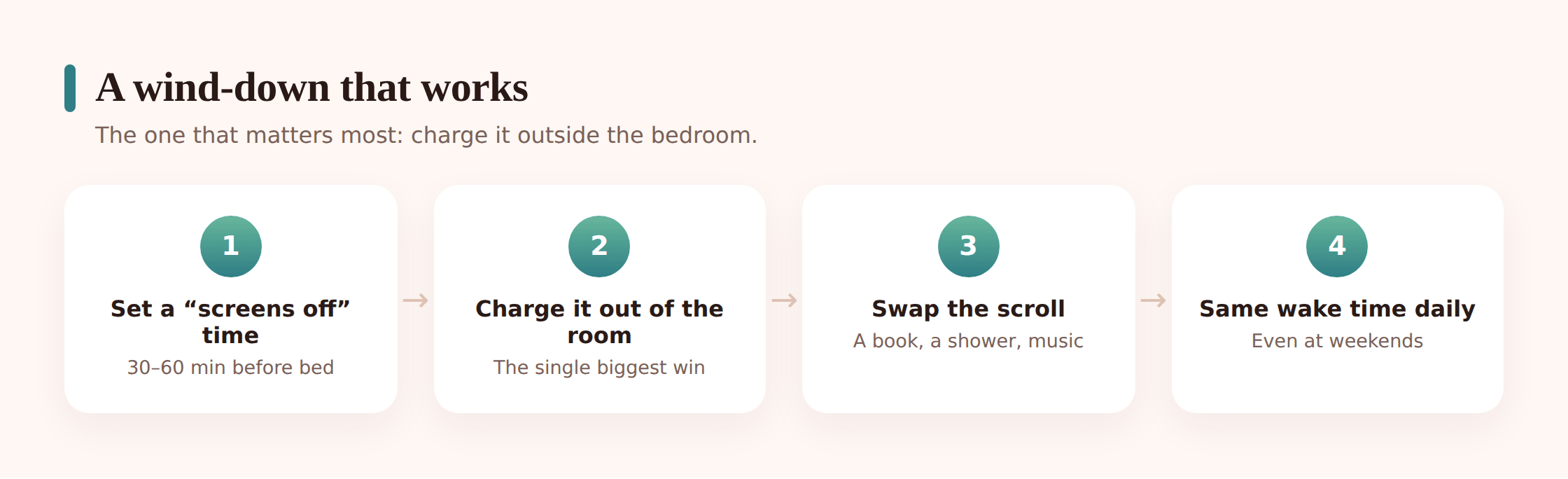
- Set a screens-off time. Thirty to sixty minutes before bed, phones go down. Pick a clock time so it’s not a negotiation every night. “Screens off at nine” is a rule. “Soon” is a fight.
- Charge the phone outside the bedroom. This is the single biggest win. A phone in another room can’t buzz at midnight, can’t tempt a 1am scroll, can’t be the last thing seen and the first thing grabbed. Everything else is fine-tuning; this is the main event.
- Swap the scroll for something low-light. A book under a warm lamp. A shower. Music with the screen face-down. A chat about the day. The point is to give the brain something calm to land on instead of a feed that keeps it revving.
- Dim the lights, and use Night Shift or dark mode — as a minor help. Warmer, lower light in the last hour is genuinely nicer for sleep. Just be honest with yourself: it’s a small assist, not a substitute for putting the phone away.
- Keep a consistent wake time, even at weekends. This anchors the whole clock. Sleeping until noon on Saturday drags the body clock later and makes Monday brutal. A wake time that barely moves is the quiet backbone of good sleep.
If your household habits have drifted a long way — phones in bed, no fixed times, everyone up late — it can be easier to reset everything at once rather than tweak the edges. A Family Digital Detox walks through doing that together, as a family, without it turning into a punishment.
Practical set-ups
Rules survive on set-up. Make the good version easy and the bad version awkward.
- Buy a cheap bedside clock or alarm. This quietly removes the number-one excuse — “but I need my phone as an alarm.” A £5 alarm clock ends that argument for good.
- Make a family charging station. A spot in the kitchen or hallway where everyone’s phone sleeps overnight. It stops singling anyone out and turns “park the phone” into just what the family does.
- Turn on Do Not Disturb or a Sleep focus. On both iPhone and Android you can silence the phone on a schedule so no late pings, no glowing screen at 2am when a group chat wakes up.
- Use the same rules yourself. Kids clock the gap instantly. A parent scrolling in bed while telling a teen to park their phone won’t hold. Charge yours in the hallway too.
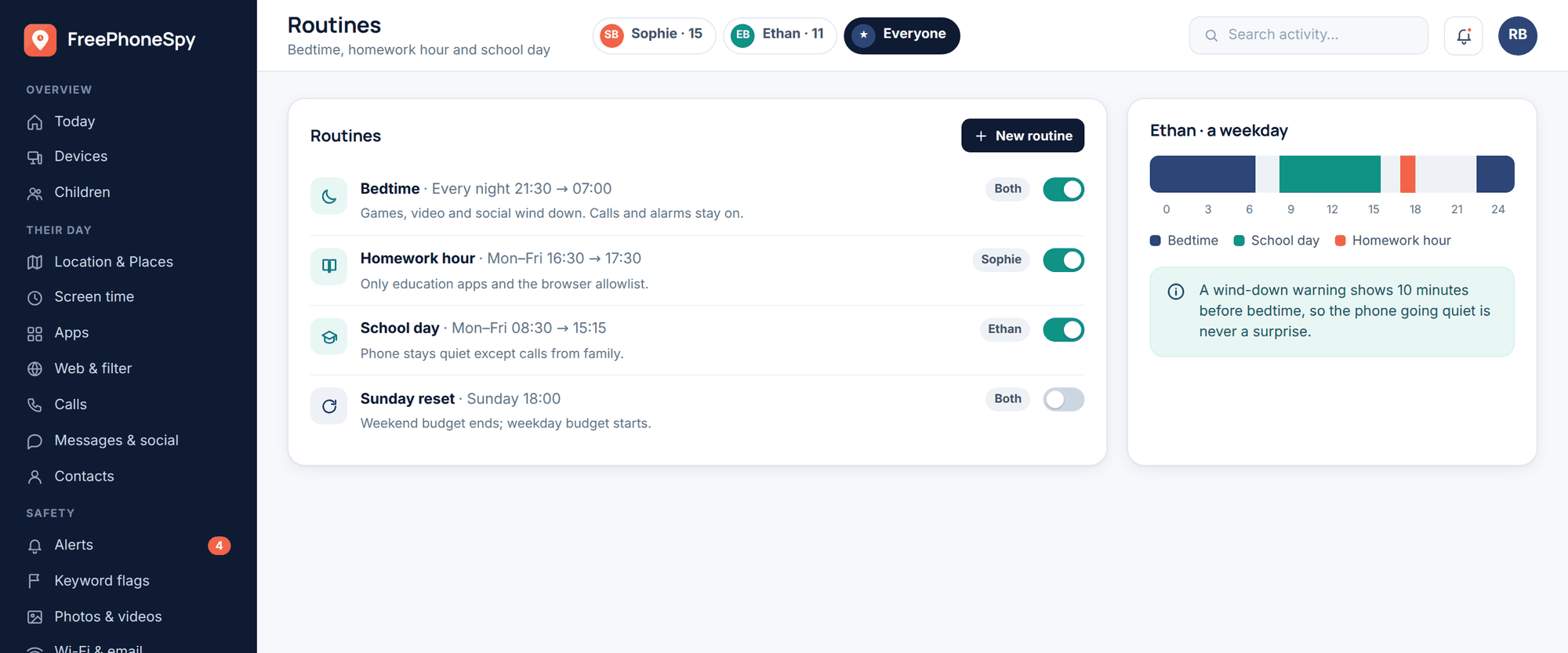
If you’d like the schedule to hold even on the nights nobody feels like enforcing it, this is where a tool can help a little. FreePhoneSpy is a transparent parental panel for Android phones: you can set a Bedtime routine so the phone winds down and parks itself overnight, and add screen-time downtime around the evening. It’s a backstop for the habit, not the habit itself — the routine is what matters. If your child is on an iPhone, Apple’s built-in Screen Time and Sleep focus do a similar job.
Do it in the open. FreePhoneSpy is built to be visible, not secret. Tell your child the bedtime limit exists, agree it together, and let them see the panel. A downtime rule your kid knows about is a shared plan. One they discover is a betrayal — and it teaches them to hide the phone better, which is the opposite of what you want at night.
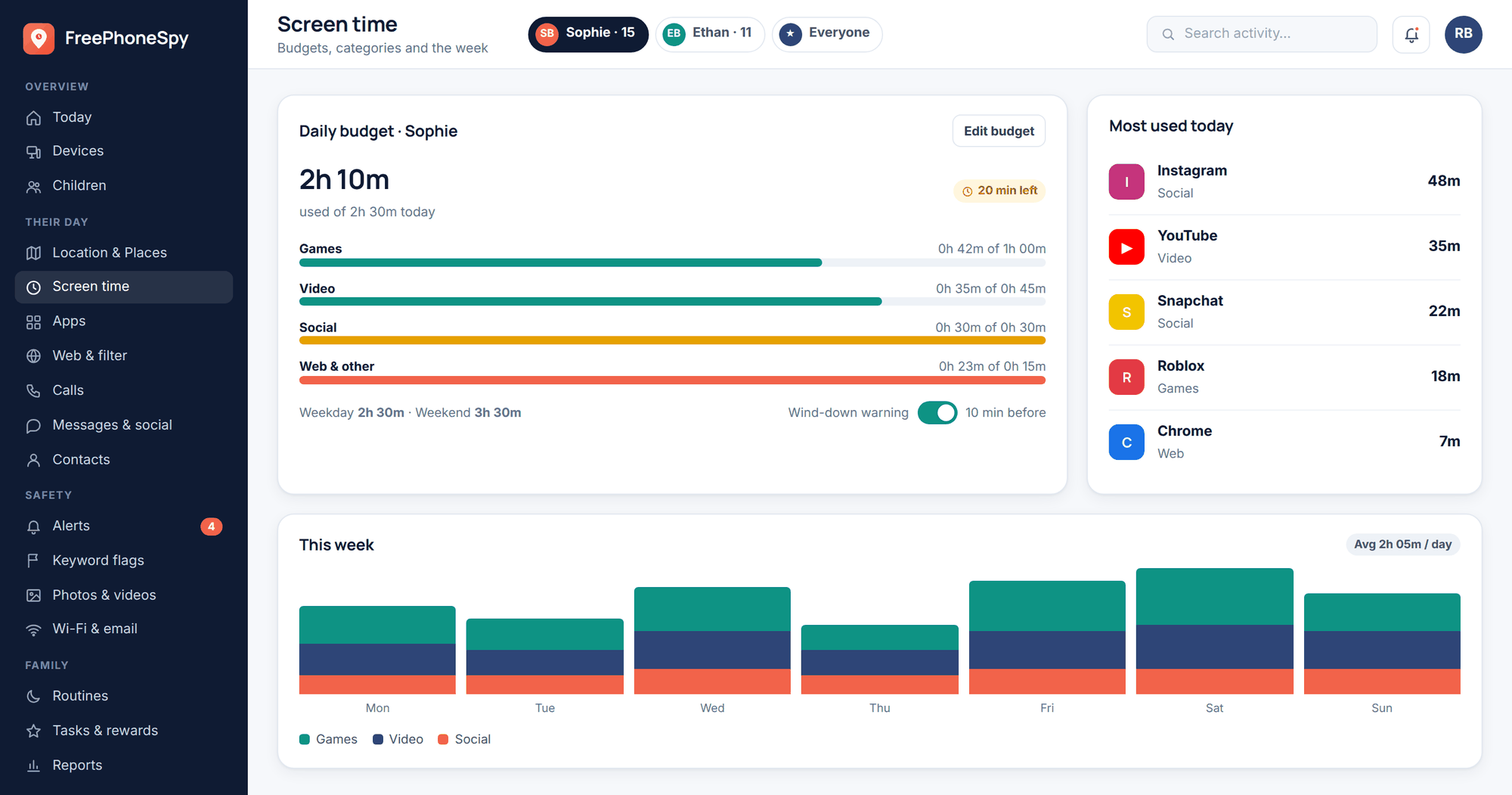
While you’re setting things up, the other quiet win is notifications. A phone that stays silent in the evening is far easier to leave alone. How to Manage Notifications covers trimming the pings so the phone stops demanding attention at exactly the wrong time.
Rough sleep needs by age
Take these as general guidance, not a prescription to hit exactly. Children vary, and a happy, alert kid who’s a bit outside the range is usually fine. But the broad shape is useful, because most kids get less sleep than they need, and teens especially.
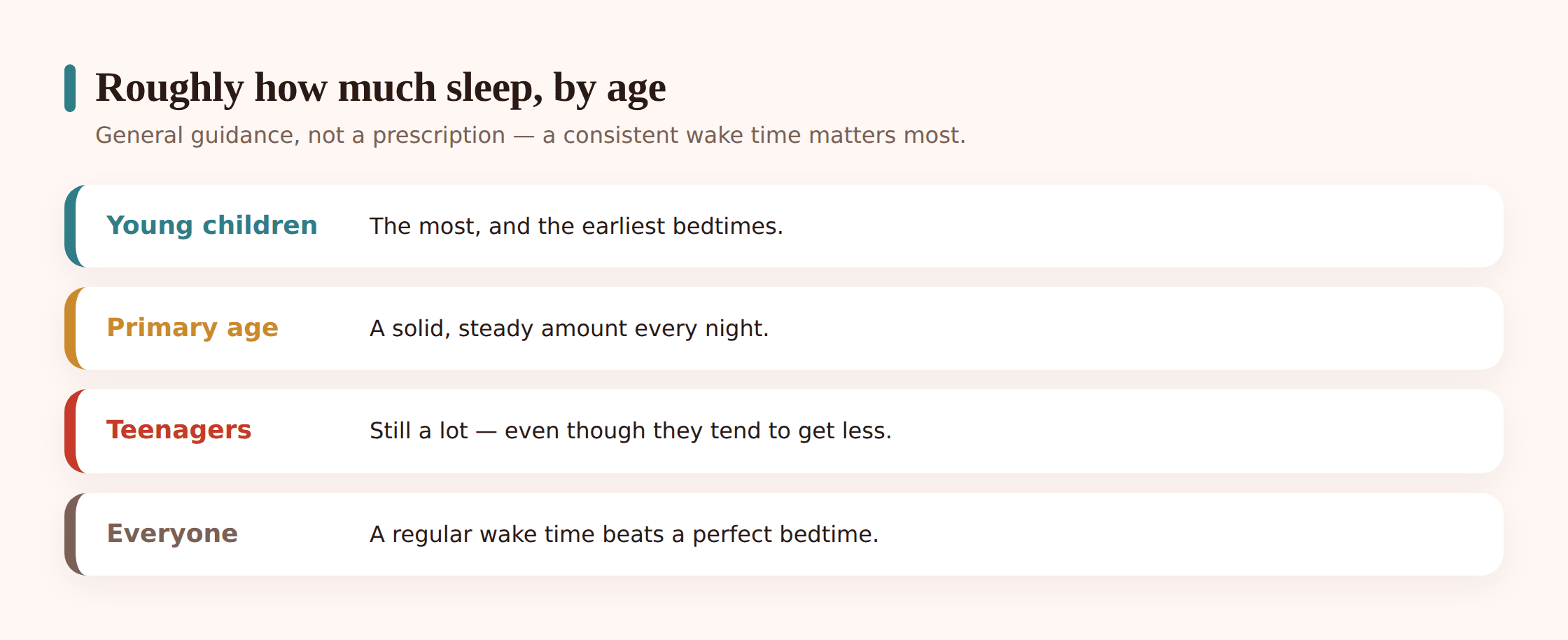
- Young children need the most — a good long night plus, for the littlest, daytime naps. This is also when a bedroom full of screens does the most damage to a routine that’s still forming. For the under-fives specifically, see Screen Time for Toddlers.
- Primary-age children need a solid, generous night. At this age bedtime is usually still yours to set, which is exactly the moment to build phone-free-bedroom habits before the teen years make it harder.
- Teenagers still need a lot of sleep, even though they’re famous for getting little. The gap between what they need and what they get is where the tired mornings live. And remember the shifted body clock — the fix is protecting the wind-down and the phone-free night, not just barking “go to bed earlier.”
Handling the bedroom fight
Almost every version of this comes down to one sticking point: “I need my phone in my room for the alarm.” It sounds reasonable, which is why it works. And nine times out of ten it isn’t really about the alarm. It’s about wanting the phone close, for the last scroll and the first check.
So solve the stated problem kindly and completely. Buy the alarm clock. Now the excuse is gone, and you can have the honest conversation: the phone charges in the kitchen so sleep gets a fair shot. Frame it as something the whole family does, yourself included, not a punishment aimed at them.
Expect some friction the first few nights. That’s normal. A phone in the bedroom is a hard habit to give up, partly because the tired-but-wired loop is real and the phone genuinely feels like relief. Hold the line gently. Acknowledge it’s annoying. Point at the charging station where your phone is sitting too. Most of the resistance fades once the better mornings show up, because a well-slept kid is a slightly happier kid, and they feel it even if they’d never admit it.
Keep it warm. This isn’t a crackdown. It’s you helping them sleep, which is one of the kindest things a parent does, even when it’s met with an eye-roll.
When to see a GP
Most sleep trouble is habit, and habits respond to the changes above. But not all of it. If your child has persistent insomnia that doesn’t budge after a few weeks of a decent routine — real trouble falling asleep or staying asleep, night after night — talk to a GP. Same if they’re exhausted despite apparently getting enough hours, or if low mood is riding along with the tiredness.
This article is about habits, not medicine, and it isn’t medical advice. Persistent sleep problems, ongoing exhaustion, or low mood are worth a proper conversation with a doctor. Trust your gut. You know your child, and if something feels off beyond ordinary teenage tiredness, get it looked at.
Better sleep tonight: a checklist
- Pick a screens-off time — a real clock time — and say it out loud tonight.
- Move the charger out of the bedroom. Tonight, not “soon.”
- Put a cheap alarm clock on the bedside table so the phone has no reason to be there.
- Set up a family charging spot, and park your own phone there too.
- Switch on Do Not Disturb or a Sleep focus so nothing pings overnight.
- Swap the last-hour scroll for a book, a shower, or a chat under low light.
- Keep the wake time steady, weekends included.
- If you want a backstop, set an evening downtime and a bedtime routine so the phone quietens itself.
FAQ
Does Night Shift or dark mode actually help my child sleep?
A little. Warmer, dimmer light in the last hour is easier on the body clock than a bright white screen. But it does nothing about the content keeping them alert, and that’s the bigger issue. Treat it as a small bonus, not the plan. Putting the phone in another room does far more.
My teen swears they need the phone as an alarm. What do I say?
Buy a cheap alarm clock, so the stated reason is genuinely solved, then agree the phone charges outside the bedroom. Most of the time the alarm was never the real reason — it’s just the most reasonable-sounding one. Solve it kindly and the conversation gets honest.
Isn’t my teenager just being difficult about bedtime?
Often not. Teen body clocks really do shift later at puberty, so they’re genuinely not sleepy when you are. Phones make that late clock later, and early school starts collide with it. Be firm about the phone, but go easy on them — the biology is real.
How long before I see a difference?
Usually within a week or two of consistent nights. The phone-free bedroom tends to work fastest because it removes the midnight pings and the 1am scroll in one move. Give it a fortnight before you decide anything isn’t working.
Should I have the same phone-at-night rules as my kids?
Yes, and it matters more than you’d think. Kids notice a parent scrolling in bed while they’re told to park theirs, and the whole thing falls apart. Charge yours in the hallway too. It’s also just good for your own sleep.
What if better sleep habits don’t fix it?
If a few weeks of a solid routine doesn’t help, and your child is still not sleeping, exhausted all the time, or low in mood, see a GP. Habits fix most sleep problems, but not all, and persistent ones deserve a proper look.