Social Media & Self-Esteem: Helping Kids With Comparison
Your child scrolls, and somewhere in that endless feed they measure themselves against everyone else. It’s a normal worry. The good news is that social media isn’t simply “bad” for a young person’s self-esteem, and there’s a lot you can do that has nothing to do with taking the phone away. Mostly it comes down to staying close, staying curious, and helping them build a life that feels good with the screen off.
The honest picture
Here’s the thing the headlines often skip: the research on social media and young people’s self-esteem is genuinely mixed. For some kids, a feed is where they find their people. A shy teenager connects with others who share a niche interest. A budding artist gets encouragement they’d never get at school. Someone going through a hard time realises they’re not alone. That’s real, and it matters.
For other kids, the same scrolling stings. The comparison bites. They come away from the phone feeling smaller than when they picked it up. And plenty of children sit somewhere in the middle, having good days and bad ones with it.
So the honest answer to “is social media bad for my child’s self-esteem?” is: it depends on the child, the moment, and what they’re doing on there. Effects vary from one kid to the next. That’s not a cop-out. It’s the most useful starting point you have, because it means your job isn’t to declare social media good or evil. It’s to notice how it’s landing for your child, and adjust from there.
None of this needs panic. Panic tends to make kids defensive and close the conversation down, which is the opposite of what helps. A calm, interested parent is worth more than any dramatic clampdown.
How feeds can dent self-esteem
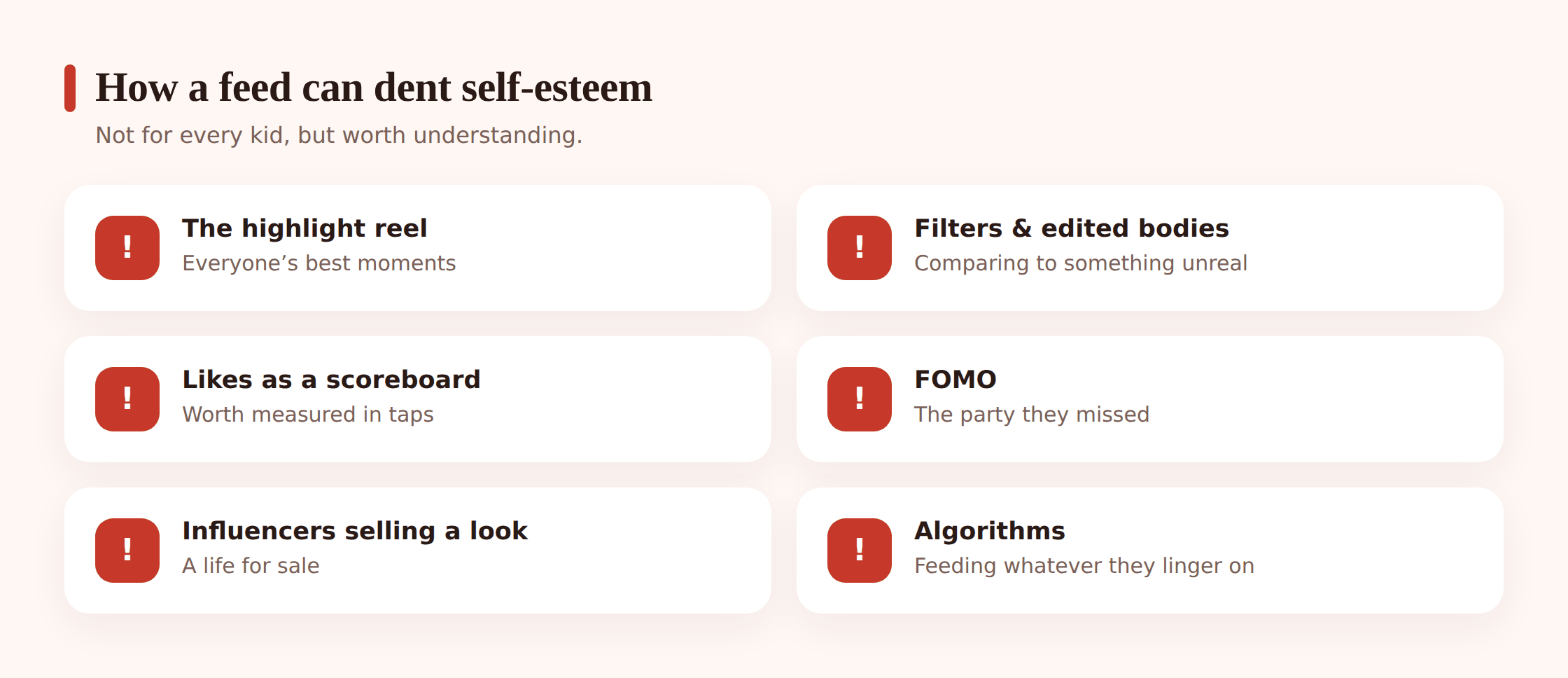
It helps to name the specific ways a feed can chip away at how a young person feels. Once your child can see the mechanics, they’re a little less at the mercy of them.
- The highlight reel. People post their best moments — the holiday, the good hair day, the party. Your child compares all of their ordinary life to everyone else’s edited best bits. It’s an unfair contest they didn’t agree to enter.
- Filters and edited images. Faces get smoothed, bodies get reshaped, skin gets perfected. A lot of what looks “natural” simply isn’t. Kids can end up chasing a version of themselves, or others, that doesn’t exist.
- Likes as a scoreboard. A number under a post can start to feel like a verdict on how much they’re liked. That’s a heavy thing to hang on a photo.
- Follower counts. Turning friendship into a running total makes social worth feel measurable — and makes some kids feel they’re falling behind.
- FOMO. Seeing the gathering you weren’t invited to, in real time, is a specific and modern kind of sting. It can make a fine evening at home suddenly feel like missing out.
- Influencers selling a look. A lot of “inspiration” is actually an advert. Someone is being paid to make a body, a lifestyle, or a face look effortless and buyable.
- Algorithms that lean in. Feeds tend to show more of whatever you linger on. If a worried kid keeps pausing on appearance content, they can quietly get served more of it. The feed isn’t trying to help them feel better; it’s trying to keep them watching.
You don’t have to lecture through all seven. But knowing them helps you spot which one is bothering your child, so your conversations can be specific rather than vague.
Who’s more vulnerable, and when
No child is uniformly at risk, but certain moments make the comparison land harder.
- Big transitions. Starting secondary school, moving house, changing friend groups. When identity is already wobbly, an unforgiving feed hits differently.
- Already feeling low. A kid who’s stressed, lonely, or down is more likely to read a feed as evidence that everyone else has it sorted.
- Late-night scrolling. Tired, alone, in the dark — this is when comparison and rumination get loudest, and when sleep gets eaten too.
- Comparing appearance. The children who focus most on how they look tend to feel the image-heavy corners of social media most sharply.
And here’s the encouraging flip side: a full, connected offline life is the buffer. A child with a couple of good friends, an activity they care about, and a home where they feel seen can scroll past a lot of comparison without it defining them. That’s where most of your effort is best spent — not on policing the feed, but on strengthening everything around it.
Gentle signs worth noticing
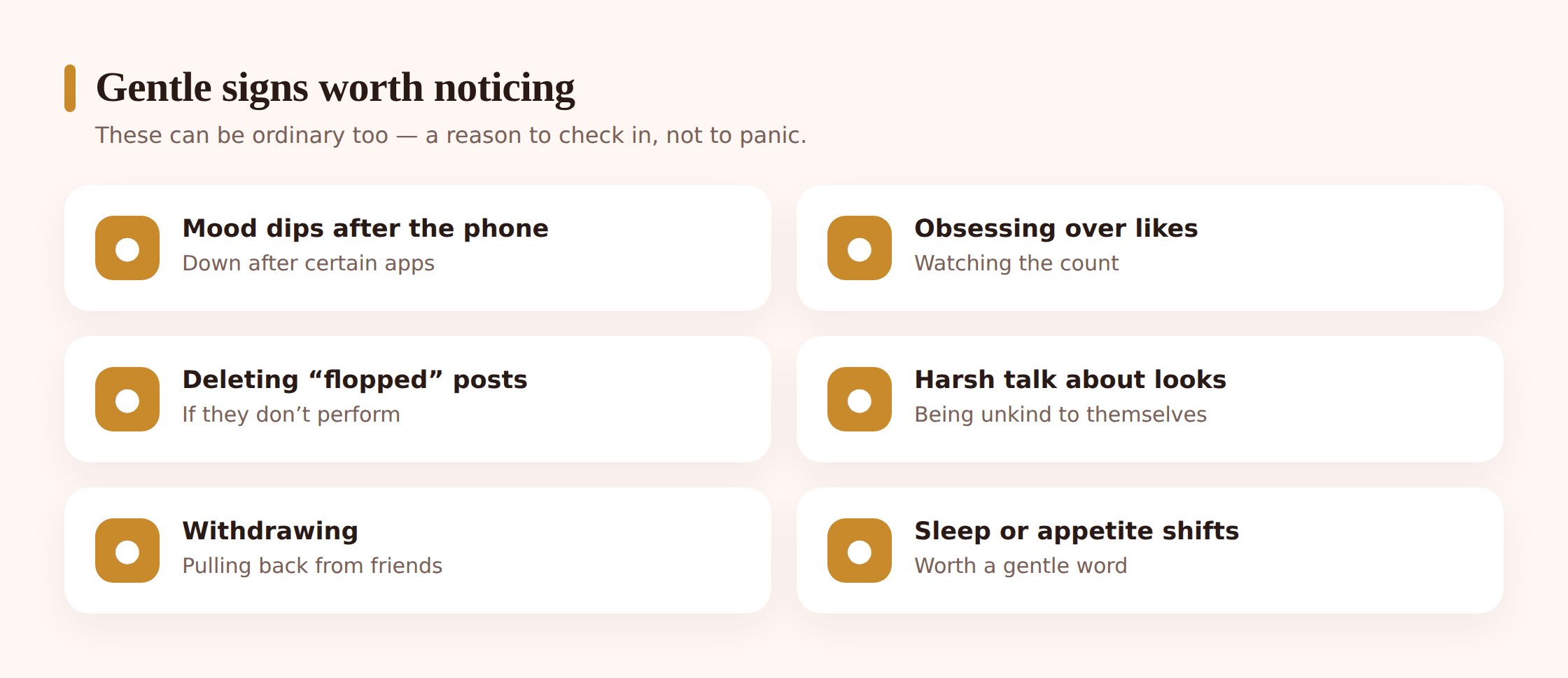
This isn’t a checklist of doom. Growing up is bumpy, and any one of these can be completely normal. Think of them as nudges to open a gentle conversation, not proof that something’s wrong.
- Mood dips that seem tied to phone use — noticeably flatter or more irritable after scrolling.
- Fixating on likes, or deleting a post that didn’t “do well.”
- Harsh self-talk about their looks, or picking apart their own photos.
- Pulling back from friends, hobbies, or family time they used to enjoy.
- Changes in eating or sleep. Keep this high-level in your own mind — the point isn’t to diagnose, it’s to notice a shift and lean in with support.
One or two of these, on and off, is just being a young person. A cluster that sticks around, or a change that worries your gut, is worth a closer look and a warmer conversation. If eating or body image is part of the picture and it’s not settling, that’s a good moment to bring in a professional rather than to manage it alone — more on that below.
Ways to help
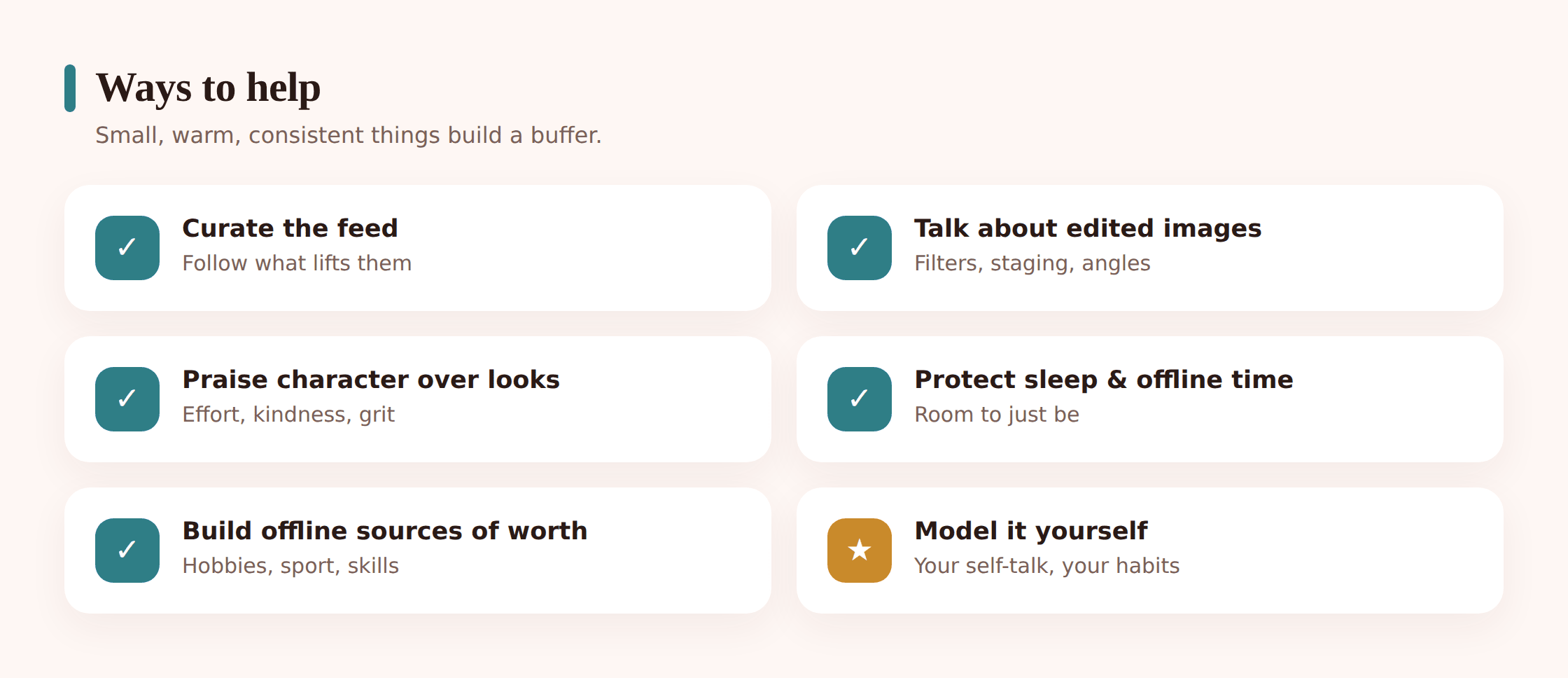
You have more influence here than any app does. These aren’t quick fixes; they’re the steady stuff that adds up.
- Keep the conversation open and non-judgemental. If your child expects a lecture, they’ll stop telling you things. Be genuinely curious about what they like on there, not just what worries you.
- Help them curate the feed. This is one of the most powerful moves. Sit together and follow accounts that lift them — the ones that leave them inspired or laughing. Mute or unfollow the ones that leave them flat. They control more of that feed than they realise.
- Talk about how images are made. Filters, angles, lighting, staging, edits, sponsorships. Media literacy takes the sting out. “That’s a paid photo shot forty times with a filter” is a surprisingly protective sentence.
- Praise effort and character over looks. What you notice out loud shapes what your child values. Kindness, persistence, curiosity, humour — name those more than appearance.
- Protect sleep and phone-free time. Getting phones out of bedrooms overnight is one of the highest-value changes a family can make. Late-night scrolling is where a lot of the damage clusters.
- Build offline sources of worth. Hobbies, friendships, sport, a skill they’re getting good at. The more a child’s identity rests on real things they do and people who know them, the less a number on a screen can shake it.
- Model it yourself. Kids clock how you talk about your own body, how you react to your own phone, whether you can put it down at dinner. Your example is teaching whether you mean it to or not.
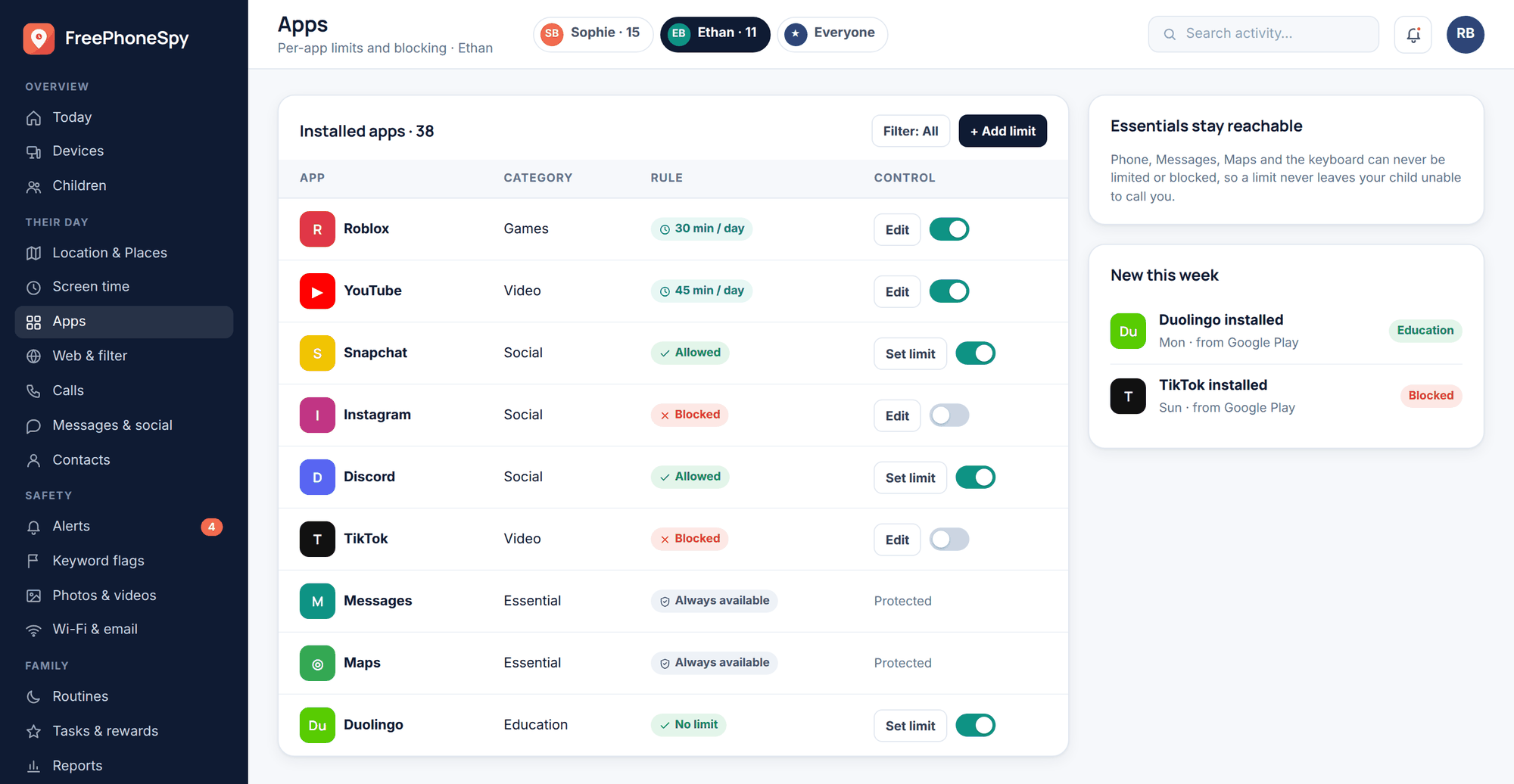
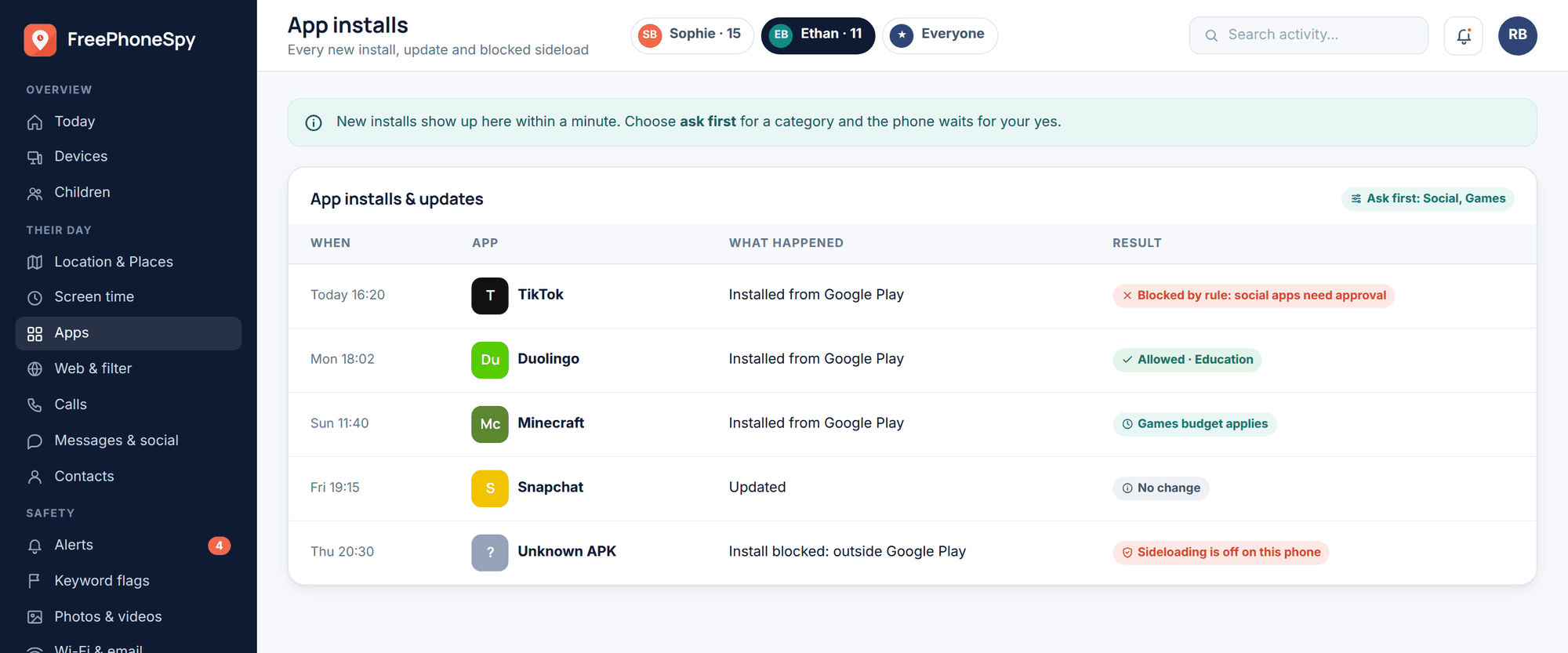
- Use screen-time budgets to make breathing room. Sometimes a feed just needs an off-switch so the day has space in it. On Android, FreePhoneSpy lets you and your child agree app limits and screen-time budgets openly through a web panel — a shared boundary, set together, not a secret. It won’t build self-esteem, but a bit of breathing room from the scroll can make the rest of this work easier.
For the practical side of budgets and limits, our screen time guide walks through sensible defaults, and managing notifications and focus covers cutting the pings that pull kids back to the feed. If the whole family could use a reset, a family digital detox is a friendly way to do it together rather than singling anyone out.
What to actually say
Big sit-down talks rarely work. Small, low-pressure openers do, usually while you’re doing something else — driving, washing up, walking the dog. A couple that tend to land:
- “Who’s your favourite person to follow right now? What do you like about them?” — starts positive, and tells you a lot.
- “Does your feed ever make you feel a bit rubbish? Mine does sometimes.” — naming that you feel it too makes it safe for them to admit they do.
Notice both openers are curious, not corrective. You’re trying to understand their world, not to catch them out. When a child feels understood rather than judged, they keep the door open — and an open door is the thing that protects them most.
When to get help
Most wobbles pass with time, sleep, and a parent who’s paying attention. But some things deserve more than a home chat. Reach out to a professional if your child’s low mood is persistent rather than passing, if they’re withdrawing from most of the things they used to enjoy, if changes in eating or sleep are significant and lasting, or if your instinct simply tells you something’s not right. You don’t need to wait until you’re certain. Asking early is a strength, not an overreaction.
Where to turn for support. Your GP is a good first stop and can point you to the right help. A school counsellor or pastoral lead often already knows your child and can support them day to day. If you’re worried between appointments, a helpline can talk things through with you. And if body image or eating is part of what’s going on, the National Alliance for Eating Disorders offers guidance and support for families — reaching out to them early is a sensible, caring step, not an overreaction.
None of this is a job you have to do alone, and none of it means you’ve failed as a parent. Kids grow up in a genuinely tricky media environment. Getting the right people around your child is part of good parenting, not a sign you got it wrong.
If you want to go deeper on the wider context, phones and teen mental health takes the balanced long view, social media safety for kids covers the practical protections, and is Instagram safe for kids looks closely at one of the platforms comparison lives on.
Above all, remember this: your steady, interested presence matters more than any app setting or clever boundary. Kids don’t need a perfect parent who blocks every bad thing. They need one who notices, who asks, who’s there. The small consistent stuff — the check-in, the shared laugh at a ridiculous filter, the phone-free dinner — quietly does the heavy lifting. Keep showing up, and you’re already doing the most important part.
FAQ
Is social media the reason my child’s confidence has dropped?
Maybe part of it, maybe not. Confidence dips for lots of reasons at this age — school, friendships, growing up, sleep. Social media can amplify comparison, but it’s rarely the whole story. Look at the fuller picture, and if the dip is lasting, talk to your GP.
Should I just ban social media to protect their self-esteem?
A blanket ban often backfires — it can push use underground and cut off the good parts, like friendship and belonging. For most families, teaching your child to use it well, plus sensible limits agreed together, works better than a total ban.
Do likes and followers really affect kids that much?
For some kids, quite a bit; for others, hardly at all. If your child seems to ride the highs and lows of a like count, that’s a good cue to talk about where their worth really comes from — and to gently take the scoreboard less seriously together.
My teen has an iPhone — can FreePhoneSpy help?
FreePhoneSpy works on Android child phones. For an iPhone, use Apple’s own Screen Time and Family Sharing tools, which cover app limits and downtime. The parenting approach in this article works whatever the device.
Won’t monitoring damage the trust I’m trying to build?
Only if it’s secret. Done openly — sat down together, explained, agreed — limits become a shared boundary rather than surveillance. That builds trust. Covert monitoring is a different thing entirely, and we don’t recommend it. Set it up together from the start.
How do I help without making my child self-conscious about it?
Keep it light and ongoing rather than one heavy talk. Curate the feed together, laugh at obvious edits, praise the non-appearance stuff, protect sleep. Most of the good work looks like ordinary family life, not an intervention.