When Gaming Becomes a Problem: A Parent’s Guide to Gaming Addiction
Most kids who love games are fine. They play too long sometimes, they moan when you call them for dinner, and they’d happily skip a shower to finish a match. That’s not addiction — that’s being a kid who found something they enjoy. But once in a while the balance tips, and gaming stops being one part of a full life and starts eating the rest of it. This guide is about telling the two apart calmly, without panic and without declaring war on the console.
Loving games isn’t the same as a problem
Here’s the thing most gaming-panic articles skip: enthusiasm is not a symptom. A twelve-year-old who talks about Minecraft redstone circuits at the dinner table, or a teenager who plans their Saturday around a raid with the same four friends they’ve had since primary school, is doing something healthy. Games are where a lot of childhood socialising happens now. They’re where kids collaborate, fail, try again, and feel competent. Loving them a lot is normal.
A problem looks different, and the difference is about function, not hours. The question isn’t “how long does she play?” It’s “what is the gaming pushing out?” A kid can play two hours a night and be thriving — homework done, friends seen, sleeping fine. Another can play the same two hours and be quietly falling apart around the edges. The clock alone won’t tell you which is which. What tells you is whether the rest of their life is still running.
So keep that frame as you read on. You’re not looking for gaming. You’re looking for gaming that has started to cost more than it gives.
The warning signs worth watching
No single one of these means your child has a problem. Kids are moody, they push back on limits, and a rough patch at school can look like a lot of things. What matters is the pattern — several of these, together, over weeks rather than days, getting worse rather than settling down.
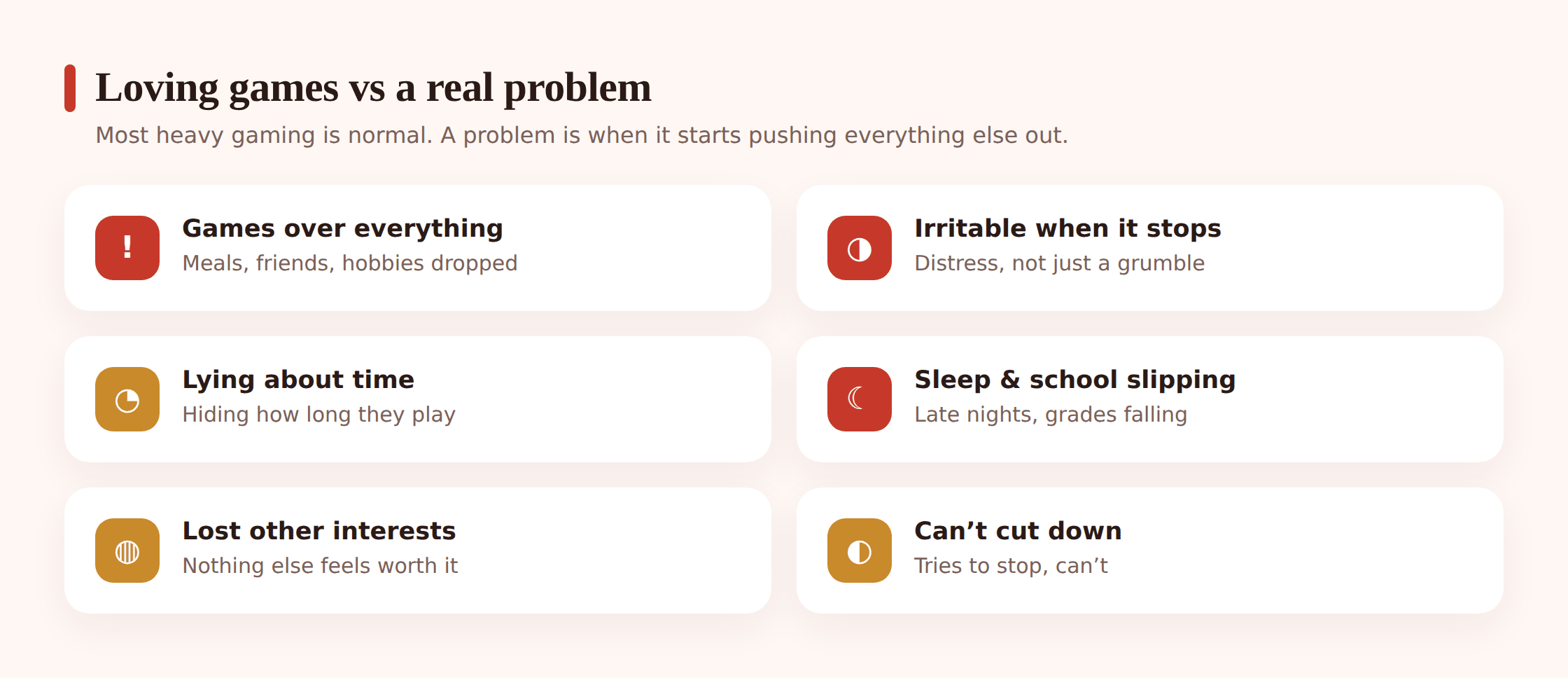
Gaming wins against everything else
The thing that used to matter — football, drawing, a best friend, a favourite show — quietly gets dropped, and the game is what’s left. When given a genuine free choice, they choose the game every time, even over things they used to love. That narrowing is one of the clearest signals.
Real distress when they stop
Every kid grumbles when you end screen time. That’s ordinary. What’s different is a reaction that looks out of proportion — genuine agitation, low mood, restlessness, or anger that lingers long after the console is off. If the come-down from stopping looks like real distress rather than a five-minute strop, take note.
Lying and hiding the time
Playing after they said they’d stopped. Sneaking the phone into bed. Getting cagey or defensive when you ask a simple question about it. When a kid starts covering their tracks, part of them already knows the amount doesn’t feel okay — and that’s worth a gentle conversation, not a search of their room.
Sleep and school slipping
Up too late because “the match wasn’t finished.” Exhausted in the mornings. Homework half-done or forgotten. Grades sliding, or a teacher mentioning they’re switched off in class. Sleep is often the first domino, and it knocks over concentration, mood and appetite behind it. Our note on phones and teen mental health digs into why the late-night hours matter so much.
Losing interest in the rest of life
Not wanting to go out. Turning down things they’d normally jump at. A flatness or irritability when they’re not gaming, as though the real world has gone grey by comparison. When the game becomes the only reliable source of feeling good, everything else can start to feel like a chore.
Why some games are built to be sticky
It helps to understand that your child is not weak-willed, and neither are you. Many games — especially free-to-play mobile and online ones — are engineered by talented teams whose actual job is to keep people playing as long as possible. Knowing the tricks makes them far less powerful, so it’s worth naming them plainly.
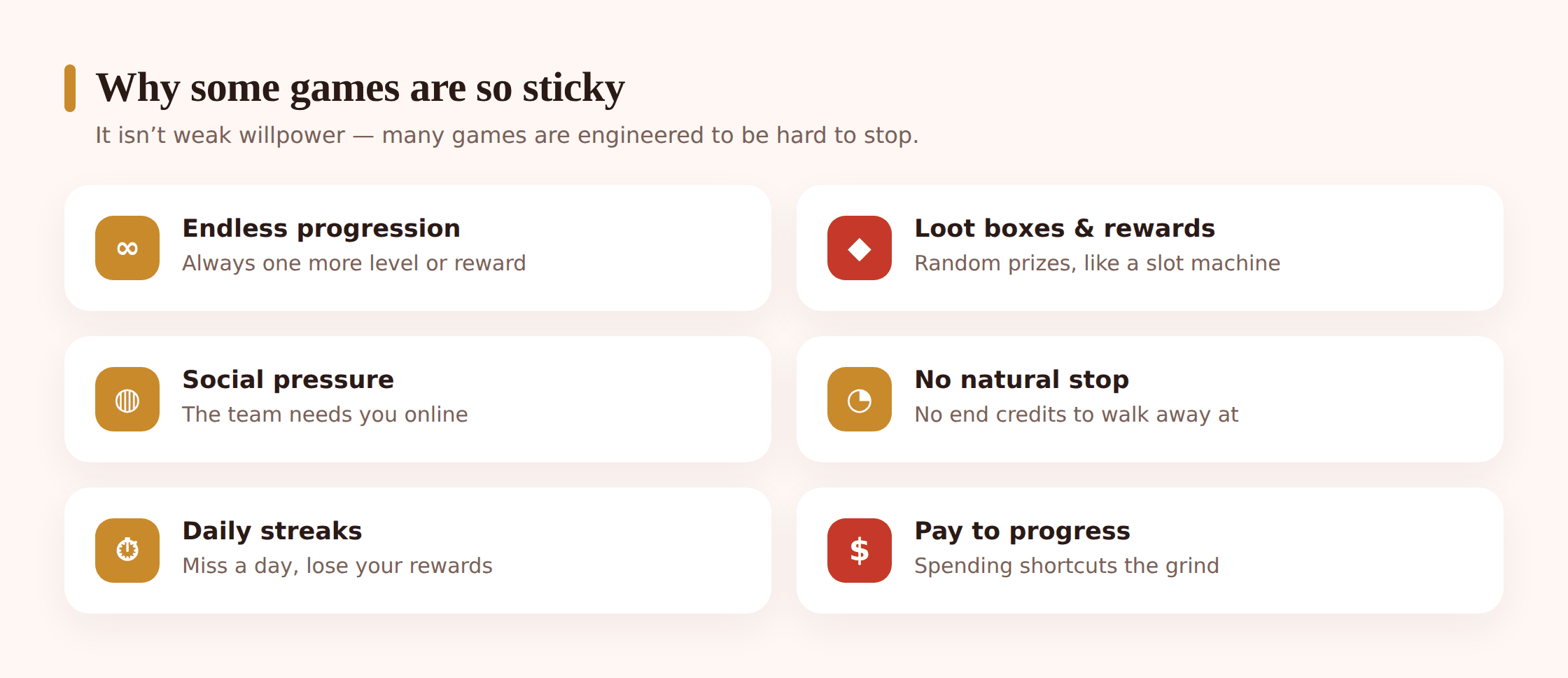
There’s no natural finish line. An old board game ends. A film rolls credits. Many modern games are built specifically to never conclude — a fresh season, a new battle pass, daily challenges that reset at midnight. The moment you might naturally stop, the game hands you a reason to keep going.
The rewards are unpredictable on purpose. Loot boxes, random drops and surprise unlocks work on exactly the same principle as a fruit machine: you don’t know when the good thing is coming, so you keep pulling the lever. That variable reward is one of the most powerful hooks in psychology, and it’s baked into games your ten-year-old plays. We cover the money side of this in more detail in our guide to in-app purchases and loot boxes.
Progress is endless and always just out of reach. Levels, ranks, streaks, XP bars that fill and reset. There’s always a next tier, and it’s always designed to feel close. Stopping means “wasting” the progress you’ve made, which makes putting it down feel like a small loss rather than a neutral choice.
The social pressure is real. When your child’s friends are all online at 8pm, logging off means missing out — not on the game, but on their friends. The fear of being left out, of letting the team down, of not being there for the thing everyone talks about tomorrow, is a genuine social cost. “Just quit” underestimates how much is actually on the line for them.
None of this makes the games evil, and none of it means your child is doomed. But it does mean that “why don’t you just stop?” is the wrong question. The game is working exactly as designed. The job is to add the natural stopping points the game deliberately left out.
What “gaming disorder” actually means
You may have seen headlines about the World Health Organization recognising “gaming disorder.” That’s real — it’s in their international classification of diseases — and it’s worth understanding in balanced terms, because the headlines tend to lose the balance.
The WHO’s definition is deliberately narrow. It describes a pattern where someone loses control over gaming, gives it increasing priority over other interests and daily activities, and keeps escalating despite clear negative consequences — and, crucially, where this has gone on for a sustained period (generally around a year) and is causing significant harm to their family life, schooling, or wellbeing. In other words, it’s not “plays a lot.” It’s “gaming has taken over, for a long time, and it’s clearly damaging things.”
By that bar, genuine gaming disorder is rare. The overwhelming majority of heavy gaming — even the kind that worries parents — is not a disorder. It’s a habit that’s got a bit out of balance, often during a stressful stretch, and it responds well to ordinary parenting: clearer routines, more competing activities, and some honest conversation. The clinical label exists for the small number of cases where that isn’t enough, not as a diagnosis to hang on any kid who games past bedtime.
Rebuilding balance without a war
The instinct, when you’re worried, is to pull the plug — confiscate the console, kill the wifi, ban the game. It almost never works. It turns you into the enemy, teaches your child to hide their gaming rather than manage it, and skips the actual skill you want them to build: stopping on their own. A slower, warmer approach lasts longer.
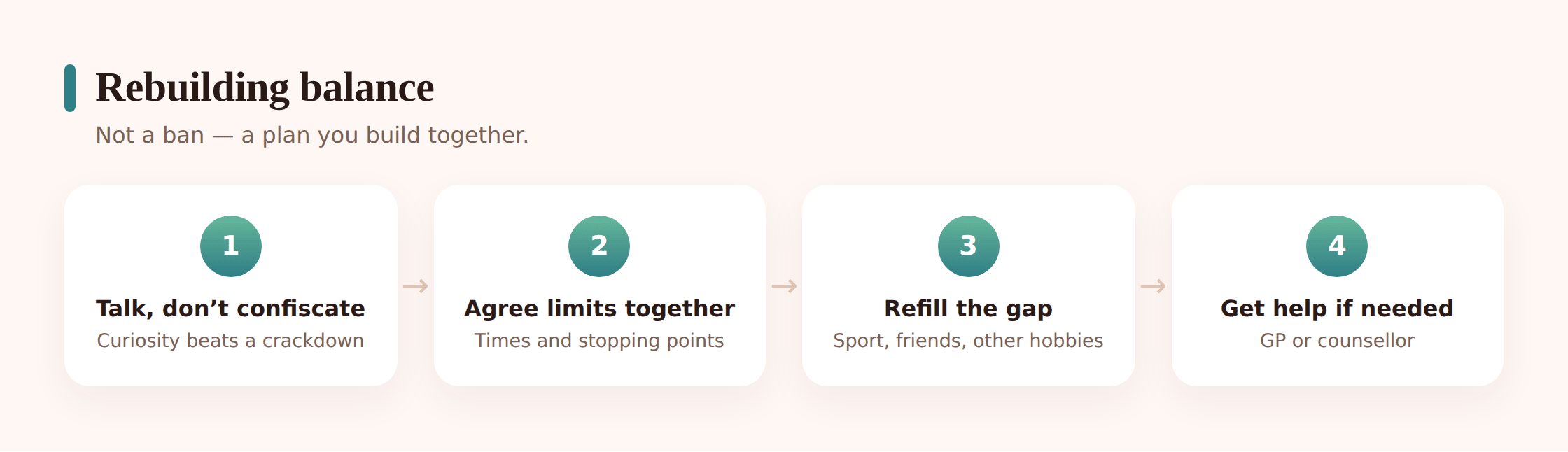
1. Start by getting curious, not cross
Before you set any limit, ask them about the game. What do they love? Who do they play with? What are they good at? You’ll learn what needs to be replaced if you cut the gaming down — the friendships, the sense of being skilled at something, the way it helps them switch off after a hard day. You can’t rebuild a balance you don’t understand.
2. Name the specific problem, not “gaming”
“You game too much” is vague and feels like an attack. “You’ve been up past midnight three nights this week and you’re wiped out at school” is a specific, shared problem you can both look at. Point at the cost — the sleep, the missed homework, the flatness — rather than the activity itself.
3. Build the limits together
A rule your child helped design is one they’ll actually follow. Agree on the shape of it — school nights versus weekends, a stop time that protects sleep, a clear “we eat dinner as a family, phones away” window. Let them have real input on where the lines go. They’ll defend a plan they co-wrote far harder than one you imposed.
4. Give the stopping points the game left out
Because the game won’t provide a natural end, the environment has to. A visible countdown, a house rule that the console goes off at a set time, a docking spot where phones sleep overnight outside the bedroom. Making the boundary about the clock and the room, rather than about you nagging, takes the heat out of it. Our family digital detox guide has more on building these into a routine that holds.
5. Fill the space with something real
Cutting gaming down leaves a hole, and boredom pulls kids straight back to the screen. So don’t just subtract — add. A sport, a club, a weekend job, time with friends face to face, a family thing on a fixed evening. The goal isn’t less gaming for its own sake; it’s a fuller life that gaming is one part of.
6. Expect pushback, and hold steady kindly
The first week or two of a new limit is usually the worst. There’ll be arguing, sulking, testing whether you mean it. That’s normal, and it passes. Stay warm, stay consistent, and don’t mistake the strop for proof that the limit is wrong. Firm and kind at the same time is the whole trick.
When and where to get help
Most families sort this out at home with patience and a few new routines. But sometimes gaming is the visible edge of something bigger, and that’s when outside help is the kind, sensible move — not a failure.
Think about reaching out to a professional if, after a genuine effort at home, you’re seeing things like: the gaming keeps escalating no matter what you try; your child seems genuinely unable to stop even when they say they want to; there are signs of real depression or anxiety underneath — persistent low mood, withdrawal from everyone, talk of hopelessness; or gaming is being used to escape something painful like bullying, grief, or trouble at school. In those cases the game usually isn’t the real problem — it’s the thing masking one.
Good first stops are ordinary and accessible. Your GP or family doctor can talk things through and point you toward the right support. A school counsellor often knows your child in a setting you don’t see and can help quietly. A psychologist or family therapist can work with a child who’s using gaming to cope with anxiety or low mood, and with the family around them. You don’t need a dramatic crisis to justify asking — “I’m a bit worried and I’d like some guidance” is a perfectly good reason to book an appointment.
Healthy habits that stick
Prevention is mostly unglamorous and it works. The families who rarely hit a crisis are usually the ones who built a few quiet defaults early and kept them boring and consistent.
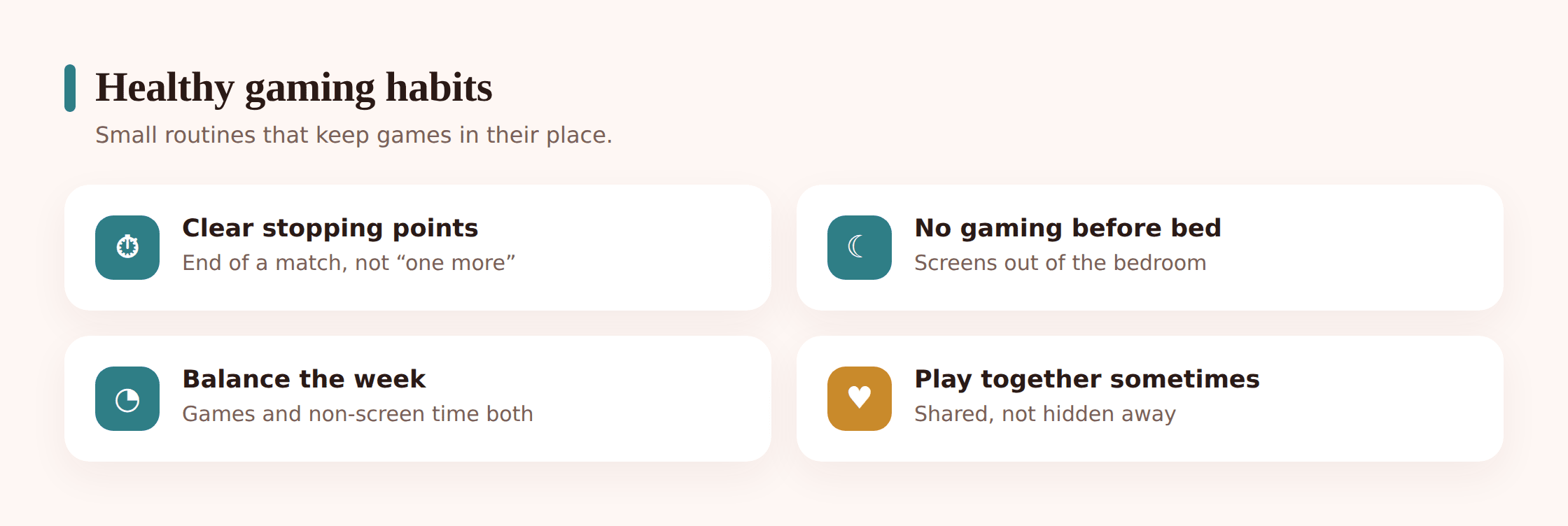
- Protect sleep above all. Screens out of the bedroom overnight, and a stop time that leaves room to wind down. Sleep is the first thing gaming eats and the most important thing to defend.
- Keep gaming social and visible. The console in a shared space, not behind a closed door, keeps it part of family life rather than a private world you can’t see into.
- Guard the anchors. Family dinner, weekend mornings, one screen-free evening — a few fixed points the week is built around, phones away.
- Model it yourself. If you’re on your own phone all evening, the limits land badly. Kids copy what you do far more than what you say.
- Praise the stopping, not just the playing. When they log off on time without a fight, notice it out loud. Managing your own limits is a skill worth catching them getting right.
- Keep talking. Regular, low-key check-ins beat one big dramatic confrontation. Ask about the games the way you’d ask about their friends — because increasingly, they’re the same thing.
Balance isn’t a destination you reach once. It drifts, especially when a big new game lands or life gets stressful, and you nudge it back. That’s not failure — that’s just the ongoing, ordinary work of raising a kid in a world full of things designed to hold their attention. If you’d like the wider picture on managing screens across the family, our online gaming safety guide covers the practical settings side.
Is my child addicted to gaming?
Almost certainly not, in the clinical sense — genuine gaming disorder is rare. Playing a lot, even loving it intensely, isn’t addiction. The question that matters is whether gaming is pushing the rest of their life out: sleep, school, friends, other interests. If those are still running, you likely have an enthusiastic gamer who needs clearer limits, not an addict. If they’re steadily collapsing over weeks and nothing you try helps, that’s when to talk to a professional.
How much gaming is too much?
There’s no magic number of hours, which is frustrating but true. A kid who games two hours a night and sleeps well, does their homework and sees friends is fine; another who games the same amount but is exhausted, withdrawn and falling behind is not. Judge by function, not the clock. If gaming fits around a full life, the amount is probably okay. If it’s crowding that life out, it’s too much — whatever the number says.
Should I ban games completely?
Usually no. An outright ban tends to backfire — it makes gaming forbidden and thrilling, turns you into the enemy, teaches your child to hide it, and skips the skill you actually want them to learn, which is stopping on their own. Clear, agreed limits with real stopping points work far better than prohibition. The exception is a specific game that’s genuinely harmful for their age, which is a different, narrower decision.
Why does my child get so angry when I stop them?
Partly it’s the game’s design — being pulled away mid-match can mean losing progress or letting friends down, which feels like a real cost. Partly it’s that games are stimulating, and the drop back to ordinary life feels flat by comparison. A short come-down grump is normal. Anger that’s genuinely out of proportion, or that lingers for a long time after every session, is worth watching as one possible sign among several.
When do we actually need professional help?
When you’ve made a real effort at home and the gaming keeps escalating anyway; when your child genuinely can’t stop even though they want to; or when you can see something painful underneath it — depression, anxiety, bullying, or gaming being used to escape. Start with your GP, a school counsellor, or a psychologist. You don’t need a crisis to justify asking for guidance — mild worry is reason enough to book an appointment.
Could the gaming be hiding a bigger problem?
Often, yes — and this is the most useful question a worried parent can ask. Heavy gaming frequently spikes when a child is anxious, low, lonely, or struggling with something at school. The game becomes the place where they feel competent and calm when the rest of life feels hard. If that fits, the answer isn’t just less gaming; it’s finding and supporting whatever the gaming is helping them cope with, which is exactly where a professional can help.