Phones and Teen Mental Health: A Parent’s Guide
If you’ve ever glanced at your teen glued to their phone at 11pm and felt a small knot of worry, you’re not alone. Most parents feel it. The good news is that the picture isn’t as bleak as the headlines suggest, and the things that help most are smaller and more doable than you’d think.
Phones aren’t simply good or bad for teenagers. Researchers are still debating exactly how much screens shape mood, and honest answers usually start with “it depends.” What a teen does on their phone, how late they’re on it, who they talk to, and what else is going on in their life all matter. So this isn’t a guide about taking phones away. It’s about understanding the real worries, spotting the signs that deserve a gentle check-in, and building a few habits that protect sleep and wellbeing.
What the worry is really about
When people say phones are bad for teens, they usually mean a handful of specific things. It helps to name them, because each one has a different answer.
Lost sleep. Late-night scrolling steals hours that a growing brain needs. This is probably the clearest link of all, and it’s the easiest to change.
Comparison. Feeds are highlight reels. Scrolling through everyone else’s best moments can quietly chip at how a teen feels about their own life, body, or friendships.
Doomscrolling. Bad news and upsetting content keep loading, and it’s hard to stop. A low mood and an endless feed can feed each other.
Less in-person time. Hours on a screen are hours not spent kicking a ball, seeing friends face to face, or just being bored enough to get creative.
Cyberbullying that follows them home. A phone means the schoolyard never really closes. Something cruel can reach your teen at midnight in their own bedroom.
All real. But here’s the honest counterpoint that rarely makes the headlines: phones also connect teens to their friends, let them create and share, help shy kids find their people, and give isolated teens a lifeline to communities that get them. For a lot of young people, the phone is where friendship lives. The research is genuinely mixed, and most careful studies land on the same quiet conclusion: it’s less about how many hours and more about how those hours are spent. A teen messaging close friends and editing videos is having a very different experience from one silently comparing themselves to strangers at 1am.
So the goal isn’t zero screen time. It’s steering the how, protecting sleep, and staying close enough to notice when something’s off.
Sleep first: the clearest, most fixable problem
If you only change one thing, change what happens at night. Sleep is where the strongest, least-disputed link sits, and it’s the one you can actually fix this week. Teens need a lot of sleep, and phones are brilliant at stealing it. One more video, one more reply, and suddenly it’s past midnight and the alarm is set for seven.
Tired teens are more irritable, more anxious, and less able to cope with the ordinary knocks of the day. Poor sleep can look a lot like a mood problem, and often it partly is one. The fix isn’t dramatic. It’s a boundary around the night.
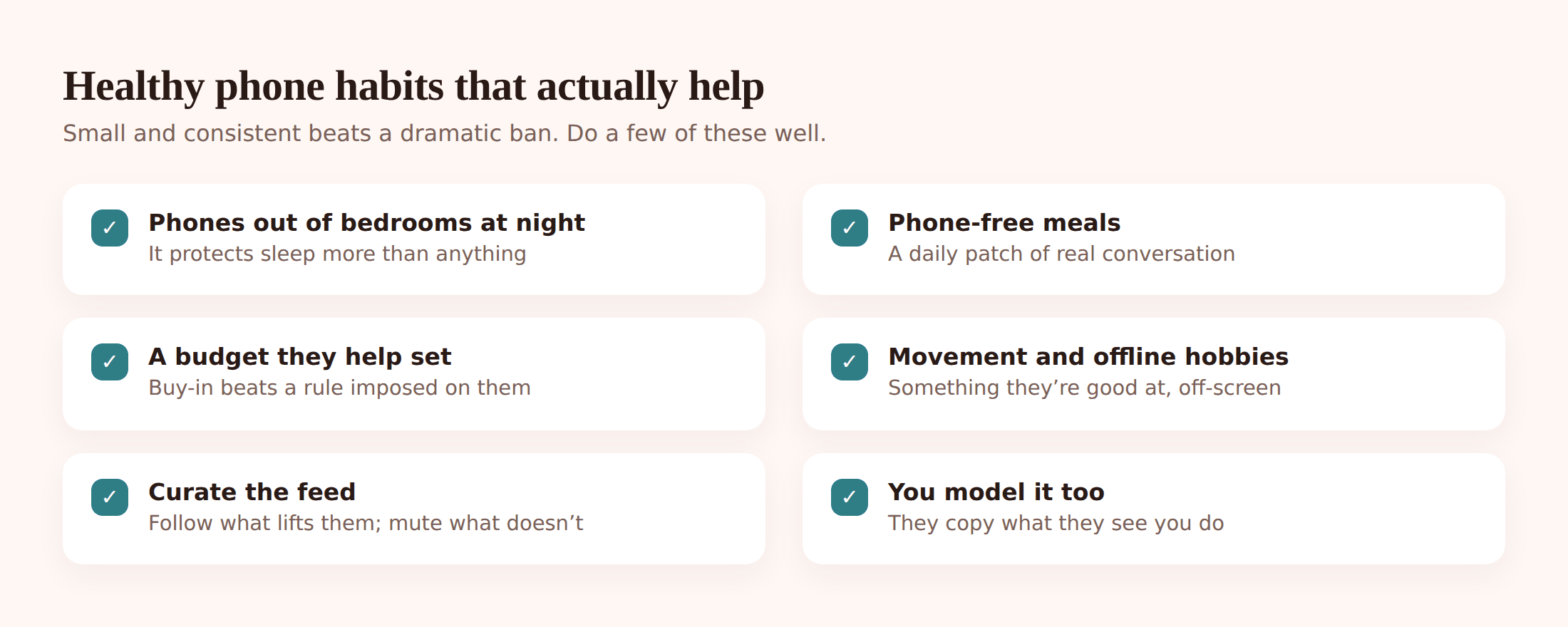
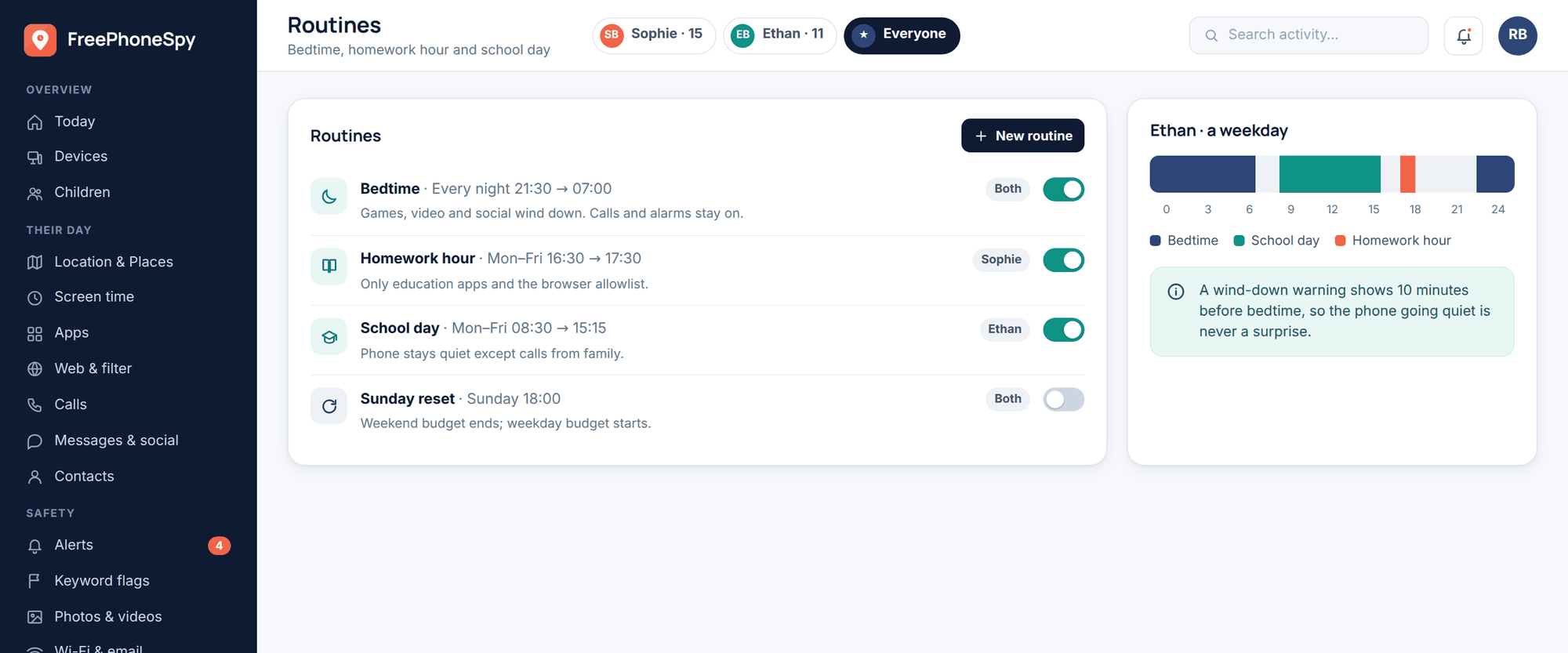
The habit that helps most: the phone winds down at a set time and parks somewhere outside the bedroom overnight. A kitchen counter, a hallway shelf, anywhere but under the pillow. Charge it there. Buy a cheap alarm clock so “I need it to wake up” stops being the reason it stays in bed. Try it for two weeks and watch what happens to the mornings.
This is exactly where phone tools earn their keep, not as a fix for anything deep, but as gentle scaffolding for a good habit. A bedtime routine that winds the phone down and parks it overnight takes the nightly negotiation off your plate. FreePhoneSpy can help set that rhythm on an Android phone from a simple web panel, so the phone quiets down at bedtime on its own. It supports the habit; it doesn’t replace the conversation about why sleep matters.
Social comparison and the feed
Social media isn’t one thing. Messaging a best friend feels good. Scrolling a stranger’s flawless holiday photos at midnight often doesn’t. The difference is connecting versus comparing, and it’s worth helping your teen notice which one they’re doing.
Curated feeds show the edited, filtered, best-angle version of everyone’s life. Adults know this and still fall for it. Teens, whose sense of self is still forming, feel it more sharply. It can quietly shape how they see their own body, their popularity, their worth.
The practical move isn’t quitting social media. It’s curating the feed. Sit with your teen and look at who they follow. Which accounts leave them feeling worse? Unfollow or mute those, no drama. Which ones make them laugh or teach them something? Keep those. A feed full of friends, interests, and creators they actually like is a healthier place to spend time. Regular breaks help too — a day off, a weekend away from a particular app — not as punishment, just as a reset.
Our guide to social media safety goes deeper on settings and boundaries by platform. And screen time by age can help you gauge what’s reasonable as they grow.
Signs worth noticing
This section comes with a big caveat: teenagers are moody, private, and changeable by nature. A grumpy week or a slammed door is usually just being a teenager. So read the list below as prompts for a gentle check-in, not a diagnosis or a reason to panic.
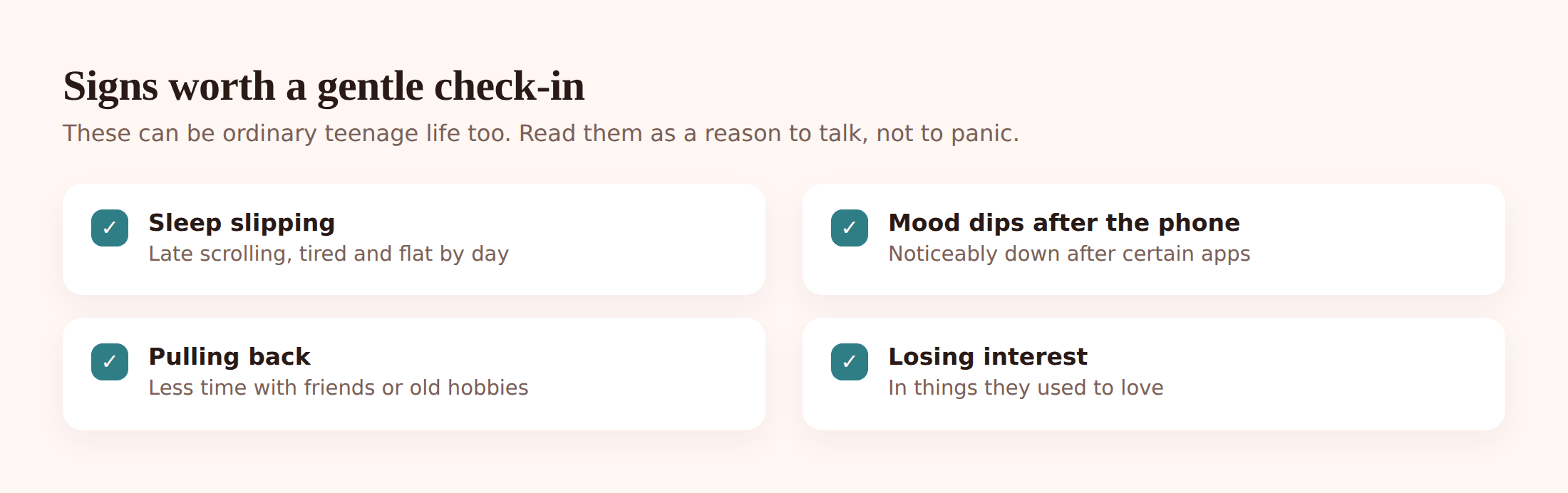
Things that are worth paying attention to, especially when several show up together or last more than a couple of weeks:
- Mood that dips sharply during or right after phone use
- Pulling away from friends, family, or activities they used to enjoy
- Changes in sleep or appetite that stick around
- Losing interest in things that used to light them up
- Seeming more anxious, secretive, or on edge about their phone specifically
- Big shifts in energy, or a sadness that doesn’t lift
Here’s the honest part: every one of these can be ordinary teen life, and every one can also be a sign to lean in. You don’t have to know which it is. Your job isn’t to diagnose. It’s to notice, stay close, and ask. If something feels off to you as a parent, that instinct is worth trusting enough to start a conversation.
And notice how the useful signs are about your teen — their mood, their sleep, their spark — not about what’s on their screen. Reading their messages behind their back rarely tells you what checking in warmly will. If you do want a fuller sense of what “concerning” looks like, we’ve written about the signs a child’s phone use might need a closer look. Just remember that talking beats surveillance almost every time.
Healthy habits that actually help
You don’t need a dramatic overhaul. Small, consistent habits do more than a big ban that collapses after a fortnight. Pick one or two of these and let them settle before adding more.
- Phone-free meals. One meal a day where everyone’s phone is away, adults included. It’s where a lot of real talk happens.
- Bedrooms are phone-free at night. The single biggest win. Park it outside the room and protect the sleep.
- Screen-time budgets they help set. A limit your teen helped choose is one they’ll actually keep. Sit down together and agree on it, rather than imposing it.
- Movement and offline hobbies. Sport, music, drawing, a job, a friend’s house. The point isn’t less screen for its own sake; it’s more of the other good stuff.
- Model it yourself. Teens notice when a parent lecturing about phones is scrolling at dinner. Your habits set the ceiling. Put yours down too.
- Protect downtime. Boredom isn’t the enemy. Some unstructured, un-scrolled time is where creativity and calm come from.
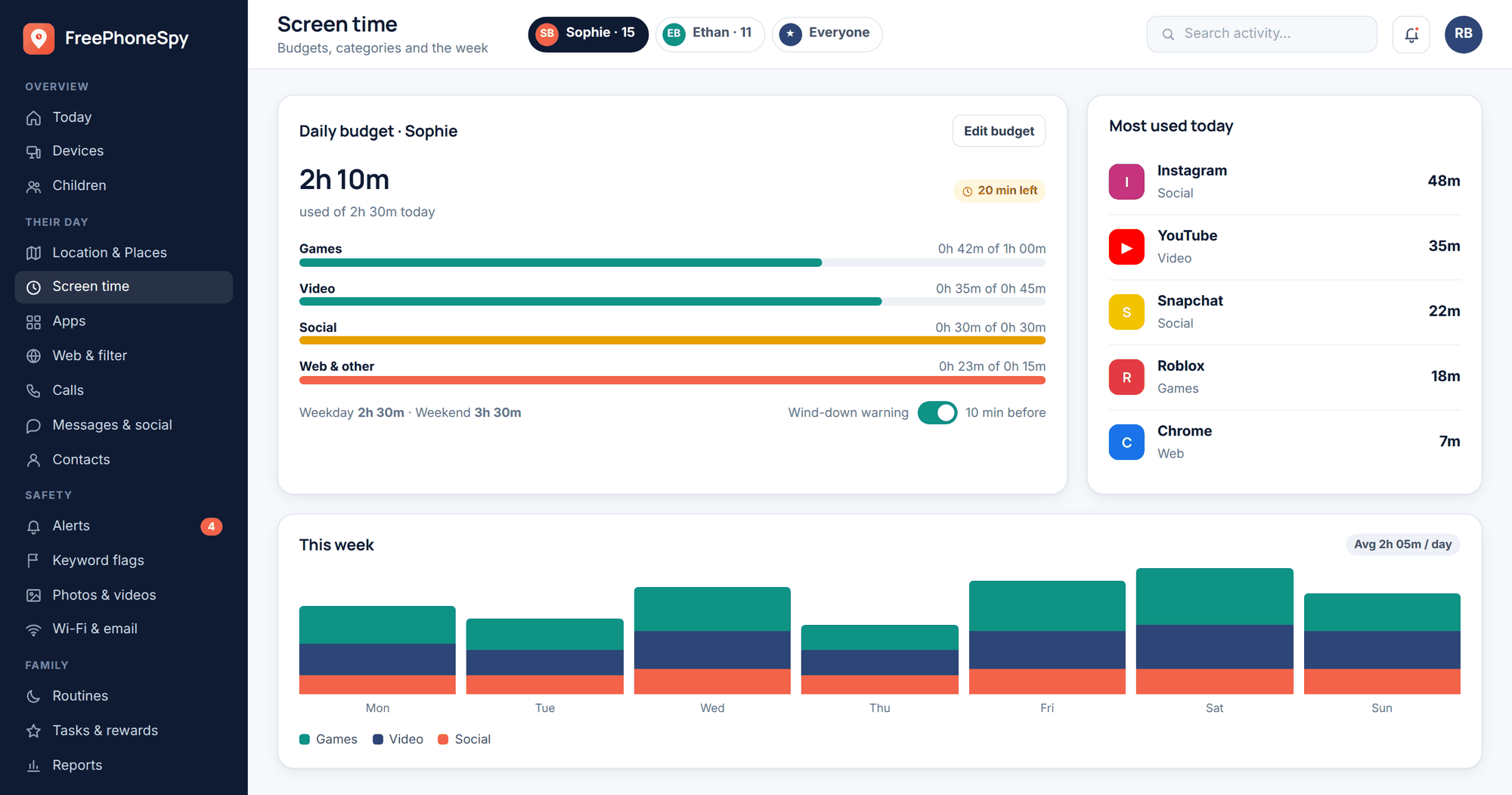
Tools can make the good habits easier to keep. On an Android phone, a screen-time budget and app limits mean the boundary you agreed on holds even when willpower runs low late in the evening. Set it together, let your teen see it, and treat it as a shared plan rather than a leash.
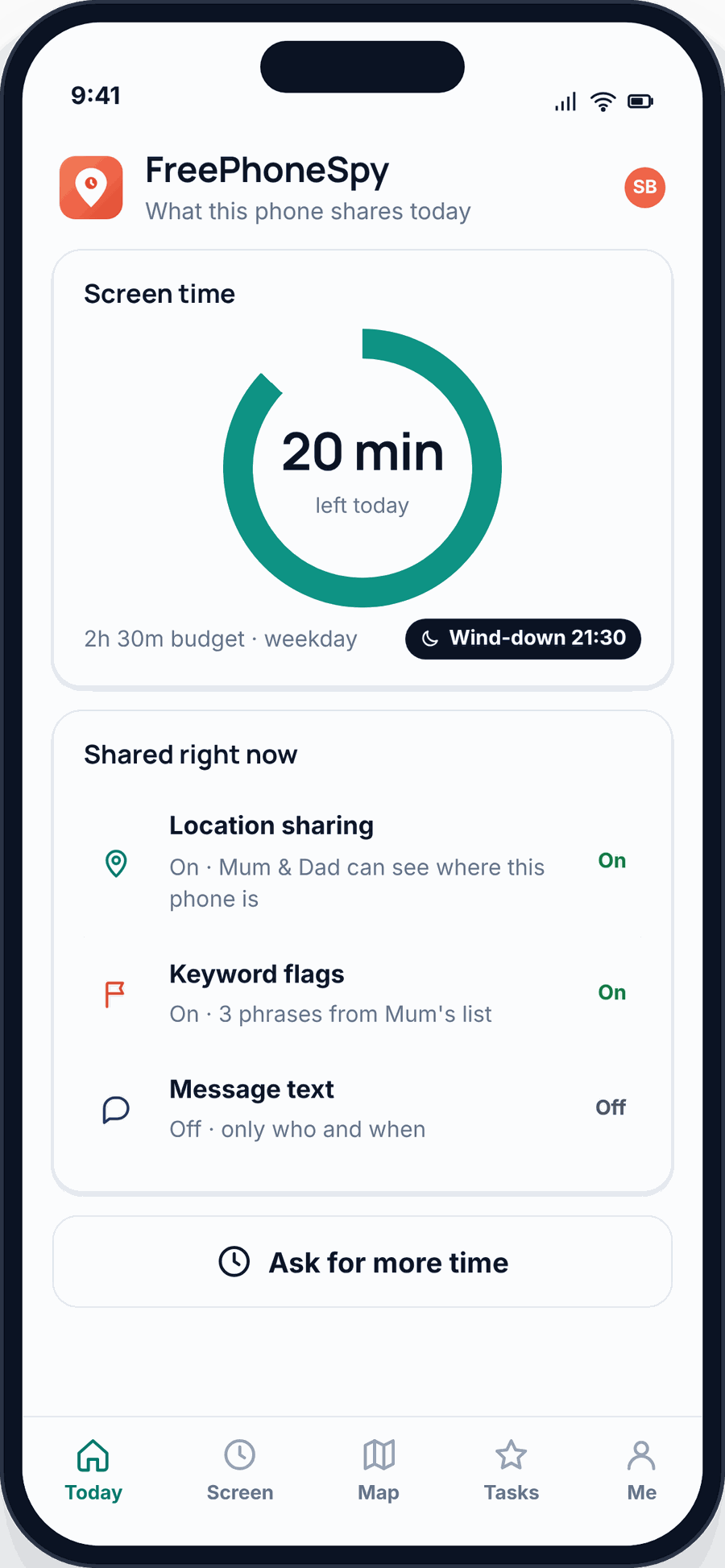
If your teen is on an iPhone, Apple’s built-in Screen Time covers a lot of this ground; FreePhoneSpy focuses on Android. Either way, the tool is the scaffolding. The relationship does the real work.
How to talk about it
The most powerful tool you have isn’t an app. It’s a conversation your teen doesn’t dread. That’s built over time, in small moments, not in one big serious sit-down.
Lead with curiosity, not accusation. “You’ve seemed a bit flat this week — how are you doing?” lands very differently from “You’re on that phone too much.” One opens a door; the other slams it. Ask about their world with genuine interest: what they’re watching, who they’re talking to, what’s funny right now. When you know the landscape, it’s easier to spot when something changes.
Try these openers when you want to go deeper:
- “I’ve noticed you haven’t been sleeping well. What’s keeping you up?”
- “Does anything online ever make you feel rubbish? You can always tell me.”
- “If something happened on your phone that upset you, I’d want to help, not take it away.”
That last one matters. A lot of teens hide problems — a nasty message, a photo that spread, someone being cruel — because they’re afraid the phone gets confiscated the moment they speak up. If your teen believes talking to you makes things better rather than worse, they’ll come to you sooner. That’s worth more than any monitoring setting. If cyberbullying is on your mind, our guide for parents on cyberbullying walks through how to respond without making it worse.
When to get help
Sometimes habits and conversations aren’t enough, and that’s not a failure. It’s a moment to bring in someone with more training. Reaching out for support is a sign of good parenting, not a sign anything has gone badly wrong.
Consider talking to a professional if you notice a low mood or heavy anxiety that lasts more than a couple of weeks, a big withdrawal from friends and life, sleep or eating changes that persist, or anything that makes you genuinely worried about your teen’s safety. You don’t need to wait for certainty. If your gut says something’s wrong, that’s reason enough to ask for help.
A good first step is often your family doctor or GP — they can listen, rule things out, and point you to the right support. A school counsellor knows your teen in a different setting and can be a steady, trusted presence. And there are helplines and support services for both teens and parents when you need to talk to someone now.
You don’t have to handle this alone. Start with your GP or family doctor, or your teen’s school counsellor — both can guide you to the right help. If your teen is struggling and needs to talk, encourage them to reach out to a trusted adult or a helpline; ask your GP or search locally for services in your area. If worries around food or body image come up, the National Alliance for Eating Disorders offers support and can help you find the right next step. If you ever believe your teen is in immediate danger, contact your local emergency services straight away.
One gentle note: if your teen opens up to you or a counsellor, resist the urge to promise total secrecy. Adults who care sometimes have to loop in others to keep a young person safe, and it’s kinder to be honest about that than to over-promise. What you can promise is that you’ll always act out of care.
A little reassurance
Most teens are, genuinely, okay. They navigate a complicated world with more resilience than we give them credit for. The phone is part of their lives, not the whole of it, and for many it’s a source of friendship and fun as much as anything else.
You won’t get this perfect, and you don’t need to. Small, steady habits beat dramatic bans that fall apart. A phone parked outside the bedroom, one screen-free meal, a curated feed, and an open door for talking will do more over a year than any single big rule. Stay close, stay curious, and trust that showing up matters more than getting every detail right.
Questions parents ask
Are phones really causing a mental health crisis in teens?
The honest answer is that researchers are still debating it. There’s a clear link between late-night phone use and lost sleep, and lost sleep affects mood. Beyond that, the effects vary a lot from teen to teen and depend heavily on how the phone is used. It’s not as simple as “phones are bad.”
How much screen time is too much?
There’s no magic number, and time alone tells you little. A teen messaging friends and making things is having a healthier experience than one silently comparing themselves for the same number of hours. Focus on protecting sleep, keeping some phone-free zones, and noticing how your teen seems — that matters more than the total. Our screen time by age guide gives rough starting points.
Should I read my teen’s messages?
Usually, talking works better than secretly reading. Covert snooping, if discovered, tends to break trust and shut down the very communication you want. FreePhoneSpy is transparent on purpose: your teen knows it’s there, and it’s meant to support agreed routines, not to spy. Save closer oversight for genuine safety concerns, and pair it with honesty.
My teen gets upset when I bring up their phone. What now?
Shift from the phone to them. Instead of “you’re on it too much,” try “you’ve seemed down lately, how are you feeling?” Take the pressure off the device and put your care front and centre. And check your own habits — leading by example carries more weight than any lecture.
Will a bedtime routine actually make a difference?
It’s the change with the best odds. Getting the phone out of the bedroom overnight protects sleep, and better sleep improves mood, focus, and resilience. Try it for two weeks. A bedtime routine that parks the phone automatically takes the nightly argument out of it.
When should I get professional help?
If a low mood, heavy anxiety, withdrawal, or changes in sleep and appetite last more than a couple of weeks, or if you’re worried about your teen’s safety, talk to your GP or a school counsellor. You don’t need to be certain first — trust your instinct and reach out.