When Your Child Is Left Out Online: Social Exclusion & Belonging
Nobody said anything cruel. That’s the strange part. Your child comes downstairs quieter than they went up, and when you ask, there’s nothing you can point to — no message to screenshot, no name-calling to report. They just saw a photo. Everyone was there. The beach, the sleepover, the birthday. Everyone except them. Being left out is the quietest kind of social pain, and because it leaves no marks, it’s the one parents miss most. This is about seeing it, sitting with it, and helping your child find their way back to feeling like they belong.
- What being left out actually looks like
- Why it hurts so much
- Exclusion isn’t always bullying — until it is
- Signs your child is struggling with it
- How to support them
- What to do in the moment
- Building belonging that isn’t on a screen
- Raising an includer
- When low mood needs more than you
- Common questions
What being left out actually looks like
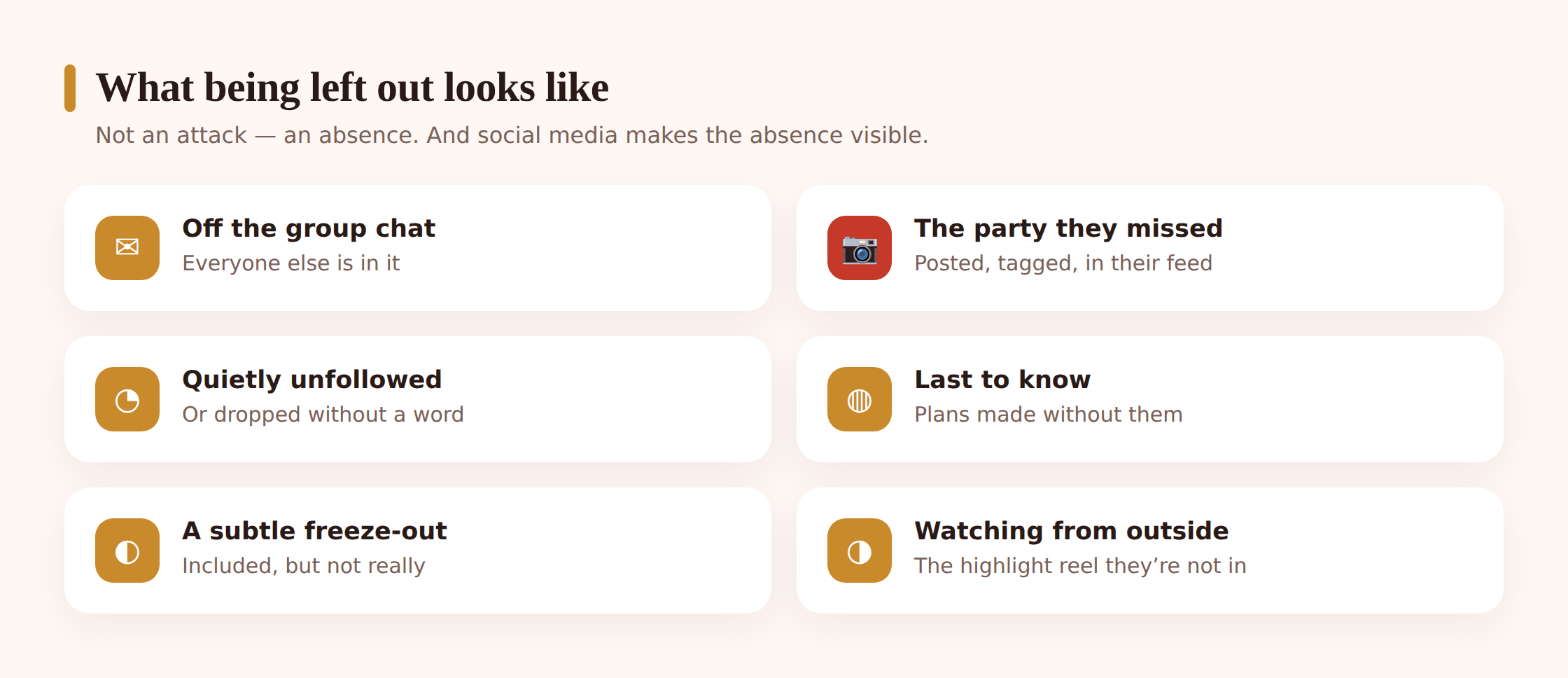
Exclusion online rarely announces itself. It’s an absence, and absences are hard to see. But once you know the shapes it takes, you start to recognise the ache behind them.
There’s the group chat that moved without them. Your child is still in the old one, but everyone’s gone quiet in it, because the real conversation shifted to a chat they’re not in. They find out when someone references a joke they’ve never heard, or plans that were clearly settled somewhere else. There’s the event they can watch but weren’t asked to: six friends at the cinema, posted in real time, tagged and beaming, while your child sees the whole thing unfold from their bedroom. There’s the quiet unfollow — someone they thought was close removes them, or drops out of their close-friends list, and there’s no announcement, just a small cold fact you discover by accident.
Then there are the softer freezes. Replies that get slower and shorter. Being the last to know things they used to be told first. A “we should all hang out soon” that somehow never includes them when it happens. Being left on read, over and over, by the same person. None of it is a punch. Each piece on its own is deniable — “we just forgot”, “it wasn’t planned”, “it wasn’t a big deal”. But your child feels the pattern long before they can name it, and the phone shows them the evidence on a loop.
This is worth separating from active cruelty. Our guide to cyberbullying covers the times when someone is deliberately going after your child. Exclusion is different terrain. Often no one is trying to hurt anyone. Kids drift, cliques tighten, plans get made in a hurry with whoever’s nearby. Your child can be genuinely, painfully left out by people who’d be horrified to hear they’d caused it. That doesn’t make the hurt smaller. It just changes what helps.
Why it hurts so much
Two things make online exclusion sting more than the offline kind ever did.
First, it’s visible. When you were young and left out of something, you mostly didn’t see it. You heard about the party on Monday, secondhand, softened by time. Your child watches it happen live — the arrivals, the in-jokes, the “best night ever” caption at 10pm — as if pressing their face to a window. Social media took the thing that used to be hidden and put it on a screen in their hand. And second, it’s permanent. The post doesn’t disappear the next morning. It sits in the feed, revisitable, a small monument to a night they weren’t part of, ready to be scrolled past again at 1am when they can’t sleep.
Underneath all of it is something simple and hardwired. Belonging isn’t a nice-to-have for a young person; it’s a core need, close to food and safety in how deeply the brain registers it. Fitting in with the group is, in the long story of being human, a survival instinct. So when a child feels pushed to the edge of their group, the alarm that goes off inside them is real and loud. It isn’t drama, and it isn’t weakness. It’s a brain doing exactly what brains are built to do, on a platform designed to make the whole thing impossible to look away from. Our piece on social media and self-esteem digs into how these feeds shape the way kids measure themselves.
Exclusion isn’t always bullying — until it is
Most of the time, being left out is just the ordinary, rough texture of growing-up friendships. Kids form groups, groups shift, someone is always on the outside of something. Learning to survive that — to feel the sting and come through it — is part of how a young person builds a self that doesn’t depend entirely on the crowd’s approval. It’s painful, but it isn’t necessarily a problem to be solved by an adult.
There’s a line, though, and it matters. Exclusion becomes bullying when it turns deliberate, targeted, and repeated. A group of kids agreeing to freeze one child out, making a chat specifically to leave someone off it, posting from an event with captions aimed at the person who wasn’t asked — that’s not drift, that’s a campaign. When exclusion is being used as a weapon, on purpose, against the same child, again and again, you’ve crossed from ordinary social bruising into something that needs the calm, firmer response we lay out in the cyberbullying guide.
The tell is usually intent and pattern. One missed invitation is life. A steady, pointed, obviously-coordinated shutting-out is different, and your child will often sense which one it is before you do. Ask them. “Do you think they forgot, or do you think they meant it?” is a question that tells you a lot, and tells them you’re taking it seriously either way.
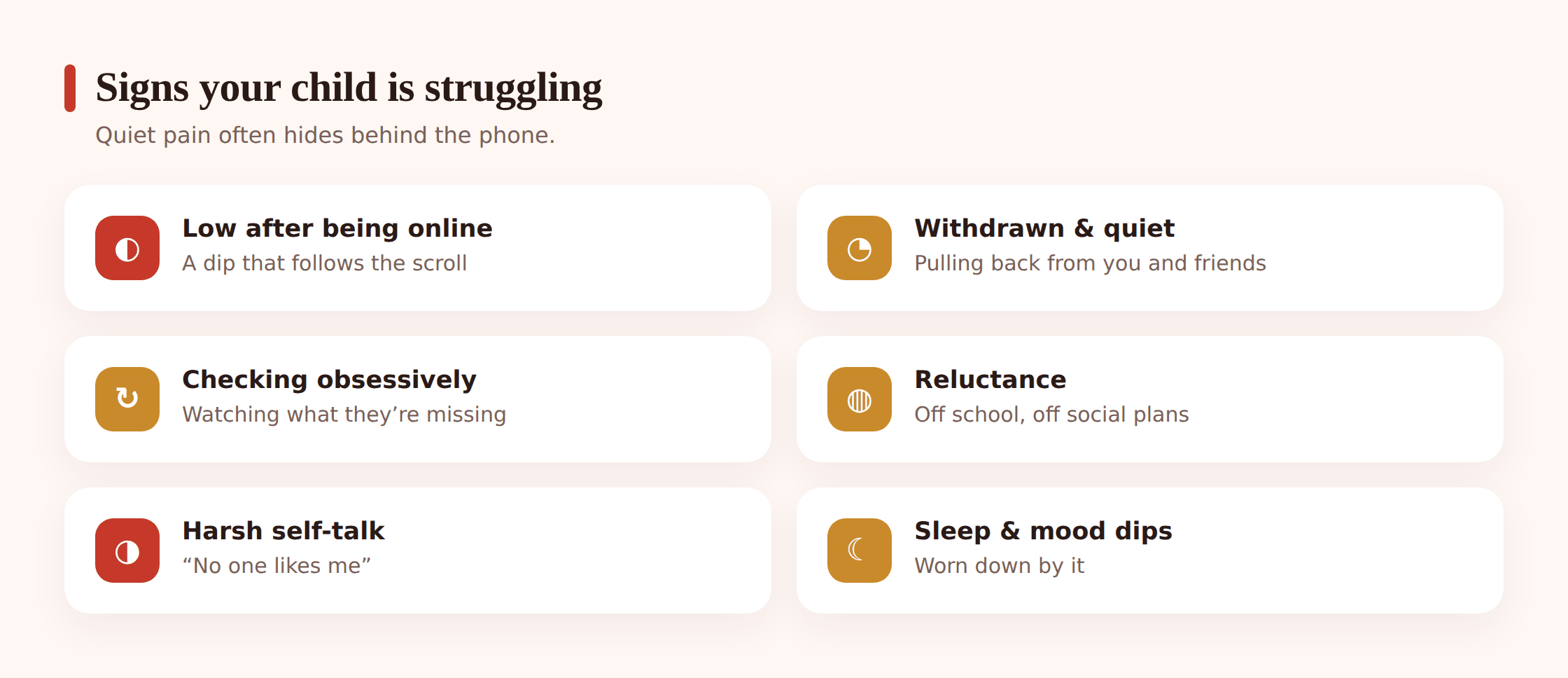
Signs your child is struggling with it
Left-out kids don’t usually come and tell you. Admitting you weren’t invited feels like admitting you’re unwanted, and few children will volunteer that. So you’re reading the weather, not the forecast. What you’re looking for is a change from their normal that clusters and sticks around, rather than one flat evening.
- The mood drops after they’ve been on their phone. They go up cheerful and come down deflated. It’s the “after” that tells you — something they saw, not something they did.
- They check obsessively but joylessly. Not the happy buzz of chatting with friends. A compulsive, anxious scrolling, refreshing to see what they’re missing, unable to put it down even though it clearly isn’t making them feel better.
- They go quiet about their social life. A child who used to narrate every plan suddenly has nothing to report. No “we’re going to”, no names mentioned. The silence is the signal.
- Reluctance where there used to be eagerness. They stop wanting to go to the club, the practice, the thing — sometimes because they’re not sure their people will be there, or worried they’ll be the spare part.
- Flashes of sadness they can’t explain. Teary over something small, or a low, flat mood that doesn’t lift. When you ask what’s wrong, “nothing” — and they might half-believe it, because the cause is a hundred tiny slights, not one big event.
- Self-critical talk. “I’m so boring.” “No one actually likes me.” “Everyone has more friends than me.” The exclusion turns inward and becomes a verdict on themselves.
None of these proves anything alone — kids are moody and private, and a quiet week is just a quiet week. It’s the pattern, and the shift from their baseline, that’s worth leaning into. Our overview of phones and teen mental health puts these signals in a wider frame.
How to support them
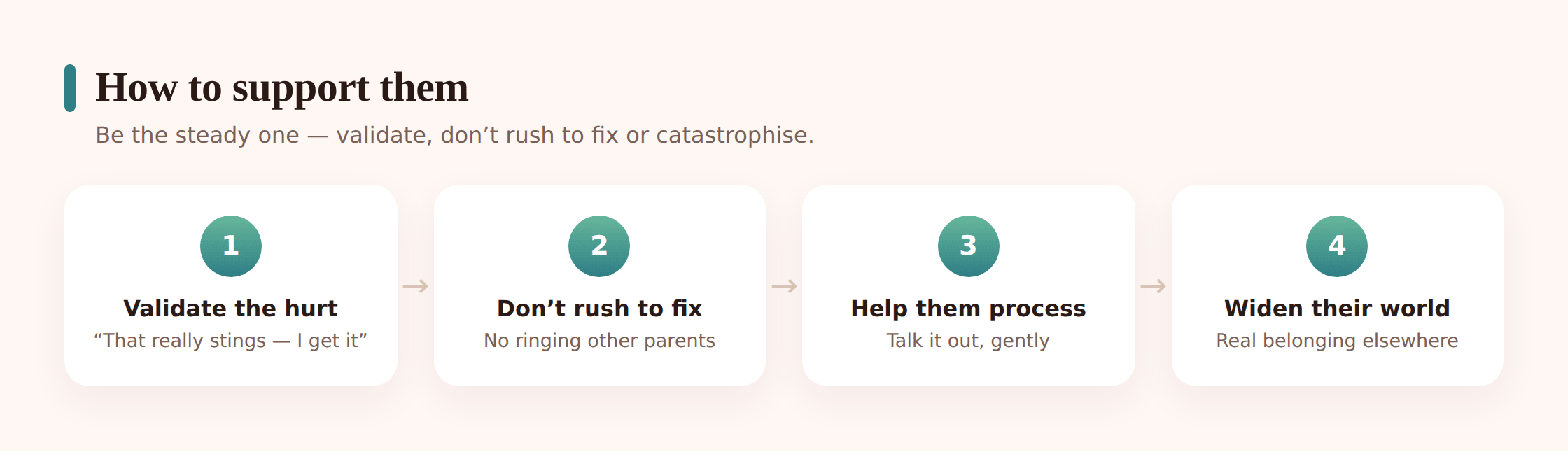
When your child is hurting from being left out, every instinct you have is to fix it — and most of those instincts, acted on fast, make it worse. Here’s what actually helps.
Validate without catastrophising. The first job is to make them feel heard, not to solve anything. “That sounds really horrible — I’d feel gutted too” does more in one sentence than an hour of advice. What you’re avoiding is both extremes: don’t wave it off (“you’ll have forgotten by next week”), and don’t inflate it (“that’s awful, those girls are poison, this is a disaster”). The first tells them their pain doesn’t count. The second tells them the situation is even bigger and scarier than they feared. Aim for warm and steady. Big feeling, safe container.
Don’t rush to fix it, and don’t call the other parents. The urge to ring another mum and sort it out is powerful and almost always wrong. It embarrasses your child, it usually backfires socially, and it teaches them that when something’s hard, an adult swoops in rather than them finding their own footing. Unless it’s crossed into deliberate, targeted bullying, resist the phone. Your child needs a listener far more than a fixer.
Help them process, not just vent. Once they feel heard, gentle questions help them make sense of it. “What do you think was going on?” “Is this a one-off, or has it been building?” “Who are the people who do make you feel included?” You’re helping them think, not handing them conclusions. Often a child talks their way to their own, calmer read of the situation — that it was thoughtless rather than cruel, or that these weren’t really their people anyway.
Resist “just get off social media.” It sounds so reasonable, and it lands as a punishment for being sad. To your child, deleting the app means being even more cut off — losing the window, not just the pain. It also tells them the problem is them and their phone, rather than something that happened. There may be a case for a break, and that’s a conversation to have together, on their terms. But “just quit the internet” as a reflex tends to close them down rather than help. If they choose to mute a person or mute a chat for a while, that’s a healthier, smaller move you can absolutely support.
What to do in the moment
Notice out loud, gently
If you can see something’s off, name it softly and leave the door open. “You’ve seemed a bit flat the last few evenings — anything on your mind?” Then stop talking. Don’t fill the silence with theories. A lot of children need a beat, and a second nudge later, before they’ll say the true thing. If they say “I’m fine”, accept it for now and try again another day. The message you’re planting is: I noticed, and I’m here when you’re ready.
Lead with the feeling, not the facts
When they do open up, respond to the emotion first, not the logistics. Not “well who was actually there?” but “that really hurts, I can see why.” The facts can come later. If you go straight to interrogation mode, they feel cross-examined rather than comforted, and the shutters come down. Sit in the sad bit with them for a minute before you go anywhere near what to do about it.
Normalise without dismissing
It helps a child enormously to know that being left out happens to everyone, including you. A short, honest story from your own teenage years — the time you weren’t asked to something and it stung — tells them they’re not uniquely unlikeable, they’re just human. The trick is to normalise the experience (“this happens to all of us”) without dismissing their version of it (“so it’s no big deal”). Both can be true: it’s common, and it still hurts.
Put the highlight reel in perspective
Gently remind them what a feed actually is. Everyone posts the night they were included and none of the nights they were home alone. The friends who look like they belong effortlessly have their own left-out evenings you never see. This isn’t to argue them out of their feelings — it’s to loosen the grip of the comparison, so the party photo stops looking like proof that everyone’s life is better than theirs.
Make one small plan together
End on a foothold, not a solution. Not a grand fix, just one warm, concrete thing to look forward to — a friend they do click with invited round, a thing they love that has nothing to do with this group, a family outing this weekend. When a child feels excluded, the world shrinks to the people who left them out. One good plan quietly widens it again.
Building belonging that isn’t on a screen
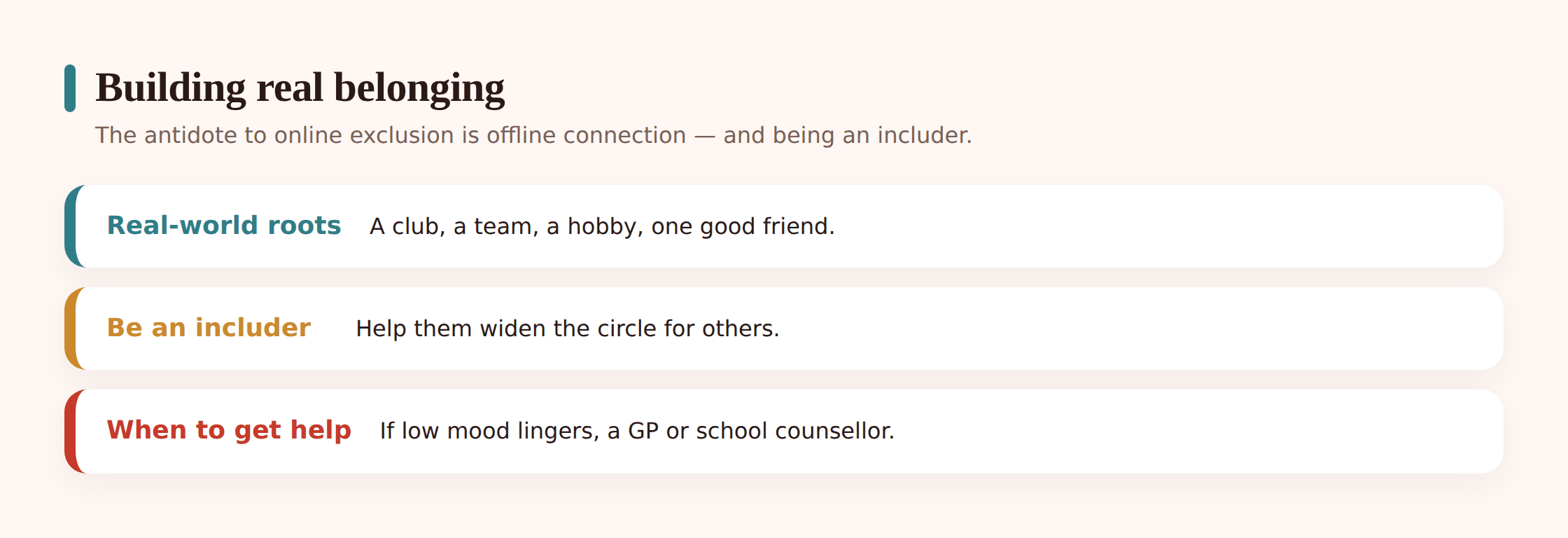
The deepest protection against online exclusion isn’t better monitoring or stricter rules. It’s a child who has more than one place to belong. When your whole social world is a single friendship group on a single app, being frozen out of it feels like the end of everything. When you also have a football team, a cousin you’re close to, a Saturday art class, a couple of friends from a different school — being left out of one thing is survivable, because it’s one thing, not the whole thing.
So the long game is breadth. Help your child put down roots in more than one place. Real-world settings especially — clubs, sport, music, volunteering, anything with regular faces and a shared purpose — build a kind of belonging that a feed can’t take away. These are the places where a child is valued for showing up and doing the thing, not for being liked in a chat. They’re also, quietly, where resilience grows: the more sources of connection a child has, the less power any single group holds over how they feel about themselves.
Family counts here too. A child who feels genuinely wanted at home carries a baseline of belonging into everything else — a sense that they matter somewhere, unconditionally, no invitation required. That doesn’t inoculate them against the sting of exclusion, but it changes what the sting means. It’s a bad night, not a verdict on their worth.
Raising an includer
There’s a lovely turn that happens when a child who’s been left out learns to look out for others who are. It’s some of the best repair work there is — and it hands them back a sense of agency in exactly the place they felt powerless.
You can nudge it, gently. Talk with your child about the kid on the edge of their own group — the one who’s a bit quiet, a bit new, a bit outside. Not as a chore, but as a small kindness with real weight: “You know how rubbish it feels to be left out. You’re in a position to make sure someone else doesn’t feel it.” Including someone in the chat, saving them a seat, replying to the message everyone else ignored — none of it costs much, and to the child on the receiving end it can be the difference in their whole week. Our guide to group chats talks more about how kids can shift the temperature of a group with very little.
It works two ways. It makes the world a bit kinder, and it quietly rebuilds your own child. A young person who sees themselves as someone who includes others is standing on firmer ground than one who’s only ever waiting to be included. Being the person who makes room is a stronger place to be than the person hoping room gets made.
When low mood needs more than you
Most of the time, being left out is a wound that heals with warmth, time, and a wider world — the ordinary, hard, survivable stuff of growing up. But sometimes low mood settles in and doesn’t lift, and that’s when it’s worth reaching for more support, without alarm.
Trust your read if the sadness has become persistent — weeks, not days — and if it’s spreading beyond the friendship stuff into things that used to be fine. Look for a child who’s withdrawing from everything, not just one group; who’s lost interest in things they used to love; whose sleep, appetite, or energy has changed in a lasting way; or who’s talking about themselves in bleak, hopeless terms. These aren’t signs you’ve failed to help. They’re signs the load is bigger than any one parent is meant to carry alone.
A GP is a good, undramatic first call — they’ve seen this often and can point you to the right next step. A school counsellor or pastoral lead is another, and they have the advantage of seeing your child in the setting where a lot of this plays out. Reaching out isn’t an overreaction, and it isn’t a last resort. It’s just widening the circle of people who’ve got your child, which is exactly the thing that helps most. If anything your child says ever makes you fear for their safety, don’t wait — contact your GP, or an urgent helpline, the same day.
A monitoring app can help you notice a change early and start a kinder conversation. It is not a counsellor, a GP, or a substitute for your own steady presence. Use it as the nudge that gets you talking — then lead with the human part, every time.
Common questions
Should I call the other parents and sort it out?
Almost never, and almost never as a first move. Ringing another parent to say your child was left out tends to embarrass your own child, strain the friendship further, and rarely produces the warm re-inclusion you’re hoping for. It also robs them of the chance to find their own footing. The big exception is when exclusion has become deliberate, targeted bullying — a coordinated, repeated freeze-out — in which case a calm word with the school, rather than a heated call to a parent, is usually the better channel. For ordinary being-left-out, be the listener at home instead.
Should I make them delete the app?
Try not to reach for that as a reflex. To a child who feels excluded, deleting the app means losing the connection too, and it lands as a punishment for being upset. It can also plant the idea that the problem is them, rather than something that happened to them. A break can genuinely help — but as a choice you make together, on their terms, not a snap decree. Muting a particular person or chat for a while is a gentler, smaller step that often does the job without the sense of being cut off entirely.
My child wasn’t invited to something and is devastated. Do I fix it or let it be?
Let the feeling be, first — really sit with it and validate it before doing anything. Then help them think, rather than swooping in. Most of the time the healthiest outcome is that they feel fully heard, get some perspective on the highlight-reel effect, and have one good thing to look forward to that isn’t tied to that group. Rescuing them by engineering an invitation usually teaches the wrong lesson and can make things socially awkward. Comfort and perspective, not a fix.
How do I know if this is normal friendship stuff or actual bullying?
The dividing line is intent and repetition. Kids drift, cliques tighten, and people get left out by accident all the time — that’s ordinary, if painful, and it’s part of growing up. It tips into bullying when the exclusion is deliberate, aimed at your child specifically, and happening again and again — a group choosing to shut one person out on purpose. Your child often senses which one it is. If it’s the targeted kind, our cyberbullying guide covers the calmer, firmer response that situation needs.
Won’t they just have to toughen up? Isn’t being left out part of life?
Being left out is part of life, and learning to weather it does build something real. But “toughen up” as advice tends to land as “your feelings are wrong”, which makes a child hide the hurt rather than handle it. Resilience doesn’t come from being told to feel less. It comes from feeling fully supported through the hard bit and coming out the other side. Validate the feeling and widen their world, and the toughening happens on its own — the good kind, from the inside.
They keep checking to see what they’re missing. How do I help with that?
That compulsive checking is a very human loop — the brain scanning for the thing it’s worried about, even though looking makes it worse. Naming it gently helps: “I notice you keep going back to look, and I notice it doesn’t make you feel any better.” Then offer an alternative, not a ban. Mute the source for the evening, put the phone in another room while you watch something together, plan the good thing you talked about. You’re not confiscating — you’re helping them step out of a loop that isn’t serving them, which is a skill worth far more than the phone ever taking the blame.
Being left out is one of the oldest hurts there is, and your child is feeling it on a stage that’s brighter and more permanent than anything you grew up with. You can’t invite them to every party, and you shouldn’t try. What you can do is be the steady place they land — the one who notices, who listens without flinching, who reminds them they belong somewhere unconditionally, and who quietly helps them build a life wide enough that no single group holds all the keys. That’s not a fix. It’s better than a fix. It’s what they’ll carry long after this particular sting has faded.