How Phone Monitoring Helps Protect Kids From Online Predators
Monitoring your child’s phone will not, on its own, keep a predator away. What it can do is give an alert, watchful parent one more chance to notice something wrong early — a new adult contact, a chat that suddenly moves to a private app, a change in mood you can’t explain — and to open a conversation before a bad situation grows. Used openly, alongside a child who knows they can always come to you, it’s a genuine layer of protection. Held up as a guarantee, it fails everyone. This guide is about using it honestly and well.
How grooming actually works
You don’t need clinical detail to protect your child. You need the shape of it — the pattern predators tend to follow — because once you can recognise the pattern, so can your child, and that recognition is worth more than any setting on a phone.
Grooming is a slow, deliberate process of building trust and then exploiting it. It rarely looks like danger at first. That’s the whole point. From the outside it can look like a lovely new friendship, which is exactly why it works and why parents miss it.
It starts with a friendly face
A predator usually poses as a peer — a child around your child’s own age — or as a warm, friendly older figure who takes an interest. The first contact often comes through somewhere ordinary: a game’s chat, a comment on a video, a follow on a social app. Nothing about it announces itself as a threat.
Then comes the flattery
Next is a flood of attention. Compliments, warmth, a quick sense of a special bond — sometimes small gifts, in-game currency, or the promise of them. This rush of affection is sometimes called love-bombing, and the speed is the tactic. It’s designed to make a child feel seen and understood before they’ve had time to think clearly, so that when things turn, they’ve already invested emotionally.
Then isolation and secrets
Once trust is building, the predator starts to separate the child from the people who’d protect them. “Your parents wouldn’t understand.” “This is just between us.” “You’re so much more mature than your friends.” Secrecy is planted as a sign of closeness. A child who’s keeping a secret is a child who won’t tell you — which is the whole aim.
Then the move to a private app
Very often the conversation shifts off the public platform where it began and onto something more private or encrypted — a direct-messaging app, a disappearing-message app, a video call. Somewhere it feels sealed off and unobserved. This move is one of the clearest structural warning signs in the entire pattern, because there’s no innocent reason a stranger needs a child on a more private channel.
Then gradual escalation
From there it escalates by small steps, each one only slightly further than the last, so no single moment feels like a line being crossed. It may build toward a request for images, or toward pressure to meet in person. The gradualness is the trap. By the time a child senses something is wrong, they often feel it’s too late to speak up — which is why an open door home matters so much.
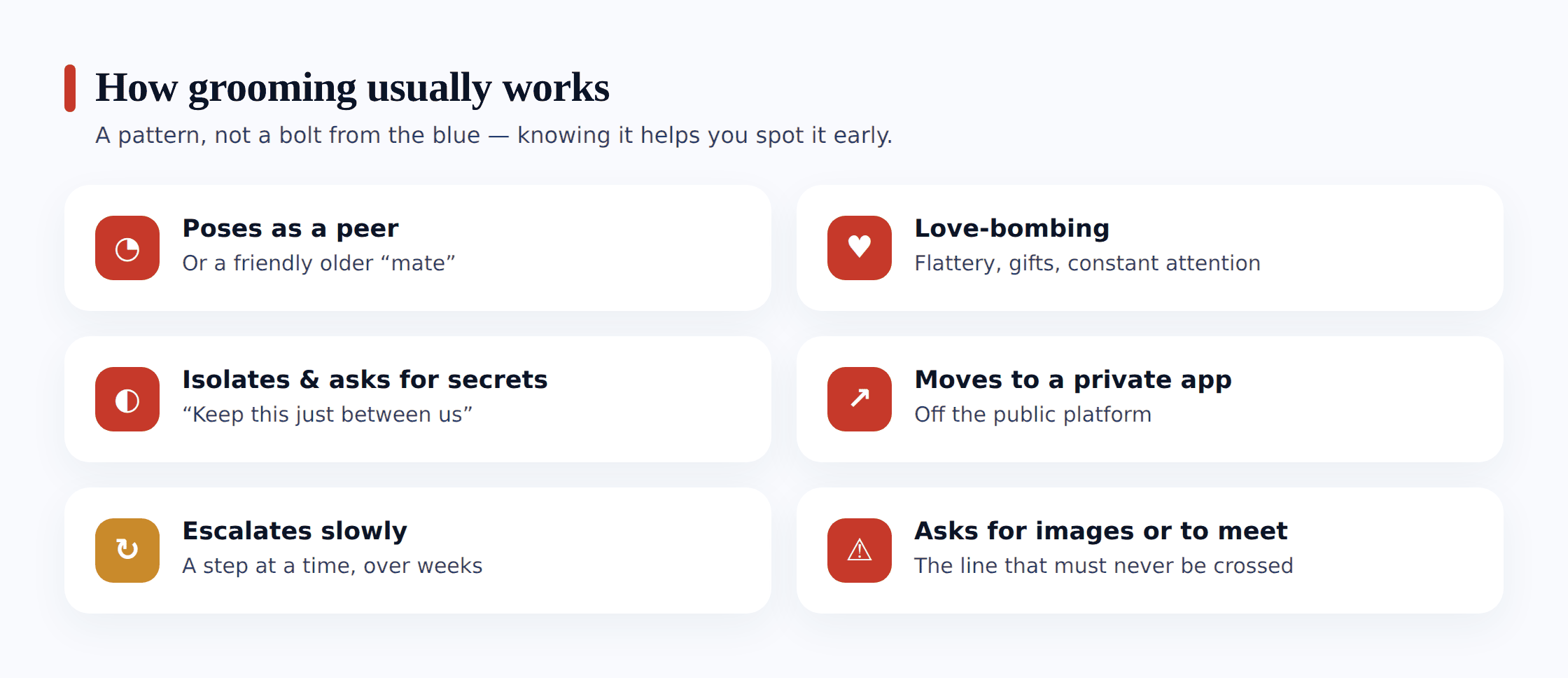
Naming this shape for your child — calmly, before anything happens — is one of the most useful things you can do. A child who recognises “someone who’s suddenly my best friend, wants secrets, and pushes me onto a private app” as a known trick is far more likely to stop and come find you. For the wider picture of online risk, our guide on how to protect kids from online predators covers the ground beyond monitoring.
Warning signs monitoring can help surface
No single sign here proves anything, and most have perfectly innocent explanations. It’s a cluster of them, and the direction things move, that says lean in. Some of these show up in a child’s behaviour; some show up in what’s actually happening on the phone, which is where open monitoring earns its place.
- A new, unknown adult contact appearing in messages, a game, or a social app.
- A conversation that moves from a game or public social app onto a private messaging app.
- Gifts, money, gift cards, or in-game currency turning up with no clear source.
- A new “older friend” your child mentions but is vague about.
- Requests — or a new habit — of deleting messages, or a chat history that’s suddenly empty.
- Talk of meeting up with someone they’ve only known online.
- New secrecy: turning the screen away, going quiet, guarding the phone, a locked app you didn’t know was there.
- Becoming withdrawn, anxious, or moody in a way that tracks with their time online.
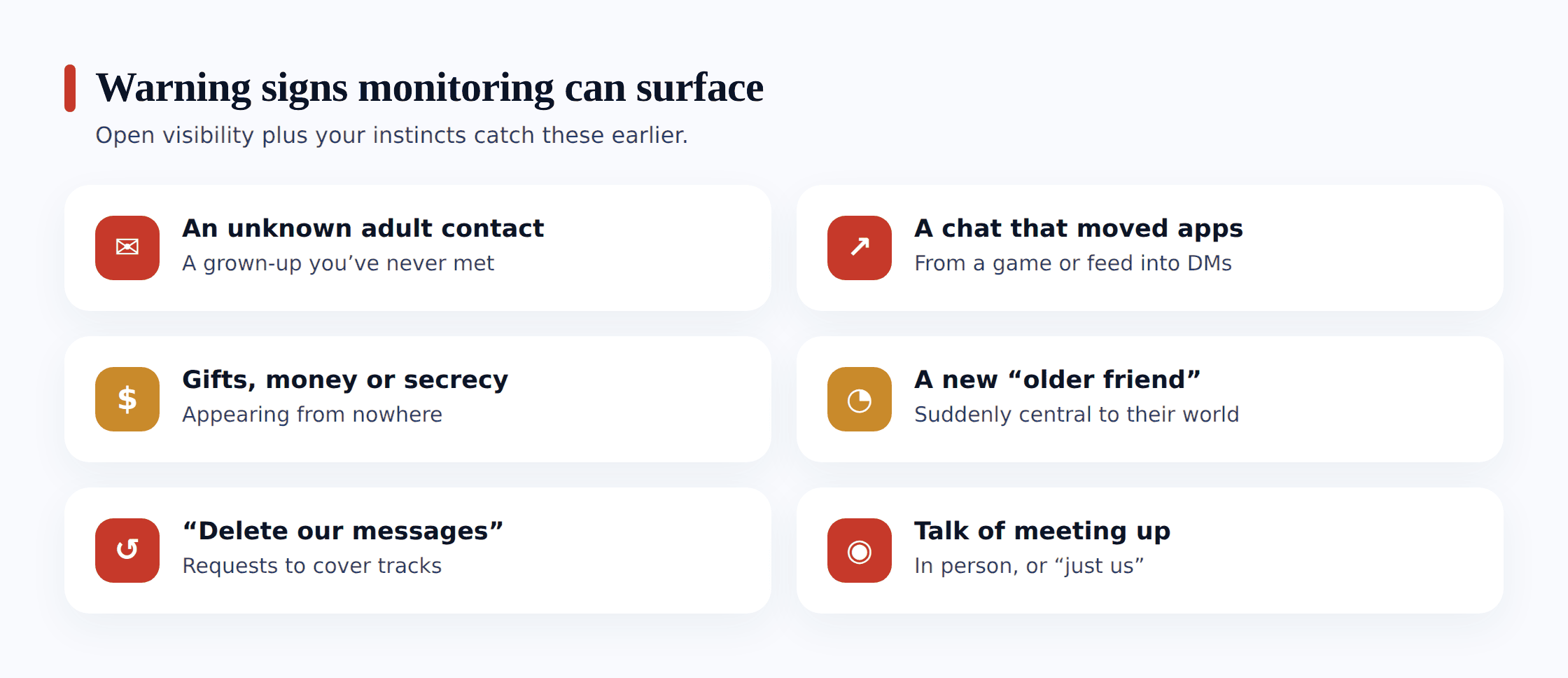
Behaviour changes and phone activity tell you different halves of the same story. A withdrawn child might be dealing with anything; a withdrawn child who also has a new adult contact who’s moved the chat to a private app is a much clearer picture. Monitoring’s real value is filling in that second half — the part a child under a predator’s influence is being coached to hide. If it’s a single stranger reaching out rather than an established pattern, our guide on what to do when a stranger contacts your child walks through assessing and reporting that specific situation.
How monitoring specifically helps — and its limits
Here’s the honest version, because overselling this does real harm. Monitoring gives you visibility into a few things that matter, and each one buys you an earlier chance to notice and to talk. None of them replaces the child’s own awareness or your relationship, which remain the most powerful protections you have.
Visibility of new apps
Seeing that a new messaging app has been installed on the phone is often the first visible trace of grooming — because moving the chat to a fresh, private app is exactly what predators do. You’re not reading any messages; you’re noticing the change, which is usually enough to prompt a conversation.
Alerts for the moments that matter
Alerts can flag when something worth a look happens — a new app installed, the phone somewhere unexpected, a missed curfew, an SOS. An alert isn’t a verdict. It’s a prompt to pay attention and ask, gently, how things are going. Treat it as the start of a conversation, never as evidence to confront a child with.
Seeing a chat move platforms
Because the jump from a public app to a private one is such a reliable warning sign, simply seeing that a child who chatted in a game has now installed a separate messaging app — and is spending time there with someone new — can surface the pattern early, while there’s still plenty of room to step in.
Location awareness if a meet-up is discussed
If talk of meeting someone in person appears, knowing where your child’s phone is adds a real safety margin. It’s a backstop for the rare, serious case, not a substitute for the conversation that should happen the moment a meet-up is even mentioned.
Set your expectations here honestly, and the tool serves you well. Expect it to prevent everything by itself, and you’ll both lower your guard and, worse, lean on surveillance instead of on the relationship that actually protects your child.
What to teach your child
This is the part that outlasts any app. A child who understands the grooming playbook carries their protection with them onto every device, including the ones you’ll never see. The teaching matters more than the monitoring, and the two work best together.
- No adult should ever ask a child for secrets. A grown-up who says “keep this between us” is doing something wrong, full stop — that rule holds no matter how kind they seem.
- No one should ask them for images, or to meet in person. Anyone who does is not a real friend, and it’s an instant reason to come and tell you.
- Name the playbook. Fast flattery, gifts, a push for secrets, a move to a private app, then things creeping further — if a child can spot that shape, they can stop it.
- Tell you is always the right move — blame-free. Make it unmistakable that coming to you never ends in punishment, a confiscated phone, or “I told you so.” Shame and fear of losing the phone are exactly what a predator counts on.
- It’s never their fault. An adult who targets a child is the one in the wrong, always. A child who was manipulated was tricked, not foolish.
Say the blame-free part often, not once. Children weigh whether to tell you against what they think it’ll cost them. When the cost is clearly nothing — no anger, no lost phone, just help — they come to you sooner, and sooner is what saves them.
What to do if you suspect grooming
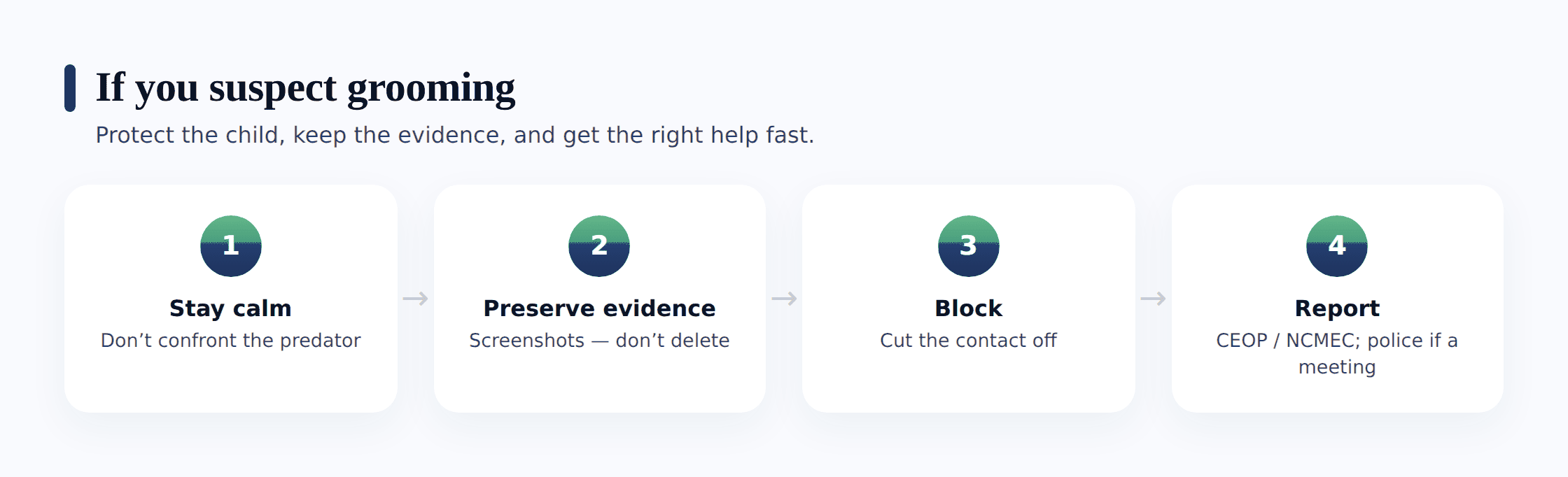
If monitoring, or your own instincts, tell you something may be seriously wrong, the order of what you do matters. Predators can vanish the moment they’re spooked, so acting calmly and in sequence protects both your child and any future case.
Step 1 — Stay calm, and go to your child, not at them
Your child needs to see steadiness first. Lead with “you’re not in trouble and I’m on your side,” not with questions about what they did. A calm parent is a parent a frightened child will actually talk to.
Step 2 — Do not confront the predator
Don’t message them, don’t pose as your child, don’t warn them off. Contact tips them to delete the account and disappear, can escalate the situation, and can complicate a police investigation. Say nothing to them.
Step 3 — Preserve the evidence
Before you change anything, capture it. Screenshot the messages, the profile, usernames, dates and times, and how the contact was made. Save the screenshots somewhere other than the child’s phone. Don’t delete the conversation — deleting first and reporting later means reporting with nothing to show.
Step 4 — Block, then report
Once evidence is saved, block the account so it can’t reach your child again, and report it — to the platform, and to the right authority below. Blocking and reporting are usually separate actions; do both.
One thing that trips up loving parents: don’t punish the child by taking the phone away. It feels protective, but it lands as a penalty for speaking up, and it teaches them to handle the next thing alone. Tighten settings together and frame it as a fix, not a consequence. If any intimate image may be involved, the situation is sextortion, and our guide on sextortion and how it works covers the specific, calm steps for that.
Where to report
You don’t have to work out on your own whether something “counts.” These organisations exist precisely to take reports and route them to the right people. When in doubt, report — it costs nothing and helps investigators spot offenders targeting many children.
In the United States
Report to the NCMEC CyberTipline at report.cybertip.org — the national clearinghouse for reports of child exploitation, which passes cases to the right investigators. If an intimate image of a minor may have been shared, Take It Down helps get images of under-18s removed. If there’s any immediate danger, call 911 first.
In the United Kingdom
Report to CEOP through its Safety Centre (the Child Exploitation and Online Protection command). If an intimate image of your child may have been shared, Report Remove — run by the IWF and Childline — helps get images of under-18s taken down. Childline (0800 1111) is there for your child directly, free and confidential. In an emergency, call 999.
Where FreePhone fits
A plain, honest note about our own tool, because we built it to support this way of parenting rather than to cut against it. FreePhone is set up with your child, not behind their back — the phone shows a “What my parents can see” screen spelling out exactly what’s shared, so nothing hides. What it gives you is part of the visible-change layer described above: approval and alerts for new apps, location and Places alerts, an SOS button and an “Are you OK?” check-in — the early prompt that tells you it’s time to talk. It never reads messages or contacts, so it won’t flag a stranger’s words. It runs on your child’s Android phone, you read it from any browser, and it’s free, with every feature. What it is not is a guarantee, and it can’t see inside any chat or replace the conversation. It’s one layer alongside the open relationship that does the real protecting — a way to notice sooner, so you can ask sooner.
Common questions
Does monitoring my child’s phone actually stop predators?
Not by itself, and any tool that promises that is overselling. What monitoring does is give you an earlier chance to notice visible signs — a chat moving to a new private app, late nights on the phone — so you can step in and talk before a situation grows. FreePhone doesn’t read messages, so the words themselves reach you only if your child shows you. The child’s own awareness and an open, blame-free relationship with you are the stronger protections. Think of monitoring as one layer that helps you catch things sooner, not a wall that keeps everyone out.
Should I monitor secretly so I catch more?
No. Secret surveillance is the wrong goal and it backfires. Monitoring works as protection partly because your child knows you’re around — that visibility is part of what keeps them safe and keeps the channel between you open. Doing it covertly, when discovered, teaches a child that you’ll go behind their back, which makes them less likely to come to you when it counts. Set it up together, explain what it does and why, and pitch it to their age.
What’s the single most useful thing I can do?
Teach your child the grooming playbook and make it unmistakable that telling you never ends in punishment. A child who can recognise fast flattery, a push for secrets, and a move to a private app — and who knows they can bring anything to you blame-free — is protected on every device, including the ones you’ll never see. Monitoring supports that; it doesn’t replace it.
An alert showed a new chat app. Do I confront my child?
No — treat an alert as a prompt to talk, never as evidence to confront them with. Go to your child calmly and curiously: “How are things going online lately? Anyone new you’ve been chatting to?” Leading with an accusation shuts the conversation down and teaches them to hide better next time. If what you find looks like genuine grooming, follow the calm steps above: don’t contact the predator, preserve evidence, block, and report.
Can I use this to check a partner’s or another adult’s phone?
No. Everything here is about your own child, on a device you manage, with their knowledge. Monitoring another adult — a partner, an ex, anyone — is a serious privacy violation and is illegal in many places. It isn’t monitoring in any protective sense, and it isn’t something we support or provide a way to do. This is strictly about keeping a child safe, openly.
This is a sensitive subject, and if you’re reading it because you’re worried right now, you’re already doing the protective thing by paying attention. You don’t have to handle it alone. In the US, the NCMEC CyberTipline (report.cybertip.org) and Take It Down are there to help; in the UK, CEOP’s Safety Centre, Report Remove, and Childline (0800 1111) are there for you and your child. If a child is in immediate danger or a meeting has been arranged, call your emergency number — 911 in the US, 999 in the UK.
Keep the tools in their proper place. Open, consent-based monitoring gives you an earlier look at the visible signs of grooming and a reason to start the right conversation sooner. But it’s the conversation — the steady, repeated message that your child can tell you anything without losing your trust or their phone — that does the protecting. Get both working together, and you’ve given your child something no predator can easily route around: a watchful parent, and an open door home.