Smart Glasses & Wearable Cameras: A Parent’s Guide
A pair of glasses that quietly takes photos, films video, records audio and answers questions is no longer a spy-movie prop — it’s on shelves, on faces, and increasingly on the wishlists of teenagers. Wearable cameras are different from the phones and watches you’ve already thought about, because the person holding the camera isn’t the only one who matters. Everyone in front of the lens matters too. That’s the shift this guide is about: raising a kid who can use these devices and understand what it means to point one at another human being.
Why this is a new kind of device
You’ve probably already worked through phones, tablets, maybe a smartwatch. Wearable cameras don’t slot neatly into any of those conversations. A phone camera is obvious — you lift it, you point it, the person in front of you can see it happening and can say no. A wearable camera lives on the body. It’s on the temple of a pair of glasses, clipped to a chest strap, sitting on a wrist, mounted on a helmet. It captures without the deliberate lifting motion that has always signalled “I’m about to take a picture.” That small change matters more than it sounds, because so much of our everyday consent runs on visible cues. When the cue disappears, so does the moment where someone could have objected.
The other shift is who’s affected. Most of the tech questions parents face are about the child using the device — their screen time, their data, their exposure to things online. Here the harder questions are often about other people: the friend who didn’t know they were being filmed, the stranger on a train, the classmate in a changing room. Your child can be the one recording, and your child can be the one recorded. A good parent handles both. This isn’t the same conversation as the one about smart home cameras, which sit in fixed spots in your own house, or smartwatches and wearables, which mostly extend the phone. A camera you wear out into the world points at everyone else.
What these devices actually do
“Wearable camera” covers a spread of gadgets, and it helps to be concrete about what each one can and can’t do before you form a view.
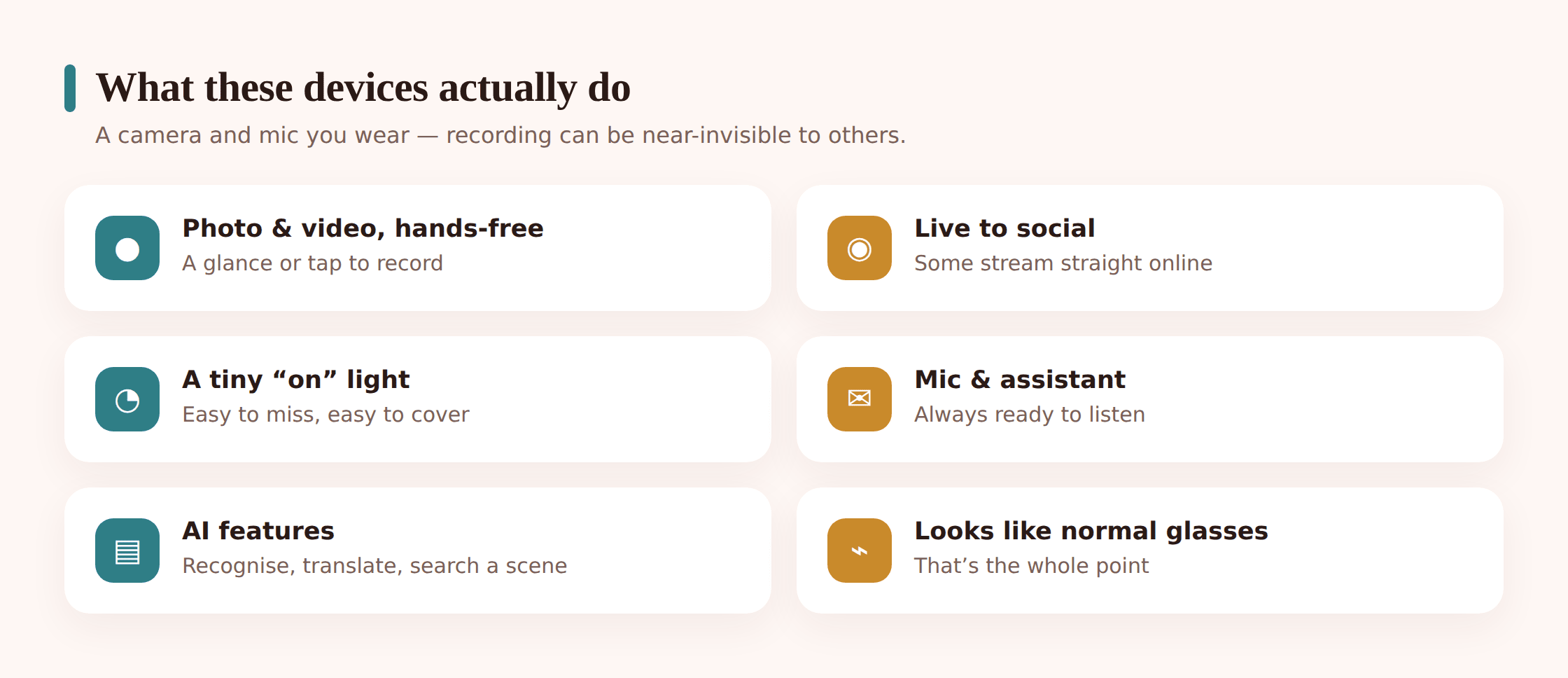
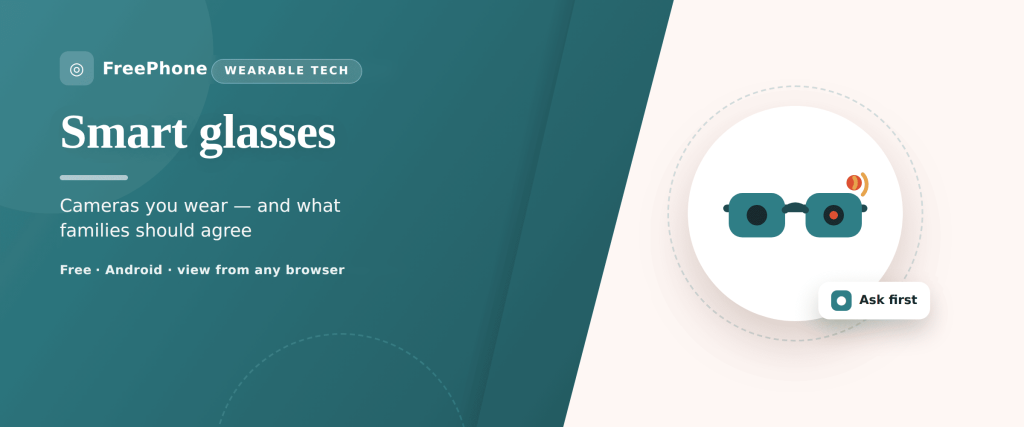
Camera glasses. The headline product. They look close to ordinary sunglasses, with one or two small cameras built into the frame. A tap or a spoken command takes a photo or starts a short video, and the footage syncs to a phone app over Bluetooth. Many capture audio alongside video. The newer ones add a built-in assistant you talk to — asking it what you’re looking at, translating a sign, answering a question — which means an outward-facing camera and a live microphone sitting on the face for long stretches.
Action cameras. Rugged little cameras made for sport — mounted on a helmet, a handlebar, a chest harness, a surfboard. Nobody mistakes these for hidden. They’re chunky, obvious, and pointed forward deliberately. The appeal is recording an activity where holding a phone is impossible.
Camera watches and clip-on cameras. Some watches and small wearable clips can take photos or short clips. These sit closer to the “discreet” end and, honestly, the closer a camera gets to being unnoticeable, the more the consent questions sharpen.
Body-worn cameras. Once the preserve of police and security, small chest-worn cameras are now sold to the public. They run continuously or on demand and are pitched for safety and evidence. On a young person, they raise every question a wearable camera can raise, turned up.
The features worth understanding
- Hands-free capture. A tap, a gesture or a voice command starts recording. No phone lifted, no obvious aim.
- Photo, video and audio. Most capture all three. The audio part is easy to forget and often the part with the strictest rules.
- Live streaming. Some can broadcast in real time to an app or social platform, so what the wearer sees, an audience sees.
- The recording light. Many devices show a small light when they’re capturing. It’s the single most important privacy feature on the device — a signal to everyone nearby. It’s also small, easy to miss, and on some products people have tried to cover it.
- An AI assistant. Newer glasses answer questions about what the camera sees. Useful, and also a reason the camera and mic may be active far more of the day.
The genuine appeal
It’s worth saying plainly: these devices aren’t villains, and treating them as though they are will lose you the conversation with your teen fast. The pull is real.
There’s the memory-keeping. A parent at a first birthday, hands full, capturing the moment without a phone between them and their child. A grandparent recording a walk to share with family far away. There’s sport and creativity — a mountain biker filming a trail, a skater landing a trick, a young filmmaker shooting from angles a phone could never hold. Hands-free capture opens up genuinely new kinds of footage, and for a creative kid that’s exciting rather than sinister.
And there’s accessibility, which gets overlooked. For someone with low vision, glasses that describe what’s in front of them can be transformative. For someone who finds it hard to hold a phone steady, a wearable is easier. For a person who struggles to read a menu or a sign, an assistant that reads it aloud is a real help. The same features that create privacy questions also do useful, sometimes life-changing things. A balanced parent holds both facts at once.
The new privacy and consent issues
This is the heart of it, and it’s where wearable cameras genuinely differ from the tech you’ve handled before. The core problem is simple to state: these devices record other people, and those other people often don’t know.
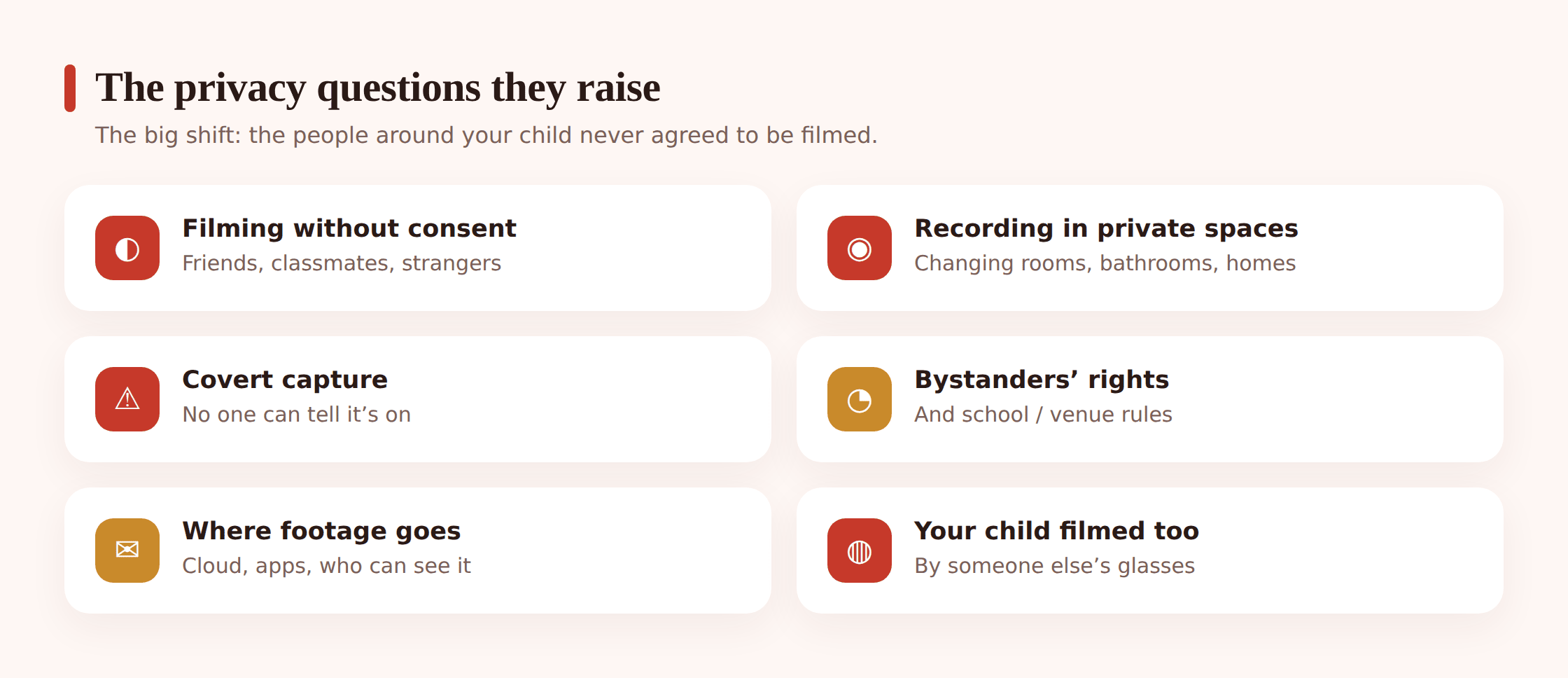
Recording others without their knowledge. When your child wears a camera into a room, everyone in that room is potentially captured — friends, classmates, teachers, strangers, kids who are much younger, adults who’d never have agreed. Filming a person who doesn’t know they’re being filmed is a violation of a basic courtesy, even when it’s technically legal. It treats people as scenery. The habit to teach is the reverse: the people around you are participants, not backdrop, and they get a say.
Private spaces are always off-limits. There’s one rule here with no exceptions worth making. Cameras never come out — worn, hidden, or otherwise — in changing rooms, toilets, locker rooms, bedrooms that aren’t your child’s own, or any space where a person has a reasonable expectation of privacy. Recording in those places isn’t a grey area or a teen mistake to be gently corrected. In many places it’s a serious crime, and it can cause profound harm to the person filmed. A child needs to know this cold, before they ever wear a device out.
Consent and the law. The legal picture varies a lot from place to place and this guide can’t give you the rule for where you live. But some threads run through most of it. Audio recording is frequently treated more strictly than video, and in some jurisdictions recording a conversation without everyone’s agreement is illegal. Publishing footage of an identifiable person — putting it online — raises separate issues again, especially when that person is a child. The safe teaching, wherever you are, is stricter than the law: ask first, and don’t publish footage of people who didn’t agree.
Being the one recorded. Flip it around, because your child will spend far more time in front of other people’s cameras than behind their own. It’s unsettling to be filmed by a stranger’s glasses and not know if the light is on, where the footage goes, or who’ll see it. Kids should know they’re allowed to ask — “are you recording?” — and allowed to say they’d rather not be filmed. That’s not rude. It’s exactly the courtesy we want them to extend to others.
Covert capture and the “always recording” norm. The quiet risk isn’t a single bad clip. It’s the slow normalising of the idea that everything, everywhere, is being recorded and that’s just how it is now. When a camera is always potentially on, people behave differently — more guarded, less spontaneous, less trusting. Kids growing up inside that norm may stop noticing it. Part of a parent’s job is to keep the norm visible and questionable rather than letting it settle in as the water everyone swims in.
Specific concerns for kids and teens
Beyond the general consent questions, a few situations come up again and again once young people are involved.
A teen wearing them around others. The most common scenario is your own teen wearing camera glasses among friends, at parties, around school. Their friends may not clock that the glasses are cameras. Footage of a private, silly, or embarrassing moment can be captured and later shared in a group chat, screenshotted, and travel far beyond the room. Teenage social life is already high-stakes; a wearable camera raises the stakes for everyone in your teen’s orbit, not only your teen.
A teen or adult recording your child. The reverse happens too. Someone else — another teen, or an adult you don’t know — may film your child without asking. This is where a child knowing they can object, and knowing that private spaces are absolutely off-limits, becomes a genuine safety matter rather than an etiquette one. If your child is filmed and it makes them uncomfortable, they should feel able to tell you, and you should take it seriously.
Filming in schools. Most schools have policies about recording on the premises, and for good reason — a classroom full of children is exactly the setting where covert or careless filming does the most damage. Wearable cameras make school rules harder to enforce because the device doesn’t look like a camera. Worth checking your school’s stance and making sure your child understands that “the school said no” isn’t negotiable, glasses or not.
Uploading footage of others. A clip of a friend, posted for laughs, can become a lasting problem for the friend — findable, shareable, out of their control. Our guide to a child’s photos shared without consent covers the harm from the other side. The rule your child needs is short: footage with other identifiable people in it doesn’t go online unless those people said yes.
House rules and etiquette to teach
Rules land better when they’re few, clear, and framed around other people rather than around trust in your kid. Here’s a set you can adapt. The spirit throughout is the same one behind teaching kids digital consent: the person in front of the lens gets a say.
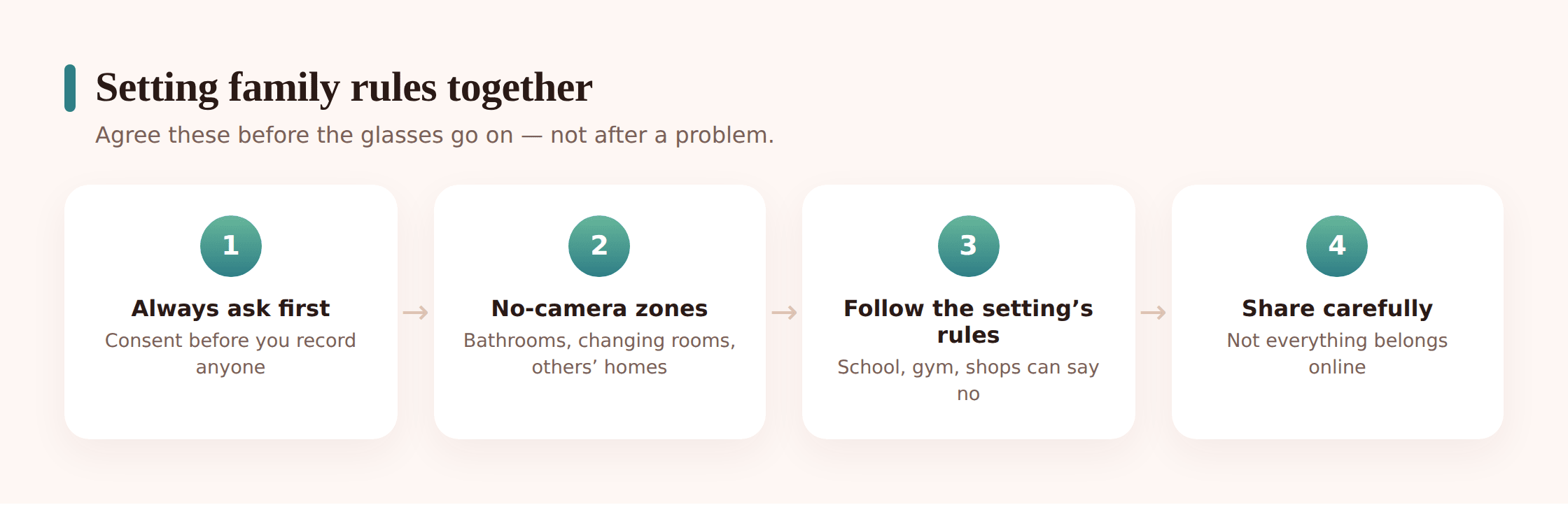
Rule 1 — Ask before you record
The default is off. Before filming people, ask them. “Mind if I record this?” costs nothing and completely changes the interaction. If asking feels awkward, that’s usually a sign the answer might be no — which is worth respecting rather than working around.
Rule 2 — Never in private spaces
Changing rooms, toilets, locker rooms, other people’s bedrooms — the camera is off and away, no exceptions, no “just for a second.” This is the one rule with zero flexibility, and it’s worth making sure your child can recite it without hesitation.
Rule 3 — Respect a no
If someone says they don’t want to be filmed, that’s the end of it. No wheedling, no “come on,” no filming them anyway from a different angle. A no about being recorded is like any other boundary — it’s honoured, not negotiated.
Rule 4 — Keep the light on and visible
If the device has a recording indicator, it stays uncovered and working. Covering it turns open recording into covert recording, and that’s a bright line in your house.
Rule 5 — Footage of others doesn’t get posted without a yes
Anything with an identifiable person in it stays off social media unless that person agreed to it being shared. When in doubt, don’t post.
Rule 6 — Read the room, and the venue
Some places — schools, some shops, some events, other people’s homes — have their own rules. Check, and follow them. Being a guest with a camera means the host’s comfort comes first.
Talking to kids as user and subject
The conversation that actually sticks isn’t a lecture about rules — it’s helping your child hold two roles at once. They’ll be the person recording, and far more often, the person recorded. Empathy runs both ways, and pointing that out does a lot of the work.
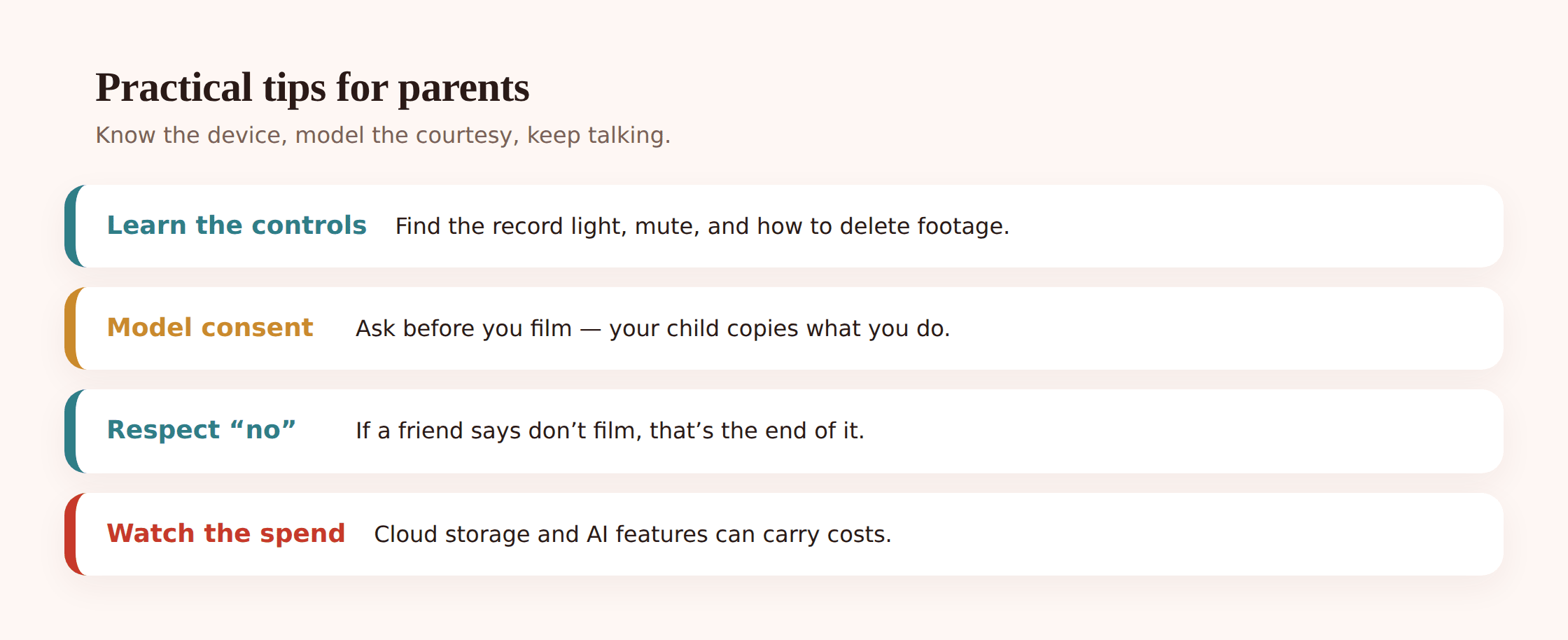
Start from the subject’s side, because it’s the one they feel most easily. Ask how they’d feel if a stranger’s glasses filmed them at the pool and they had no idea where the footage went. Once they’ve felt that, the rule about asking first isn’t an imposition you’re placing on them — it’s the courtesy they’d want for themselves. Most kids get there quickly when the question is framed as fairness rather than restriction.
Then talk about the invisible audience. A clip doesn’t stay in the moment it was filmed. It can be saved, forwarded, screenshotted, and seen by people who were never in the room — including years later. That’s true of a lot of digital life, and it connects to the wider point about a child’s privacy and digital footprint. Wearable cameras just make it easier to create that footage without anyone deciding to.
Keep the door open rather than banning your way out. A flat “no camera glasses, ever” tends to push the interest underground, where you can’t guide it. Better to agree the rules, let them use the device within them, and stay someone they’ll come to if something goes wrong — if they’re filmed and it bothers them, or if they realise they filmed something they shouldn’t have. The goal isn’t a child who never touches a wearable camera. It’s one who uses it like a considerate adult, and who knows they can talk to you when it gets complicated.
These devices are still early, and the norms around them are being written right now, by the first generation to grow up with cameras on their faces. Your child gets to be part of setting those norms. Raising them to ask first, respect a no, and keep the light on isn’t just protecting the people around them today — it’s helping shape what “polite” means for a technology the rest of us are still figuring out. If you want to zoom out to the connected-gadget picture more broadly, our guide to smart toys and connected devices is a good companion.
FAQ
Can you tell when smart glasses are recording?
Usually, but not always easily. Most reputable camera glasses show a small light when they capture, and that’s the signal to look for. The trouble is it’s small, can be hard to spot in bright sun or from a distance, and some people try to defeat it. So the honest answer is: often yes, sometimes no. That uncertainty is exactly why it’s fair for anyone to ask “are you recording?” — and why teaching your own child to keep the light on and visible matters.
Is it legal to record people with them?
It depends heavily on where you are, so treat this as general rather than a ruling. In many places, filming in a public space is broadly permitted, while recording in private spaces — changing rooms, toilets, bedrooms — is not, and can be a serious offence. Audio is often governed by stricter rules than video, and some jurisdictions require everyone’s consent to record a conversation. Publishing footage of identifiable people, especially children, raises further issues. The safe habit, wherever you live, is to be stricter than the law: ask first, avoid private spaces entirely, and don’t post footage of people who didn’t agree.
My teen wants camera glasses. Should I say yes?
Not automatically, but not a flat no either. The better move is to make the rules the condition of the yes — ask before recording, never in private spaces, respect a no, keep the light on, don’t post footage of others without consent. If your teen can genuinely sign up to that and you trust them to hold it, a wearable camera can be fine. If those rules feel like an argument waiting to happen, that tells you something worth listening to.
What do I do if someone films my child without permission?
Stay calm and ask directly — “are you recording? I’d rather you didn’t film my child.” Most people will stop when asked. If it happens somewhere with staff or rules, like a school or a pool, raise it with them. And use it as a teaching moment: your child seeing you object, politely and firmly, shows them it’s allowed and shows them how to do it themselves.
Are wearable cameras different from just using a phone camera?
Yes, in one important way. A phone camera involves lifting the phone and aiming it — a visible act that gives people around you a chance to notice and object. A wearable camera removes that cue. It can capture without the obvious motion, which is why the etiquette has to be more deliberate: because the device won’t announce itself the way a raised phone does, the wearer has to.
What about the built-in AI assistant listening all the time?
It’s a fair concern. Glasses with an assistant may keep a microphone active to hear commands, and the camera may be used more often to answer questions about what you’re seeing. Check the specific device’s settings — most let you control when the assistant and camera are active, and review or delete what’s stored. As a household, it’s reasonable to agree the assistant gets switched off in private settings and around people who haven’t agreed to be within range of a live mic.