What to Do If Your Child’s Photos Are Shared Without Consent
Finding out that a photo or video of your child has been passed around without permission is a gut-punch. Your heart races, your mind jumps to the worst version, and every instinct says do something this second. Take one breath first. There’s a calm, orderly way through this, the situation is more fixable than it feels right now, and none of it is your child’s fault.
The first hour: what to do right away
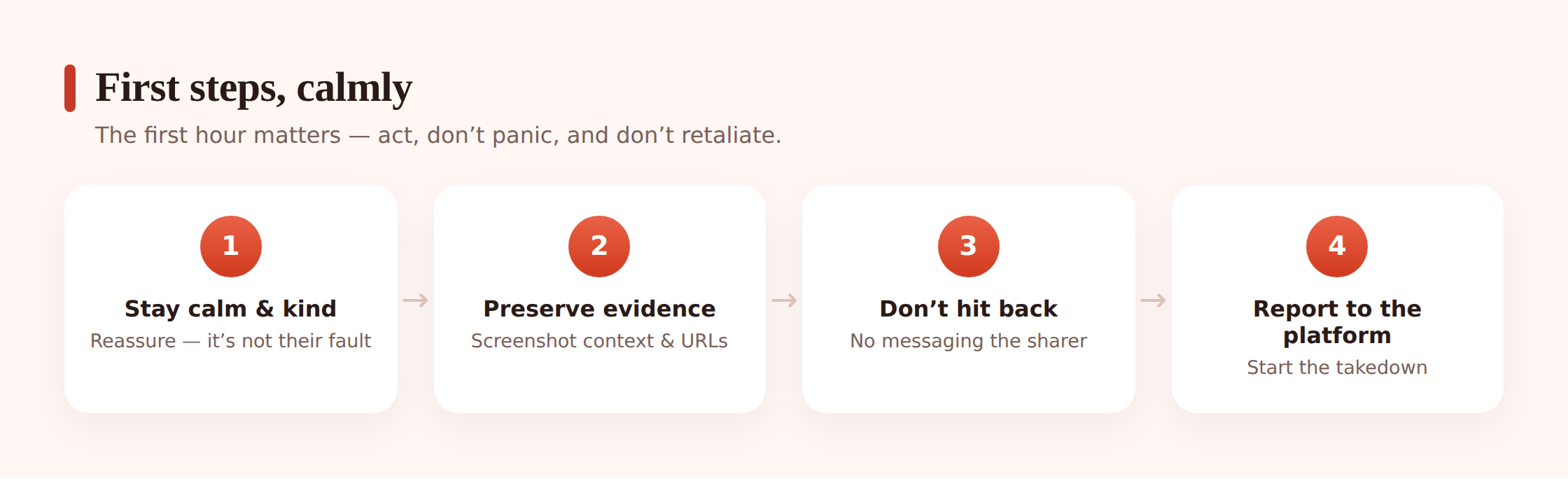
The early moments matter, mostly because a few small actions now make everything afterward easier. You don’t need to have the whole plan. You just need to slow down, protect the evidence, and avoid the two or three moves that make things worse.
Before anything else, sit with your child, not across from them. This is a moment to be on the same side of the table, literally if you can. What you do in the next hour tells them whether home is a safe place to bring hard things. So lead with steadiness.
Stay calm and say the first sentence right
Whatever you’re feeling, your child is reading your face for the verdict. Open with reassurance: “I’m really glad you told me. You’re not in trouble, and we’ll sort this out together.” The relief that follows does more good than any technical step. Anger, even anger at the person who shared it, can land on the child as blame in that first moment, so hold it for later.
Don’t delete anything yet
The urge to make it disappear is powerful. Resist it for now. Before anyone blocks, closes accounts, or wipes a chat, you want a record of what’s there. Deleting too fast can erase the very proof that helps a platform or the police act.
Preserve the evidence
Take screenshots that capture the context, not just the image: the username or profile that posted it, the web address (URL) of the page or post, the date and time, any captions or comments, and how you found it. Note where it’s appearing and who seems to have seen it. Keep these records somewhere private and secure. For an image that is nude or sexual and shows someone under 18, don’t save or forward the image itself — screenshot the surrounding context and links, and let the reporting services described below handle the picture. More on that in a moment.
Don’t retaliate or confront
If you know who shared it, the temptation to message them, name them publicly, or get other parents involved is huge. Don’t. Confrontation can tip the person off to delete accounts, escalate, or spread the content further out of spite. It can also complicate a police investigation later. Let the reporting channels do the work instead.
Block, then report
Once you’ve captured the evidence, your child can block the account that shared or re-posted the image. Blocking stops further contact without wiping what you’ve already recorded. Then move on to reporting it, which is where the real removal happens.
The different shapes this takes
“Shared without consent” covers a wide range, and the right response shifts a little depending on which one you’re dealing with. Here’s the map, kept deliberately non-graphic. You don’t need vivid detail to act well.
An embarrassing photo passed around
Maybe it’s a silly, unflattering, or private moment that a classmate screenshotted and sent round a group chat. It feels enormous to your child even when it’s mild to an adult eye. Take that feeling seriously. This is often a school and friendship issue as much as an online one, and it usually resolves with removal, a word to the school if peers are involved, and a lot of reassurance. Our guide on cyberbullying goes deeper if it tips into targeting or ridicule.
A private image leaked
A photo your child shared with one person, or kept private, has been forwarded or posted more widely. The betrayal cuts deep here because trust was broken. The response is the same steady sequence: preserve, report, remove, support. If your child sent the image themselves under pressure, please read that as something done to them, not by them.
A photo re-posted by a stranger
Sometimes an ordinary photo, a holiday snap, a sports photo, gets lifted from a public account and re-posted by someone your child doesn’t know. This can be unsettling and occasionally a safety concern if it reveals location or routine. Report it to the platform, lock down the original account, and keep an eye out for any contact attempts.
An image that’s been altered or AI-edited
This is the newest and most distressing version. An ordinary photo of your child is digitally manipulated, sometimes with “nudify” style apps or AI tools, to appear nude or sexual when it never was. It is fake, but the harm and the fear are completely real, and your child may feel exposed as if the image were genuine. Two things to hold onto. First, a fake sexual image of a real under-18 child is treated as seriously as a real one by removal services and by the law in many places, so the same reporting routes apply. Second, this is not something your child did; it’s something done to them by someone in the wrong. We cover how the technology works in our deepfakes and AI guide if you want to understand the mechanics.
A note on how we’re describing this. We’re keeping every description here high-level on purpose. You do not need graphic detail to respond well, and neither does your child. What helps is knowing the shape of the problem and exactly where to turn. If an image is sexual and involves a minor, skip to the removal services below rather than examining, saving, or forwarding it.
If the image is being used to threaten or blackmail your child, for money, more images, or anything else, that’s a specific crime called sextortion, and it has its own playbook. Read our guide on sextortion alongside this one.
Getting it removed and where to report
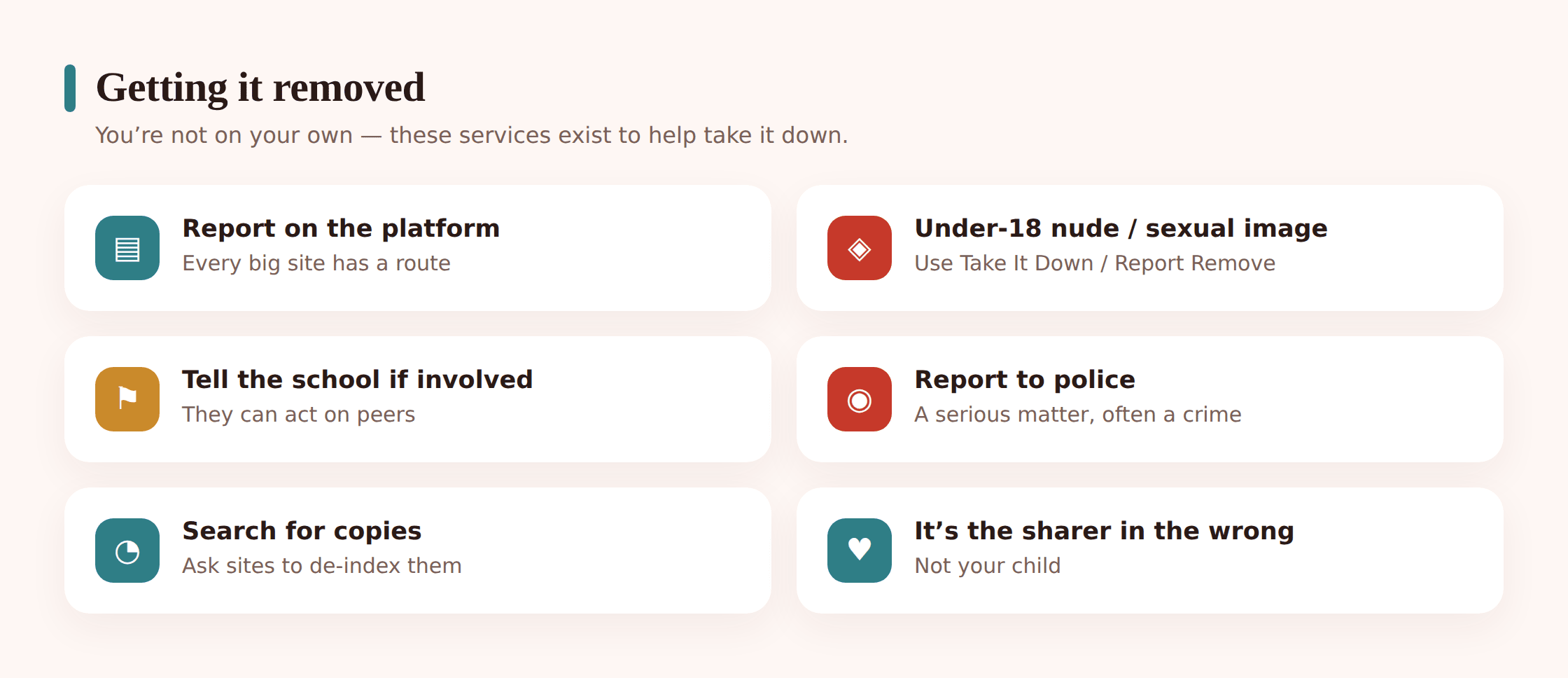
This is the part that turns a helpless feeling into forward motion. There are two tracks running in parallel: reporting to the platform where the content lives, and, for anything sexual involving a minor, using the specialist services built exactly for this. Do both.
Report it on the platform first
Every major app, Instagram, TikTok, Snapchat, YouTube, X, WhatsApp, has a way to report a post, account, or message. Look for the three-dot menu on the content and choose report, then pick the closest reason: harassment, non-consensual intimate image, impersonation, or that it involves a minor. Reporting that a piece of content shows someone under 18 in a sexual way tends to trigger the fastest review. If your child appears in the image, you can usually also request removal of content posted without consent.
For a nude or sexual image of an under-18, use the specialist services
In the US: use NCMEC’s Take It Down service (takeitdown.ncmec.org), which is built to help remove nude or sexual images of people who were under 18, including fake or AI-altered ones, and works from a digital fingerprint rather than requiring you to send the image around. Report to the NCMEC CyberTipline at report.cybertip.org, and contact the FBI or your local police.
In the UK: use Report Remove, the free tool from Childline and the Internet Watch Foundation, which helps young people get a nude image of themselves taken down. Report to CEOP through the CEOP Safety Centre. Call the police on 101, or 999 in an emergency.
Elsewhere: contact your national child-protection or child-safety organisation and your local police. Many countries have an equivalent hotline, and StopNCII.org helps adults and teens tackle non-consensual intimate images across major platforms.
Report to the police when it involves a minor or a crime
Sharing a sexual image of a child, real or faked, is a criminal matter in most places, and so is harassment or threats. You don’t have to decide whether to press charges to make a report. Reporting creates a record, and officers can pursue removal and identify who’s responsible. Bring the evidence you preserved.
Tell the school if peers are involved
If classmates shared or received the image, the school’s safeguarding lead should know. Schools have a duty of care and can act quickly among students in a way that platforms can’t. Ask them to handle it discreetly to protect your child from further exposure.
Follow up and keep records
Removal can take time and sometimes more than one report. Keep a simple log: what you reported, where, when, and any reference numbers. If content reappears, report it again and reference the earlier case. Persistence works.
One honest word on services and helplines. They’re there to support you and your child and to get harmful content down. Where a child is at risk, some services and professionals may need to take safeguarding steps. That’s a good thing, and it’s better to promise your child help and safety than a secrecy no one can fully guarantee. Our broader guide on how and where to report online abuse lists more channels if you’re not sure where to start.
Supporting your child
The technical steps get the image down. This part gets your child through it, and it’s the half that lasts. However fast the removal goes, a young person who feels exposed carries the feeling for a while, and how the people around them respond shapes how heavy it stays.
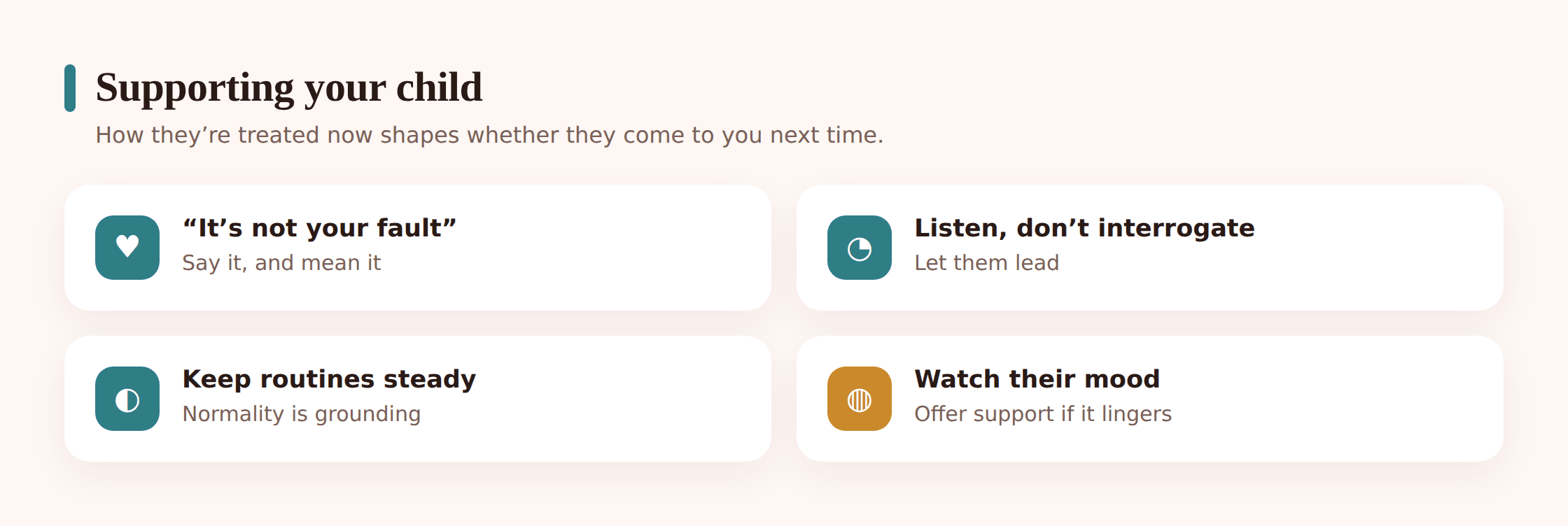
Say it plainly: this is not your fault
Say it out loud, more than once, and mean it. “This is not your fault. The person who shared this did something wrong, and possibly illegal. You didn’t cause this.” Children are quick to blame themselves, especially if they sent an image or posted it publicly at first. None of that transfers the blame. Consent to one person, or no consent at all, is not permission to spread something. The wrong belongs entirely to whoever shared it.
Take the shame off the table
Shame is what makes this hurt most and heal slowest. You lift it by staying warm, refusing to lecture, and not asking a stream of “why did you” questions in the raw early days. There’ll be time to talk about choices later, gently. Right now your child needs to feel loved exactly as they are.
Reassure them about how it ends
Early on, it can feel like the whole world has seen it and always will. That’s almost never how it plays out. Posts come down, the internet’s attention moves on quickly — usually far quicker than a scared teenager imagines — and the day-to-day slowly returns to normal. Say that to them plainly: “This feels enormous right now. It shrinks. We’ll deal with it one step at a time, and you’ll be all right.”
Bring in more support if they need it
Some children bounce back with a parent beside them. Others carry anxiety, sleep trouble, or a dip in mood, and that’s normal too. A school counsellor, your GP, or a therapist can help. In the UK, Childline is free and confidential for young people; other countries have equivalents. Sometimes a child finds it easier to talk to someone outside the family first, and that’s fine. What matters is that they’re talking to someone safe.
- Reassure first, ask questions later.
- Keep saying it’s not their fault, and that you’re glad they told you.
- Don’t punish them for how the image came to exist or get shared.
- Watch for lasting distress, and reach for professional support without hesitation.
- Give it a few days of calm, steady action before judging how bad things really are.
Reducing the risk going forward
Once the immediate crisis settles, there’s room for a gentle look at prevention, not to relive what happened, but to make the next stretch safer. Keep this conversation light and blame-free, or it undoes the reassurance you just built.
- Set social accounts to private, and treat friend or follow requests from strangers as a no.
- Talk about the fact that anything sent, even to one trusted person, can be copied or forwarded, so the safest images are the ones never shared.
- Trim what’s public: remove old photos that show location, school uniforms, or routines that a stranger could use.
- Agree the household rule that if anything online turns scary or embarrassing, they come to you, and there’s no punishment for telling.
- Keep talking. One calm conversation now is worth more than any setting. Our guide on talking to your teen about sexting helps with the harder version of this chat.
That last point carries most of the weight. The children who come through incidents like this best are the ones who told a parent early, and they tell early when they trust they’ll be helped rather than shamed. Settings and tools support that; they never replace it.
Where transparent monitoring fits, honestly. No app stops a photo being shared, and none of this is really fixed by software — it’s fixed by a child who tells you early. FreePhoneSpy sits on your child’s Android phone out in the open, with their knowledge, and things like keyword alerts can quietly surface a worrying word in a notification days before it might otherwise come to light. That only helps as part of an honest, agreed arrangement; done behind their back it does the reverse. Set it up together, keep talking, and treat any tool as a smoke alarm rather than a stand-in for closeness.
Common questions
Should I keep the image as evidence?
For a normal but embarrassing or misused photo, yes, keep screenshots that show the context, the account, and the URL. For a nude or sexual image of anyone under 18, do not save or forward the image itself. Screenshot the surrounding context and links instead, and let services like Take It Down or Report Remove and the police handle the image through their own secure process. That protects your child and keeps you on the right side of the law.
It’s a fake or an AI edit, not a real photo. Does that still count?
Yes. A fabricated sexual image of a real child is treated seriously by removal services and by the law in many places, and it causes real harm regardless of how it was made. Report it through the same channels you would a genuine image, and make sure your child hears clearly that everyone knows it’s fake and that none of it reflects on them.
Can we actually get it taken down?
Usually, yes. Platforms remove content that breaks their rules, and specialist services like NCMEC’s Take It Down and the IWF and Childline’s Report Remove exist specifically to get nude images of under-18s removed, including from across multiple sites. It can take time and sometimes more than one report, so keep records and follow up. Persistence pays off.
My child already deleted everything. Is it too late?
No. Report it anyway with whatever you still have: the username, which app it was on, rough dates, anyone who saw it. Those details still help. Going forward, ask your child not to delete further messages or posts so evidence is preserved for any report.
Should I confront the person who shared it?
No. Confronting them can escalate things, tip them off to delete accounts, spread the content further, or complicate a police investigation. Preserve the evidence and report through the proper channels instead. If it’s a classmate, tell the school’s safeguarding lead rather than approaching the family yourself.
How do I bring it up if I found out but my child hasn’t told me?
Lead with love and safety, not interrogation. Try: “I’ve seen something that worries me, and I want you to know you’re not in trouble and I’m on your side. Can we sort it out together?” Then listen more than you talk. How you open that conversation shapes whether they trust you with the next hard thing.