A Family Digital Detox: How to Reset Screen Habits
Somewhere along the way, the phone stopped being a thing you picked up and became a thing you just held. A quiet minute appears and your hand reaches out before your brain catches up. Your kids see it. You see them do it back. A family digital detox is how you break that reflex — not forever, not cold turkey, just a reset that lets everyone remember what the evenings used to feel like.
What a detox really means
Forget the word “detox” for a second. Nobody’s poisoned. Your phone is genuinely useful — maps, cameras, group chats, homework, the recipe you’re halfway through. This isn’t anti-tech, and it isn’t a lecture about how things were better before.
A family digital detox is a short, deliberate break from the autopilot use. The scrolling you don’t remember doing. The pickup that had no reason behind it. You set aside a chunk of time — an evening, a Sunday, a long weekend — where phones step back and real life fills the gap. That’s it.
The point isn’t to prove you can survive without a screen. It’s to interrupt the habit loop long enough that you get a say in it again. After a day or two, most people notice the reflex quieting down. The phone stops calling from the other room. You reach for it less because you’ve remembered there are other things to reach for.
Think reset, not punishment. A detox that feels like a grounding will be resented and quietly sabotaged. A detox that feels like a shared adventure — even a slightly awkward one — is the kind people agree to do again.
Why it actually helps
Here’s what tends to happen when a family steps back from screens for a stretch. No invented numbers — just the things you’ll probably feel yourself.
- Sleep gets easier. Phones out of the bedroom means no midnight scroll, no blue glow, no “one more video.” Bodies wind down the way they’re supposed to.
- The doomscroll loses its grip. When you’re not topping up on outrage and comparison all day, your mood has room to level out. That’s true for teens and adults both.
- People talk again. Real conversations happen in the gaps — the car, the kitchen, the dead ten minutes before dinner. Fill those gaps with a screen and the conversations never start.
- The reach-for-it reflex fades. Break the loop for a couple of days and the automatic pickup weakens. You start choosing when to use the phone instead of it choosing for you.
- Your kids see you do it. This is the big one. A child who watches a parent put the phone away learns more than any rule could teach. You can’t nag a kid into a habit you don’t have yourself.
None of this needs to be dramatic. You’re not chasing a transformation. You’re just clearing some space and seeing what grows back into it.
The one rule: do it together
If you take one thing from this page, take this. A detox aimed only at the kids will fail. Every time.
Kids have a finely tuned sense of fairness, and nothing sets it off like a parent scrolling on the sofa while telling them to put their phone down. The rule has to be the family’s rule, and it has to apply to the person who made it. When parents opt out, the whole thing reads as a punishment dressed up as wellbeing — and it gets treated like one.
So agree it together. Sit down, talk about why, and let everyone have a voice in the shape of it. Pick a scope that feels doable rather than heroic: one screen-free evening, a phone-light Sunday, a weekend away, the first days of a holiday. Start small. A modest detox you finish beats an ambitious one that collapses by lunchtime.
The plan, step by step
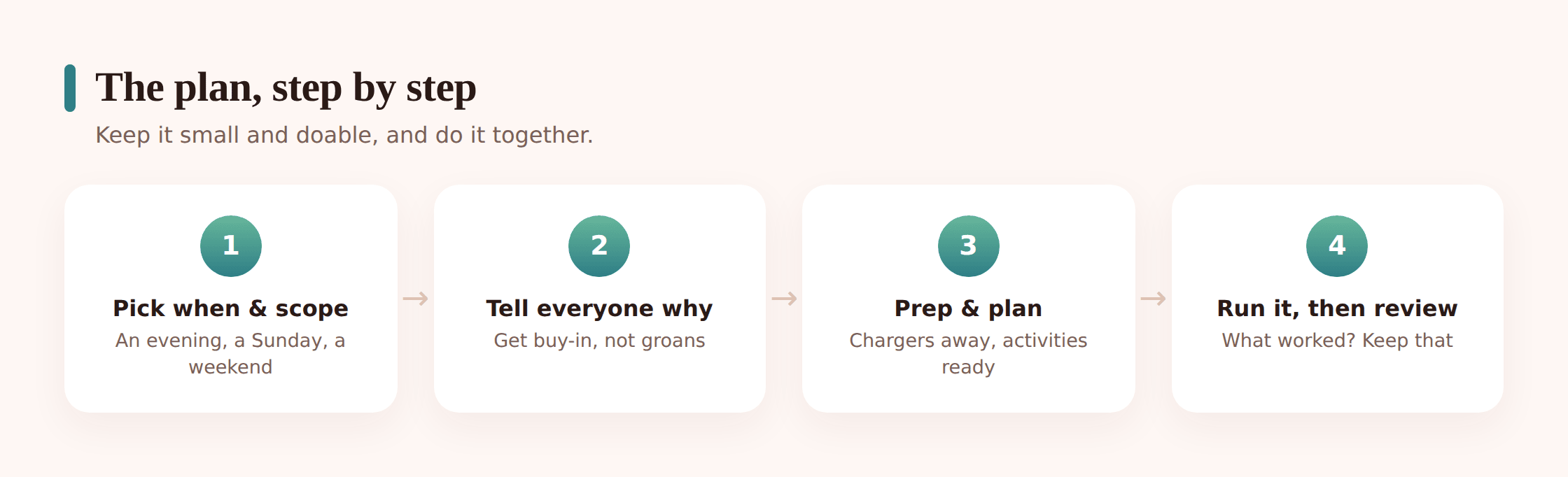
You don’t need a spreadsheet. You do need a few decisions made ahead of time, so nobody’s improvising when the first bored sigh arrives.
1. Pick the when and the scope
Choose a specific window and write it down. “Friday after dinner until Saturday breakfast” is a plan. “We should use our phones less” is a wish. Match the scope to your family’s appetite — first-timers should start with a single evening.
2. Tell everyone why, and get buy-in
Explain what you’re doing and what you’re hoping for, in plain words. Ask what they’d want to do with the time. When kids help shape it, they defend it instead of dodging it. Non-negotiable: parents are in too.
3. Prep the ground
Move chargers out of bedrooms and set up one charging spot by the door. Set an auto-reply or tell a couple of people you’ll be slow to answer, so nobody’s anxious about a missed message. Most importantly, plan the activities in advance — an empty afternoon with nothing lined up is where detoxes die.
4. Set the boundaries clearly
Decide together what’s off and what’s allowed. Usually the social apps, games and video go quiet, while calls, maps, camera and music stay fair game. Naming the exceptions upfront stops every grey area from turning into a negotiation.
5. Run it
Start the clock. Put the phones on the charging station and leave them there. When the itch hits — and it will — lean into whatever you planned. The first hour is the hardest. It gets easier fast.
6. Review together after
When it’s done, talk about it. What was hard? What was surprisingly nice? What would you change? This is how a one-off becomes a habit. Ten minutes of honest chat here is worth more than the whole rest of the plan.
Screen-free activities by age
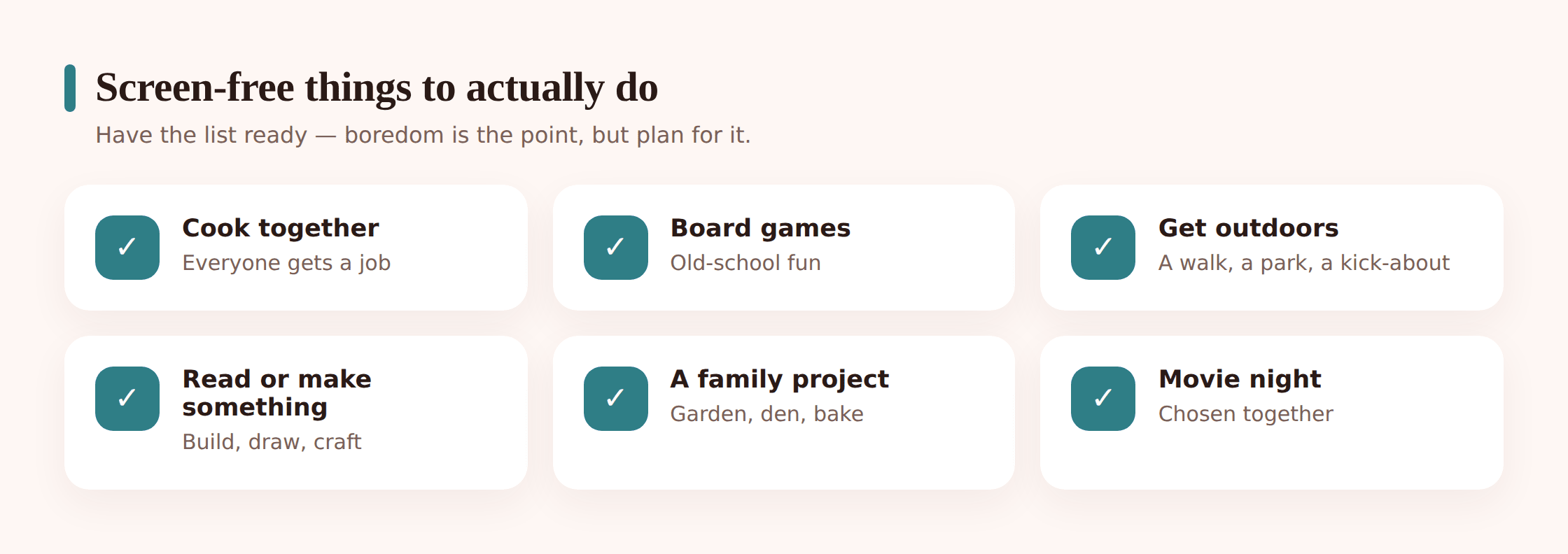
Boredom is the enemy of a detox, so have a list ready. Here are things that actually work, roughly by age. Mix and match — the best ones pull the whole family in at once.
Little ones (toddlers to early primary)
- Baking something simple together — they stir, you supervise the mess.
- A pillow fort, a blanket den, an indoor obstacle course.
- Drawing, painting, playdough, sticker books.
- A walk to look for specific things — red doors, dogs, the biggest tree.
- Reading the same picture book three times because they asked.
Middle years (primary to early teens)
- Board games and card games — a proper tournament with a scrap-paper leaderboard.
- Cooking a whole meal as a team, each person on a job.
- Building something — Lego, a model, a bird feeder, a fort in the garden.
- Bikes, a ball in the park, a swim, a kick-about.
- A puzzle left out on the table that everyone adds to in passing.
Teenagers
- Cooking something more ambitious and letting them lead it.
- A film they choose, watched together with actual snacks.
- A real project — fixing a bike, planting something, starting an instrument, a bit of DIY.
- Getting out: a hike, a climb, a run, a swim, kicking a ball around.
- Reading — and this counts for you too, on the sofa, at the same time.
Everyone at once
- A family walk, phones left behind, no destination required.
- A shared project with a finish line — a garden bed, a repainted shelf, a batch of biscuits.
- Games night as a fixed ritual, not a one-off.
- Making dinner together and eating it at the table with nothing buzzing.
Gentle rules that stick
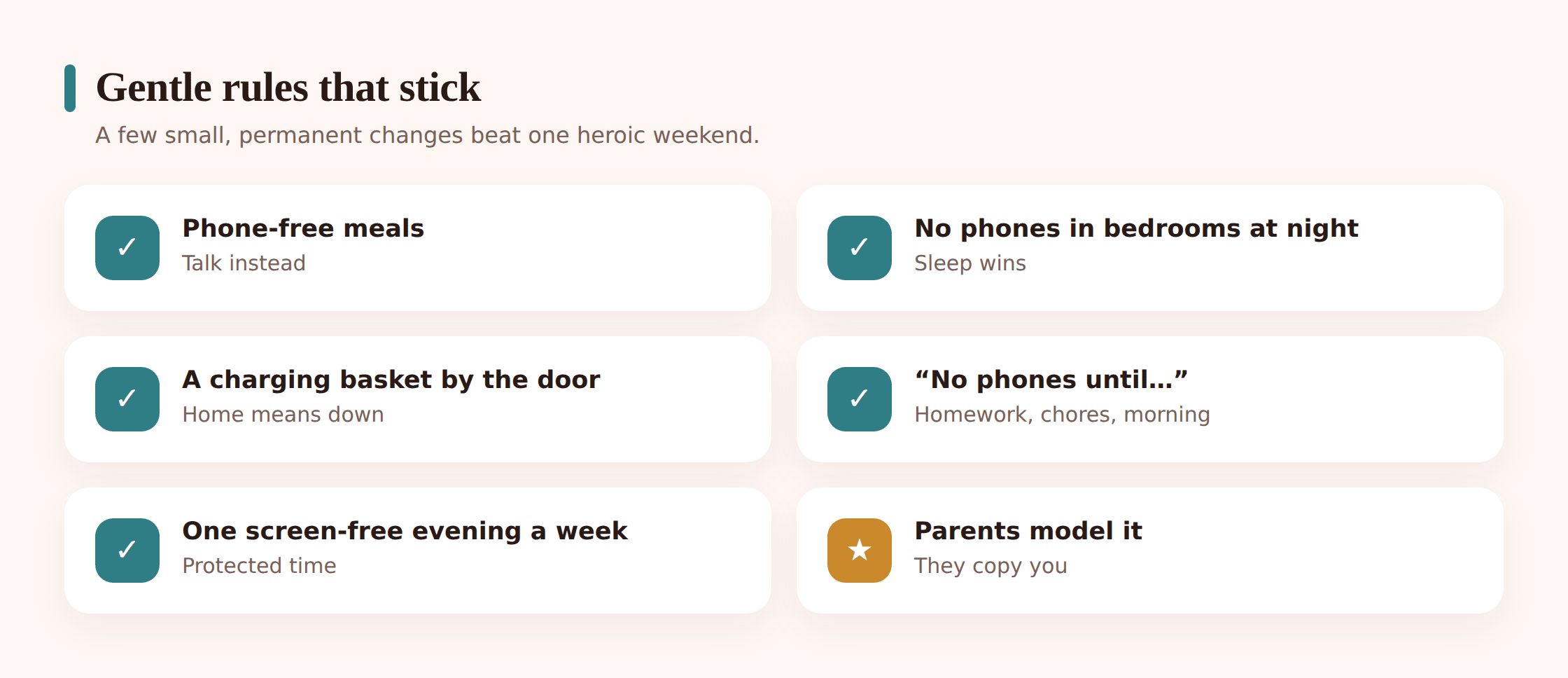
A detox is the reset. Rules are what keep a bit of the calm once normal life starts again. Keep them few, keep them fair, and keep them the same for adults.
- Phone-free meals. No phones at the table, chargers or a basket handles the rest. This one change does a lot on its own.
- Phones out of bedrooms at night. They sleep in the kitchen. Buy a cheap alarm clock so “but it’s my alarm” stops being the excuse.
- A charging station by the door. Phones come home and land in one spot. Out of hands, out of pockets, out of mind.
- “No phones until X.” Pick a line — after homework, after breakfast, after a job’s done. Predictable beats arbitrary.
- A chosen-together movie night. One protected evening a week where the screen is shared, not solo. It’s still a screen, but it’s the good kind.
- Downtime windows. Agree a stretch each day — say, the hour before bed — where phones are simply parked.
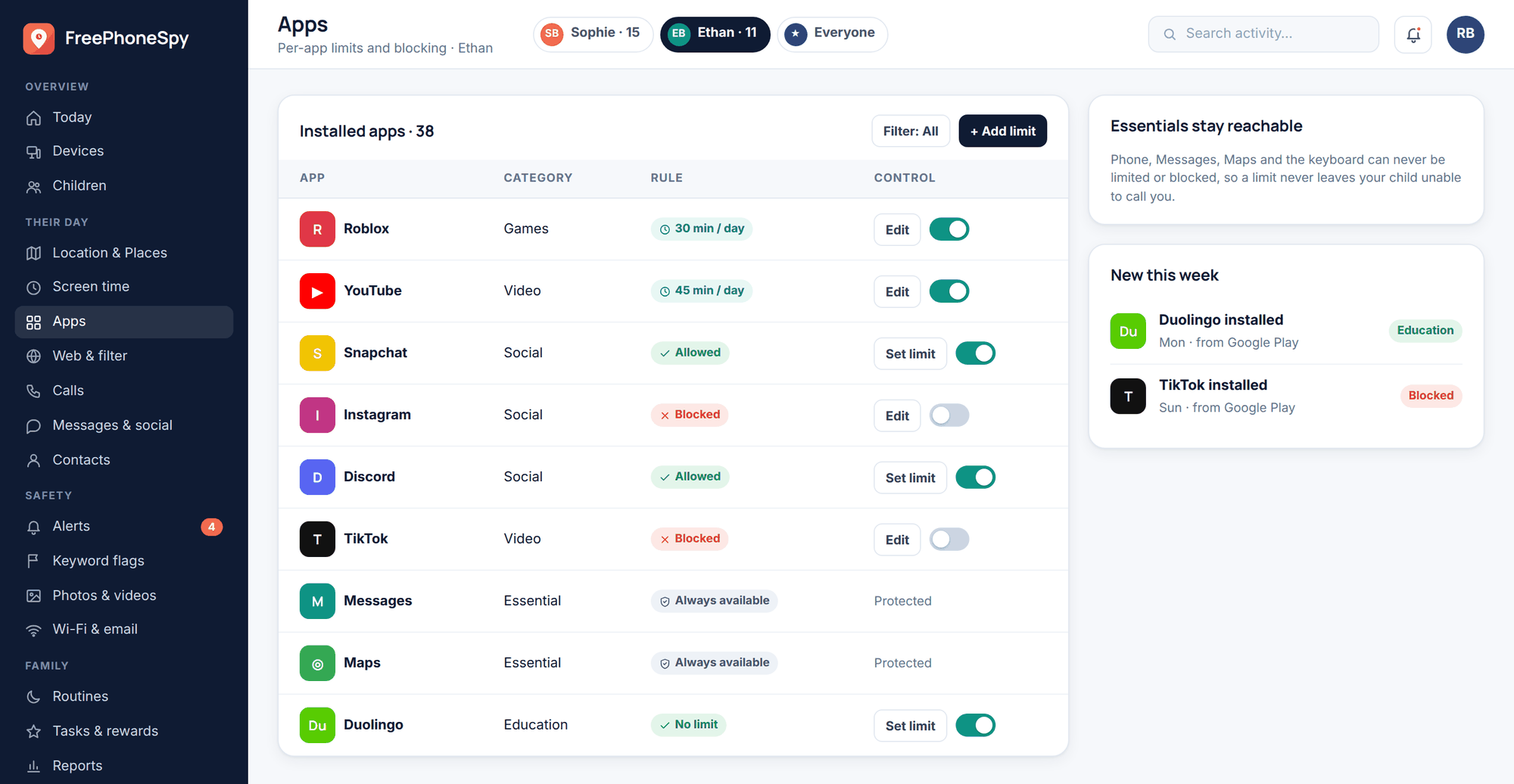
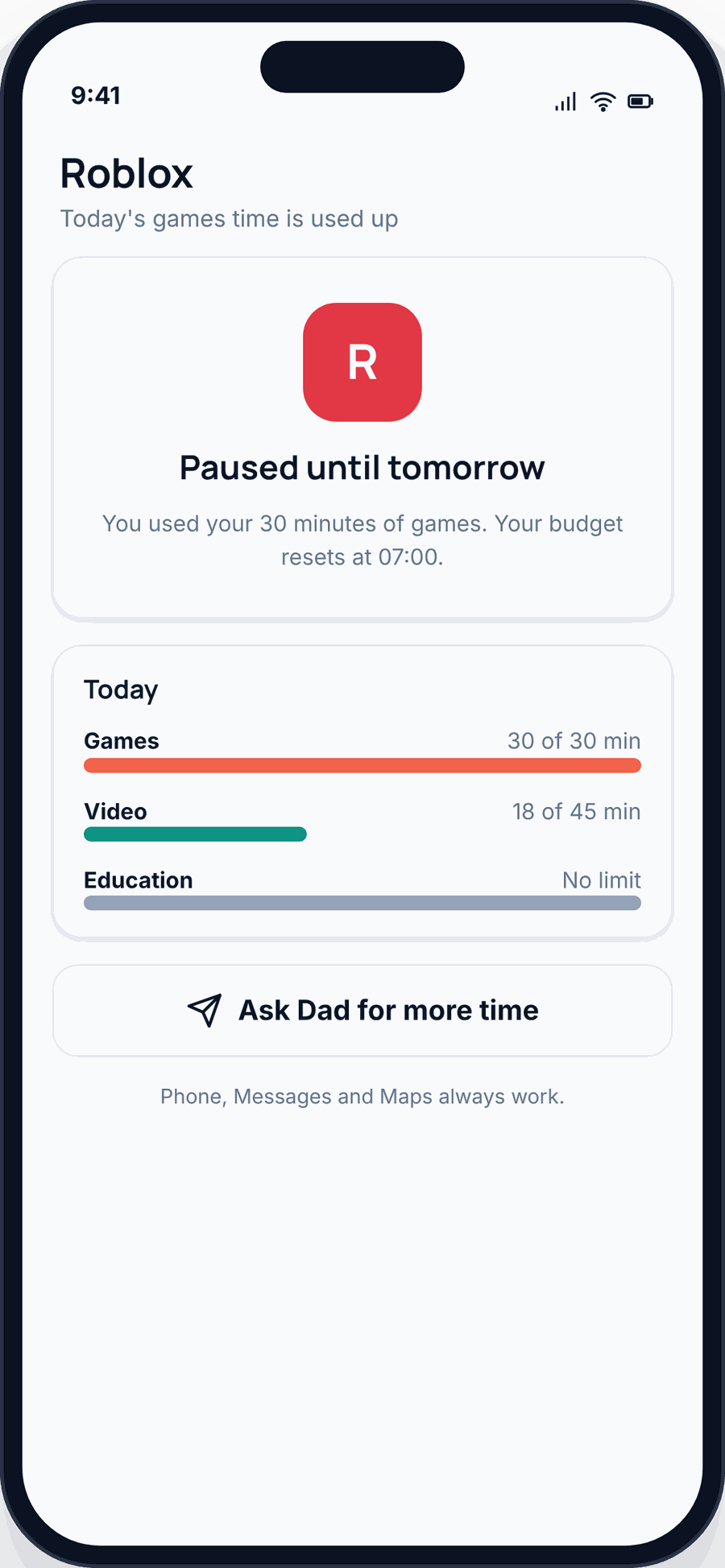
Rules hold better with a little scaffolding behind them, and this is the one place a monitoring tool earns its keep. If you’re on Android, screen-time budgets, app limits and a scheduled “downtime” can quietly enforce the boundaries you all agreed, so bedtime isn’t a fresh argument every night. FreePhoneSpy does this openly through a web panel — transparent, consent-first, with the child knowing it’s there — and it’s free to start, then kept free by simple tasks. On iPhone, Apple’s built-in Screen Time does the same job. The tool never replaces the family agreement, though. It just helps you keep the promise you made together.
Handling the grumbling
There will be resistance. Expect it, and don’t panic when it shows up. The first stretch of a detox is genuinely uncomfortable — for the teenagers, and honestly for you too. That flat, restless, “I’m bored” feeling? That’s the withdrawal, and it’s exactly the thing you’re here to work through.
Boredom is the point. It’s the brain rebooting after months of constant input. On the other side of it is the ability to sit with a quiet moment, to start something, to make your own fun. If you rescue everyone from boredom with a screen the second it appears, you never get there.
So ride it out. Have the activity list ready so there’s always an off-ramp that isn’t a phone. And resist the urge to lecture. Nobody’s habits ever changed because they got a speech about dopamine. Just keep showing up, keep your own phone parked, and let the calm do the persuading. A parent who’s visibly enjoying the break makes a far better case than one who’s counting down the hours.
Don’t referee, join in. The moment you become the phone police, the detox becomes something done to your kids instead of with them. Sit down, pick up a controller or a book, and be a participant. Your presence is the whole intervention.
Keeping it going after
A one-off detox is a nice weekend. The real prize is the small changes you keep. Don’t try to hold onto all of it — pick the two or three things that felt genuinely good and make them permanent.
- One screen-free evening a week. Same night, every week, no debate. It becomes a thing your family does, like a Sunday roast.
- Protect the edges of the day. The first hour after waking and the last hour before bed stay phone-light. These two windows shape how the whole day feels.
- Keep the charging station. The single easiest habit to hold, and one of the most useful.
- Small and permanent beats big and temporary. A modest change you keep for a year does more than a heroic month you never repeat.
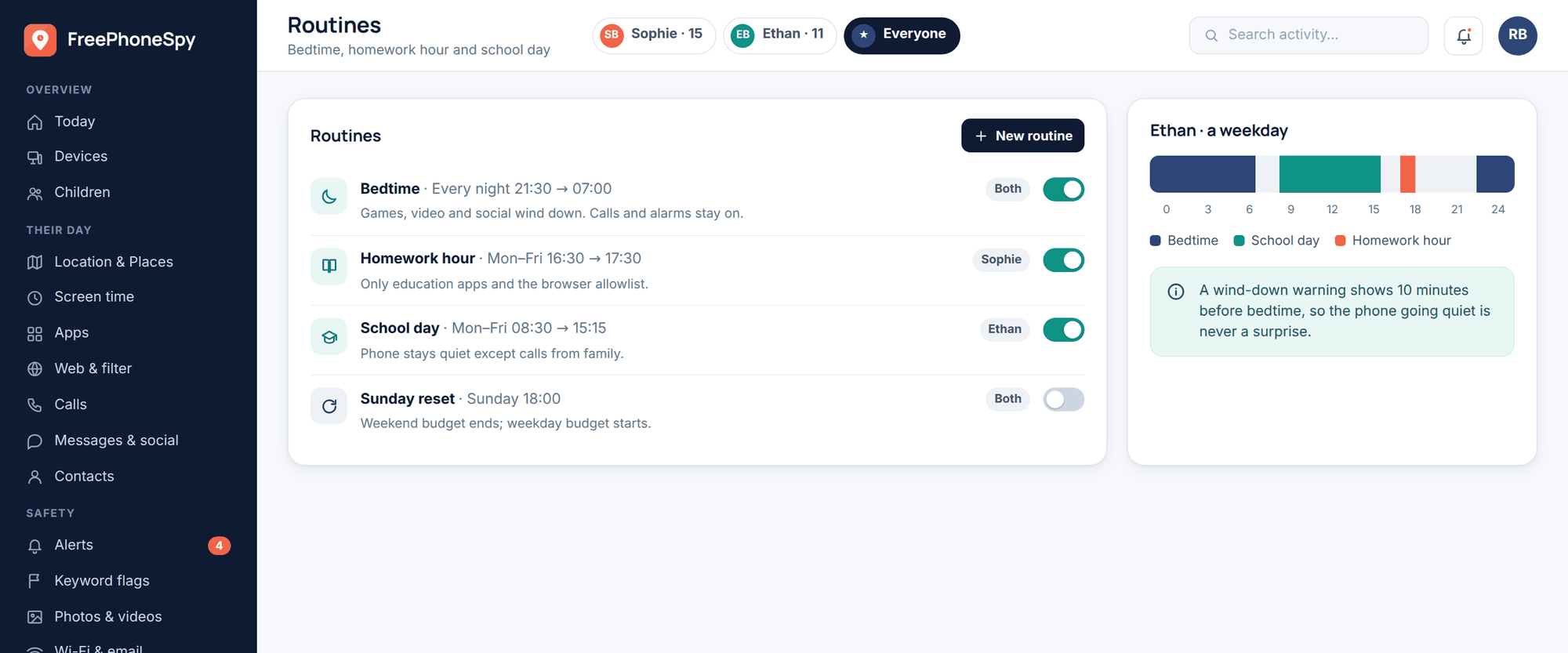
A consistent bedtime routine and a shared family phone agreement are what turn a good weekend into a lasting shift. Write down the handful of things you’re keeping, stick it on the fridge, and let it be a living agreement you revisit rather than a one-time announcement. If you want a little help holding the wind-down window, a scheduled downtime routine can carry it for you — quietly, in the background, so the good habit doesn’t rely on willpower alone.
And go easy on yourselves. You’ll slip. Someone will sneak a scroll, movie night will get skipped, the phones will creep back to the bedside. That’s fine. The aim is better, not perfect. A family that’s a bit more present than it was last month is winning, full stop.
Questions families ask
How long should a first detox be?
Start with a single screen-free evening or one phone-light day. It’s long enough to feel the difference and short enough that everyone finishes it. Once you’ve done one, a weekend feels far less daunting.
My teenager says a detox is unfair when their friends are all online. What do I say?
Acknowledge it’s real — being out of a group chat genuinely stings at that age. Keep the scope short, let calls and messages stay on if that eases the worry, and above all do it with them, not to them. When you’re off your phone too, “unfair” loses most of its force. There’s more on the pressures teens face on our page about phones and teen mental health.
What about really young kids?
Little ones are the easy part — they’d usually rather have you than a tablet anyway. The harder job is modelling it, since they copy what you do with your phone long before they own one. We go deeper into this in our guide on screen time for toddlers.
Isn’t cutting off all screens a bit extreme?
It would be, which is why you don’t. A detox is a short reset, not a lifestyle. Calls, maps, camera and music can stay on. You’re breaking the autopilot scrolling, not declaring war on technology.
Do we need an app to do this?
No. A detox is a family agreement above all, and plenty of families run one with nothing but a charging basket by the door. A tool like screen-time limits only helps hold the boundaries afterward, so bedtime and downtime don’t become nightly arguments. It supports the agreement — it never replaces it.
What if it doesn’t stick?
Then you run another one, and keep whatever small piece did stick. Habits shift slowly. Aim for a family that’s a little more present than before, not a spotless one, and you’ll actually get there.