When to Stop Monitoring Your Child’s Phone
Almost every guide about monitoring tells you how to start. Far fewer tell you how to stop, which is strange, because stopping was always the point. You didn’t put a safety net under a young child so that you could keep it there forever. You put it there so that one day it wouldn’t be needed — so that the wobbling, uncertain kid on the phone would grow into a young adult who handles their own digital life and comes to you because they want to, not because you can see everything. Winding monitoring down isn’t a risk you’re taking with all that careful work. It’s the finish line the work was aiming at the whole time. This guide is about knowing when your child is ready for less, and how to step back in a way that grows trust instead of gambling it.
Why monitoring needs an exit
Think about how you taught your child almost anything physical — crossing a road, riding a bike, using the kitchen. You didn’t hold their hand at the kerb for life. You held it, then you walked a step behind, then you watched from the door, then you stopped watching. The help was real, and the help was temporary. Every stage was designed to make the next stage possible, and the goal at the very top was a person who didn’t need you standing there at all. Phone monitoring is the same kind of help. It’s scaffolding around a building that’s still going up. Scaffolding that never comes down isn’t support any more — it’s a cage, and everyone can see the building was finished years ago.
The thing you’re actually growing is self-regulation. A child who is only ever safe because a parent is watching hasn’t learned to be safe; they’ve learned to be watched. Those are different skills, and only one of them travels with them into a dorm room, a first job, a life you’re no longer in the room for. Every month you keep the oversight running past the point it’s needed is a month your child doesn’t get to practise the judgement they’ll need when it’s gone. Stepping back isn’t the opposite of protecting them. Past a certain age, it is protecting them.
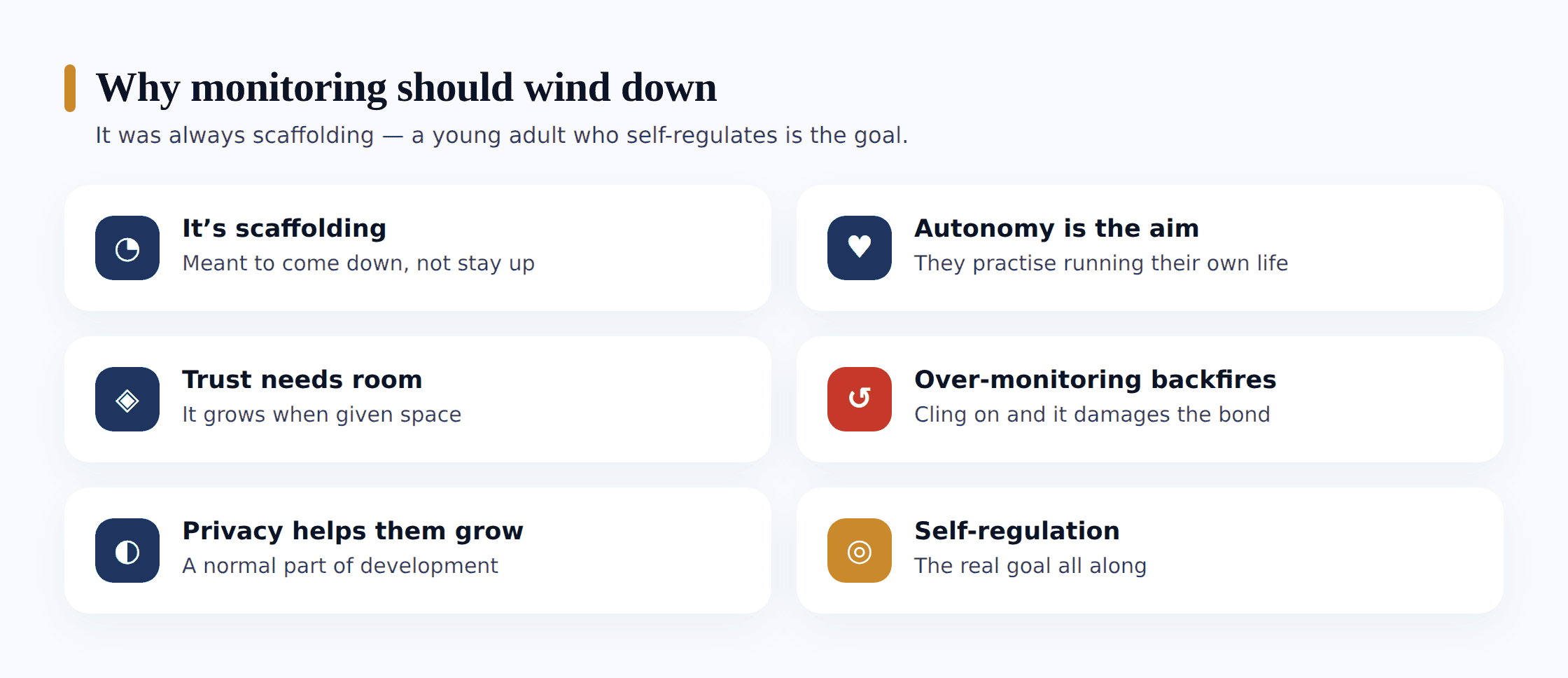
There’s a relationship cost to overstaying, too, and it’s steeper than most parents expect. Monitoring an older teen the way you monitored a ten-year-old doesn’t read as care to them — it reads as “you still don’t trust me,” repeated every single day. It teaches a corrosive lesson: that no amount of good behaviour ever buys freedom, so why bother behaving well where you can see? The teens who go furthest underground are very often the ones whose parents never eased off. Privacy isn’t a reward you’re withholding until they’re perfect. It’s a developmental need, as real at fifteen as sleep or food, and the room to have a private life is part of how a person becomes one. We’ve written about that need on its own terms in a teen’s growing need for privacy and independence, and it’s the ground this whole guide stands on.
Signs they’re ready for less
So how do you know it’s time? Not by a birthday alone, and not by a single good week. Readiness shows up as a pattern that holds over months — the accumulated evidence that your child can handle more room than they’ve currently got. You’re looking for consistency, not perfection. Here’s what genuine readiness tends to look like.
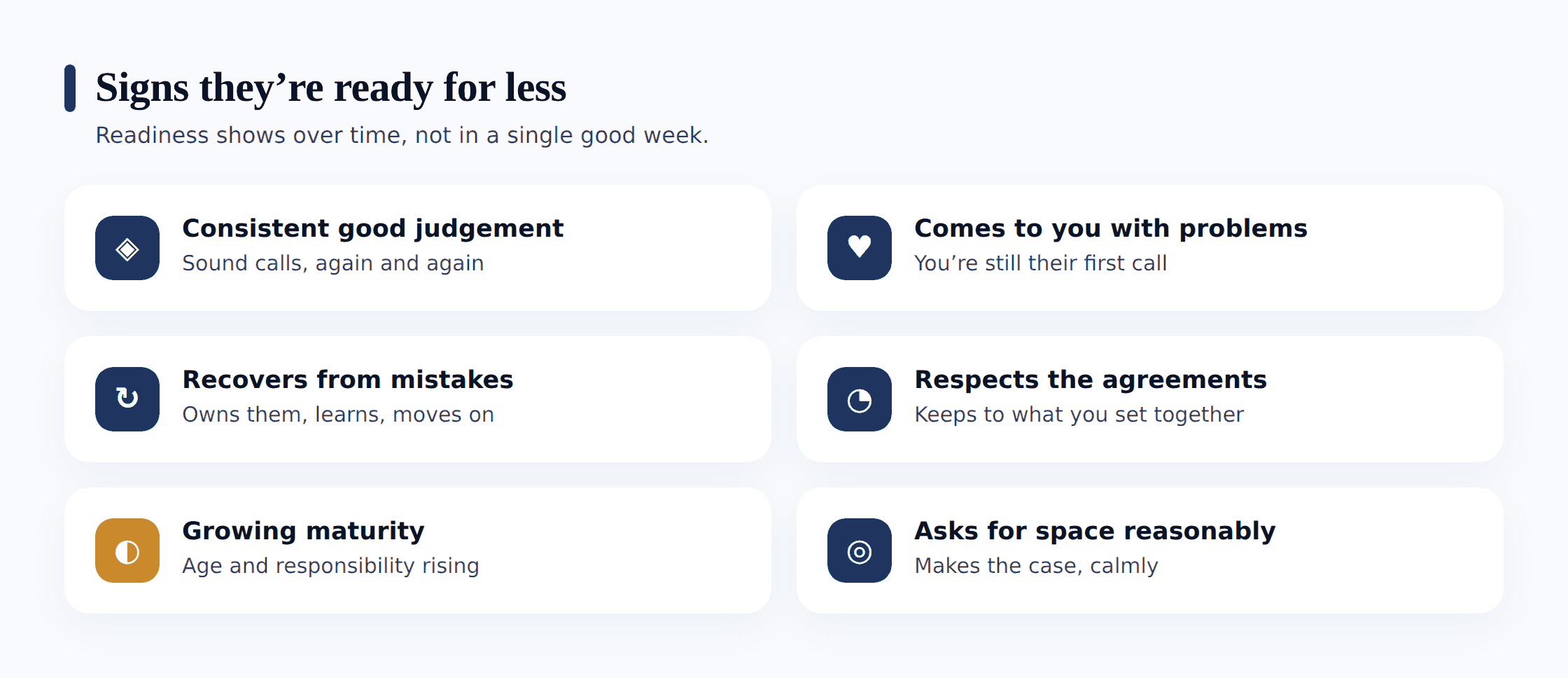
- Consistent good judgement over time. Not one sensible choice, but a run of them — blocking the stranger without being told, walking away from the group-chat pile-on, closing the app that was making them miserable. When you keep noticing they’ve already done the right thing before you’d have said anything, the watching has largely done its job.
- They come to you with problems. This is the big one. A child who brings you the awkward message, the friend who’s worrying them, the mistake they made — that child has an open channel to you, which is worth more than any dashboard. If they’re telling you things, you don’t need to go looking for them.
- They handle mistakes and recover. Everyone slips. Readiness isn’t never messing up; it’s messing up and dealing with it — owning it, fixing it, learning from it — rather than hiding it or falling apart. A teen who can recover from a bad decision has the exact skill that makes oversight unnecessary.
- They respect the agreements you set. The phone goes away at night as agreed. The boundaries you settled on together mostly hold, without a daily fight. Someone who keeps the deals they make can be trusted with bigger ones.
- Growing maturity and age. A fourteen-year-old and a seventeen-year-old are different people with different needs, and the older one should simply have more room by default. Age isn’t the whole story, but it’s a real part of it — expectations should climb with the years.
- They ask for more space, reasonably. “Can we stop the location thing now, I’m sixteen and I always tell you where I am” is not defiance. It’s a young adult advocating for themselves in exactly the way you’d hope. How they ask tells you a lot — a calm, reasoned request is itself a sign of the maturity that earns the yes.
Notice what’s missing from that list: a promise to be good, a stretch of not getting caught, or your own anxiety finally quieting down. Readiness is about what your child has actually shown you, over time, not about how nervous you feel. Anxiety is a normal part of this — more on that below — but it’s not the gauge. The gauge is their track record.
How to wind it down, gradually and openly
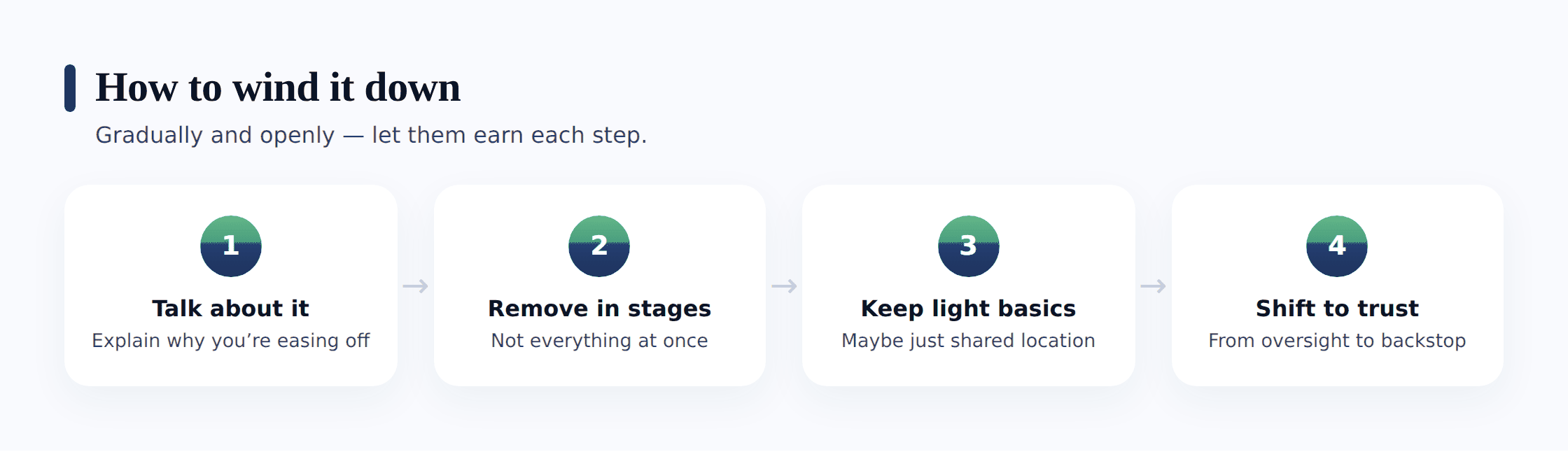
The single biggest mistake here is doing it all at once, or doing it silently. Flipping everything off overnight throws away the chance to show your child that this was always a planned handover, and quietly removing controls without a word teaches them that the whole thing was secret machinery they were never really part of. Wind-down done right is a conversation and a staircase — a series of visible, earned steps, each one talked through.
Talk about it first, and say why
Start with the conversation, not the settings screen. Tell your child what you’re doing and the reason behind it: “You’ve shown me you’ve got this, so we’re going to start easing off. Here’s what changes, and here’s why.” Naming it out loud turns the wind-down into something you’re doing with them, and it lets them feel the trust land. A control that vanishes silently teaches nothing. A control you turn off in front of them, explaining that they earned it, teaches exactly the lesson you want.
Remove things in stages, not in one go
Peel it back layer by layer. Maybe the message and browsing oversight comes off first, then the app checks, then the tighter alerts, with weeks or months between each step so both of you can see how it’s going. Staging does two jobs: it gives your child room to prove each new level of freedom before the next arrives, and it gives you a gentle, reversible path rather than a cliff edge. If something wobbles, you’ve stepped back one stair, not fallen down the whole flight.
Keep only light safety basics, for a while
Winding down doesn’t have to mean bare zero the same afternoon. It’s completely reasonable to keep one or two light, mutual safety basics running for a stretch after the closer stuff is gone — the kind of thing the whole family does, like a shared family location app everyone’s on, or simple emergency features. The distinction that matters: these are shared and consensual, not surveillance. The family map that you’re on too is a different animal from reading a sixteen-year-old’s messages. Keep the light stuff, drop the heavy stuff, and be clear about which is which.
Shift from oversight to trust — and let them earn each step
The through-line of the whole process is a handover from “I check” to “I trust, and you tell me.” Make the link visible so your child can see it working: good judgement and honesty buy the next loosening, plainly and reliably. When a teen can watch responsibility literally convert into freedom, they’ve every reason to keep being responsible. That’s the engine of the whole thing — not the tool coming off, but the trust going on. If you want the fuller picture of building that trust while any monitoring is still running, how to monitor a teenager without losing trust is the companion piece to this one.
What stopping looks like at 16, 17, 18+
There’s no universal switch-off age, but the direction is unmistakable, and the older your child gets the closer to zero routine monitoring should be. Here’s roughly how the last few years tend to go.
Around 16. For most teens this is deep into wind-down territory. Close monitoring of messages and browsing should mostly be behind you, with any remaining oversight light, agreed and increasingly mutual. A sixteen-year-old who’s shown steady judgement has earned a phone you essentially don’t inspect, backed at most by shared family basics and an open door. If you’re still auditing weekly at sixteen out of old habit, that’s the drift to correct.
Around 17. The default now is trust, with monitoring the rare exception rather than the standing arrangement. A seventeen-year-old is a year from legal adulthood and should be living something close to the independence that’s coming. Routine checking has essentially ended; what’s left is a relationship, a family location share they’re part of by choice, and your availability when they want it.
18 and legal adulthood. This is a genuine line, not just another step. Your child is now an adult, and monitoring an adult’s phone without their clear, ongoing consent isn’t parenting — it crosses into surveillance of another grown person, and we don’t support it. If an eighteen-year-old still at home chooses to stay on the family location app because it’s handy for everyone, that’s their consensual choice and it’s fine. What changes for good is that it’s now theirs to opt into or out of, not yours to impose. The job that started years ago is, by design, complete.
Reading this backwards is useful, too. The whole arc — start hands-on with a young child, ease off through the teens, arrive at nothing by adulthood — is a single planned taper, and it helps to see both ends. If you’re earlier in the journey and wondering where the beginning sits, we’ve mapped that in what age to start monitoring a child’s phone. Knowing where the off-ramp is makes the on-ramp far less fraught.
Staying connected after you stop
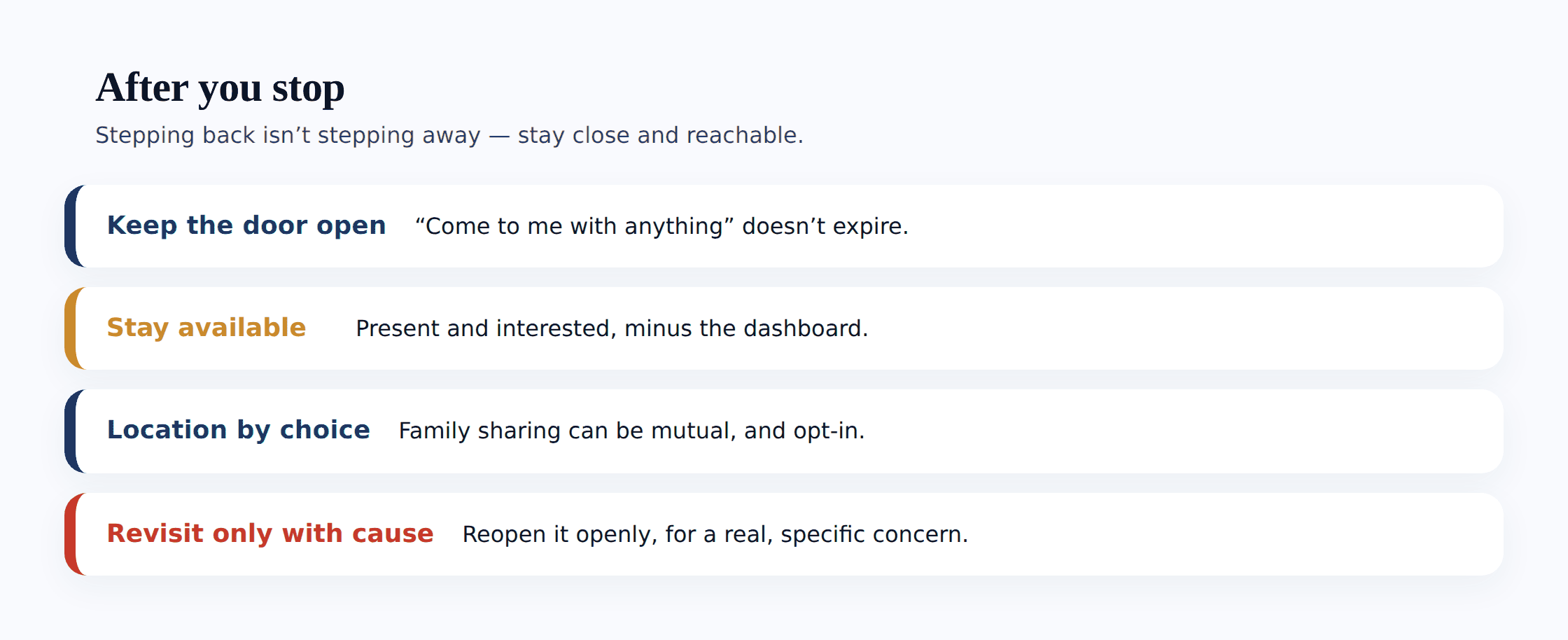
Here’s the reassuring part for any parent whose stomach tightens at “stop”: stepping back from monitoring is not stepping back from your child. You’re trading one kind of closeness — the kind that comes through a screen — for a better one that comes through the relationship itself. The connection doesn’t end. It changes shape, and usually improves.
- Keep the door open. The most protective thing you can offer a young adult isn’t a dashboard — it’s the certain knowledge that they can bring you anything, including the ugly stuff, without it blowing up. That door stays open long after every app is gone, and it’s what they’ll actually use when something goes wrong.
- Stay available, not on standby to inspect. Be the parent who’s easy to talk to, quick to help and slow to judge. Availability is the grown-up version of monitoring: you’re still there, still ready, just waiting to be invited rather than looking uninvited.
- Let family location be mutual and chosen. Plenty of families keep a shared location app going into adulthood, and there’s nothing wrong with it as long as it’s by choice and it goes both ways — they can see you as easily as you see them. Mutual and voluntary is worlds apart from one-way surveillance. Choose it together, or not at all.
- Revisit only for a genuine, specific concern — openly. Trust isn’t a promise never to worry again. If a real, concrete safety issue arises down the line, it’s fair to have the conversation and, if truly needed, agree on something temporary. The rules that governed the whole journey still hold: specific reason, said out loud, wound back once it passes, never done in secret.
If stepping back makes you anxious, that’s normal, and it isn’t a signal to keep monitoring. The anxiety is yours to manage; the freedom is theirs to grow into. A young adult who knows you trust them, and who knows the door is open, is far safer than one still being watched — because the first one will actually come to you when it counts.
Where FreePhone fits
A brief, honest word on our own tool, because it’s built to be eased off rather than kept forever. FreePhone is set up with your child, not behind their back — every phone shows a “What my parents can see” screen listing exactly what’s shared — and each feature can be scaled back or switched off as trust grows. You can drop the closer checks and keep only the lightest safety basics, like SOS and location, then turn even those off when the time comes, in stages that match the wind-down this guide describes. It runs on your child’s Android phone, you view it from any browser, and it’s free, with every feature. It’s designed to be temporary scaffolding — there to help you notice sooner and talk sooner while your child is growing into their own judgement, and to come down cleanly once they have.
Questions parents ask
At what age should I completely stop monitoring my child’s phone?
There’s no single magic age, but the arc is clear. By around sixteen most close monitoring should be behind you, by seventeen trust is the default and monitoring the rare exception, and at eighteen your child is a legal adult whose phone you shouldn’t monitor without their clear, ongoing consent. Let a steady track record of good judgement, not a birthday alone, set the pace — and aim for essentially zero routine oversight by the late teens.
Isn’t stopping risky? What if something happens after I step back?
The instinct is understandable, but keeping monitoring past its usefulness carries its own risk — it stops your child from practising the judgement they’ll need when you’re not there, and it can quietly damage the relationship that actually keeps them safe. A young adult who trusts you and knows the door is open will come to you when something goes wrong. That’s more protective than any dashboard. Step back gradually and openly, and if a genuine, specific concern ever arises, you can revisit it — out loud.
How do I know my teen is genuinely ready for less?
Look for a pattern that holds over months, not a single good week: consistent good judgement, coming to you with problems, handling mistakes and recovering, respecting the agreements you set, and asking for more space in a calm, reasonable way. The clearest sign of all is that they tell you things — if the channel between you is open, you don’t need to go looking. Readiness is about what they’ve shown you, not about whether your own anxiety has settled.
Should I tell my child I’m reducing the monitoring, or just quietly turn it off?
Tell them, always. Winding down silently misses the entire point — it leaves them thinking they’re still watched when they’re not, and it wastes the trust-building moment. Say what’s coming off and why: “You’ve earned this, so we’re easing off — here’s what changes.” Turning a control off in front of your child, and naming that they earned it, teaches exactly the lesson you’re after. Openness runs both ways, at the start and at the finish.
Can I keep any monitoring going after my child turns 18?
Only with their genuine, ongoing consent. An eighteen-year-old is a legal adult, and monitoring an adult’s phone without clear agreement isn’t parenting — it’s surveillance of another grown person, and we don’t support it. What’s perfectly fine is a mutual, chosen arrangement: if your adult child wants to stay on the family location app because it’s useful for everyone, that’s their call to make and unmake. The difference is consent, and after eighteen it’s entirely theirs to give.
Winding monitoring down can feel like the hardest part, precisely because it looks like letting go of something that was keeping your child safe. But the safety was never really in the tool. It was in the judgement your child was building the whole time, and in a relationship where they can still tell you the truth. Stepping back on purpose — gradually, openly, tied to what they’ve earned — is how you hand both of those over intact. Do it well and you don’t lose a watched child. You gain a trusted young adult who manages their own phone, knows exactly where you are when they need you, and walks through the open door because they want to. That was always the goal. Reaching it is the whole success.