How to Monitor Your Child’s Contacts: Who They’re Talking To

A child’s contact list is a quiet map of who’s in their life. Not the words they trade with friends, not the private jokes in a group chat, but the plainer question underneath all of it: who is actually talking to my kid? Most of the people saved there are exactly who you’d expect. Now and again a name shows up that doesn’t fit, or an unknown number starts calling, and that’s the signal worth catching early. This guide is about the contacts themselves — the address book, and who’s ringing and messaging — as a safety layer you tend to above board, your child fully in the loop. It is not about secretly reading their conversations.

Why do a child’s contacts matter for safety?
Think about how a phone number and a contact entry work. A number is a direct line — no friend request, no shared server, no algorithm deciding who reaches whom. Once someone is saved in a child’s contacts, or once their number is calling and messaging, they have a standing invitation to land on that screen. That’s why the contact list is such a useful thing to keep a light eye on. It answers the who, and the who is often the earliest sign that something’s off.
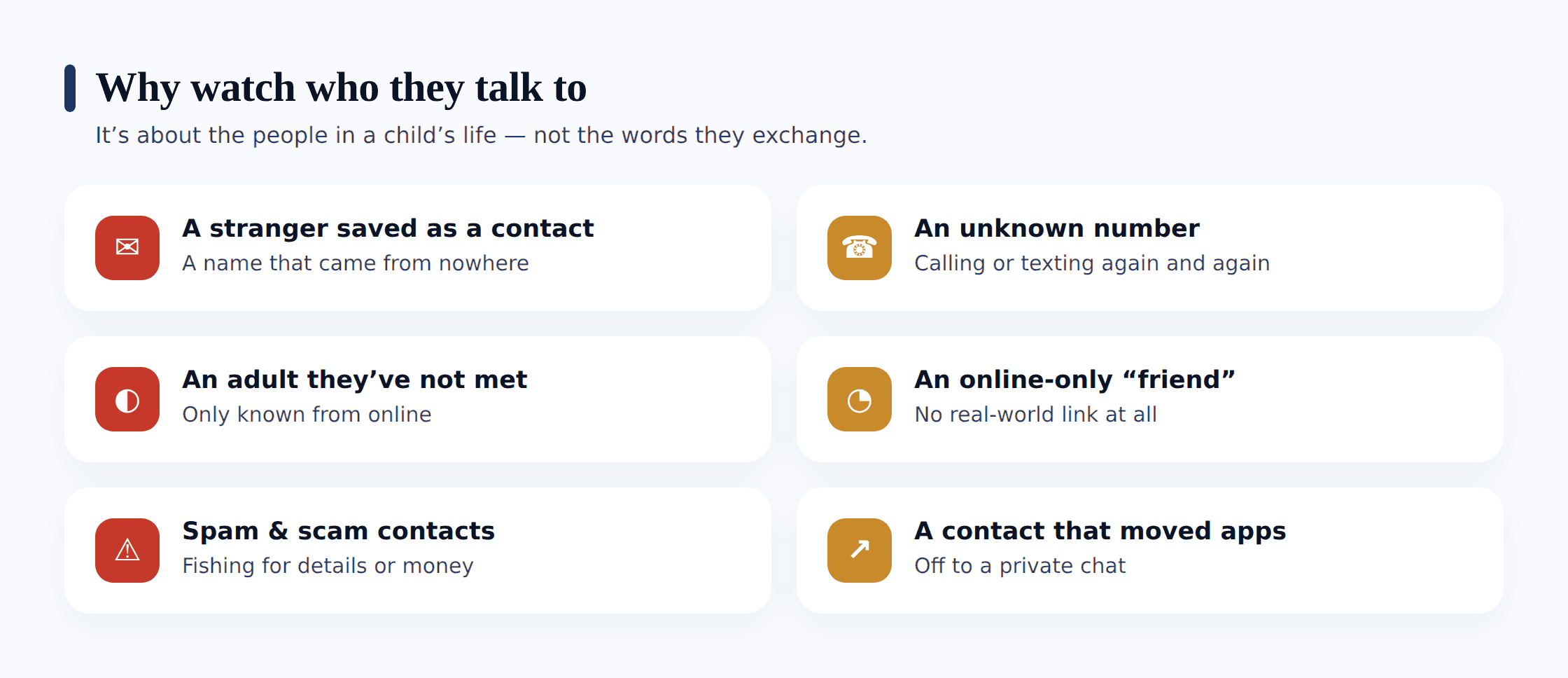
Nearly every name will be one you know: school friends, cousins, a couple of clubs, the group chats that come with being a kid. That familiarity is reassuring in itself. What you’re watching for is the entry that doesn’t fit the pattern. A stranger saved as a contact. An unknown number that calls or messages repeatedly, always from the same place. An adult your child has never met in person. A “friend” they only know from a game or an app, who has now got their number. A spam or scam contact that slipped in through a prize text. Or a contact whose chat starts on the phone and then, suddenly, moves to a private app where you can’t see it.
None of these is proof of anything on its own. A new name might be a genuine new classmate. An unknown number might be a dentist reminder. But the contact list is where the first thread usually shows, and noticing it early — calmly, together — is far better than finding out much later that a name you never asked about had been calling for weeks.
What does watching contacts openly actually mean?
Here’s the line that keeps this healthy rather than invasive. Watching contacts means seeing who — the address book and the log of who’s calling and messaging — not the content of what’s said. You’re looking at names and numbers, at whether a contact is saved with a real name, at which unknown numbers keep coming back. You are not reading the messages inside those threads. The distinction matters, and it’s the difference between a family safety habit and snooping on a child’s private life.
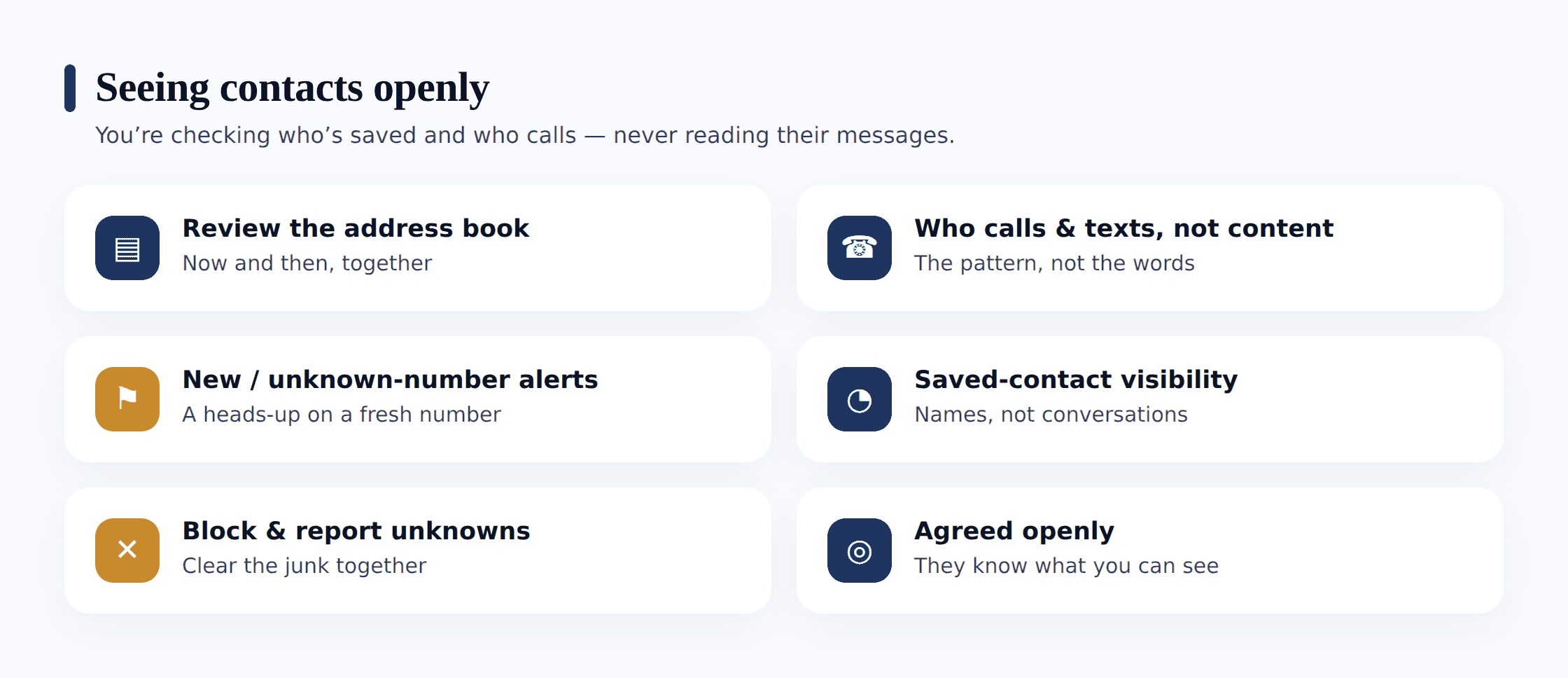
In practice, watching contacts openly looks like a few plain things. Reviewing the address book together every so often, so the two of you actually know who’s saved. A call and message log that shows who and when — the number, the saved name if there is one, incoming or outgoing, the time — without the content of the conversation. An alert when a new or unknown number starts calling or messaging repeatedly. Visibility of the saved contacts, so a stranger added quietly doesn’t stay invisible. And the ability to block and report an unknown number when one turns out to be spam or worse.
That last point is worth sitting with. It’s possible to spot that some unsaved number pinged the phone repeatedly one evening, filed under no name at all, while never once opening what it actually wrote. The log hands you the outline of who’s in the picture. The words themselves stay your child’s — which is precisely how an older teen, above all, deserves to have it.
Which contacts are worth a closer look?
You don’t need to audit the address book line by line. Skim it now and then, and let the odd entry catch your eye. What stands out isn’t a normal friend with a normal name — it’s the contact that’s saved strangely, or the number that behaves differently from the rest. Here’s what tends to be worth a second, unhurried look.
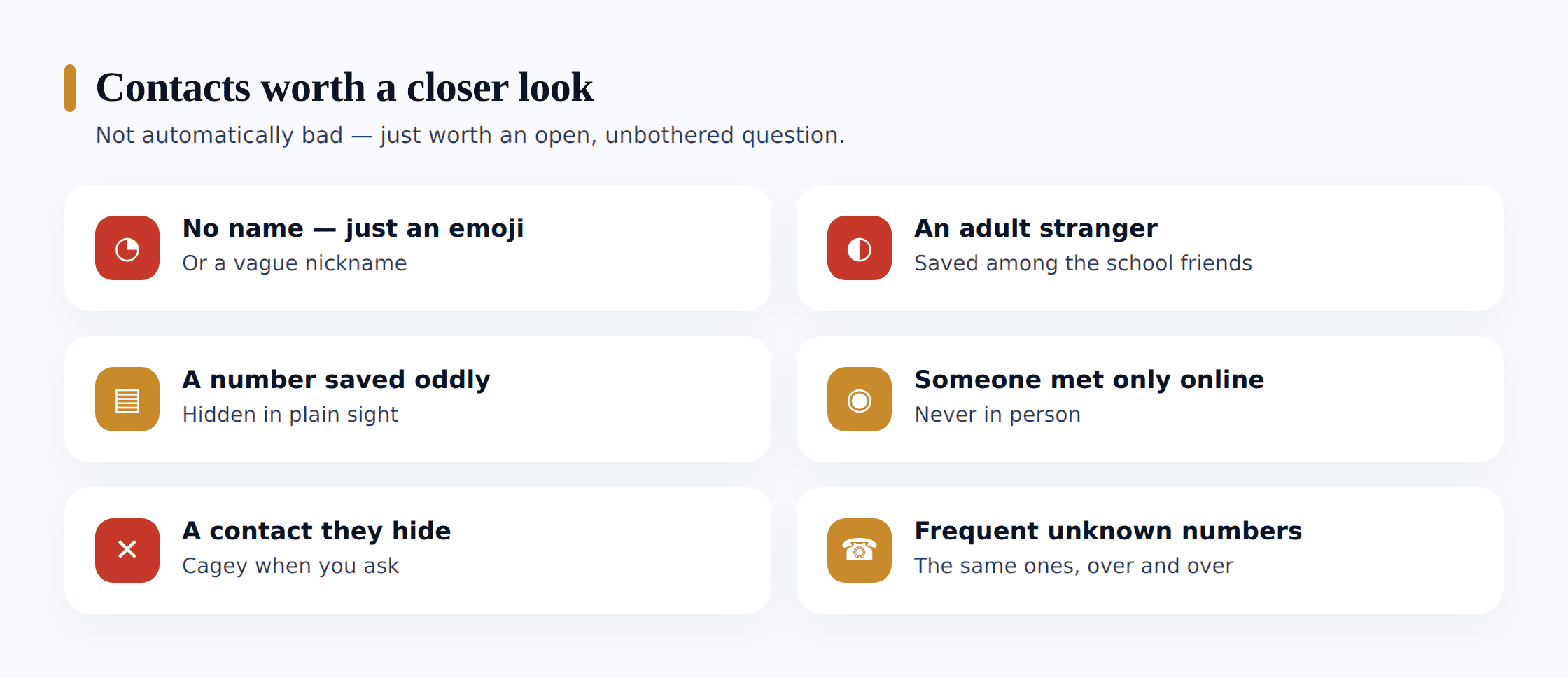
- A contact saved with no real name — just an emoji, initials, or a vague nickname like “H” or “gamer_mike”.
- An adult stranger: a grown-up your child has no obvious reason to have saved and hasn’t mentioned.
- A number saved in an odd way — an area code from nowhere the family knows, or a contact with no surname when everyone else has one.
- Someone your child only knows from online — a game, a group, an app — who now has their phone number.
- A contact your child goes quiet or cagey about when it comes up, or seems keen to skip past.
- Frequent unknown numbers: the same unsaved number calling or messaging again and again, at similar times.
Spam and a worrying real person often look different in the list. Scam contacts tend to arrive once and move on — a fresh unfamiliar number each time, a prize text, a “your parcel is held” link. A real person who’s fixed on a child usually comes from the same number or two, keeps returning, and may push to move the chat somewhere more private. When you notice a contact whose conversation has jumped from the phone to a closed app, that shift itself is the thing to ask about — gently, and without assuming the worst.
How do I keep an eye on contacts well?
What tends to work is open, gentle, and shaped alongside your child instead of dropped on them. Here’s a sensible order.
Keep an eye on contacts in six steps
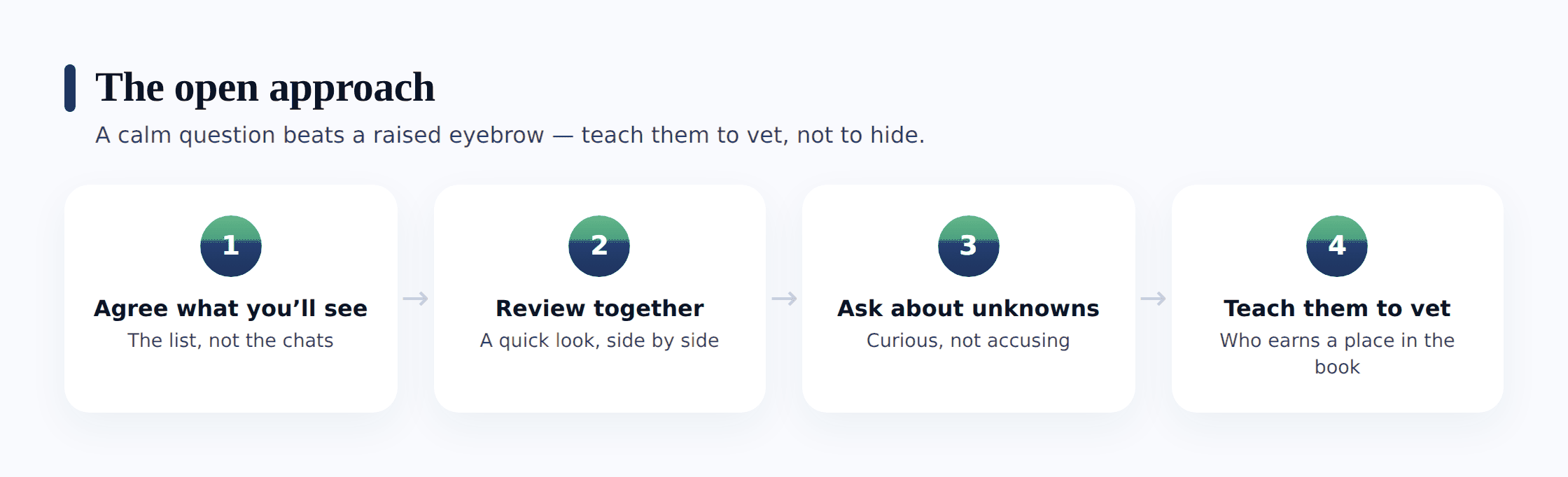
- Agree what you’ll see, first. Ahead of turning anything on, let your child know you’ll have sight of the address book and of who rings and texts — the names and numbers, never the conversations. Say it plainly: this is for catching strangers and scams, not poring over their chats.
- Save the real people together. Set aside an evening to enter your child’s actual friends, relatives, school and clubs as fully named entries. Once each person who belongs in the book carries a proper name, a stranger or a strangely saved entry pops out at once.
- Review the address book now and then. Every so often, scroll the list together. Ask lightly about any name you don’t recognise. Most will have a simple answer, and the habit keeps the list honest.
- Look at recent calls together. Every so often, open the phone’s own call list side by side and ask about any number that keeps coming back. The odd pattern shows up quickly when you look together.
- Block and report the bad ones side by side. The moment a scam or junk number surfaces, deal with it as a pair, so your child picks up how to clear the next one solo. On Android it takes only a tap or two from that entry.
- Loosen as trust grows. An occasional glance suits most households fine. As your child proves their judgement, look in less and pass more of the job over to them.
Coaching your child on vetting who earns a spot in the book counts for as much as anything you keep an eye on. A handful of plain rules go far: only save a person you genuinely know or have a solid real-world reason to; stay cautious with anyone met online who’s fishing for your number; you’re never obliged to save, pick up, or reply to a stranger; and flag to a parent anybody who unsettles you or nudges the chat somewhere hidden. A kid who trusts that reporting a creepy entry brings no punishment is a kid who reports it.
What if a contact concerns you?
Sometimes the list turns up the thing you’d rather it hadn’t: an adult stranger saved under an emoji, or an unknown number that keeps returning and that your child seems uneasy about. Take it steadily, working through this order.
When a contact doesn’t add up
- Ask about it without accusing. Point to the entry and ask, plainly and warmly, who it is and how they know them. Curiosity, not interrogation. Often there’s an ordinary answer, and your child is relieved you asked.
- Listen to how they answer. A quick, easy reply is usually the end of it. Vagueness, defensiveness, or “just someone from a game” about an adult is a reason to keep the conversation going gently, not to raise your voice.
- Block and report if it’s spam or a stranger pushing. If it’s a scam number or an adult making contact who shouldn’t be, block it on the phone and report it through the built-in tools and your carrier.
- Keep a record. Grab a screenshot of the entry and its log lines — the number, any saved name, the dates, the frequency. Should it carry on, that’s the material investigators will ask for.
- Bring in the police if there are threats or grooming. Where a grown-up is plainly zeroing in on your child, issuing threats, or nudging them toward hidden apps and secrecy, phone the police. That belongs with the authorities to handle, not with a parent digging into it solo.
Never text the entry yourself to have it out with them, and keep your child from doing so as well. The tools that fit are blocking, a report, a kept record and — when it’s called for — the police. Where the worry is an adult who reached your child out of nowhere, our guide on handling a stranger who has approached your kid lays out the opening moves in detail. The address book earned its keep by turning up the name; your steady response takes it from there.
Young child or teenager: how much is right?
How much watching is right swings widely with age, and tuning it to the specific kid in front of you counts for more than any lone setting. A little one with their first handset does well with hands-on, close support. At that stage it’s fair to know every entry in the book and to go through the list together often — the work is teaching, not surveilling. A big part of it is simply showing them that not everyone who makes contact deserves saving, and that a stranger angling for their number is a cue to check with you.
An older teen sits in a wholly different place. Everyday privacy in their friendships is theirs by right, and combing through each fresh name would feel, fairly, like an intrusion. For teens the pared-back version suits: a heads-up when a strange number keeps recurring, a mutual understanding that a real safety flag won’t slip past you, and otherwise your hands kept off. The tone shifts from “I’m auditing who you know” to “I’ll have your back if some stranger starts appearing.” Let go bit by bit as trust firms up. What you’re after is a young adult who runs their own address book and can spot a bad entry unaided — and watching that never eases up never delivers them there.
How do I talk about it with my child?
The talk is the piece that carries everything else, and it goes down more smoothly than most parents dread. Hold it brief and straight. Spell out what you’ll see: who has a place in their contacts and who rings and texts — names and numbers, not their conversations, since the private back-and-forth with friends belongs to them. Spell out the reason: strangers and scams find kids by way of their number, and every so often an adult tries to slip into a child’s address book, and you’d sooner catch it together early than learn of it once the damage is done.
Cast it as standing with them, since you are. The focus lands on who’s turning up, not on policing who they’re friends with. Settle in advance what follows if something surfaces — you’ll raise it, clear it together when it’s bad, and nobody’s in hot water over a junk text or a name they can account for. And give the pledge that counts above the rest: if any entry ever unsettles them, or pushes to shift a chat somewhere hidden, they can bring it to you and meet no anger. A kid who trusts that will share things an address book never would.
Where FreePhone fits
Should you want a tool alongside this, be clear about what FreePhone does and doesn’t do. You set it up together, and the child’s Android phone carries a “What my parents can see” screen that spells out what’s shared, so nothing about it is hidden. It does not show contacts, call logs or messages — so for the address book, lean on the side-by-side checks above. What it does give you is the safety layer around it: location and Places alerts, approval before a new chat app is used, an SOS button and an “Are you OK?” check-in. Everything is viewed from any browser or the FreePhone app, and it’s free, with every feature.
Common questions
Isn’t looking at my child’s contacts the same as reading their messages?
No, and the difference is the whole point. Looking at contacts means seeing who’s saved and who’s calling or messaging — names, numbers, times. Reading messages means opening the conversation itself. This guide is about the first: knowing who is in your child’s life as a safety signal, without touching the private content of their chats.
My child saved a contact with just an emoji or a nickname. Should I worry?
Not automatically — kids save friends under jokes and initials all the time. Treat it as a reason to ask, warmly and without accusing, who it is. A quick, easy answer is usually the end of it. Save real friends under real names together, and an entry that stays vague or turns out to be an adult stranger is the one worth watching.
An unknown number keeps calling and messaging my child. What’s the first step?
Gently check with your child whether the number rings any bells, and from there block it on the handset and file a report. Hang on to screenshots of the entry and its log lines for the record. Where threats crop up, or a grown-up is plainly zeroing in on a child, ring the police. Resist texting the number back to have it out with them.
How do I keep strangers out of my child’s contacts in the first place?
Teach the habit of only saving people they actually know or have a clear reason to, and of being cautious with anyone from online who wants their number. Save the genuine contacts together so strangers stand out, look over recent calls together now and then, and make it easy for your child to tell you about anyone who makes them uncomfortable.
My child is a teenager. Isn’t watching their contacts too much?
With a teen, go light: a nudge when a strange number keeps recurring beats sifting through each fresh entry, paired with a deal that you’ll only weigh in for a genuine safety flag. Friendships come with privacy teens have earned. How much watching fits tapers as they mature, and letting go is part of getting it right.
Keeping tabs on a child’s contacts boils down to something small and workable. Track who fills the book and who’s getting in touch, never the words tucked inside their conversations. Enter the real people as a pair so a stranger jumps out, spot the entry saved oddly or the number that won’t quit, and raise it evenly rather than pointing a finger. Let a little one rely on you further while a teen shoulders more, loosening the grip as trust takes hold. Do that, and the address book stays what it ought to be — a chart of the people who truly belong in your child’s life, and far tougher ground for anyone who doesn’t to lie low.