How to Monitor a Teenager’s Phone Without Losing Their Trust
Monitoring a teenager is the hardest version of this whole subject, and anyone who tells you otherwise hasn’t lived with one. A small child accepts oversight as part of the furniture. A teenager, by design, does not. They are busy becoming a separate person, and privacy is one of the main tools they use to do it. So the question isn’t really “how do I watch my teen’s phone.” It’s “how do I keep them safe without treating a nearly-grown human like a suspect.” Those can both be true at once, but only if you lead with honesty and keep the touch light. This guide is about exactly that balance, and it starts from a rule that never bends: with a teenager, you never do it in secret.
Why teenagers are different
A thirteen-year-old and a six-year-old are both your children, but they are not the same job. The six-year-old needs you to hold the map. The teenager needs to start drawing their own, and getting it wrong sometimes is how they learn to draw. That difference is not a phase to be managed away. It’s the actual developmental work of adolescence, and their phone sits right in the middle of it.
Three things are happening at once inside a teenager, and each of them makes heavy-handed monitoring land badly.
- They’re building autonomy. A teen’s whole trajectory is toward doing things without you. Every time you insert yourself into a space they consider theirs, you’re pushing against the current they’re supposed to be swimming in.
- They need privacy to form an identity. Teenagers try on selves in their messages — funny, dramatic, awkward, romantic. Most of it is rehearsal, and rehearsal only works when nobody’s grading it. A watched teenager performs; an unwatched one experiments.
- Their radar for hypocrisy is brutal. They will clock the gap between “I trust you” and behaviour that says otherwise faster than you can. Nothing erodes your standing with a teen quicker than a rule that says one thing while your actions say another.
None of that means a teenager needs no safety net. The risks are real, and some of them — coercion, sextortion, scams that target exactly their age group — are more serious than the ones a younger child faces. But the method that keeps a ten-year-old safe will actively harm a sixteen-year-old, because it collides head-on with the person they’re trying to become. We’ve written more fully about a teen’s growing need for privacy and independence, and it’s worth reading alongside this — the developmental picture is the ground everything here stands on.
How over-monitoring backfires
Parents rarely over-monitor out of malice. They do it out of fear, and the fear is understandable. But it helps to be honest about what heavy surveillance actually produces in a teenager, because the results run opposite to the intent.
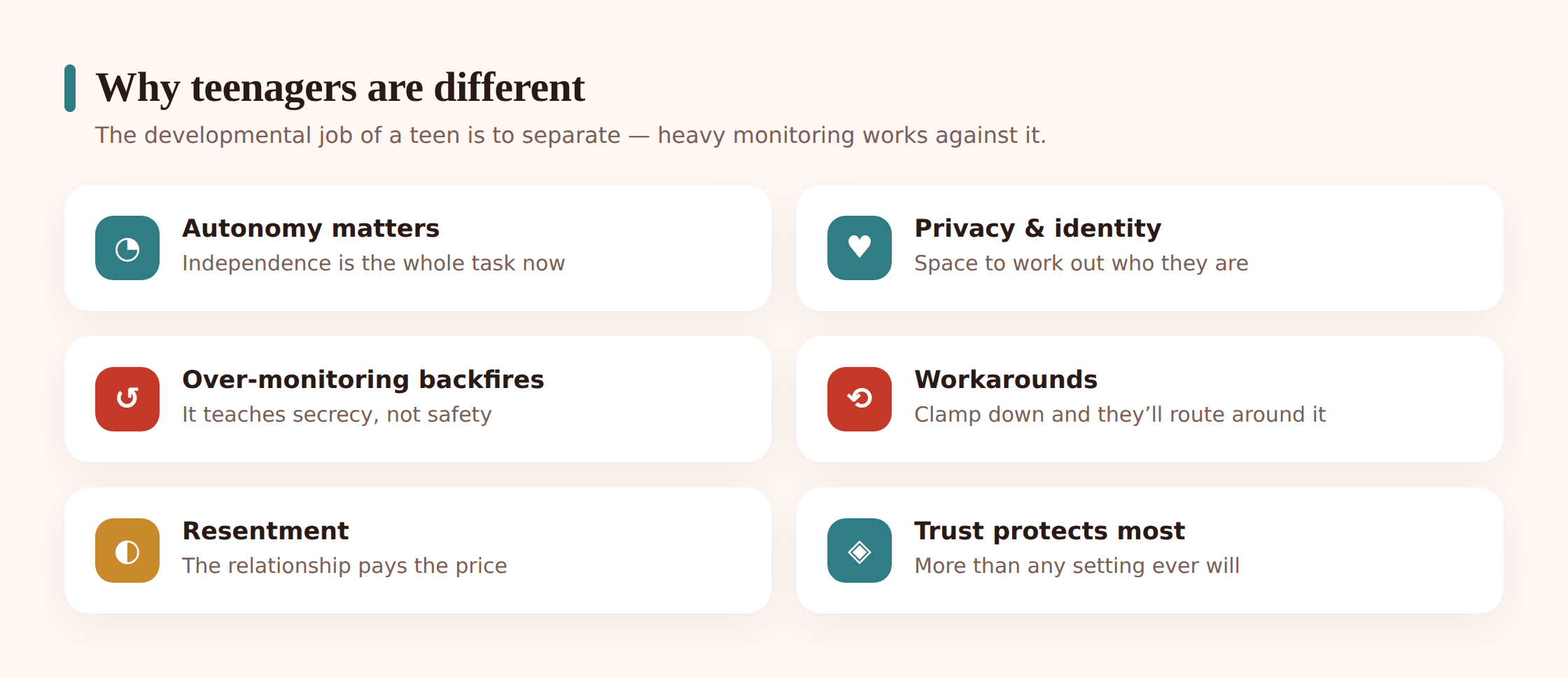
The first thing it produces is secrecy. A teenager who feels surveilled doesn’t become an open book. They become an engineer. Second accounts, a friend’s old phone, an app that looks like a calculator, conversations moved to whatever platform you’re not watching. The tighter the net, the more inventive the workaround, and now the very things you were worried about are happening completely outside your view.
The second is resentment. Being treated as guilty by default, day after day, corrodes the relationship in a slow, quiet way. The teen learns that you see them as a problem to be contained rather than a person to be trusted, and they file that away. It surfaces later as distance — the shrug, the closed door, the “it’s nothing” — long after the specific rule is forgotten.
The third, and the most costly, is that they stop coming to you. This is the real loss. When something genuinely frightening happens online — a threat, a leaked image, a stranger applying pressure — a teenager’s split-second decision is whether to tell a parent. A teen who expects surveillance and overreaction keeps it to themselves and tries to handle it alone, which is precisely when things get dangerous. A teen who trusts you to stay calm brings you the phone. Every heavy-handed month spends down the account that pays out in that moment.
The case for telling them everything
The alternative to secrecy isn’t no monitoring. It’s monitoring they know about, agreed to, and understand the reasons for. That sounds like it should be weaker. It’s actually far stronger, and the reason is simple: a teenager who helped set the terms has a stake in them, while a teenager who was ambushed has only a grievance.
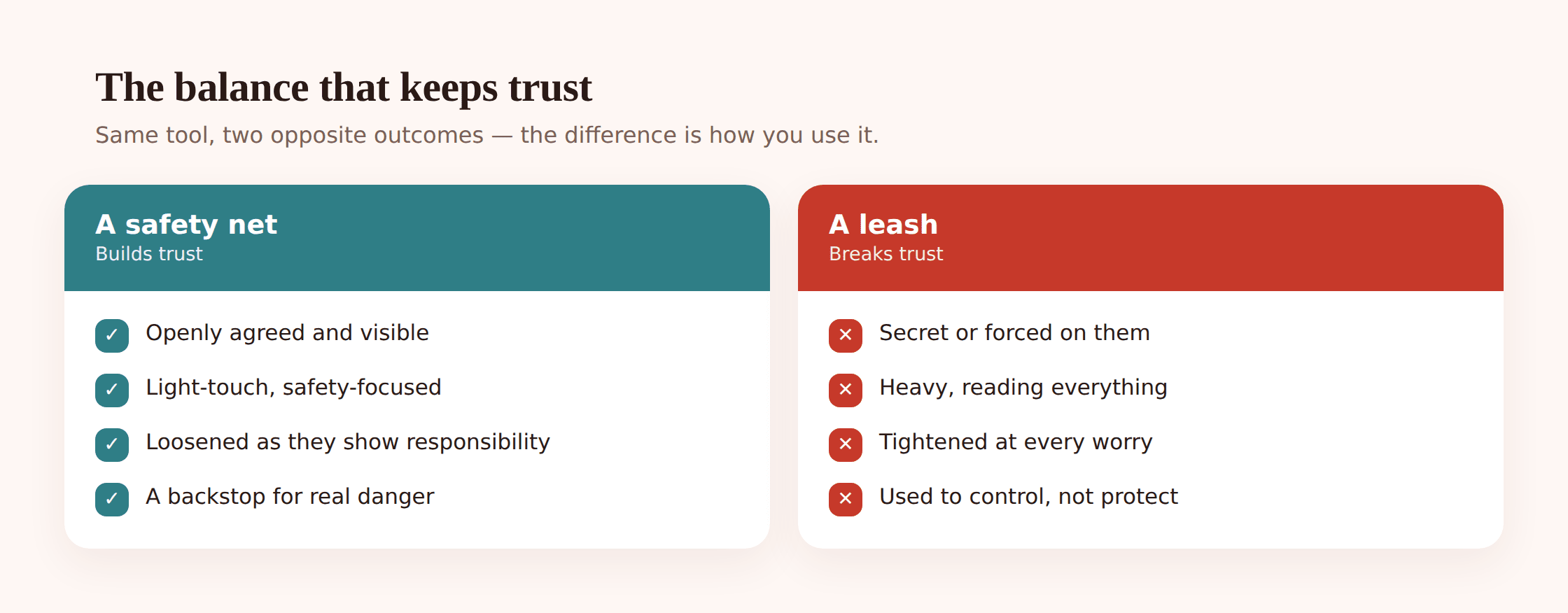
Transparency does three useful things at once. It removes the “gotcha” dynamic that poisons everything — nobody’s being caught, because everybody knows the deal. It models the exact behaviour you want back, which is honesty. And it keeps the door open, because a teen who knows what you can see has no reason to build a hidden life to hide from it.
There’s also a clean ethical line under all of this, and it’s worth naming. Monitoring your own teen, on a device you manage, openly and proportionately, for safety, is parenting. Reading a competent teenager’s private life in secret because you can is something else, and it’s the thing to avoid. If you want that boundary drawn out in full, we’ve written about where monitoring ends and spying begins — it’s the frame that settles most of the hard calls on this page.
What light-touch teen monitoring looks like
So what does the right amount actually look like at this age? Much less than most parents imagine, and much less than they’d use for a younger child. The guiding principle is that you’re watching for genuine danger, not reading a life. For a teenager, the sensible default is closer to a safety net than a spotlight.
In practice, light-touch teen monitoring tends to mean a small handful of things, and deliberately not the rest.
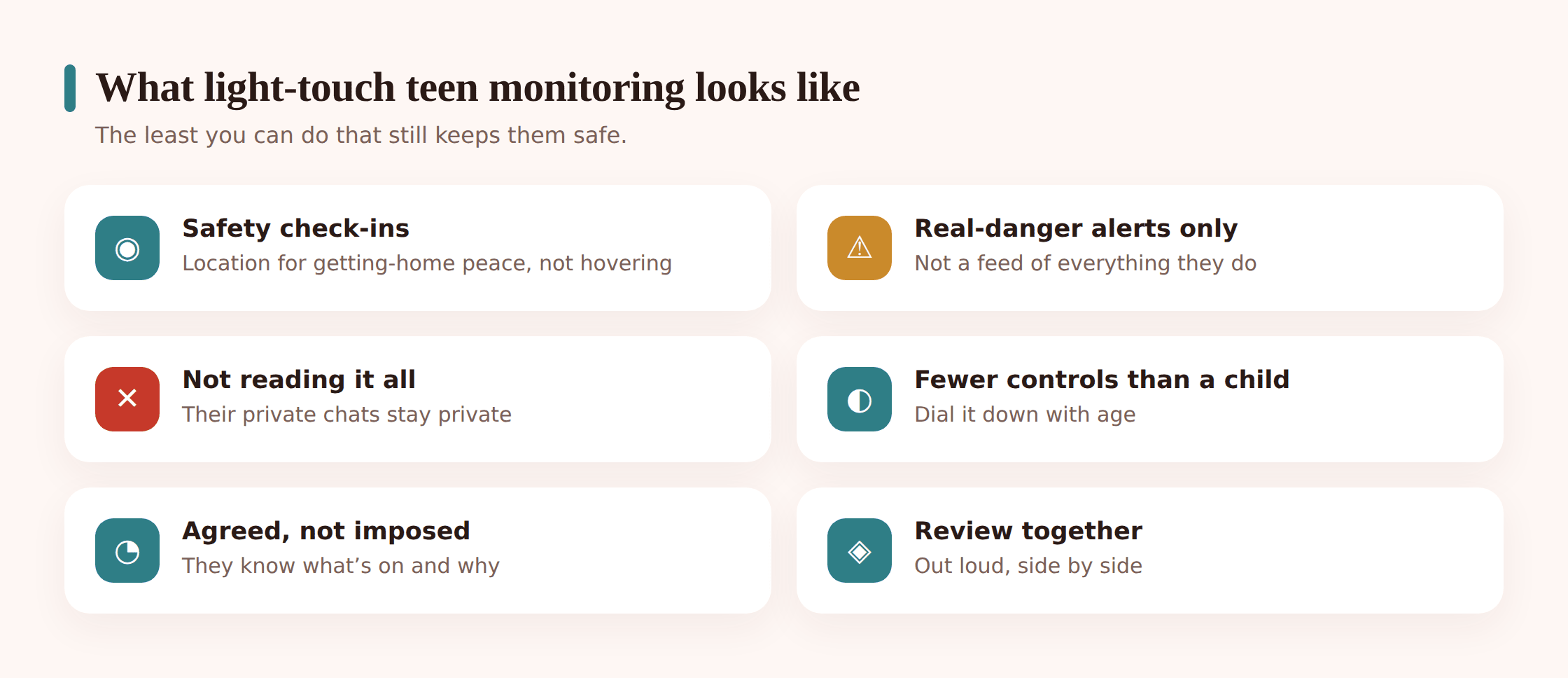
- Location for safety, not surveillance. Knowing they got to the party, or being able to find them if a night goes sideways, is reasonable and most teens accept it — especially framed as “so I don’t have to text you every hour.” Tracking their every movement to audit where they’ve been is not.
- Alerts for real danger, not a reading feed. A flag if a genuinely alarming phrase appears, or an unknown adult starts making contact — the signal, not the whole stream. You don’t need to read a teenager’s group chat to catch the thing that actually matters.
- Far fewer controls than a young child. The web filters, app blocks and time locks that suit a nine-year-old mostly come off by the mid-teens. A sixteen-year-old learning to manage their own screen time badly, with your coaching, is closer to the point than one you’ve locked down.
- The private majority stays private. Their jokes, crushes, venting and half-formed opinions are theirs. Leaving them alone isn’t a gap in your safety system. It is the system working.
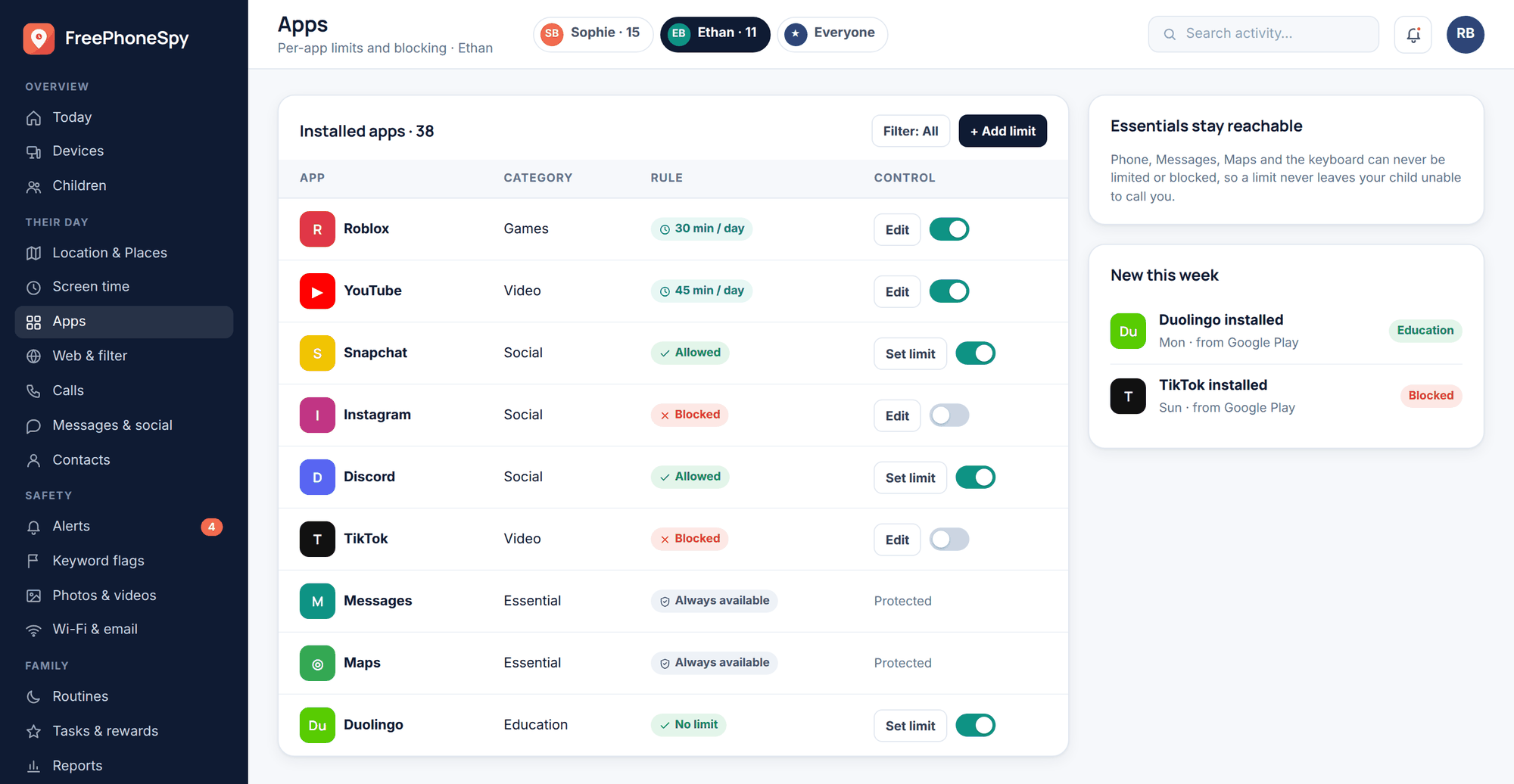
Notice what’s missing from that list: reading every message, logging every keystroke, screenshotting their screen. Those belong to a much younger stage, if anywhere. For a teenager they’re not a stronger version of the same thing — they’re a different thing, and they buy fear where you wanted safety.
How to have the conversation
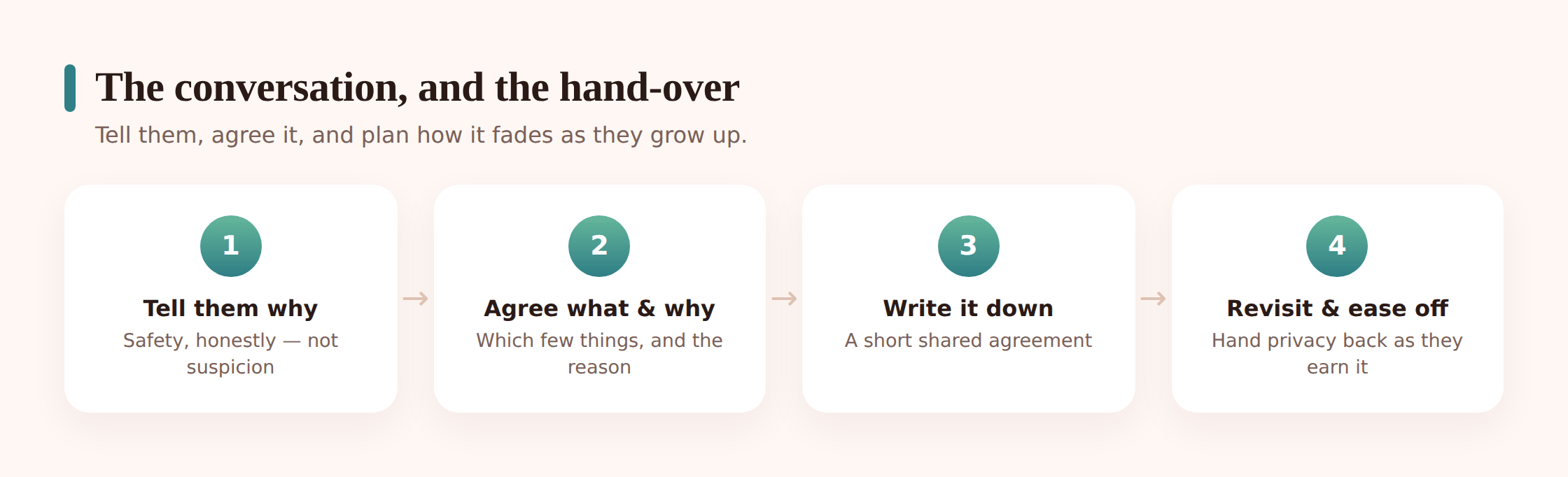
The conversation matters more than any setting, so it’s worth doing well rather than springing it over dinner. The goal is a genuine two-way talk, not an announcement of terms.
Lead with the why, not the what
Start from the reason, which is that you care about their safety and the world online has some sharp edges aimed squarely at their age group. “I want you to have freedom on this thing and I want you to be safe, and I’m trying to figure out how to do both” is an honest opening a teenager can actually respect.
Ask before you tell
Find out what they already worry about. Teens know the risks — the scams, the pressure, the creepy DMs — often better than you do, because they live in it. Asking “what feels sketchy to you online?” positions you as an ally, not a warden, and their answers will shape what’s actually worth watching.
Be specific about what you will and won’t see
Vagueness breeds suspicion. Say it plainly: “I’ll be able to see roughly where you are and get a heads-up if something looks genuinely dangerous. I won’t be reading your chats.” A clear, narrow scope is far easier to trust than a fuzzy “I’ll be keeping an eye on things.”
Name the exit
Tell them, out loud, that this shrinks as they show you they’ve got it. Monitoring a teenager should always come with a visible off-ramp. “This isn’t forever, and it gets lighter as I see you handling things” turns the whole arrangement from a cage into a set of training wheels you’re both planning to remove.
Expect pushback, and don’t treat it as failure. A teenager arguing for more privacy is doing their job. Your job is to listen, concede where they’re right, hold firm where safety genuinely requires it, and explain the difference every time. The talk itself teaches more than the rules do.
Writing a shared agreement
Once you’ve talked, put it in writing together. Not a contract you hand down, but a short agreement you build side by side, so both of you know exactly what was decided and neither can quietly redraw it later. A page is plenty.
A workable teen agreement usually covers a few things: what’s monitored and what isn’t, why each piece is there, what you’ll do if a real concern comes up, and — crucially — the milestones at which things ease off. Let your teen argue for terms. When they win a point, they own the whole document a little more. If you’d like a starting frame you can adapt, our family phone agreement guide lays one out, though for a teenager you’ll want to strip it down and hand them more of the pen.
Write the review date into the agreement itself. “We’ll look at this again in three months” makes the whole thing a living arrangement rather than a life sentence, and it gives your teen something concrete to work toward. It also forces you to actually loosen the grip on schedule, instead of letting yesterday’s caution harden into a permanent setting nobody remembers agreeing to.
Handing back privacy as they earn it
Here’s the part parents find hardest, and it’s the most important: the plan is to need less over time, not more. Monitoring a teenager well means actively dismantling it as they mature. If you’re using the same settings at seventeen that you set at thirteen, something has gone wrong, even if nothing bad ever happened.
Treat privacy as a currency you pay out for demonstrated responsibility. They handle a tricky situation well; a control comes off. They’re straight with you about a mistake; you widen the trust. Make the link explicit, because a teen who can see that good judgement literally buys freedom has every reason to practise it. Growing up should feel like doors opening, and you hold a lot of those doors.
- Retire app blocks and web filters first — most are outgrown by the mid-teens.
- Shift location from “always on” to “check in when you’re out late,” then to trust plus a text.
- Narrow alerts down to only the genuinely serious, then let them lapse.
- Aim, by the late teens, for a phone you don’t monitor at all and a young adult who still talks to you.
The finish line isn’t a perfectly surveilled teenager. It’s one who no longer needs surveilling, and who learned to manage their own digital life with you coaching from the sideline rather than refereeing from the middle. Letting go on purpose, a piece at a time, is the whole point.
When more oversight is justified
Stepping back is the default, but it isn’t unconditional. Sometimes a genuine concern warrants tightening things up for a while, and that’s legitimate — as long as you’re open about it. The rule doesn’t change even here: you tell them what you’re doing and why.
Some signals justify a temporary closer look: a sudden, dramatic personality shift; secrecy that spikes far beyond normal teenage privacy; contact with someone who’s clearly an adult stranger; signs of self-harm, an eating disorder, or a crisis; evidence they’re being coerced or exploited. These aren’t “caught them texting a boy” situations. They’re welfare situations, and a caring parent leans in.
Even when you step up oversight, do it in the open: “I’m worried about you, so for now I’m going to watch a bit more closely, and here’s exactly what that means and when we’ll reassess.” Increased care announced honestly still protects the trust. The same thing done in secret destroys it.
Temporary is the operative word. When the concern passes, the extra oversight comes back off, on a stated timeline. A worry that permanently ratchets up control and never releases it teaches your teen that being vulnerable with you costs them freedom — which guarantees they’ll hide the next crisis. Lean in during the storm, then step back out once it clears.
Rebuilding trust if it’s already frayed
Maybe you’re reading this after the fact. You checked their phone in secret, or clamped down hard, and now there’s a chill in the house and a teenager who’s gone quiet. That’s recoverable, but only by owning it plainly. Teenagers forgive far more readily than we expect when a parent is genuinely honest.
Start with an apology that doesn’t hedge. “I read your messages without telling you, and I was wrong to do it that way. I did it because I was scared, but that’s not an excuse, and I’m sorry.” No “but you shouldn’t have,” no conditions. A clean apology from a parent is rare enough that it lands hard, in a good way.
Then rebuild the arrangement together, out loud, with them holding more of the pen this time. Trade some of the covert oversight for open agreement. Show, over weeks, that you meant it — that you’re not sneaking back in. Trust returns at the speed of demonstrated change, not apology, so the proof is in what you do next, repeatedly, when it would be easier to peek.
Where FreePhoneSpy fits
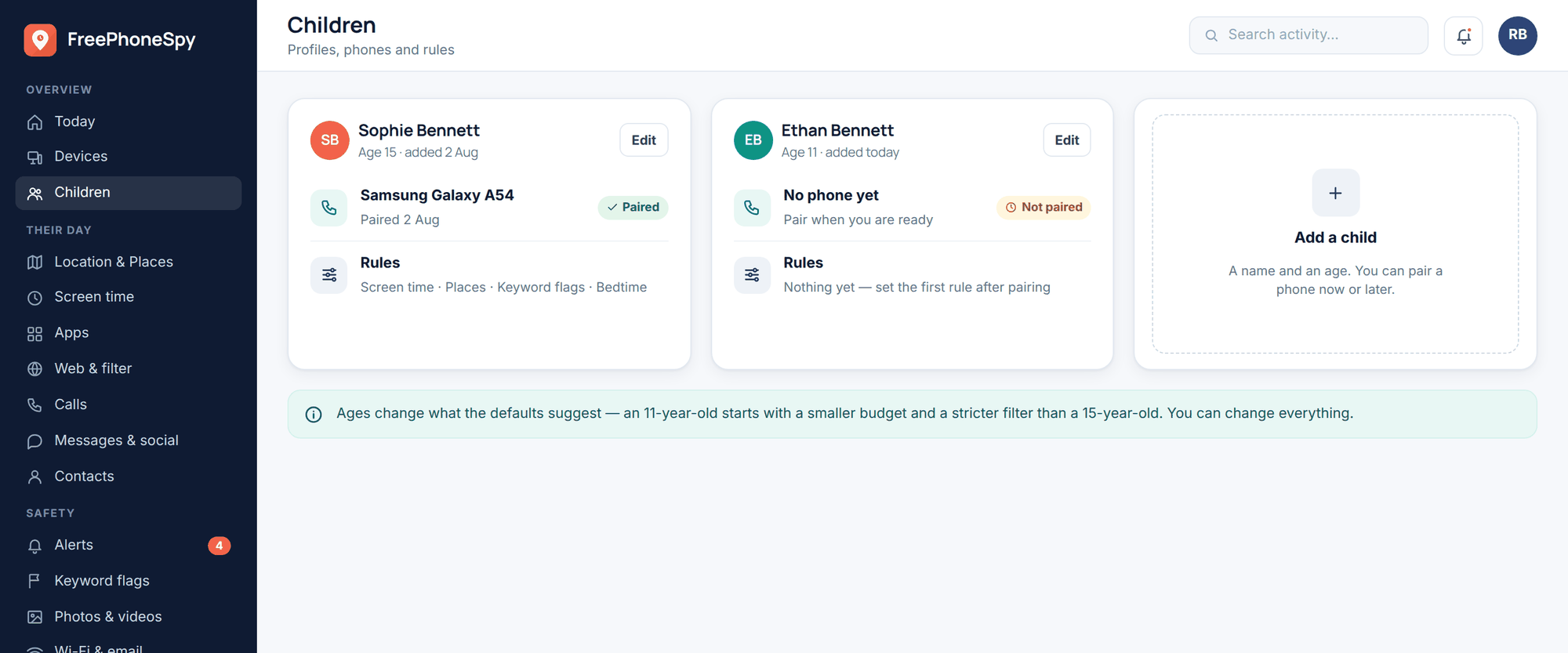
A brief, honest word on our own tool, because it’s built for the approach above rather than against it. FreePhoneSpy is meant to be set up with your teenager, not behind their back — every monitored phone carries a Transparency screen showing what’s shared, and the app is visible, not hidden. It’s designed for the light touch this age needs: a safety-oriented overview and alerts on genuine concerns, with the heavier, more private data sitting behind a deliberate consent switch your teen can see. It runs on their Android phone, you view it from any browser with nothing to install on your side, and it’s free to start. Think of it as a safety net you agree on together and loosen over time — a way to notice sooner and talk sooner. It’s a scaffold, not a leash, and the plan is always to take the scaffold down.
Questions parents ask
Should I read my teenager’s text messages?
For most teenagers, no. Reading a competent teen’s private conversations wholesale is intrusive, has little real safety upside, and reliably teaches them to move the real talk somewhere you can’t see. A light safety net — location for genuine safety, an alert if a real danger appears — protects them just as well and keeps the relationship intact. Save closer looks for genuine welfare concerns, and be open even then.
Is it okay to monitor my teen without telling them?
No. With a teenager, secret monitoring is the fastest way to destroy trust, and when it comes out — it usually does — the damage outlasts whatever you were worried about. Do it openly: agree what’s watched and why, be clear about what you can’t see, and put a plan to ease off in writing. Transparency is exactly what turns monitoring into protection rather than betrayal.
My teen says any monitoring means I don’t trust them. How do I answer?
Honestly, and without pretending it’s nothing. Something like: “I do trust you. I don’t fully trust the internet, and some of what’s out there is aimed right at people your age. This is a light net for the genuinely dangerous stuff, not a leash — and it gets smaller as you show me you’ve got it.” Naming the exit, and meaning it, is what makes the answer credible.
How do I know when to stop monitoring altogether?
There’s no fixed age, but the direction is clear: taper steadily and aim to reach zero by the late teens. Retire controls as your teen shows responsibility, tie each loosening to something they’ve earned, and write review dates into your agreement so it actually happens. The goal is a young adult who manages their own digital life and still talks to you — not a perfectly watched seventeen-year-old.
At what age should teen monitoring really start winding down?
Most families over-monitor the mid-to-late teens out of habit rather than need. If you’re weighing the broader question of when oversight fits at all, our guide on what age to monitor a child’s phone maps it out by stage. For teenagers specifically, assume you’re winding down, not ramping up, and let anything you keep be narrow, agreed, and openly on its way out.
Monitoring a teenager was never really about the phone. It’s about staying close enough that they’ll turn to you when something goes wrong, while trusting them enough that they still want to grow up under your roof rather than around it. The lightest honest touch — agreed together, alert to real danger, and eased off as they mature — keeps a teenager far safer than any amount of watching, because it protects the one thing that actually protects them: a relationship where they can still tell you the truth. Build that, loosen the rest, and you’ll both come out the other side intact.