How Often Should You Check Your Child’s Phone?

“How often should I check?” is one of the most common questions parents ask, and it hides two very different fears inside it. Check too much and you tip from parenting into surveillance, teaching your child that they’re never quite trusted. Check too little and you can miss the exact thing you set up monitoring to catch. The right answer isn’t a number you can borrow from someone else — it depends on your child’s age, on what you’ve agreed together, and on whether anything is actually going on. But there is a shape to it, and once you can see the shape, the rhythm gets a lot easier to find. This guide walks through it, and it starts from a single rule: whatever cadence you land on, your child knows about it.
Why the frequency matters
Frequency is where a lot of well-meaning monitoring quietly goes wrong. Two parents can use the exact same tool, see the exact same information, and end up in completely different places with their child — because one of them checks in a way that feels fair and the other checks in a way that feels like being followed. The gap between those two outcomes is almost entirely about how often, and how openly, you look.
Start with the risk of looking too much. A phone you inspect every day, or several times a day, sends a message no reassurance can undo: I am watching, all the time, and I expect to find something. Even a child with nothing to hide starts to feel like a suspect in their own home. They begin to self-edit, to move the honest conversations somewhere you’re not, to treat their phone as a stage rather than a diary. The irony is sharp — the more constantly you check, the less of their real life you actually see, because constant checking is exactly what teaches them to hide it.
Now the opposite. A phone you handed over and never look at again isn’t respect; it’s absence. Real problems rarely announce themselves. A child being pressured in a group chat, a stranger warming up a friendship, a worrying app that appeared last month — these things build quietly, and a parent who never looks is a parent who finds out late, if at all. Somewhere between “every hour” and “never” is a rhythm that keeps you close enough to notice without standing over their shoulder.
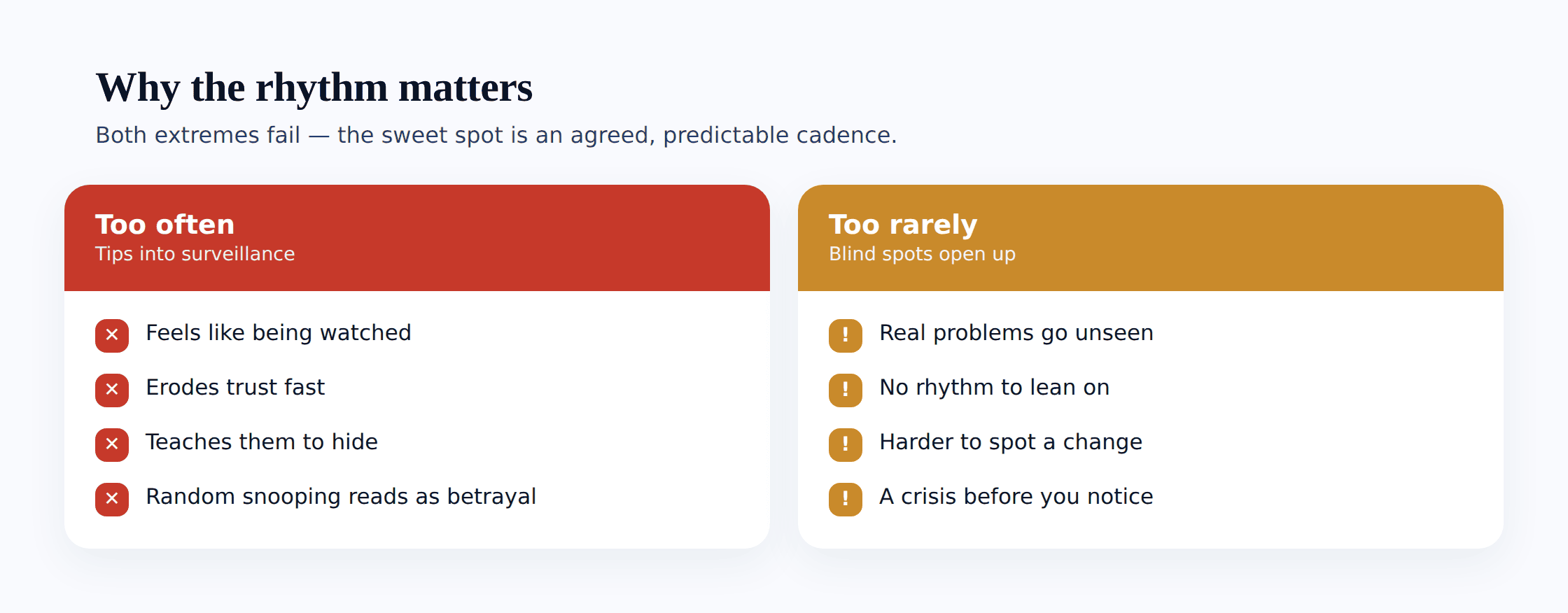
What actually decides which side you land on isn’t the number of checks so much as whether they’re expected. A predictable, agreed rhythm — “we look together on Sunday” — feels fair because nothing is hidden and nothing is a trap. The same amount of looking, done at random moments your child didn’t know about, feels like being caught out over and over, even when there’s nothing to catch. Agreed and open reads as care. Random and secret reads as suspicion, and children feel the difference long before they can name it. If that line interests you, we’ve mapped it out in full in where monitoring ends and spying begins — cadence is one of the places that line gets drawn.
How often, by age
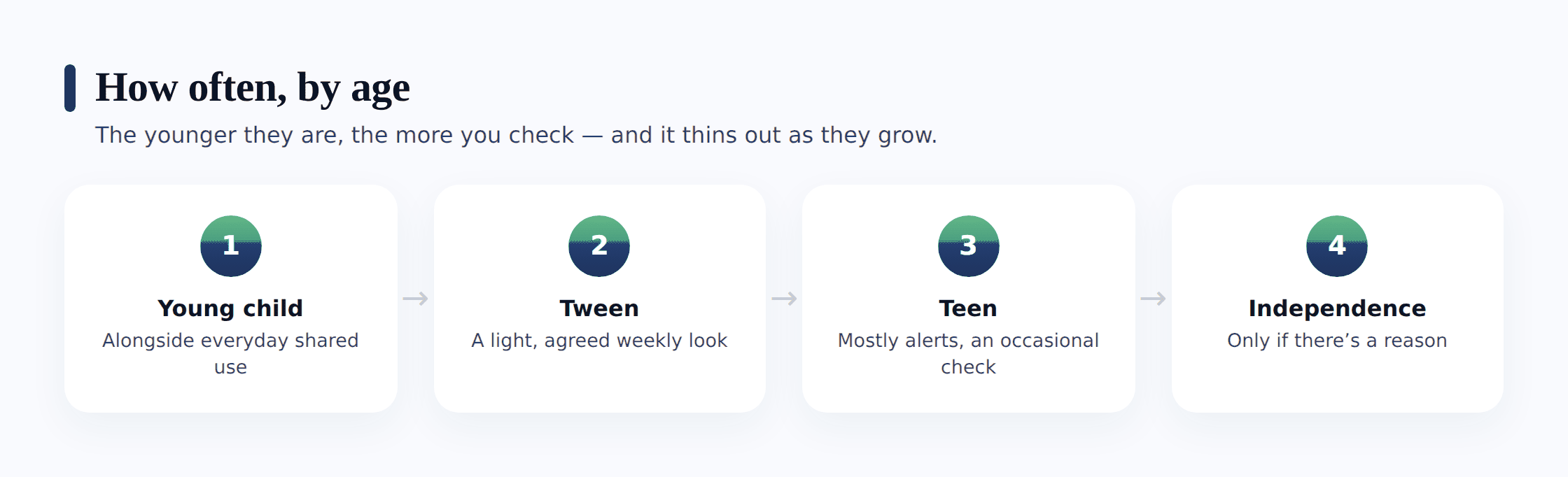
There’s no single correct frequency, because a six-year-old and a sixteen-year-old are not the same job. The honest answer is that the right cadence starts high and hands-on, then tapers steadily toward almost nothing as your child grows into managing their own digital life. Here’s roughly how that looks at each stage.
Young child: alongside everyday shared use
For a young child, “checking” isn’t really a separate event at all — it’s woven into how they use a device in the first place. At this age the phone or tablet is a shared object more than a personal one. You’re in the room, often on the sofa next to them, watching the same screen. You know what they’re playing because you can see it, and you approve what they download because you’re the one tapping install.
So the cadence here is simply “very frequent and hands-on,” and that’s entirely appropriate. Nobody feels surveilled at five, because oversight is just part of the furniture, the same as holding their hand near a road. You’re not auditing a private life; there isn’t one yet. If you want the fuller picture for this stage, our guide to signs a child’s phone needs a closer look covers what’s worth noticing before it becomes a pattern.
Tween: a light, regular, agreed look
Somewhere around the tween years the device becomes genuinely theirs, and that’s the moment checking should become a deliberate, named thing rather than a constant background presence. This is the sweet spot for an agreed regular check — something like a short look together once a week, at a time you both know about.
A weekly rhythm does a lot of quiet work. It’s frequent enough to catch a problem while it’s still small, and rare enough that your tween doesn’t feel shadowed between times. Because it’s on the calendar, it isn’t a raid — there’s no surprise, no scramble to delete anything, just a routine you sit down and do side by side. And because it’s regular, the conversation becomes normal instead of dramatic. “Show me what you’ve been up to this week” lands very differently from a phone snatched off the table mid-message.
Teen: agreed alerts plus the occasional check
With a teenager the daily-reading model stops working, and pushing it anyway does real damage. A teen needs privacy to become a person, and a parent combing through their messages several times a week teaches them, fast, to build a life you can’t see. The frequency here should drop sharply.
For most teenagers the sensible pattern is to lean on agreed alerts for the genuinely serious stuff — an SOS, a missed curfew, the phone somewhere unexpected — and reserve actual looking for the occasional agreed check rather than a running feed you scroll every night. You’re watching for danger, not reading a diary. The heavy lifting is done by the safety net catching the rare real thing, which frees you from the temptation to check constantly. We go deeper on this exact balance in how to monitor a teenager without losing trust, which is worth reading alongside this if you’ve got a teen in the house.
Nearing independence: only with a specific reason
By the late teens, as a young adult comes into view, routine checking should have wound down to essentially nothing. At this stage you don’t check on a schedule at all. You check only if there’s a specific, real reason to — and even then, openly, and only for as long as the reason lasts.
A seventeen-year-old you’re still auditing weekly out of habit is a seventeen-year-old learning that responsibility never actually buys freedom, which is precisely the wrong lesson to send into adulthood. The finish line isn’t a perfectly watched near-adult. It’s one who manages their own phone and still talks to you.
Agreed check-ins, reactive checks, continuous watching
It helps to be clear that “checking a phone” isn’t one thing. There are three quite different modes, and a lot of confusion about frequency comes from muddling them. Knowing which one you’re in tells you how often is right.
- Agreed regular check-ins. A look on a known rhythm — the weekly sit-down, the occasional glance you both expect. This is the everyday backbone for most families, and its whole value is its predictability. It’s the mode you should live in most of the time.
- Reactive checks. A look prompted by something specific — a worry, a flag, a change you noticed. These aren’t scheduled; they’re triggered by a reason, and the reason gets named out loud. Reactive checks are legitimate and sometimes necessary, but they should be the exception, not the water you swim in.
- Continuous monitoring. Watching the live stream all the time, reading everything as it happens. For a young child using a shared device this is just supervision and it’s fine. For anyone older it’s the mode to be most careful with, because permanent continuous watching of a tween or teen is the fast route to the surveillance problems above.
The healthy default for a school-age child is to live mostly in agreed check-ins, drop into a reactive check when there’s a genuine reason, and reserve continuous watching for the youngest ages or a real, temporary crisis. Most of the trouble parents run into comes from accidentally treating a teenager as if continuous monitoring were the normal setting.
How to check well when you do
Frequency is only half of it. A weekly check done badly can do more harm than a daily one done kindly. So when the moment comes, a few habits make the difference between a check that strengthens things and one that strains them.
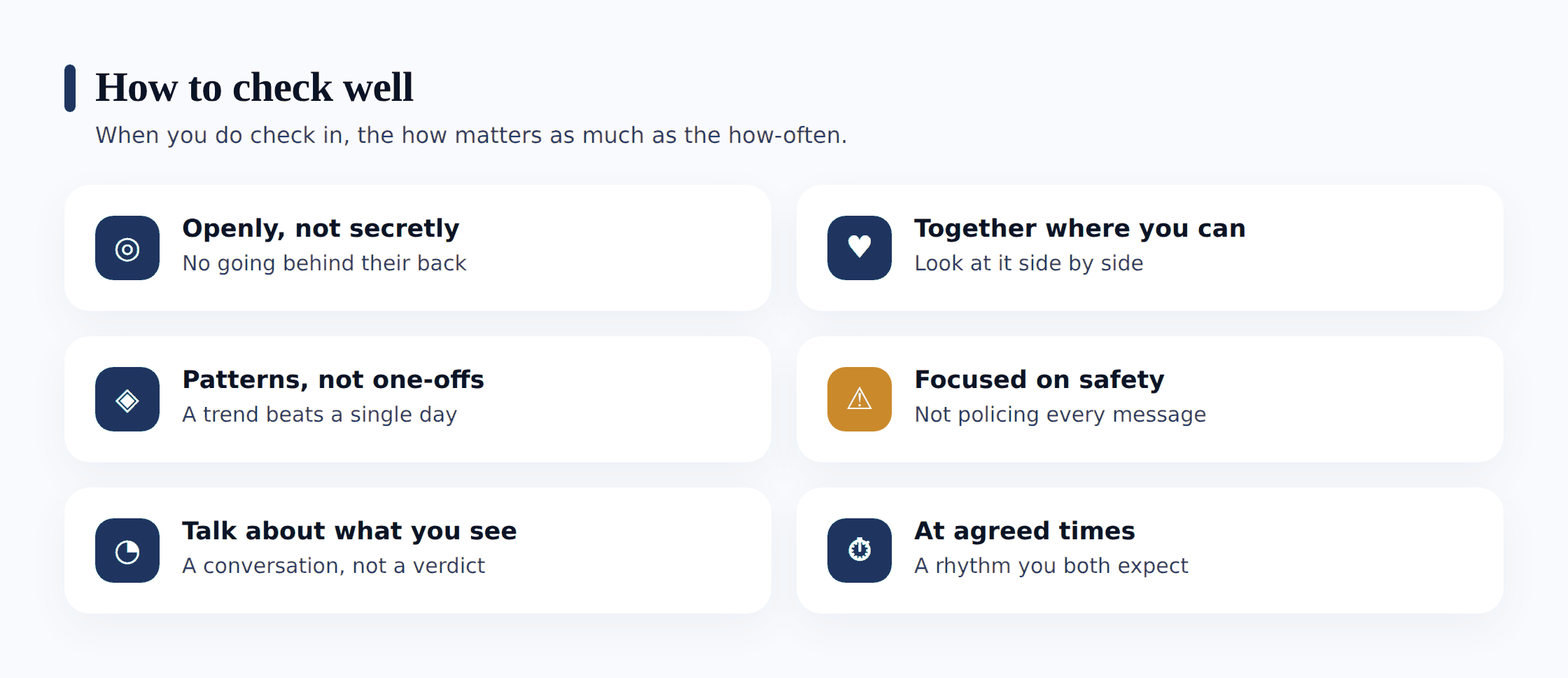
Do it openly, and together where you can
The best check is one where your child is sitting next to you. “Let’s have our Sunday look” turns the whole thing from an inspection into a shared routine. Even when you glance at a summary on your own, they know it’s happening and they know what you can see. Nothing about the check is a secret, so nothing about it feels like a trap.
Look for patterns, not one-offs
A single odd message, a late night, one game you don’t recognise — these are almost never the story on their own. What matters is the pattern over time: the mood that’s been sliding for a fortnight, the contact that keeps reappearing, the app that’s quietly taken over the evenings. Reacting to every isolated blip teaches your child that you’ll overreact, which is exactly what makes them stop telling you things.
Stay focused on safety
You’re looking for genuine risk, not gossip. A crush, a silly argument, an opinion you’d have phrased differently — none of that is yours to police, and treating it as if it were turns a safety check into a character audit. Keep the lens on what actually keeps them safe, and leave the ordinary mess of a young life alone.
Talk about what you see
A check that ends in silence, or a punishment out of nowhere, teaches your child that being looked at is dangerous. A check that ends in a conversation — “I noticed this, tell me about it” — teaches them that you’re a person they can bring things to. The talking is the point. The looking is just what starts it.
When to check more, for a while
The steady, tapering rhythm is your baseline, but nothing about it is fixed for all weather. A real concern can justify checking more closely and more often for a spell — and that’s a legitimate thing for a caring parent to do. Even then the one rule holds firm: you tell your child you’re raising the frequency, and you tell them the reason.
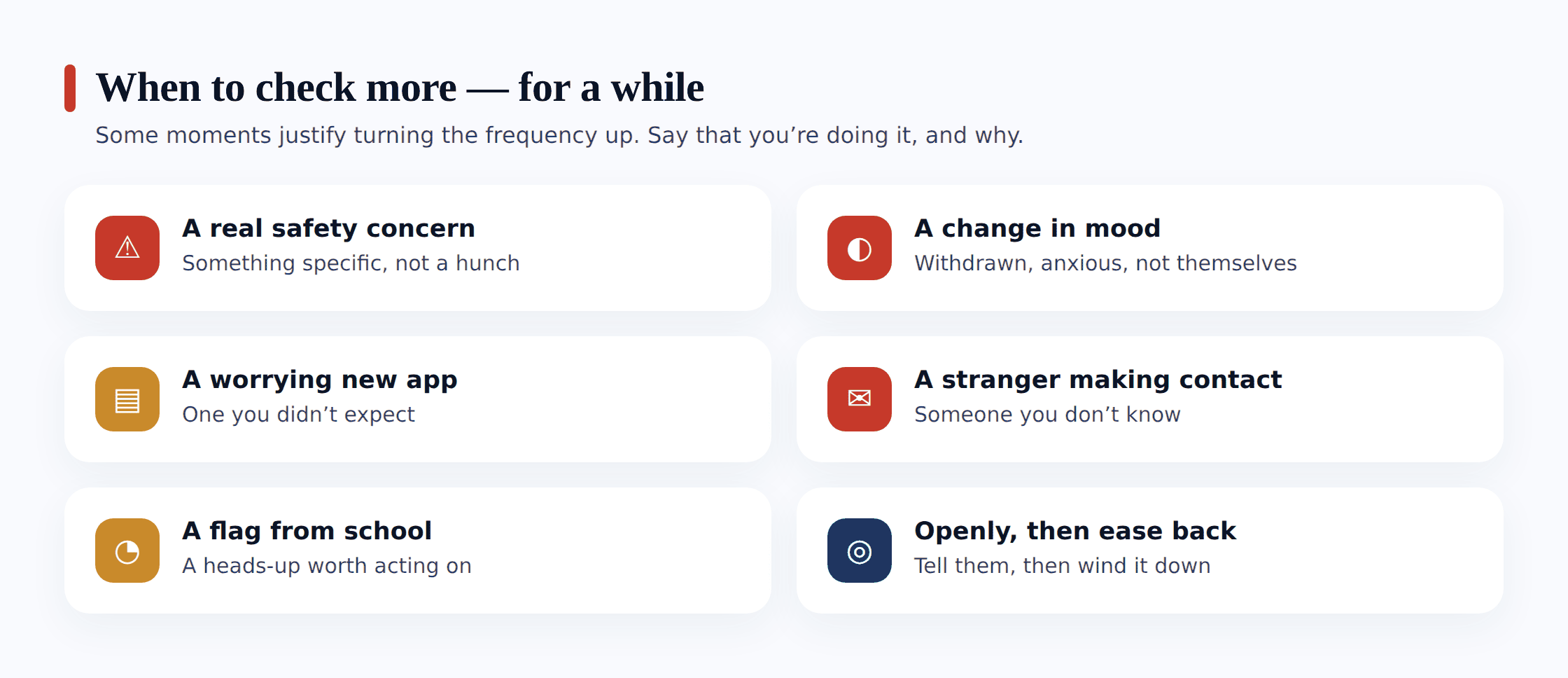
Some situations genuinely warrant turning the frequency up for a time:
- A specific, credible safety concern — something you saw, or something your child said, that points to real risk.
- A marked change in mood or behaviour — a child who’s gone quiet, withdrawn, jumpy or unusually secretive in a way that’s new.
- A worrying new app appearing, especially one built around disappearing messages or contact with strangers.
- Contact from someone who looks like an adult stranger, or a “friend” nobody in real life seems to know.
- A flag from school — a message from a teacher, a mention of an incident, a concern raised by another parent.
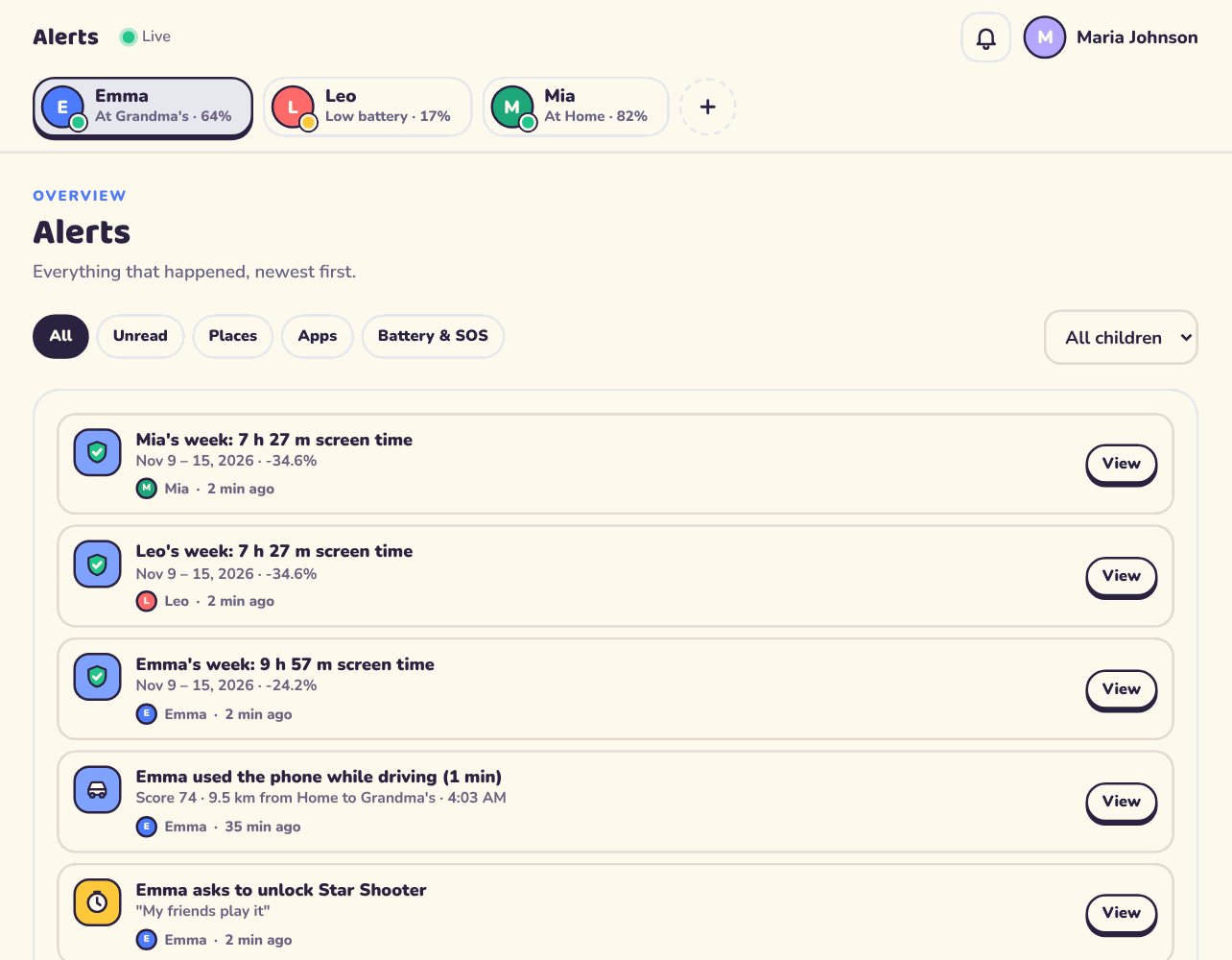
Even when you turn the frequency up, keep it announced: “I’ve been worried, so for a stretch I’m going to look more often — this is what I’ll be looking at, and this is when we drop back to normal.” A cadence you raise out loud still protects the trust. Raise it in silence and you spend that trust instead.
“For a while” is the crucial part. When the concern passes, the frequency drops back to its normal rhythm on a timeline you’ve said out loud. A scare that pushes the checking up for good and never lets it fall again tells your child that opening up to you only costs them room — which is close to a guarantee that the next hard thing stays hidden. Check closer while the weather’s bad, then loosen off again the moment it clears.
Winding the frequency down
The single most important thing to understand about cadence is that it’s meant to shrink. The plan, from the day you hand over the first device, is to need to check less over time, not more. If you’re looking at your child’s phone just as often at fifteen as you did at nine, something has drifted, even if nothing bad ever happened.
Treat a lighter cadence as something they earn, and make the link visible. A tween who deals with a tricky message well and tells you about it has just shown you the weekly look can stretch toward fortnightly. A teen who owns up to a mistake has shown you the reading can stop and the agreed alerts can carry the load on their own. Once a child sees that steady judgement is exactly what thins out the checking, keeping it up has an obvious payoff. Each stage of growing up should unlock a bit more room, and how often you look is one of the dials you get to turn down.
Bake a review point into the arrangement itself. “Let’s see how this rhythm is working in a few months” keeps the cadence a living thing rather than a fixed sentence, and it makes you revisit the schedule on purpose — so last year’s caution doesn’t quietly set into a checking habit nobody remembers choosing. The aim, by the late teens, is a phone you barely open and a young person who still talks to you.
Where FreePhone fits
A quick, straight word on our own tool, since it’s designed to support the rhythm above rather than fight it. The whole point of FreePhone is to be installed out in the open, with your child in the loop — each phone shows a “What my parents can see” screen listing exactly what’s shared, so nothing about it is tucked away. Its agreed alerts — places, curfews, new apps, SOS — are what let the checking stay occasional: rather than feeling you must look every night, you let the alert catch the rare real concern and hold your own looks to the calm, on-the-calendar rhythm this guide keeps coming back to. It lives on your child’s Android handset, you read it from any browser, and it’s free, with every feature. Treat it as what makes a lighter cadence workable — a way to spot things earlier and talk earlier, without hovering over a shoulder.
Questions parents ask
Is checking my child’s phone every day too much?
For most children past the youngest years, yes. Daily checking tends to feel like surveillance rather than care, and it quietly teaches your child to move the honest parts of their life somewhere you can’t see. For a tween, a light agreed look about once a week catches problems while they’re small without the shadowing. Daily checking really only fits a very young child on a shared device, or a genuine, temporary safety concern you’ve been open about.
Is it worse to check too often or not enough?
Both fail, but differently. Checking too often erodes trust and pushes the real life out of view, so you end up seeing less while feeling like you see more. Checking never means you find out about real problems late, if at all. The way out isn’t picking a side — it’s an agreed, predictable rhythm that’s frequent enough to notice things and open enough that your child never feels ambushed.
Should the checks be a surprise so they can’t hide anything?
No — surprise checks tend to backfire. A child who never knows when you’ll look doesn’t become more honest; they become permanently guarded, and a guarded child hides more, not less. A predictable rhythm they agreed to feels fair and keeps them relaxed, which is exactly the state in which they’ll actually tell you things. If a real concern means you need to look right now, say so and say why. Openness beats surprise every time.
My teen says any checking at all proves I don’t trust them. What do I say?
Answer it straight, and don’t wave it away. Try something close to: “I trust you. What I don’t trust is the internet — a fair amount of it is built to target people exactly your age. This is a light, occasional look for the genuinely dangerous things, not a nightly read of your messages, and it shrinks as you show me you’ve got this.” Naming the point where it eases off, and honouring it, is what makes the answer land.
How do I know when to stop checking altogether?
No age flips the switch, but the trend line is the same everywhere: thin the checking out gradually until routine looks have basically stopped by the late teens. Ease the rhythm as your child proves reliable, link every easing to something they’ve actually done, and pencil review points into your arrangement so the loosening isn’t left to memory. Past that, look only when a specific real reason turns up — in the open, and just for the span of that reason.
The question was never really “how often” as a number on a page. It’s “how do I stay near enough to catch trouble while giving them enough room that they still bring it to me.” A cadence they can predict — hands-on while they’re small, a light weekly look through the tween years, mostly alerts with the odd agreed check for a teen, and barely anything as independence comes into view — does more to keep a child safe than any round-the-clock watch. What guards them in the end isn’t how frequently you look. It’s a bond in which the truth still travels toward you rather than away from you. Settle on a rhythm you both know, let it fade as they grow, and lift it only when you’ve told them why. Get the frequency right and the checking largely runs itself.