Kids & Conspiracy Theories: Helping Them Think Critically
One day your kid mentions something strange they read online. It sounds a little off, maybe a lot off. Your first instinct is to correct it fast — and that instinct, followed straight, is often the thing that makes it worse. Conspiracy thinking has a pull that has almost nothing to do with how smart a person is, and everything to do with how they feel. If you understand the pull, you can meet your child where they actually are instead of arguing with where you wish they were.
Start with the pull, not the claim
It’s tempting to treat a conspiracy theory as a wrong fact that needs correcting, the way you’d fix a spelling mistake. But the belief usually isn’t doing a factual job in your child’s life. It’s doing an emotional one. It’s answering a need — to feel certain, to belong, to matter, to make sense of a world that can feel chaotic and unfair. Fix the fact and leave the need untouched, and the need just reaches for another belief to fill the gap.
So this article stays deliberately away from any specific theory, movement, or figure. Naming them doesn’t help you parent, and repeating a claim only gives it another airing. What helps is understanding the process: how an ordinary curious kid ends up somewhere strange, what it looks like from the outside, and how you respond in a way that keeps them close enough to talk to. The content of the belief matters far less than the relationship you keep while they hold it.
Why they’re so appealing to teens
Adolescence is almost custom-built for this stuff. Teens are figuring out who they are, questioning what adults told them, hungry for meaning, and wired to seek out their own tribe. A conspiracy theory hands them several things at once, and each one lands hard at that age.
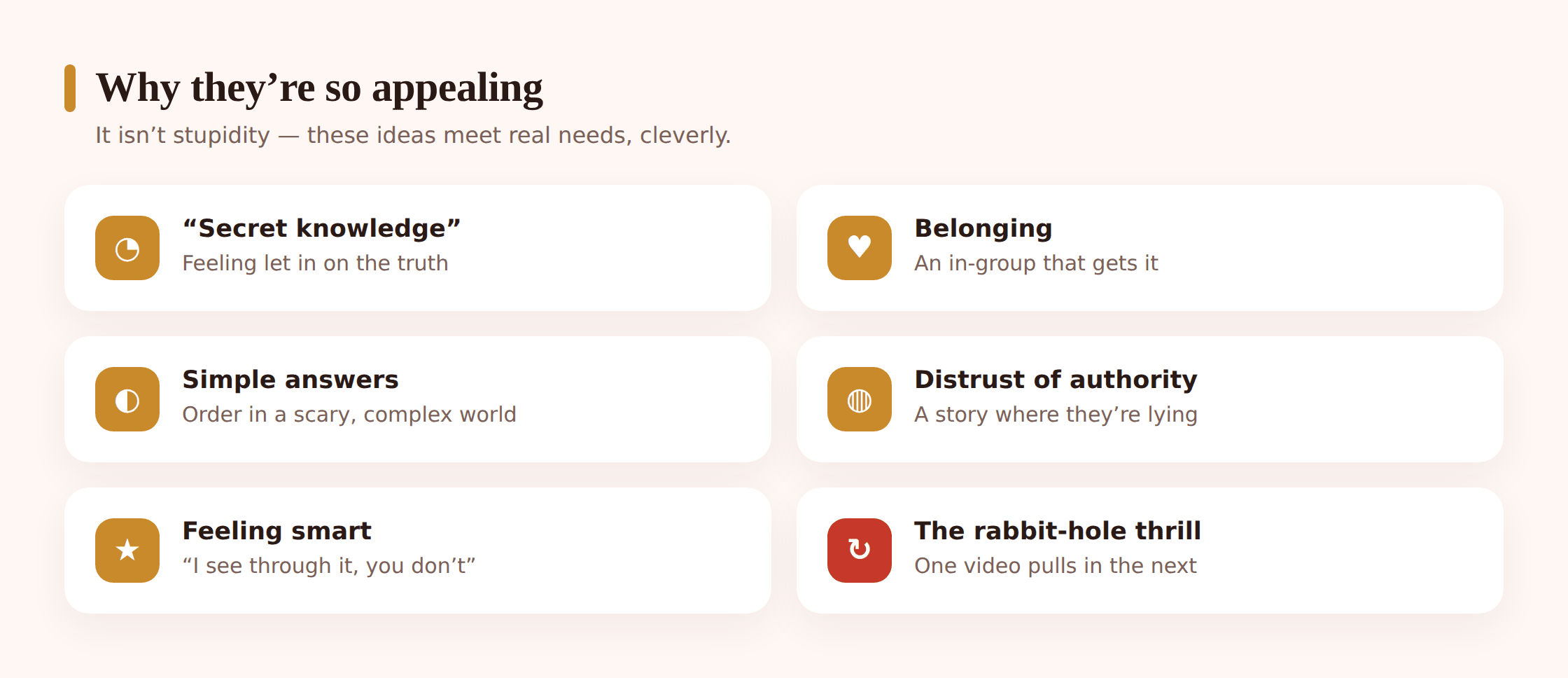
- Secret knowledge. The core promise is that you now know something hidden, something the crowd is too asleep to see. That feeling of being let in on a secret is genuinely thrilling, and it flatters a teenager who’s desperate to feel grown-up and clued-in.
- Belonging to an in-group. Believing puts you among “the ones who get it.” There’s an us, and the us is warm and welcoming, especially to a kid who feels on the outside of things at school. The community can matter more than the content.
- Simple answers to a scary, complicated world. Real life is messy — bad things happen for tangled, boring, partly random reasons. A theory replaces that mess with a clean story: someone is in charge, someone is to blame, and once you know who, the world stops feeling so random. That’s oddly comforting.
- Distrust of authority. Teenagers are supposed to question adults; it’s part of growing up. A theory takes that healthy instinct and points it at everything at once — schools, media, experts, government — offering the flattering idea that all of them are either fools or liars.
- Feeling smart for “seeing through it.” Nothing feels better at fifteen than being the one who isn’t fooled. The belief reframes doubt as intelligence: you’re not gullible like everyone else, you’re a critical thinker who did your own research. The irony is that it usually shuts real thinking down.
- The thrill of the rabbit hole. Following a trail of clues is genuinely fun. Each video, each connection, each “wait, that explains this” gives a little hit. It has the momentum of a mystery you’re solving, except the mystery never resolves and keeps pulling you further in.
None of this makes your child foolish. These are normal human needs — certainty, belonging, meaning, a bit of rebellion — arriving at exactly the age they burn hottest. Smart, thoughtful, kind kids are pulled in all the time. Treating it as a stupidity problem gets the diagnosis wrong and pushes them away from the one person who could help.
How they spread online
The pull explains why a kid stays. The internet explains how they arrive, and how a passing curiosity turns into a worldview. A few mechanisms do most of the work.
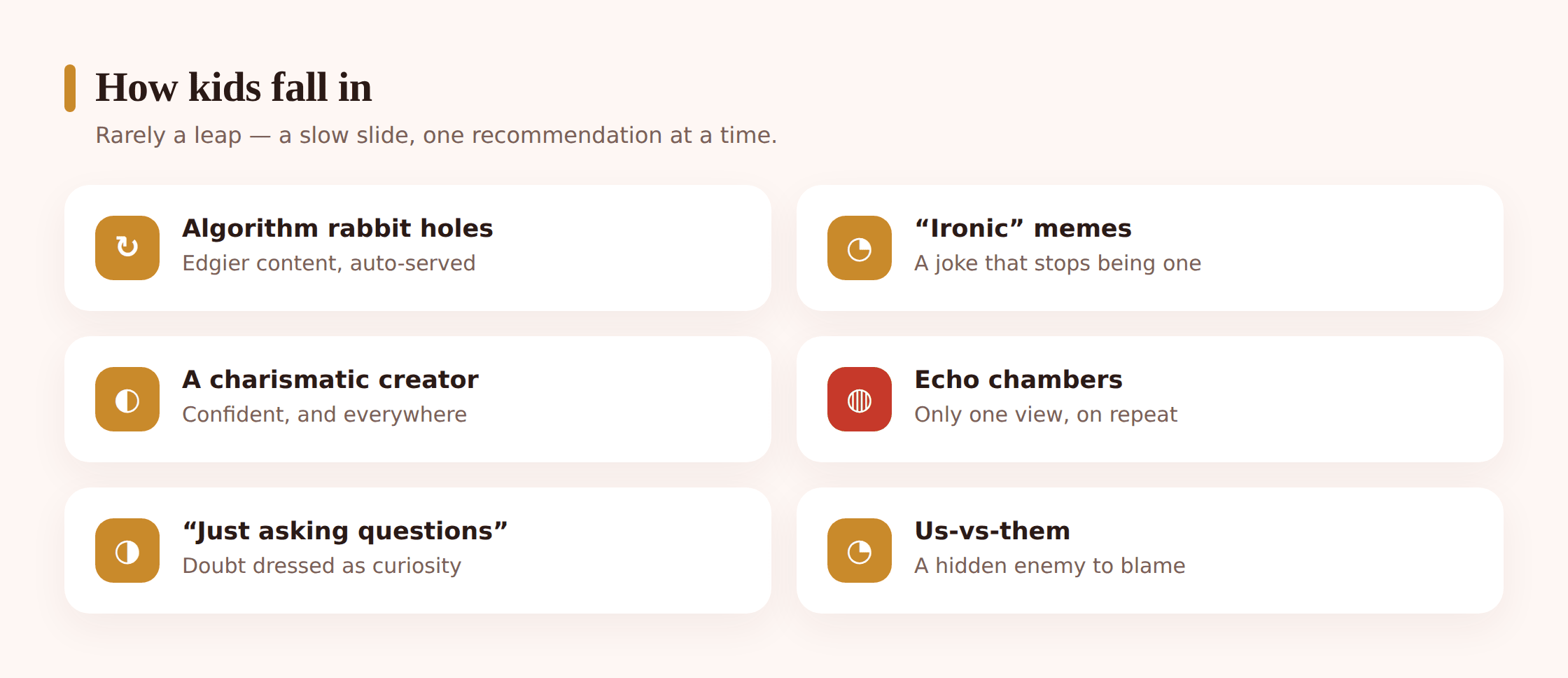
Recommendation rabbit holes
Feeds are tuned to keep people watching, and few things hold attention like a dramatic, unresolved mystery. Watch one video that flirts with a fringe idea and the system reads it as interest, then offers three more a little further out. Nobody designed this to radicalise anyone — it’s optimising for time spent — but the drift toward the more extreme, more certain version is baked into how it learns. Our piece on how social media algorithms work unpacks the mechanics.
Edgy and ironic memes as the front door
Very little of this arrives as a solemn manifesto. It arrives as a joke — a meme that’s funny first and only half-serious about the idea underneath. Laughing along feels harmless, and mostly it is. But irony is a soft on-ramp: it lets an idea get repeated and normalised without anyone quite committing to it, until the line between “joking” and “kind of meaning it” quietly disappears.
Charismatic creators
Behind most rabbit holes is a person your kid finds compelling — funny, confident, seemingly brave for saying what others won’t. The parasocial bond does a lot of the lifting. Your child isn’t just weighing an argument; they trust a creator who feels like a friend, and disagreeing with the idea can feel like betraying the person.
Echo chambers and “just asking questions”
Once inside a community — a forum, a comment section, a group chat — every voice agrees, dissent is mocked or removed, and the belief stops being tested against anything. A favourite move here is “I’m just asking questions.” It sounds open-minded and reasonable, which is what makes it effective: it plants a claim while dodging any responsibility to back it up, and it frames anyone who pushes back as the closed-minded one. This overlaps with the pathways in our guide to online radicalization and extremism, and the two can shade into each other.
Warning signs your child is deep in one
Curiosity is not a crisis. A teenager asking wild questions, poking at official stories, or going through a sceptical phase is often just thinking — and you don’t want to pathologise healthy doubt. What’s worth noticing is a shift in how they hold ideas, not just which ideas they hold. Look for a pattern, not a single remark.
- Absolute certainty. Not “I wonder if” but “I know, and it’s obvious.” Genuine curiosity stays open; conspiracy certainty slams shut. When every question already has a settled answer, that’s a flag.
- Dismissing all mainstream sources at once. Any outlet, expert, or institution that disagrees is written off wholesale as bought, brainwashed, or in on it. The circle of trustworthy sources shrinks down to a handful of aligned voices.
- Us-versus-them framing. The world gets sorted into the ones who see and the sheep who don’t. Talk about people who disagree turns contemptuous rather than curious.
- A whole new online world. New accounts, new creators, new vocabulary you don’t recognise, hours in communities you’ve never heard of. Their information diet has quietly changed and narrowed.
- Distress, paranoia, or isolation. The belief starts costing them — anxiety about threats that feel huge and imminent, suspicion of friends and family, pulling away from people who don’t share it. This is the sign that matters most, and the one that shades from “a phase” into “needs support.”
One flag on its own usually means nothing. It’s the cluster — certainty plus contempt plus a new closed world plus a change in mood — that tells you something bigger is going on and it’s time to lean in, gently.
How to respond well
Here’s the hard truth most parents learn the slow way: the obvious moves backfire. Mockery, a stack of facts, a lecture on how they’ve been fooled — these don’t dislodge the belief. They confirm it. Remember what the theory promised: that outsiders would dismiss them, that the sheep wouldn’t understand, that being doubted is proof of being right. Every eye-roll you offer, the belief has already predicted, and it collects your reaction as evidence. You can’t debunk your way out of a system built to treat opposition as confirmation.
Winning the argument can lose the kid. You might flatten every point and still push them further in, because you’ve made the belief’s core prediction come true and made yourself one of “them.” The goal isn’t to win. It’s to stay someone they’ll keep talking to.
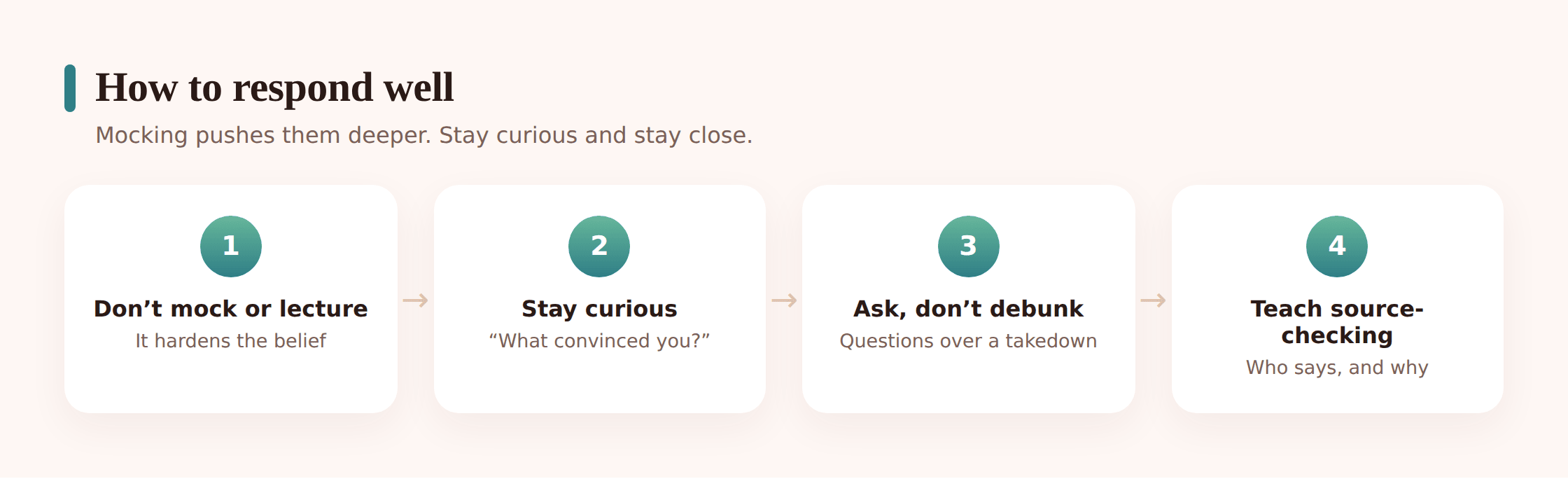
So respond to the relationship first and the belief second. A slower approach that actually works:
- Stay calm and stay connected. Before anything else, decide you won’t fight. Your relationship is the only channel through which anything gets through, and panic or contempt closes it. Keep doing the ordinary stuff together — meals, drives, games, whatever you share — so the belief isn’t the whole of your bond.
- Get genuinely curious. Ask what drew them in, what feels true about it, what the community is like. Not as a trap to spring, but because you actually want to understand the need it’s meeting. “What is it about this that makes sense to you?” opens a door that “that’s nonsense” welds shut.
- Ask questions instead of debunking head-on. Rather than telling them they’re wrong, help them think. “How do we know that’s true?” “Who’s saying it, and how would they know?” “What would it take to change your mind?” “Is there anything this doesn’t explain?” You’re handing them the tools to examine it themselves, which sticks far better than a conclusion you handed down.
- Teach source-checking on neutral ground. Don’t make the fight about the belief itself. Build the skill sideways — on ads, on a random viral clip, on something neither of you cares about — of asking where a claim came from, whether anyone independent backs it, and what the person sharing it has to gain. Our media literacy guide is full of practical routines for this.
- Look for the real worry underneath. Often a theory is a stand-in for a fear that’s easier to name once you go looking — anxiety about the future, a feeling of powerlessness, loneliness, a need to matter. If you can meet the underlying need directly, the belief loses some of its grip because it has less work to do.
- Leave the door open and give it time. You will not fix this in one conversation, and pushing for a recantation just triggers defensiveness. Plant a question, let it sit, come back another day. People talk their way out of these beliefs gradually, usually through someone who kept treating them as a whole person the entire time.
Building critical-thinking resilience early
The best time to build resistance is long before any of this comes up, and it looks nothing like a lecture on misinformation. It looks like a home where thinking is welcome and questions are safe.
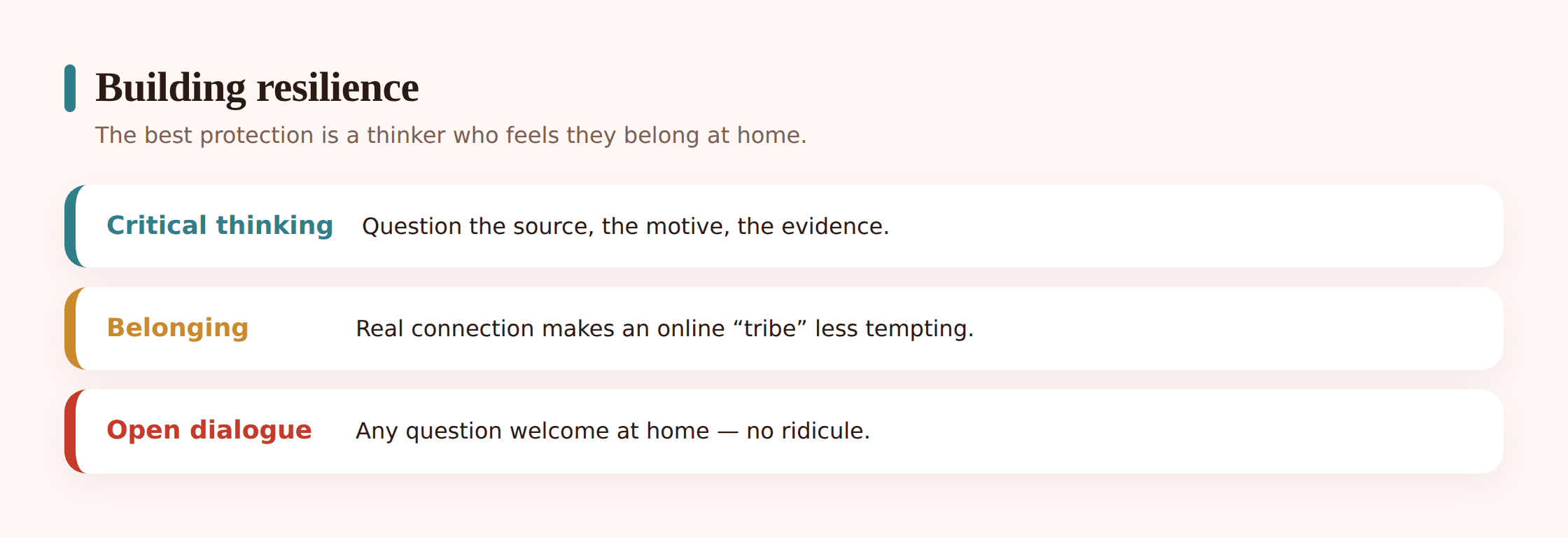
- Make “how do you know?” an ordinary question. Ask it warmly and often, about everything — not as a challenge but as genuine interest in how conclusions get reached. A kid used to tracing claims back to evidence carries that habit into the rabbit hole.
- Get comfortable with “I don’t know.” Much conspiracy appeal is the promise of certainty. A child who can sit with “we’re not sure yet” or “it’s complicated” is far less hungry for a story that ties everything up neatly. Model it yourself: say “I don’t know, let’s find out” out loud.
- Teach that real experts disagree, and that’s normal. The conspiracy frame paints authority as a single monolithic lie. Reality is messier and more honest — knowledgeable people argue, revise, and admit mistakes. Showing that this is how truth actually works makes the “they’re all in on it” story less convincing.
- Reward good questions more than right answers. When your kid pokes a hole in something, notice it and praise it. You’re growing the instinct to examine, which protects them from being fooled by anyone, in any direction.
- Give them agency and belonging offline. A lot of the pull is a hunger to matter and to belong. A kid with real friendships, a role, something they’re good at, and a sense that their voice counts has less of that hunger for an online tribe to feed on.
- Talk about how persuasion works. Not just “this is false” but “here’s how content is built to grab you” — the outrage hook, the sense of urgency, the flattery of feeling let in on a secret. The same awareness helps them see through the confident, agreeable answers from AI chatbots, which can sound authoritative while being plainly wrong.
When a belief tips into something harmful
Most conspiracy interest is a phase — uncomfortable to watch, but not dangerous, and often something a kid grows out of as their world widens. Keep a sense of proportion. A weird belief held by an otherwise happy, connected teenager is usually not an emergency.
But some cases need more than patient conversation, and it’s worth knowing the line. Seek extra support when a belief turns hateful — targeting a group of people with contempt or dehumanising them; when it points toward danger — talk of harm to themselves or others, or of acting on the belief in risky ways; or when it comes wrapped in real distress — deepening paranoia, fear that’s taking over their life, or withdrawal that looks like a mental-health crisis rather than a hobby.
In those cases you don’t have to handle it alone, and you shouldn’t try to. A school pastoral or safeguarding lead can help and may already be seeing patterns. Your GP is a sensible first door for anything that looks like anxiety, depression, or a crisis, and can point you toward proper mental-health support. If you ever believe your child or someone else is in immediate danger, treat it as the emergency it is. Reaching for help isn’t an overreaction or an admission of failure — it’s the same as calling in any other expert when something’s beyond what a parent should carry solo.
Where tools fit (and where they don’t)
Let’s be honest about what technology can do here, because it’s a narrow slice. For younger children, a content filter can keep some of the worst rabbit holes out of easy reach, and topic or keyword alerts can let you know when a worrying subject shows up in their world — a prompt to start a conversation, not a verdict to act on.

The honest limit: no app teaches critical thinking, and none can talk a teenager out of a belief. A filter can’t tell a thoughtful sceptic from someone spiralling, and it won’t be there on a friend’s phone or when your child is grown and scrolling on their own. The durable defence is the thinking in their head and the trust between you — and both of those are built in conversation, out in the open. Tools are a modest backstop for the youngest kids. The real work is human.
Frequently asked questions
Should I just debunk it?
Head-on debunking usually backfires. A stack of facts confirms the story’s own prediction — that outsiders will dismiss and doubt them — so it can push a kid in deeper while you feel like you’re winning. Ask questions instead. Help them examine the claim’s sources and gaps themselves, and let the doubt come from inside their own head, where it actually lasts.
My teen believes something wild — should I worry?
Not necessarily. A single strange belief in an otherwise happy, connected, functioning teenager is often just a phase of testing ideas, and many kids grow out of it as their world widens. Worry less about the belief itself and more about the pattern around it: rigid certainty, contempt for anyone who disagrees, a shrinking social world, and rising distress. That cluster is what tells you to lean in.
Won’t ignoring it make it worse?
Ignoring and staying calm aren’t the same thing. You shouldn’t pretend not to notice — stay engaged, curious, and connected. What you’re avoiding is the fight, not the topic. Keep the conversation open and ongoing without turning every dinner into a debate. Steady, low-drama presence does more than either a blow-up or a cold shoulder.
How do I keep my own politics out of it?
Focus on the how, not the what. Teach the process — checking sources, noticing when something is engineered to enrage, asking how anyone could actually know a claim — and apply it evenly to everything, including things you happen to agree with. You’re building a method that makes your kid harder to fool by anyone, not handing down a set of conclusions.
What if the belief came from a friend or a creator they love?
Go gently, because attacking the source feels to them like attacking a friend, and they’ll defend it. Separate the person from the claim: you can acknowledge that a creator is funny or that a mate is great while still asking how they’d know a particular thing is true. Aim at the idea, never the relationship.
When should I get outside help?
When a belief turns hateful toward a group of people, points toward danger to themselves or others, or arrives with real distress — deepening paranoia, fear that’s taking over, or withdrawal that looks like a mental-health crisis. Then loop in a school safeguarding lead or your GP, and treat any immediate danger as an emergency. That’s good parenting, not overreaction.