Online Radicalization & Extremism: What Parents Should Know
No one wakes up one morning holding hateful beliefs. Radicalization is slow. It works through friendship, belonging and small steps, and by the time a young person is deep in it, they usually think they found the truth on their own. That’s the part worth understanding — not to panic about it, but so you can stay close enough to notice, and steady enough to help.

What online radicalization actually means
Radicalization is the process by which someone comes to adopt extreme beliefs — and, crucially, to accept that hostility, hatred, or even violence toward some group of people is justified. The word that matters there is process. It’s a road, not a switch. People travel it in stages, and most of the stages feel reasonable to the person walking them.
Two things are worth saying plainly before anything else. First, extremism isn’t one thing. It comes in many forms, across the whole spectrum of politics, religion, and grievance, and it isn’t tied to any one movement, country, or cause. Second, this guide takes no side on any of that. Naming groups or explaining what any of them believe would miss the point entirely — and frankly, it would do the recruiters’ work for them. What every version has in common is the same underlying machinery: a story that divides the world into us and them, and a promise that you belong with the us.
So we’re going to stay on the machinery. How the process works, what it looks like from a parent’s chair, and what actually helps. The specific ideology matters far less than you’d think, because the pull is almost always emotional before it’s ever political.
Why young people are vulnerable
None of this is about a kid being foolish or badly raised. Adolescence is, by design, a stretch of life spent figuring out who you are and where you fit. That openness is healthy. It’s also exactly what recruiters and communities built around grievance are good at exploiting.
A few ordinary things about being young make the pull stronger:
The search for identity and belonging
Teenagers are trying on identities and looking for a crowd that feels like home. A group that offers instant, unconditional acceptance — “you’re one of us now” — is powerful when a young person feels awkward, left out, or unseen. The belonging comes first. The beliefs get absorbed later, as the price of staying inside.
Grievance and the wish for simple answers
Feeling wronged — bullied, overlooked, humiliated, or just powerless — is normal at that age, and sometimes entirely justified. Extremist narratives take a real, painful feeling and hand over a tidy explanation: here’s exactly who did this to you, and here’s who to blame. Certainty feels like relief when everything else is confusing.
Wanting to matter
These communities offer a sense of purpose and importance that an ordinary teenage life can seem to lack. Being told you’re part of something big, that you see a truth others are too asleep to notice, is flattering. It gives a shape and a mission to feelings that were previously just discomfort.
The way the feed is built
Recommendation systems reward engagement, and outrage engages. A young person doesn’t have to go looking for extreme content; a few curious clicks can be enough for the feed to start serving steadily more of it, because that’s what holds attention. We go into the mechanics in how social media algorithms work — the short version is that the road toward the edges is paved, and it’s often downhill.
How it happens, step by step
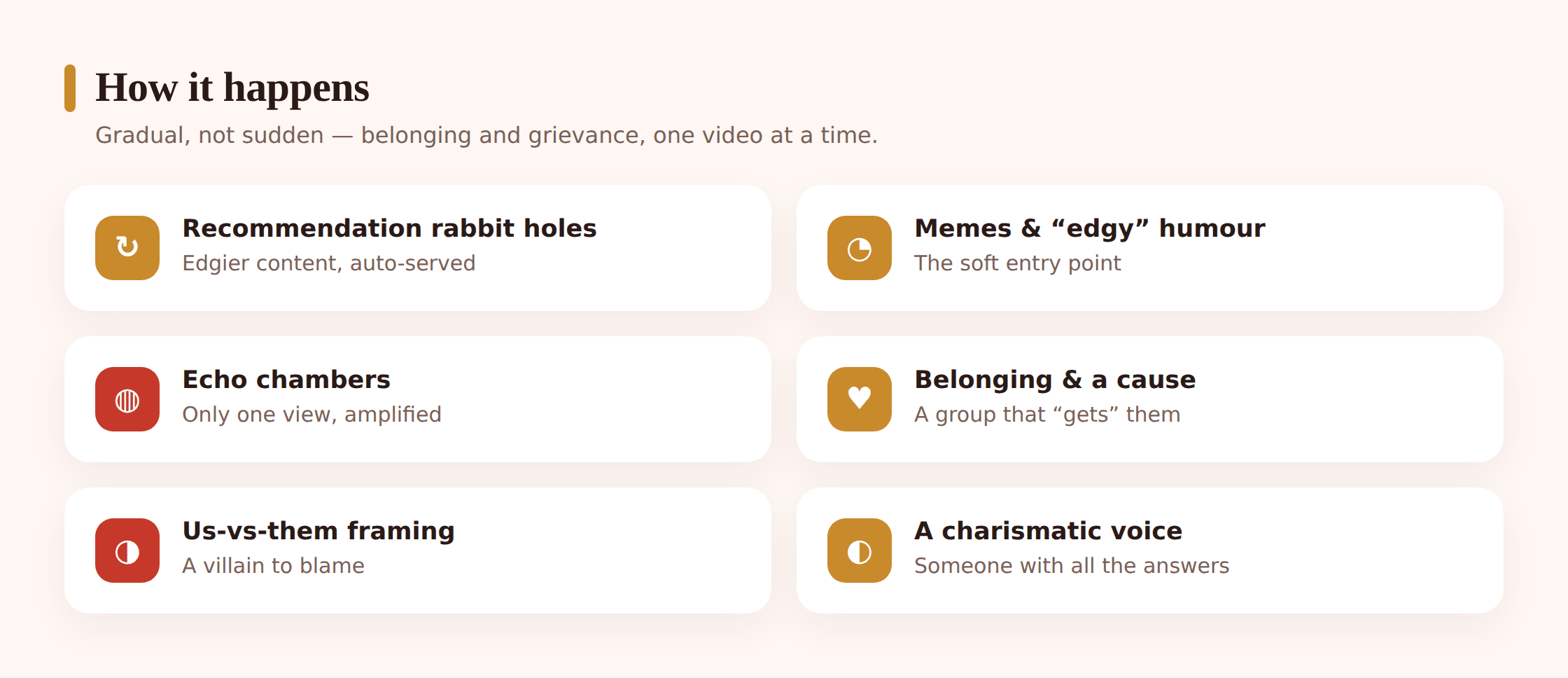
There’s no single script, but the pattern rhymes across very different ideologies. Understanding the shape of it helps you recognise it early, while it’s still just a shape.
It starts with humour, not doctrine
The entry point is very often edgy jokes and memes, not manifestos. Shock humour lowers the stakes: it’s “just a joke,” so nothing needs defending. But the jokes normalise the ideas underneath them, one laugh at a time, and they sort people into those who “get it” and those too sensitive to. By the time the ideas stop being ironic, the young person has already been laughing at them for months.
The rabbit hole
Curiosity plus a recommendation engine is a potent combination. One video, one thread, one community leads to a slightly more intense one, then another. Each step feels like a natural continuation rather than a leap. Nobody chooses to go to the bottom; they just keep taking the next reasonable-looking step down.
Gaming chats and private communities
A lot of contact happens in the ordinary places young people already gather — voice chats, gaming servers, group messages, comment sections. These spaces are social and unsupervised, which is exactly what makes them useful to someone looking to befriend and gradually influence a younger person. It’s less like a lecture and more like being adopted by an older crowd. Our note on online predators covers the grooming dynamic more broadly; the recruitment version borrows the same playbook.
The charismatic voice
Somewhere along the way there’s usually a personality — a confident, funny, seemingly-honest influencer who “tells it like it is” and appears to genuinely care about young people who feel ignored. The bond is real to the teenager even though it’s entirely one-directional. That trust becomes the delivery system for everything that follows.
The echo chamber closes
As the young person spends more time inside, the walls go up. Dissent gets mocked or pushed out. Outside sources are reframed as lies. The group becomes the only trusted narrator of reality, and “us versus them” hardens into the basic map of the world. AI tools can deepen this too, and we touch on that in AI chatbots and kids — a system that always agrees with you is a poor guide out of a hole.
Love-bombing and the cost of leaving
Belonging is the hook, and it’s applied deliberately. New members are showered with warmth, attention, and status — love-bombing. That warmth makes the group feel like family. And once it does, leaving isn’t just changing your mind; it feels like losing everyone who understands you. That’s what makes the pull so sticky, and why arguing someone out of it head-on so rarely works.
Notice what’s missing from that whole sequence: a big obvious moment where a good kid decides to believe something terrible. There isn’t one. That’s precisely why it’s easy to miss and unfair to blame anyone for.
Warning signs to watch for
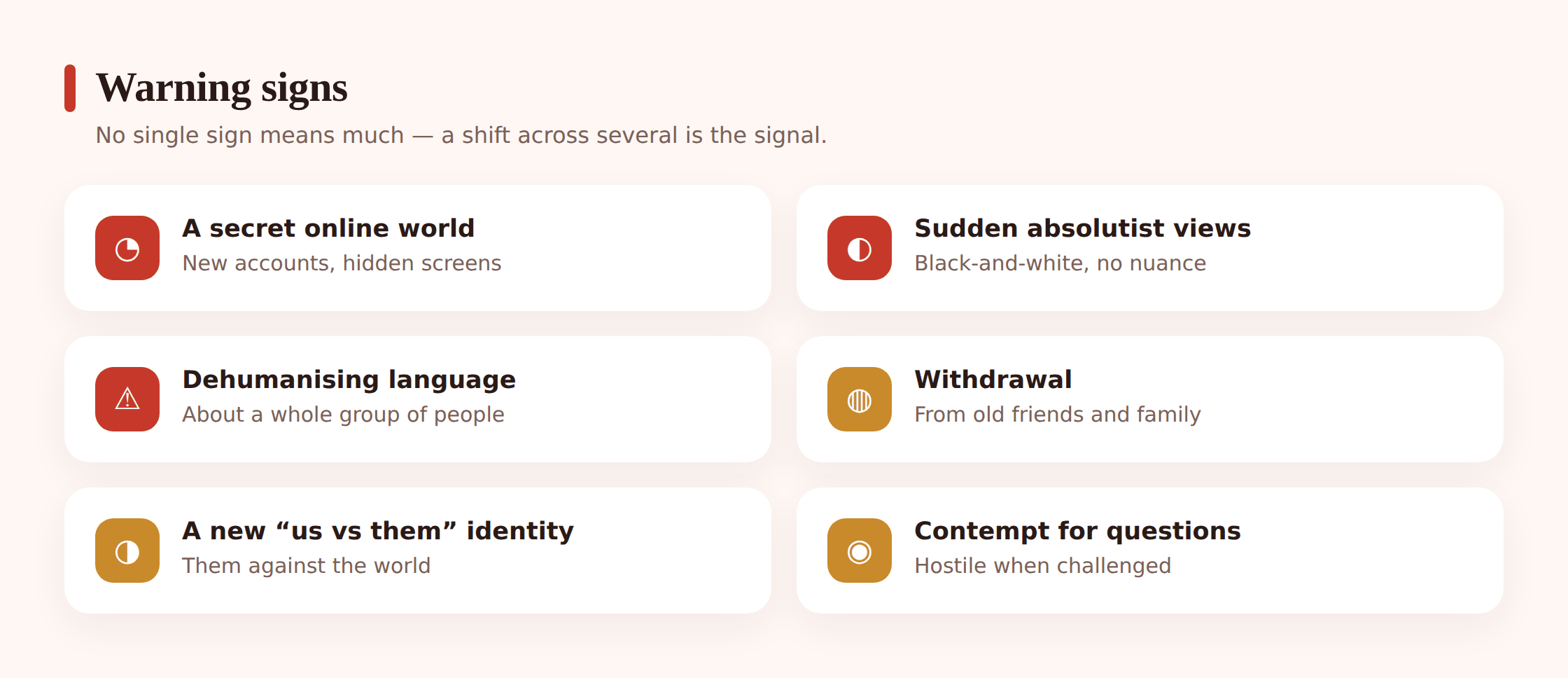
A word of caution before the list. Teenagers hold strong opinions, test provocative ideas, argue for effect, and go through private phases — all of that is normal and healthy, and none of it means your child is being radicalized. What you’re watching for isn’t a single opinion. It’s a pattern and a change: several of these appearing together, and your child becoming someone you recognise a little less.
- A new, secretive online world. Hours in communities they won’t talk about, quick screen-switching when you walk in, new accounts or handles they keep separate from the rest of their life.
- Sudden absolutism. Complex questions collapse into total certainty. Nuance disappears. Every issue has one obvious answer and anyone who disagrees is stupid, evil, or “asleep.”
- Dehumanising language about a group. This is the serious one. Talking about a whole category of people as less than human, as a disease, as the enemy — not disagreement, but contempt aimed at people rather than ideas.
- A hard us-versus-them identity. A strong new sense of belonging to one group defined mainly by who it’s against. Old friends dropped, the family framed as not understanding, the new group as the only ones who do.
- Withdrawal and secrecy. Pulling back from family, old hobbies, and offline friends, while the online world takes up more and more space.
- New slogans and in-jokes. Vocabulary, symbols, or catchphrases that seem to come from somewhere specific and carry a charge you don’t fully understand.
- Escalating hostility to being questioned. Gentle pushback that once led to a conversation now triggers real anger or a shutdown.
Read that list as a smoke detector, not a diagnosis. It’s there to make you look, talk, and stay close — not to convict your kid of anything.
How to respond well
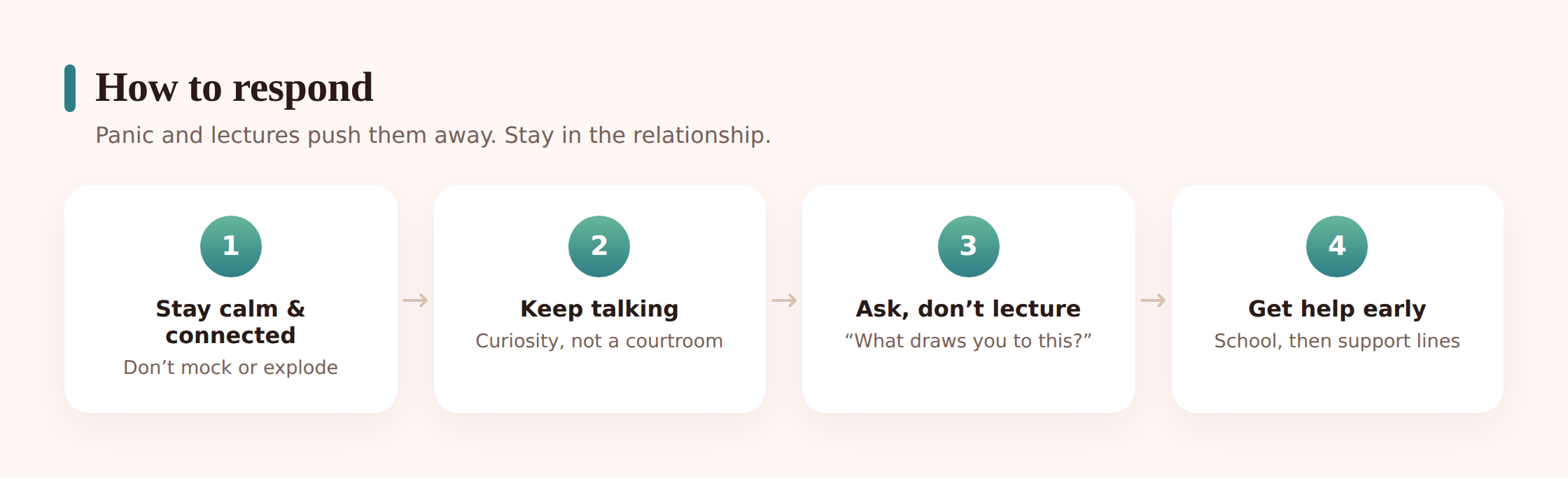
The instinct to confront, forbid, and lecture is completely understandable, and it tends to backfire. Recruitment narratives actually predict that the family will react this way — “they’ll try to shut you down, that proves we’re right.” A furious parent can confirm the story. What breaks the story is a parent who stays calm, stays curious, and stays in the room.
Step 1 — Stay in the relationship
Your connection with your child is the single most protective thing you have, and it’s what these groups compete with directly. Keep it warm even when their views appall you. The goal in every interaction is to remain someone they’ll still talk to tomorrow. You can’t influence someone who has stopped listening.
Step 2 — Don’t panic, and don’t mock
Ridicule and horror both push a young person further in — one makes them defensive, the other makes them feel unseen. React to alarming words with steadiness rather than a scene. Cooler than the moment, warmer than the words. That’s the tone that keeps the conversation alive.
Step 3 — Ask, don’t lecture
Questions work where speeches don’t. “What drew you to that? Where did you hear it? Who’s saying it? What do you think they get out of you believing it?” Genuine curiosity invites a young person to examine their own beliefs, which they can only do if they don’t have to defend them against an attack. Being listened to is also, quietly, the thing the group promised them — and you can offer it for real.
Step 4 — Separate the person from the idea
You can reject an idea completely while making it unmistakable that you accept and love the person. “I think that’s wrong, and I’m always glad you’ll talk to me about it” is a sentence that keeps both true at once. Never let them feel that losing the belief means losing you too.
Step 5 — Build critical thinking, not a counter-argument
You don’t have to win the specific debate. You have to reawaken the questions the echo chamber switched off. Who benefits from this? What would change your mind? Who’s being left out of this story? Teaching the habit of checking sources and noticing manipulation outlasts any single argument — our guide to media literacy for kids is a practical companion here.
Step 6 — Rebuild the offline world
Isolation is the soil all of this grows in. Sport, music, a job, old friends, family time, anything that offers real belonging and a sense of mattering — these compete directly with what the group is selling, and they’re better because they’re real. You don’t have to out-argue a community. You can out-belong it.
Building resilience before it starts
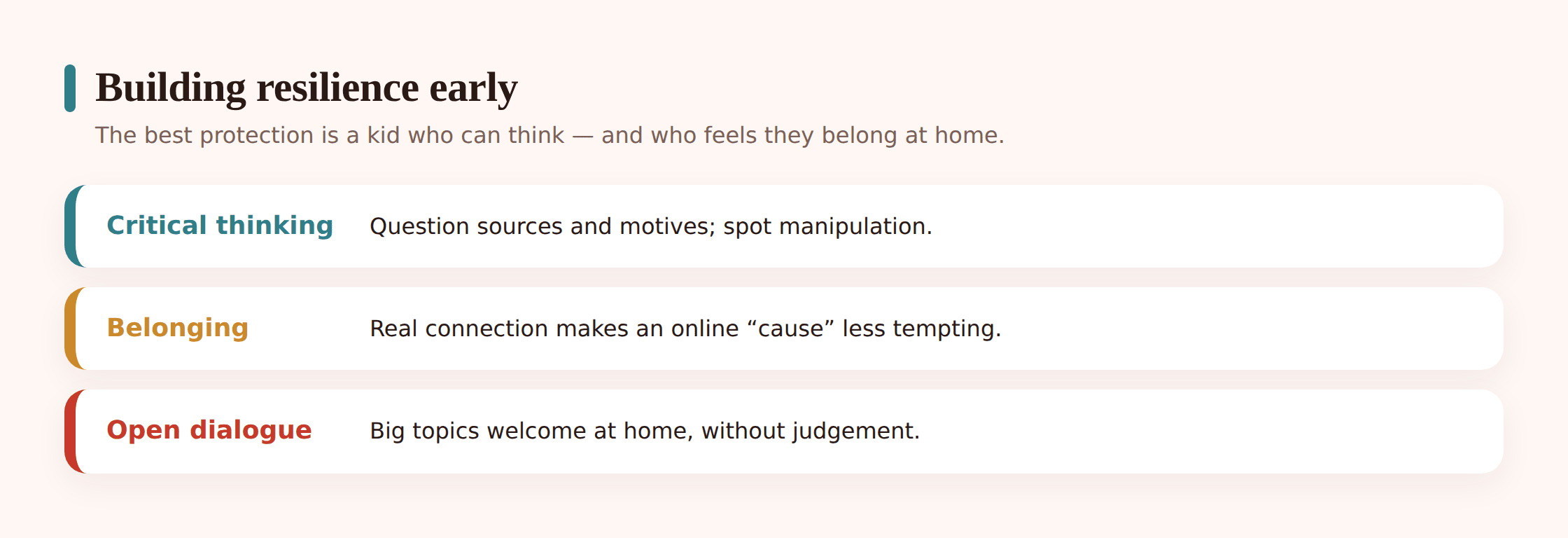
Most of what protects a child from this is built long before any of it is on the horizon, and it’s mostly ordinary parenting rather than anything specialised.
- A home where they belong. A child who feels genuinely accepted and important at home has far less need to go find those feelings in a group that demands hatred as the entry fee.
- Permission to disagree. If your child can argue with you, be wrong, and still be fully loved, they learn that belonging doesn’t depend on toeing a line. That’s an immune response against groups that punish dissent.
- The habit of asking who benefits. Raise a kid who instinctively wonders where a claim came from and what the person making it wants. Curiosity is corrosive to propaganda.
- Emotional footing. Naming and handling anger, shame, loneliness and grievance well means those feelings are less likely to get hijacked by someone offering a villain to blame.
- Real-world roots. Friendships, activities, and responsibilities offline give a young life ballast, so no single online world can become the whole of it.
- An open line about the internet. Talk about the strange, extreme, and manipulative things they’ll run into online as a normal topic, early and without drama, so that when something unsettling appears, coming to you is the obvious move.
You don’t need to name ideologies or teach a course on extremism. You need a child who feels solid, questions easily, and knows the door home is always open.
Where to get help
If you’re worried, you’re not the first parent to be, and there are people whose job is exactly this. Start close and widen out as needed:
- Your child’s school. Teachers, a counsellor, or the designated safeguarding lead deal with these concerns as part of their role. They can advise, watch discreetly, and connect you to specialist support. A quiet conversation there is a sensible first step.
- National safeguarding and anti-extremism support. Many countries run dedicated, confidential services to help families with exactly this worry, staffed by people who understand the process and won’t judge. In the UK, for instance, ACT Early (actearly.uk) and the Prevent safeguarding programme offer advice and support to parents. Search for the equivalent service where you live.
- Local police, non-emergency. For a serious but non-urgent concern — someone contacting your child to recruit them, or worrying material — a non-emergency police line can advise on the right step. These conversations are usually about safeguarding a young person, not punishing them.
- Emergency services. If you believe someone is in immediate danger, or a threat of violence is real and imminent, call your emergency number without hesitating.
Reaching out doesn’t mean giving up on your child or handing them over to a system. In practice it usually means getting the right support around a young person who’s being pulled somewhere harmful. The aim is help, not punishment.
Staying in the loop, openly
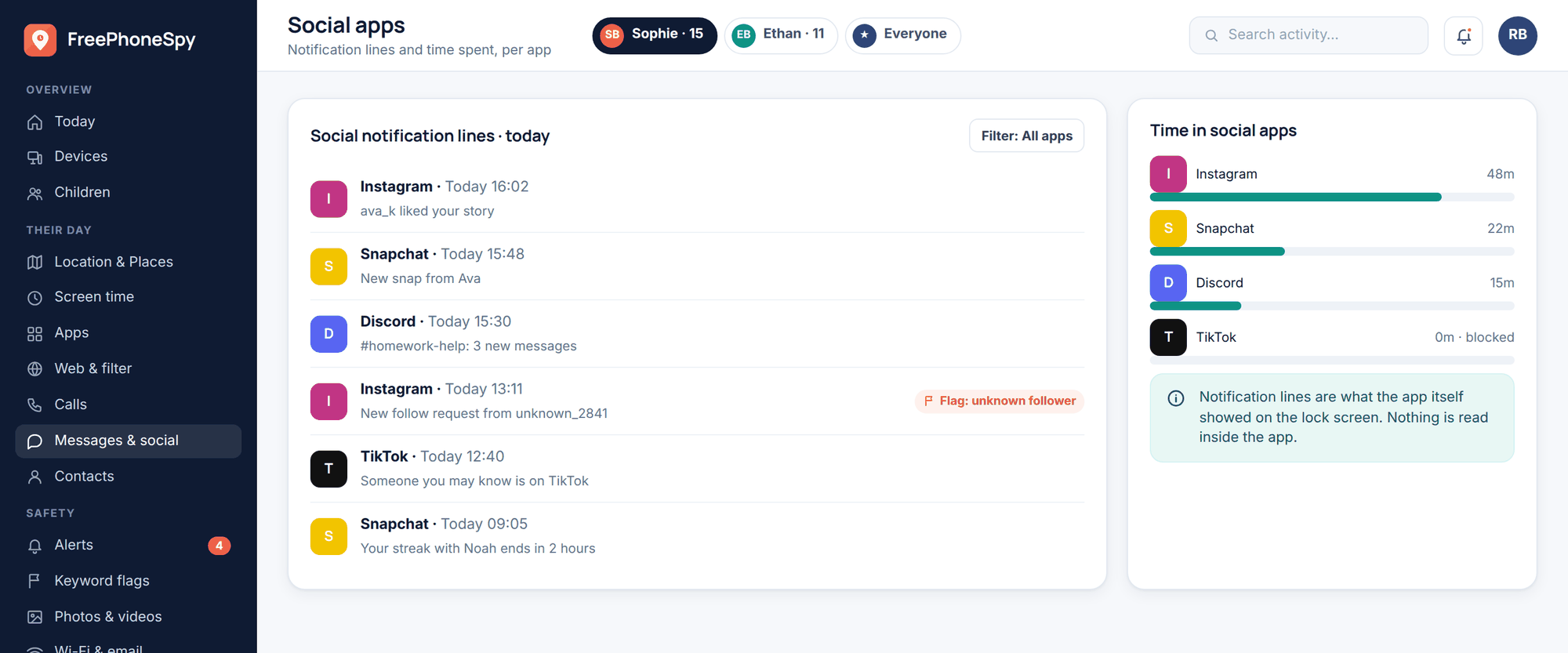
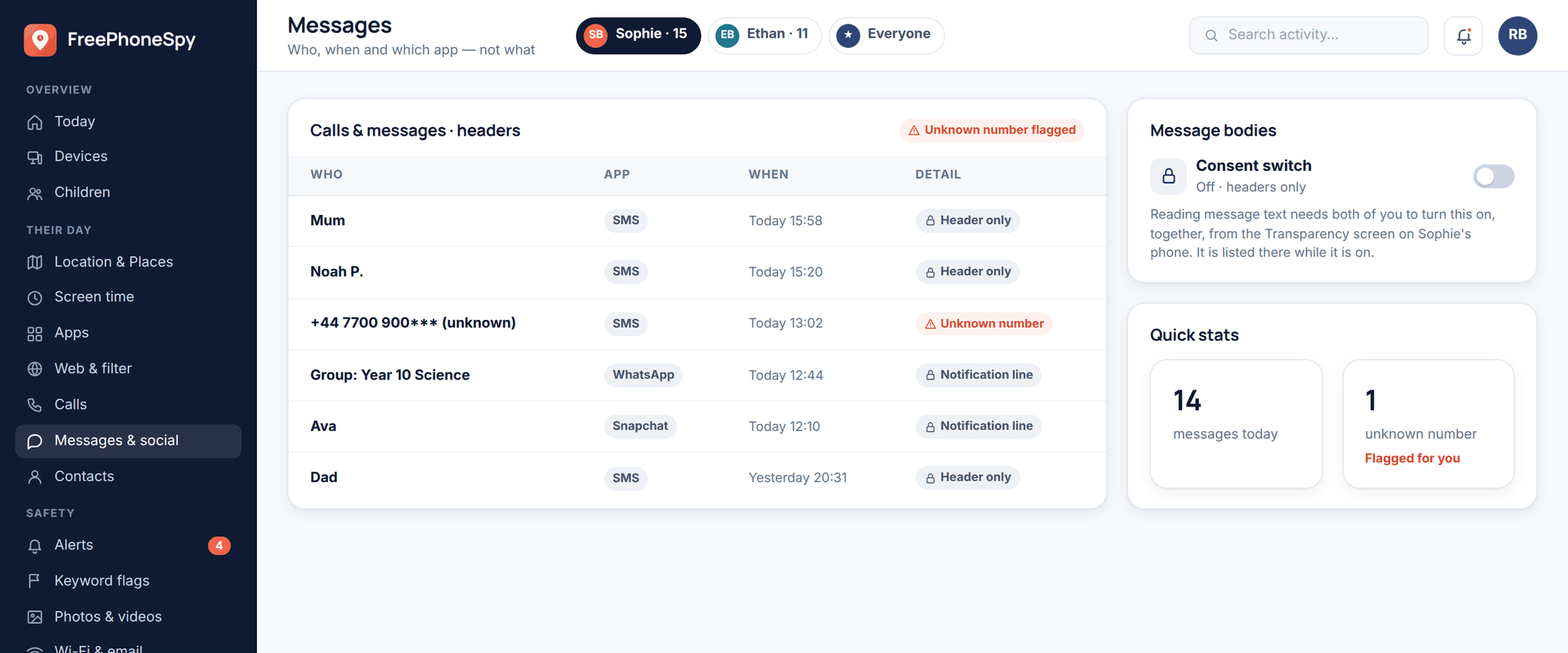
Tools have a small, honest place in this, and it’s worth being clear about where. None of what’s described above is solved by surveillance. Radicalization is a relationship problem, and it’s answered with relationship — conversation, trust, belonging, and staying close. No app substitutes for that, and secretly monitoring a teenager tends to damage the very trust that protects them.
If a tool has any role here, it’s as one more reason to stay in dialogue — a shared, agreed way to keep a light, honest awareness of your child’s digital life, so an ordinary check-in happens before a small thing becomes a big one. The conversation is the protection. Everything else is just support for it. You can keep a general sense of active apps and time spent — see how algorithms shape the feed for why that awareness matters — without ever turning it into spying.
FAQ
Is edgy humour a red flag?
Not on its own. Dark and provocative humour is a normal part of being young, and most of it means nothing more than that. What’s worth noticing is a shift: jokes that consistently target one group of people, humour that seems to be sorting the world into insiders and outsiders, or a young person who defends “just a joke” with real heat. It’s the direction and the intensity, not the existence of edgy jokes, that matters.
My teen has extreme opinions — should I worry?
Strong, even extreme-sounding opinions are part of working out who you are, and arguing a provocative position is often just thinking out loud. The concern isn’t a bold opinion. It’s when opinions harden into total certainty, come wrapped in contempt for whole groups of people, and coincide with secrecy, withdrawal, and a new us-versus-them identity. A fierce debate at dinner is healthy. A closing mind is the thing to watch.
What if I’ve found something alarming?
Stay calm and resist the urge to confront in the heat of the moment. Give yourself time to think, and lead with curiosity rather than accusation: “I saw this — help me understand it.” Keep the relationship intact, because it’s your route back. If what you found is genuinely serious — recruitment, threats, real fear of harm — bring in help. The school’s safeguarding lead is a good first call, and national anti-extremism support (in the UK, ACT Early) exists for precisely this. You don’t have to work out on your own whether it’s serious.
Won’t talking about it plant the idea?
No — and staying silent is riskier. Children encounter this material whether or not you’ve mentioned it. A calm, values-led conversation ahead of time means that when they meet something extreme online, they’ve got a framework and a person to bring it to. Silence just leaves the recruiters as the only voice in the room.
Should I ban the platforms where this happens?
Blanket bans tend to push the activity underground and cost you visibility and trust, which are your best assets. It’s usually more effective to stay involved — talk about what they watch and who they follow, keep the dialogue open, and use any awareness tools transparently and together. Belonging and honesty protect a child far better than a locked door.
Can a child come back from this?
Yes. People leave these communities and rethink these beliefs all the time, and a young person who feels loved and has a way back almost always finds it. The most powerful thing you can do is make sure that way home stays open — that leaving the group never means losing you.