Health & Wellness Misinformation: Helping Kids Spot Bad Advice Online
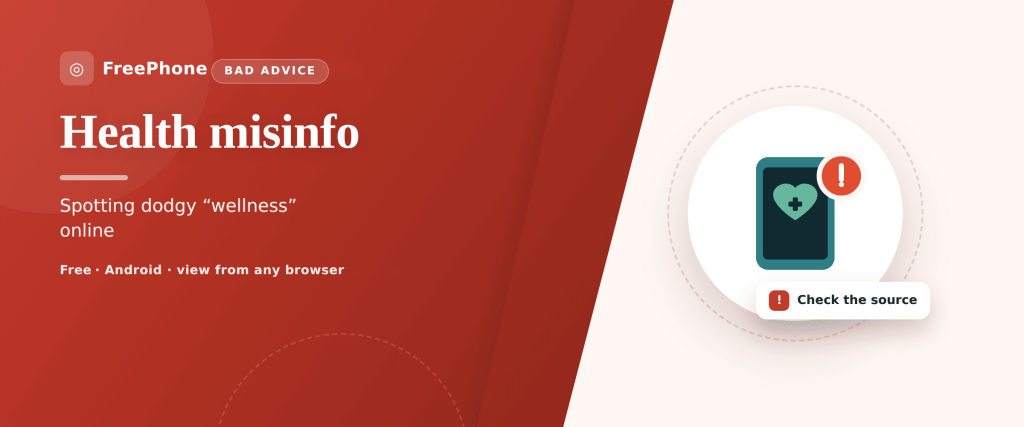
Somewhere between a workout clip and a makeup tutorial, your teenager is being told that a spoonful of a certain oil will fix their acne, that a supplement will cure their anxiety, and that the reason they feel tired is a “toxin” only one particular tea can flush out. None of it is true. All of it is delivered by someone confident, likeable, and speaking straight into the camera. This is a guide to what health and wellness misinformation actually looks like now, why it lands so hard with young people, and how to help your child weigh a health claim instead of swallowing it.
What we’re actually talking about
Health and wellness misinformation is bad advice about bodies and minds, dressed up to look like knowledge. It’s different from the fake news your child might see about politics or current events — that’s covered over in media literacy — because it’s personal. It aims at how they feel about their skin, their weight, their energy, their moods. And it usually arrives not as an argument but as a promise: do this one thing, and the problem that’s been bothering you goes away.
Some of it is harmless nonsense that costs nothing. Some of it drains money into supplements that do nothing. And some of it is genuinely dangerous — advice that leads a young person to skip real medical care, try an unsafe “hack,” or slide into eating patterns that hurt them. The tricky part is that all three arrive in the same format, from the same kind of confident creator, in the same thirty-second clip. Your teenager can’t feel the difference. They have to learn to check.
What it looks like in the feed
It rarely announces itself as misinformation. It looks like a tip from someone who seems to have their life together. Here are the shapes it most often takes.
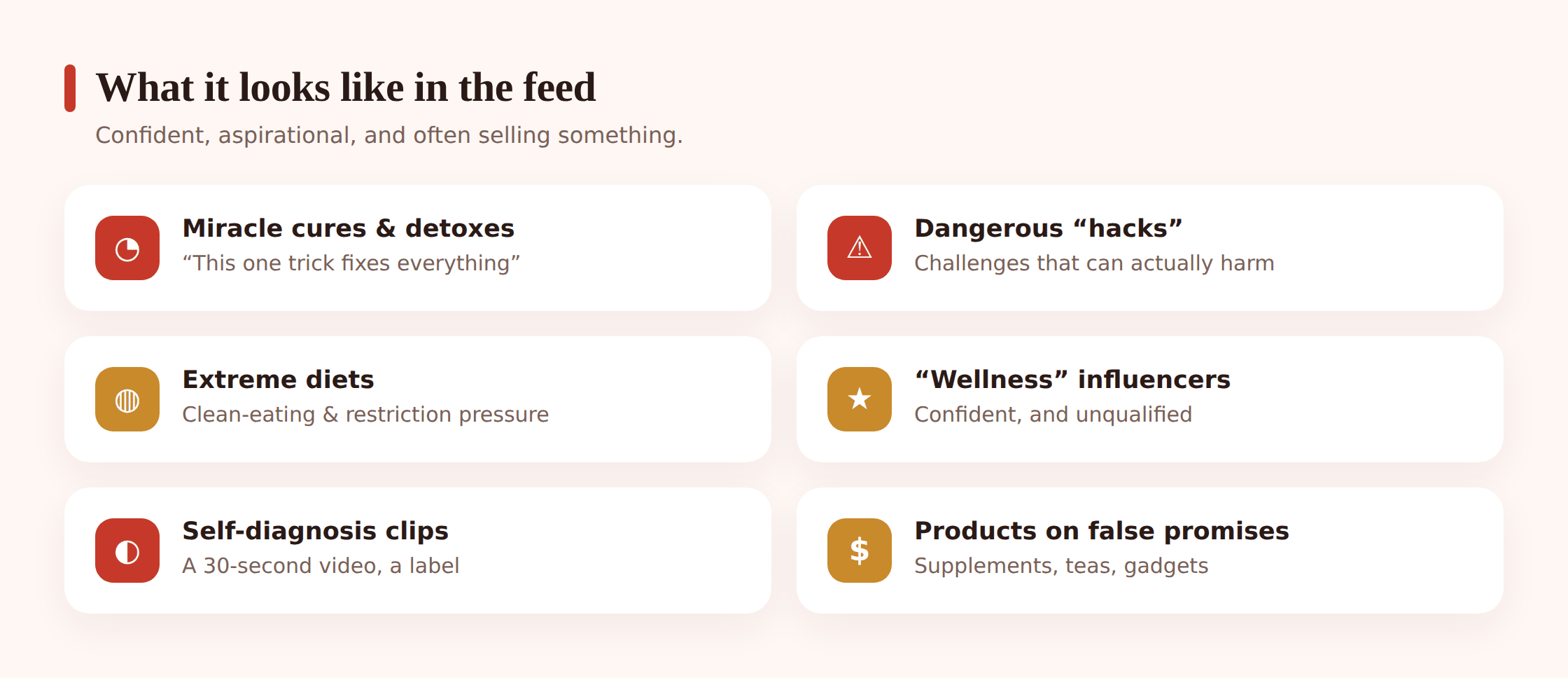
Miracle cures and detoxes
Teas, cleanses, “resets,” and drinks that claim to pull toxins out of the body. The body already has a liver and kidneys that do this; it doesn’t need a fourteen-day tea to help. But “detox” sounds scientific and virtuous at once, which is exactly why it sells.
Dangerous “hacks” and challenges
DIY dermatology with household chemicals, taping the mouth shut to “fix” breathing, mega-doses of an ordinary vitamin, viral challenges that treat a genuine risk as a dare. These spread because they’re dramatic and easy to film, not because they work.
Supplements and “what I eat in a day”
A creator lists the powders, pills, and gummies that supposedly gave them clear skin or endless energy — often with a discount code, because they’re paid on every sale. Alongside it sits the “what I eat in a day” clip: one person’s meals presented as a template, usually far less food than a growing teenager needs, and quietly aspirational rather than nutritional. There’s more on that pattern in fitness apps & body image.
Extreme diets and clean-eating pressure
Whole food groups declared “toxic.” Elaborate rules about what’s “clean” and what isn’t. The moral framing is the tell — food gets sorted into good and bad, and eating the “bad” kind becomes a failure of character rather than just lunch.
Unqualified “wellness” experts
Confident creators with no medical or nutritional training who speak with total authority about hormones, gut health, anxiety, and disease. A big following reads, to a teenager, like credibility. It isn’t. Popularity and expertise are unrelated, a theme running through kids & influencers.
Self-diagnosis from short videos
“Signs you have ADHD,” “symptoms of this condition you didn’t know about,” lists so broad that they describe nearly everyone. A young person recognises themselves in a few points and arrives at a diagnosis in ninety seconds — for a physical or a mental-health condition — without anyone qualified ever seeing them.
Anti-science and fear-based claims
Content built to frighten: this common food is poisoning you, doctors are hiding the real cure, ordinary medicine is a conspiracy. Fear travels further and faster than calm, accurate information, so the algorithm rewards it.
Why teens are such an easy target
This isn’t about your child being gullible. It’s about a system designed to be persuasive meeting a stage of life that’s especially open to it.
- The algorithm favours extremes. Measured, boring-but-true advice doesn’t get watched to the end. Shocking claims and dramatic transformations do, so that’s what keeps getting served up.
- Influencers feel like friends. A teenager watches the same creator every day for months. That familiarity builds a trust that a stranger in a white coat can’t match — even though the doctor is the one who actually knows.
- Adolescence comes with real health anxiety. Changing bodies, spots, moods, energy, sleep. When someone’s genuinely worried about themselves, a confident promise is a relief, and relief lowers the guard.
- Simple answers are appealing. “Your problem is one toxin, and here’s the fix” is far more comforting than “bodies are complicated and there’s no quick answer.” The simple story wins on feel, not on truth.
- Belonging is wrapped up in it. Following the same regimen as a creator and their fans is a way of being part of something, which is a powerful pull. That overlap with identity is explored in social media & self-esteem.
Put those together and you get a young person who isn’t foolish at all — just human, at an age when the pull is strongest and the defences are still being built.
The real risks
Most bad wellness advice is a waste of time and a little money. Some of it does real harm. It’s worth being clear-eyed about where the genuine dangers sit, without catastrophising every green smoothie.
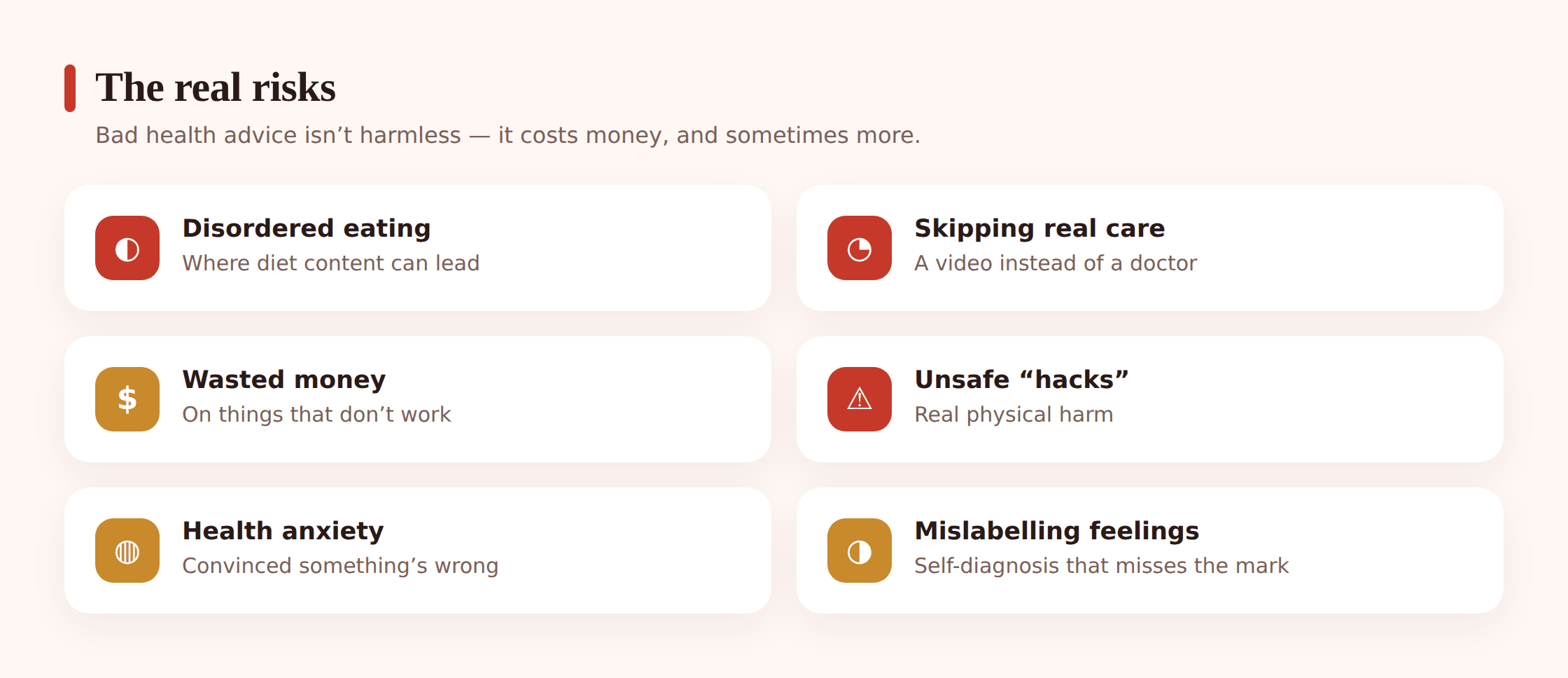
- Disordered eating. Clean-eating pressure, restrictive “what I eat in a day” content, and food moralising can nudge a vulnerable young person toward rigid, anxious, or restrictive patterns. This is the risk to take most seriously.
- Skipping real care. If a teenager trusts a self-diagnosis or a home “cure” instead of seeing a doctor, a treatable problem can be left untreated — or a real one missed entirely.
- Wasted money. Supplements, powders, and programs sold on false promises quietly drain savings for no benefit. It’s the least dangerous risk, but the most common.
- Unsafe hacks. DIY treatments and viral challenges can cause burns, poisoning, injury, or worse. “It was on my feed” is not a safety check.
- Anxiety and health obsession. A feed full of frightening claims and symptom checklists can leave a young person convinced something’s wrong with them, monitoring their body constantly, and more anxious than when they started.
How to evaluate a health claim
The goal isn’t to make your child cynical about everything. It’s to give them a handful of quick questions they can run automatically, the way they’d check a price before buying. Teach these once, use them together a few times, and they start to stick.
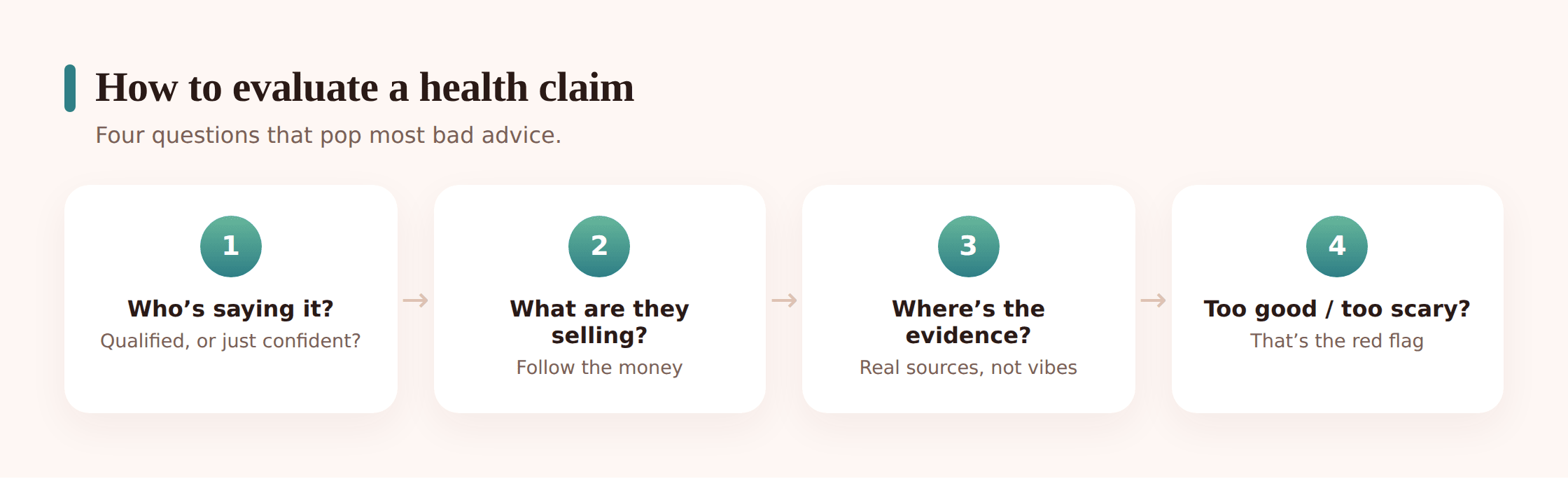
1. Who’s saying it — and are they qualified?
Is this a doctor, dietitian, or recognised health body, or a creator with a ring light and a big following? Ask out loud: what actually makes this person an authority on the human body? Popularity isn’t a qualification.
2. What are they selling?
Follow the money. Is there a product, a discount code, a paid program, a brand partnership? Someone who profits from you believing them isn’t a neutral source. That doesn’t make them automatically wrong — but it changes how hard you check.
3. Where’s the evidence?
“Trust me,” “it worked for me,” and “do your own research” are not evidence. Real claims can point to studies, professional guidance, or bodies like a national health service. A single before-and-after photo proves nothing.
4. Does it sound too good — or too scary?
Miracle cures and terrifying warnings are both engineered to grab you. If a claim promises a fast, total fix, or insists everyone else is lying to you, treat that intensity as a warning light, not a selling point.
5. Check it against a real source.
Before acting on anything, look it up somewhere trustworthy or ask a professional. A GP, a pharmacist, the school nurse, or a recognised health website will settle most questions in a couple of minutes. Make “check first” the normal last step, not a special event.
You don’t have to know the medical answer yourself to model this. In fact, saying “I’m not sure — let’s look it up properly together” teaches the skill better than pretending to be an expert. The habit you’re building is the pause before belief.
Talking about it without dismissing them
The fastest way to lose this conversation is to roll your eyes at the creator your child likes. Mock the source and you make your teenager defend it, and now they’re arguing for the misinformation instead of examining it. Stay curious instead.
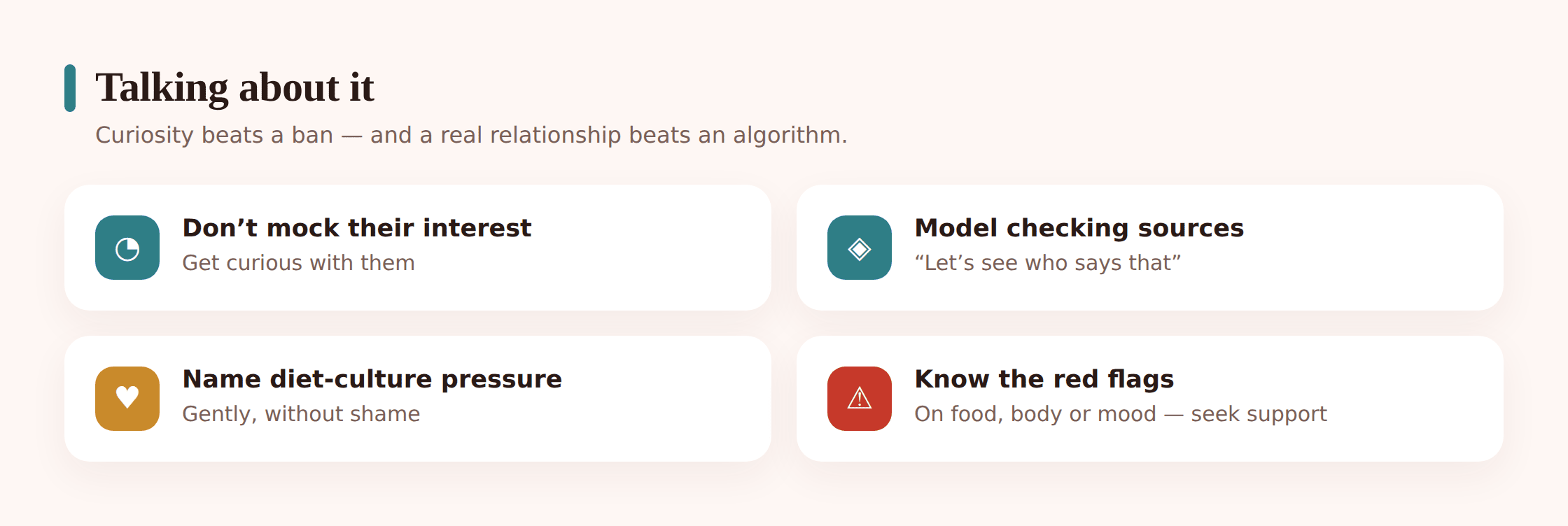
A few things that help:
- Ask what drew them in. “What do you like about her stuff?” tells you whether it’s the person, the promise, or a worry underneath. Often there’s a real concern — about skin, weight, energy, mood — hiding behind the interest, and that’s the thing worth talking about.
- Be curious, not corrective. “Huh, how would that even work?” invites them to think. “That’s rubbish” invites them to argue. You want them doing the evaluating, not you.
- Share your own near-misses. Tell them about a wellness fad you fell for, or an ad that nearly got you. It normalises being fooled and makes checking feel smart rather than paranoid.
- Separate the interest from the claim. You can be genuinely glad they care about health and still question one specific video. “Loving that you’re into this — let’s just sanity-check that one bit” keeps you on their side.
- Don’t make every chat a warning. If the only time you mention their feed is to sound the alarm, they’ll stop showing you. Sometimes just watch a clip together and enjoy it.
When food, body or mood content is a red flag
Most interest in health and food is ordinary and fine. But a heavy diet of restriction, body, and “wellness” content can both reflect and feed something more serious, so it’s worth knowing what warrants a closer look — and gentle, non-graphic here on purpose.
- Food becoming ruled by anxiety, rigid categories, or guilt rather than hunger and enjoyment.
- New secrecy or distress around meals, or around content they’re consuming about eating and bodies.
- Skipping meals, cutting out whole food groups, or exercise that feels driven and non-negotiable.
- Mood dropping, withdrawal, or self-worth that seems tied tightly to weight, food, or appearance.
- Fixating on a self-diagnosis and resisting the idea of seeing anyone qualified.
If several of these are showing up, treat it as a reason to draw closer and get support, not to panic or police. Start with a calm, non-accusing conversation, and loop in your GP, who can assess things properly and point you toward the right help. For eating-related worries specifically, the National Alliance for Eating Disorders runs a helpline staffed by clinicians who can talk through what you’re seeing and what to do next — you can find it by searching for the National Alliance for Eating Disorders helpline. You don’t need to be certain anything’s wrong to reach out; that’s exactly what these services are for.
FAQ
My teen is self-diagnosing from TikTok — what do I do?
Don’t dismiss it, and don’t confirm it either. Start with what they’re feeling: “What’s been going on that made this ring true?” There may be a real concern worth taking seriously. Then separate the worry from the diagnosis — a short video can raise a good question, but it can’t answer it. Offer to book a proper appointment so someone qualified can actually look. You’re validating the feeling while gently redirecting the diagnosing to a professional.
Are wellness influencers dangerous?
Some are, many aren’t, and the label doesn’t tell you which. The useful question isn’t “is this person bad” but “is this specific claim safe, honest, and backed by evidence — and are they selling something?” Plenty of creators share reasonable advice; others confidently spread nonsense or push products. Teaching your child to judge each claim on its merits is far more protective than banning a category of person.
How do I push back without sounding like I’m attacking their favourite creator?
Aim your questions at the claim, never at their taste. “I like a lot of what she does — I just want to check this one thing” keeps you allies. If you attack the creator, your teenager defends them, and the misinformation gets a bodyguard. Stay curious about how a claim would actually work, and let the checking do the persuading.
Is it a problem if my child takes supplements they saw online?
It can be. Some supplements are useless, some interact with medication, and “natural” doesn’t mean safe or well-regulated. Before they take anything, run it past a pharmacist or GP — both are free to ask and used to the question. And follow the money on the recommendation: if the person promoting it earns on every sale, that’s reason to check harder, not to trust more.
Should I just block this kind of content?
Blocking can lower the volume of the worst material, and family tools can help with that, but it won’t teach the skill. Your child will meet dubious health claims for the rest of their life, on feeds you don’t control. The lasting protection is a young person who instinctively asks who’s saying it, what they’re selling, and where the evidence is — so aim for the thinking, and use blocking as a support, not a substitute.
My teen wants to try an extreme diet they saw online. How do I respond?
Get curious before you get worried. Ask what they’re hoping it’ll do — the answer is usually about a feeling or a body worry you can address directly. Explain, without drama, that growing bodies need proper fuel and that cutting out whole food groups can backfire. Offer to look into it together with a GP or dietitian, who can suggest something safe if there’s a genuine goal. If the interest looks driven by distress rather than curiosity, treat that as the real issue and seek support early.