Viral Challenges & Online Trends: A Parent’s Guide
Your kid comes in laughing, phone out, mid-dance, wanting you to watch. Or you’ve seen a forwarded warning about some “deadly challenge” and your stomach dropped. Both of these are the same thing from different angles: online trends. Most are silly, creative, and completely fine. A few aren’t. Knowing the difference — and staying the kind of parent your kid actually tells things to — matters more than any ban.
What “challenges” and trends actually are
A trend is just a format lots of people copy at once. A dance to a specific song. A prank on a sibling. A “duet” where you react to someone else’s clip. A recipe everyone suddenly makes. A running joke with a punchline everyone already knows. Platforms are built to spread these — that’s the whole point of them.
Here’s the honest truth, and it’s worth saying loudly because the news rarely does: the vast majority of trends are harmless. Better than harmless, actually. They’re creative. They get shy kids performing. They connect a child in one town with kids everywhere doing the same silly thing. Learning a dance takes practice and patience. Making a good edit is a real skill. A lot of what looks like “wasting time on the phone” is your kid making something and being part of something.
So the starting posture isn’t suspicion. It’s interest. If you treat every trend as a threat, you’ll be wrong most of the time, and your kid will learn to stop showing you. Save your concern for the small slice that earns it.
Why kids join in
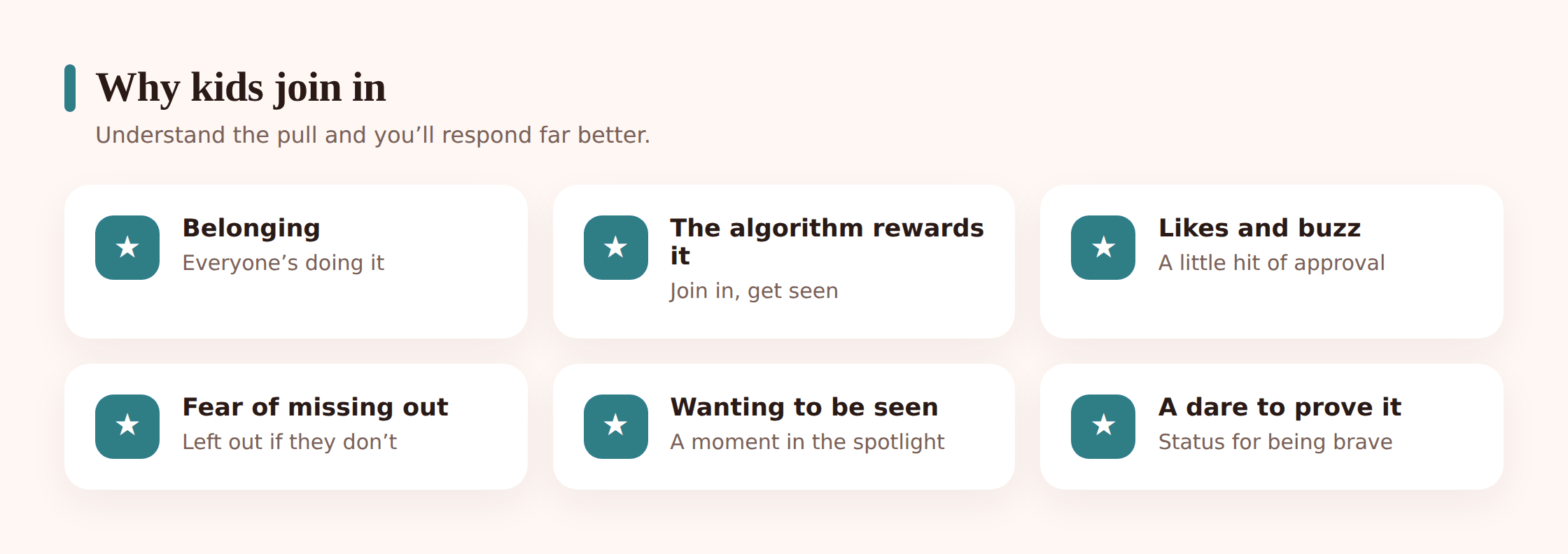
If you get why a trend is so magnetic, you’ll handle it far better. A few things are usually working at once:
- Belonging. Everyone at school is doing it. Joining in is how you’re part of the group, not the kid on the outside.
- The algorithm rewards it. Post the trending thing and you get seen. Platforms actively push participation, so kids feel a nudge to keep up.
- Likes feel good. A notification, a comment, a view count going up — each one is a little hit. That’s not a character flaw. It’s how these apps are designed to work on all of us.
- Fear of missing out. Trends move fast. Miss the window and the joke’s already over. That urgency is genuinely felt.
- Wanting to be seen. Kids are figuring out who they are. Posting is a way to try on a version of themselves and see how it lands.
- Peer pressure. Sometimes it’s soft (“everyone’s doing it”), sometimes it’s direct. Either way it’s a strong force, especially with dares.
None of this is new — it’s playground dynamics with a bigger audience and a faster clock. What’s changed is the reach and the speed. That’s exactly why the occasional risky trend deserves attention, and why understanding the pull is your best tool. If your child feels a strong reason to join in, “just don’t” won’t cut it. You need to speak to the real thing underneath.
The spectrum: harmless to harmful
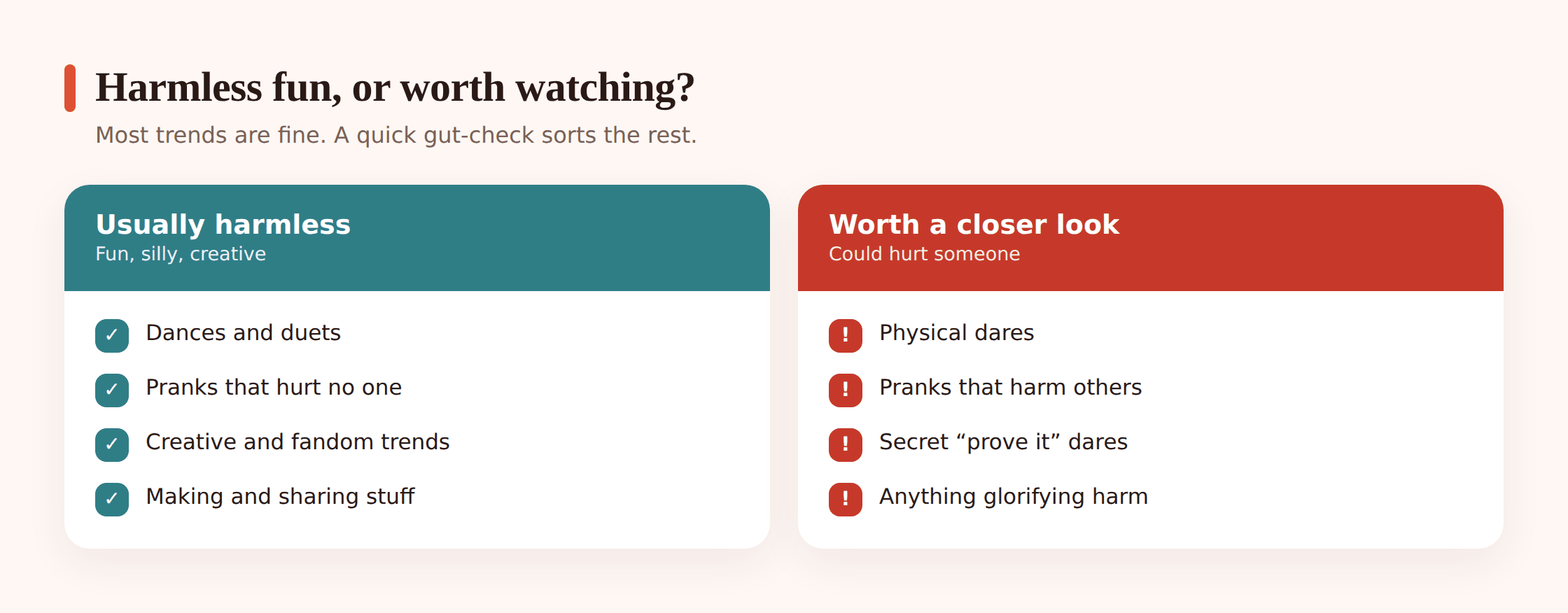
Lumping every trend together is where parents go wrong. They’re not all the same, and treating a dance like a dare makes you look out of touch. Here’s a rough map — categories, not a catalogue.
Harmless creative and dance trends. The bulk of it. Dances, lip-syncs, edits, jokes, transitions, cooking, art. Zero risk beyond a bit of screen time. Encourage these, honestly. Ask to see them.
Embarrassing-but-fine pranks. Jump-scaring a family member, a harmless setup, a “gotcha” that ends in laughs. Fine, as long as everyone’s laughing afterwards, including the person on the receiving end.
Risky-to-others pranks. This is where a line appears. A prank that scares a stranger, damages something, or embarrasses someone who didn’t agree to be filmed. The physical risk is low, but someone gets hurt — their feelings, their property, sometimes their reputation. Worth a real conversation about consent and consequences. This overlaps with what can tip into cyberbullying.
Genuinely dangerous physical dares. The small category that makes the headlines. Anything where the “challenge” is to risk your body to prove something. These are rare relative to everything else, but they’re real, and they’re the ones to take seriously. I won’t describe any here — describing them spreads them — but you’ll recognise the pattern: it’s a dare, it could hurt someone, and doing it is the whole point.
Hoaxes and moral-panic scares. Here’s one that catches parents more than kids. Every so often a warning goes viral — “there’s a deadly new challenge telling children to do X.” A lot of these are exaggerated, recycled from years ago, or outright fake. They spread through parent groups and local news precisely because they’re scary. Before you forward one, check it. A calm, fact-checking parent is worth more than a dozen panicked shares. Forwarding an unverified scare doesn’t protect anyone; it just teaches kids that adults panic about things they don’t understand.
Be the parent who verifies. When a scary warning lands in your inbox, pause before sharing. Search the exact wording. Check whether a reputable source confirms it or debunks it. Many “deadly challenge” alerts turn out to be hoaxes — and the panic itself can introduce a dangerous idea to kids who’d never heard of it. Calm and checked beats fast and wrong.
Trends that normalise self-harm or disordered behaviour. This is the most sensitive category, and I’ll keep it brief and careful. Some content and trends can make self-harm, disordered eating, or other harmful behaviour seem normal or even aspirational. There’s no how-to here and there won’t be. What matters is that this is not a discipline problem — it’s a wellbeing one. If you ever see signs pointing this way, the response isn’t a ban, it’s connection and support. More on that below, and in our piece on phones and teen mental health.
How to spot a risky one
You don’t need to memorise a list of bad trends. Lists go out of date in a week. You need a gut-check that works on anything, including trends that don’t exist yet. Run a trend through these questions:
- Could someone actually get hurt? Physically, or their feelings, their stuff, their name. If yes, it’s worth a conversation.
- Is it secret? Harmless fun gets shown off. If a kid is hiding a “challenge” from adults, that secrecy is the signal, not the specifics.
- Does it pressure others? “Do it or you’re a coward.” “Tag three friends who have to do it next.” Coercion baked into the format is a red flag.
- Does it involve strangers? A dare that requires contact with people your child doesn’t know changes the risk entirely.
- Is the point to prove something? Fun trends are their own reward. Dares where you have to prove you’re brave, or tough, or not scared — that framing is where kids get pushed past their own judgement.
Most trends fail every one of these and are completely fine. The rare one that ticks two or three is the one to talk through — calmly, specifically, without turning it into a lecture about the entire internet.
How to respond without killing the fun
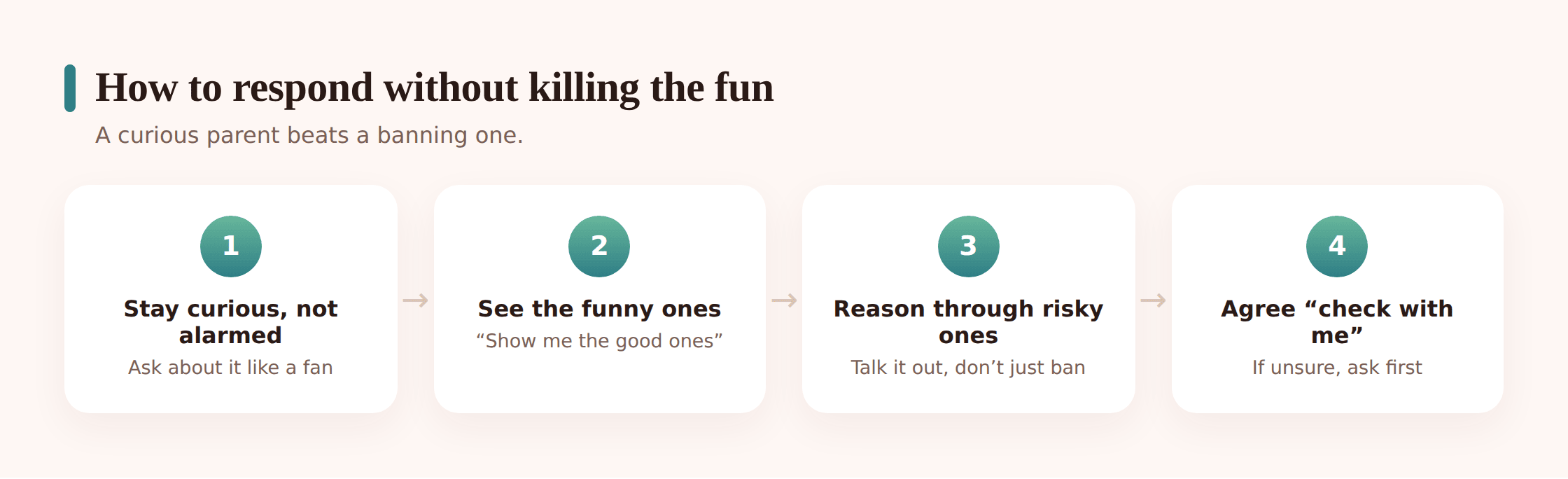
The instinct when you hear “viral challenge” is to clamp down. Resist it. Blanket bans are the fastest way to lose your view into your kid’s world. Here’s what works better.
- Stay curious, not alarmed. “Show me the funny one everyone’s doing” opens a door. “Give me that phone” slams it. Interest keeps you in the loop; alarm pushes them underground.
- Ask to see the good stuff regularly. If watching their trends is a normal, low-stakes part of your week, you’ll notice the odd worrying one naturally — and they won’t feel surveilled.
- Don’t ban blindly. Banning a specific app or trend without explaining why usually backfires. They find another way, and they learn not to tell you. Reserve hard nos for genuine danger, and explain them.
- Talk the risky ones through with real reasons. Not “because I said so.” Walk through the gut-check with them. “Who could get hurt here? What happens if it goes wrong?” You’re teaching judgement they can use when you’re not there.
- Agree a check-in rule. “If a trend feels off, or someone dares you, or you’re not sure — just ask me first. You won’t be in trouble for asking.” Make asking safe, and they’ll actually do it.
- Be the calm one about scares. Model the fact-checking yourself. When you get a viral warning, say out loud, “Let’s check if this is even real before we worry.” That’s a lesson in itself.
The through-line: you want to be the parent your kid comes to, not the one they hide from. Every over-reaction spends a little of that trust. Every calm, interested conversation builds it. For more on the how of these conversations, see our guide on talking to kids about online safety.
Staying aware without hovering
Staying aware doesn’t mean reading every message or watching every video. It means keeping enough of a pulse that nothing big blindsides you. A few practical ways:
- Follow what’s trending. You don’t have to do the dances. Just know roughly what’s going around. It makes conversations easy and shows you’re paying attention to their world, not just policing it.
- Watch together sometimes. Scrolling side by side for ten minutes tells you more than any report. You’ll see what they find funny and what they skip past.
- Use alerts as a backstop, not a spycam. On an Android child phone, FreePhoneSpy’s keyword alerts can flag genuinely worrying terms in the alerts feed, so a concerning pattern doesn’t slip by unnoticed. It’s a light safety net for the rare serious thing, not a substitute for talking. And it’s Android only — for an iPhone, use Apple’s own Screen Time and Family Sharing tools.
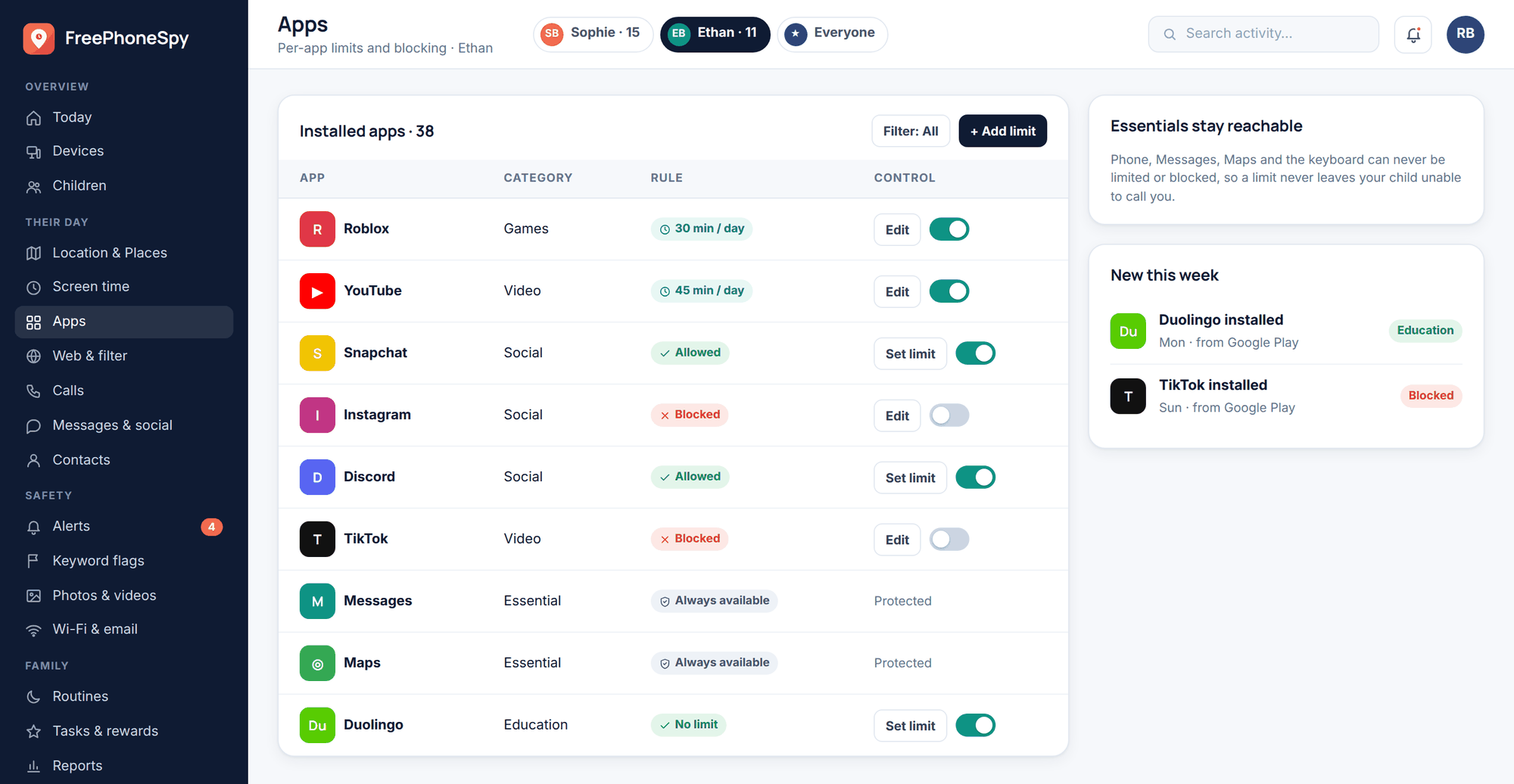
- Keep some rhythm around screens. Shared app and screen-time limits help keep phones from swallowing every evening, which matters more for balance than for any single trend.
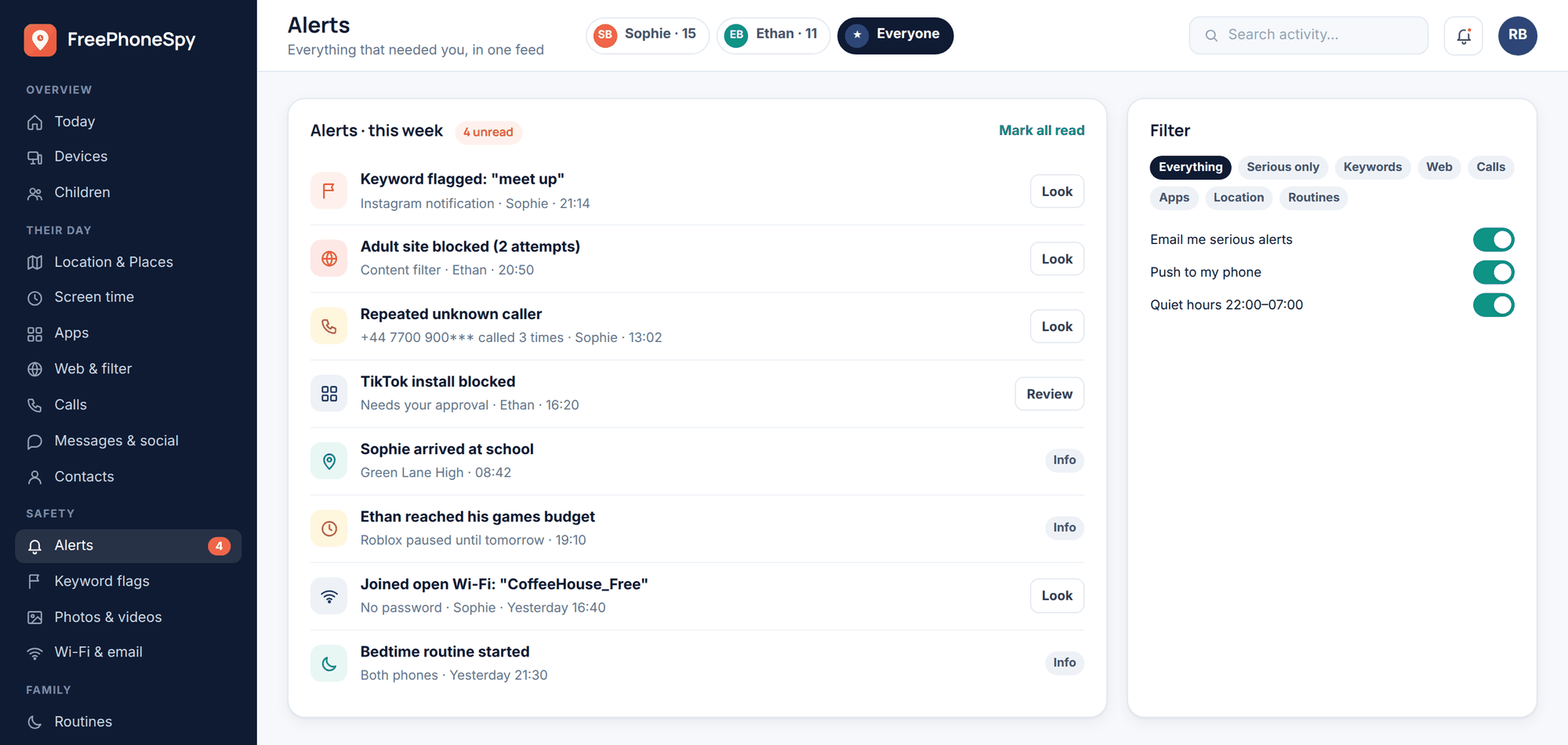
Be honest with yourself about the ratio here. Ninety-something percent of your awareness should come from conversation and watching together. The alerts are for the small remainder — the thing that would otherwise go unseen until it was a problem. If you find yourself reaching for the dashboard instead of asking your kid, that’s a sign to close the laptop and go talk to them.
Worth reading alongside this: whether TikTok is safe for kids and our broader take on social media safety. Both go deeper on the platforms where most trends live.
When a trend crosses into danger
Rarely, a trend isn’t a discipline question at all — it’s a wellbeing one. If you see signs that your child is drawn to content or challenges that normalise self-harm, disordered eating, or hurting themselves, treat it with the seriousness you’d give any health concern, and skip the anger entirely.
What that looks like in practice, briefly and without detail:
- Take it seriously and stay calm. Your steadiness makes it safe for them to be honest. Panic or punishment shuts the door.
- Talk, and mostly listen. You don’t need the perfect words. “I’ve noticed something and I love you and I want to understand” is plenty to start.
- Get professional support. A GP, a school counsellor, or a dedicated helpline can help in ways a parent can’t. Reaching out isn’t an overreaction — it’s the right move.
You are not expected to handle this alone, and you shouldn’t try to. The job at home is connection and getting the right help involved. Our guide on phones and teen mental health has more on spotting signs and where to turn.
Questions parents ask
- Should I just ban the apps where challenges spread?
Usually no. Blanket bans tend to backfire — kids find workarounds and stop telling you things. Reserve hard limits for genuine danger, explain your reasoning, and lean on conversation for everything else. Staying informed beats staying in charge. - How do I know if a scary warning I’ve been sent is real?
Check before you share. Search the exact wording, look for a reputable source confirming or debunking it, and be wary of anything with no date or origin. Many viral “deadly challenge” alerts are hoaxes or years out of date, and the panic can do more harm than the supposed trend. - My kid loves doing trends. Should I worry?
Almost certainly not. Doing trends is creative and social, and most are completely harmless. Stay interested, ask to see them, and you’ll spot the rare risky one naturally. Enthusiasm for trends is not a warning sign. - What’s the single most useful thing I can do?
Be the parent they come to. A kid who’ll say “is this one okay?” is far safer than one being watched in silence. Everything else — limits, alerts, rules — supports that; it doesn’t replace it. - Does FreePhoneSpy block dangerous challenges?
No tool can reliably do that, and any that claims to is overselling. On Android, keyword alerts can flag worrying terms so you notice sooner, and screen-time limits help with balance. The actual protection is you knowing what’s trending and talking about it. For iPhone, Apple’s built-in tools cover the basics. - How do I bring up a risky trend without lecturing?
Ask, don’t tell. Run the gut-check together: could anyone get hurt, is it secret, is it pressuring people? Let them reach the conclusion. You’re building judgement they’ll carry when you’re not around, which lasts longer than any rule.