You Found Something Worrying on Your Child’s Phone: What to Do

Your stomach drops. You’ve seen something on your child’s phone that you can’t unsee — a message, an image, an app, a name you don’t recognise — and your first instinct is to do something right now. Before you do, know this: the next ten minutes matter less than the next ten days. How you react in this moment shapes whether your child keeps letting you close or learns to hide better. This is a guide for exactly that moment: how to steady yourself, work out how serious it really is, and open a conversation your child will actually stay in.
- First, pause — don’t act on the adrenaline
- The awkward part: how you found it
- Assess how serious it really is
- Decide: talk now, watch, or get help
- How to have the conversation
- Handling specific worries
- When to bring in outside help
- Protecting the relationship afterwards
- A quick checklist
- Questions parents ask
First, pause — don’t act on the adrenaline
Right now your body is doing something ancient and unhelpful. Fear and anger have flooded in, your heart’s going, and there’s a powerful urge to march down the hall and sort this out. Resist it. Almost nothing you found gets worse in the next hour, and almost everything gets worse if you act while you’re this activated.
There’s a simple reason to wait, and it isn’t about you managing your temper for its own sake. It’s strategic. A child confronted by a furious parent does one thing reliably well: they shut down. They deny, they minimise, they delete, and they file away a lesson — telling Mum or Dad anything leads to an explosion. If your goal is to keep a line open so you can actually protect them, the angry version of you is working against that goal, however justified the anger feels.
So the first job is you. Put the phone down. Go somewhere your child isn’t. Breathe until the shaking eases. If your partner or a trusted friend is around, say the thing out loud to one steady adult — not to build a case, but to let some of the pressure out so you don’t discharge it onto a twelve-year-old. Give yourself permission to sit with it for an evening if you need to. The clock is only truly ticking in a narrow set of situations, and we’ll cover those.
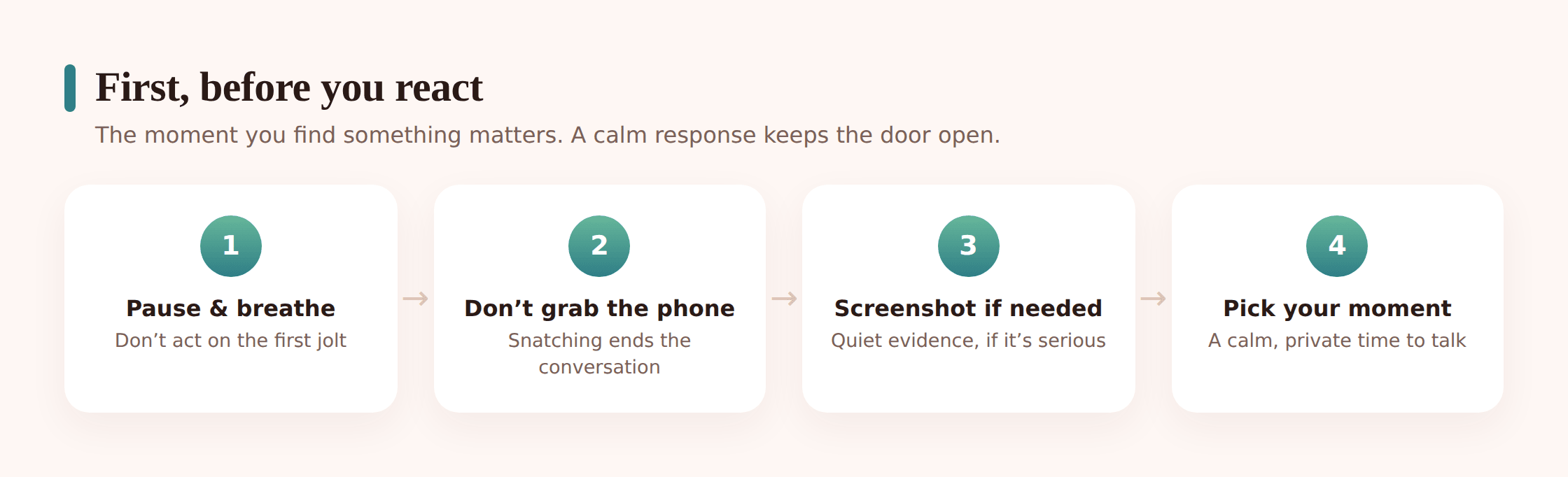
Step 1 — Stop and put the device down
Don’t keep scrolling to build a fuller picture while your heart’s racing. You’ve seen enough to know there’s something to look at properly. Reading more in this state just deepens the panic and tempts you into a confrontation you’re not ready for.
Step 2 — Physically leave the situation
Walk to another room. Distance from the phone is distance from the urge to storm in. If your child is home and might notice you’re rattled, a neutral “I’m just making a cup of tea” buys you the space you need.
Step 3 — Name what you’re feeling
Say it to yourself plainly: “I’m frightened,” or “I’m furious,” or “I feel sick.” Naming the feeling turns the volume down a notch and reminds you that the feeling isn’t a plan. It’s just weather passing through.
Step 4 — Decide nothing yet
Resist making any decision — no confiscating, no confronting, no messaging the other child’s parents — until the adrenaline has drained and you can think in full sentences. Sleep on it if it’s late. Clear heads make better first moves.
The awkward part: how you found it
There’s a question sitting underneath all of this that’s easy to skip past, and it matters: how did you come to see this? Because how you found something shapes how you can honestly raise it.
Broadly there are two situations. In the first, your family already has some open, agreed awareness of what happens on the phone — a shared understanding, maybe a family phone agreement, maybe monitoring your child knows about. In that case, you’re on solid ground. You can say plainly, “I saw this, and I want to talk about it,” because seeing was part of the deal, not a betrayal of it.
In the second, you snooped. You picked up an unlocked phone, or read over a shoulder, or went looking because a feeling told you to. And now you’ve found something real, but you found it in a way you’d struggle to defend if your child asked, “Why were you even in my phone?” That’s an uncomfortable place to be, and it deserves honesty rather than a cover story.
If you did snoop, own it. That doesn’t mean grovelling, and it absolutely doesn’t mean the worrying thing doesn’t matter. It means when you raise it, you don’t pretend you found it by magic. “I looked at your phone. I know that’s not something we’d agreed, and we should talk about that too. But I saw something that scared me, and it matters more than how I found it.” Leading with a small honesty of your own makes it far more likely your child meets you with theirs. Kids have a fine-tuned radar for hypocrisy, and “how dare you keep secrets” lands badly coming from someone who just went through a phone in secret.
Assess how serious it really is
Once you’re calm, the real work begins, and it’s a work of judgement, not reflex. Not everything that alarms a parent is actually dangerous, and treating a normal-but-cringey thing like an emergency does real damage. So before you decide what to do, decide honestly what you’re looking at.
A few questions help you place what you found:
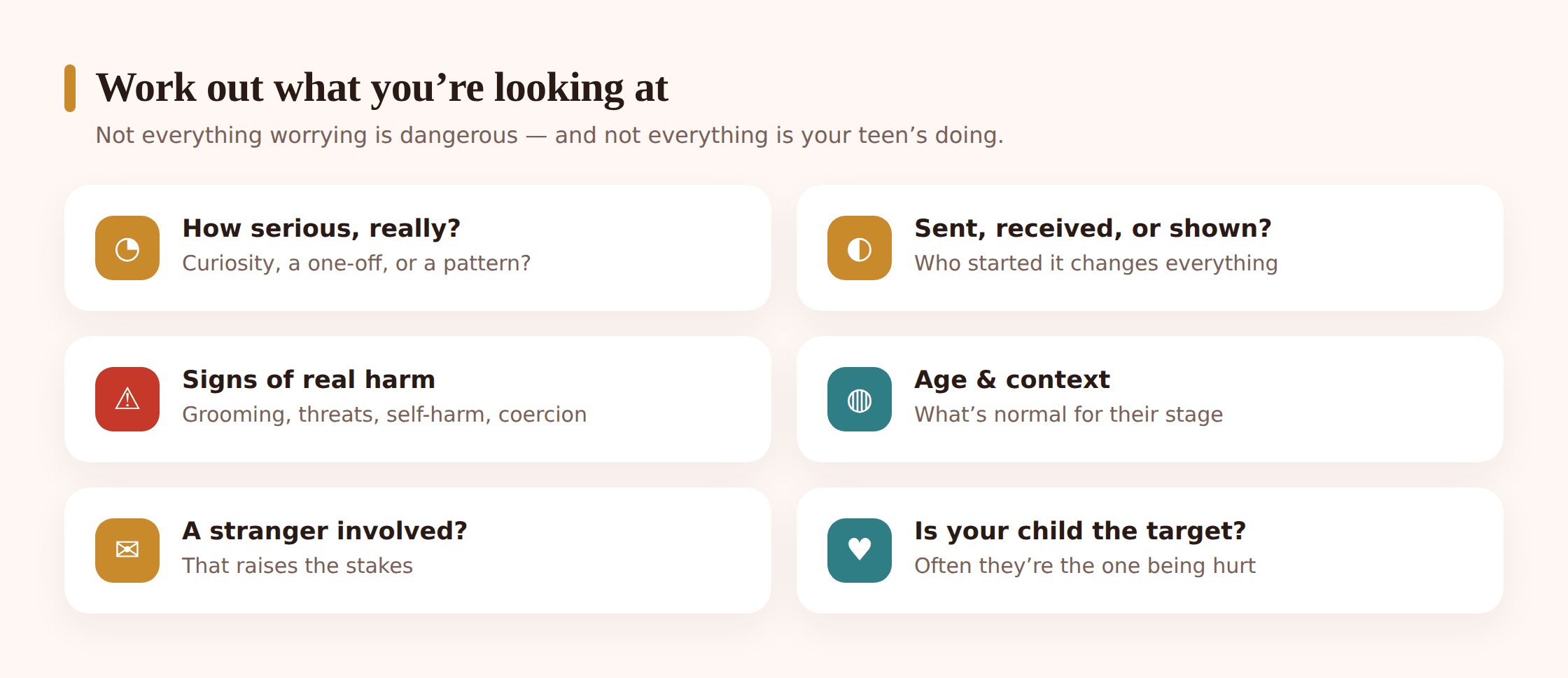
Is it a one-off, a phase, or a pattern? A single rude meme forwarded in a group chat is not the same as a running conversation over weeks. One curious search is different from a browsing history full of the same worrying theme. Look for whether this is a moment or a direction.
Is it developmentally normal, just earlier than you’d like? Curiosity about bodies, swearing, testing edgy humour, wanting to seem older — a lot of what horrifies parents is ordinary growing up colliding with a device that has no sense of timing. Uncomfortable isn’t the same as unsafe.
Who is on the other side? A message from a school friend sits in a completely different category from contact with an adult stranger or someone pretending to be a peer. If there’s any adult or unknown party involved, the seriousness jumps, and our guide on a stranger messaged my child covers that specific situation in depth.
Is anyone being hurt — including your own child? Signs of bullying, whether your child is the target or the one doing it, sit high on the scale. So does anything involving self-harm, and anything that looks coercive, predatory, or illegal.
It helps to sort what you found into rough tiers, because the tier decides the response.
- Watch and note. Cringey, immature, or a bit rude, but not dangerous — edgy jokes, mild swearing, ordinary friend drama. Worth keeping half an eye on, not worth a crisis meeting.
- Talk soon, calmly. Something that needs addressing but isn’t an emergency — an app they’re too young for, risky oversharing, a nasty exchange with a friend, first brushes with content they’re not ready for.
- Talk now, and act. Real safety risk — contact with a stranger or adult, bullying that’s escalating, drugs or vaping being arranged, sending or receiving images, or signs your child is in genuine distress.
- Get help immediately. Anything predatory, illegal, or involving self-harm or suicide. Here you don’t handle it alone — you loop in the right services, which we cover below.
If you’re not sure whether a pattern is even there, our piece on signs your child’s phone needs a closer look can help you read the wider picture rather than one alarming snapshot.
Decide: talk now, watch, or get help
With the tier roughly settled, you’re choosing between three broad paths, and often a blend of them.
Watch quietly. For the lowest tier, sometimes the wisest move is to do very little visibly. Keep a gentle eye on it, stay warm and available, and let a passing phase pass. Not every worry needs to become a conversation your child dreads. Over-reacting to small things teaches a child that everything you see becomes a big deal, which is a fast route to them locking you out.
Raise it calmly. For most of the middle tier, a caring, unhurried conversation is the whole intervention. You bring it up, you listen, you and your child figure out something together, and it quietly gets better. This is where the bulk of parenting happens, and it’s covered in the next section.
Bring in help. For the top tiers — predatory contact, illegal material, escalating bullying, self-harm — you’re not the only person who should be handling this. School, your GP, specialist services, and in some cases the police or a reporting body have a role. Reaching for help isn’t failure; it’s what a good parent does when something is bigger than a bedroom chat.
How to have the conversation
This is the part everything else was clearing space for. Get the conversation right and most worries become manageable. Get it wrong and you can turn a solvable problem into a closed door.
Lead with care, not accusation
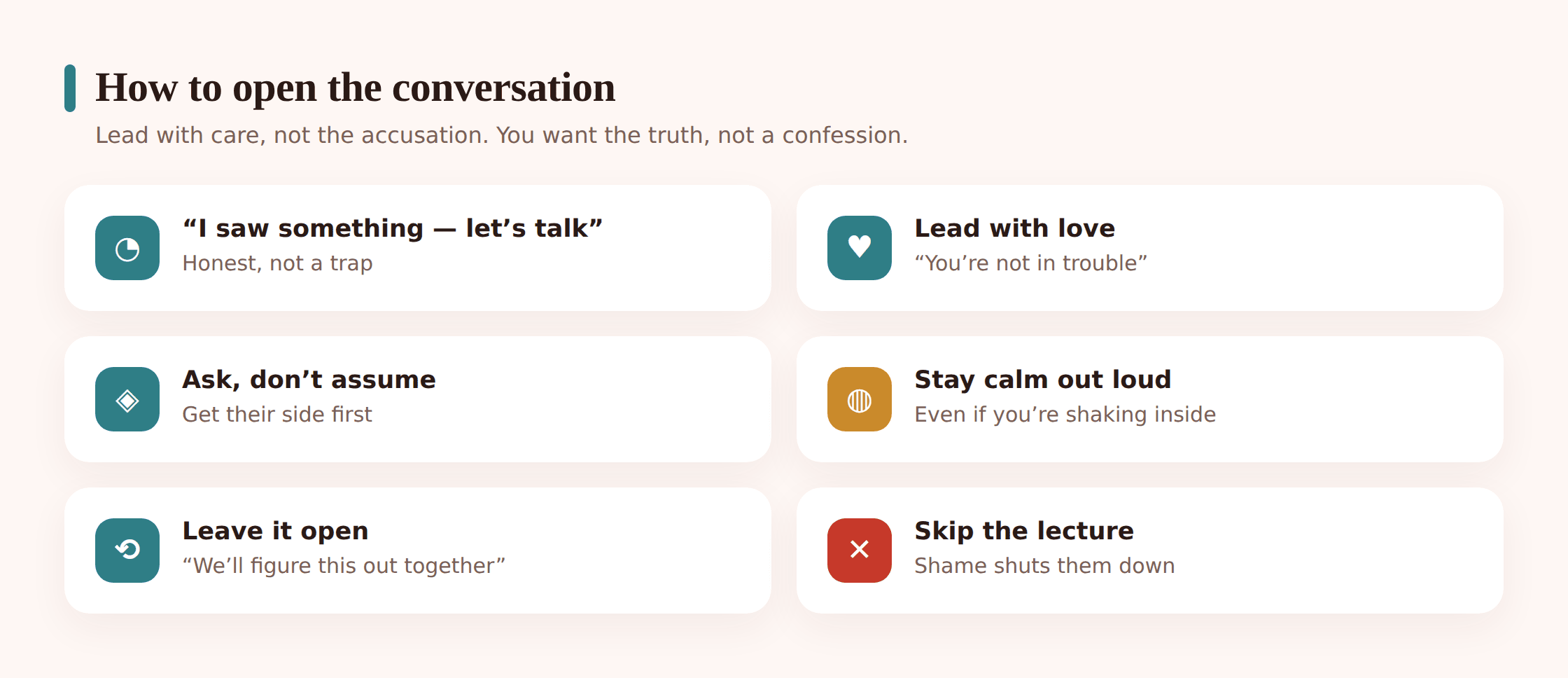
Open with the feeling underneath the worry, which is almost always love and fear, not anger. “I saw something that worried me, and I care about you too much not to talk about it” lands completely differently from “What is this?” thrust at them on a screen. The first invites a conversation. The second starts an interrogation, and children clam up in interrogations.
Pick the moment and the setting
Face-to-face across a table can feel like a tribunal. Many kids open up far more when there’s no eye contact to manage — in the car, on a walk, drying up after dinner. Choose a time that isn’t rushed and isn’t right before school or bed. And choose privacy; nothing shuts a teenager down like being confronted in front of a sibling.
Listen first, and actually mean it
Ask, then stop talking. “Can you tell me what’s going on with this?” and then genuine silence. Let them fill it. What looked damning from the outside sometimes has a context you couldn’t see — a joke, a dare gone wrong, a friend who sent it unasked, a situation they were already frightened by and didn’t know how to escape. You can’t discover any of that if you’re delivering a verdict. Listening isn’t weakness or letting them off. It’s how you find out what actually happened.
Don’t confiscate the phone as a reflex
The urge to grab the phone is strong and almost always counterproductive. To a child, the phone is their whole social world, and snatching it reads as pure punishment. Worse, it teaches the exact lesson you don’t want: that opening up to you costs them everything, so next time they’ll hide it. There are situations where changing phone access is the right call — but as a considered step you explain, not a reflex you reach for in the heat of the moment. If the worry is genuinely about safety, framing any change as protection rather than punishment matters: “Let’s keep this account paused while we sort it out,” not “That’s it, it’s gone.”
Keep the door open at the end
However the conversation goes, close it with the same message: you’re glad they talked to you, you’re not going anywhere, and they can always come to you, even about the hard stuff, even if they messed up. That single sentence — “You can always tell me, and I’ll help, not hit the roof” — is worth more than any rule you set that evening. For the wider skill of these conversations, our guide on talking about online safety goes further.
Handling specific worries
The general approach holds, but a few discoveries deserve a specific note.
Contact with a stranger. Treat any contact from an unknown adult, or a “peer” you can’t verify, as serious. Don’t let your child keep engaging, preserve rather than delete the messages, and read our dedicated guide on a stranger messaged my child before you act. If anything looks predatory, see the help section below.
Bullying — either direction. If your child is being bullied, they may be more ashamed than you’d expect, so lead very gently. If your child is the one bullying, resist the shame spiral; a calm, firm conversation about the harm done, plus repair, teaches more than punishment. Either way the school usually needs to know.
Drugs, vaping, or risky behaviour. Curiosity and bravado drive a lot of this. Aim for honest information and a genuinely open line over scare tactics, which tend to end the conversation rather than change the behaviour.
Self-harm or suicide-related content. This one you handle protectively and you do not handle alone. Stay warm and non-judgemental, tell them you’re glad you know, and don’t react with panic or anger — both make a struggling child hide. Then bring in professional support: your GP, child and adolescent mental health services, or a helpline can guide you and your child. If you believe your child is in immediate danger, treat it as the emergency it is and seek urgent medical help. You don’t need to have the perfect words. You need to stay close and get the right people involved.
When to bring in outside help
Some things genuinely need more than a parent. Knowing who to turn to takes the weight off.
- School. For bullying, friendship breakdowns playing out online, or worries involving other pupils, the school can act in ways you can’t and often already knows the children involved.
- Your GP or child mental-health services. For anything involving self-harm, persistent low mood, disordered eating, or distress that isn’t lifting. A GP is a good first door and can refer onward.
- A helpline. For advice in the moment — for you or your child — a reputable child-welfare or mental-health helpline can talk you through what to do next without you needing to know the answer first.
- Platform reporting tools. Harmful content, harassment, and fake or predatory accounts can and should be reported in-app. It’s quick and it works more often than people expect.
- Police and specialist reporting bodies. For anything predatory, sexual, or illegal involving a child — grooming, sextortion, indecent images — report it. In the UK that’s the police and CEOP; in the US, the NCMEC CyberTipline. Preserve evidence rather than deleting it, and don’t try to investigate an adult offender yourself.
Protecting the relationship afterwards
Whatever you found, the relationship is the thing you’re really protecting — because the relationship is what keeps working long after any single worry has passed. A child who trusts that coming to you is safe will come to you next time, and there will be a next time. That trust is your single best safety feature, better than any filter or setting.
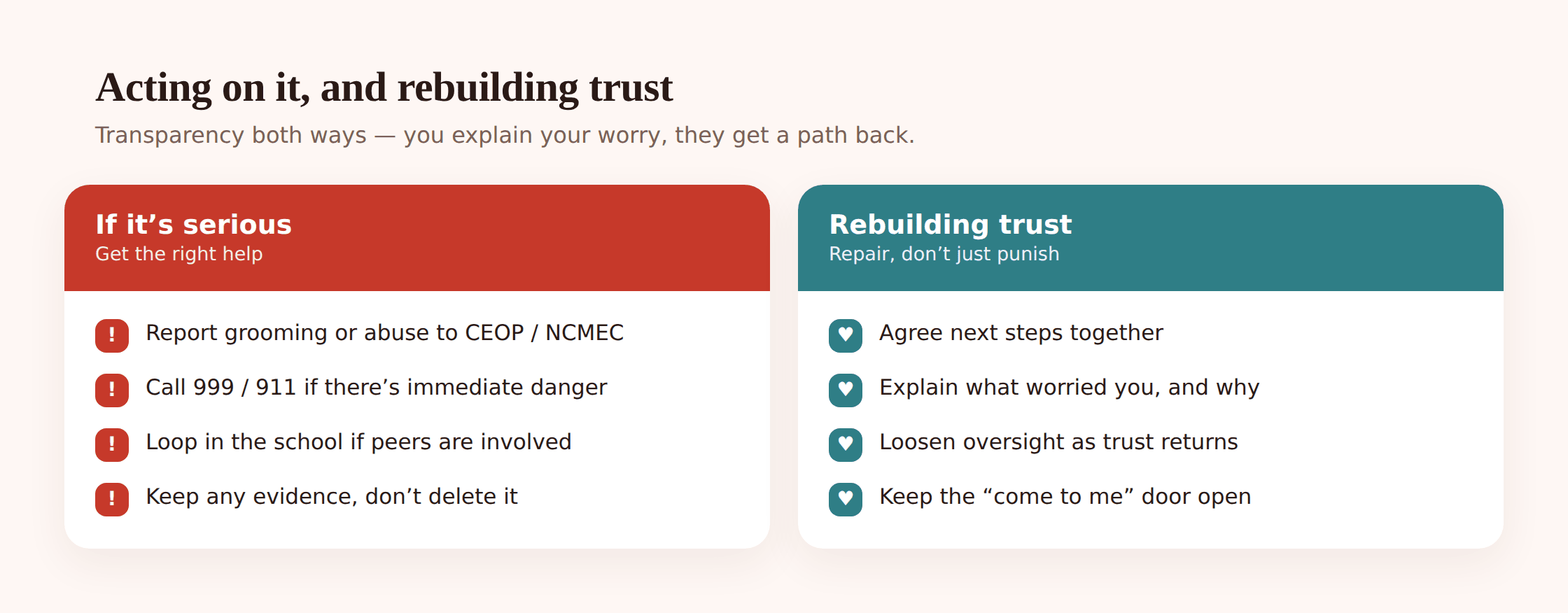
In the days after, resist two temptations. Don’t keep bringing it up — one good conversation, warmly closed, does more than a week of returning to it, which just tells your child the subject will haunt them. And don’t let the discovery quietly curdle into constant suspicion. If you now watch everything with narrowed eyes, they’ll feel it, and they’ll respond by getting better at hiding, not by being safer.
If this whole episode has left you wanting more visibility, let it push you toward the open kind. Talk to your child about awareness they know about — an agreement, shared expectations, monitoring that isn’t a secret — rather than sharpening your snooping. The difference isn’t just ethical. Discoveries that arrive through an arrangement your child already accepted come with a conversation attached and no betrayal to explain. Discoveries that arrive through the back door start every conversation from a hole you dug yourself.
Above all, let your child see that they told you a hard thing, or you found a hard thing, and the world didn’t end. You stayed. You helped. You were still on their side in the morning. That’s the memory that makes them pick up the phone and call you when the next thing happens — which is exactly where you want to be.
A quick checklist
- Pause before you act — put the phone down and leave the room until the adrenaline drains.
- Be honest with yourself about how you found it; if you snooped, plan to own it.
- Place it on the scale — one-off or pattern, cringey or genuinely unsafe, who’s on the other side.
- Pick your path: watch quietly, talk calmly, or bring in help.
- Open with care, not accusation, and choose a private, unhurried moment.
- Listen first and mean it — the context often changes the picture.
- Don’t confiscate the phone as a reflex; any change should be explained, not sprung.
- Get outside help for self-harm, mental health, and anything predatory or illegal.
- Close every conversation with “you can always come to me.”
Questions parents ask
Should I confront them right away?
Almost never in the first heat of it. Confrontation while you’re flooded with fear or anger tends to produce denial and a slammed door, not honesty. The exception is genuine, immediate danger — active contact with a predator, or a real risk of self-harm — where you stay close and act now while still keeping your voice calm. For everything else, a short pause makes your first conversation far more useful.
Do I admit I looked through their phone?
Yes, if that’s how you found it. Trying to hide how you know usually unravels, and your child’s sense that you were sneaky can eclipse the actual worry. Owning it — “I looked, I know that’s not what we’d agreed, and we should talk about that too, but this scared me” — models the honesty you want from them and keeps the focus on the thing that matters. It also nudges you toward setting up open awareness in future so you’re not back here again.
Should I take the phone away?
Not as a reflex. Grabbing the phone reads as pure punishment and teaches your child that talking to you costs them their whole social world, so next time they’ll hide. There are cases where changing phone or account access is the right protective step — but as something you explain and frame as safety, not as a snatch in the heat of the moment. Lead with the conversation; adjust access second, if at all.
What if they lie or get angry when I bring it up?
Expect some of that and don’t take the bait. Anger and denial are often fear wearing a costume. Stay calm, stay warm, and don’t escalate to match them. You can say, “I’m not angry and I’m not going anywhere — I just want to understand.” Sometimes the real conversation happens hours or days later, once they’ve seen you didn’t explode. Leaving the door open beats winning the first round.
How do I know if this needs a professional and not just me?
Reach for help when it involves self-harm or suicide, an adult stranger or anything predatory, illegal material, or distress that isn’t lifting with your support. Those aren’t situations to carry alone, and getting the right people in early is the strong move, not a sign you’ve failed. Your GP, the school, and a reputable helpline can all help you figure out the next step when you’re unsure.
I overreacted before I read this. Can I undo it?
Usually, yes. Children are forgiving when a parent comes back and repairs. “I reacted badly earlier, I was scared, and I’m sorry — can we start that again?” is one of the most trust-building sentences a parent can say. It shows your child that people can lose it and still come back, own it, and make things right — which is exactly the resilience you want them to have too.