Anonymous Messaging Apps (NGL, Sendit & More): What Parents Should Know
Your teen posts a sticker on their Instagram story — “send me anonymous messages” — and within an hour a stranger’s app has pulled a hundred replies out of their friend group. Some are sweet. Some are cruel. And a few come with a nagging little upsell: pay to find out who said it. This is the world of anonymous messaging apps, and it’s worth understanding before your child gets a message that lands hard.
What these apps are, and why teens love them
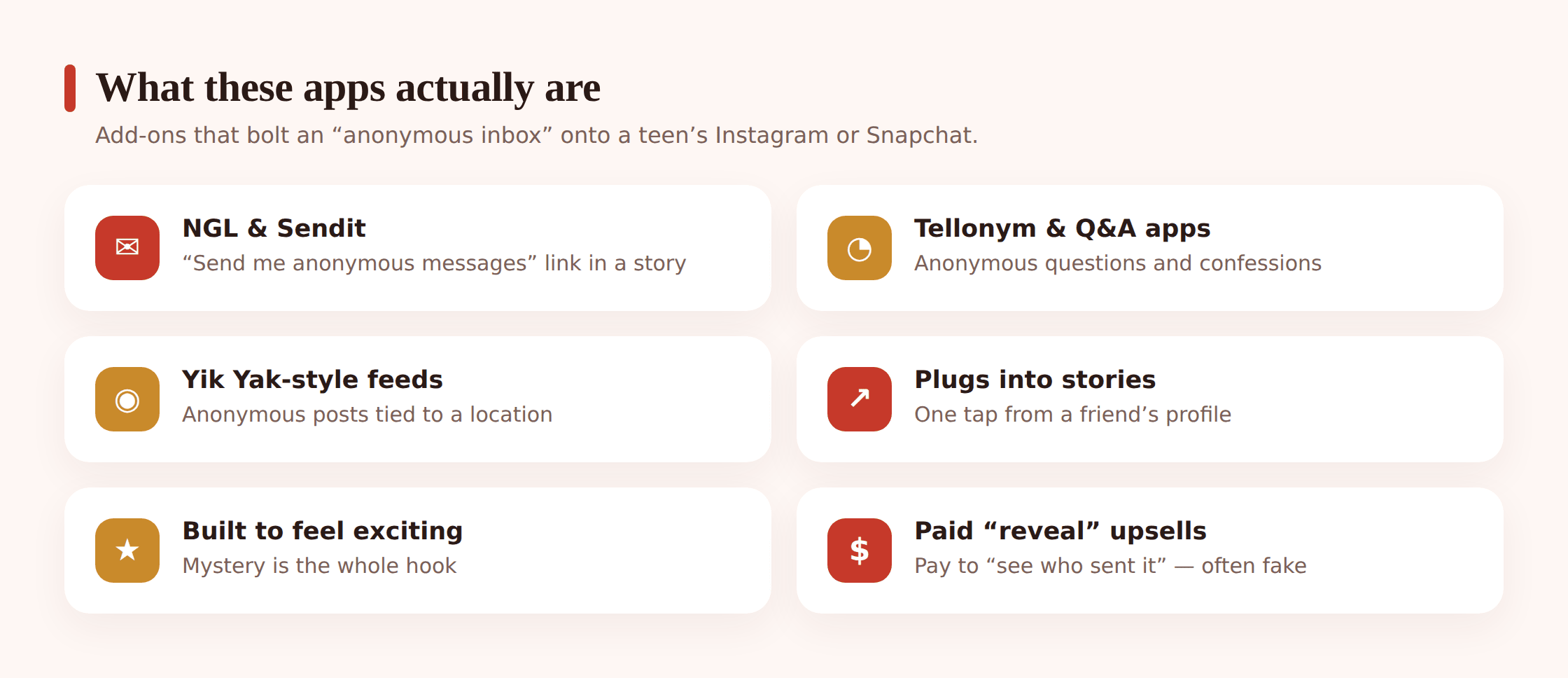
Anonymous messaging apps are a small, sticky category with a simple hook: they let people send you messages without saying who they are. The best-known right now are NGL (the name literally stands for “not gonna lie”) and Sendit, both of which bolt onto Instagram and Snapchat. There’s also Tellonym, an anonymous question-and-answer app that’s been around longer, and Yik Yak, which is location-based — it shows you anonymous posts from people physically near you, which on a school campus means near you.
The mechanics are almost always the same. Your teen adds a prompt to their story — “ask me anything”, “send me a confession”, “rate my new haircut, be honest” — with a link. Friends tap the link, type something, hit send, and it arrives in your teen’s inbox stripped of a name. Then your teen can screenshot the good ones and repost them, which advertises the whole thing to the next wave of friends. That loop is the engine. It’s designed to spread.
So why do teens love them? Partly it’s the same reason anyone likes a compliment they didn’t fish for too obviously. An anonymous “you’re honestly so funny in class” feels more real than a public comment, because the sender had nothing to gain by saying it. Partly it’s curiosity — who’s thinking about me, and what do they actually think? At an age where social standing feels like everything, a stream of unfiltered opinions is magnetic. And partly it’s just fun and a bit chaotic, the digital version of passing notes with the names torn off.
None of that is sinister on its own. A lot of the traffic through these apps genuinely is teenagers being nice to each other, or being silly. The trouble is what happens in the same inbox, from the same anonymous slot, when someone decides to be cruel.
How the “anonymous” part actually works
Here’s the thing most teens don’t realise, and most parents assume the opposite of: the anonymity these apps sell is often thinner than it looks — and in a different sense, more permanent than it looks. Both facts matter.
“Anonymous” to your teen, not to the app
When a friend sends your teen a message through NGL or Sendit, your teen genuinely can’t see who it was from the inbox. But the app usually can. These services run on servers that log a great deal — the device that sent each message, timestamps, sometimes location, the account it was linked to. “Anonymous” here means “the recipient doesn’t see a name”, not “no record exists anywhere”. A few of these apps have faced regulator attention precisely because of the gap between what they promised users and what they were quietly collecting and doing with it.
That has two edges. It means a genuinely dangerous message — a real threat — isn’t as untraceable as a scared teen might fear, because platforms can and sometimes do cooperate with schools or police in serious cases. But it also means the “anonymous” label is partly a marketing illusion. Your teen’s data, and their friends’ data, is being harvested by a company whose whole business model is that stream of curious taps.
Anonymous to send, permanent once received
The other trick of the mind is that “anonymous” makes the message feel weightless, like it doesn’t count. It counts. A screenshot is a screenshot. An anonymous message calling a girl a slur can be reposted, spread round a year group, and shown to her for months — the sender’s namelessness doesn’t make the words evaporate. If anything it does the opposite: because no one owns the comment, no one has to answer for it, and there’s no obvious person to hold accountable or apologise. The cruelty just floats there, un-ownable.
The pitch to teens is “say what you really think, no consequences”. The reality is the sender is often traceable to the company, and the target has to live with words that nobody will admit to. Both halves of that are worth explaining to your child before they get burned.
The paid “reveal” trap
Now for the part that turns a free bit of fun into a small money machine. Several of these apps dangle the one thing every recipient of an anonymous message wants: the sender’s identity. Get an intriguing message? Tap here to find out who sent it. Then comes the catch — a subscription, a one-off fee, “upgrade to reveal”.
And here’s the ugly bit. In a number of cases the “hint” you pay for turns out to be worthless — a vague clue, a rough location, a first letter, or nothing solid at all. People have paid to unmask an anonymous message and received, essentially, a shrug dressed up as a reveal. The app has monetised the anxiety it manufactured. A teenager who’s just been told “you’re ugly and everyone knows it” by an unnamed classmate is in exactly the emotional state to hand over money for the promise of a name — which is precisely why the button is placed there.
Some of these apps have been the subject of legal complaints on this basis: prompting minors with distressing or provocative fake messages to drive them toward paid reveals. Whether or not a given app has cleaned up its act, the pattern is worth knowing, because it reframes the whole thing. These are not neutral little toys. Several are businesses built to profit from teenage curiosity and teenage hurt, in that order.
- The reveal is often fake or useless. Paying rarely gives a real name. It gives a vague hint, or nothing.
- The messages can be manufactured. Some apps have been accused of sending automated, provocative “anonymous” messages to keep teens hooked and paying.
- The target is the customer. The person being upsold is the one who just got an unkind message — sold to at their lowest moment.
- Subscriptions are easy to start, hard to notice. Small recurring charges attached to an app store account can run for months unspotted.
The real harms parents should know
Put the pieces together and you can see where the damage comes from. It isn’t that anonymous messaging is uniquely evil; it’s that removing the sender’s name removes the one thing that usually keeps casual cruelty in check — accountability. Take that away and a certain amount of nastiness that would never be said to someone’s face gets typed instead.
Anonymous bullying and harassment
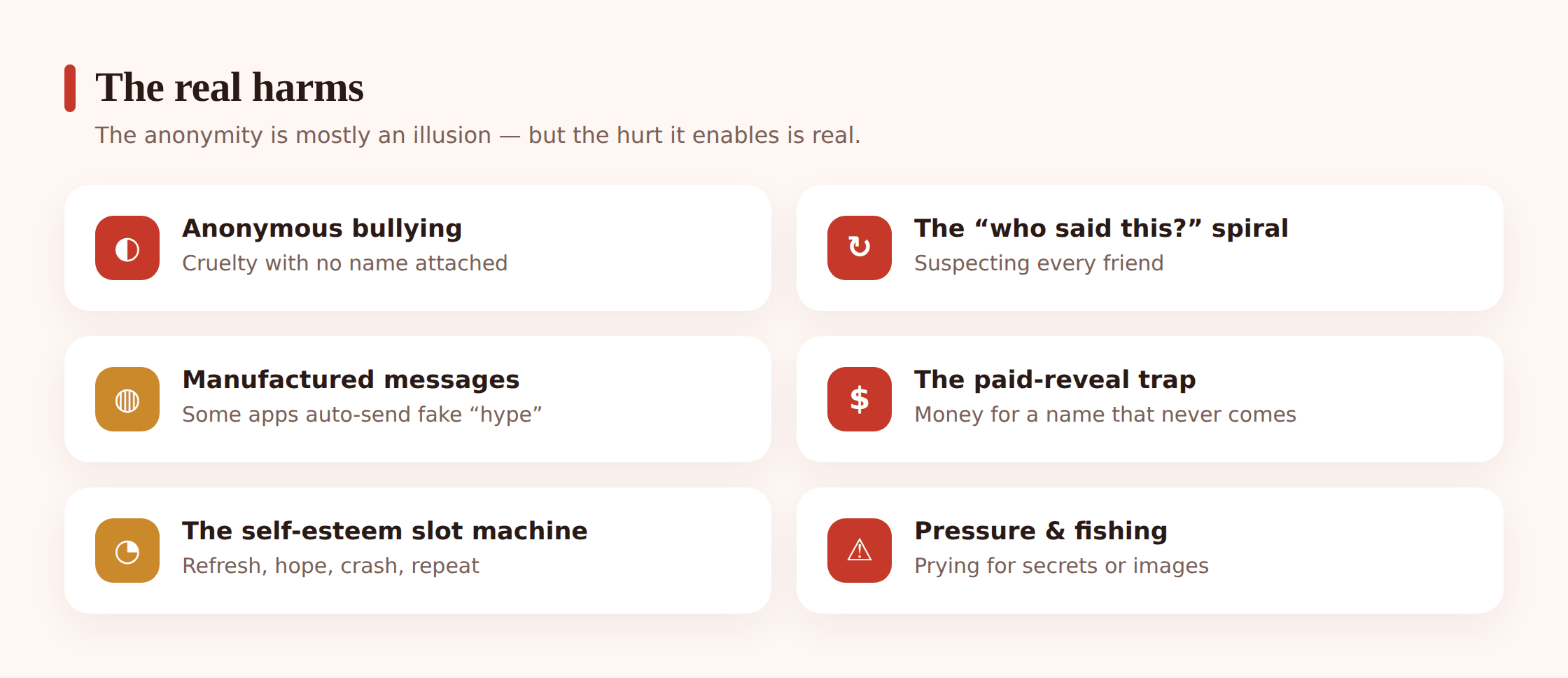
This is the big one. A public comment can be traced and challenged. An anonymous one can’t, so it’s the natural home for the meanest stuff. Surveys of teens consistently suggest a meaningful slice have received hurtful anonymous messages, and many schools report anonymous apps flaring up during friendship fallouts and breakups. If your child is already dealing with cyberbullying and how to spot it, an anonymous app pours petrol on it, because the target can’t even tell who to avoid.
The “who said this?” spiral
There’s a specific, corrosive harm to anonymity that’s easy to miss: it doesn’t just hurt with the words, it poisons trust with the mystery. A teen who gets an anonymous “your best friend talks about you behind your back” now looks at every friend differently. Was it her? Him? The whole group? A single unsigned message can crack a friendship that took years to build, and there’s no one to confront and no way to clear the air. The uncertainty is the weapon.
Pressure, fishing, and manufactured drama
Anonymous prompts also invite pressure. “Anonymously tell me a secret” turns into people pushing for confessions, dares, or romantic admissions. Older users can slide in unnoticed. And because reposting the spicy replies drives engagement, the apps quietly reward drama — the more provocative the exchange, the more it spreads. This overlaps with ordinary group chat drama and pressure, but anonymity strips out the brakes that a named group chat still has.
Self-esteem, on a slot machine
Finally, there’s the slower harm. Inviting anonymous judgement is emotionally a slot machine — you pull the lever hoping for a compliment and sometimes get a gut-punch, and you keep pulling. For a teen whose sense of self is still forming, outsourcing “am I okay?” to a stream of nameless strangers is a shaky place to stand. Even the nice messages train the habit of needing the machine.
What parents can do
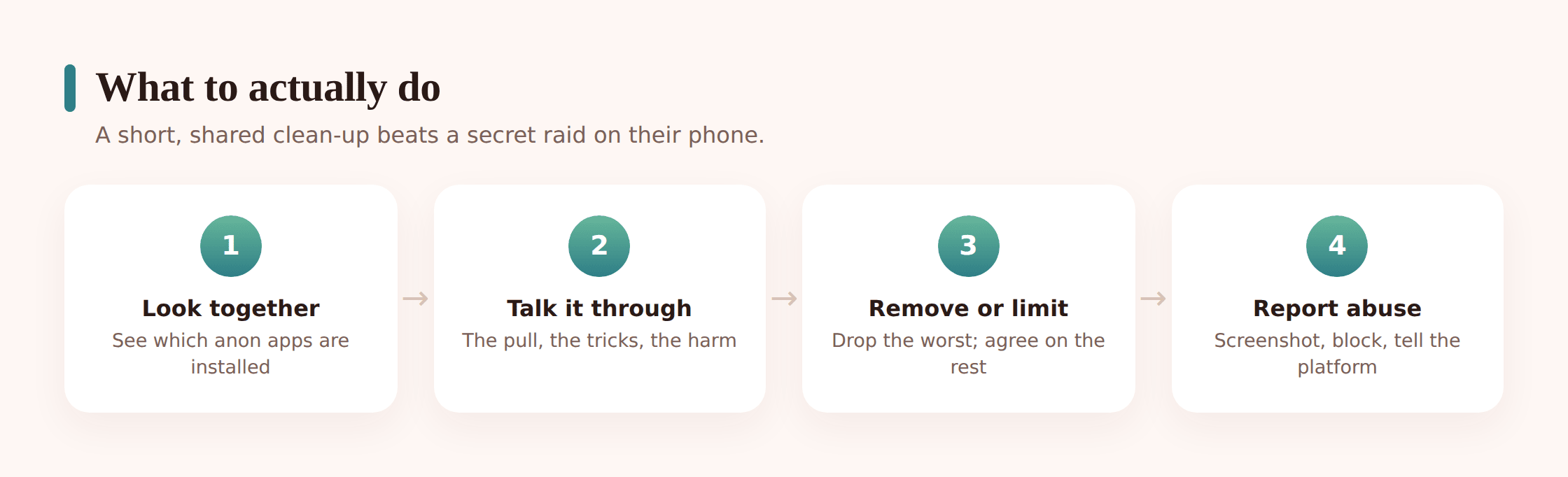
The instinct is to ban the apps outright, and sometimes for a younger teen that’s the right call. But bans alone tend to push things underground, and these apps are trivially easy to reinstall. What works better is a mix: some sensible friction, a lot of conversation, and knowing what’s going on. Think coaching, not confiscation.
- Know the names. NGL, Sendit, Yik Yak, Tellonym, and whatever’s replaced them by the time you read this. New ones appear constantly with the same “send me anonymous messages” hook. If you spot the sticker on your teen’s story, you know an app is in play.
- Check the app store settings. Turn on purchase approval so a “pay to reveal” or subscription can’t go through without you seeing it. This alone defuses the paid-reveal trap.
- Lock down who can reach them. Many of these apps piggyback on a public Instagram or Snapchat. Tightening those toward a private, friends-only setup — the basics of social media safety — cuts off the stranger traffic.
- Agree a “show me the bad ones” rule. Not “show me everything” — that’s a losing battle. Just: if you get a message that upsets you or scares you, bring it to me and you won’t be in trouble and you won’t lose your phone.
- Keep the receipts. If a message is a genuine threat, screenshot it with the date. Anonymous doesn’t mean untraceable to the platform, and a school or the police can sometimes act.
How to talk about it without a lecture
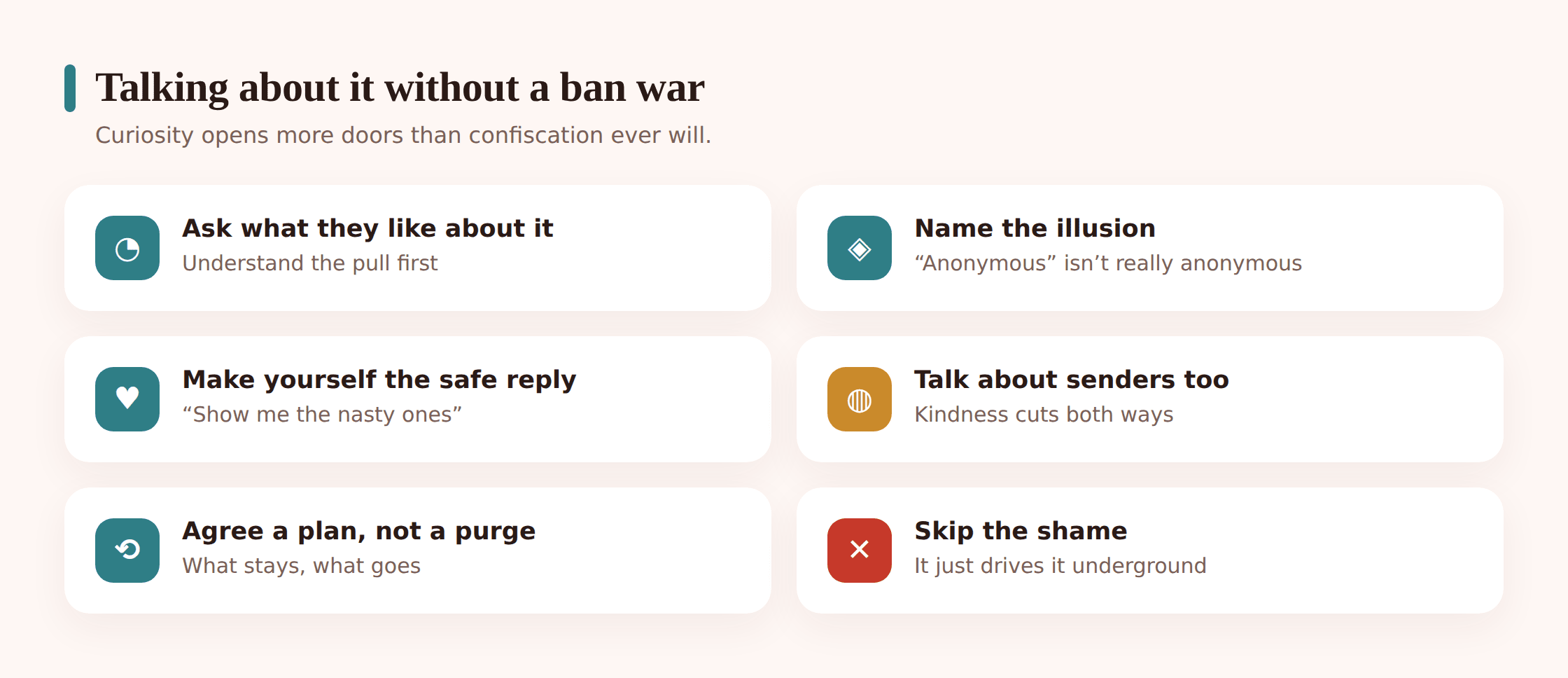
Lead with curiosity, not a warning. Most teens already have complicated feelings about these apps — they’ve seen a friend get hurt, or felt the little sting of a mean one themselves — and they’ll tell you more if you’re genuinely asking than if you’re clearly building toward “so you’re deleting it.”
A few openers that tend to work better than a lecture:
“I saw one of those ‘send me anonymous messages’ things on your story — what’s the deal with those? Do people actually say nice stuff, or is it mostly nonsense?”
“Has anyone ever sent you something horrible on one of those anonymous apps? You don’t have to show me — I just want to know if it’s a thing that happens.”
Then, once they’re talking, a few ideas worth landing gently rather than all at once. That “anonymous” mostly means the app still knows — so it’s not the free-for-all it feels like, and the truly nasty stuff isn’t as untraceable as bullies think. That the “pay to see who sent it” button is usually a con that gives you nothing. And the one that tends to stick most: an anonymous message tells you far more about the person who sent it than about you. A kind person doesn’t hide behind no-name to tear someone down. If a message is cruel, the cruelty is theirs, not a fact about your teen.
It’s also worth naming the flip side — that anonymity makes it easy for your own kid to be crueller than they mean to be, because it doesn’t feel real. “If you wouldn’t say it with your name on it, it’s probably not worth sending” is a small rule that travels well. And keep the door open at the end: not “so delete it”, but “if one of these ever gets to you, come find me — I won’t overreact and I won’t take your phone.” The whole point is to be the safe person they come to, not another thing to hide from.
Where a family tool fits
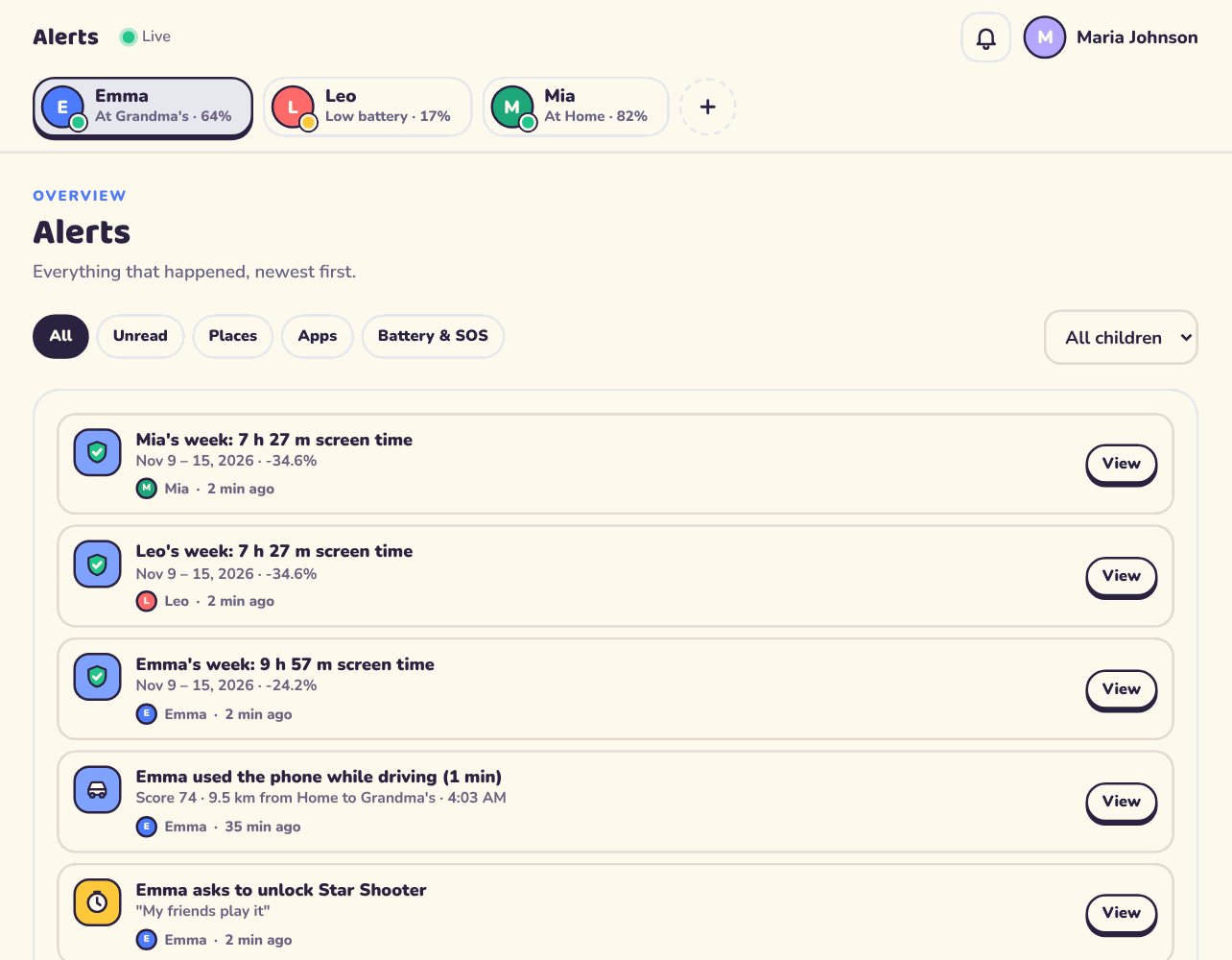
If your family already uses a monitoring app, be clear-eyed about what it can and can’t do here. It won’t sit inside NGL and read anonymous messages — nothing on your side can, and anyone promising to “reveal senders” is selling the same con the apps are. What an open, consent-based tool like FreePhone is genuinely good for is the early nudge: noticing that a new app has appeared and is soaking up hours of screen time, so you know to ask a question tonight rather than a month too late.
FreePhone is built to be set up together, in the open, on your child’s Android phone — not slipped on in secret. You manage it from any browser, with nothing to install on your side, and it’s free, with every feature. Treat it as a smoke alarm for a rough patch, not a way to snoop on anonymous chatter. The real work still happens face to face: the conversation, the trust, the “you can always come to me.” The tool just helps you notice when it’s time to have it.
Support, not surveillance. A family tool earns its place by getting you into the conversation sooner. It’s no substitute for being the parent your teen wants to tell when an anonymous message lands wrong.
Common questions
Are NGL and Sendit actually anonymous?
To your teen, yes — they can’t see who sent a message from the inbox. But the apps themselves usually log a lot, including which device sent each message. “Anonymous” means the recipient doesn’t get a name, not that no record exists. In serious cases, platforms can sometimes trace a message, which is worth telling a teen who thinks a threat can never be tracked.
Should I just ban these apps?
For a younger teen, restricting them is reasonable. But a flat ban alone tends to push it underground, since they’re a two-minute reinstall. A mix works better: tighten the linked Instagram or Snapchat toward private, turn on purchase approval to block the paid reveals, and keep an honest conversation going so your teen brings the bad messages to you instead of hiding them.
My teen got an upsetting anonymous message. What do I do?
Stay calm and don’t grab the phone. Thank them for showing you — that’s the behaviour you want to reinforce. Remind them the cruelty says more about the sender than about them. Screenshot it if it’s a real threat, block and report through the linked platform, and if the kids all go to the same school, the school can often help. Don’t pay any “reveal the sender” prompt — it’s almost always worthless.
Is the “pay to see who sent it” feature ever worth it?
Almost never. These reveals frequently hand over a vague hint or nothing at all, and some apps have been accused of sending fake provocative messages just to drive those payments. It’s a feature designed to profit from a hurt teenager’s curiosity. Turn on purchase approval so it can’t be bought impulsively, and treat any promise to unmask an anonymous sender as a red flag.
Can a monitoring app show me the anonymous messages?
No, and be wary of anything claiming it can. An open tool like FreePhone, set up together on Android and viewable from any browser, helps you notice when a new app has appeared or is taking up a lot of screen time — the cue to check in. It won’t read the anonymous stream, and that’s not what it’s for. The conversation does the real work.
Anonymous messaging apps aren’t going away — one name replaces another, but the “send me anonymous messages” hook stays the same. The good news is that the thing that protects your teen isn’t a clever block or a secret reveal. It’s understanding how these apps really work, knowing the anonymity is thinner and the reveals emptier than the marketing suggests, and being the parent your child comes to when a nameless message hits harder than it should. Set the sensible limits, keep the conversation warm, and stay the safe place to land.