How to Monitor Your Child’s Calls: A Guide to Call Tracking
Most of what a child does on a phone happens in apps now, so the humble phone call is easy to forget. It shouldn’t be. A call is the one channel that reaches a kid directly, no account or friend request needed, and it’s where scammers, spam robocalls and the occasional persistent stranger still land. The good news is that keeping a child safe around calls is simple, and it doesn’t mean listening in on private conversations. It means paying attention to the call log — who’s calling, how often, at what hours — and doing it out in the open, with your child in on the plan.
Why does call safety matter for kids?
Phone calls feel old-fashioned, and that’s part of why they slip through. A parent who has locked down Instagram and set screen-time limits may never think about the dialer at all. Yet the phone number is the most public thing a child owns. It gets shared on sign-up forms, leaks in data breaches, ends up on a friend’s contact list that later gets scraped, and from there it can be dialed by anyone.
Several kinds of unwanted call reach children specifically. Robocalls and spam are the everyday nuisance: automated pitches, “your account is suspended” recordings, prize scams. A younger child who answers one of these has no frame of reference for it, and a confident recorded voice can be genuinely frightening or convincing.
Then there’s phone phishing, sometimes called vishing — voice phishing. A live caller pretends to be from a bank, a delivery company, a game’s “support team”, or even a relative in trouble, and tries to talk the person into handing over a code, a password or a payment. Teens are targeted with fake job offers, prize claims and “you’ve won a gift card, just confirm your details” scripts. The pressure is the whole trick: act now, don’t tell anyone, stay on the line.
And occasionally, more seriously, there’s a real person — an adult who has got hold of a child’s number and keeps calling. It might start as a wrong number that turns odd, or a stranger a child met through a game who moved the contact to a phone call. This is rare, but it’s the situation every parent wants to catch early, and the call log is often where the first sign shows up.
What does responsible call monitoring actually mean?
Here’s the important distinction, and it’s the one that separates a healthy family habit from something invasive. Responsible call monitoring means seeing the call log — the metadata. That’s the number, the saved contact name if there is one, whether the call was incoming, outgoing or missed, the time it happened, and how long it lasted. It’s the same information a phone bill used to give you, laid out clearly by day.
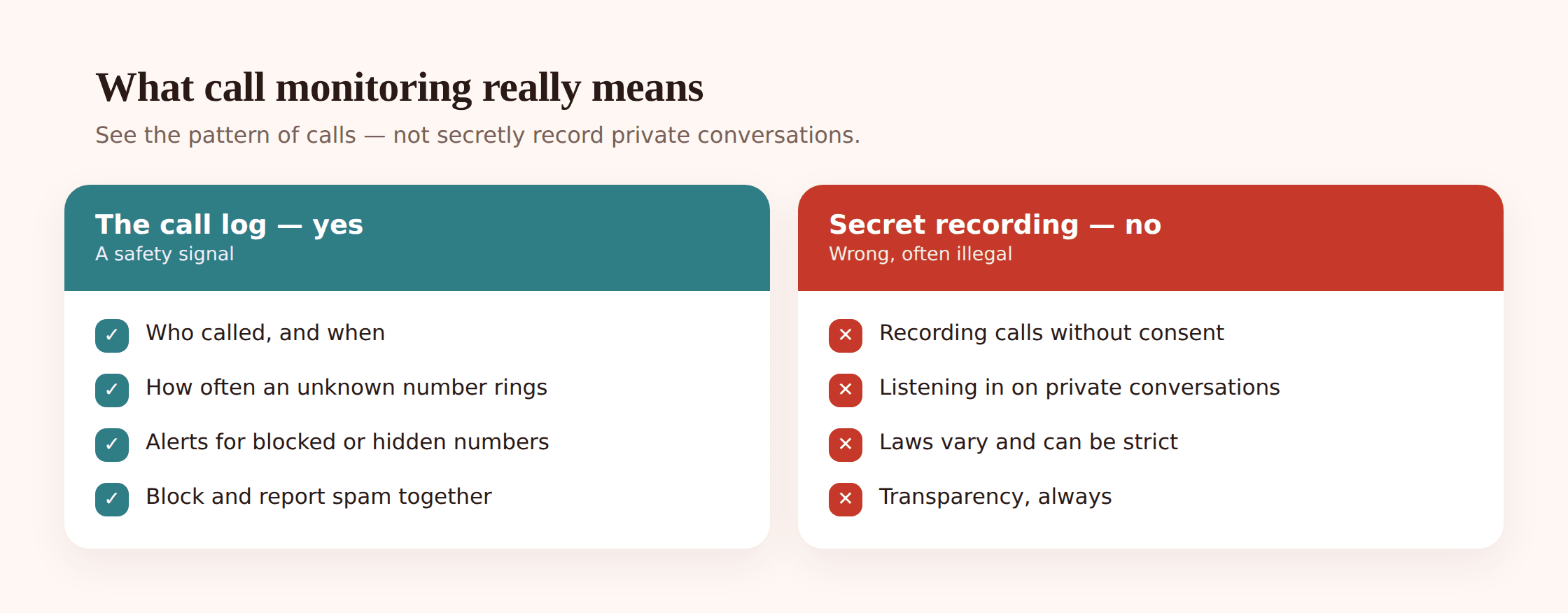
What it does not mean is secretly recording your child’s private conversations, or listening in on a live call. That’s a different thing entirely, it’s rarely necessary for safety, and — as the next section explains — it can be illegal. The log tells you almost everything that actually matters for safety without touching the content of a single call. You can see that an unknown number rang four times on a school night without ever hearing a word that was said.
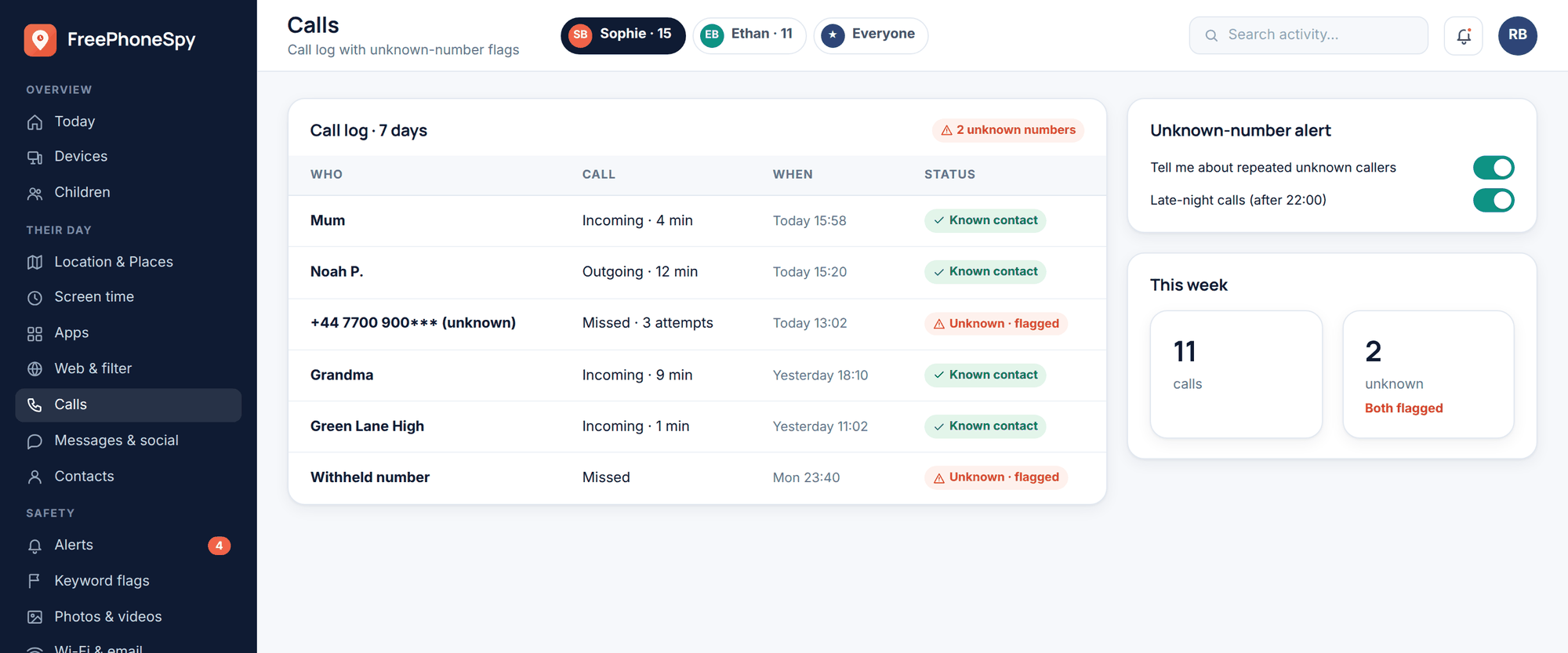
Good call monitoring adds one more thing on top of the log: gentle alerts. A notification when an unknown or blocked number calls repeatedly, or when there’s a burst of calls at an unusual hour. The point of an alert isn’t to trigger alarm every time a friend rings. It’s to surface the pattern that’s out of the ordinary, so you can glance, recognise it, and move on — or, once in a while, ask a question.
Is it legal to record my child’s calls?
This deserves a straight answer, because a lot of monitoring marketing is coy about it. Recording the content of phone calls is governed by law, and those laws vary widely by country and, in the United States, by state. Some places require only one party to a call to consent to it being recorded; many require all parties to consent. Secretly recording a conversation your child has with a friend can mean recording that friend without their knowledge — and that can break the law, even when the phone belongs to you and the child is your own.
So the responsible position is simple. Don’t secretly record calls. For genuine safety concerns, you almost never need the audio anyway — you need to know who is calling, how often, and when. That’s the log, and reviewing your own child’s call log on a device you manage is a very different, far less fraught thing than intercepting the words of a private conversation.
Which call patterns are worth noticing?
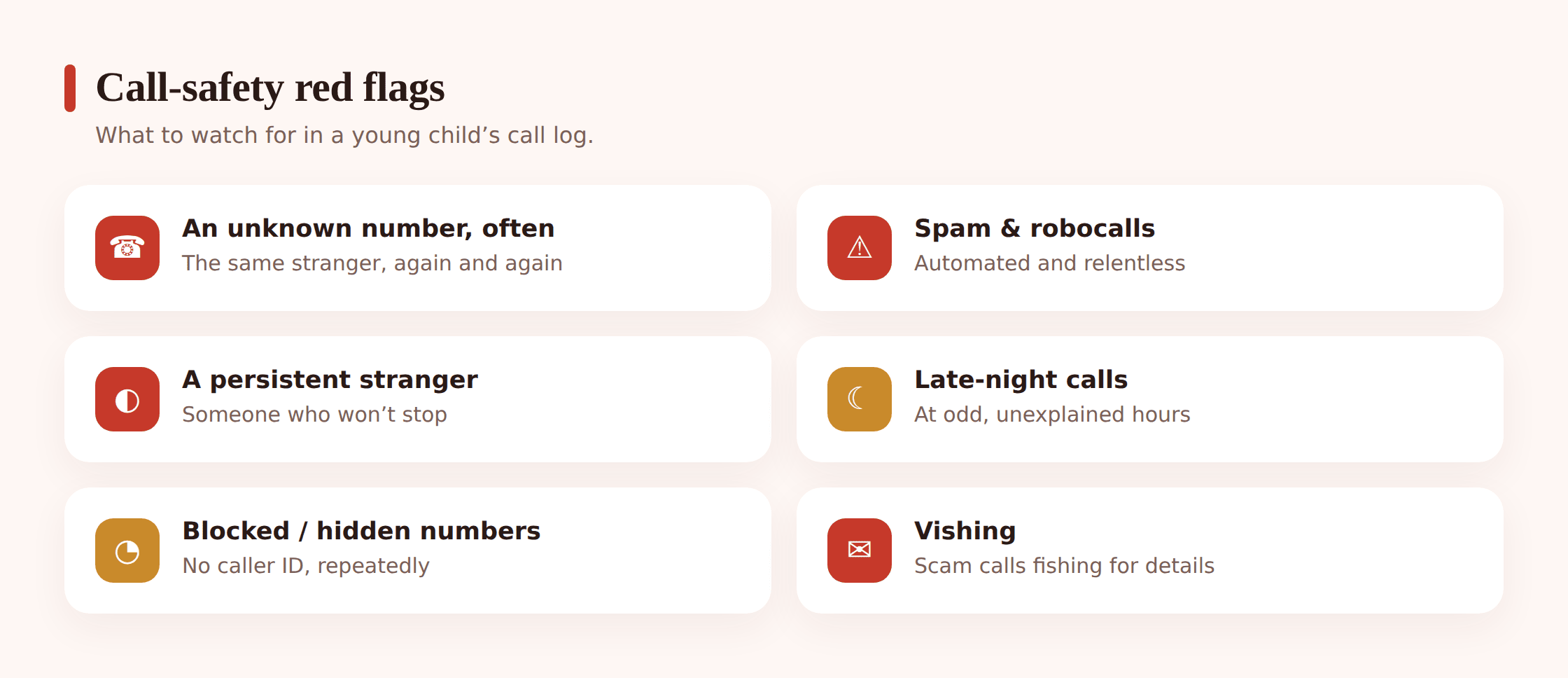
You don’t need to study the log every day. Most of the time you’ll recognise nearly every name on it, and that in itself is reassuring. What you’re watching for is a change from your child’s normal — a pattern that stands out. None of these proves anything on its own; it’s the combination that’s worth a second look.
- An unknown number that calls repeatedly, especially the same one over several days.
- Calls clustered at odd hours — late at night on a school night, or during class time.
- A run of missed calls from one number your child never picks up or mentions.
- A number saved under just a first name, a nickname or emojis, calling a lot.
- A sudden spike in calls from unfamiliar numbers, which can signal a leaked number or a scam campaign.
- Calls your child seems anxious or secretive about afterwards.
Spam and vishing tend to look different from a worrying real caller. Scam numbers are often each used once — a new unfamiliar number every time, sometimes spoofed to look local. A persistent stranger, by contrast, usually calls from the same number or two, at similar times, and keeps trying. The log makes that difference visible at a glance.
How do I set up call tracking well?
The setup that works is open, light-touch, and paired with a conversation. Here’s a sensible order to do it in.
Set up call safety in six steps
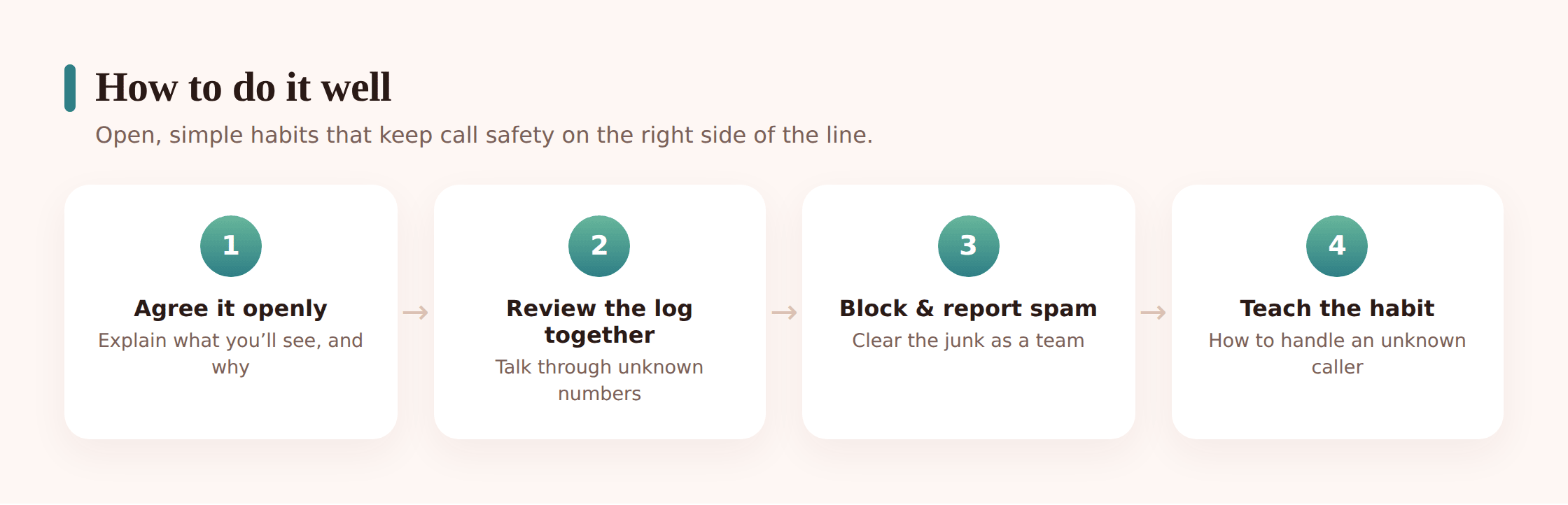
- Agree it openly first. Before anything is switched on, tell your child you’ll be able to see the call log — who called, when, for how long — and that you won’t be listening to their conversations. Explain it’s about spotting spam and strangers, not policing their friendships.
- Turn on the call log overview. Whether through a monitoring app or by reviewing the phone together, get a clear view of incoming, outgoing and missed calls, grouped by day so patterns are easy to read.
- Set alerts for unknown and blocked numbers. Ask to be notified when an unrecognised or blocked number calls repeatedly, rather than reading through everything. Let the pattern come to you.
- Save the real contacts. Sit down and save your child’s genuine friends, family, school and clubs as named contacts. Once the people who should be calling are named, an unknown number actually stands out.
- Block and report spam together. When a spam or robocall shows up, do the blocking side by side. Show your child how to block a number and report it, so they can handle the next one themselves.
- Review lightly, and less over time. A weekly glance is plenty for most families. As your child grows and shows good judgement, check less often and hand more of it to them.
Teaching a child to handle an unknown caller is worth as much as any monitoring. A few plain rules go a long way: it’s fine not to answer a number you don’t recognise; never give out your name, address, school, passwords or codes to a caller; no real bank, prize or delivery company asks you to confirm details or pay by staying on the line; and if a call feels strange, hang up and tell a parent. A child who knows they won’t be in trouble for hanging up is a child who will hang up.
What if a stranger keeps calling?
Occasionally the log shows the thing you hoped it wouldn’t: the same unknown adult calling again and again, or a caller your child is frightened of. Handle it calmly and in this order.
When one number won’t stop
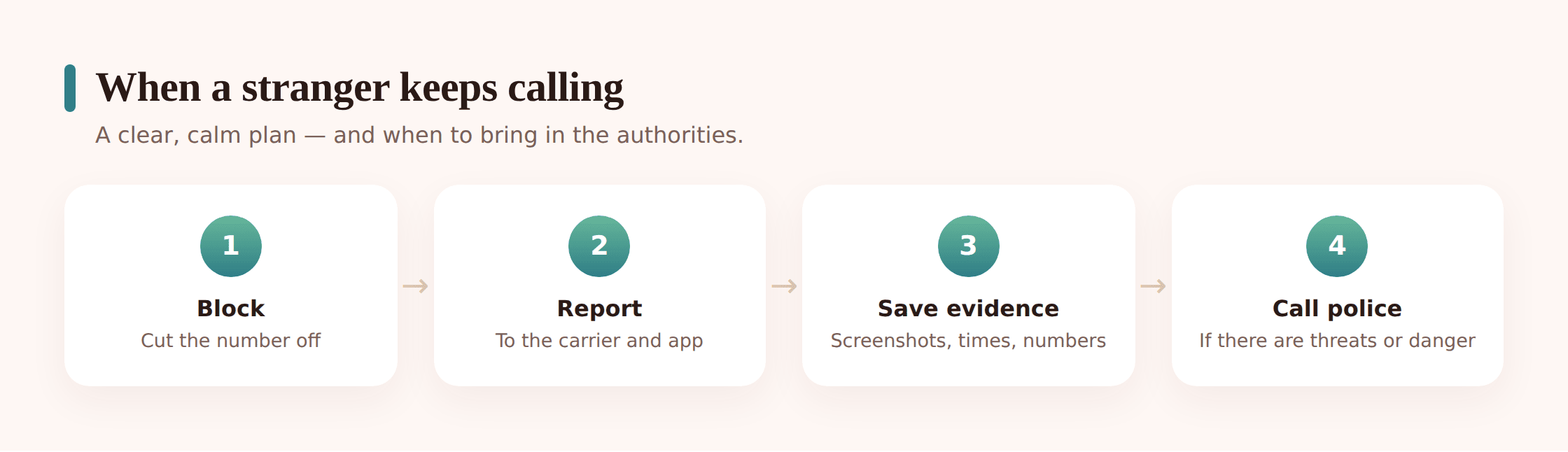
- Talk to your child first. Ask, without accusation, who the number might be and what’s been said. Often they know exactly who it is and are relieved to be asked.
- Block the number. Block it on the phone so it can’t get through. On Android this is a couple of taps from the call log entry.
- Report it. Report spam and scam numbers through your phone’s built-in reporting, and to your carrier or national reporting line where one exists.
- Keep a record. Screenshot the log entries — number, dates, times, how often. If it continues, that record is what authorities will want.
- Involve the police if there are threats. If a caller threatens your child, claims to know where they are, or the contact is clearly an adult targeting a child, contact the police. This is a report-to-authorities situation, not one to investigate yourself.
Do not call the number back to confront the person, and don’t let your child do it either. Blocking, reporting and — if needed — the police are the right tools. If the caller turns out to be someone your child first met online, the situation overlaps with protecting kids from online predators, and the same principle applies: preserve the evidence, don’t engage, and get the right people involved. For contact that began in messages before it moved to a call, our guide on what to do when a stranger contacts your child walks through the first steps in detail.
Young child or teenager: how much is right?
The right amount of call oversight changes a lot with age, and matching it to your child matters more than any single setting. A young child with a first phone benefits from close support. At that age a full call-log overview makes sense — you’re teaching, not surveilling, and most of your job is helping them learn that unknown callers can wait and spam gets blocked. You might sit down together after school and go through anything unfamiliar.
A teenager is different. They’re entitled to ordinary privacy in their friendships, and reading into every call would rightly feel like a breach. For teens, the light version fits best: alerts for repeated unknown numbers, a shared understanding that you’ll notice a genuine safety flag, and otherwise a hands-off arrangement. The message shifts from “I’m watching your calls” to “I’ve got your back if something dodgy starts calling.” As trust builds, ease off further. The end goal is a young adult who manages their own phone safely, and monitoring that never loosens never gets them there.
How do I talk about it with my child?
The conversation is the part that makes everything else work, and it’s easier than parents fear. Keep it short and honest. Explain what you’ll see: the call log — numbers, times, how long — and that you won’t be listening to their conversations, because their private talk with friends is theirs. Explain why: spam and scam calls target kids, and once in a blue moon a stranger tries a child’s number, and you’d rather catch that early together than find out too late.
Frame it as being on their side, because it is. The tool is pointed at the callers, not at your child. Agree what happens if something turns up — you’ll talk about it, block it together, no one’s in trouble for a scam call. And make the promise that matters most: if a call ever scares or confuses them, they can come to you and you won’t be angry. A child who believes that will tell you things the log never could.
Where FreePhoneSpy fits
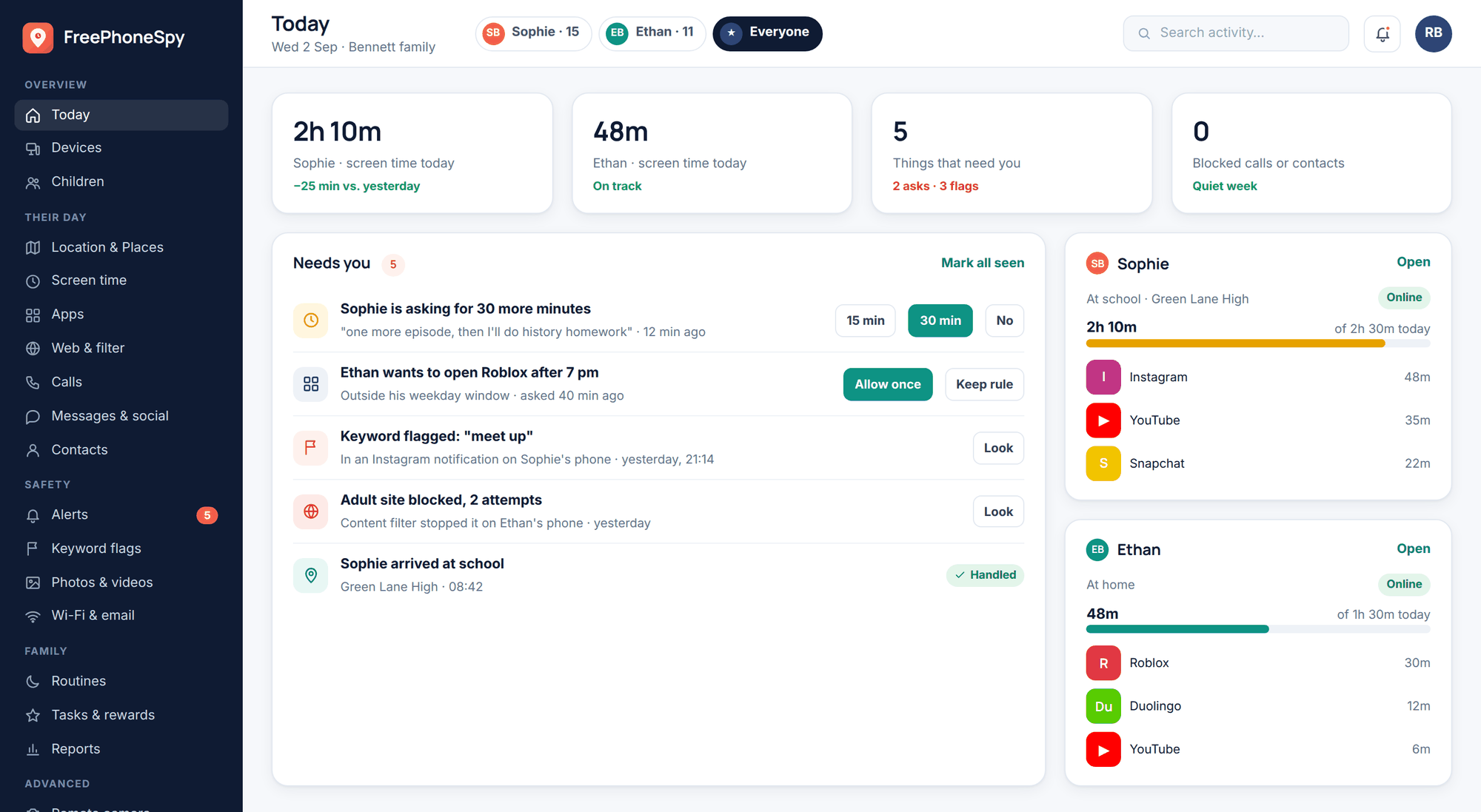
If you’d like a tool for this, FreePhoneSpy is built the way this guide describes. You set it up together with your child, and the app on their Android phone has a transparency screen listing what’s shared, so the call log isn’t a secret from the person carrying the phone. You see a clear call-log overview — numbers, saved names, times, duration, incoming and missed — plus alerts when unknown or blocked numbers call repeatedly. It does not secretly record private conversations. You watch from any web browser on your own laptop or phone, nothing installs on your side, and it’s free to start. It’s a call-log overview and a set of gentle alerts, pointed at keeping your child safe, in the open.
Common questions
Can I listen to my child’s calls?
You can, in the sense that it’s your child and your device — but you generally shouldn’t, and secretly recording calls can be illegal because it captures the other person too. For safety, you almost never need the audio. Knowing who called, when and how often answers the real questions without touching a private conversation.
Is monitoring my child’s call log spying?
Not when it’s done openly. Spying is secret. If your child knows the log is visible, understands you’re not listening to conversations, and you’re using it to catch spam and strangers rather than to police their friendships, it’s closer to knowing who they’re meeting after school. Done in secret, it would be a breach of trust; done in the open, it’s ordinary care.
A stranger keeps calling my child. What’s the first step?
Talk to your child calmly to find out who it might be, then block the number on the phone and report it. Keep screenshots of the log entries as a record. If there are any threats, or the caller is an adult clearly targeting a child, contact the police. Don’t call the number back to confront them.
How do I stop robocalls and spam reaching my child’s phone?
Block and report each spam number as it appears, keep the number off public forms and sign-ups where you can, and use your carrier’s spam-filtering or a reputable call-blocking feature. Just as important, teach your child that it’s fine not to answer unknown numbers and never to give out details or codes to a caller.
My child is a teenager. Isn’t call monitoring too much?
For a teen, keep it light: alerts for repeated unknown numbers rather than reading into every call, and an agreement that you’ll step in only for a real safety flag. Teens deserve privacy in their friendships. The right amount of oversight shrinks as they grow, and easing off is part of doing it well.
Call safety for kids comes down to something modest and doable. Watch the shape of who’s calling, not the content of what’s said. Keep it open, agree it together, and let a young child lean on you more while a teen handles more themselves. Block the spam, teach the couple of rules that see off a scam call, and stay calm and available for the rare call that worries them. Do that, and the phone stays a way for your child to reach the people who matter — and a much harder place for anyone who doesn’t.