Is It Safe to Meet an Online Friend? A Parent’s Guide
Your kid has a friend you’ve never seen. They met in a game, or a Discord server, or under a video they both liked. Now your child wants to meet them in real life. That request can be exciting for them and gut-churning for you. Here’s how to think it through calmly, spot the friendships that are fine, catch the ones that aren’t, and set rules everyone can actually live with.
The honest picture
Let’s start without the panic. Kids make real friends online. Someone they raid with every weekend. A group chat from a fandom. A person on the other side of the country who gets their sense of humor better than anyone at school does. These friendships are real. They can be kind, steady, and good for your child. Writing them all off as fake or dangerous just tells your kid you don’t understand their world.
But there’s a catch you can’t wave away: you can’t see who’s really behind a screen. A profile picture is a picture. An age in a bio is a number someone typed. Most of the time the person is exactly who they say. Sometimes they aren’t, and the ones who aren’t are good at seeming like they are. That’s why an online friendship staying online is low-stakes, and meeting in person is the moment that needs real care.
So the goal isn’t to ban online friends. It’s to help your child keep the good ones and stay safe when the friendship wants to step off the screen. If you want the wider picture of fake identities, our guide to catfishing and fake profiles pairs well with this one.
Real friend or warning sign?
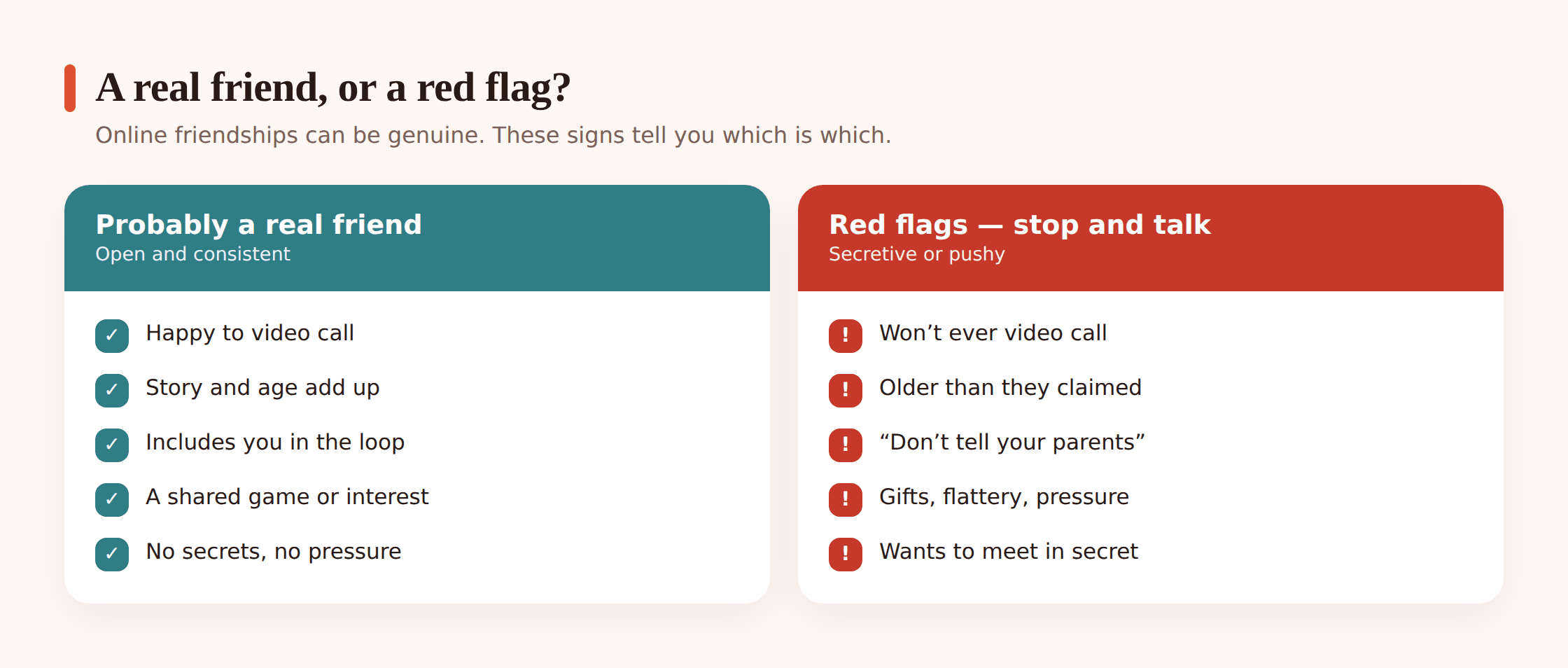
You don’t need to profile every person your kid talks to. You need to know the shape of a healthy friendship versus the shape of a problem. A genuine peer friend will video call without a fuss. They’ll be roughly the age they claimed. They know the same games, memes, and drama your kid does, because they actually live in that world. They’re happy for your child to mention them to you. They don’t need anything from your kid.
Now the signs to stop and talk about. None of these on its own proves anything, but each one earns a conversation, and several together mean pump the brakes.
- They won’t video call, ever. There’s always an excuse: broken camera, shy, “later.”
- They’re vague about who they are. No consistent story, no mutual friends, details that shift.
- They turn out to be older than they first claimed.
- They isolate your child. “Don’t tell your parents.” “Your friends wouldn’t get it.” “It’s just between us.”
- They shower your kid with attention, compliments, or gifts, fast.
- They push to move off the public platform onto a private app where no one can see.
- They ask for photos, especially private ones, or for money, or for gift cards.
- They want to meet in secret, and they want your child to keep the plan hidden.
Secrecy is the thread that ties the warning signs together. A friend who’s who they say they are has no reason to make your child hide them from you. Anyone teaching your kid to keep secrets from their parents has told you something about themselves.
These patterns are the early moves of grooming, and they can be slow and gentle rather than obvious. Our deeper guide to protecting kids from online predators walks through how that process actually unfolds, so you can name it early.
The rule for younger kids
For younger children the rule is short and it doesn’t bend: they don’t meet online-only contacts in person. Full stop. Not at the mall, not “just for a minute,” not with a friend along. And the second half of the rule matters as much as the first: they always tell you when an online friend suggests meeting, asks for a photo, wants to move to another app, or says anything that made them uncomfortable.
Keep this rule simple and repeat it plainly, the way you’d repeat “hold my hand crossing the road.” You’re not scaring them. You’re giving them a bright line so they don’t have to work out a hard judgment call on their own in the moment. And make clear that telling you is the win, never the thing that gets them in trouble.
If an older teen wants to meet
Older teens are different, and pretending they’re not usually backfires. If you flatly ban it, a determined sixteen-year-old doesn’t stop wanting to meet their friend. They just stop telling you, and then you’ve lost your only real safeguard. So for older teens, harm reduction beats prohibition. If a meeting is going to happen, make it happen the safe way, out in the open, with you in the loop.
A safer first meeting, step by step
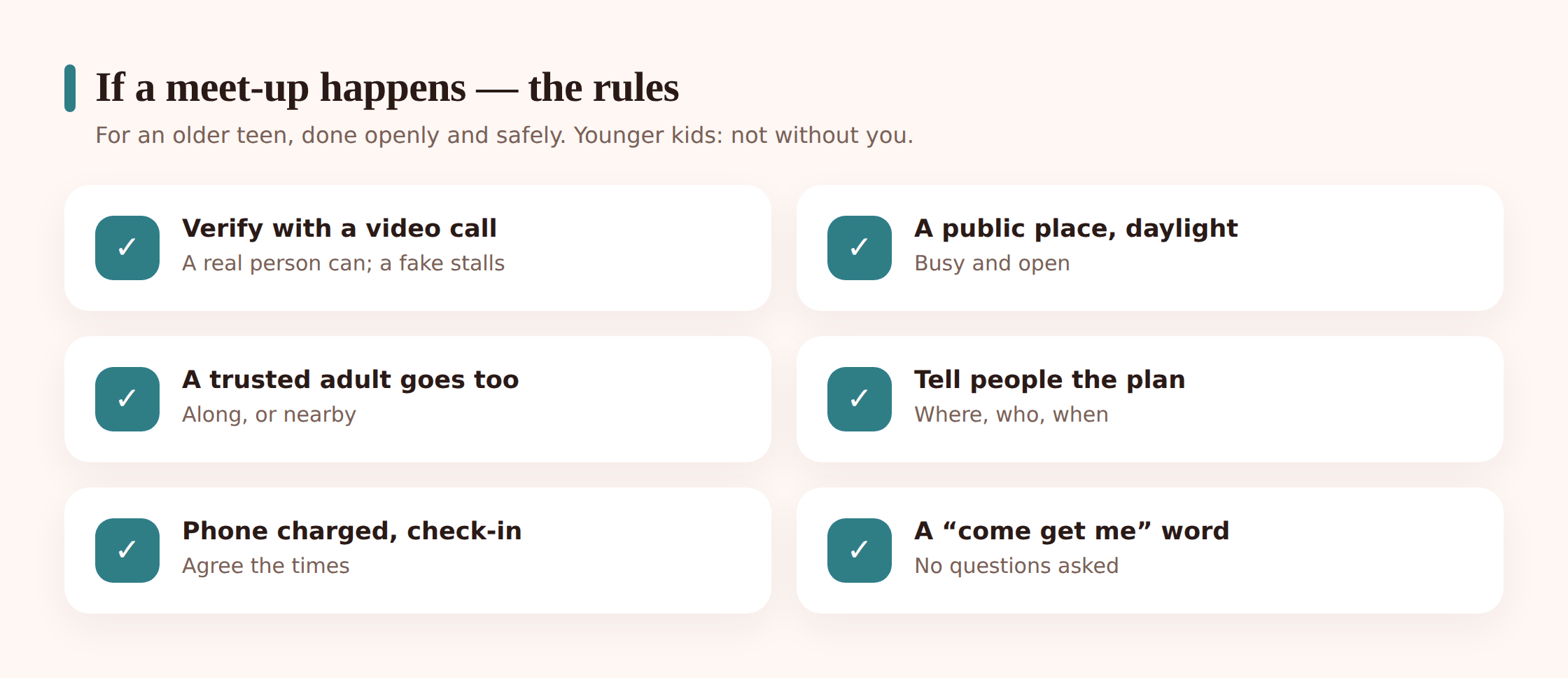
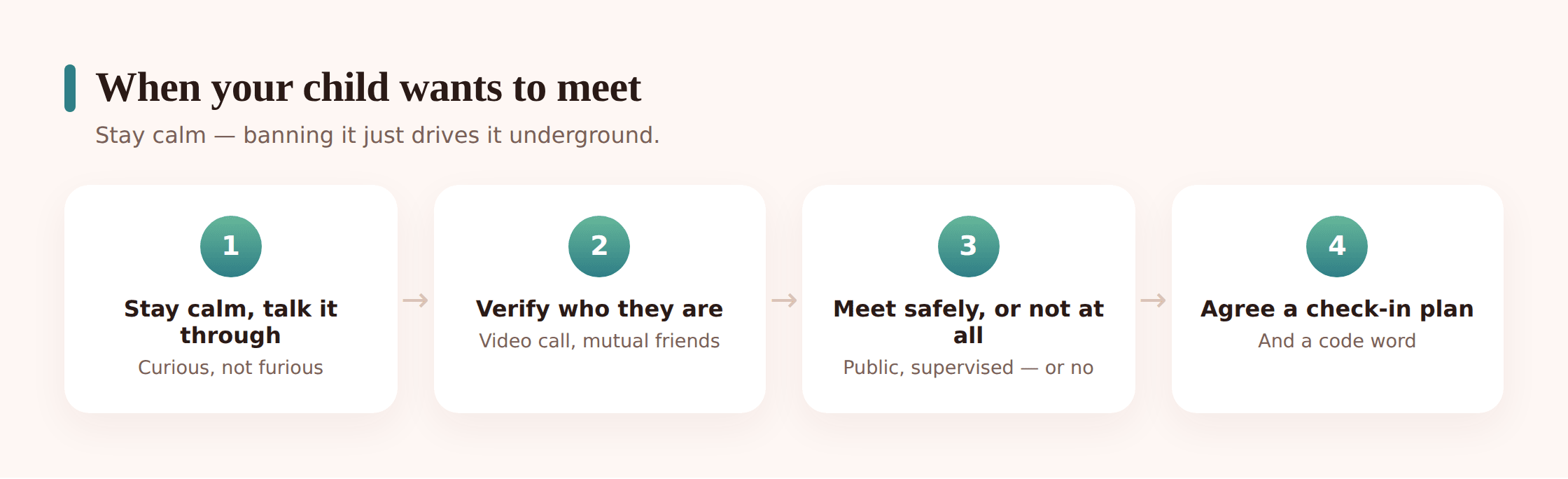
- Verify who they are first. A video call before any meeting, so your teen sees a real face and voice that matches the story. Mutual friends who actually know the person in real life are gold. If the friend dodges the video call, the meeting’s off.
- Public place, daylight. A busy cafe, a food court, a park with people around. Never somewhere private, never a home, never a car.
- An adult goes along or stays nearby. You, or another trusted adult, either at the table’s distance or dropping off and staying close by. For a genuine friendship this is no big deal. For a predator it’s a dealbreaker, which tells you a lot.
- Everyone knows the plan. Where, when, who with, and when they’ll be back. Written down, shared with you, not a secret from anyone.
- Phone charged and on. Full battery, a charger in the bag, location sharing on.
- A check-in and a code word. Agree a time they’ll text you, and a “come get me” code word they can drop into any message if they want out without making a scene.
- A “home safe” plan. They text or the phone pings when they’re home. You know the meeting’s over and everyone’s fine.
Set these up together, not as a lecture but as a plan you build with your teen. When they’ve helped write the rules, they’re far more likely to follow them. And if the online friend resists any of this, especially the video call and the public place, that resistance is your answer.
Red flags that mean no meeting
Some things aren’t a “be careful,” they’re a hard no. If any of these are in play, the meeting doesn’t happen, and it’s time for a longer talk about what’s going on.
- Any pressure to keep the meeting secret.
- Refusal to video call before meeting.
- Wanting to meet somewhere private instead of a public place.
- The “friend” turning out to be an adult when your child is a minor.
- Anyone asking your child to lie to you about where they’re going or who with.
An adult who wants to meet a child in private, without the parents knowing, is not a friendship. Trust that instinct in your gut. You will never regret calling off a meeting that felt wrong.
How monitoring can help, honestly
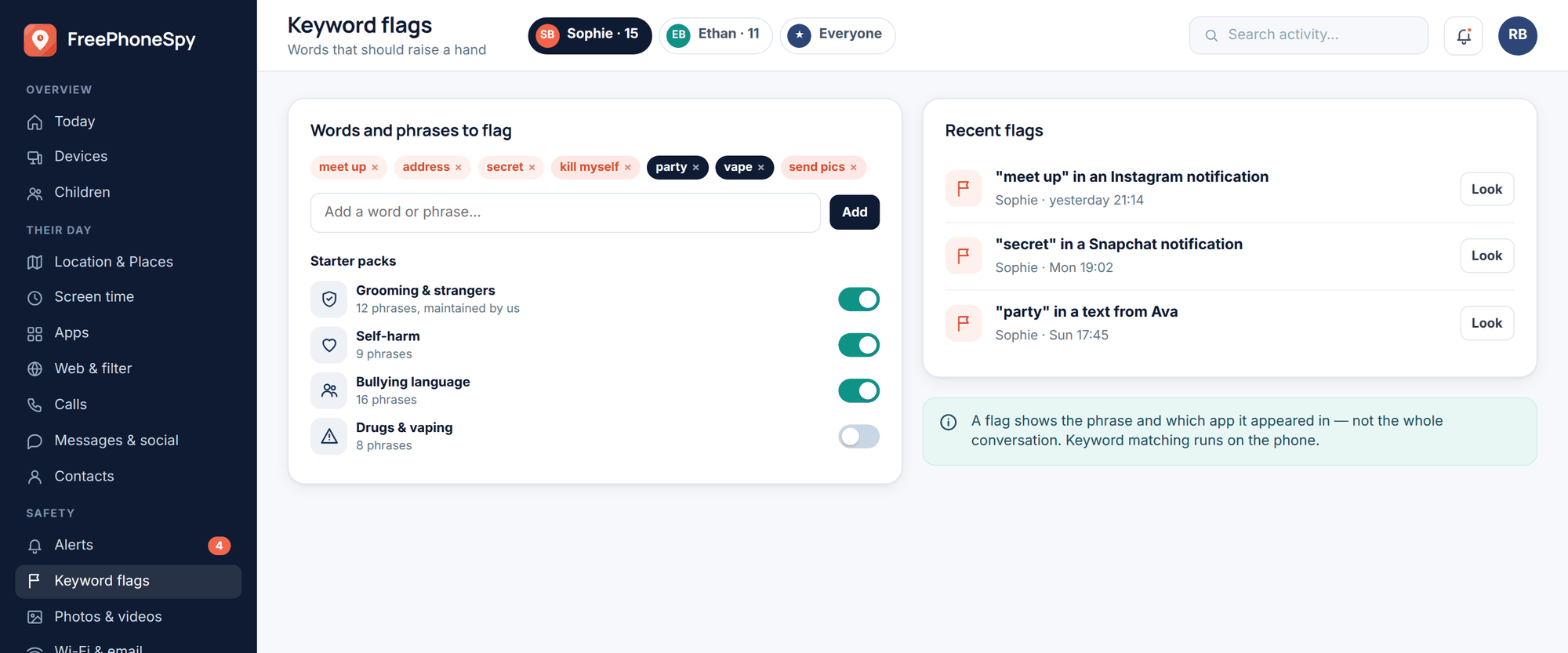
Tools help at the edges. They don’t replace the thing that actually protects your child, which is your child telling you. Keep that order straight and monitoring becomes genuinely useful.
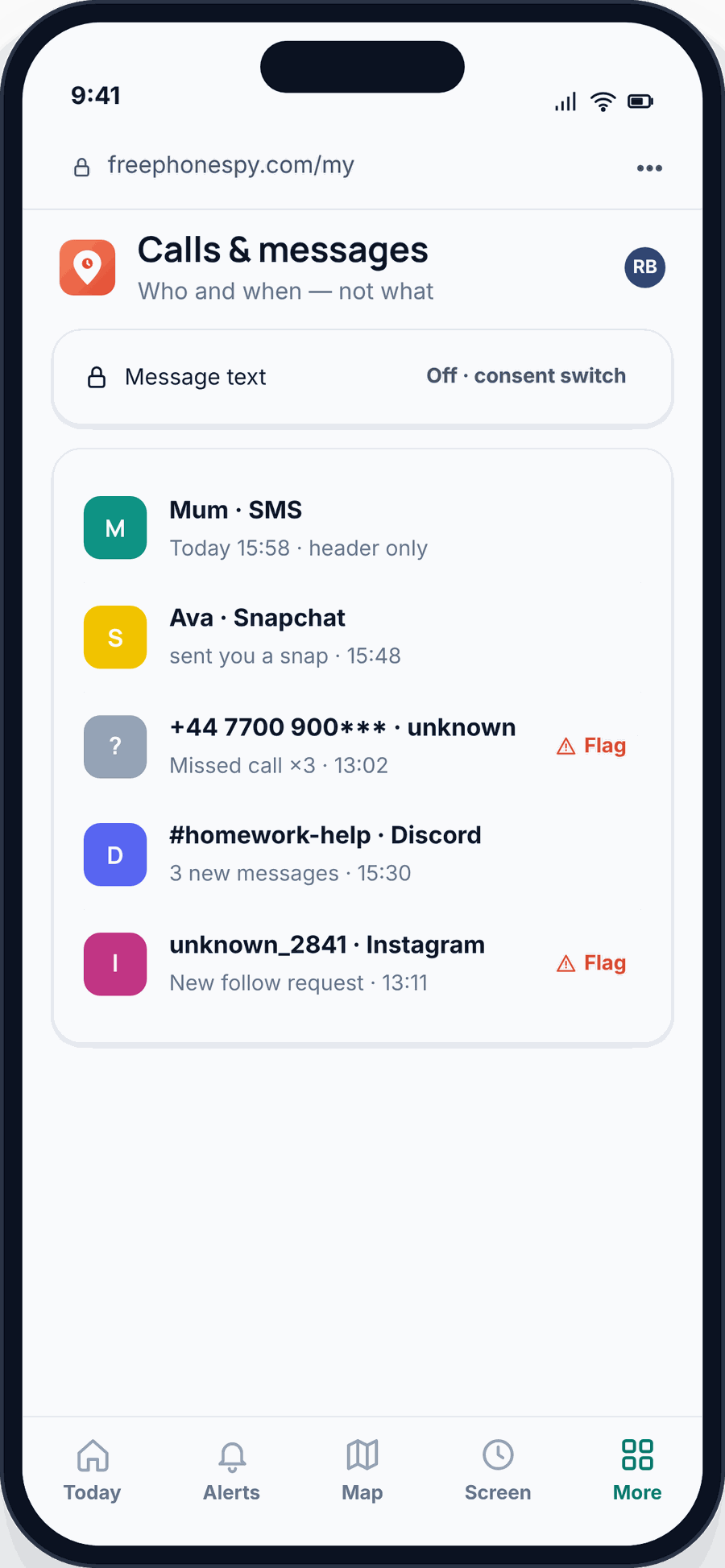
Keyword alerts can flag grooming-style language, “don’t tell your mum,” “send me a pic,” “our secret,” so a phrase you’d want to know about surfaces instead of scrolling past. You’re not reading every message. You’re getting a nudge when something matches. Message headers in the alerts feed help you see who’s talking to your child a lot and when, so a new contact who’s suddenly everywhere doesn’t slip by.
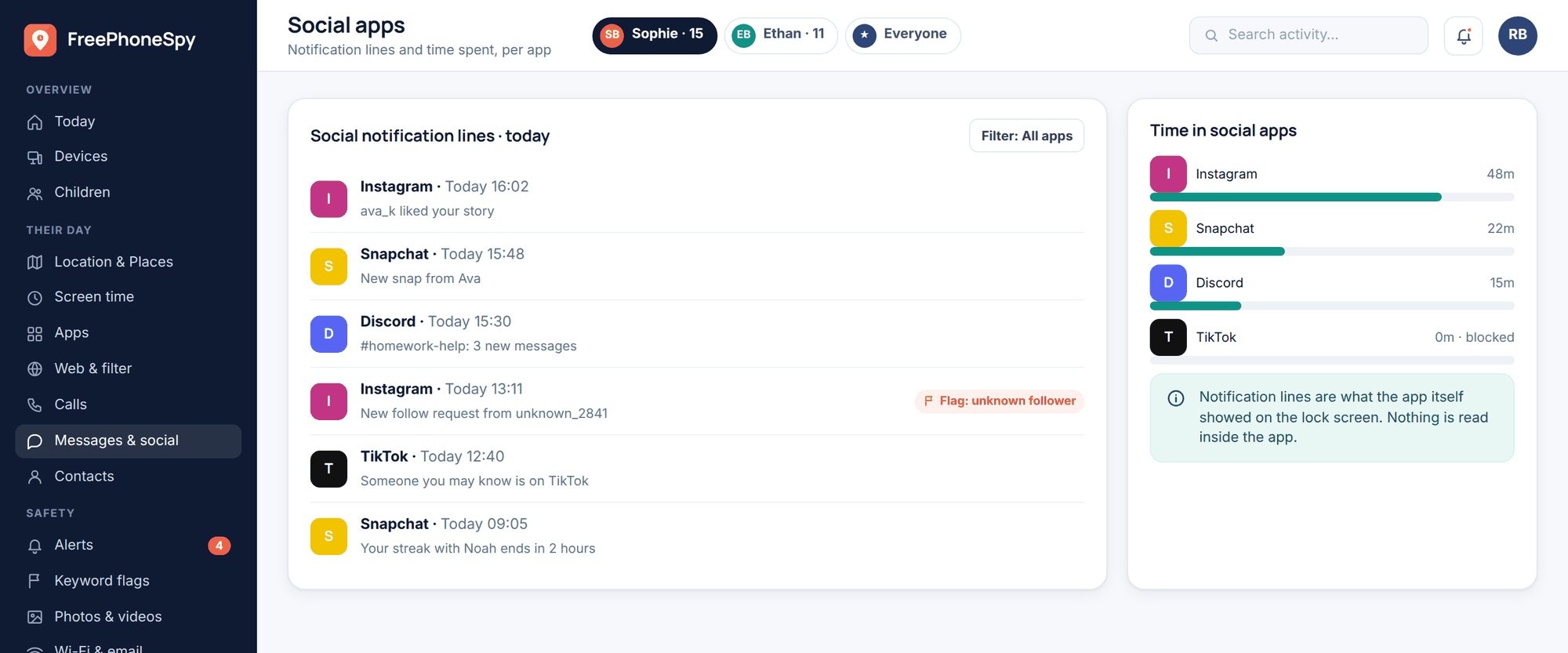
On the day of a meeting, saved Places plus a “home safe” alert do quiet work. Mark home and the meeting spot, and you get a ping when your teen arrives and when they’re back. It’s the calm version of watching the clock. And the social view helps you keep a light, general sense of where your child’s online life is happening, which matters because so many of these friendships live inside apps. Our guide to social media safety for kids goes deeper there.
None of this is surveillance for its own sake, and it only works on your own child’s Android phone with the arrangement out in the open. On iPhone, Apple’s own Screen Time and Family Sharing cover the basics. Whatever the tool, treat it as a smoke detector: it might catch the thing you’d have missed, but the real safety is the conversation.
Keeping the door open
Everything above depends on one thing: your child coming to you. So protect that. The single most useful rule in this whole guide is the “you won’t be in trouble” rule. If your kid tells you an online friend asked for a photo, or wanted to meet in secret, or said something that scared them, they don’t get punished for it. They get thanked. The moment telling you costs them, they stop telling you.
That means how you react is a safety feature. If you blow up, ban everything, and read them the riot act the first time they open up, you’ve just taught them to handle the next scary thing alone. React calmly even when you’re frightened inside. Ask questions. Say “I’m really glad you told me.” Then figure out the next step together.
- Agree the “no trouble for telling me” rule out loud, in advance.
- Ask about their online friends the way you’d ask about school ones. Curious, not suspicious.
- When they do come to you, lead with thanks, not with the lecture.
- Make decisions with them, not at them. Rules they helped set are rules they keep.
For the how-to of these conversations, including openers that don’t make kids shut down, see how to talk to your kids about online safety.
If something feels wrong
Sometimes you’ll realize it’s gone past caution, that an adult may be grooming your child. If that’s where you are, move carefully.
If you suspect grooming
- Don’t confront the stranger. Tipping them off can make them delete accounts, destroy evidence, or pressure your child. Don’t message them.
- Preserve evidence. Screenshot messages, usernames, profiles, and anything shared. Don’t delete the chats.
- Report it. Report the account to the platform, and report the person to the authorities: CEOP in the UK, NCMEC’s CyberTipline in the US, or your local police. They handle exactly this.
- Support your child. Make sure they know this isn’t their fault, they’re not in trouble, and you’ve got them. That reassurance matters more than anything.
If the situation involves images or threats to share them, act fast and read our guide on sextortion and what parents need to know, which covers the immediate steps in detail.
FAQ
My kid says everyone meets their online friends. Are they right?
Some teens do, and plenty of those meetings are fine because they’re between actual peers who verified each other and met in public. “Everyone does it” isn’t a safety argument, but it’s also not a reason to panic. Use the rules above rather than a flat yes or no.
Is it wrong to worry about who my child talks to online?
No. Worrying is part of parenting. The trick is turning worry into a plan and a conversation instead of a ban, so your child stays willing to tell you things.
What if my child already met someone without telling me?
Stay calm, even if you’re not. Find out who, where, and what happened. Thank them for telling you now. Then set the rules together for next time. Coming down hard mostly guarantees they won’t tell you next time either.
Can monitoring software tell me if a friend is a predator?
No tool can do that reliably, and any that claims to is overselling. Keyword alerts and activity headers can flag worrying language and patterns so you look closer. The judgment, and the protection, still come from you and your child talking.
Should I read all my teenager’s messages?
Generally no, and doing it secretly breaks trust fast. Openly agreed monitoring focused on safety signals, paired with a real relationship, protects better than reading every word ever could.