Catfishing & Fake Profiles: How to Protect Your Child
A stranger with a friendly face and a good story slides into your child’s DMs. They’re funny. They get it. They message every day. The trouble is, the face isn’t theirs, the story is invented, and the goal was never friendship. That’s catfishing, and kids are easy targets because they’re kind, trusting, and keen to be liked. Here’s how it works, how to spot it, and how to teach your child to check who they’re really talking to.

What catfishing actually is
Catfishing is when someone builds a fake identity to start a relationship with you. They lift photos from a real stranger’s account, invent a name and a backstory, and pour attention on their target until a bond forms. Then they use it.
The “why” varies. Some are after attention or the thrill of a secret life. Some want money. Some want images — and once they have one, they use it to demand more. And some are adults setting out to groom a child, using the fake persona to seem safe, close in age, and easy to trust. The photo of a smiling teenager is bait.
It’s worth being honest about who this targets. There’s no “type” of child who gets catfished. Confident kids, shy kids, popular kids, lonely kids — all of them. A fake profile doesn’t need your child to be naive. It needs them to be human: to enjoy attention, to want a friend, to give someone the benefit of the doubt. That instinct is a good one. The person exploiting it is the problem, not your child.
Where it happens
Anywhere strangers can message strangers. In practice that means a handful of familiar places.

- Social DMs. Instagram, Snapchat, TikTok. A follow request, a compliment on a post, a “hey, you seem cool” — and a conversation begins.
- Games and their chats. Roblox, Fortnite, Discord servers. Someone helpful and friendly in-game moves the chat somewhere more private.
- Dating-style apps kids sneak onto. Age gates are easy to lie past. A child on an adult app is talking to adults, by design.
- Group chats. A stranger gets added to a group of school friends, blends in for a while, then starts DMing members one by one.
The pattern is almost always the same: meet somewhere public and busy, then steer the conversation somewhere quiet where no one else can see it. That move — from the group to the private app — is one of the clearest signals worth teaching your child to notice. For a wider look at platform-by-platform risks, our guide to social media safety for kids goes further.
Warning signs a profile is fake
No single sign proves a catfish. But they cluster. When a few of these show up together, something’s off.

- They won’t video call — ever. Bad camera, broken phone, “I’m shy,” always a reason. A real person will show their face eventually. A catfish can’t.
- The account is thin. Few posts, few real friends, no one tagging them, photos that start only a month ago. Real lives leave more of a trail.
- The photos are too perfect. Every shot looks like a model or a magazine. Stolen photos are usually someone’s best ones, and only their best ones.
- The story doesn’t add up. Details shift. They’re “16” but talk like an adult. They go to a school that doesn’t quite exist. Ask twice and the answers change.
- It moves too fast. Deep feelings, “you’re the only one who understands me,” talk of love or secrets within days. Fast intimacy is a tactic.
- They push to a private app. “Let’s chat on Snap/WhatsApp/Telegram instead.” Somewhere the messages disappear or you can’t see them.
- They ask for images or money. A photo “just for them,” a favour, help with a hard-luck story. The ask is the whole point of the setup.
- They dodge specifics. Vague about where they live, what they do, who their friends are — but very curious about your child.
One line worth giving your child: “If someone you’ve only met online won’t get on a video call, assume they’re not who they say they are — and tell me.” It’s simple, it’s true, and it holds up.
How to check who someone really is
The best defence isn’t a rule you enforce. It’s a skill your child owns. Teach them to check, calmly, the way they’d check a price before they buy something. Here’s what that looks like.
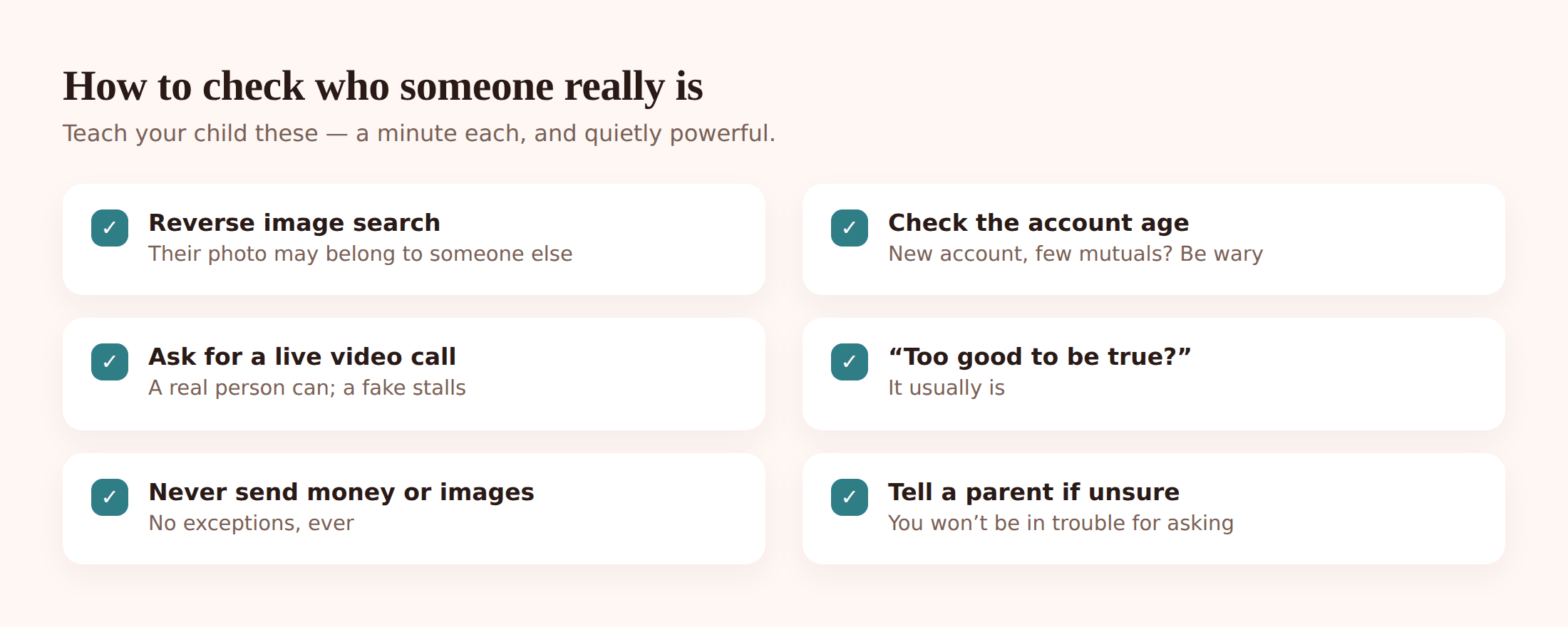
Teach your child these five checks
- Reverse image search the profile photo. Save the picture, drop it into Google Images or a reverse-search tool. If it belongs to a model, an influencer, or a stranger with a different name, that’s your answer.
- Look at the account’s age and links. When did it join? How many mutuals do you actually share? Does anyone your child knows in real life vouch for them? A real person is connected to other real people.
- Ask for a live video call. Not a photo — those can be stolen. A short, live call. Watch how they wriggle out of it. That reaction tells you more than the answer would.
- Be sceptical of “too good to be true.” The older kid who’s suddenly obsessed with them. The “model” who messaged first. If it feels like a fairy tale, treat it like one.
- Never send money or images. Full stop. No exceptions, no “just this once,” no matter how the story is framed. Money and pictures are what the whole thing was built to extract.
Make these normal, not dramatic. A child who reverse-searches a photo out of habit isn’t scared — they’re equipped. And an equipped child is a much harder target. Our piece on how to talk to kids about online safety has more on making these conversations land without the lecture.
When it turns to scams or threats
Catfishing shades into two nastier things, and it helps to name them.
The romance scam. The flattery comes fast, the bond feels real, and then — the ask. A crisis. A phone bill. A plane ticket to finally meet. Money for a friend in trouble. It’s aimed at teenagers as often as adults, and the emotional setup is the con. If someone your child has never met in person is asking for money, the honest answer is that they’re being scammed, whatever the story says.
Sextortion. Sometimes the request is for an image. The moment your child sends one, the tone flips: send more, or send money, or the photo goes to everyone you know. This is a crime, it moves fast, and it terrifies kids into silence and paying — which never makes it stop. If a fake profile turns to threats, treat it as sextortion. Our sextortion guide for parents walks through exactly what to do and say, and it’s worth reading before you ever need it.
The rule that covers both: the moment money or images enter the conversation, it stops being a friendship and becomes a crime in progress. Stop, don’t pay, don’t send, keep the evidence, and get help.
If your child’s been catfished
If it’s already happened, how you react in the first ten minutes matters more than anything. Kids stay quiet because they’re ashamed and afraid of being in trouble. Lead with the opposite.
What to do
- Don’t shame them. This is the whole game. Say plainly: “You’re not in trouble. This person tricked you. That’s their fault, not yours. I’m glad you told me.” Mean it.
- Stop the contact. No more replies, no goodbye message, no final “please leave me alone.” Just stop. Engaging keeps the door open.
- Preserve the evidence first. Before blocking, screenshot the profile, the username, the messages, and any account link. If police or the platform get involved, this is what they’ll need.
- Block and report. Report the account to the platform, then block it. Reporting can get it taken down and protect the next child.
- Involve the police if money, images, or threats are in play. Any of those three, and this is a crime worth reporting. In the UK you can contact your local police, or CEOP for anything involving a child.
- Support them afterwards. Check in over the following days. Kids can carry a lot of quiet embarrassment. Remind them they did the right thing by telling you.
If the person was posing as an adult targeting your child, read our fuller guide on protecting kids from online predators — the reporting steps and support advice there apply directly.
Prevention and the conversation
Most of prevention is boring, and that’s fine. Boring works.
- Accounts set to private. Fewer strangers can see them, message them, or scrape their photos.
- Don’t accept strangers. If your child doesn’t know someone in real life, they don’t need to be a follower or a friend.
- Online friends stay online — or meet in public, with you knowing. The safest answer to “can I meet them?” is usually no. If it’s ever yes, it’s a public place, in daylight, with a parent who knows exactly where they are.
- Above all: they can tell you anything. No phone confiscated as punishment for telling the truth. The child who believes they won’t be blamed is the child who comes to you early, while you can still help.
Tools can help, honestly, but only as a backstop to the talking — not a substitute for it. FreePhoneSpy is a transparent, consent-first parental monitor for an Android child’s phone, run from a web panel. Your child knows it’s there; that’s the whole design. In practice, a couple of things earn their keep here.
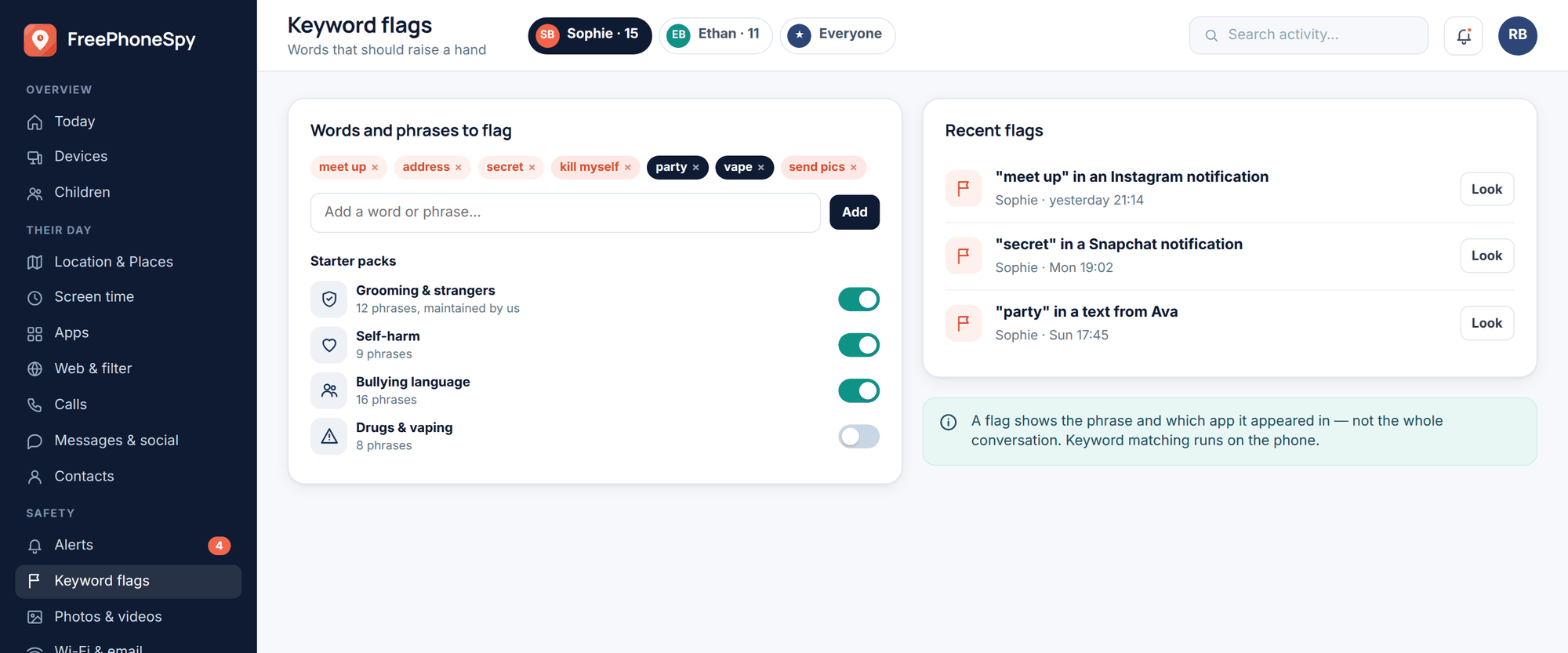
Keyword alerts can flag a worrying word that turns up in a notification, and unknown-number or new-contact flags can hint that a stranger’s arrived. None of that reads your child’s mind or replaces a conversation. What it does is give you a nudge — a reason to say “how are things, anything odd going on?” before a small problem grows.
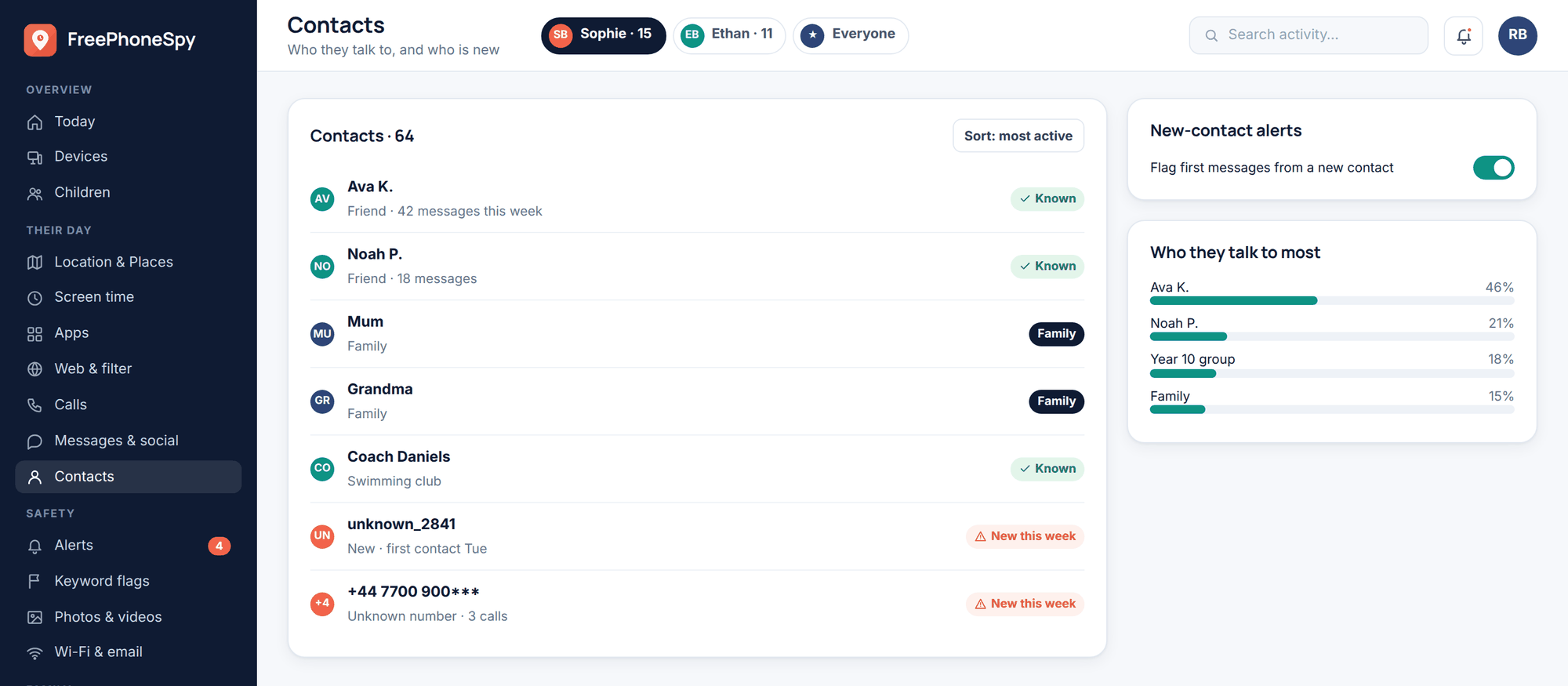
Keep it in proportion. The alert is the small part. The conversation it prompts is the real thing. A child who’s been taught to spot a fake, who checks a photo out of habit, and who knows they can come to you without being punished is protected in a way no app can match.
FAQ
How can I tell if someone is catfishing my child?
Look for the cluster: won’t video call, a thin or too-perfect account, a story that shifts, fast emotional talk, a push to a private app, and any request for images or money. One sign might be nothing. Several together is a strong signal something’s fake.
What age does catfishing start affecting kids?
As soon as a child can message strangers — often around the age they get their first social or gaming account, so from roughly nine or ten upwards. The younger the child, the more it’s on you to set the accounts up safely and keep the conversation open.
Should I read all my child’s messages to catch a catfish?
Reading everything in secret tends to backfire: kids who feel spied on hide more and tell you less. A better approach is openness plus light, agreed prompts — like keyword or unknown-contact flags your child knows about — that give you a reason to ask a question, paired with a relationship where they’ll actually answer.
My child sent a photo to a fake profile. What now?
Stay calm and don’t blame them. Screenshot the account and messages as evidence, stop all contact, then block and report. If there are threats or demands for money, that’s sextortion — report it to the platform and the police, and read our sextortion guide for the exact steps.
What’s the difference between catfishing and grooming?
Catfishing is the fake identity — the mask. Grooming is what an adult does behind it: slowly building trust with a child to exploit them. A catfish isn’t always a groomer, but grooming very often starts with a catfish. Both rely on your child staying quiet, so the fix for both is a child who’ll talk to you.
Are boys catfished too, or mainly girls?
Both, and boys are heavily targeted in image-based scams and sextortion in particular. Don’t assume a son is safe because he’s a boy. The signs and the advice are the same regardless.