How to Talk to Your Kids About Online Safety
The single best safety feature your child has isn’t an app. It’s the belief that they can come to you when something goes wrong, and you won’t lose it. That belief gets built one small, calm conversation at a time — and it protects them long after the phone’s been put away for the night.

Why the conversation beats the lockdown
You can block every app, set every filter, and lock the phone in a drawer at nine. Plenty of parents do. And then the kid borrows a friend’s device, or finds the workaround in an afternoon, and you’ve learned nothing about it because they’re not going to tell you — the rule made them quieter, not safer.
Rules a child doesn’t understand get treated like a lock to pick. Rules a child helped write get treated like an agreement. That’s the whole difference. A limit you’ve explained (“we keep the phone out of the bedroom at night because sleep matters more than a group chat”) is something they can hold onto when you’re not there. A limit you’ve just imposed is a puzzle to solve.
Here’s the part that’s easy to miss when you’re worried: the danger online isn’t usually the thing you blocked. It’s the message that got through, the friend who turned nasty, the stranger who was patient and kind and slowly wasn’t. No filter catches all of that. A child who’ll come to you does. When they say “someone messaged me and it felt weird,” you’ve got a chance to help. When they say nothing because they’re scared of your reaction, you don’t.
So this isn’t a lecture about being permissive. It’s the opposite. The most protective thing in the house is a kid who talks. Everything else — the settings, the agreements, the monitoring — exists to support that, not to replace it. If you want the longer version of that argument, we wrote it up in monitoring vs spying.
The mindset before the words
Before any of the scripts, the posture. Get this wrong and the best-worded talk lands flat.
It’s chats, not a talk. There is no single big sit-down that inoculates a child for life. Nobody remembers the speech. What sticks is the offhand thing you said in the car, the two minutes over breakfast, the comment while you were both watching something. Little and often beats long and rare. Aim for a dozen five-minute chats a year, not one dreaded lecture.
Curious, not interrogating. “Who were you talking to? Show me your phone right now” makes a kid defensive and quiet. “What’s everyone using at the moment? Is that one any good?” gets them talking. You learn far more as an interested person than as border control.
Calm, not panicked. Your child is reading your face for how big a deal this is. If you flinch every time the internet comes up, they’ll conclude it’s a topic that makes you unsafe to talk to, and they’ll take it elsewhere. Keep your voice level even when your stomach isn’t.
Admit you don’t know everything. You don’t need to know what the app is or how the trend works. “I’ve not heard of that — show me?” is a great line. It flips them into the expert, which they love, and it keeps you honest. Pretending to understand a platform you don’t is how you lose credibility fast.
Don’t overreact — ever. This is the big one. The first time your child tells you something scary and you explode, you’ve taught them the cost of honesty. They’ll do the maths and stop telling you. Whatever they say, your first job is to keep your face kind. There’ll be time to problem-solve. There is no second chance at being safe to talk to.
What to say, by age
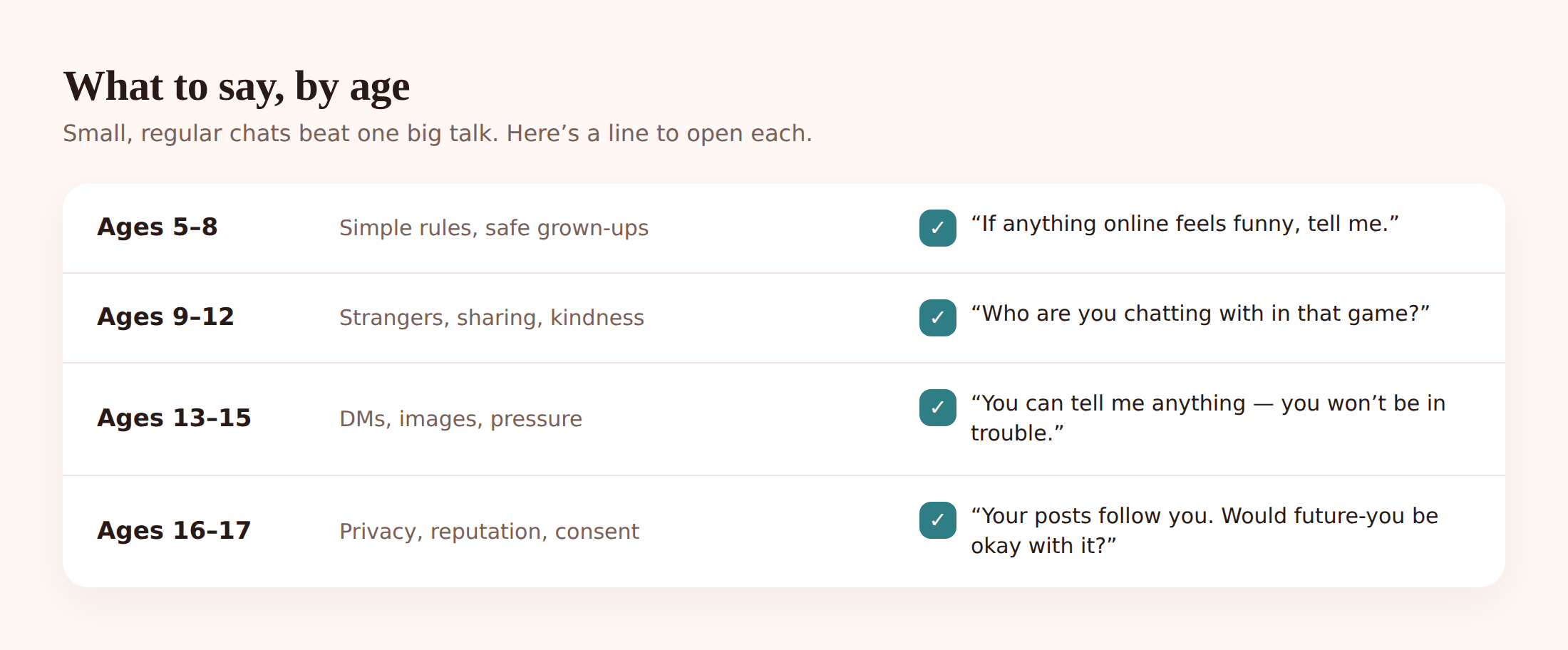
A five-year-old and a fifteen-year-old need completely different conversations. Match the message to where they actually are, not where the packaging on the toy says they should be. If you’re weighing up when monitoring even makes sense, what age to monitor a child’s phone goes into it properly.
Young children (5–8): simple, concrete, no fear
Little kids don’t need the concept of “the internet.” They need a couple of clear rules and one reliable instinct: if something feels wrong, tell a grown-up. Keep it as plain as road-crossing.
“On a tablet, some things are for kids and some aren’t. If you ever see something that makes you feel funny or scared or yucky, that’s not naughty — just come and tell me or Dad. You’ll never be in trouble for telling me. Deal?”
“We don’t tell people we don’t know our name, where we live, or our school. Those are just-for-family things.”
At this age you’re not explaining predators or scams. You’re building the reflex — feels wrong, tell a grown-up — and making sure telling you carries zero punishment. That reflex is the foundation everything else sits on.
Tweens (9–12): strangers, sharing, kindness, passwords
Now the world gets bigger. Games have chat. Friends have phones. This is the age to introduce the idea that people online aren’t always who they say, that things you send don’t come back, and that being kind counts as much on a screen as off it.
“Some people online pretend to be someone they’re not. A person who’s kind and wants to chat privately and asks you to keep it secret from me — that’s exactly the person to tell me about. Not because you’re in trouble. Because that’s my job.”
“Once you send a photo or a message, it’s not yours anymore — the other person has it forever. So the test is: would I be OK if Grandma saw this? If not, don’t send it.”
“Your password is yours. Not even your best friend gets it. Best friends fall out.”
Kindness belongs in this conversation too. The tween who learns “you don’t pile on, you don’t forward the mean thing, you tell me if it gets bad” is less likely to be a bully and better at surviving one. Our cyberbullying guide for parents has the fuller picture.
Early teens (13–15): DMs, images, pressure, comparison
This is the deep end, and you have to wade in. Direct messages, images, the pressure to send them, and the slow ache of comparing your real life to everyone else’s highlight reel. Be direct, be unshockable, and repeat the one line that matters most.
“Someone’s going to ask you for a photo at some point, or send you one. Here’s the only rule that protects you: no image, no leverage. If it doesn’t exist, nobody can use it against you. And if you ever have sent something and it’s being used against you — you come to me. You will not be in trouble. We’ll sort it, together, and I mean that.”
“Everyone online looks like their life is amazing. It’s edited. The girl with the perfect feed cried this week too, you just didn’t see that bit. Your real Tuesday is not losing to somebody’s best angle.”
“Whatever happens — whatever you’ve done, whatever’s been done to you — there is nothing you can tell me that’s worse than you dealing with it alone. Come to me. No matter what.”
Say that last line often enough that it’s boring. You want it lodged in their head for the night at 2am when something’s gone wrong and they’re deciding whether to wake you. If images or pressure are already in the picture, sextortion: what parents need to know is the calm, practical guide.
Older teens (16–17): privacy, reputation, consent, bystanding
They’re nearly adults, and treating them like children now backfires. Shift the conversation from rules to judgement — their digital footprint, the consent that governs other people’s images as much as their own, and their power to defuse a situation rather than film it.
“The stuff you post now has a long tail — universities and employers look. I’m not saying be boring. I’m saying post like future-you is watching, because they are.”
“Consent isn’t just about you. Don’t screenshot and share someone else’s private message or photo. If a mate sends round something of someone else, you’re the person who doesn’t pass it on — and quietly checks the person in it is OK.”
“You’ll be in the room when something’s going wrong online. The good bystander isn’t the one who films it. It’s the one who says ‘leave it’ or tells someone. That’s you.”
The hard topics, gently
You don’t have to be graphic to be useful. In fact graphic is counterproductive — you scare them off the subject. Name the risk plainly, give them the one action that helps, and point to a deeper resource for when you need it.
- Strangers and grooming. The pattern to teach: someone who’s very kind very fast, wants to move the chat somewhere private, and asks you to keep it secret. “Secret from your parents” is the flag. A safe adult never needs you to hide them. More in protecting kids from online predators.
- Bullying. Both directions — being targeted, and being pulled into targeting someone else. The message: you tell me, we don’t fight it alone, and we never pile on. Screenshots help; we keep them.
- Pressure and sextortion. Keep it high-level and keep it warm. “Someone might pressure you for a photo, or threaten you over one. If that ever happens you come straight to me. You won’t be in trouble, and we will fix it.” That’s the whole script for most kids — the reassurance, not the detail.
- Scams. Free skins, prize messages, “your account will be deleted, click here,” a friend suddenly asking for money or a code. Teach the pause: if it’s urgent and it wants something, slow down and ask me. Urgency is the con.
Notice what all four have in common. The action you’re teaching is the same one every time: come to me, you won’t be in trouble. That single reliable response covers more ground than any specific rule.
Keeping the door open
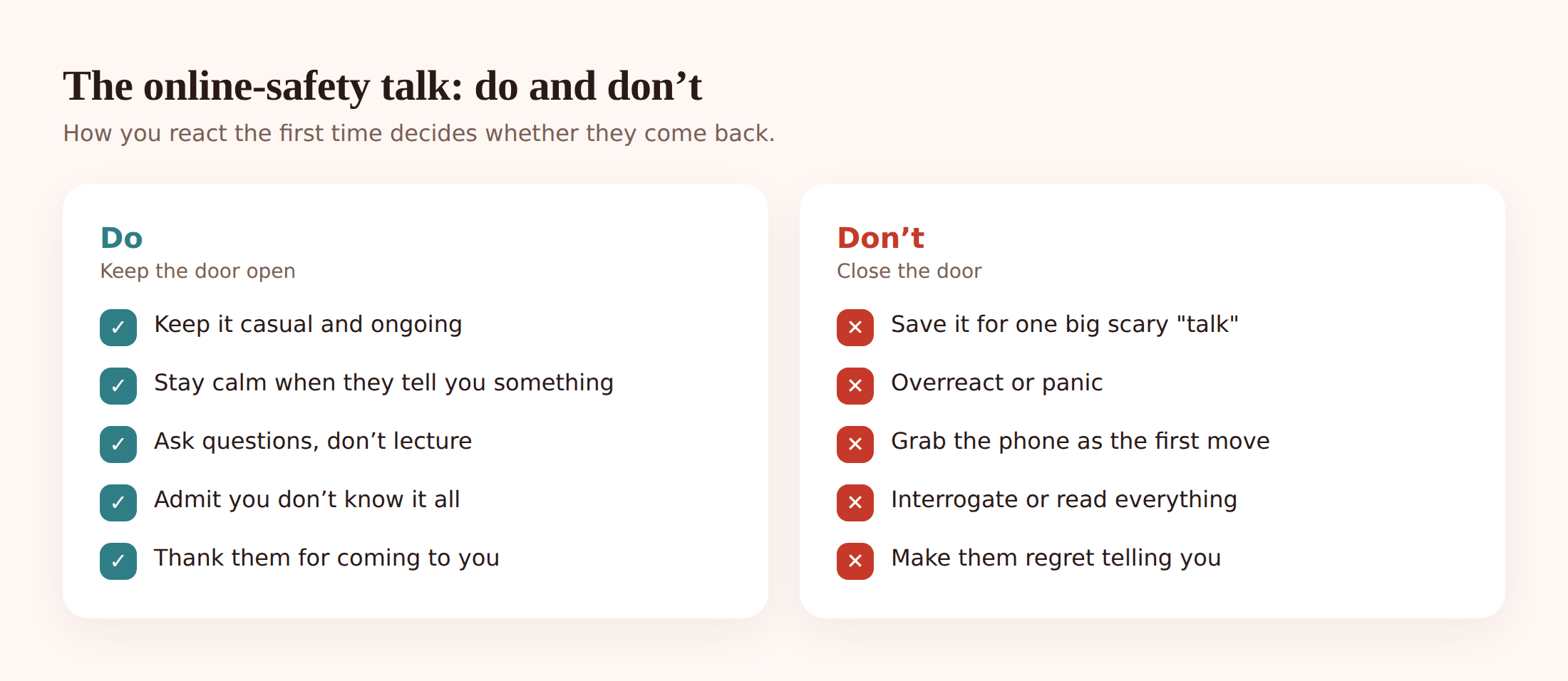
Everything above buys you one thing: a child who tells you. It’s worth almost nothing if you slam the door the first time they use it. So the moment they come to you actually matters more than any prevention you did beforehand.
React calmly. Your face first, your feelings later. Whatever you’re screaming inside, the outside says “OK. Thank you for telling me. Let’s have a look.” Panic is contagious and it teaches silence.
Thank them, out loud. “That took guts to tell me. I’m really glad you did.” You are reinforcing the exact behaviour you want more of. Reward the telling and you’ll get more telling.
Problem-solve together, don’t take over. Ask “what do you want to happen here?” before you charge in. A teen who’s part of the fix stays part of the conversation. A teen who gets rescued against their will learns not to report next time.
Don’t confiscate the phone as the reflex punishment. This is the mistake that quietly does the most damage. If honesty costs a kid their phone, honesty becomes a bad trade. Separate the safety response from any consequence, and be explicit: “You’re not losing your phone for telling me the truth. That’s not how this works.” The phone is where the next problem will surface too — you don’t want it taken off the table.
Pairing talk with tools, honestly
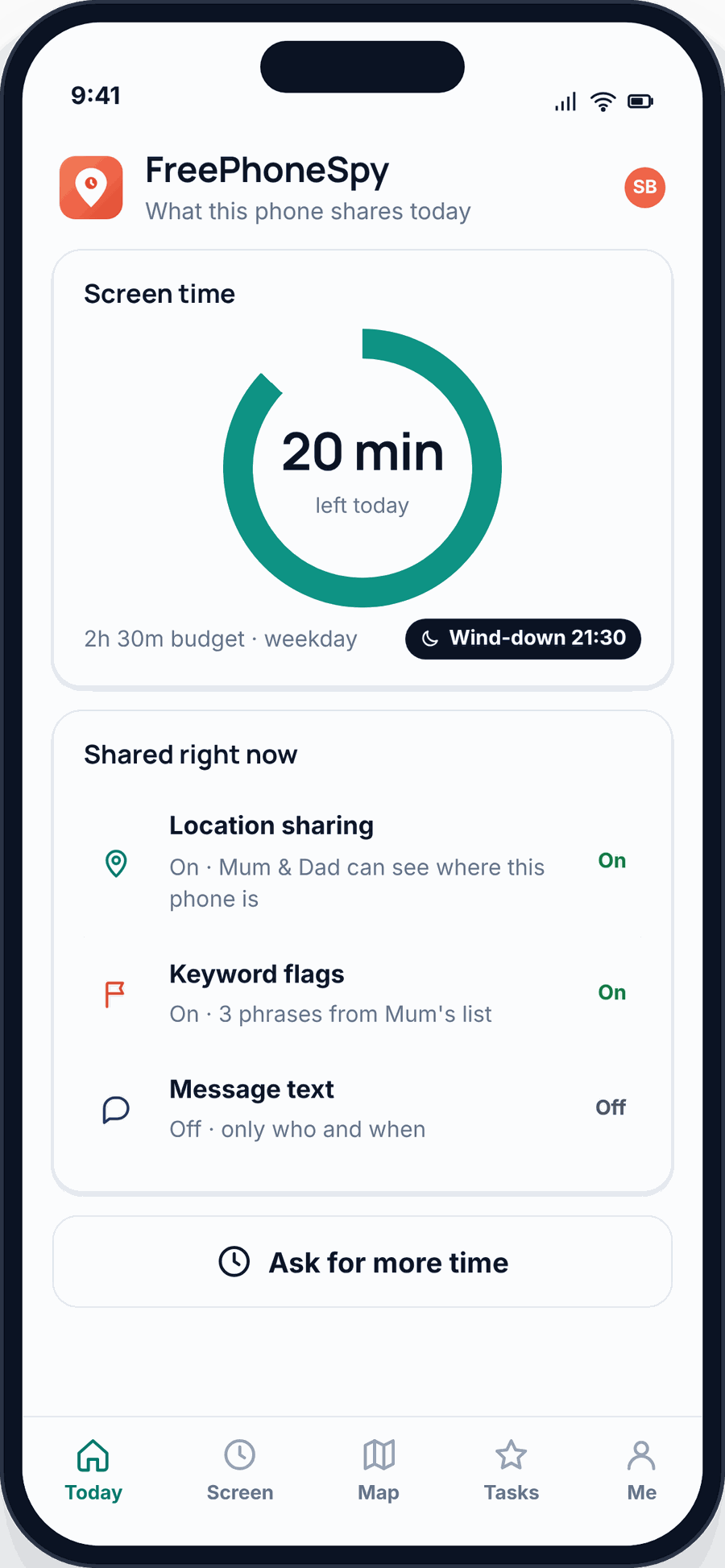
Tools have a place. Just not the one they’re usually sold for. They don’t replace the conversation and they can’t manufacture trust. What they can do, when everyone knows they’re there, is back up the rules you agreed together and catch the thing you’d otherwise miss.
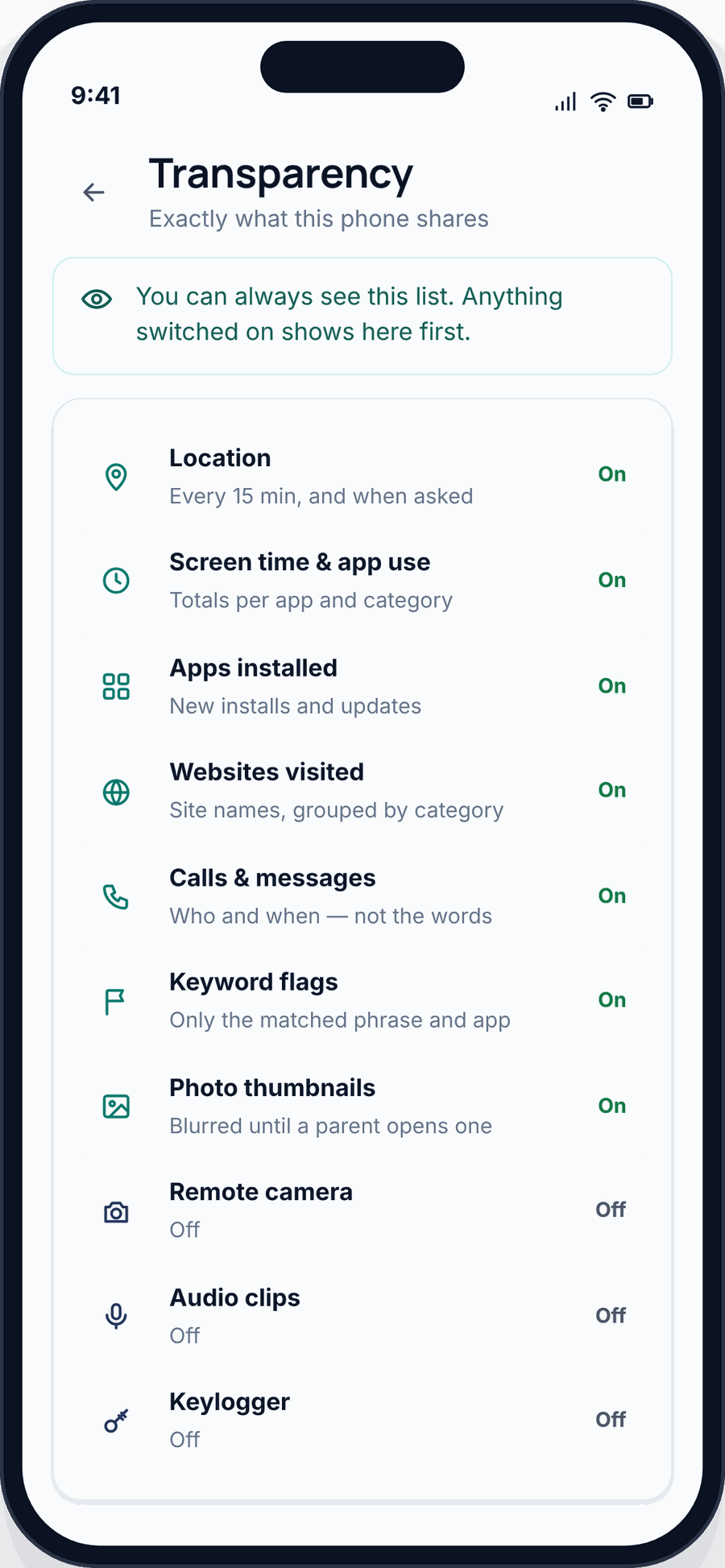
Two ideas do most of the work. First, agree the rules together and write them down — a family phone agreement turns “because I said so” into a deal both sides signed. Kids follow rules they helped make. Second, if you do monitor, the child knows about it. Openly. That’s not a loophole in the surveillance; it’s the entire point. Covert monitoring, if it’s found — and it usually is — teaches a child that trust is a thing that gets taken. Open monitoring, agreed as part of the deal, does the opposite.
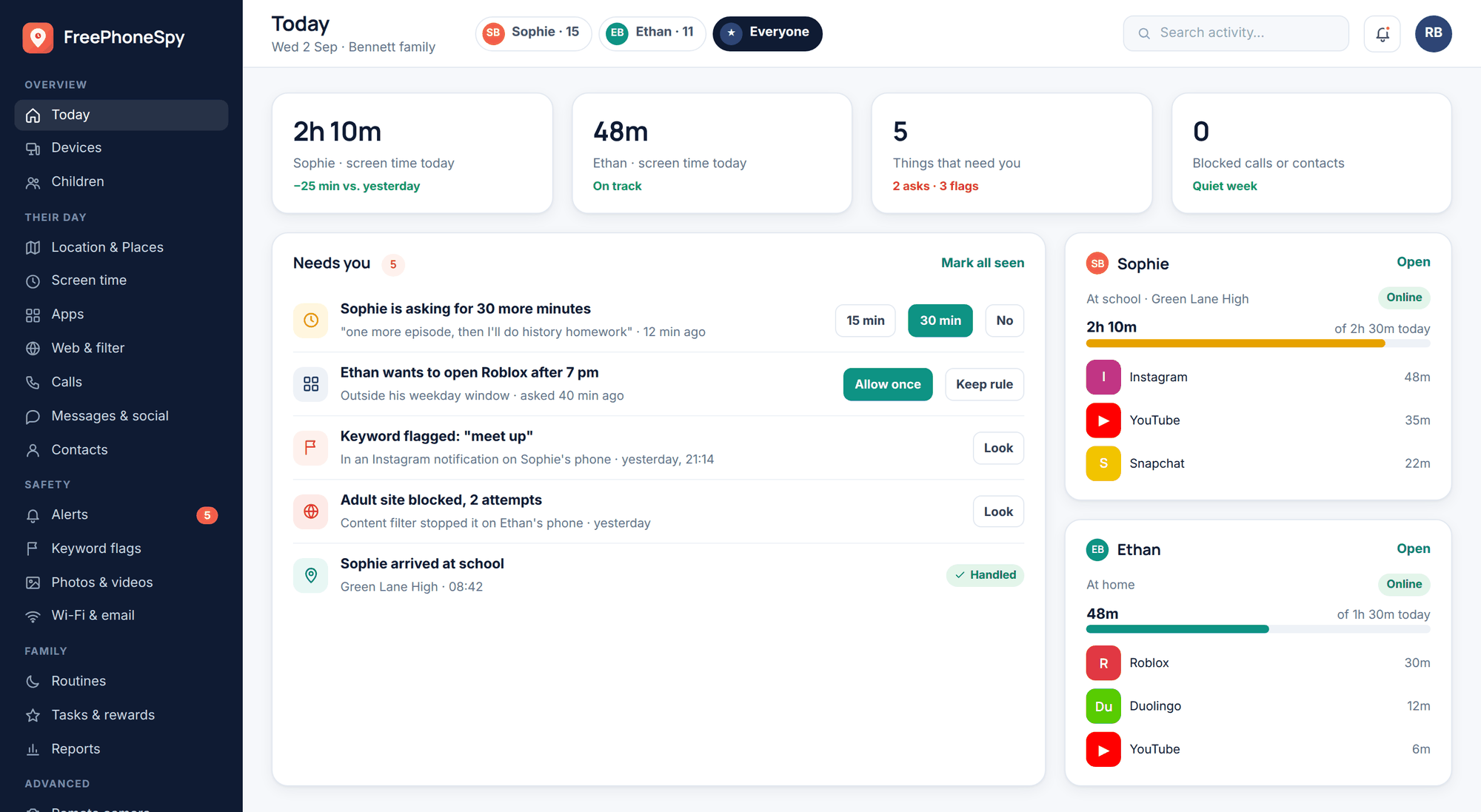
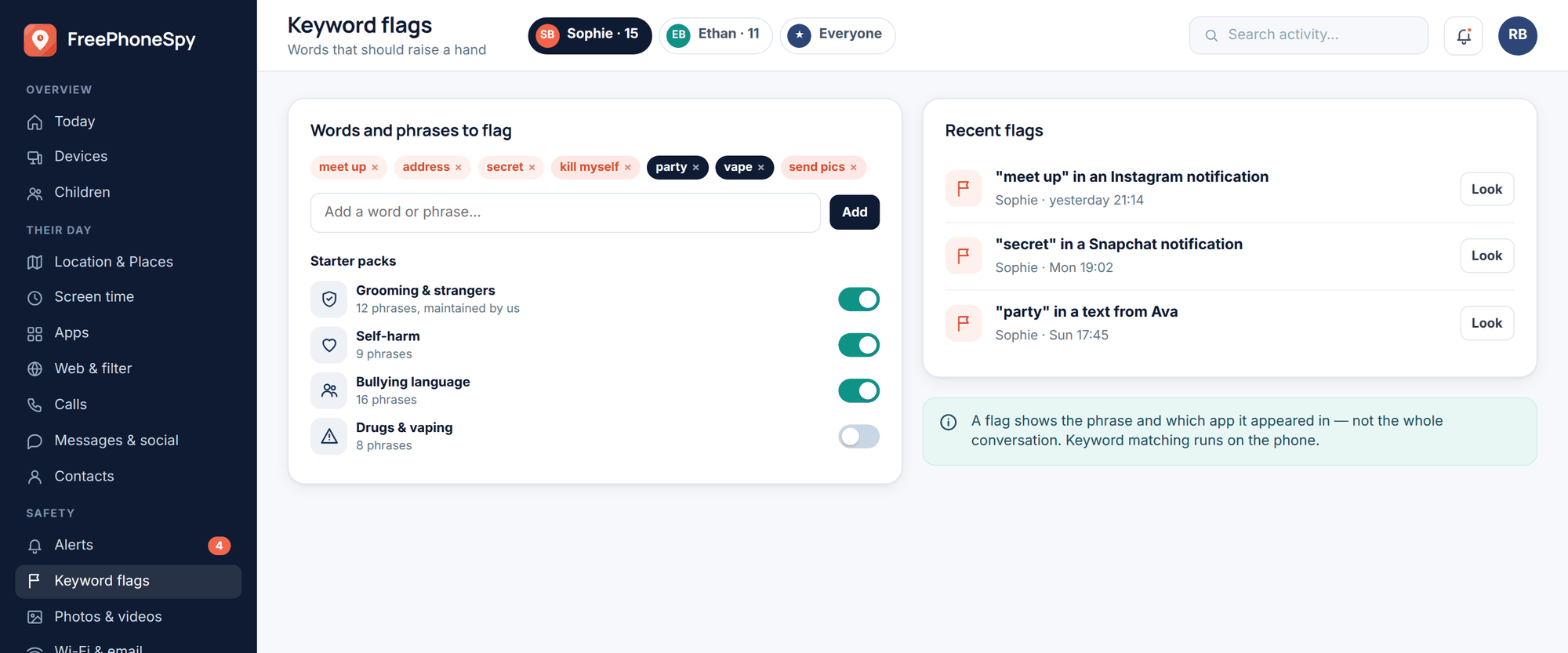
That’s the honest pitch for what we make. FreePhoneSpy is transparent, consent-first monitoring for a child’s Android phone, run from a simple web panel — and the child can see it’s there. It’s a backstop for the conversation, not a substitute. It’ll flag the things worth a chat; it won’t do the chatting for you. It’s free to start and kept free through occasional tasks. If your child’s on an iPhone, Apple’s own Screen Time and Family Sharing tools are the honest place to look. Whatever you use, the rule holds: nothing your child doesn’t know about.
Conversation starters for tonight
You don’t need to schedule a summit. Drop one of these into the next ordinary moment — the car, the washing-up, the ad break — and just listen to the answer.
- “What’s the app everyone’s on right now? Is it any good, or a bit much?”
- “Has anyone ever sent you something that made you go ‘ugh, why did you send me that’?”
- “If a stranger messaged you online, what would you actually do?”
- “Do you know anyone who’s been picked on in a group chat? You don’t have to name them.”
- “What’s the most ridiculous thing you’ve seen online this week?” (This one’s a door-opener — start light, follow where it goes.)
- “Is there anything online that’s ever worried you a bit? Even a small thing?”
- “You know you can tell me anything, right? Even the stuff you think I’ll be cross about — especially that stuff.”
If they shrug, that’s fine. You’ve made the topic normal and shown the door’s open. That’s the win. Try again next week.
FAQ
At what age should I start these conversations?
As soon as they’re using a screen with anyone else on the other end — often five or six. You’re not discussing predators with a six-year-old. You’re building one habit: feels wrong, tell a grown-up, never in trouble for telling.
My child clams up whenever I bring this stuff up. What do I do?
Stop bringing it up as a Topic. Sit alongside instead of across — the car and the kitchen work because there’s no eye contact and an easy exit. Ask about the fun stuff first, keep it short, and let a shrug be a fine answer. You’re playing a long game.
Isn’t monitoring their phone a betrayal of trust?
Covert monitoring is — that’s the whole problem with it. Open, agreed monitoring the child knows about is the opposite: it’s a rule you set together, out in the light. The betrayal is the secret, not the tool. We laid the difference out in monitoring vs spying.
What if they tell me something genuinely serious?
Keep your face calm, thank them, and don’t act unilaterally in the first minute — ask what they want to happen. Take a breath before you take the phone or ring anyone. For the heavy topics — grooming, sextortion, serious bullying — the deeper guides walk through the actual steps, and for anything involving a crime or a child’s immediate safety, involve the police or a helpline.
Should I read all their messages?
Usually no. Constant reading is the thing that erodes trust fastest, and it drowns you in noise. Agree what you’ll look at and when — more oversight for a young tween, far less for a sixteen-year-old — and treat alerts as a nudge toward a conversation, not a licence to read everything.
They’re on an iPhone. Does your app work?
No — FreePhoneSpy is Android only. On iPhone, use Apple’s built-in Screen Time and Family Sharing. The conversation in this article matters just as much either way; the tool is the smaller half.