Sextortion: What Every Parent Needs to Know
If your child is being threatened over an image, take a breath. This is happening to a lot of families, the people behind it are practiced criminals, and your child is not the one who did something wrong. There’s a clear, calm way through it, and you can start right now.

What sextortion actually is
Sextortion is a type of blackmail. Someone tricks or pressures a young person into sending an intimate image of themselves. Then they turn on them. They threaten to send that image to the child’s friends, family, or whole school unless the child pays money or sends more.
That’s the whole cruel mechanism. Get one image, then use fear to demand more. The threats can arrive within minutes, and they’re designed to feel like the sky is falling.
There are two common shapes to it. One is financial. Offenders, often working in organised groups, set up fake accounts and go after teens for money. The other is coercion, where the person wants more images or control rather than cash. In both cases the tactics are similar, and in both cases the young person is the victim of a crime.
Law enforcement agencies on both sides of the Atlantic have warned that these offences have risen sharply and are now a serious, everyday online threat to teenagers. It helps to know that going in, because the more normal this feels to name out loud, the easier it is for a frightened child to say it happened to them.
How offenders operate
You don’t need the technical details to spot the pattern. From the outside, it tends to look the same each time.
It starts with a fake profile. Often it’s built to look like an attractive peer, sometimes a stranger who’s suddenly very interested. The flattery comes fast. Lots of attention, lots of warmth, a quick sense of a special connection. That speed is the point. It’s meant to lower a young person’s guard before they’ve had time to think.
Next comes a nudge to move somewhere more private. A different app, a direct message, a video chat, somewhere the conversation feels sealed off. Then the pressure to share an image, sometimes after the offender sends one first (which may itself be fake or stolen).
The moment they have something, the tone flips. Warmth turns to threats. There’s urgency: pay in the next hour, send another now, or everyone sees. They may name your child’s friends to prove they’ve done their homework. It’s frightening by design, and it’s built to stop a young person from pausing long enough to tell an adult.
Naming this pattern for your child, calmly, before anything happens, is one of the most useful things you can do. If they recognise “fast flattery, then a private app, then pressure” as a known trick, they’re far more likely to stop and come find you.
A note on how we talk about this. We’re keeping every description here high level on purpose. A protective conversation with your child doesn’t need graphic detail either. What children need is the shape of the danger and the certainty that you’re a safe place to bring it.
Who gets targeted
Any child can be targeted. This is worth sitting with, because a lot of parents quietly assume it only happens to a certain kind of teen, and that assumption is exactly what offenders rely on.
Boys and girls are both targeted. Financial sextortion in particular has hit a lot of teenage boys, who may feel there’s no one they can tell. The people running these schemes are experienced. They approach many young people at once, they have scripts, and they know precisely which fears to press.
So please hold onto this and say it to your child in plain words: it is not their fault. They were manipulated by someone who does this deliberately and often. A young person who sent an image was tricked, not reckless. Shame is the offender’s best weapon, and it’s the first thing you can take away.
Warning signs to watch for
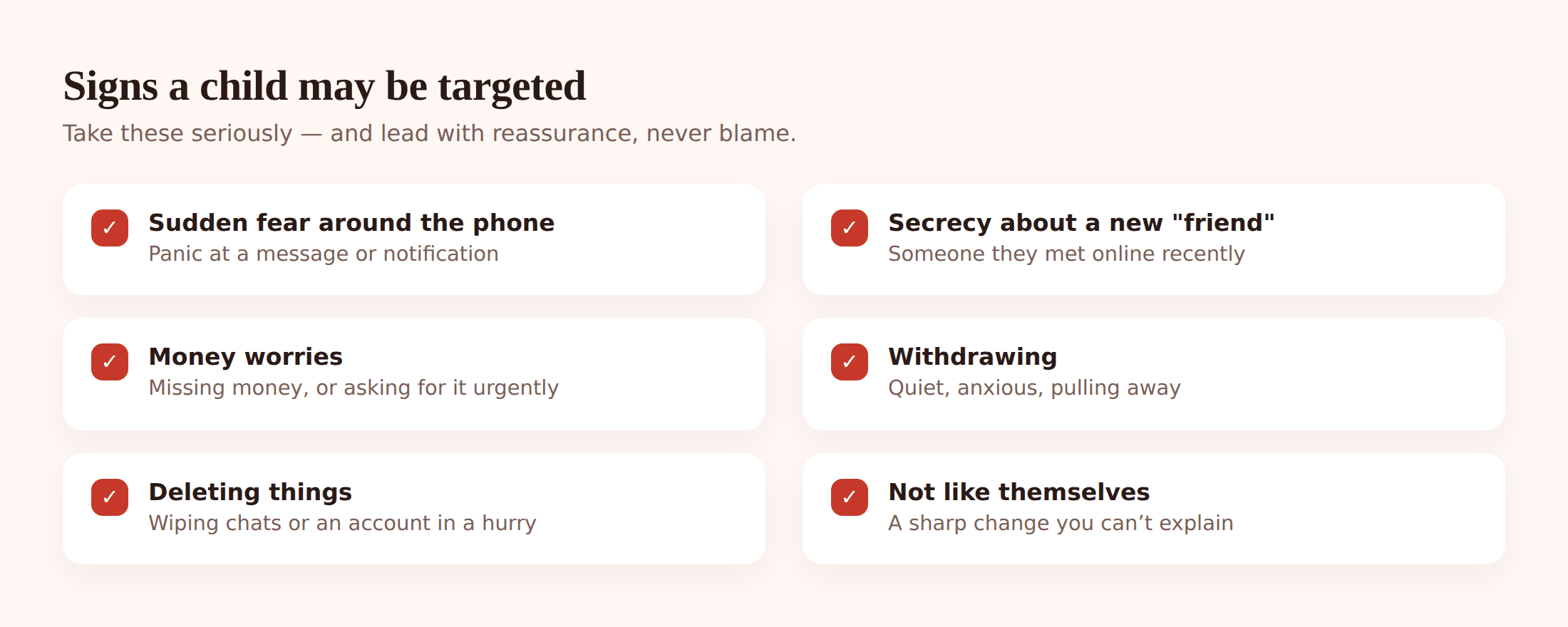
Sextortion moves fast, so changes can appear suddenly rather than building over weeks. None of these alone proves anything, but together they’re worth a gentle, caring check-in.
- Sudden fear, panic, or distress when a message arrives.
- New secrecy around the phone — turning it face down, leaving the room, guarding the screen.
- Withdrawing, going quiet, or seeming frightened for no clear reason.
- Money worries, or money going missing, including gift cards or requests to borrow.
- Talk of a new online “friend” they’ve only just met.
- Suddenly deleting messages, apps, or an account.
- Trouble sleeping, or a big drop in mood or appetite.
If you notice a cluster of these, don’t lead with an accusation. Lead with, “You seem worried lately, and whatever it is, I’m on your side. You can tell me anything.” For more on reading behaviour changes, see our guide on the signs a child’s phone needs monitoring.
What to do right now
This is the part that matters most. If it’s happening tonight, this is the plan. Read it once, then work through it with your child beside you, not at them.
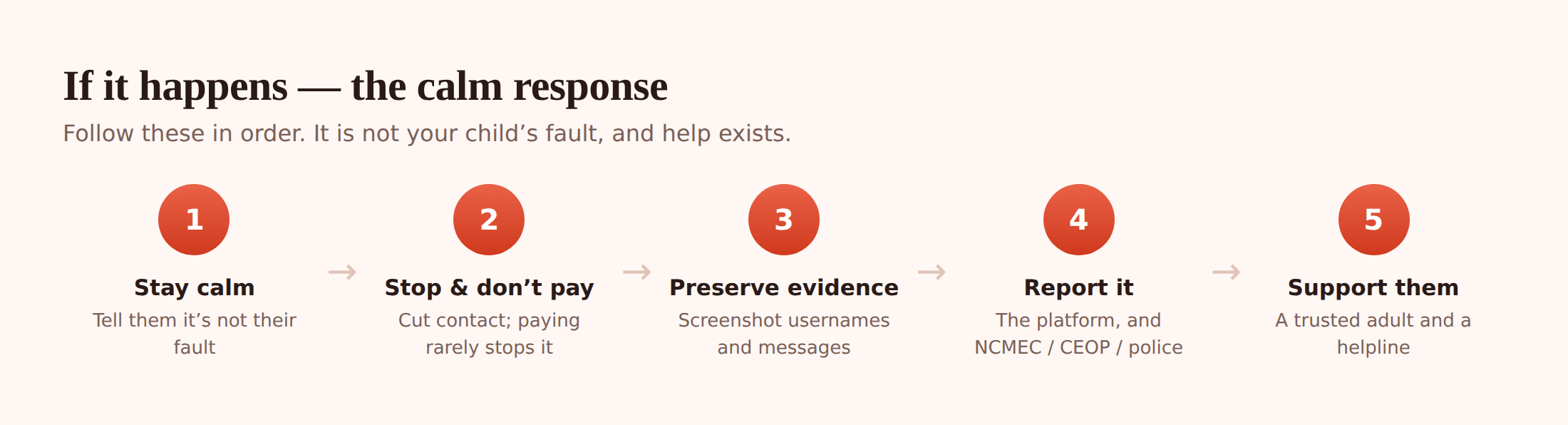
If your child is being threatened right now:
- Stay calm and tell them it’s not their fault. Your reaction sets the tone. Relief that they told you, not anger.
- Stop all contact. Don’t pay, and don’t send anything more. Paying rarely stops it — it usually invites more demands. Block, but don’t delete yet (see next step).
- Preserve the evidence. Screenshot the messages, usernames, profiles, and any payment demands. Don’t delete the account or the conversation yet; it helps the people who can act on it.
- Report it. Report the account to the platform, and report to the authorities and child-safety services (details below).
- Get support for your child. A trusted adult, your GP or a counsellor, and a helpline your child can talk to directly.
Where to report and get images taken down
In the US: Report to the NCMEC CyberTipline at report.cybertip.org, and use NCMEC’s Take It Down service, which is built to help remove intimate images of people who were under 18. You can also contact the FBI or your local police.
In the UK: Report to CEOP through the CEOP Safety Centre, and use the IWF’s Report Remove tool (run with Childline) to get images of under-18s taken down. Call the police on 101, or 999 in an emergency.
Your child can also reach a helpline directly — in the UK, Childline is free and confidential for young people. Services vary by country, so if you’re elsewhere, contact your local police and your national child-protection or child-safety organisation.
One honest note on confidentiality. Helplines are a safe, supportive place to talk, but where a child is at risk, adults and services may need to act to keep them safe. That’s a good thing. It’s better to promise your child support and safety than total secrecy you might not be able to keep.
Prevention and the open conversation
You can lower the risk a lot, and almost all of it comes back to trust rather than tech. Still, a few practical habits help.
- Keep social accounts private, and treat friend requests from strangers as a no.
- Talk about the “no image, no leverage” idea: an intimate image once sent can’t be pulled back, so the safest move is never to send one, no matter how much someone pushes.
- Name the pattern out loud — fast flattery, a push to a private app, then pressure — so it’s recognisable.
- Agree the golden rule: if anything online turns scary, they come to you, and there’s no punishment for telling.
That last point does the heavy lifting. Offenders survive on a child’s silence, and silence grows in homes where a young person expects to be blamed. If your child believes, deep down, that you’ll help rather than shame them, you’ve removed the offender’s main advantage. Our guides on social media safety for kids and protecting kids from online predators go further on building those habits.
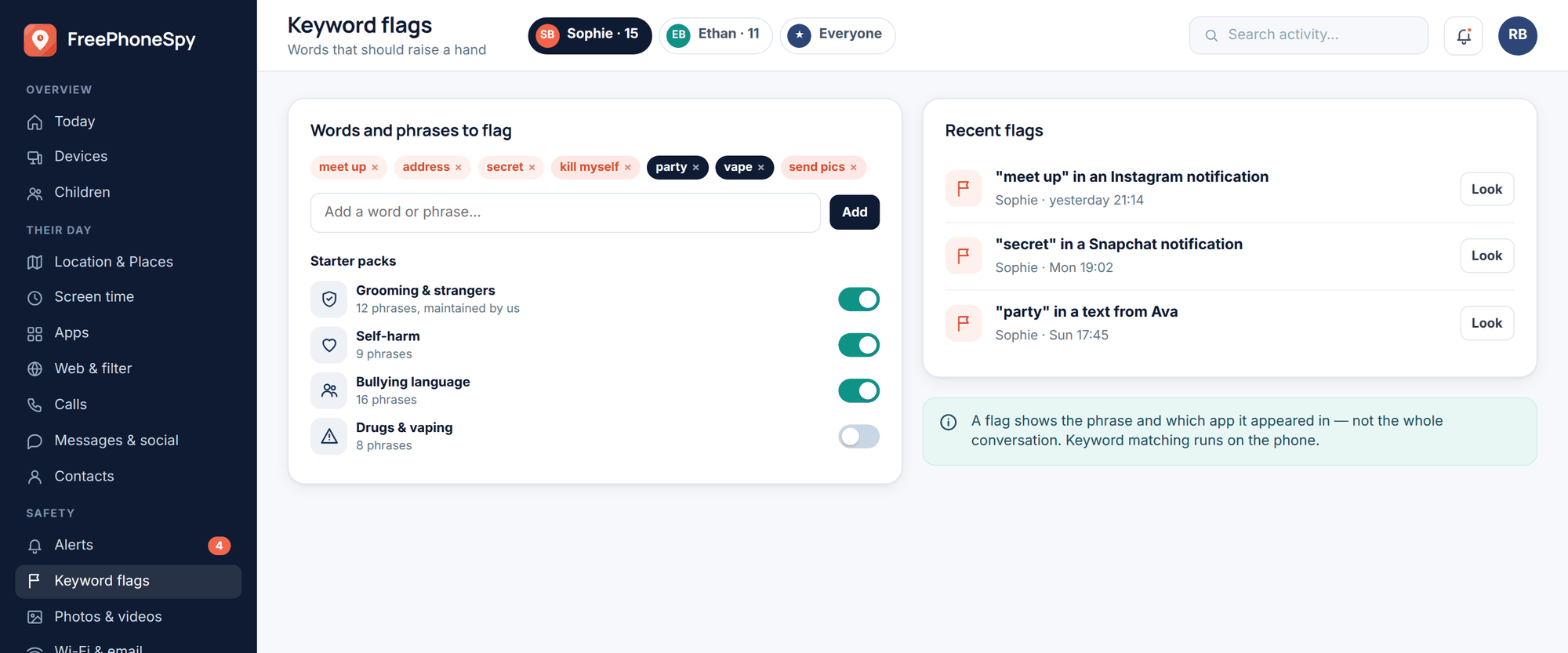
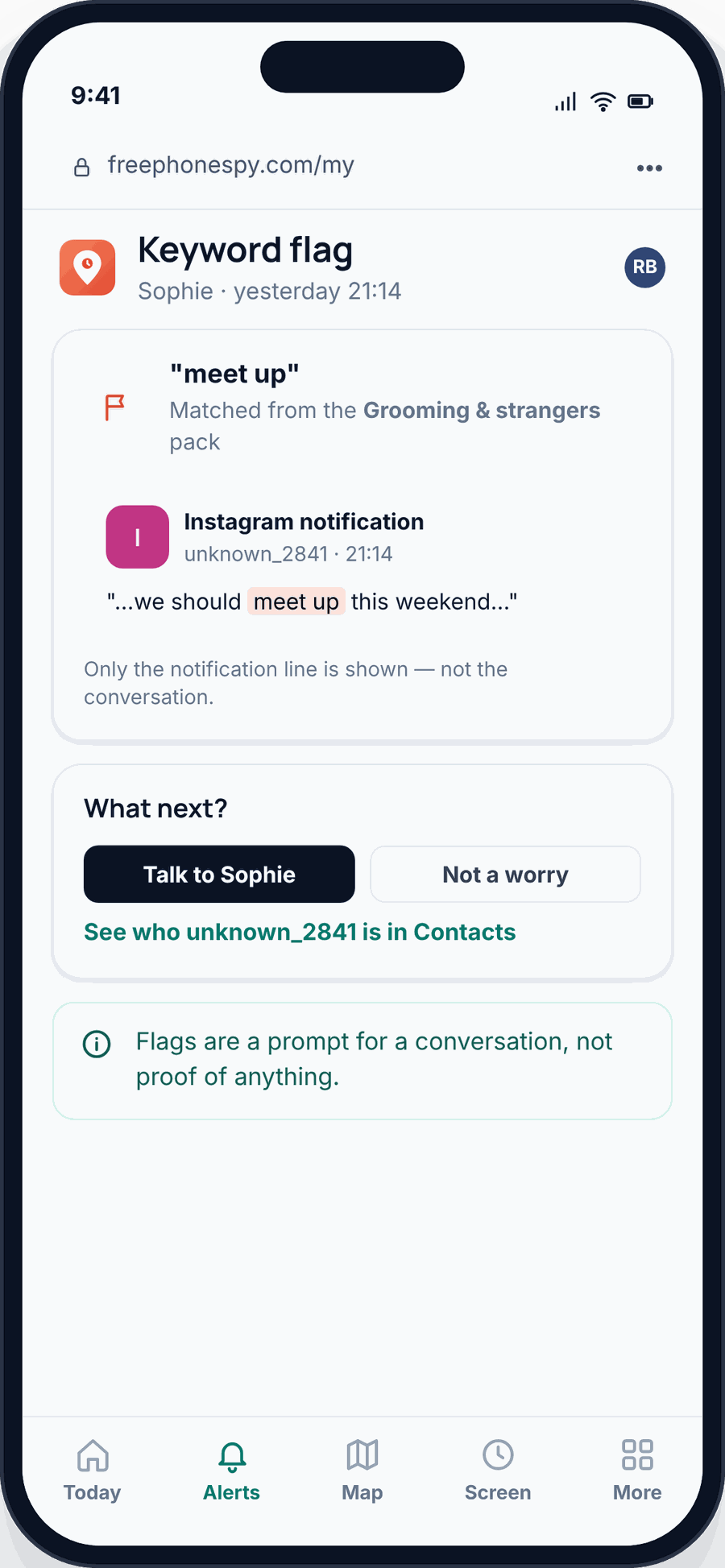
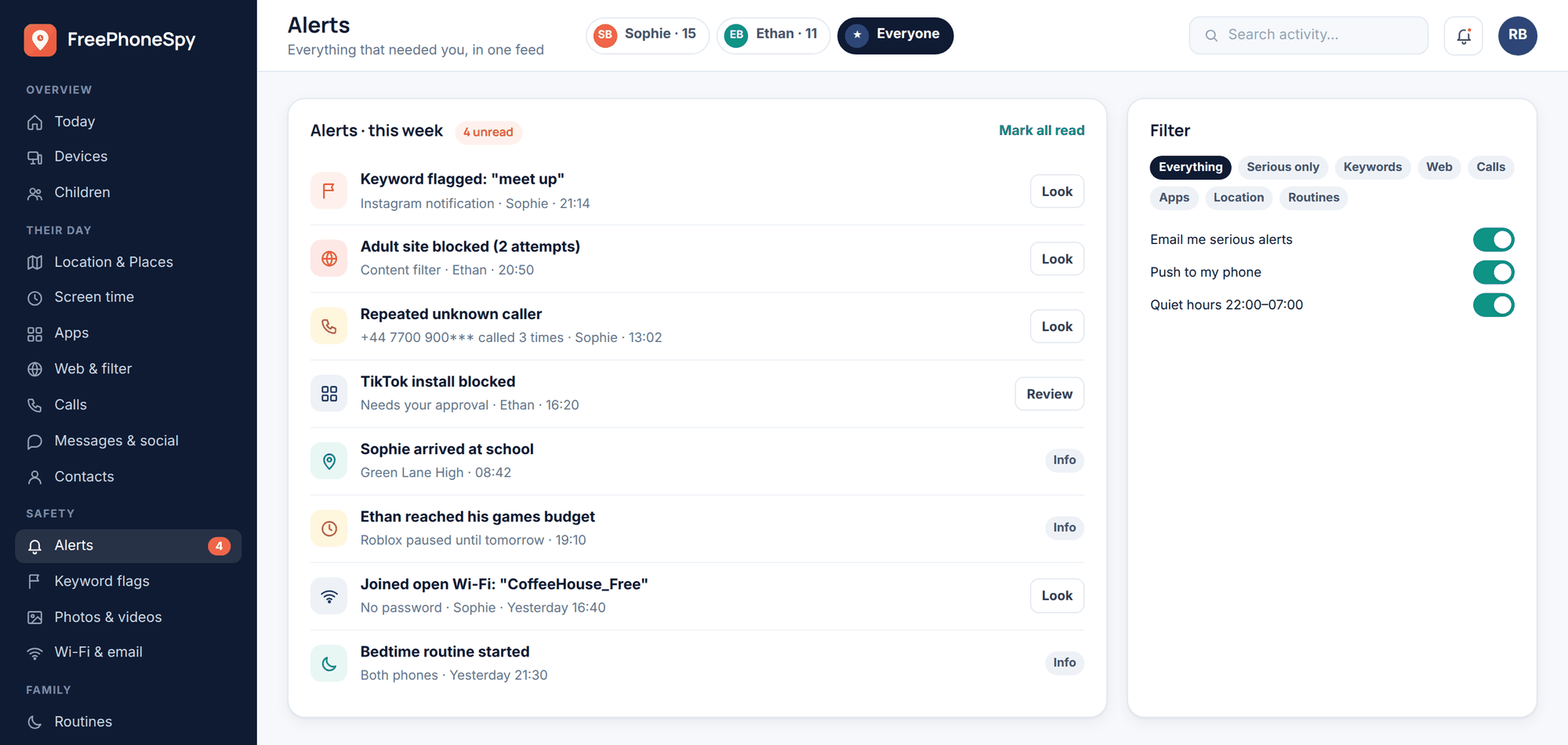
Where transparent monitoring fits — honestly. Tools can help a little, but they aren’t the protection. The protection is the conversation. FreePhoneSpy is a consent-first, transparent monitor for a child’s Android phone: it’s set up openly, your child knows it’s there, and keyword alerts can flag worrying words in notifications so a problem surfaces sooner. Used in the open, that kind of setup supports trust rather than replacing it. Used in secret, it does the opposite. Keep it visible, keep talking, and let the tool be the smoke alarm, not the babysitter.
Reassurance: it can be undone
If you’re in the middle of this right now, here’s what you most need to hear. There is real help, and this does not have to define your child’s life.
Intimate images of minors can be reported and taken down. Services like Take It Down and Report Remove exist precisely for this. Law enforcement takes these crimes seriously and would far rather hear from you early than late. And children recover. With a calm adult beside them, honest support, and often some counselling, young people come through this and go on to be okay.
It also helps to keep the long view in mind. In the first hours everything feels permanent and public, but that’s the fear talking, not the reality. Most of these threats are never carried out, and the ones that are can be reported, chased, and taken down. Give it a few days of calm, steady action and the ground usually starts to feel solid again.
The threats feel enormous in the moment. They’re meant to. But you’re not powerless, your child isn’t alone, and the worst thing the offender counted on — silence — is already broken the moment you’re reading this together.
Common questions
Should we just pay to make it stop?
No. Paying rarely ends it and usually leads to more demands, because it tells the offender the threats are working. Stop contact, preserve the evidence, and report instead.
My child already deleted everything. Is it too late to report?
No. Report it anyway. Any details you still have help — usernames, the app it happened on, screenshots you took, rough times. Going forward, ask your child not to delete further messages so evidence is preserved.
How do I bring it up without my child shutting down?
Lead with safety, not questions about what they did. Try: “You seem really worried, and I love you no matter what. If something scary is going on, we’ll sort it out together and you’re not in trouble.” Then listen more than you talk.
Could this really happen to my child?
Yes, to any child, boys and girls alike. The people behind it are practiced and approach many young people at once. That’s not a reason to panic — it’s a reason to talk about it openly before it ever comes up.
Where can my child get support if they don’t want to talk to me first?
A helpline like Childline in the UK is free and confidential for young people, and a school counsellor, GP, or trusted relative can help too. What matters is that they talk to someone safe. Many children find it easier to open up to you afterwards once they’ve said it out loud once.