How to Protect Your Kids From Online Predators
A stranger rarely arrives looking like a stranger. To a child, they turn up as a friendly player in a game, a funny account that likes their posts, a “fan” who says exactly the right thing. Most kids will never meet anyone who means them harm. But the ones who do are usually approached the same handful of ways, and those ways are learnable. Once you can see the pattern, you can talk about it with your child before it ever matters, and you can notice the early signs if it does.
- How do predators actually approach kids today?
- What are the warning signs a parent can notice?
- What does grooming look like, step by step?
- What can open monitoring actually help with?
- What should I actually say to my child?
- What if I find something worrying?
- Which prevention habits genuinely work?
- Why does doing this openly matter?
- Common questions
How do predators actually approach kids today?
They go where kids already are. That means game chats, group servers, and the comments and DMs on the apps your child uses every day. Roblox and Minecraft have in-game chat. Discord servers gather thousands of strangers around a shared interest. Instagram, TikTok and Snapchat let anyone message anyone. None of these apps are the problem on their own. They’re just the front door.
The opening move is almost always friendly and low-pressure. A new “friend” compliments your child’s build, their art, their gaming skill. They’re attentive in a way that feels flattering, especially to a kid who’s a bit lonely or bored. Then, quite early, comes a small push: “This chat’s rubbish, let’s talk on Snapchat” or “Add me on Telegram.” That move off the public, moderated platform onto something more private is one of the clearest signals there is. It takes the conversation somewhere adults can’t see and messages disappear.
From there the tempo picks up. Fast intimacy — “you’re not like other kids,” “you’re so mature,” “I feel like I can tell you anything.” Small gifts or offers: game currency, Robux, a gift card, a promise of followers. And a steady drift toward secrecy: “our little thing,” “don’t tell your mum, she wouldn’t get it.” Eventually, a request for a photo. It’s rarely blunt at first. It starts ordinary — “send a selfie” — and escalates.
What are the warning signs a parent can notice?
Some signs are behavioural and you’ll spot them at the kitchen table. Some sit on the phone. Neither one alone proves anything. It’s the combination, and the change from your child’s normal, that matters.
In behaviour, watch for a child who becomes secretive about the phone — angling the screen away, quickly switching apps, going quiet when you walk in. New emotional highs and lows tied to messages. Being online at odd hours. Mentioning an online “friend” who is older, or whose details never quite add up. Suddenly having money, credit or in-game items you didn’t give them.
On the phone itself, the tells are more concrete:
- A new contact saved under a single first name, a nickname or just emojis.
- An unknown number that messages a lot, especially late.
- A brand-new messaging app appearing without explanation.
- Messages clustered at 1am or 3am.
- A “friend” who wants to move the chat somewhere more private.
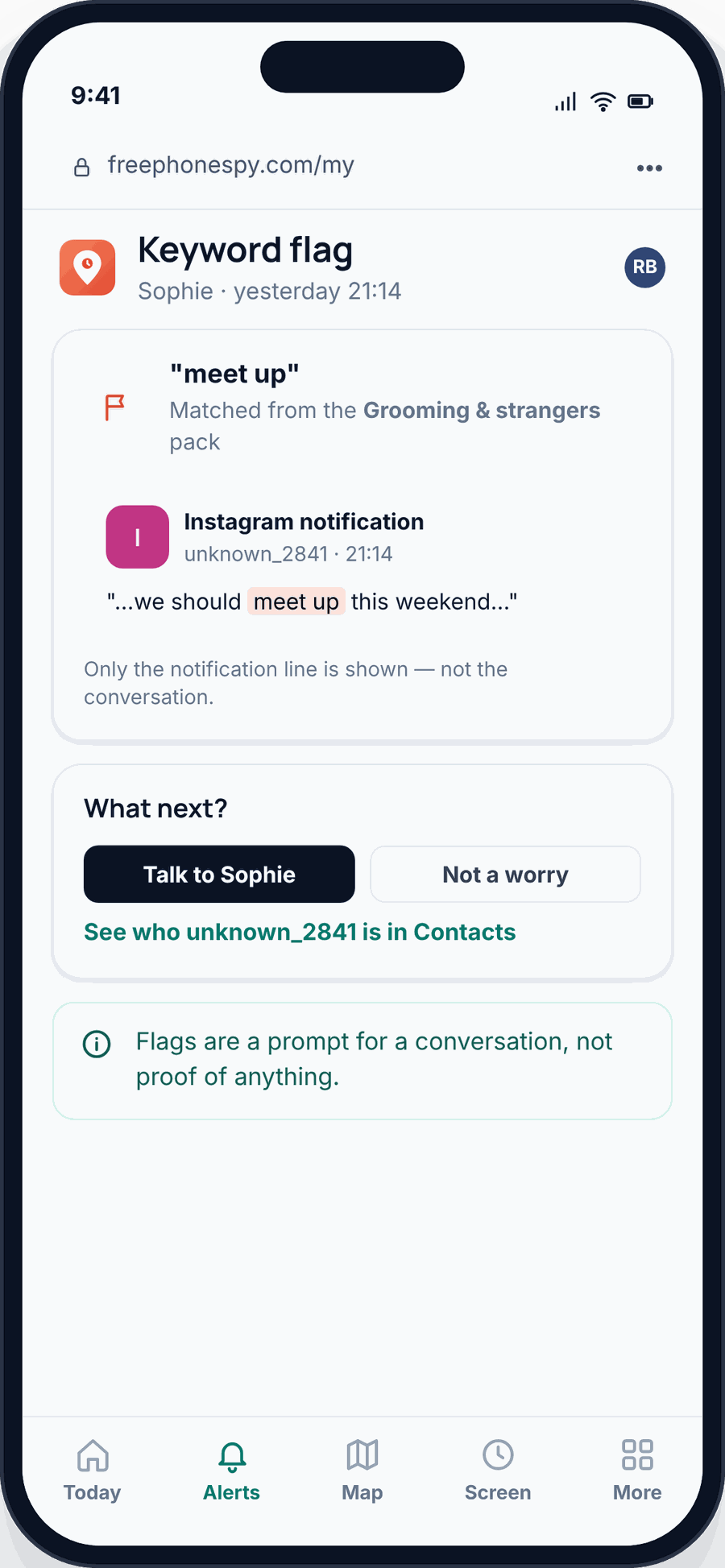
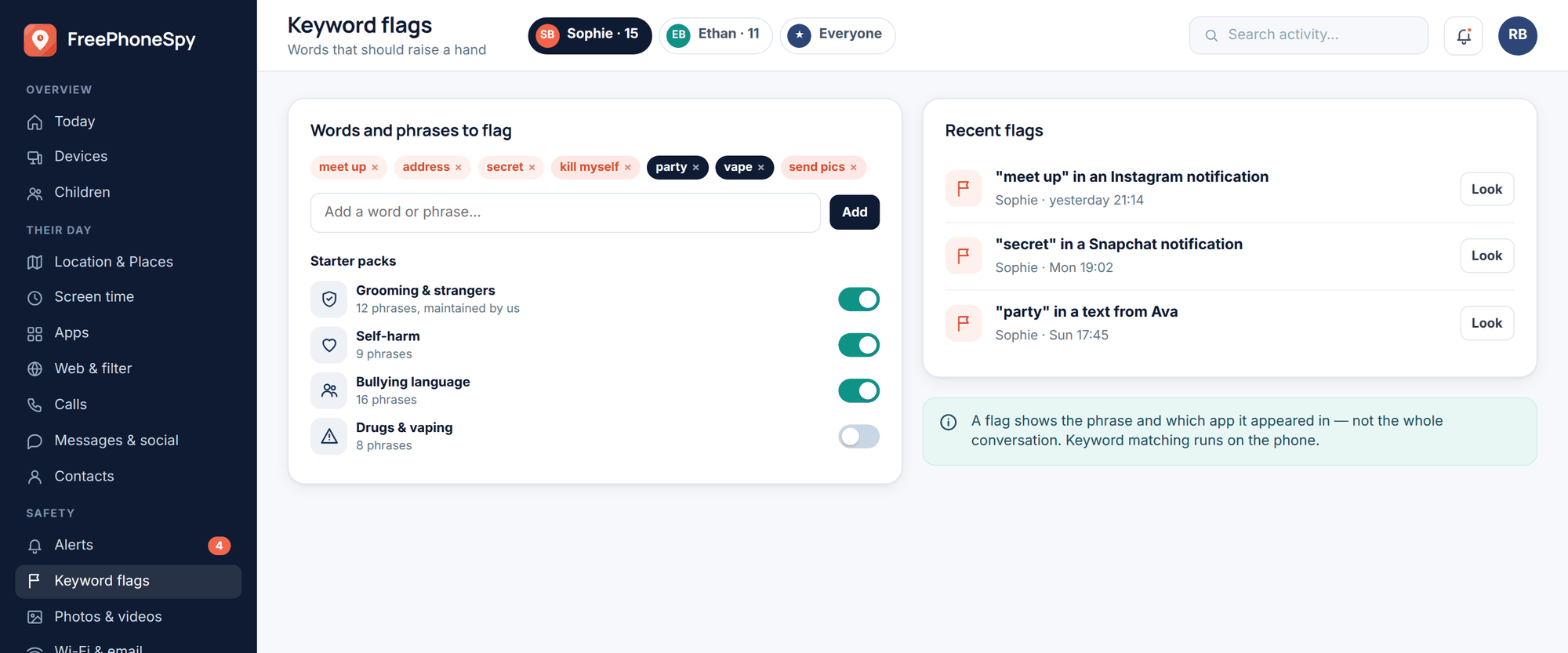
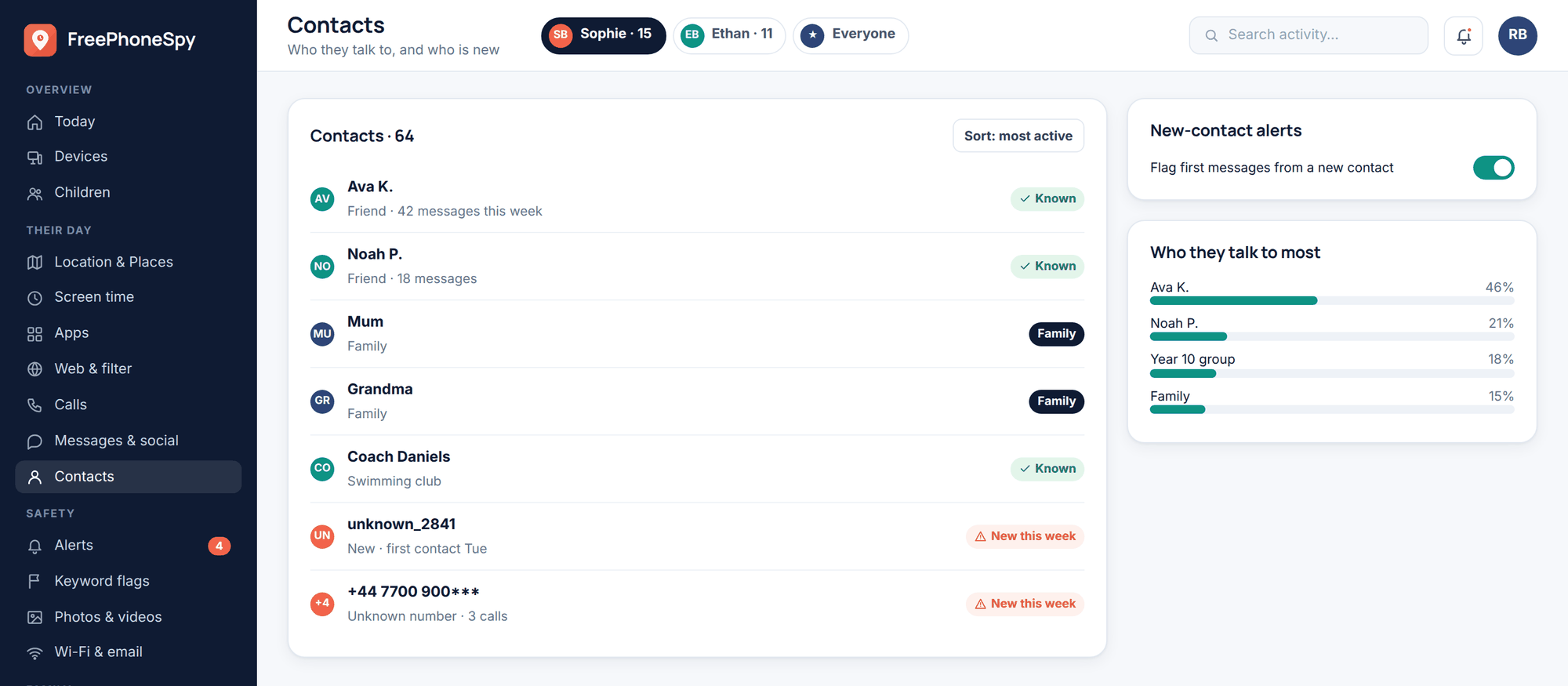
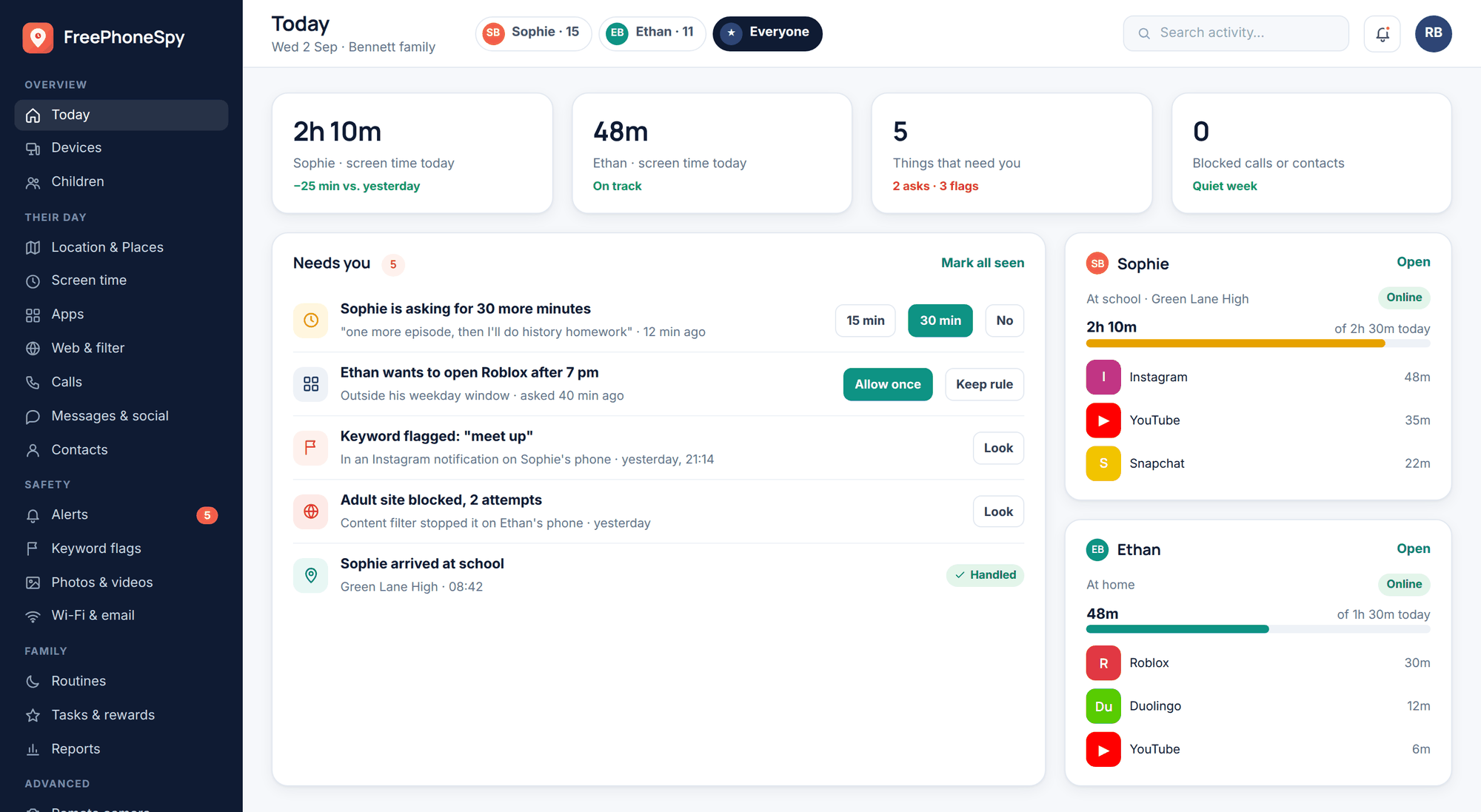
You don’t need to read every message to catch most of this. Who is contacting your child, how often, and at what hours tells you a great deal on its own. That’s the layer a tool like FreePhoneSpy is built to surface, and it’s why the contacts and message view flags numbers that aren’t saved as anyone your child knows.
What does grooming look like, step by step?
Grooming isn’t one dramatic event. It’s a slow sequence, and each stage has a signature you can learn to recognise. Understanding it calmly is more useful than any single warning, because it tells you what to look for next.
Building trust
It starts warm. Constant attention, shared jokes, taking your child’s side against the world. The predator becomes the person who “gets” them. Nothing here looks alarming — that’s the point. The only tell is a new online relationship that suddenly matters a lot.
Isolating
Next comes a wedge. Gentle at first: “your parents are so strict,” “your friends don’t really understand you.” The aim is to make your child feel that this person is the only one who truly sees them, and that the adults around them are obstacles.
Introducing secrecy
Then the private channel and the “just between us” framing. This is the stage that shows up most clearly on a phone: the move to a new app, the disappearing messages, the contact saved under a codename. Keyword alerts for phrases like “don’t tell” or “our secret” exist precisely to catch this moment.
Escalating
Finally, the ask — a photo, personal details, a meeting. By now the child feels bonded and afraid of losing the relationship or getting in trouble, which is exactly what keeps them quiet. Every earlier stage was in service of this one.
Seeing it laid out like this is the reassuring part. A predator needs all these stages to work. Break any one of them — a child who tells you early, a secret contact you spot, an open conversation that removes the shame — and the whole thing tends to collapse.
What can open monitoring actually help with — and what can’t it?
Let’s be straight about what a tool can and can’t do, because a false sense of security is its own risk.
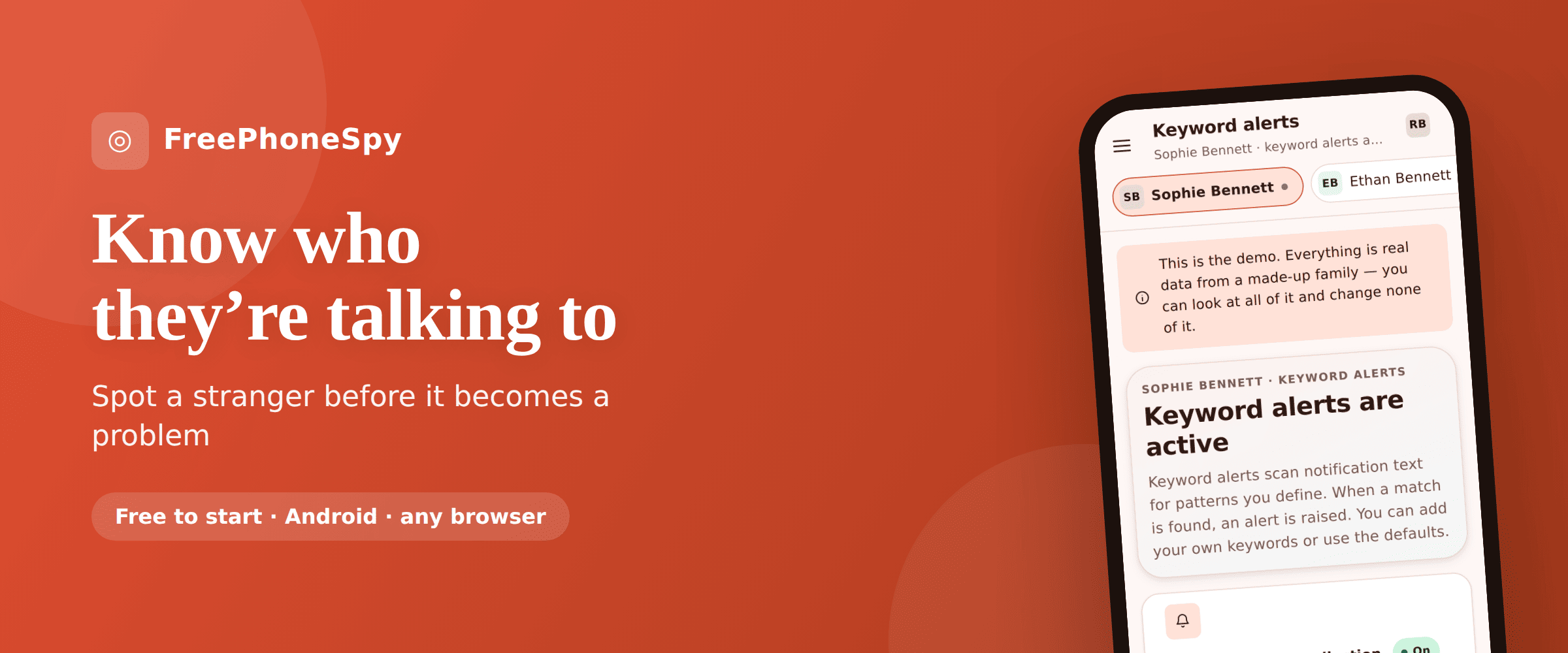
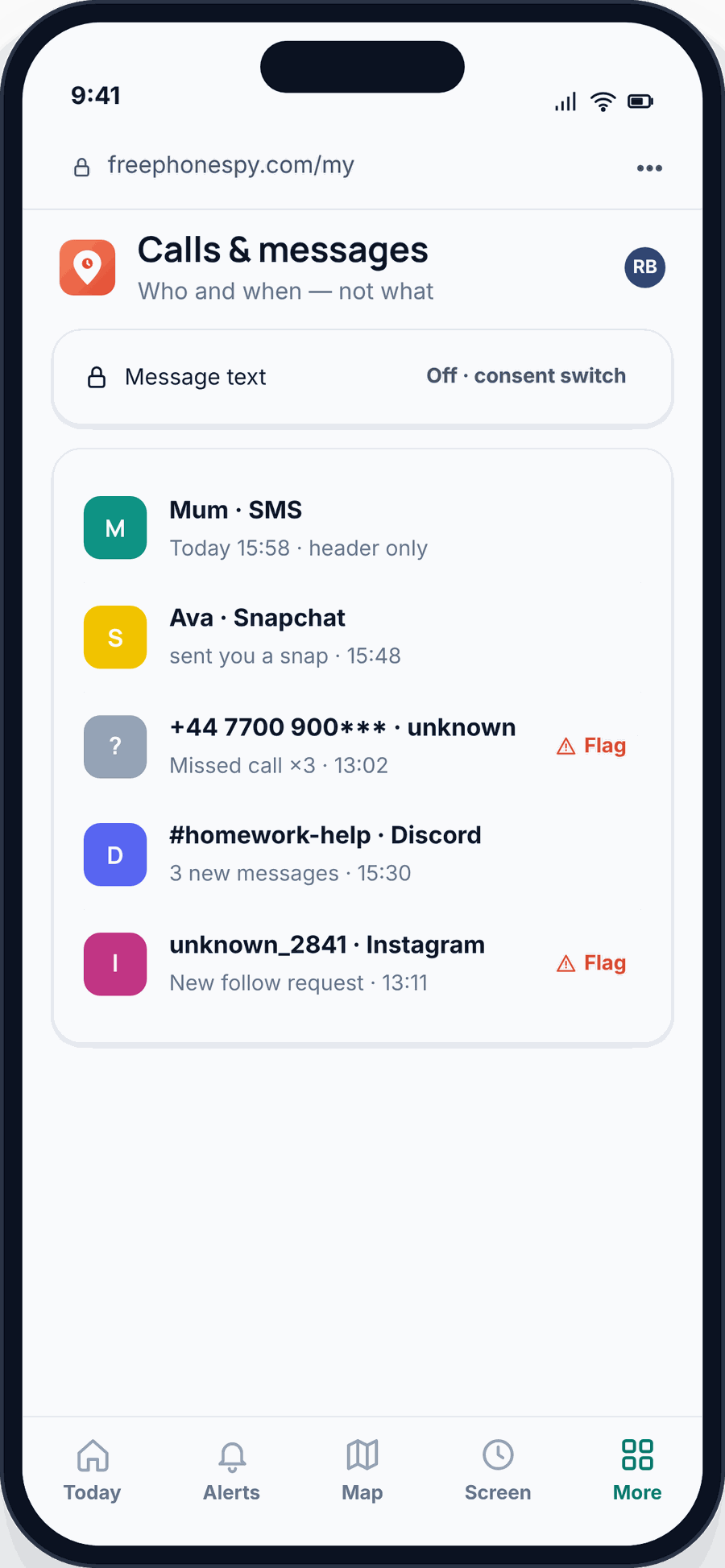
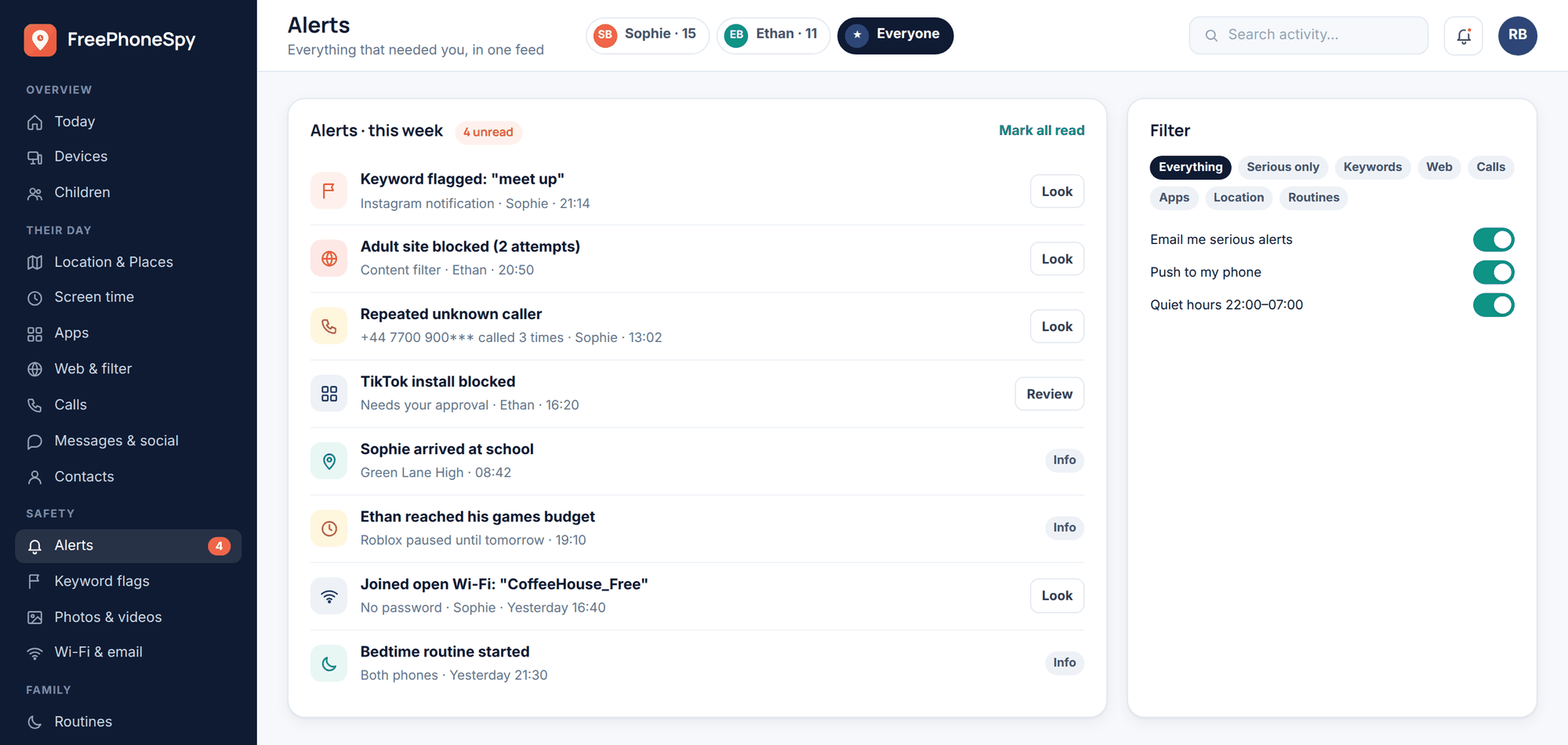
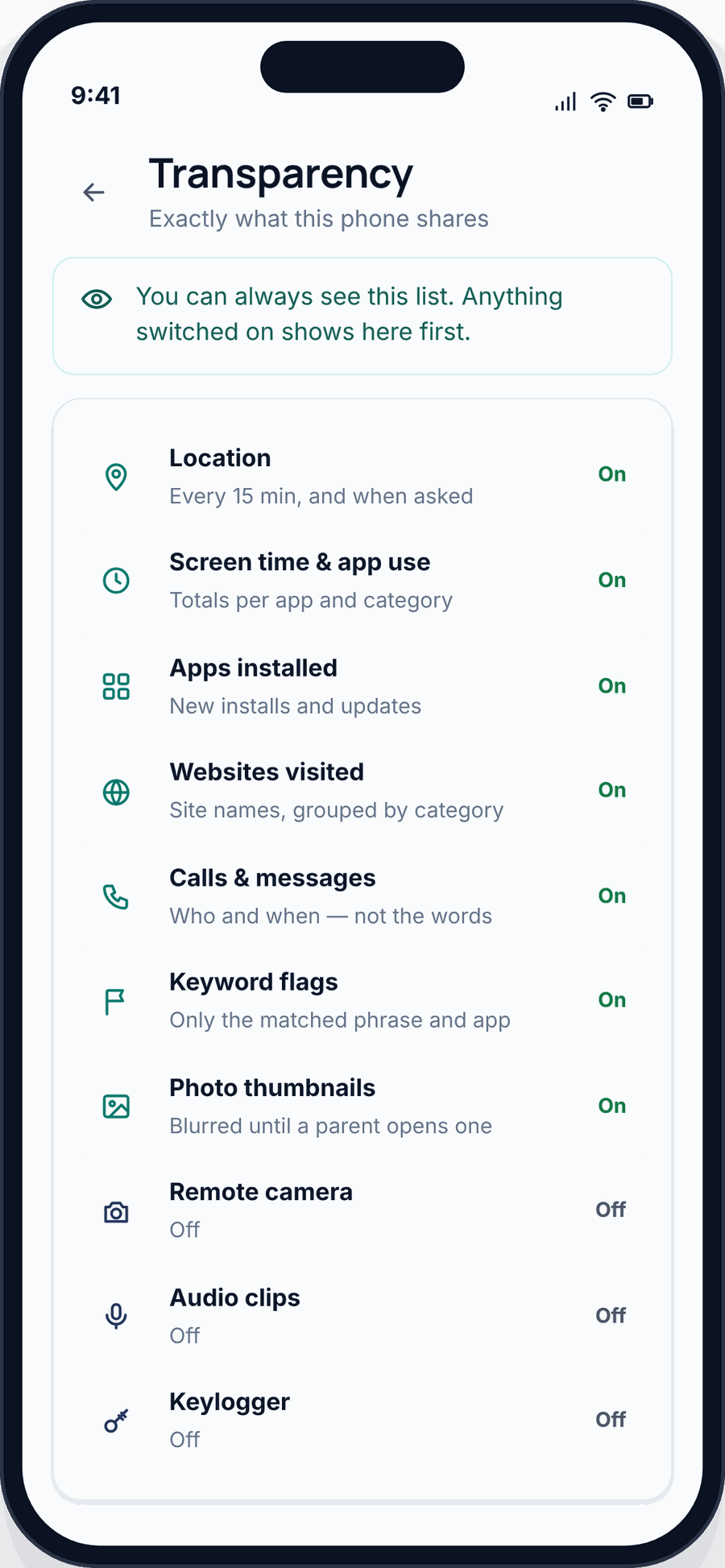
What open monitoring helps with is early, quiet signal. Keyword alerts let you flag a specific stranger’s username, or phrases that tend to appear in grooming, and get a heads-up when one shows in a notification. The messages and social view always shows headers — who is talking to your child and when — so a barrage of late-night contact from an unknown number stands out without anyone reading private words. Message bodies stay hidden unless you and your child agree to switch that on together. New and unknown contacts get flagged. And everything lands in one readable feed so you’re not hunting through the phone.
Now the honest limits. Our child app runs on Android. If your family is on iPhone, use Apple’s built-in Screen Time and Family Sharing — they’re genuinely good for limits and contact management. Second, encrypted apps limit what any tool can see. If a conversation happens inside an end-to-end encrypted chat, the content is not readable by us or anyone else; what you can still notice is the notification line, the contact, and the pattern. Third, no software replaces a conversation. The single biggest protective factor is a child who feels safe telling you something is wrong. A tool buys you early awareness. What you do with it is the part that protects your child.
What should I actually say to my child?
Scary lectures don’t stick, and they can make a child hide problems rather than share them. What works is a short, calm, repeated conversation that treats them as capable. Match it to their age.
Younger children (around 8–11, like Ethan)
Keep it simple and rule-shaped. Try: “Online, people can pretend to be anyone. If someone you don’t know in real life messages you, or asks for a photo or to keep a secret, that’s a stop-and-tell-me moment. You’re never in trouble for telling me.” The “never in trouble” clause does a lot of work. Say it often.
Older children and teens (around 12–15, like Sophie)
Respect their independence and be specific about tactics. Try: “If someone you’ve only met online wants to move the chat to Snapchat or Telegram, or starts saying you’re so mature and this is just between you two — that’s a known move. It doesn’t mean you did anything wrong. It means block, and come tell me.” And one for the moment it goes wrong: “If you ever sent something you regret, or someone’s threatening you over a photo, the worst thing is silence. We fix it together, no matter what it is.”
Notice what these scripts have in common. No shame. A clear next action. And an open door back to you. That door is what predators rely on being shut.
What if I find something worrying?
First, breathe. The instinct is to confront, confiscate the phone, and demand answers. Try not to. A raid usually ends the conversation you most need to have, and it can destroy evidence.
A calm sequence:
- Preserve. Screenshot messages, profiles, usernames and dates. Don’t delete the thread.
- Talk, gently. Lead with “you’re not in trouble.” Let your child tell you what happened before you fill in the blanks.
- Block and report on the platform. Every major app has a report route for child safety; use it.
- Escalate when it’s an adult targeting a child. If there’s grooming, a request for images, threats, or any suggestion of meeting, contact the police. In the UK you can report to CEOP; in the US, the NCMEC CyberTipline. If your child is in immediate danger, call your emergency number.
- Loop in the school if other children may be affected or if it overlaps with bullying.
You don’t have to decide it’s “serious enough” before acting. Reporting a false alarm costs little. Staying quiet about a real one costs a great deal.
Which prevention habits genuinely work?
A handful of ordinary habits do most of the protecting, and none of them require a screen showdown.
- Private by default. Set accounts to private, turn off “suggested friends” where you can, and switch off location sharing on posts. A public account with the school badge in the bio is an open invitation.
- No location in photos. Teach kids not to post their location live, and to avoid backgrounds that give away where they are.
- Know the contacts. Every so often, look through who’s actually in the phone together. New, unknown numbers are worth a friendly “who’s this?” The unknown-number flags make this a two-minute check rather than a chore.
- The one unbreakable rule. “Tell me and you’re never in trouble.” Repeat it until it’s boring. It’s the sentence that gets a scared kid to speak up on day one instead of day thirty.
- Watch the pattern, not every word. You don’t need to read everything. If you’re unsure whether monitoring even fits your family, our take on monitoring versus spying and the signs a child’s phone needs a closer look may help you decide.
If your child is out and about a lot, agreed location sharing — the kind they know about — is worth a mention too. Not to track their every move, but so “I’m at Maya’s” can be quietly confirmed.
Why does doing this openly matter?
It would be easy to sell you the fantasy of secret, total surveillance. We won’t, and not only for ethical reasons — it doesn’t work as well. A child who discovers they were watched in secret learns one lesson: hide better next time. A child who knows you’re around, and knows the rule is “no trouble for telling,” comes to you sooner. Openness isn’t the soft option. It’s the effective one.
That’s why FreePhoneSpy is transparent by design. The app is visible on your child’s phone. Message text stays behind a switch you turn on together. Nothing is monitored until you set it up. You can start free with full access for 10 days, no card, and keep the core free afterward by doing simple things like leaving a review or referring a friend. Nothing about your family is sold, and your data is never sold.
Common questions
Isn’t monitoring a breach of my child’s trust?
Done in secret, it can be. Done openly — with the app visible, the rules agreed, and message text behind a shared switch — it’s closer to teaching them to cross a road safely. The point isn’t to catch your child out. It’s to notice a stranger early and keep the door between you open.
Can you read my child’s messages?
By default, no. You see headers — who and when — always. The actual words stay hidden unless you and your child switch that on together. And encrypted apps limit what any tool can see, which we’re upfront about.
We’re an iPhone family. Can we use this?
The FreePhoneSpy child app is Android only. On iPhone, Apple’s built-in Screen Time and Family Sharing are honest, capable options for limits and contact management. Start there.
My child is being contacted by an adult stranger. What’s the first step?
Preserve the evidence with screenshots, don’t delete the thread, and don’t reply pretending to be your child. Then talk to your child calmly, block and report on the platform, and contact the police or a child-protection reporting line if it involves grooming, image requests, threats, or any talk of meeting.
Will keyword alerts catch everything?
No, and it’s important to say so. They flag words and names you choose, in notifications the phone shows. They’re an early prompt, not a guarantee. Pair them with the contacts view, the alerts feed, and — above all — a child who feels safe telling you things.
Does it cost anything?
You can start free with full access for 10 days and no card. After that, the core stays free if you complete simple tasks like reviews or referrals. Your data is never sold.