Selling Online Safely: A Teen’s Guide to Vinted, Depop & Marketplace
There’s a moment most parents recognise: the wardrobe won’t shut, the trainers under the bed haven’t been worn since spring, and your teenager announces they’re going to “sell some stuff.” Good instinct. Second-hand selling teaches real skills — pricing, describing honestly, dealing with strangers, handling money — and it clears out clutter while it does it. But a teen who’s brilliant at spotting a fake buyer on a shopping site can be surprisingly green when the tables turn and they’re the seller. The scams aimed at sellers look nothing like the ones aimed at buyers, and they’re clever. This is a walk through how to sell safely on the big platforms, the tricks that specifically target people selling, and the habits that keep a sale from turning into a headache.
- Why teens sell, and why it’s worth encouraging
- The platforms and their built-in protections
- Scams that target sellers specifically
- Safe selling practices
- Privacy in your photos and listings
- Safe meetups for local sales
- A safe sale, start to finish
- If a teen gets scammed
- Where a parent fits in
- The safe-selling checklist
- FAQ
Why teens sell, and why it’s worth encouraging
Ask a teenager why they’re selling and you’ll usually get one of three answers. They want the space back — a declutter that’s finally overdue. They want pocket money without asking for it, which for a lot of teens feels better than an allowance. Or they’ve genuinely bought into the sustainability side: re-wearing and reselling instead of binning, which is now completely normal in a way it wasn’t for previous generations.
All three are worth backing. Selling something you own teaches pricing in a way no lesson can — list too high and nothing sells, too low and you feel the loss. It teaches you to describe things honestly, because a dishonest listing comes back as a refund. And it puts a teen face to face with strangers who don’t all play fair, which is a lesson better learned on a £15 hoodie than somewhere higher-stakes later on.
The flip side is that selling exposes information buying never does. A buyer hands over money and waits. A seller hands over an item, often an address, sometimes a phone number, and has to trust that payment is real. That reversal is exactly where the scams live.
The platforms and their built-in protections
Teens sell across a handful of well-known places, and each has its own rhythm. It’s worth knowing them by how they handle money and postage, because that’s what keeps a seller safe.
Vinted
Big for clothes, shoes and accessories. Vinted’s model is built around keeping everything in one place: the buyer pays through the app, the platform holds the money, you post using a prepaid label the app generates, and the funds release to you once the buyer confirms the item arrived (or after a set window). Because the payment and the postage both run through the platform, a seller who never steps outside it is well protected.
Depop
Popular for vintage, streetwear and one-off fashion, with a social, Instagram-like feel. Payments go through the app’s integrated checkout, and staying inside that checkout is what gives sellers cover if something goes wrong. Depop leans on ratings and profiles, so building a clean seller history matters here.
eBay
The all-rounder — tech, games, collectables, clothes, nearly anything. eBay has the most developed system of the lot: managed payments, tracked postage, and a formal dispute process. That structure protects honest sellers, but the same buyer-protection rules can be leaned on by dishonest buyers, which is why proof of postage matters so much here.
Facebook Marketplace
This one’s different, and teens need to know why. Marketplace is largely a local, meet-in-person, cash-in-hand marketplace with far fewer built-in protections than the others. There’s no escrow holding a buyer’s money, no automatic tracked label. That makes it useful for selling something bulky locally, and also the platform where the most care is needed — both for scams and for the physical safety of meeting a stranger. Because of that, Marketplace is really a parent-alongside activity for a minor, not a solo one.
Scams that target sellers specifically
These are the ones aimed at the person selling, and they don’t look like the scams teens already know from shopping. A confident young seller who’d never fall for a fake shop can still get caught here, because the con is dressed up as an eager buyer.
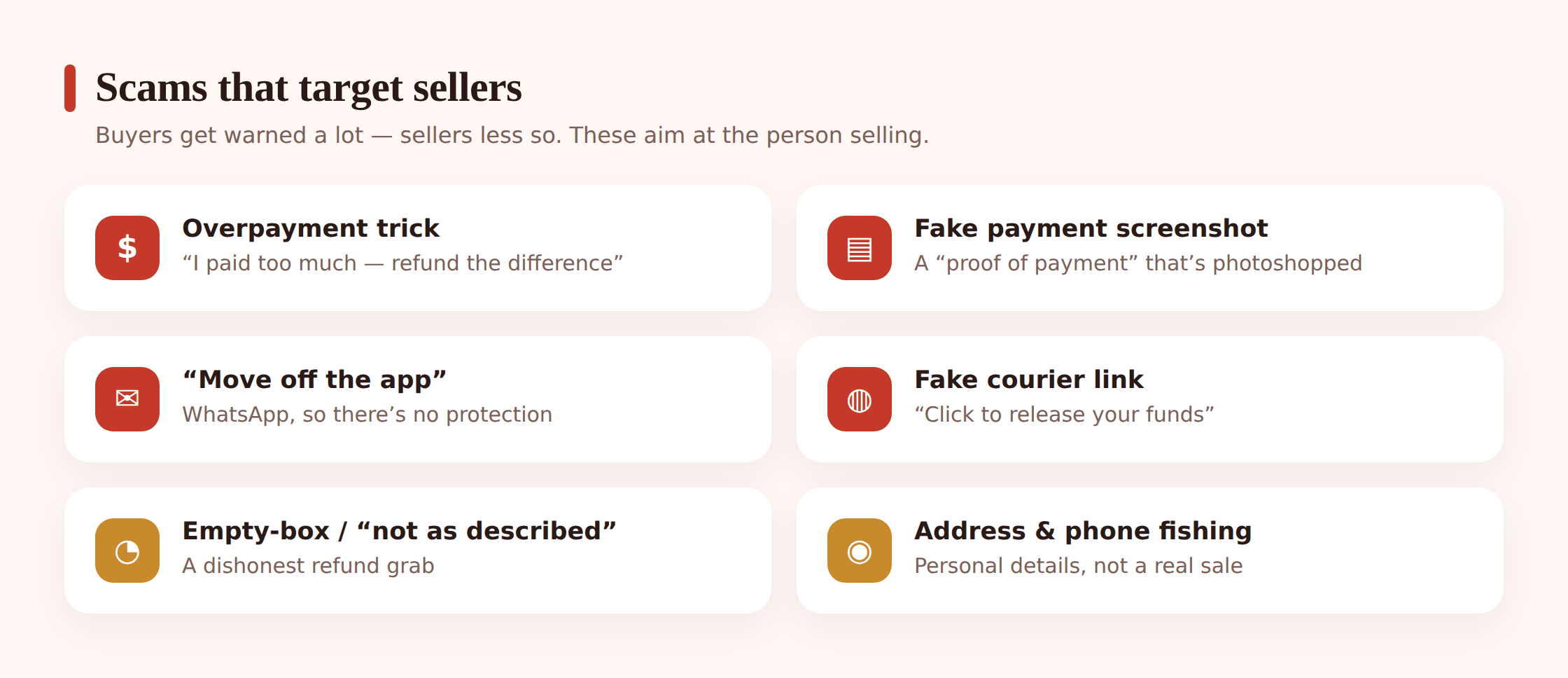
The overpayment / fake payment screenshot
A “buyer” says they’ve paid, and sends a screenshot of a bank transfer or a payment confirmation as proof. Except the screenshot is faked, or the payment is set to a method that can be reversed later. Sometimes they “accidentally” overpay and then ask you to refund the difference — you send back real money against a payment that never actually clears. A screenshot is a picture, not money. Real payment shows up in your app’s own balance or your own bank, and nowhere else.
“I’ve paid — now refund the difference”
A cousin of the above. The buyer claims they sent too much, or paid twice, and asks you to send back the overpayment quickly, often with a sob story about needing it urgently. The original “payment” is fake or will bounce; the refund you send is real and gone. No genuine buyer needs a rushed refund to a different account.
“Let’s just sort it on WhatsApp”
Early in the chat, the buyer suggests moving to WhatsApp, Instagram DMs, email, or text — anything off the platform. The reasons sound reasonable: “the app’s playing up,” “I’ll pay you directly, saves the fees.” The moment you leave, you lose the platform’s payment protection, its record of the conversation, and any recourse if it goes wrong. It also hands over your phone number. Off-platform is where sellers get fleeced. Stay in the app.
Fake courier and “click here to release your funds”
You get a message or email that looks like it’s from the platform or a delivery company: your payment is “on hold,” and you need to click a link and “confirm your details” or “verify your account” to release the money. The link leads to a fake login page built to steal your account password or your bank details. Real platforms release seller funds automatically through the app — they don’t make you click an email link and re-enter your bank card to get paid.
The empty-box and “item not as described” refund
After delivery, a dishonest buyer claims the parcel arrived empty, or that the item is fake, damaged, or “not as described,” and opens a refund. Sometimes it’s genuine; sometimes it’s a buyer trying to keep both the item and the money. This is why honest listings and proof of postage are a seller’s armour — clear photos of the real item and a tracked, weighed postage receipt make a false claim much harder to win.
Address and phone fishing
Not every scam is about money directly. Some “buyers” are really fishing for personal details — pushing for your full address for “insurance,” a phone number “to arrange delivery,” or asking a suspicious number of questions about when you’re home. For a teen, that information is worth guarding hard. The platform’s own postage label means a buyer never needs to see your address as free text at all.
Safe selling practices
Selling safely really comes down to a handful of habits. Build these into how they list and post, and they’ll sidestep almost every trick a scammer tries on.
Keep the whole deal on the platform
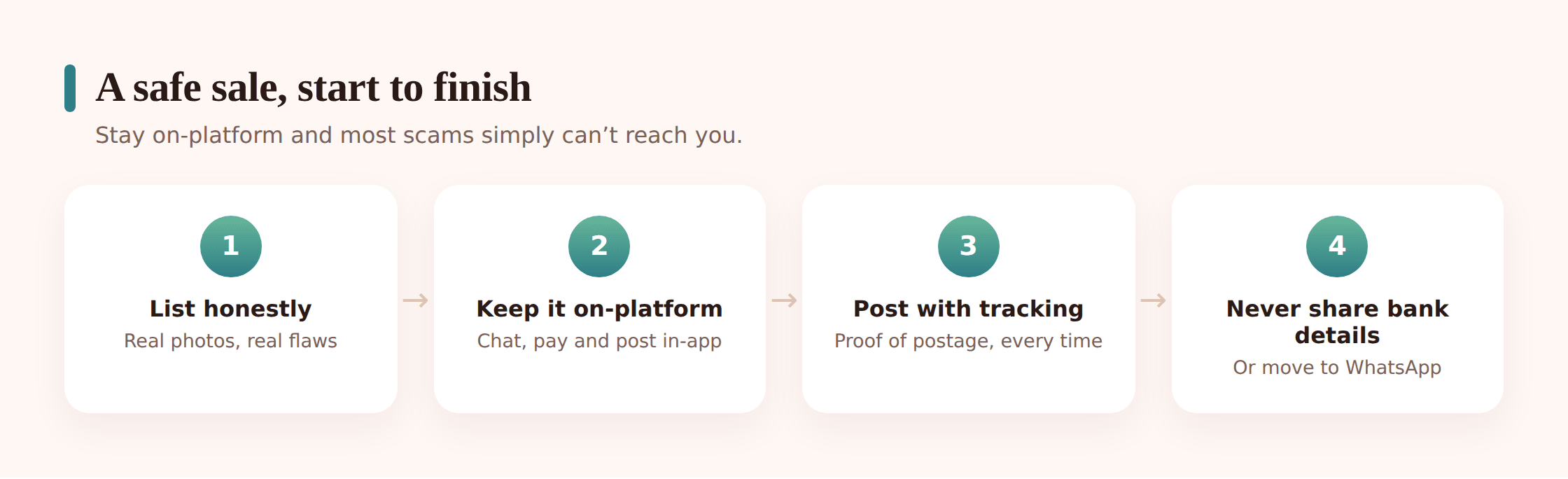
Payment, messages, postage — all of it through the app you listed on. This single habit defeats most seller scams by itself, because the con almost always needs you to step outside first. If a buyer won’t pay the normal way, they’re not really a buyer.
Use the platform’s payment and its postage label
Let the app take the buyer’s money and hold it. Print the prepaid, tracked label the app offers rather than arranging your own postage or, worse, a courier the buyer suggests. Tracked postage protects you against the “it never arrived” claim, and a platform label usually hides your address into the bargain.
Never share bank details or move to WhatsApp
A seller never needs to give a buyer their sort code, account number, or card details — the platform handles the money. Anyone asking for those is either scamming or about to. Same with the nudge to move to WhatsApp: it’s a red flag on its own, whatever the excuse.
Get proof of postage, every time
When you drop a parcel off, get the receipt and keep it — ideally photograph it next to the packed item before sealing. If a buyer later claims an empty box or a no-show delivery, that weighed, tracked receipt is what settles a dispute in your favour. It costs nothing and takes seconds.
List honestly, photograph the real thing
Describe flaws plainly — the small mark, the missing tag, the slight fading. Photograph the actual item you’re sending, not a stock picture from the internet. An honest listing barely ever gets a “not as described” complaint, and if one comes anyway, your own accurate photos are the defence.
Privacy in your photos and listings
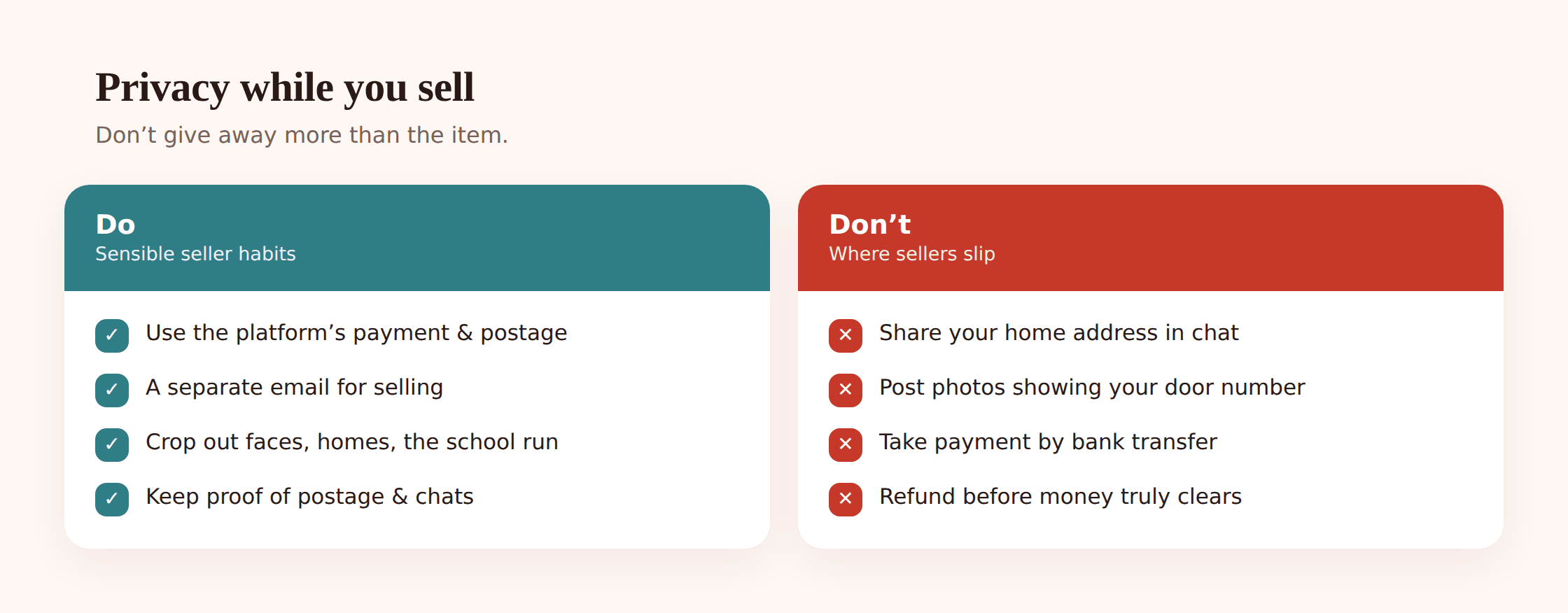
Selling means posting photos in public, and photos leak more than teens realise. A listing picture can quietly show a face, a house number through a window, a school uniform on a chair, a street sign, or a reflection in a mirror. None of that helps sell a hoodie, and all of it tells a stranger something about where a young person lives or goes to school.
The fix is simple. Shoot items against a plain wall, a bed, or a floor with nothing identifying in the frame. Check the background before posting — and check reflections in anything shiny. No faces, no home, no school. If a teen wants to model an item, crop above the neck or shoot in a way that doesn’t reveal the location. It’s the same instinct as keeping a bedroom out of a video background, applied to a sale.
Two more privacy habits are worth building. Use a separate email address for selling accounts rather than a main personal one, so a marketplace login isn’t tied to everything else. And never put a phone number or address into a listing or a message as plain text — the platform never needs it there, and a scraper or a nosy buyer very much does. Our guide to teen location sharing covers the wider habit of not broadcasting where you are.
Safe meetups for local sales
Some sales happen in person — bulky items, local Marketplace deals, a bike or a games console that isn’t worth posting. Meeting a stranger to hand over goods and take cash is a different kind of risk from an online-only sale, and for a minor it changes the rules.
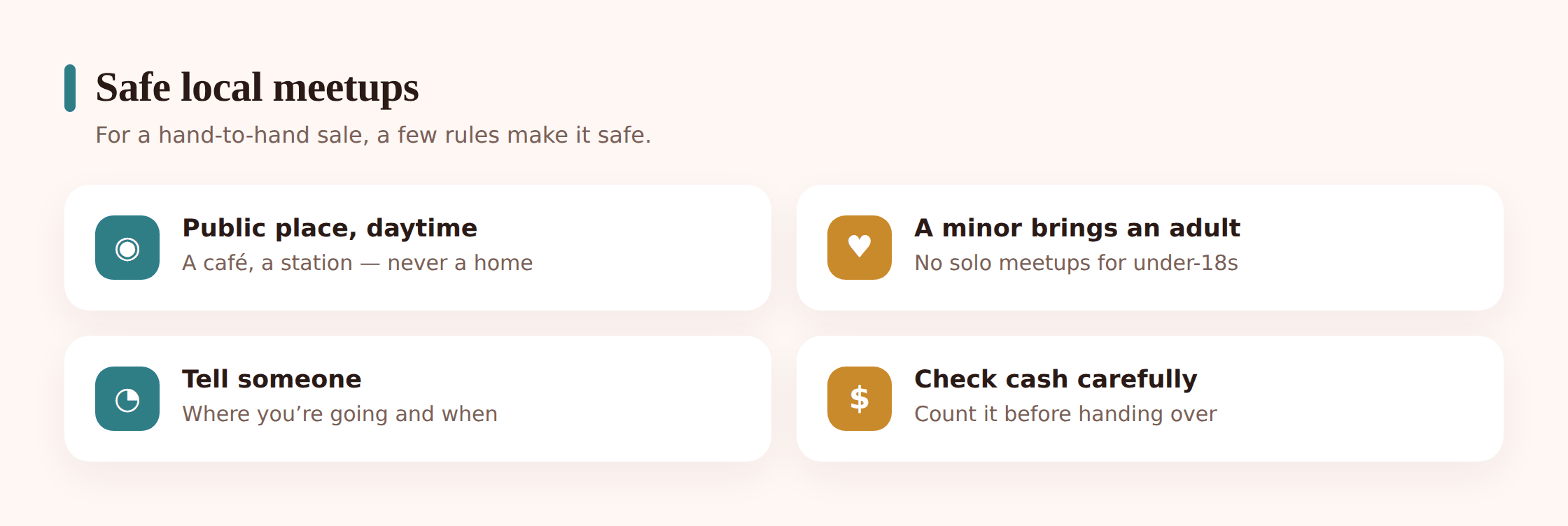
- Meet in a busy public place — a shopping centre, a supermarket car park, outside a station. Some police stations now offer designated “safe exchange” spots. Never at your home, and never at theirs.
- Daytime only. An evening handover in a quiet spot is exactly the situation to avoid. If it can’t happen in daylight somewhere busy, it can wait.
- A minor brings an adult. For anyone under 18, a parent or older sibling comes along — visibly. This isn’t babysitting; it’s the single biggest safety factor for an in-person sale, and it puts most opportunists off entirely.
- Tell someone the plan. Where, when, who with, and a rough time you’ll be done. A quick “meeting a buyer at the retail park at 2, back by 3” to a parent is enough.
- Cash care. Check notes are real in good light, don’t flash a wad of cash, and don’t carry more than you need for change. If a “buyer” wants to test-ride a bike or take an item “to check,” they don’t leave with it until money’s in hand.
- Trust the gut. If a buyer feels off, pushes to change the location to somewhere quieter, or wants to meet late — walk away. A sale is never worth ignoring that feeling.
A safe sale, start to finish
Here’s what a clean, low-drama sale actually looks like, in order — the sequence worth walking a first-time seller through once.
1. Photograph and describe honestly
Real photos of the real item against a plain, non-identifying background. Note any flaws in the description. Honesty up front prevents disputes at the end.
2. Price it and list it on-platform
Check what similar items sold for, set a fair price, and list on the app. Use a selling-only email and never put a phone number or address in the listing.
3. Chat inside the app only
Answer questions in the platform’s own messages. If a buyer pushes to move to WhatsApp or pay “directly,” that’s your cue to stop, not to accommodate them.
4. Let the platform take payment
Wait until the money is confirmed in your app’s own balance — not a screenshot, not a promise. The platform holds it safely until the deal completes.
5. Post with the platform label and keep proof
Print the app’s tracked label, pack carefully, and get a proof-of-postage receipt. Photograph the packed item and the receipt before you seal and send.
6. Let the funds release normally
The money releases to you through the app once the buyer confirms delivery or the window passes. Ignore any email or message asking you to “click to release funds” — that’s a fake.
If a teen gets scammed
It might happen once, and if it does, the response matters more than the blame. Speed and calm get better outcomes than a telling-off.
Stop and don’t send anything more. The instant something feels wrong — a refund request against a payment you can’t see, a link demanding bank details — the move is to send nothing further and not click anything. Most seller scams only succeed if the seller acts on the pressure.
Report it inside the platform. Every major selling app has a report button for a user and a message. Reporting freezes the con and flags the account for others. Screenshot the conversation, the profile, and any dodgy messages first, because accounts get deleted.
If real money left, tell the bank fast. Where a teen was tricked into sending an actual bank transfer, ring the bank the moment you realise — act quickly and there’s a chance of clawing some of it back. If they typed card or account details into a fake “release your funds” page, assume those details are now in the wrong hands: freeze the card and change the account password without delay.
Change the password and turn on 2FA. If a phishing link captured a marketplace login, change it everywhere that password was used and switch on two-factor authentication. Our guides on online scams targeting kids and job and money-making scams cover the wider pattern these tricks belong to, and the money and shopping safety (buying) guide handles the other side of the counter.
Where a parent fits in
For a minor, selling online isn’t a fully solo activity — it’s something a parent stays alongside, especially at the start and especially for anything involving a meetup. That doesn’t mean taking over. It means setting the account up together, agreeing that meetups are chaperoned, and being the person a teen checks a weird message with before replying.
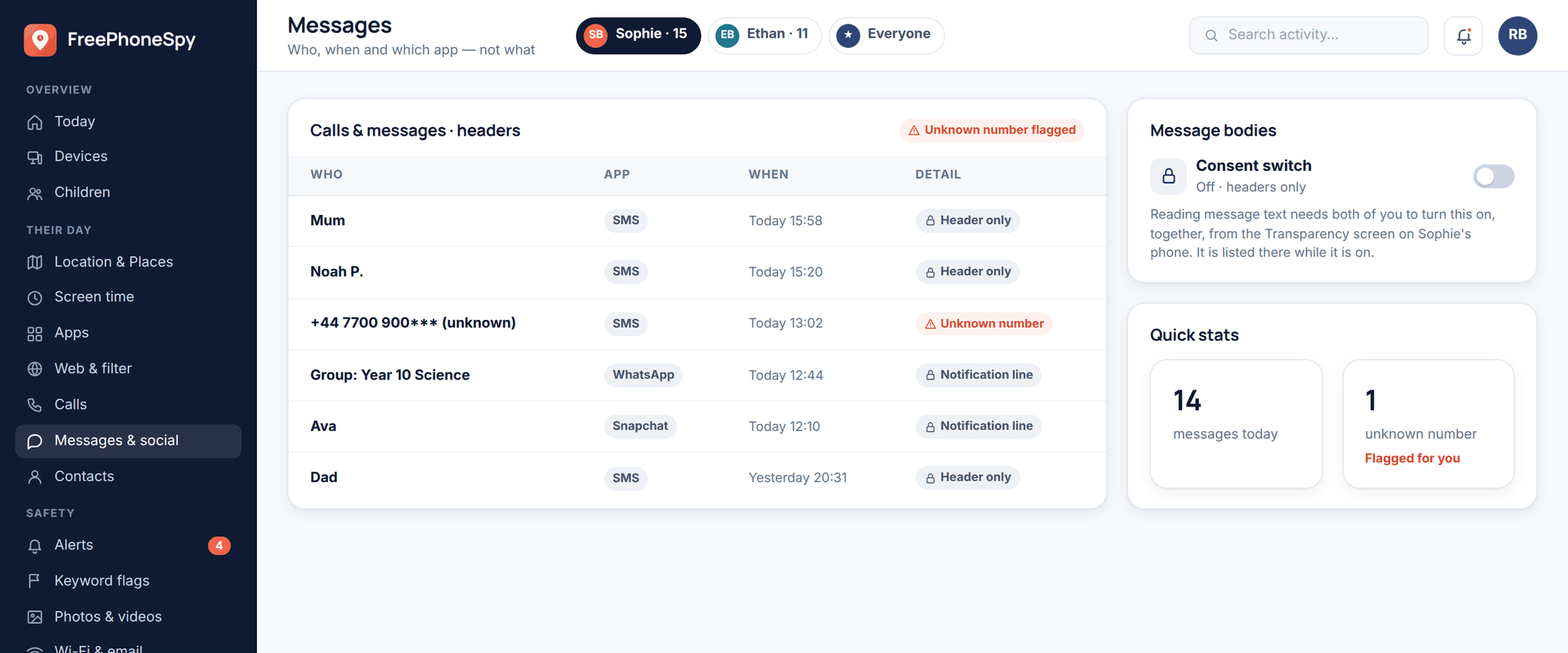
On an Android device you own and manage, a tool like FreePhoneSpy can give you awareness of the apps a teen is using and general activity, which can help you stay in the loop about a new selling app or an unfamiliar payment app appearing. The value is in the conversation it enables, not in secretly reading messages.
The safe-selling checklist
The whole article, boiled down to what to actually do. Run through it once with a first-time seller.
- Keep every part of the deal — payment, chat, postage — inside the platform.
- Never move to WhatsApp, email, or text, whatever excuse a buyer gives.
- A payment screenshot is not money. Wait for it to show in your own balance.
- Never refund an “overpayment” or send money back to a buyer.
- Never share bank details, sort code, or card number — the platform handles cash.
- Use the app’s tracked postage label and keep the proof-of-postage receipt.
- List honestly and photograph the real item, so a false “not as described” claim can’t stick.
- Check photos for faces, home, school, street signs, and reflections before posting.
- Use a separate selling email; never put a phone number or address in a listing.
- For meetups: public place, daytime, a minor brings an adult, tell someone the plan.
- Ignore any “click here to release your funds” message — real payouts are automatic.
- If something goes wrong, tell a parent fast — speed beats blame.
FAQ
A buyer wants to pay outside the app — is that ok?
No. This is the single most common seller scam. The moment payment leaves the platform, you lose every protection the app offers — the money held safely, the record of the conversation, any recourse if it goes wrong. Genuine buyers are perfectly happy to pay the normal way. Anyone insisting on a direct transfer, a “friends and family” payment, or paying you off-app is either scamming or about to. The answer is a polite “I only sell through the app,” and if they push, walk away.
They sent a payment screenshot — is it real?
Treat it as if it isn’t. A screenshot is just a picture, and fake ones are trivial to make. Real payment shows up in your selling app’s own balance or, for an in-person cash sale, as actual cash in your hand — never as an image someone messages you. Don’t post an item, and above all don’t send any “refund,” on the strength of a screenshot. Wait until the money is confirmed on your side, in the platform’s own system.
A buyer says they overpaid and wants the difference back. What do I do?
Don’t send anything. This is a classic con: the original “payment” is fake or will be reversed, and the refund you send is real money you’ll never get back. No honest buyer needs an urgent refund to a different account. If you genuinely received too much through the platform’s own system, let the platform’s support handle any adjustment — never handle a refund yourself off the back of a buyer’s story.
Is Facebook Marketplace safe for a teen to use?
It’s the one that needs the most care. Marketplace is largely local and cash-in-person, with far fewer built-in protections than Vinted, Depop, or eBay — no held payment, no automatic tracked label. That makes it fine for selling something bulky locally, but it means a minor shouldn’t use it solo. Meetups should be chaperoned by a parent, in a busy public place, in daylight. For anything postable, one of the platforms with tracked postage and held payment is the safer route.
Do I have to give a buyer my address to post an item?
No — and you shouldn’t type it into a message. The selling platform’s own postage label handles the addressing, usually without showing your address to the buyer as plain text. A buyer who insists they need your full address “for insurance” or pushes for your phone number is often fishing for personal details rather than trying to buy. Keep it to the platform’s built-in postage and there’s nothing to hand over.
How do I keep a listing photo from giving away where we live?
Shoot the item against a plain background — a wall, a bed, a bare floor — with nothing identifying in the frame. Before posting, scan the background and any reflective surfaces for house numbers, street signs, school uniforms, faces, or a view through a window. If your teen models an item, crop above the neck or frame it so the location isn’t visible. The item is the only thing that needs to be in the photo; everything else is a detail a stranger doesn’t need.